http://wrap.warwick.ac.uk
Original citation:
Ullrich, Carsten, Borau, Kerstin and Stepanyan, Karen (2010) Who students interact
with? a social network analysis perspective on the use of twitter in language learning. In:
Sustaining TEL: From Innovation to Learning and Practice. Lecture Notes in Computer
Science, Volume 6383 . Springer, pp. 432-437. ISBN 978-3-642-16019-6
Permanent WRAP url:
http://wrap.warwick.ac.uk/55805
Copyright and reuse:
The Warwick Research Archive Portal (WRAP) makes this work by researchers of the
University of Warwick available open access under the following conditions. Copyright ©
and all moral rights to the version of the paper presented here belong to the individual
author(s) and/or other copyright owners. To the extent reasonable and practicable the
material made available in WRAP has been checked for eligibility before being made
available.
Copies of full items can be used for personal research or study, educational, or
not-for-profit purposes without prior permission or charge. Provided that the authors, title and
full bibliographic details are credited, a hyperlink and/or URL is given for the original
metadata page and the content is not changed in any way.
Publisher’s statement:
“The final publication is available at
http://link.springer.com/chapter/10.1007%2F978-3-642-16020-2_33
”.
A note on versions:
The version presented here may differ from the published version
or, version of record, if you wish to cite this item you are advised to consult the
publisher’s version. Please see the ‘permanent WRAP url’ above for details on
accessing the published version and note that access may require a subscription.
Who Students Interact with? A Social Network
Analysis Perspective on the use of Twitter in Language
Learning
Carsten Ullrich1, Kerstin Borau1 and Karen Stepanyan2
1 Shanghai Jiao Tong University, Shanghai, China
2 Buckinghamshire New University, High Wycombe, United Kingdom [email protected], [email protected], [email protected]
Abstract. This paper reports student interaction patterns and self-reported results of using Twitter microblogging environment. The study employs longitudinal probabilistic social network analysis (SNA) to identify the patterns and trends of network dynamics. It is building on earlier works that explore associations of student achievement records with the observed network measures. It integrates gender as an additional variable and reports some relation with interaction patterns. Additionally, the paper reports the results of a questionnaire that enables further discussion on the communication patterns. Keywords: microblogging; social network analysis; social networking; collaborative learning
1
Introduction and Background
Microblogging platforms have acquired a considerable attention of educational practitioners and researchers [1]. Twitter is one of the microblogging services that enable users to post brief messages and communicate with other users. This paper summarises an empirical study that evaluates the use of Twitter as part of a foreign language learning course. It, namely, [a] analyses the interaction of participants (both learners and teachers) by using SNA techniques and [b] evaluates the self-reported use of microblogging – developing a coherent argument on the prevalent patterns of student communication.
shedding light on the dynamics of participant interaction within a microblogging environment.
2
Description of the Study and Research Methods
Twitter was introduced at the distant college of Shanghai Jiao Tong University, China (Online-SJTU). This microblogging service was used as part of an English course for native speakers of Chinese. The participants created a new, personal Twitter account. Students were prompted to become “follow”/“befriend” the instructor as well as their peers. Since each Twitter user receives the messages of his/her friends, each student who followed the instruction would receive the messages of fellow students and of the instructor. The students were then told to post at least seven microblogging messages a week and to read the incoming messages of their fellow students. In order to increase Twitter participation, we introduced a grading scheme in which the student use of Twitter contributed up to 20% of their final grade. Each week, student updates were counted and scores assigned. The score did only depend on the number of messages. Students received the full score of five points when more than 20 updates a week were posted.
The methodology of this study integrates analysis of the interaction network and the collected questionnaire data. The study, first, employs SNA techniques that are commonly used for analysing human interaction and relationships between individuals, groups and communities [5, 6]. The evaluation and monitoring of student communication using SNA techniques can shed light on the levels of cohesion within the group of learners and identify disadvantaged participants [2, 7]. The application of SNA can identify hidden factors that may affect student participation, open collaboration and personal development. The use of SNA in educational research can become a valuable and a fundamental resource for understanding student interaction and participation, subsequently leading to improvement of teaching techniques and tools [8].
This study employs application of probabilistic longitudinal SNA techniques that enable reporting identified patterns with statistical precision. The techniques used in the analyses in of this study were drawn from conceptual works on SNA. The previous study identified preferences of students to interact with participants of similar achievement scores. At the same time the study indicated a popularity of participants with higher scores [4]. This study is aiming to identify whether there are network interaction patterns that are associated with participant gender. Furthermore, this study evaluates quantitative data of using Twitter and discusses the results within the context of this study.
2.1 Data Overview and Operationalisation
used within the selected microblogging environment. In case a message was addressed to a specific peer, it was therefore possible to identify the addressee. The messages posted by one participant (actor i) to another (actor j) are defined as a directed tie (from i to j; i→j) only when there are more than three messages posted in total. The interaction was observed throughout a period of 56 days. Out of total 5256 messages, posted by 108 participants, 1266 directed messages and 87 interacting participants were considered in the study. The network of participant interaction that includes all the exchanged messaged is presented in Fig. 1. The diagram and the measure of density (d=0.16) indicates that the participants were relatively well connected.
Fig. 1. Overall interaction network. Ties with greater weight denote intensity of interaction.
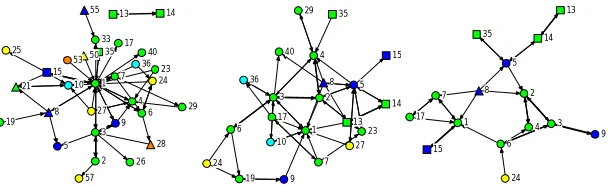
The network data was then divided into three equally timed waves (i.e. segment of communication data) for further longitudinal network analysis. Despite having the timestamp of each communicated message, this segmentation of data was required before processing in SIENA 3.17. Furthermore, the overall valued network was dichotomised to include only the communication with a threshold of at least three exchanged messaged. The dichotomised waves are presented in Fig 2.
Fig. 2. Networks of intensive interaction in three consecutive stages of the course.
At the end of the lecture, as part of their homework students were asked to fill out a bilingual questionnaire (English/Chinese) about their usage of and opinion on Twitter. A total of 96 students completed the questionnaire. Of these, 82 students claimed to have used Twitter at least once. Since this paper investigates the effects of usage of Twitter, we excluded the 14 questionnaires of the students who never used Twitter from the analysis. Most participants (62 = 75%) of the students who completed the survey were female, 25% (=20) were male. Half of the participants were aged 20-25 (=42), 40% (=33) were aged 25-30, and 10% (=7) over 30.
[image:4.612.141.445.439.532.2]3
Data Analysis
[image:5.612.143.472.557.632.2]This study employs stochastic SNA models for capturing regularities with statistical accuracy. This section conjecture and test a set of hypothesis (Table 1), that are derived from the research literature that discusses social interaction patterns in relation to network theories. This approach allows testing whether common interaction patters are also prevalent in an online learning environment that employs microblogging. Furthermore, the results enable a discussion the benefits of employing SNA in online learning research.
Table 1. Research hypotheses, parameters and conditions.
Hypotheses Null Hypotheses
H1: (Homophily effect) Same gender participants tend to interact among themselves. (Actor Level)
H10: Same Gender <= 0;
at α<0.05 H2: (Indegree popularity effect) Participant gender is related
to his/her acquired attention. (Actor Level)
H20: Gender Covariate-alter =
0; at α<0.05 H3: (Outdegree popularity effect) Participant gender is related
to his/her outreach. (Actor Level)
H30: Gender Covariate-ego =
0; at α<0.05
To evaluate the dynamics of the developed network, a set of concepts for addressing issues related to the formation and evolution of social networks have been selected, namely homophily (actor level) and reciprocity (dyadic level). The analysis was conducted by using dynamic actor-driven models defined and evaluated with SIENA (v. 3.17) software jointly with the StOCNET graphical interface package [9, 10]. Based on the conjectured hypotheses a number of models were defined. The models determine the sets of probabilistic tests.
Network Dynamics in Relation to Gender: Models 1-4 are drawn for testing the
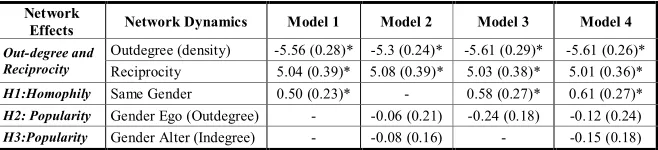
hypotheses around the conjectured homophily and popularity effects in relation to participant gender. This approach is similar to the earlier discussed study [4] that revealed an association of student scores with the number of replies students get and the people they communicate with. This approach may indicate whether gender is, in any way, related to the prominent interaction patterns. The results of the estimation tests (Table 2) allow us to comment on network parameters with at least 95% confidence interval. The significant results are marked with an asterisk. A negative value of outdegree density is consistent in all the models. This pattern indicates a tendency for exhibiting a selective approach in reaching out other participants. Similarly, reciprocity is identified as a prominent pattern within the observed network. The parameters of reciprocity are positive and statistically significant suggesting a tendency towards reciprocation of initiated communication.
Table 2. Estimation results: testing for gender effects.
Network
Effects Network Dynamics Model 1 Model 2 Model 3 Model 4
Outdegree (density) -5.56 (0.28)* -5.3 (0.24)* -5.61 (0.29)* -5.61 (0.26)* Out-degree and
suggesting an existence of gender homophily effect within the network. Furthermore, the model design allows us to report that female participants tend to interact with other females. However, there are a number of constraints that that need to be taken into account when interpreting the results. Firstly, while some of the results are statistically significant the values are very close to the acceptable barrier of α < 0.05. Additionally, the distribution of sexes among the registered participants was not equal and most importantly, the gender information was partially missing. While SIENA software allows the use of missing data and adjusts computations accordingly [11], the paper restrains further generalisation. Models 2-4 test the existence of popularity effects based on participant gender. It is apparent from Table 2 that none of the parameters (i.e. Gender Ego or Gender Alter) indicate statistical significance. Hence, H20 and H30
cannot be rejected. In other words, it is impossible to report on the existence of participant popularity effect with due statistical precision. Hence, no assumptions can be made on whether certain gender can be related to the behaviour of initiating or attracting communication from other participants.
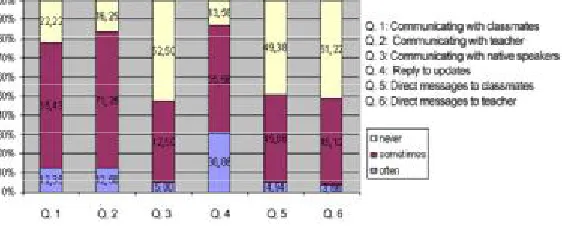
Self-Reported Communication Results: The communication patterns were analyzed
[image:6.612.149.430.392.507.2]by six questions (see Figure 3). The first two questions inquired whether the students used Twitter updates to communicate with their classmates and teacher, respectively. 22% (=18 students) and 16% (=13 students) stated that they never used Twitter for such communication. The log data of the actual updates confirms this data: 22 students posted less than 4 updates during the grading period (recall that Twitter was introduced two weeks before the grading period started). However, about 80% sometimes or often used Twitter for communication in class. Given number of 4552 updates, Twitter indeed has stimulated active communication.
Fig. 3. Self-reported communication patters.
4
Conclusions
This study examines participant interaction within a microblogging environment and reports the prevalent network patterns. The probabilistic approach to the network analysis allows reporting the results with statistical precision. The results indicate: [a] a significant homophily effect – a preference of participants to interact with peers of the same gender; [b] no significant evidence of popularity effect in relation to gender; [c] self-reported inclination to reply to initiated posts; and [d] self-reported tendency towards public communication. Employing SNA techniques and questionnaire data, this study attempts to identify interaction patterns that may not otherwise be immediately evident. It raises points for consideration when integrating microblogging services to teaching and learning.
References
1. C. Ullrich, K. Borau, H. Luo, X. Tan, L. Shen, and R. Shen, "Why web 2.0 is good for learning and for research: principles and prototypes," 2008.
2. C. Haythornthwaite, "Social Network Methods and Measures for Examining E-learning," Social Networks, 2005.
3. K. Borau, C. Ullrich, J. Feng, and R. Shen, "Microblogging for Language Learning: Using Twitter to Train Communicative and Cultural Competence," 2009, p. 87.
4. K. Stepanyan, K. Borau, and C. Ullrich, "A Social Network Analysis Perspective on Student Interaction Within the Twitter Microblogging Environment," in The 10th IEEE International Conference on Advanced Learning Technologies, Sousse, Tunisia, 2010.
5. B. Wellman and S. D. Berkowitz, Social structures: A Network Approach: Elsevier Science & Technology Books, 1997.
6. S. Wasserman and K. Faust, Social Network Analysis: Methods and Applications: Cambridge University Press, 1994.
7. C. Reffay and T. Chanier, "How social network analysis can help to measure cohesion in collaborative distance-learning," Designing for change in networked learning environments. Proceedings of the International Conference on Computer Support for Collaborative Learning, pp. 343-352, 2003.
8. A. Martínez, Y. Dimitriadis, B. Rubia, E. Gómez, and P. De la Fuente, "Combining qualitative evaluation and social network analysis for the study of classroom social interactions," Computers & Education, vol. 41, pp. 353-368, 2003.
9. T. A. B. Snijders, "The Statistical Evaluation of Social Network Dynamics," Sociological Methodology, vol. 31, pp. 361-395, 2001.
10.C. Steglich, T. A. B. Snijders, and P. West, "Applying SIENA: An Illustrative Analysis of the Coevolution of Adolescents’ Friendship Networks, Taste in Music, and Alcohol Consumption," Methodology, vol. 2, pp. 48-56, 2006.