Using Depth Sensing and
Augmented Reality to Improve
Ski-learning.
Jop Paulissen
B.Sc Thesis
February 2018
Supervisors:
Dr. Job Zwiers
Robby van Delden
Telecommunication Engineering Group Faculty of Electrical Engineering, Mathematics and Computer Science University of Twente
P.O. Box 217 7500 AE Enschede The Netherlands
3
A
BSTRACT
5
A
CKNOWLEDGEMENTS
6
T
ABLE OF CONTENT
Abstract ... 3
Acknowledgements ... 5
1 Introduction ... 11
1.1 Problem Statement ... 11
1.2 Research Questions ... 11
1.3 Outline of the Document ... 12
2 State of the Art Review ... 13
2.1 Augmented Reality ... 13
2.2 Depth Sensors ... 17
2.3 Learning Styles in Sports... 19
2.4 Motivation ... 21
2.5 Conclusion ... 27
3 Methods and Techniques ... 28
3.1 Design Process for Creative Technology ... 28
3.2 Methods ... 29
4 Ideation Phase ... 31
4.1 Stakeholder Analysis ... 31
4.2 Use Cases ... 32
4.3 Brainstorm ... 34
4.4 Concept Ideas ... 39
4.5 Product Idea ... 41
5 Specification Phase ... 42
5.1 Lo-Fi Prototyping Creation and Testing ... 42
5.2 Hi-Fi Prototype Creation ... 44
5.3 Product Requirements ... 45
6 Realization Phase ... 47
6.1 Ski Platforms ... 47
6.2 Depth Sensor Testing ... 47
6.3 Game Creation ... 51
6.4 System Architecture ... 56
7 Evaluation phase ... 58
7.1 Functional analysis ... 58
7
7.3 Results ... 61
8 Conclusion and Discussion... 66
8.1 Conclusion ... 66
8.2 Discussion ... 68
8.3 Future work ... 68
9 References ... 70
8
List of Figures
Figure (F) Table (T)
Description Page
F 2.1 Simplified representation of a Reality-virtuality Continuum 11
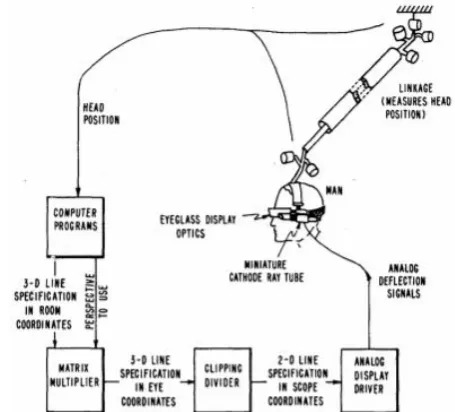
F 2.2 The parts of the three-dimensional display system by Sutherland 12
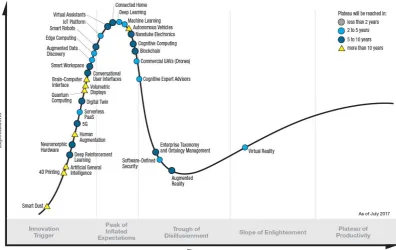
F 2.3 Gartner Hype Cycle for Emerging Technologies 13
F 2.4 Comparison of three depth sensors based on ability of skeleton tracking and availability
15
F 2.5 Two-by-two matrix of the different learning styles 17
F 2.6a Learning styles expressed as a percentage based on type of sport/recreation
18
F 2.6b Learning styles expressed as a percentage based on level of performance
18
F 2.7 Taxonomy of human motivation 20
T 2.1 Overview of the six most highly cited motivation questionnaires in the sport sector
22
F 2.8 Average number of user-generated tags per condition 24
T 4.1 Baseline stakeholders 30
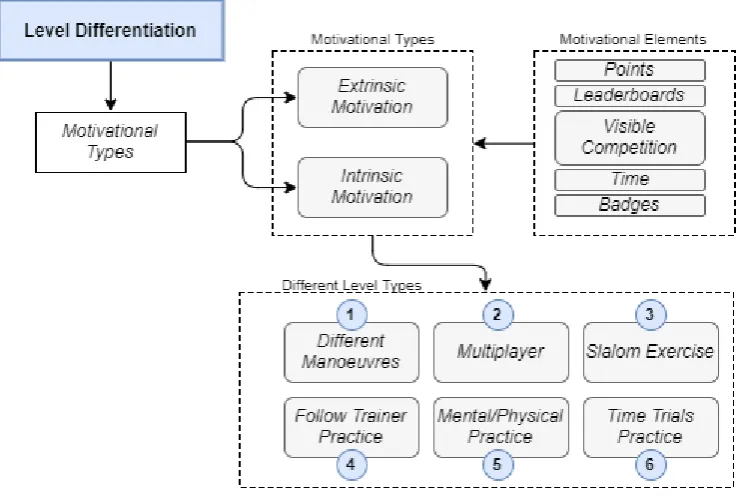
F 4.1 Brainstorm train of thought on Level Differentiation 33
T 4.2 Level type explanation 34
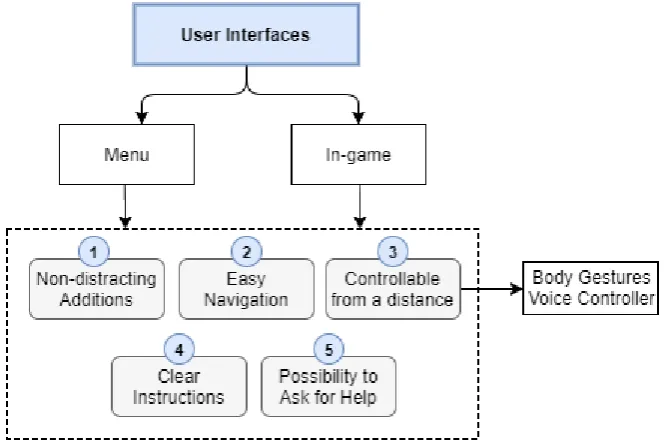
F 4.2 Brainstorm train of thought on User Interfaces 35
T 4.3 Explanation on the UI requirements 36
F 4.3 Train of thought on the hardware possibilities and requirements 36
T 4.4 Explanation on the hardware possibilities and requirements 37
F 4.4 Final brainstorm visualization 37
F 4.5 Direct Skeleton Feedback draft 39
F 4.6 Indicator of the Direct Skeleton Feedback 39
F 4.7 Interface for the application 39
T 4.5 Advantages and disadvantages of concepts 40
T 5.1 Product requirements 45
F 6.1 Pro Ski-Simulator 46
F 6.2 Revolving Ski Slope 46
F 6.3 System architecture 47
F 6.4 Log of the Sharing Service 47
F 6.5 Outlines test setup 48
F 6.6 Actual test setup 48
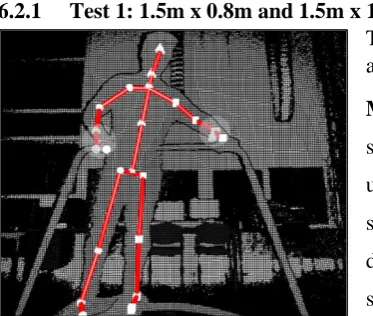
F 6.7 Skeleton tracking at 1.5m 48
F 6.8 Skeleton tracking at 2.0m 49
F 6.9 Skeleton tracking at 2.5m 49
F 6.10 Skeleton tracking at 3.0m 50
T 6.1 Overview results depth sensor test 50
F 6.11 Gates, plane and model in Environment 51
F 6.12 UI Menu and background sound in Environment 51
9
F 6.14 Menu seen as from the HoloLens 53
F 6.15 Application as from the HoloLens 53
F 6.16 Interface of the Motion Capture asset 53
F 6.17 Rigged 3D model of a skier used in the project 54
F 6.18 Scripts architecture 55
F 6.19 Model position and looks for the direct feedback skeleton 55
T 7.1 Product requirements with its assessments 57-58
F 7.1 Set-up test with Pro Ski-Simulator 59
F 7.2 Participant playing the game 60
F 7.3 Participant filling in the survey 60
F 7.4 Set-up for test with revolving Ski Slope 60
F 7.5 Results of the Interest/Joy in General topic. Shown are the means and the standard deviations.
61
F 7.6 Results of the application as a ski-learning game topic. Shown are the means and the standard deviations.
62
F 7.7 Results of the Kinect elements as a ski-learning elements. Shown are the means and the standard deviations.
10
List of Abbreviations
Abbreviation Description
AR Augmented Reality
HMD Head-Mounted Display IM Intrinsic Motivation EM Extrinsic Motivation SMS Sport Motivation Scale
11
1
I
NTRODUCTION
1.1
P
ROBLEMS
TATEMENTWhen you want to go practice your skiing skills in the Netherlands, you’d have to visit one of the few artificial ski venues available. This could take valuable time and money, therefore many people wait till they have the opportunity to visit a real skiing slope in the mountains. This means that people don’t practice as much as they possibly want to. The client, Michiel Groot-Koerkamp, specializes in portable revolving slopes where people can train their skiing abilities on. This however could become monotonous quite easily. To counter this, the idea arose to create an Augmented Reality application using a revolving ski slope. This application contains different types of hardware that adds elements, which can boost the impact of the skiing training. That is what is being researched in this report.
1.2
R
ESEARCHQ
UESTIONSThis thesis will discuss research where an AR game has been created for a portable ski slope by using different types of hardware. Therefore, the main research question is:
RQ: “How to create an augmented reality skiing application for on a portable slope where different
types of hardware work together to support the ski-learning process ?”
To answer this question other sub research questions have to be answered. First, a literary research has been conducted to find out what types of hardware can contribute the best to the AR skiing game. SQ1: “What type of hardware can be used best to add new elements to an AR skiing game?”
The setup of the game in combination with the portable ski slope should be examined. The type of hardware has been examined and elements have been considered that can be added to the AR skiing game. Therefore, the second sub question is:
SQ2: “What types of new elements can be implemented into the AR skiing game to support the
ski-learning process?”
Lastly an evaluation has been conducted to find out the effects of the different types of elements put into the game. Therefore, the last sub research question is:
12
1.3
O
UTLINE OF THED
OCUMENT13
2
S
TATE OF THE
A
RT
R
EVIEW
In this State of the Art review certain important topics will be discussed. In chapter 2.1 Augmented Reality and HMD’s will be discussed and a comparison will be made to find out what the best HMD is for this project. In chapter 2.2, depth sensors will be discussed as it has been chosen as the hardware of choice. A second comparison will be made to figure out which depth sensor is best for this project. In chapter 2.3 motivation for participating is discussed. First the differences between types of motivation will be explained, after which several types of questionnaires will be thoroughly analysed to find out which one fits this context optimally.
2.1
A
UGMENTEDR
EALITYMain Research Requirement Focus: “How to create an augmented reality skiing application for a
portable slope where different types of hardware work together to support the ski-learning process ?”
This project is based upon Augmented Reality (AR) technology as its basis. As defined by Carmigniani et al., 2010, AR is “a real-time direct or indirect view of a physical real-world environment that has been enhanced/augmented by adding virtual computer-generated information to it.” There are many
different types of AR technology in existence. For example, one category are the recognition based AR technologies, which projects digital images on physical objects. Another is location based AR, which uses GPS location to perform images. A third example is the superimposition based AR, which provides an ‘alternate’ view of the object in concern, either by replacing the entire view with an augmented view of the object or by replacing a portion of the object view with an augmented view .Some types make use of other types of AR (i.e. superimposition uses recognition based AR), but defined by Azuma et al., 2001 all types of AR system share to following properties:
• Real- and virtual elements will be blended within a real environments;
• Real-time interactive elements;
• Accurate alignment of real and virtual objects in 3D, without accurate registration, the illusion
that the virtual objects exist in the real environment is severely compromised.
14
Milgram, Takemura, Utsumi, & Kishino, (1994) defined a continuum of real to virtual environments. In this continuum, which can be seen in Figure 2.1, AR is part of the ‘Mixed Reality’ area. Next to AR,
the continuum distinguishes an environment with no virtually displayed objects and information, a completely virtual environment where there are no real objects and real environments are visible, but only the virtual objects and information (VR), and a virtual environment where both virtual objects and real-world objects are visible in the environment which is called Augmented Virtuality (AV). VR is used in different types of fields, such as military training, healthcare, construction and of course games. An example of the usability of AV is when an aircraft maintenance engineer uses a visualization of a real time model of an engine in flight. He can see the simulation of the real-time engine on a computer screen to search for errors or help the pilots who are thousands of kilometres away.
AR is not limited to a particular type of display nor is it limited to the sense of sight. It can apply augmented senses, smell, touch and hearing as well. This is what was used during the first iteration of the usage of ‘Augmented Reality’ which predated the digital era. In the 1962 Morton Heilig, a cinematographer, constructed the what he called ‘The Cinema of the Future’, named Sensorama. In this project he would draw the viewer into the onscreen activity by augmenting all the senses in an effective manner. In 1968 Ivan Sutherland was the first one to create an augmented reality system using an optical
see-though head-mounted display (HMD), which can be seen in Figure 2.2 (Sutherland & E., 1968). This was the first HMD created and the foundation for the HoloLens and other AR HMD’s available at this moment. A HMD is an object that a person could put on his head which can construct AR, AV and AR environment with the use of screens on the inside of the structure. The first digital representation of AR technology was made by Myron Krueger. His “Videoplace” 1 was a room that allows users to interact
with virtual objects. The first AR game, ARQuake, developed in 2005 by Bruce Thomas was demonstrated during the International Symposium on Wearable Computers in 2005 (Carmigniani et al., 2010).
The Gartner Hype Cycle provides a graphic representation of the maturity and adoption of technologies and applications, and how they are potentially relevant to solving real business problems and exploiting
1 Link to his work: https://www.youtube.com/watch?v=dmmxVA5xhuo
Figure 2.2. The parts of the three-dimensional display system by
[image:14.595.295.523.271.477.2]15
new opportunities. On the Gartner Hype Cycle for Emerging Technologies AR has seen a rise on this cycle. Companies use the Hype Cycles to educate themselves about promises of an emerging technology within the context of their industry and individual appetite for risk. There are five key phases within the Hype Cycles (Linden & Fenn, 2003):
• Innovation Trigger: The kick off of a potential technology breakthrough. Normally no products
exist yet but the concept stories trigger publicity;
• Peak of Inflated Expectations: Success stories are produced. Companies will go on with their
products or will stop development;
• Trough of Disillusionment: Interest in the technology fades away as products fail. Companies
stop developing or continue improving to continue investments;
• Slope of Enlightment: Product becomes more understood. More enterprises fund the pilots.
• Plateau of Productivity: Mainstream adoption starts to take off. The technology's broad market
applicability and relevance are clearly paying off.
[image:15.595.77.474.433.683.2]In 2011 AR technology was put in the ‘Peak of Inflated Expectations’ area with an expected lifespan of 5 to 10 years. Some companies developing AR stop producing (Google Glass), but some continue development (Microsoft HoloLens, Meta). Now in 2017 it is put in the ‘Through of Disillusionment’ with also an expected lifespan of 5 to 10 years. Surviving providers satisfy the early adopters, but products still fail and stop developing which keeps the mainstream public cautious.
16
2.1.1 Head-mounted Displays (HMD)
Nowadays AR technology is used in different ways. The most used ones are HMD’s like the Microsoft HoloLens and the Meta 2 AR, and AR technology on tablets/phones. An example of the latter is the immensely popular game Pokémon GO. Since Sutherland made the evolution of HMD AR possible the development of these machines has not stood still. According to calculations made by Digi-Capital the prediction is that the value of the AR technology market will grow from 3.9 billion US dollars in 2016 to 82 billion US dollars in 2021. In this part the HMD’s will be discussed.
Google Glass
Google was one of the first to start the idealisation of the modern augmented reality HMD. Their product, called Google Glass, was being constructed for developers who could create their own applications for the hardware. They were also the first company to start a market for consumers. The product is no longer in production, since the company got too much negative attention and could not fulfill the demands.
Microsoft Hololens
In March 2016 Microsoft released its developer edition of the HoloLens, a HMD that was one of the first computers running the Windows Mixed Reality platform under Windows 10 operating system. The ‘wearable computer’ has four cameras that track movement and will place virtual objects realistically in the wearers view.
Metavision Meta 2 AR
In 2013 Meta launches a crowdfunded Kickstarted campaign which resulted in $194.444. A year later the Meta 1 Development Kit was released. AR enthusiast and Fortune 500 companies including Boeing, Toyota and Caterpillar were now customers of the company. On March 2016 Meta starts accepting pre-orders for the Meta 2 Development Kit. This product offers an industry leading Field of View, 2.5K resolution and direct hand interactions.
2.1.2 Conclusion
17
2.2
D
EPTHS
ENSORSMain Research Requirement Focus: “How to create an augmented reality skiing application for on a
portable slope where different types of hardware work together to support the ski-learning process ?”
Depth sensors are used for tracking the player’s location and used for Motion capturing certain movements of a person, which will be integrated into a game style. There are many different types of depth sensors, which all can be optimally used for a specific situation. Because of its possibilities and its broad usability the choice fell on using a depth sensor for this project.
2.2.1 Depth Sensor Requirements and Comparison
There are sensors that work best for medium-range indoor applications, like the Intel SR3002, sensors that are used for tracking hand gestures for small-range indoor applications, like the Leap Motion3, and sensors that work best for large-range outdoor applications, like the Stereolabs ZED Stereo Camera4. Stimulant5, a company that uses emerging technologies to transform static physical spaces into dynamic
interactive environments, compared 11 different types of depth sensors to find out which application is best use in which environment. In Appendix A, specification comparison Depth Sensors the documented comparison is displayed.
The depth sensor that is necessary for this project should meet some function requirements. It should work steadily on a medium-range distance. The price should be relatively cheap. Skeleton tracking is not necessarily a requirement, but will make the process of creating and usability more accessible. When looking for perfect matches it is found that the following depth sensors fit the requirements:
• Microsoft Kinect v1;
• Microsoft Kinect v2;
• RealSense R200;
To find out which one is optimal for the environment of the project a comparison will be made of these three with new requirements: the possibility to full body tracking and the availability of the product. The results can be seen in Figure 2.4.
2https://software.intel.com/en-us/realsense-sdk-windows-eol
18
Full Body Tracking
(All Joints) Availability
Microsoft Kinect v1 2 bodies trackable Discontinued, can be bought elsewhere
Microsoft Kinect v2 6 bodies trackable €99,99
RealSense R200 Only waist and up €99,95
The RealSense R200 is not suitable for this project, because of its lack in Full Body Tracking. The Microsoft Kinect v1 is not for sale anymore but can be bought through other means. A comparison of these two depth sensors will now be made.
Kinect v1 and Kinect v2 comparison
Although the first Kinect is discontinued, it is still possible to buy it via other ways. In an article of Wasenmüller and Stricker (2017) a thorough comparison between the two Kinect’s is conducted. They state that the Kinect v1 uses the Pattern Projection principle, known infrared patterns are projected into the scene and out of its distortion the depth is computed. to measure depth, whereas the Kinect v2 contains a Time-of-Flight (ToF) camera and determines the depth by measuring the time emitted light takes from the object and back. When increasing the distance the accuracy will exponentially decrease when using the Microsoft Kinect v1, while the Kinect v2 has a constant accuracy in form of an offset of -18mm. In addition, Kinect v1 incorporates the pattern in the depth images, which is difficult to compensate. For Kinect v2 all central pixels show a similar accuracy; only the image corners deviate. On the other hand, the precision of the depth images is higher for Kinect v1. This holds for flat surfaces, but especially for depth discontinuities, where flying pixels occur for Kinect v2. Flying pixels are erroneous depth estimations, which occur close to depth discontinuities . These flying pixels occur with every device that uses ToF. Furthermore, the depth estimation of Kinect v2 is influenced by the scene colour, whereas Kinect v1 is unaffected by colour. In contrast to Kinect v1, Kinect v2 depth images are influenced by the multipath interference effect, meaning that concave geometry is captured with bulges (Wasenmüller & Stricker, 2017).
2.2.2 Conclusion
After a comparison of 11 different depth sensors6 a conclusion has been made on which depth sensor is
most usable in the project environment. Three key requirements where constructed and used to deduct the best sensor. At the end the best depth sensor seems to be the Microsoft Kinect v2. It is one of the cheaper depth sensors ($99,99), it has the perfect medium range (0.5m – 4.5m) and includes the
6Source: https://stimulant.com/depth-sensor-shootout-2/
19
possibility to track six skeletons at the same time. Beside being the best depth sensor for this project, it was also one that was available during the duration of the project.
2.3
L
EARNINGS
TYLES INS
PORTSWhen looking for ways to effectively instruct people it is important to find the optimal way to do this. There are different learning styles that people prefer in certain environments. First, the different types of learning styles will be discussed and will then be placed into a exercise environment to find the optimal way to instruct people.
2.3.1 Differences in Learning Styles
According to the Experiential Learning Cycle (Kolb, 1984), learning involves four phases: concrete experience (feeling), reflective observation (reflection), abstract conceptualization (thinking), and active experimentation (doing).
• Concrete Experience (CE) - A new experience of situation is encountered, or a reinterpretation
of existing experience.
• Reflective Observation (RO) of the new experience. Of particular importance are any
inconsistencies between experience and understanding.
• Abstract Conceptualization (AC) - Reflection gives rise to a new idea, or a modification of an
existing abstract concept.
• Active Experimentation (AE) - The learner applies them to the world around them to see what
results.
Effective learning is seen when a person progresses though this cycles of four stages. This cycle can be rewritten to the following cycle: Experience → Reflection → Conceptualise → Test → […] (McLeod, 2013). Kolb explains that different people prefer a different learning style, which are caused by different influences in a person’s life. The preferred learning style is a product of two pairs of variables/choices that people make. There is the processing continuum and the perception continuum. The perception continuum describes our preferred means of acquiring new information (from CE to AC) and the processing continuum refers to how we make sense of things (from AE to RO). Kolb believes that both variables can’t be performed at once (e.g. think and feel) and that a learning style is a combination of these two choice decisions. Lowy & Hood (2004) put this construction in a two-by-two matrix, which can be seen in Figure 2.5.
Doing (AE) Watching (RO)
Feeling (CE) Accommodating (CE/AE) Diverging (CE/RO)
Thinking (AC) Converging (AC/AE) Assimilating (AC/RO)
20
The four quadrants (e.g. accommodating, diverging, converging and assimilating) have different ways of learning, because of the different combinations of preferred learning styles.
• Accommodating learn style: using other people’s analysis and information to take a practical
and experiential approach.
• Diverging learn style: these people prefer to watch rather than do and view concrete situations
at several different viewpoints to obtain information.
• Converging learn style: solving problems and using their learning to find solutions to practical
issues. Preferring technical tasks and are less concerned with people and interpersonal aspects.
• Assimilating learn style: ideas and concepts are more important than people. They require good
clear explanation rather than practical opportunity. They excel at understanding wide-ranging information and organizing it in a clear logical format.
2.3.2 Learning Styles in an Exercise Environment
Different learning styles can be effective in different environments, but since different people prefer different learning styles it is important to figure out what type of learning people in the exercise environment prefer. In an experiment conducted by González-Haro, Calleja-González, and Escanero (2010) a total of 71 athletes took part into the study. The athletes played different sports or practised recreational and partook on different levels in the sport. The experiment found out what percentage of the athletes preferred a certain learning style. The percentages can be seen in Figure 2.6a (different sports/recreational) and Figure 2.6b (level of performance).
2.3.3 Conclusion
When focussing on recreational exercise it is visible that 55% of the recreational athletes prefer the accommodation learning style approach. When looking at the other sports, including level of performance, it’s clear that this approach is the most preferred by the athletes.
Figure 2.6a. Learning styles expressed as a percentage based on
type of sport/recreation
Figure 2.6b. Learning styles expressed as a percentage
21
2.4
M
OTIVATIONTo test the impact and effectiveness of the application a questionnaire will be used that can indicate the amount of impact the application has. First intrinsic and extrinsic motivation are discussed, then several types of questionnaires are compared to find out which one is most suitable for this project.
2.4.1 Intrinsic and Extrinsic Motivation
The Self-Determination Theory (SDT; E. Deci & Ryan, 1985), distinguishes between different types of motivations based on the different reasons or goals that give rise to an action. These are based on the identified needs that, if satisfied, allow optimal function and growth. These three innate needs are:
• Competence, wanting to experience mastery and being able to control the outcome of the
situation;
• Relatedness, wanting to interact with, be connected to, and care for other people;
• Autonomy, wanting to be in control of one’s own life; however, according to (Deci &
Vansteenkiste, 2004) this doesn’t mean that someone want to be completely independent of other people.
There are three basic types of motivation: amotivation (AM), intrinsic motivation (IM) and extrinsic motivation (EM). People are often motivated by factors such as grades, money and fame to name a few. This, being driven by external rewards, is what defines EM. IM on the other hand is defined as the doing of an activity for its inherent satisfactions, rather than for some separable consequence. When intrinsically motivated a person is moved to act for the fun or challenge entailed, rather than of external prods, pressures, or rewards (Ryan & Deci, 2000). Within the SDT there are several subtheories. The first subtheory is Cognitive Evaluation Theory (CET) which specifies the factors on social contexts that produce variability in IM (Deci & Ryan, 1985). “CET argues that interpersonal events and structures (e.g., rewards, communications, feedback) that conduce toward feelings of competence during action
can enhance intrinsic motivation for that action because they allow satisfaction of the basic
psychological need for competence.” (Ryan & Deci, 2000). Feelings of competence, however, must be
accompanied by a sense of autonomy to enhance IM, which mean that people must feel that their actions are self-determined. The last need, the need of relatedness, will flourish the IM when present. For example, Grolnick & Ryan (1989) found that when a child finds his teacher non-caring, thus not fulfilling the relatedness needs, that the IM for the course diminishes.
22
stimulation relates to experiencing stimulating passion, like sensory pleasure or aesthetic experiences, whilst performing in an activity.
[image:22.595.76.521.219.445.2]A second subtheory within the SDT is the Organismic Integration Theory (OIT). The OIT distinguishes different types of EM with its contextual factors. Figure 2.7 illustrates the taxonomy of motivational types according to the OIT. The far left illustrates AM, which arises when someone is not valuing the activity, not feeling competent to do it, or does not believe it will result in the desired outcome (Ryan & Deci, 2000).
Figure 2.7 Taxonomy of human motivation (Ryan & Deci, 2000; Ryan, P. Connell, & Grolnick, 1992)
Originally people thought that EM was only obtainable by external contingencies like giving out rewards. R. Ryan, P. Connell, & Grolnick (1992), however, proposed that there were different types of EM. As can be seen in Figure2.7, from lower to higher levels of self-determination you have:
• External regulation, behaviour controlled by external rewards. An athlete who engages into a
sport to obtain praise or feel pressure from their peers.
• Introjection, behaviour controlled by internal pressure (e.g. guilt, anxiety). An athlete that
trains to stay in shape for aesthetic reasons.
• Identification, behaviour controlled by judging it as important and, therefore, performing it out
of choice. The activity is done to, for example, achieve personal goals, but is internally regulated and self-determined.
• Integration, “occurs when identified regulations have been fully assimilated to the self. This
occurs through self-examination and bringing new regulations into congruence with one’s other
23
Examples of the different motivational styles: a student can be unmotivated because he/she feels that the assignment is not worth the time and not valuable to this person (AM), the student can be motivated to study hard for a test out of curiosity and interest of the topic (IM) or the student is motivated because he/she wants to obtain a high grade to get approval from their superiors and wants to brag about it in class (EM). Looking at the project we want to obtain both intrinsic motivation and extrinsic motivation.
2.4.2 Measuring Motivation in Sports
There are several questionnaires available to measure the IM, EM and AM of playing a sport. In this chapter a summary of different questionnaires will be given and the best suitable questionnaire will be discussed.
SMS-28
Brière, Vallerand, Blais, & Pelletier, (1995) constructed the Échelle de Motivation dans les Sports (EMS), a scale for measuring motivation in sport. The scale, written in French, consists of seven subscales that measure different forms of motivation. Namely, the three IM styles by Vallerand and Bissonnette (1992; IM to know, IM to accomplish and IM to experience stimulation), three EM styles by R. Ryan, P. Connell, & Grolnick (1992; EM identified, EM introjected and EM external regulation, excluding integrated regulation) and amotivation. Pelletier et al. (1995) translated the French model to the English language calling it the Sport Motivation Scale (SMS), or the SMS-28.
SMS-6
Mallett, Kawabata, Newcombe, Otero-Forero, & Jackson (2007), however, revised the SMS-28 into SMS-6, because the old version does not contain the most autonomous form of EM, integrated regulation. They also state that the three IM factors are “not empirically distinguishable” and there are items cross-loading or not loading well onto hypothesized factors (Martens & Webber, 2002). Their version consist out of a general IM subscale, the EM types of SMS-28, but with integrated regulation included and amotivation.
BRSQ-8 and BRSQ-6
24
SMS-II
Pelletier, Rocchi, Vallerand, Deci, & Ryan, (2013) constructed a new SMS, calling it the SMS-II, which contains six subscales. They claim that the SMS-II addresses the limitations of the first SMS better than the SMS-6 or the BRSQ by Lonsdale, Hodge, & Rose (2008). However, Lonsdale, Hodge, Hargreaves, & Ng (2014) state in a paper that there is insufficient information to support the claim that the SMS-II is superior over BRSQ.
A critical review by Clancy, Herring, & Campbell (2017) evaluates the six most highly cited motivation questionnaires in the sport sector: Task and Ego Orientation in Sport Questionnaire (TEOSQ; Duda, 1989), Perceptions of Success Questionnaire (POSQ; Roberts, Treasure, & Balague, 1998), SMS-28 (Pelletier et al., 1995), BRSQ-6 (Lonsdale et al., 2008), Intrinsic Motivation Inventory (IMI; McAuley, Duncan, & Tammen, 1989) and the Situational Motivation Scale (SIMS; Guay, Vallerand, & Blanchard, 2000). A quick overview of the measures can be found in Table 2.1. Clancy et al., summarizes that the SMS is a well-supported, multidimensional questionnaire with a limitation that integrated regulation is
not assessed. However, this can be overcome by using SMS-II. The IMI is a flexible measure, but there are no subscales for EM of AM, thus focussing on, what the name implies, predominantly IM. The SIMS is a brief, non-sport-specific measure that uses a general IM and only uses two EM types. The POSQ is not usable for measuring motivation, but for measuring achievement goals in sport. Same goes for the TEOSQ which has measures of task and ego goal orientation in sport, and not measuring motivation. Lastly, the BRSQ is designed for use among competitive athletes, which makes it unsuitable for exercise or physical activity environments.
See Appendix C: SMS-II Questionnaire.
7 When there are multiple versions of the measure, the most commonly used version will be used 8 Addition of the English and French articles
Construct Measure Items7 Subscales Responses/item Citations*
Motivation SMS-28 28 7 1-7 2037 8
SMS-6 24 6 1-7 154
SMS-II 18 6 1-7 167
IMI 16 4 1-7 1641
SIMS 16 4 1-7 974
BRSQ 24 6 1-7 267
Goal orientation TEOSQ 12 2 1-5 850
POSQ 13 2 1-5 553
25
2.4.3 Motivation in Games
2.4.3.1 Intrinsic Motivation in games
Malone (1981) proposed a framework where the primary factors for making activities intrinsically motivated are challenge, curiosity and fantasy. He also specifically applied this to the design of computer games. According to Csikszentmihalyi (1979) intrinsically motivating activities can be described as: 1. The level of challenges must be able to be changed to match his skill with the requirements for action; 2. Isolation of the activity from external and internal stimuli that might interfere; 3. Criteria for performance must be set up so that someone can, at every given point, see how he is doing; 4. Feedback that shows the player how close he is to the criteria of performance must be in place; 5. Broad range of challenges, and different ranges of challenges to show the player what he can do.
All points, with number two as exception, make the activity challenging and are thus part of Malone’s framework. Richard E. Mayer (2014) adds: “Concerning challenge, the game should require performance at a level that is slightly higher than the player’s current level of competence, which can
be achieved by building progressively more difficult levels into a game”, thus agreeing with the
statements of Csikszentmihalyi. Mayer then states that the player has to be allowed to experience an enticing environment that goes beyond the player’s normal experience in relation to fantasy. Lastly, by revealing holes in the player’s knowledge curiosity can be maintained. Malone (1982) proposed heuristics for designing enjoyable User Interfaces (UI) and uses the three primary factors. It can be seen as a checklist for creating the UI.
See Appendix D: Heuristics for Designing Enjoyable User Interfaces for the framework.
In short, activities can be made intrinsically motivating by using the primary factors challenge, fantasy and curiosity. This, together with the UI heuristics, can be used to make the game more intrinsically motivating.
2.4.3.2 Extrinsic Motivation in Games
As discussed in Chapter 2.4.1, EM has four different subscales. In this part we want to find out what types of game elements to use in the project to create environments for the types of motivations.
Singleplayer games can be fun, but will most likely get boring quicker than multiplayer. Multiplayer gives the constant excitement of challenging other people and wanting to get better in the game just to beat them (Göbel, Hardy, Wendel, Mehm, & Steinmetz, 2010). Games against people will always play out differently, thus enhancing replayability and motivation. Multiplayer could be both intrinsically motivating and extrinsically motivating (introjection or external regulation).
26
Figure 2.8b. Average quality of user-generated tags per
condition. Error bars indicate standard error of the mean.
environments, narrative context, feedback and behaviour reinforcement, reputations (ranks and levels), marketplace and economies, competition within rules, teams, parallel communication systems, and time pressure. Although these are for non-game applications, some mechanics overlap with other sets of game elements found by researchers. For example, two studies suggest other sets of game elements. Ten elements, also called affordances, were set up by Hamari, Koivisto, & Sarsa (2014) and are in line with the mechanics Kumar (2013) identified. These ten are: points, leaderboards, achievements/ badges, levels, story/theme, clear goals, feedback, rewards, progress and challenge. Kumar, Hamari et al., and
Reeves and Read found that points, leaderboards and levels are commonly used as important game elements for boosting extrinsic motivation. This is also the case in the research done by Franscisco-Aparicio, Gutiérrez-Vela, Isla-Montes, & Sanchez (2013) where they found that these three game mechanics: “could enhance feelings of competence”, and therefore boost extrinsic motivation and performance (Przybylski, Rigby, & Ryan, 2010). So, filtering the identified game elements on the basis of: usage in games and effectiveness based on possible boost for motivation gives us three important game elements to investigate, which are: points, leaderboards, levels.
In an empirical evaluation, Mekler, Brühlmann, Tuch, & Opwis (2017) conducted a 4 x 2 between-subject online experiment (n=273). The independent variables were three of the most common game elements: points vs. leaderboard vs. levels vs. plain condition without any game elements. Mekler et al., (2017) attempted to empirically evaluate the impact of gamification elements on user performance, intrinsic motivation and satisfaction of autonomy and competence needs. This research was done by executing four different tests. One without game elements and three tests with each a different element.
This evaluation showed that points, levels and leaderboards increased tag quantity compared to the plain condition tests (Figure 2.8a). It also showed that it has no influence on the quality of the tags (Figure 2.8b). To test the intrinsic motivation aspect of the test, Mekler et al., made use of the Intrinsic Motivation Inventory (IMI). The results of the IMI showed that neither a significant main effect or a significant game element effected the intrinsic motivation. Because of the lack of effects on intrinsic motivation and tag quality it is suggested that points, levels and leaderboards function as an extrinsic
Figure 2.8a. Average number of user-generated tags per
27
motivation factor. So, users do it for the rewards rather than doing it for their own sake, which was expected.
2.4.4 Conclusion
In this section, motivation was explored and several conclusion can be drawn. First of all several types of IM and EM where found and explained. These types should be measured to find out what drives a player to practice his sport, because if that is clear a special game mode can make the player more motivated to use the installation. Several types of questionnaires were discussed and compared and a conclusion was drawn that the IMI was the best option to use. Although the SMS-II was also qualified to be used during the project, the choice was made to pick a more general motivation scale, because the experiment is not always in a sport environment. Then a research was conducted to find out what types of elements can motivate intrinsically and extrinsically. It was found that activities can be made intrinsically motivating by using the primary factors challenge, fantasy and curiosity. This, together with the UI heuristics, can be used to make the game more intrinsically motivating. It was also found that activities can be made extrinsically motivating when using points, levels and leaderboard. Multiplayer is also an important game element that boosts motivation and replayability.
2.5
C
ONCLUSIONSeveral conclusions can be drawn from the review. The first sub research question was:
“What type of hardware can be used best to add new elements to an AR skiing game?”
By deciding on using an AR HMD in combination with an depth sensor an comparison between different types was made. First, the AR HMD of choice was the Metavision Meta 2 AR, because of its leading field of view and high resolution. The device was not send in time to be used unfortunately, therefore the Microsoft HoloLens was used instead. Second, the choice of depth sensor was made based on an big comparison of 11 different sensors. It was concluded that the Microsoft Kinect v2 will be used for the project, because of it’s ability to track the users skeleton. This will open up many types of new elements to the AR skiing game.
The third research question was:
“How do players of the game perceive the different types of elements in the game?”
28
3
M
ETHODS AND
T
ECHNIQUES
To be able to answer the research questions of this project, it is necessary to design different gamified environments where each environment has a different kind of game element implemented. With this application an experiment can be conducted through user testing in the evaluation phase, which leads to a conclusion and a discussion about future work. Two processes are described in the next chapters that will secure quality of the application to fulfil the needs of the user. These processes consist of several methods which are also described.
3.1
D
ESIGNP
ROCESS FORC
REATIVET
ECHNOLOGYCreative Technology students often use The ‘Design Process for Creative Technology’ within their graduation projects (Mader & Eggink, 2014). This process consists of four phases that will guide students through the design process of the product/application and make clear and well-supported design choices. These four phases are: the ideation phase, specification phase, realisation phase and the evaluation phase. When following this process a clear product/application will be the result.
The Ideation Phase is the first step in the design process. As described in the document this phase focusses on evaluating early ideas with clients or users and using other user centred design techniques (the use of mock-ups, sketches, user scenarios and story boards) (Mader & Eggink, 2014). A better view and elaborated project idea and acquired problem requirements are the results of the Ideation Phase, which can be acquired through interviews with clients, users or user experts who characterize the needs, describe the problem setting and provide requirements. Also, a stakeholder identification is performed to understand how the users of the application work. These result in Personal, Activities, Context and Technologies (PACT, Benyon & Macaulay (2002)) user scenarios that describes the current way of working. Other results of the Ideation Phase are new ideas on: “experience, interaction, as well as a service and business mode.”
29
In the Realisation Phase the prototype ideas and its fulfilled requirements will lead to the creation of a prototype. Because of the use of the MoSCoW method the order of implantation of functionalities is clear which will lead to a better prototype.
After the prototype has been constructed the Evaluation Phase commences. In this phase two different types of evaluation will be concerned: functional evaluation and user evaluation. A conclusion will be drawn from the outcomes of these evaluations and future work will be addressed.
The design process of Creative Technology that is suggested can be seen in Appendix B: Creative Technology Design Process.
3.2
M
ETHODSDuring the description of the Design Process for Creative Technology a few methods were mentioned. Listed below are these methods including a explanation of what each method contains. The methods are: Stakeholder Identification & Analysis, User & Expert Interviews, PACT scenarios, Product Requirements & MoSCoW and Evaluation methods.
3.2.1 Stakeholder Identification & Analysis
To understand how users work and react in certain environments, especially the specific gamified environment in this experiment, a stakeholder identification and analysis is conducted. There are different variants on the definition for a stakeholder, but the definition of Dix, Finlay, Abowd, & Beale (2004) concerning stakeholder identification is chosen. This is because of its frequent use within software engineering projects. Dix et al., identifies stakeholders as: “anyone whose jobs will be altered, who supplies or gains information from it, or whose power or influence within the organization will
increase or decrease.” The goal of setting up a stakeholder identification and analysis is to gather
information on the users who are affected by the application. Another goal is to identify the possible end-users of the product.
30
3.2.2 PACT Scenarios
During the Ideation Phase and the Specification Phase, PACT scenarios will be constructed and used. PACT stands for people, activities, context and technology and are key points to think about during the construction of a scenario.. According to Benyon & Macaulay (2002), scenarios are useful methods to discuss a product, because it represents a concrete situation of the product. These so called PACT scenarios will be based upon the user and expert interviews and the stakeholder identification and analysis. Creating and using a user story, experiences of people in what they do and what they want, can help making the product clear to different parties. These user stories will be created by creating a conclusion based on the conducted PACT scenarios.
3.2.3 Product Requirements and MoSCoW
Product requirements are formulated to concretize and clear up the idea of the application which were formulated in the PSCT scenarios. These requirements are written down with its corresponding functionality. These corresponding functionalities are divided into two parts: functional and non-functional requirements. The main focus will be on the non-functional product requirements, because the effectivity of the product is being measured. Because of time restraints it won’t be possible to address all functionalities of the product requirements, therefore the MoSCoW method is used to prioritize these requirements. This method contains out of four groups: ‘Must haves’, ‘Should haves’, ‘Could haves’ and ‘Won’t haves’ (Clegg & Barker, 1994).
3.2.4 Evaluations
31
4
I
DEATION
P
HASE
Main Research Requirement Focus: “How to create an augmented reality skiing application for on a
portable slope where different types of hardware work together to support the ski-learning process ?”
The objective of the ideation phase is to obtain a concrete project idea that can fulfil the needs and requirements set by the target group. Firstly, the target group is identified together with other stakeholders in Chapter 4.1 by conducting an stakeholder analyses. Then, having identified the target group, several use cases are described in Chapter 4.2 to identify the way of working of the users. Afterwards, a brainstorm has been conducted to find different possible project ideas (Chapter 4.3). In Chapter 4.4, the different potential project ideas are discussed and explained. Finally, in chapter 4.5, the final project idea is described.
4.1
S
TAKEHOLDERA
NALYSISAs described in the Methodology section of this research, the stakeholder identification method of Sharp, Finkelstein, & Galal (1999) is applied. The stakeholders which are identified as ‘baseline stakeholders’ are displayed in Table 4.1. The table shows us that there are three users: People who practice skiing along ski enthusiasts, ski trainers/personal trainers and gym- and ski hall owners. The first mentioned is concluded to be the primary target of the product, thus making them the main target group. Since ski and personal trainers are users of the product and are expected to explain and demonstrate it, they are identified as secondary users. Finally, the ones influencing the purchase and affecting the introduction of the system are the tertiary users, which are in this case gym and ski hall owners.
In addition to the users, the baseline stakeholder identification also contains developers, legislators and decision-makers stakeholders. Although it is important to identify the needs and requirements of these other roles the main focus is on the identified target group, the users. In addition, further stakeholder identification like suppliers, clients and satellite stakeholders will not be identified because of this.
Role Stakeholder
Users People practicing skiing/ski enthusiasts (primary) Ski trainers/Personal trainers (secondary) Gym owners/Ski hall owners (tertiary) Developers Programmers
Designers
Maintenance Expert Developers of the ski slope Legislators Government
Insurance companies Safety executives
Decision-makers Executive board/Management/CEO of distributor company
32
4.2
U
SEC
ASESTo concretize the interests of the target group two user cases were written based on the stakeholders analyses. The format of the use cases are based on Cockburn (2000) examples. Additionally, these user cases make use of the PACT method. These cases cover the needs of the users and show different scenarios regarding the product. The first case is a related to using the installation for the first time, whereas the second case focusses more on the motivational elements of the installation.
Use Case 1
Title Using the installation for the first time.
Description The user is going on a skiing holiday in the future, but wants to train his skiing abilities some more before going. He goes to a gym where this installation is located and asks a personal trainer to help him out.
Primary Actor Amateur Skier
Preconditions User wants to train his skiing abilities .
Postconditions User has trained certain ski abilities and feels motivated. PACT analysis
People Bjorn, an amateur skier, 23 years old, ski experience of 3 years, hasn’t practiced skiing in half a year, wants to practice more before going on vacation. Zachery, a personal trainer at a gym, 28 years old, instructing expertise on gym installations and core training sessions.
Activities Performing a ski training sessions with use of an AR game on a portable slope for the first time.
Context The AR ski installation is located in a gym.
Technology People who want to practice skiing use the portable ski slope with the AR game.
Main Success Scenario 1. Bjorn enters the Gym where the installation is located and talks to Zachery, the personal trainer, that is available.
2. Zachery explains how the system can be operated and helps Bjorn in the correct skiing gear.
3. When standing on the Ski Slope Zachery prepares the HMD and gives it to Bjorn.
4. Bjorn can ask final questions and Zachery will explain once again shortly what is going to happen.
5. Bjorn can now make a choice which type of training he wants to do. 6. After selecting the desired training Zachery will turn on the portable ski slope.
7. Then after a small habituation period the game will commence. 8. Bjorn will play the game that is linked to the desired training. 9. Zachery will give tips to train Bjorn even more.
10. When the game is finished Zachery will turn off the portable ski slope and give final tips to Bjorn.
33
12. Bjorn either keeps on training or removes the HMD and to practice something else.
Extensions 2. If no personal trainer is present with knowledge of the system Bjorn may have to wait till there is one.
4. The game might not start due to technical difficulties.
11. When Zachery observes that Bjorn cannot exercise without supervision he can either choose to stay or to make him train something else.
Use Case 2
Title Using the installation to beat a record on a specific game mode
Description Some game modes in the AR skiing game have leaderboards included. The user found out that someone broke his record on the ‘Follow the Trainer’ game mode and is motivated to get the record back.
Primary Actor Amateur Skier Secondary Actor Personal Trainer
Preconditions User wants to beat the current record on a specific game mode.
Postconditions The user leaves the installation satisfied after beating the previous record. PACT analysis
People Martin, an amateur skier, 26 years old, goes skiing every year with his friends, always want to be the best in every context. Rosie, a personal trainer at a gym, 24 years old, expertise in core training sessions and Pilates courses.
Activities Performing a ski training sessions with use of an AR game on a portable slope to beat a record.
Context The AR ski installation is located in a gym.
Technology People who want to practice skiing in the gym use the portable ski slope with the AR game.
Main Success Scenario 1. Martin visits the gym to start a training sessions with a friend of his. 2. He checks the leaderboards on the portable ski slope and finds out that his previous record on the game mode ‘Follow the Trainer’ has been broken by someone.
3. He becomes very motivated to regain his position as record holder. 4. He walks to Rosie, the personal trainer available, and asks her to set up the game.
5. Rosie gives Martin the gear and sets up the game mode.
6. Martin puts on the HMD and starts the game by using the voice commands.
7. Rosie, knowing how much experience Martin has, walks away to help other people.
34
10. When finished he either calls Rosie or his friend to shut down the portable ski slope.
11. Martin removes the HMD and takes off the gear.
12. Martin shows his record to his friend and leaves the gym content. Extensions 4. The personal trainer available is busy at the moment so he has to wait
till she’s done.
5. The game might not start due to technical difficulties. 6. Due to external factors, the voice commands might not work.
10. When no-one is coming the user has to keep waiting and keep skiing till someone can shut it off.
12. The leaderboards might not work due to technical difficulties.
4.3
B
RAINSTORMIn this section important branches on the concept were explored during a brainstorm session. It was concluded that three topics should be explored: Level difficulty, use interfaces and hardware possibilities and requirements. Every topic shows a figure with the train of thought with at the end different ideas. These ideas are numbered in the figure and are discussed in the table underneath it.
4.3.1 Level Differentiation
[image:34.595.73.443.484.732.2]This part of the brainstorm session was about the level differentiation. In Figure 4.1, the train of thought is visible. The most important step to get to the goal is to address the importance of motivation. In the State-of-the-Art section a research has been conducted to discuss motivation. By combining two motivational types (and corresponding motivational elements) six different types of level types have been thought of. In Table 4.2 the explanations of all the level types is discussed.
35
Number Explanation Elements
1 Different Manoeuvres, the idea behind this game mode is that the player will be skiing down a slope and has to perform certain manoeuvres* to proceed in the race. These manoeuvres could be for example, having to make a sharp turn to the right/left, having to brake quickly to avoid collision, evade objects that will become visible very late.
* In discussion with a ski trainer other suitable manoeuvres could be explored.
Time, Points
2 Multiplayer is known for making games more exiting and playable. As discussed in the State-of-the-Art review it is proven that multiplayer motivates players and makes the game less repetitive. The fact that it is constantly played against new players makes it more unpredictable. That in combination with the fact that people get motivated by competitiveness, might make this game mode utter attractive for our target group. Visible Competition Points, Badges, Leaderboard
3 Slalom Exercise is a game mode that incorporates the classic ski routine. Gates shall be displayed for the player to ski through. The player shall obtain points and will compete with others in a semi-multiplayer environment (no direct multiplayer elements whilst playing, but compete against other players) though a leaderboard.
Points, Leaderboards
4 The Follow the Trainer exercise is that you’ll be following a character that will be visible in front of you. When skiing you’ll need to follow this character and mimic his movements. When successfully mimicking a movement*, you’ll be rewarded with points.
* Mimicking a movement can be a successful follow through a gate or successfully mimicking the stance of the trainer using a skeleton tracker
Points, Leaderboards
5 Mental/Physical practice will make you solve mathematical equations* whilst skiing through gates. A sum shall be displayed on screen (which will not be irritating) and the player has to calculate the solution and ski through the gate that has the correct solution. Points shall be awarded. * It does not have to be mathematical equations. It could also be another way players have to think about an solution.
Points, Leaderboards
6 Time trials exercise is a race against the clock. This could also be a semi-multiplayer game mode where you can see a ghost, shadow of another contender on your display. Your goal is to finish the track as quick as possible. This could be done by collecting boost items that will be spawned along the track.
Time, Visible Competition
36
4.3.2 User Interfaces
[image:36.595.68.401.206.429.2]Another important part of the product is the User Interfaces within the game. In Figure 4.2, the train of thought is visible of this section. It was important to differentiate between two different parts of the game: Menu and In-game. Both these elements have certain requirements. These requirements are explained in Table 4.3. The menu interfaces are visible when starting the game, and when pausing the game. Smaller interfaces, like addressing the option to ask for help and the text that you should follow the trainer, are visible during the duration of the game.
Figure 4.2. Brainstorm train of thought on User Interfaces
Number State Explanation
1 Menu When looking through an HMD to your menu, it should be clear and non-distracting. Important factors are: crowdedness, soothing and irritation. In-Game When motivational elements are used (e.g. timer, points counter,
leaderboard) it should not be distracting and irritating during the game 2 Menu Buttons should be clearly readable and understandable. The text that
described the button should be recognizable and should not be confusing in any way. It should be clear how to navigate through the menu and people should be able to get stuck in a sub-menu.
In-Game When wanting to pause, continue, change level or change settings whilst in-game it should be a quick and easy action to undertake.
3 Menu The buttons and options should be controllable from a distance, since you are not close to the pc when using the product. Voice controllers or hand gestures might be utilized to control the game. Both have clear positives and negatives. Voice controlling makes it possible to minimize the amount of buttons on the screen (positive), but makes you have to talk loudly in a room where others might be working too (negative). The hand gestures have the complete opposite.
37
be the best and quickest solution here, since hand gestures might be irritating to do whilst doing an exercise.
4 Menu When using the voice controller or hand gestures it should clear what functionalities it can perform. It should be indicated what the options are and there should never be confusion about how to, for example, open a certain menu, how to lower the volume or how to pause the game.
In-Game
5 Menu There should be an option to click the Help button that displays exactly what every option does.
[image:37.595.69.430.344.608.2]In-Game
Table 4.3. Explanation on the UI requirements
4.3.3 Hardware possibilities and requirements
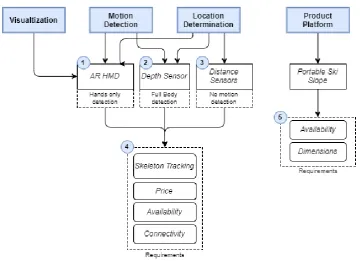
A big part of the research is about using different types of sensors/hardware. It has been identified that there are three important subjects that should be covered. These are: Motion Detection, Location Determination and Visualization. As part of the hardware connectivity it is important to include the
Product Platform in this part. In Figure 4.3 the train of thought can be seen and in Table 4.4
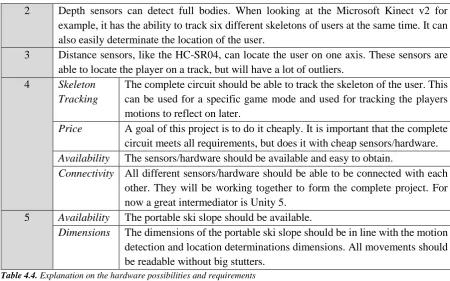
explanations of both the sensor/hardware and the requirements can be seen.
Figure 4.3. Train of thought on the hardware possibilities and requirements
Number Explanation
38
2 Depth sensors can detect full bodies. When looking at the Microsoft Kinect v2 for example, it has the ability to track six different skeletons of users at the same time. It can also easily determinate the location of the user.
3 Distance sensors, like the HC-SR04, can locate the user on one axis. These sensors are able to locate the player on a track, but will have a lot of outliers.
4 Skeleton Tracking
The complete circuit should be able to track the skeleton of the user. This can be used for a specific game mode and used for tracking the players motions to reflect on later.
Price A goal of this project is to do it cheaply. It is important that the complete circuit meets all requirements, but does it with cheap sensors/hardware. Availability The sensors/hardware should be available and easy to obtain.
Connectivity All different sensors/hardware should be able to be connected with each other. They will be working together to form the complete project. For now a great intermediator is Unity 5.
5 Availability The portable ski slope should be available.
[image:38.595.70.521.68.349.2]Dimensions The dimensions of the portable ski slope should be in line with the motion detection and location determinations dimensions. All movements should be readable without big stutters.
Table 4.4. Explanation on the hardware possibilities and requirements
4.3.4 Complete overview of brainstorm
In Figure 4.4 the combination of all three brainstorm sessions can be seen.
[image:38.595.69.507.377.726.2]39
4.4
C
ONCEPTI
DEASBy combining the brainstorm outcomes with the use cases several concept ideas can be created. First, four ideas are described below. These are based on both the user needs and the information found during the state of the art of this study. Second, these ideas are shortly evaluated. As a result of this evaluation, one idea is chosen to examine in this research.
4.4.1 Four Augmented Reality Concept Ideas
Motivation Selection (using HMD)
Ryan & Deci (2000) identified different types of extrinsic motivation in the OIT. In the accompanied taxonomy six different types are discussed. The levels of the motivational types can be tested by using the SMS-II (Pelletier et al., 2013). Using the results of this test it can be concluded what type of game give the player the most motivation. This, in combination with the identified learning style, (González-Haro, Calleja-González, & Escanero, 2010; i.e. accommodating, using other people’s analysis and information to take a practical and experiential approach) will make the game modes motivational for the player. Each type of motivation will have a game mode dedicated to it. The process will be in the following steps:
• The player will fill in the SMS-II (which can be either on paper or online, the latter is optimal).
The results of this test will notify the game which type of game mode the player will need to play to get optimal motivation.
• When the player is playing the game the recommended game mode will be the one based on the
results of the test. Although the player has the option to choose another type of game mode, if he wants to, it is recommended to play the recommended game mode, since it will make it more fun and enjoyable and thus more motivational.
Motion Capture, position tracing, simple direct feedback and voice control (using Kinect v2 and HMD)
40
Figure 4.7 Interface for the application
Advanced direct Skeleton Feedback (using Kinect v2 and HMD)
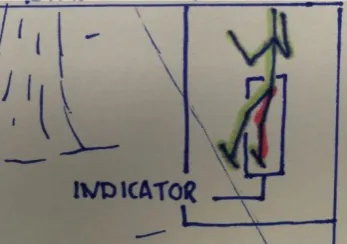
By tracking the players skeleton and displaying it in the top right corner, feedback can be given be the means of colours to show how the stance of the player is related to the optimal stance. The player will get visual feedback on what to change and what to keep. This would require a pre-programmed skeleton of a professional skier on which the skeleton of the player will be compared. . When outside the boundaries of error-acceptance it shall indicate the problem.
Gym vs Gym multiplayer (using Kinect v2 and HMD)
When having multiple devices in different gym’s a multiplayer game among all devices can be created. When standing on the portable ski slope you can see if:
• Another player in another gym is online and have the chance to invite him to a battle;
• There is a recent player which you can battle in a semi-multiplayer environment. As seen in
Figure 4.7 you can see where the opponent has skied, whilst the opponent isn’t actually skiing in real time. It will display a track of the other player on the ground.
It will mostly work on a point-based system, since you can’t measure velocity (all ski slopes go with the same speed). When wanting to use time to clear the path the best way is to link it to a Kinect for Skeleton tracking to calculate speed by correct movement. The better the movements that faster you should go.
[image:40.595.340.514.188.310.2]