http://wrap.warwick.ac.uk/
Original citation:
Eubanks, Dawn L., Murphy, Stephen T. and Mumford, Michael D.. (2010) Intuition as an influence on creative problem-solving : the effects of intuition, positive affect, and
training. Creativity Research Journal, 22 (2). pp. 170-184. doi:10.1080/10400419.2010.481513
Permanent WRAP url:
http://wrap.warwick.ac.uk/44524
Copyright and reuse:
The Warwick Research Archive Portal (WRAP) makes this work of researchers of the University of Warwick available open access under the following conditions. Copyright © and all moral rights to the version of the paper presented here belong to the individual author(s) and/or other copyright owners. To the extent reasonable and practicable the material made available in WRAP has been checked for eligibility before being made available.
Copies of full items can be used for personal research or study, educational, or not-for-profit purposes without prior permission or charge. Provided that the authors, title and full bibliographic details are credited, a hyperlink and/or URL is given for the original metadata page and the content is not changed in any way.
Publisher statement:
"This is an Accepted Manuscript of an article published by Taylor & Francis Group in Creativity Research Journal on 20/05/2010, available online:
http://www.tandfonline.com/10.1080/10400419.2010.481513
.A note on versions:
The version presented here may differ from the published version or, version of record, if you wish to cite this item you are advised to consult the publisher’s version. Please see the ‘permanent WRAP url’ above for details on accessing the published version and note that access may require a subscription.
Running Head: Intuition
Intuition as an Influence on Creative Problem-Solving:
The Effects of Intuition, Positive Affect, and Training
Dawn L. Eubanks, Stephen T. Murphy, and Michael D. Mumford
The University of Oklahoma
Running Head: Intuition
Abstract
Intuition may be a critical component of creative thought. To test this hypothesis, a measure of
individual differences in intuition was developed. After completing this measure, 320
undergraduates were asked to work on a domain relevant creative problem-solving task under
conditions where positive and neutral affect were induced and they were exposed to one of three
different types of training. It was found that intuitive people produced more creative problem
solutions, but that positive affect and training offset the advantage intuitive people showed in
creative problem-solving. The implications of these findings for understanding the nature of
Intuition as an Influence on Creative Problem-Solving:
The Effects of Intuition, Positive Affect, and Training
Creative thought is a complex, elusive, construct (Mumford & Gustafson, 1988). Over
the years, as we have made progress in our understanding of creative thought (e.g. Brophy, 1988;
Scott, Lonergan, & Mumford, 2005; Ward, Patterson, & Sifonis, 2004), scholars have begun to
ask new questions about the attributes of people that might contribute to creative problem-
solving. The attributes considered in these studies have included errors (Mumford, Blair, Dailey,
Leritz, & Osburn, 2006), mental models (Johnson-Laird, 1983), insight (Sternberg & Davidson,
1995), and intuition (Policastro, 1995). Although all of these attributes might influence creative
problem-solving, and eventual creative achievement, intuition appears to be especially important
(Bowers, 1987; Perkins, 1992).
One illustration of the potential impact of intuition on creative problem-solving and
creative achievement may be found in Gardner and Nemirovsky, (1991). They conducted an
in-depth case study of two emergent creators – Georg Cantor, a mathematician and Sigmund Freud,
a psychologist. They found that in the identification of unconscious local coherences in complex
fields, their definition of intuition was a key influence of the contributions made by both these
scholars. Other investigators, including Agor (1989), Bastick (1982), and Simonton (1980), have
all also argued that intuition may be integral to creative problem-solving in the arts, life sciences,
and management.
Although there is reason to suspect that intuition might play a critical role in creative
thought, and ultimately creative achievement, direct evidence demonstrating the impact of
intuition on creative problem-solving is not available (Shirley & Langan-Fox, 1996). Moreover,
2003; Policastro, 1995). With these points in mind, our intent in the present study was two-fold.
First, we hoped to show that intuition was related to creative problem-solving. Second, we hoped
to examine the mechanisms giving rise to intuition – specifically examining the role of positive
affect and training.
Intuition
Intuition has been defined in different ways by various investigators (Shirley &
Langan-Fox, 1996). For example, Bastrick (1982) has defined intuition as a form of foresight, or the
ability to see the end in the distance, under conditions where the individual is working on a
novel, complex, and uncertain task – the kind of task associated with creative thought (Mumford
& Gustafson, 1988). Policastro (1995) has defined intuition as a vague anticipatory perception
that orients creative work in a promising direction. Gardner and Nemirovsky (1991) see intuition
as the formation of inarticulate, or unconscious, local coherences that emerge as people begin
work on a creative problem.
Although these definitions of intuition differ from each other in some notable ways, three
key characteristics of intuitive thought are implicit in these definitions. First, intuition involves
the identification of a pattern with minimal information. Second, intuition is not necessarily
subject to conscious objective analysis. Third, intuition serves to guide work on complex tasks at
times inducing affect. Put more directly, intuition may be said to involve the formation of an
inarticulate, unconscious, pattern that guides problem-solving and decision making on complex
tasks.
When intuition is defined in this way, it becomes apparent that intuition at some level
involves implicit or tacit knowledge (Baylor, 2001; Reber, 1989; Simon, 1989). In fact, studies
tacit knowledge does give rise to intuitive behavior. Some compelling evidence pointing to the
role of knowledge, albeit unconscious inarticulate knowledge, in the identification of emergent
patterns may be found in work by Bowers and his colleagues (Bowers, 1987; Bowers, Farvolden,
& Mermigis, 1995; Bowers, Regher, Balthazard, & Parker, 1990). In these studies people were
presented with incomplete information on a series of tasks and they were asked to generate
solutions. For example, recognition of an object in a picture lacking key elements, or cues, that
would assist in guiding the formation of associations. In this series of studies, it was found that
1) people could detect coherences before having fully sufficient information and 2) people often
formed viable hypotheses before they had acquired enough information to permit generation of
the correct solution. Not only do these findings point to the relevance of unconscious pattern
recognition in intuition, these studies also indicate that people display individual differences in
their willingness to work with intuitions.
The existence of these individual differences in intuition point to the feasibility of
developing measures of intuition. Westcott developed a measure intended to capture individual
differences in intuitive ability (Westcott, 1961, 1966; Westcott & Ranzori, 1963). On this
measure people were presented with 20 analogy problems where they could request additional
information bearing on the problem. People differed in not only the number of correct answers,
but more significantly, the number of clues requested and their confidence in their solutions.
Intuitive people were held to be those who produced correct conclusions with few clues. Scores
on this measure were found to evidence adequate test-retest reliability (Westcott, 1966) and
construct validity with regard to performance on cognitive measures (Westcott & Ranzom,
intuition such as those derived from the Myers-Briggs Type Indicator (Langan-Fox & Shirley,
2003).
Although Westcott’s (1961, 1966) measure provides a plausible basis for measuring
individual differences in intuition, this measure has been criticized (Bastick, 1982). This measure
is subject to criticism because the type of problems being examined, analogy problems, have
limited relevance to real-world experience – the kind of experiences held to give rise to implicit
expertise and pattern recognition. Moreover, evidence is not available indicating that
performance on this measure is related to creative problem-solving. Assuming that the domain
relevance issue (Baer, 2003) can be addressed, one would expect that scores on the resulting
measure of intuition would be related to creative problem-solving. Hence, our first hypothesis:
Hypothesis one: Scores on a domain relevant measure of intuition will be
positively related to creative problem-solving performance within this domain.
Of course, creative problem-solving is a complex phenomenon in its own right. Besemer
and O’Quin (1999), in their examination of the attributes of creative problem solutions, found
that these solutions could be characterized in terms of three attributes – quality, originality, and
elegance. Although intuition, the emergence of unconscious patterns, can be expected to be
related to the production of creative solutions, intuition may be differentially related to these
three elements. More specifically, if intuition represents the unconscious emergence of themes or
patterns (Gardner & Nemirovsky, 1991), the tendency of people to pursue and elaborate these
patterns should give rise to solutions of relatively high elegance. As a result, a second hypothesis
seems indicated:
Hypothesis two: Individual differences in intuition within a domain will be
domain relevant creative problem-solving tasks but intuition will be more strongly
related to elegance than solution quality and originality.
Positive Affect
If intuition involves the unconscious recognition of patterns that promote creative
problem-solving, individual differences in intuitive ability within a domain may not be the only
variable influencing performance. In fact, one variable that might be of some importance in this
regard is positive affect. Positive affect is induced through a variety of manipulations – watching
films, listening to music, and the experience of success (Nummenmaa & Niemi, 2004). Isen and
her colleagues (Estrada, Isen, & Young, 1994; Isen, 1993, 2001; Nygren, Isen, Taylor, & Dulin,
1996) have conducted an extensive series of investigations examining how positive affect
influences creative thought and decision making. The findings obtained in these studies indicated
that positive affect contributes to performance on measures of creativity such as Mednick’s
(1968) remote associations test. These effects, moreover, did not appear attributable to general
motivational sets but instead how people go about problem-solving.
For example, Estrada, Isen, and Young (1994) induced positive affect in physicians
working on a diagnosis problem by providing chocolates. Subsequent comparison of doctors
who had, or had not, experienced this affect induction manipulation indicated that under
conditions of positive affect physicians were less subject to decision making errors, such as
anchoring, integrated different sources of information bearing on the disease more effectively,
and were likely to generate correct hypotheses about the nature of the disease earlier in their
problem-solving efforts.
Of course, the findings of Estrada, Isen, and Young (1994) are of interest, in part, because
recognition. In fact, Isen and Daubman (1984) and Kahn and Isen (1993) have found that under
conditions of positive affect people appear to 1) formulate patterns more readily, 2) incorporate a
wider range of material, and 3) recognize the similarities and differences among elements of this
pattern. More rapid and effective construction of patterns attributable to positive affect should, in
turn, give rise to intuitive behavior if the emergence of unconscious patterns, or themes, provides
a basis for intuition.
In the context of the present study, if positive affect leads to the emergence of viable
patterns, it can be expected to induce intuitive behavior and creative problem-solving. With the
induction of intuitive behavior, however, underlying differences across individuals in intuitive
ability will become a less important influence on performance. In contrast, intuitive ability
should exert a particularly strong influence on creative problem-solving when people are
working under conditions of neutral affect. These expected effects, in turn, led to our third
hypothesis:
Hypothesis Three: Individual differences in intuitive ability will be more strongly
related to creative problem-solving when people are working under conditions of
neutral as opposed to positive affect.
Training
Positive affect, of course, is not the only situational variable that might influence the
relationship between intuition and creative problem-solving. If people are more skilled in
recognizing and applying intuitions, or emergent patterns, one would expect that these skill
differences would moderate the relationships between intuitive grasp of a problem and
Blake (1992) have argued that training in strategies, such as relaxation and guided imagery,
might contribute to the effective application of intuition in creative thought.
Of course, training likely to encourage the effective application of intuition in creative
problem-solving should ultimately be guided by our understanding of the cognitive mechanisms
underlying intuition (Scott, Leritz, & Mumford, 2004). At least three models have been proposed
that might account for how intuition operates to influence creative problem-solving: 1)
associational models, 2) mental models, 3) fit appraisals.
Simonton (1980) has argued that the basis for intuition may arise from unconscious
associational mechanisms. Within this view, stimuli activate broader associational networks tied
to salient, affective, events (Estes, 1991). Activation of these networks may in turn give rise to
the emergence of unconscious patterns that provide a basis for intuition. Accordingly, one would
expect that strategies promoting exploration and elaboration of these networks would contribute
to the application of intuition in creative problem-solving. In contrast, Johnson-Laird (1983) has
argued that mental models, broader schematic structures, might influence intuition and creative
problem-solving. With the activation of a mental model, and perhaps analyses of this model in
relation to situational constraints, patterns should be activated. Subsequent application of these
patterns in creative problem-solving would give rise to intuition (Bonnerfon, 2004; Jansson,
1999; Perales, Catena, & Maldonado, 2004; Von Hecker, 2004). Finally, the degree of fit
between mental models and the situation at hand might give rise to identification of congruent
elements with these high fit, or congruent elements, providing a basis for the emergence of
patterns and intuition (Gresov, 1989; Mockler, 2001).
Although direct empirical evidence is lacking with regard to the application of all these
provide a plausible basis that might account for the emergence of patterns and intuitive thought.
More centrally, each of these models suggests strategies that might be used to enhance intuition.
For example, in an associational model, a broad search should contribute to innovation, while in
a fit model appraisal of element congruity to the situation at hand should prove useful.
Accordingly, it seems reasonable to expect that training in effective application of these
strategies will facilitate the application of intuitive ability in creative problem-solving (Scott,
Leritz, & Mumford, 2004). Hence, our fourth hypothesis:
Hypothesis Four:Training application of the strategies underlying the
application of emergent patterns will contribute to creative problem-solving.
The hypotheses sketched out above, in fact, point to the unique contributions of
the present study. Although extant theory, and prior historical research, suggest that
intuition contributes to creative problem-solving, evidence directly bearing on this
proposition is not available. Moreover, it seems likely that intuition will contribute to
creative problem-solving in unique ways. Specifically, intuition may be more likely to
give rise to elegant as opposed to original solutions. Not only will the present study
examine the effects of intuition on creative problem-solving, the basis of intuition on the
emergence of patterns will be assessed through both an examination of the effects of
positive affect and these alternative strategies, associational models, mental models, and
fit appraisals, that might be used to account for the emergence and application of those
patterns.
Method
Sample
psychology courses at a large southwestern university. The 126 men and 181 women (13
gender unreported) recruited to participate in this study were drawn from courses
providing extra-credit for participation in experiments. Students in these classes reviewed
available experiments listed on a website and selected the experiment they would
participate in to receive extra-credit. The average age of sample members was 19 and
most were in their sophomore year. Their academic ability, as indicated by scores on the
Scholastic Aptitude Test, lay a quarter of a standard deviation above national norms for
freshman entering four year institutions.
General Procedure
Participants were recruited to take part in an experiment that was purported to be
a study of problem-solving. During the first hour of this three hour study, participants
were asked to complete a background information form and a battery of reference
measures. These individual differences measures were intended to provide a set of
covariate controls to take into account other potential influences on creative
problem-solving. After participants had completed the background information form, affect, either
positive or neutral, was induced through music they listened to before starting work on
the reference measures and other experimental tasks. After they had completed the
reference measures, participants were asked to work through a series of self-report
instructional exercises illustrating strategies for applying intuition in creative
problem-solving based on associational models, mental models, and fit appraisals. Following
training, and induction of positive affect, participants were asked to work on a task where
intuition was to be assessed with respect to the decisions to be made in managing an
decisions, provided the basis for identifying more and less intuitive individuals. These
individuals were then asked to provide a solution to a creative problem - an idea for
establishing a new club at a university. The quality, originality, and elegance of solutions
to this problem provided the primary dependent variables used to assess the effects of
training, intuition, and positive affect on creative problem-solving.
Reference Measures
Based on the findings of Vincent, Decker, and Mumford (2002), participants were
asked to complete measures examining three cognitive capacities, divergent thinking,
expertise, and intelligence, known to influence creative problem-solving. Intelligence was
measured using an analogical reasoning test drawn from Ruch and Ruch (1980). This 30-
item test presents a series of facts where people are asked to indicate whether conclusions
drawn from these facts are true, false, or unclear. This test yields test-retest reliability
coefficients in the .80s. Evidence for the validity of this test as a measure of intelligence
has been provided by Ivancevich (1976) and Ruch and Ruch (1980).
Divergent thinking was measured using Guilford’s (Guilford & Hoepfner, 1971)
Consequences A Test. This measure of divergent thinking presents 5 questions where
people are asked to list the outcomes of unlikely events (e.g. What would happen if
gravity was cut in half?). When scored for fluency, or the number of responses generated,
this measure yields internal consistency coefficients in the high .70s. Evidence for the
construct validity of the consequences test as a measure of divergent thinking may be
obtained by consulting Merrifield, Guilford, Christensen, and Frick (1962) and Vincent,
Expertise was measured using a variation on the procedures developed by Scott,
Lonergan, and Mumford (2005). More specifically, participants were presented with 10
background data questions (Mumford, Stokes, & Owens, 1990) examining participants
exposure to and involvement with student clubs (e.g. How many clubs had they belonged
to? How often had they resolved conflicts in student groups? How many clubs had they
belonged to where they had held leadership positions?). After scaling, these questions
produced an internal consistency coefficient above .80. This experiential measure was
used to provide an assessment of prior exposure to the problem-solving task.
In addition to these cognitive measures, participants were also asked to complete
a measure of trait-based positive affect. This measure, drawn from Watson, Clark, and
Tellegen (1988), presents 20 affective descriptors (e.g. interested, excited, hostile, afraid).
Participants were asked to rate, on a 5-point scale, the extent to which these words
describing feelings and emotions characterized them over the past week. When scored for
positive and negative affect this measure yields internal consistency coefficients in the
.80s. Evidence bearing on the construct validity of this measure as an index of trait-based
affect has been provided by Watson, Clark, and Tellegen (1988).
The final measure participants were asked to complete was intended to provide an
overall assessment of personality. This measure, Goldberg’s (1992) Unipolar Measure,
provides scales for assessing neuroticism, extroversion, openness, agreeableness, and
conscientiousness. This measure presents 100 self-descriptive words (e.g. active,
agreeable, or energetic). People are asked to rate on a 9-point scale how accurate these
words are in describing them relative to peers. The resulting scales for measuring
internal consistency coefficients above .80. Evidence for the validity of these scales has
been provided by Reysen (2005), Saucier (2002), Conway and Peneno (1999), and
Becker, Billings, and Eveleth (1997).
Positive Affect
As noted earlier, intuition might also be influenced by induction of positive affect.
A number of manipulations have been used to induce positive affect relative to a neutral
affective state (Nummenmaa & Niemi, 2004). Although a number of manipulations for
induction of positive affect are available, prior studies by Kerr, Walsh, and Marshall
(2001) and Isen (1993) indicate that music can be used to induce positive affect.
Accordingly, based on the findings Silvia and Abele (2002), participants were
asked to listen to one of two instrumental pieces of music, each approximately 3 minutes
in length. In the positive affect condition participants were asked to listen for 3 minutes to
Guaraldi’s (1968) composition “Linus and Lucy”. In the neutral affect condition,
participants were asked to listen for 3 minutes to Moby’s (1995) “Hymn”. These songs
were played from a laptop computer placed at the front of the room after participants had
completed the background information form, but before they began work on reference
measures, training, and intuition measures. It is of note that evidence for the validity of
this manipulation for induction of positive and neutral affect has been provided by Silvia
and Abele (2002). This manipulation occurred early in the experiment to induce a general
set effect (Hodges, 2000).
Training
The training participants were asked to complete was based on strategies that have
appraisals in problem-solving and intuitive thinking (Scott, Leritz, & Mumford, 2004).
Initially, a review of the literature bearing on associational models (e.g. Estes, 1991;
Grim, Denis, and Kokalis, 2004; Sima, 2003; Simonton, 1980), mental models (e.g.
Burns, 2005; Jonassen, 2004; Perales, Catena, & Maldonado, 2004), and fit appraisals
(e.g. Agor, 1989; Bergeron, Raymond, & Rivard, 2004; Gresov, 1989; Mockler, 2001)
was conducted to identify candidate strategies that would contribute to the application of
each form of knowledge in intuitive thought. Based on this review, five strategies were
identified by three psychologists that might contribute to the application of each form of
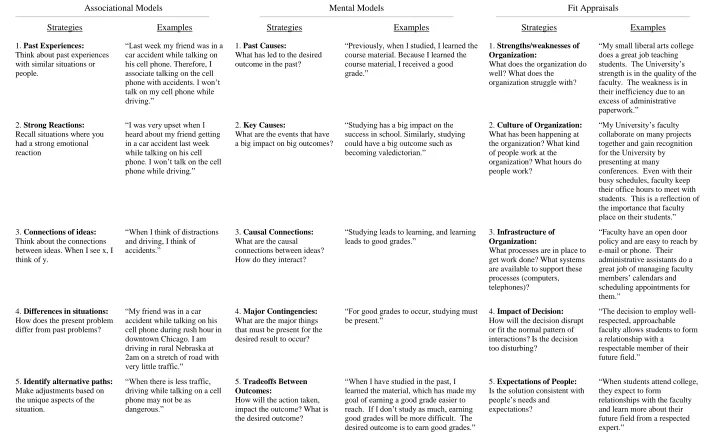
knowledge in intuitive problem-solving. The strategies identified for applying
associational models, mental models, and fit appraisals in intuitive thought are presented
in Figure 1.
---
Insert Figure 1 About Here
---
After the strategies to be trained had been identified, material for training
application of associational models, mental model, and fit appraisals in intuitive
problem-solving was developed. The instructional material provided in all conditions was based
on a self-paced format. Initially, participants were provided with a description of each
strategy and how application of this strategy might contribute to problem-solving using
day-to-day examples. Next, participants were presented with a series of three multiple
choice questions asking when and how each of these five strategies should be applied in
review the correct answers concerning strategy application, and the associated
justifications for these answers, before moving to the third, and final, section of training.
In this final section of training, participants were asked to apply these strategies in
working through a series of 15 problems involving the management of clubs in a
university setting. Across these 15 problems, 3 problems were presents for each of the 5
strategies under consideration. Each problem began by presenting a one paragraph
description of the problem that considered the context, setting, and nature of the problem.
Subsequently, participants were presented with a potential solution to this problem that
illustrated application of a particular strategy. These sample solutions described
application of the strategy in the context of the problem. After reading through a
summary statement describing the strategy, and a one paragraph illustration of how this
strategy was to be applied in the context of the problem, participants were asked to
underline the three most critical points in this solution statement. This underlining
intervention was used to help insure active processing (Chi, Bassok, Lewis, Reimann, &
Glaser, 1989) of the solution material provided. Figure 2 illustrates the nature of this
training material for application of past experiences in each of the training conditions.
---
Insert Figure 2 About Here
---
Based on this material, a training manipulation was induced. Three groups
received training – 1) one group was trained in associational model strategies, 2) one
group was trained in mental model strategies, and 3) one group was trained in fit
Intuition
Individual differences in intuitive ability were measured using a domain specific
variation on Westcott’s (1961) measure. On this measure, following training, all
participants were asked to assume the role of an individual starting a psychology club at a
university. After participants had been presented with this goal, and background
information concerning the university and the psychology department, they were
presented with a series of 20 decisions to be made about this club.
Each decision was to be based on a one paragraph description of the issue to be
addressed. These scenarios described the context surrounding the issue, the nature of the
issue, and the decision to be made. After reading through this material, participants were
asked to write out a three or four line answer to the question being asked. At the time
they began work, they were asked to record start times. After they had completed their
answer, they were asked to record end times. Figure 3 provides an illustration of one of
these decision scenarios.
---
Insert Figure 3 About Here
---
To help participants arrive at their decisions, additional resources were provided
on a page following the general scenario. These additional resources provided
information bearing on the decision. Participants were told that use of this additional
support material was “up to them”. However, if they decided to use this information, they
make their decision. Figure 4 provides an illustration of this additional material made
available to participants, in reaching their decisions.
---
Insert Figure 4 About Here
---
A panel of three psychologists reviewed each scenario. They then formulated one
good, two average, and one poor response to the problem raised in the decision scenario.
A judge, familiar with the scoring rules for each scenario, then appraised participants’
solutions. Intuition was scored based on performance across all 20 decisions where an
individual was classified as intuitive if a) they had above average standard scores for the
correctness of their decisions, b) below average standard scores for the time from when
they started until they finished making their decisions, and c) below average standard
scores for the use of additional materials. These intuition scores had a split-half reliability
of .74. Individuals were assigned to the intuitive and non-intuitive categories based on
their scores on this measure through a weighted average of correct, rapid, and use of
additional materials as reflected in their responses across the 20 decisions.
Creative Problem-Solving
To assess creative problem-solving, participants were asked to write a one to two
page plan for establishing a new club at the university. In preparing the plans for a new
club, participants were asked to describe what kind of club they would establish. They
were also asked to indicate, in preparing this plan, how they would recruit members,
These one or two page plans for a new club were presented to a panel of three
psychologists – all doctoral candidates in industrial and organizational psychology. These
judges were asked to rate the solutions provided to this problem for quality, originality,
and elegance (Besemer & O’Quin, 1999) using a variation on consensual rating technique
developed by Redmond, Mumford, and Teach (1993). Quality solutions were defined as a
logical coherent plan for a club that might prove of interest to undergraduates. Original
solutions were defined as unexpected surprising plans that might prove workable. Elegant
solutions were defined as coherent well organized plans that would have maximal impact
on the student body with minimal investment. Quality, originality, and elegance ratings
were to be made on a 5-point scale. Figure 5 provides examples of solutions receiving
high, medium, and low ratings of quality, originality, and elegance.
---
Insert Figure 5 About Here
---
Prior to making their evaluations of the quality, originality, and elegance of the
plans provided for establishing these clubs, the 3 judges were asked to participate in a 40-
hour training program. In this training, judges were familiarized with the nature of the
problem-solving task and the definitions of quality, originality, and elegance to be
applied in evaluating solutions. Subsequently, judges evaluated a set of sample plans
selected to represent varying levels of quality, originality, and elegance. In the first set of
sample products feedback was provided concerning ratings by one of the investigators.
Judges then proceeded to rate a second set of sample products. They then met and
training, the interrater agreement coefficients obtained for evaluations of plan quality,
originality, and elegance were .82, .81, and .75, respectively.
Analyses
To examine the effects of intuition, training, and positive affect on the quality,
originality, and elegance of the plans provided for new clubs, a series of analysis of
covariance tests was conducted. In these analyses, scores on the reference measures and
background information form were treated as covariate controls. The independent
variables examined included training condition, positive versus neutral affect, and
intuitive versus non-intuitive individuals to examine the effects of these variables on the
quality, originality, and elegance of solutions. It is of note that a covariate control
measure was retained only if it provided a relationship significant beyond the .05 level.
Results
Quality
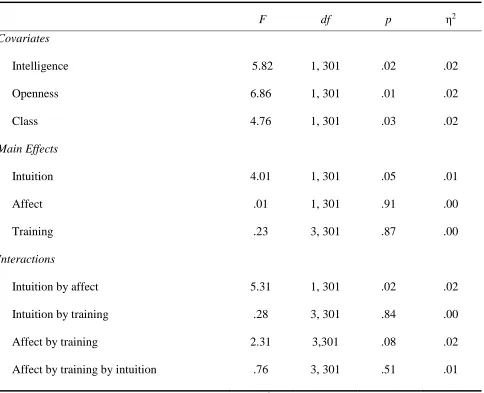
Table 1 presents the results obtained in the analysis of covariance examining the
quality of the solutions obtained on this creative problem-solving task. As might be
expected based on the findings of Vincent, Decker, and Mumford (2002), intelligence
proved to be a significant (F (1, 301) = 5.82, p < .05) covariate in accounting for solution
quality with more intelligent people producing higher quality plans for a new club.
Openness also produced a significant (F (1, 301) = 6.86, p < .01) relationship with
solution quality. In keeping with the observations of McCrae (1996), people evidencing
greater openness produced higher quality solutions on the creative problem-solving task.
Finally, class year produced a significant (F (1, 301) = 4.76, p < .05) relationship with
---
Insert Table 1 About Here
---
In accordance with our initial hypothesis that intuition, when assessed within
domain of expertise, would be related to the production of more creative solutions, a
significant (F (1, 301) = 4.01, p < .05) main effect was obtained for intuition. Intuitive
people produced higher quality solutions (M = 2.98, SE = .10) than less intuitive people
(M = 2.74, SE = .06). Apparently, intuition is related to the quality of the solutions
obtained on creative problem-solving tasks.
A significant (F (1, 301) = 5.31, p < .05) interaction was also obtained between
intuition and affect. Inspection of the relevant cell means indicated that particularly high
quality solutions were obtained from intuitive individuals in the neutral affect condition
(M = 3.11, SE = .14). However, induction of positive affect, in keeping with our earlier
hypothesis, resulted in the production of solutions of higher quality for both intuitive (M
= 2.85, SE = .14) and non-intuitive (M = 2.89, SE = .09) individuals than those that are
low intuitives in the neutral affect condition (M = 2.61, SE = .09). Therefore, it would
appear that induction of positive affect can offset the poor performance observed for
non-intuitive individuals under conditions of neutral affect. However, induction of positive
affect, perhaps by undermining critical analysis of emerging intuitions, may inhibit the
production of high quality solutions by more intuitive people.
A marginally significant (F (3, 301) = 2.31, p < .10) interaction was also obtained
between training condition and affect. When no training was provided and neutral affect
Solutions of particularly high quality (M = 3.09, SE = .16) were obtained when no
training was provided but positive affect was induced. Training in associational model
strategies (M = 2.80, SE = .18), mental model strategies (M = 2.85, SE = .16), and fit
appraisal strategies (M = 2.90, SE = .17) all produced better performance with respect to
the quality of obtained solutions vis-à-vis the no training and neutral affect condition.
These relationships held regardless of affect suggesting training may offset the
debilitative effects of no training and neutral affect. Training, however, did not result in
better performance than simply inducing positive affect – perhaps because training,
unlike positive affect, disrupted application of familiar, preferred, problem-solving
strategies.
Originality
Table 2 presents the results obtained in the analysis of covariance conducted for
solution originality. Again, intelligence proved to be a significant (F (1, 304) = 6.03, p <
.05) covariate. As might be expected, more intelligent people provided more original
solutions on this creative problem-solving task. No other covariate produced significant
relationships with solution originality.
---
Insert Table 2 About Here
---
Two marginally significant interactions were obtained, however, in accounting for
solution originality. One of these marginally significant (F (1, 304) = 3.08, p < .10)
interactions occurred between intuition and affect. In keeping with the findings obtained
obtained from non-intuitive individuals working under conditions of neutral affect.
Solutions of particularly high originality (M = 2.95, SE = .16) were obtained from
intuitive individuals working under conditions of neutral affect. More original solutions
were obtained from individuals working under conditions of positive affect regardless of
whether they were (M = 2.80, SE = .16) or were not (M = 2.83, SE = .10) intuitive relative
to people who were not intuitive working under conditions of neutral affect. Again,
however, it was found that intuitive individuals working under conditions of neutral
affect produced more original solutions.
A marginally significant interaction (F (3, 304) = 2.42, p < .10) was also obtained
between affect and training in accounting for the originality of problem solutions.
Inspection of the relevant cell means indicated that solutions of low originality (M = 2.54,
SE = .16) were obtained when no training was provided and people worked under
conditions of neutral affect while solutions of high originality (M = 3.10, SE = .18) were
obtained when no training was provided but people worked under conditions of positive
affect. Again, regardless of affective condition, training in the application of associational
model strategies (M = 2.80, SE = .20), mental model strategies (M = 2.65, SE = .18) and
fit appraisal strategies (M = 2.83, SE = .19) resulted in solutions of originality lying
between the two extremes defined by positive and neutral affect with no training.
Notably, however, somewhat less original solutions were obtained for application of
mental models suggesting that application of extant models may have limited the
generation of more original solutions.
Table 3 presents the results obtained with analysis of covariance conducted for
solution elegance. Intelligence was the only significant (F (1, 303) = 6.53, p < .01)
covariate with more intelligent people producing more elegant solutions on the creative
problem-solving task. In accordance with our second hypothesis, a strong, significant (F
(1, 303) = 7.60, p < .01) main effect was obtained for intuition. More intuitive individuals
(M = 2.71, SE = .10) produced more elegant solutions than less intuitive individuals (M =
2.40, SE = .06).
---
Insert Table 3 About Here
---
A marginally significant interaction (F (3, 303) = 2.54, p < .10) was also obtained
between affect and training. In keeping with the findings obtained for solution quality and
originality, solutions of particularly low elegance (M = 2.31, SE = .14) were obtained
from individuals working under conditions of neutral affect with no training while
solutions of much higher elegance were obtained from individuals working under
conditions of positive affect with no training (M = 2.90, SE = .16). Again, training in
strategies, regardless of affective condition, resulted in solutions of elegance lying
between these extremes regardless of whether the training focused on associational model
strategies (M = 2.53, SE = .18), mental model strategies (M = 2.55, SE = .16), or fit
appraisal strategies (M = 2.54, SE = .16). Thus training could, apparently, contribute to
the production of more elegant solutions although it did not necessarily result in solutions
Discussion
Before turning to the broader conclusions flowing from the present study, certain
limitations should be noted. To begin, the present study was based on a “classic”
experimental paradigm where intuition was studied in a cognitive framework. As a result,
the findings obtained in this effort do not speak to personality, or dispositionally, based
views of intuition (Langan-Fox & Shirley, 2003). Although this cognitive paradigm has
certain advantages, particularly with regard to demonstrating the impact of intuitive
ability on creative problem-solving, caution is nonetheless called for in generalizing our
findings to creative thought in “real-world” settings. Indeed, differences in expertise
(Weisberg, 1999) and peoples’ involvement in the creative effort (Collins & Amabile,
1999) may lead to some shifts in observed relationships. Along related lines, it should
also be recognized that the findings obtained in this study emerged as a function of a
certain pattern of manipulations. Thus, it is possible that somewhat different effects might
have been obtained if music was played throughout the study rather than just at the outset
of the study. Moreover, while assessment of intuition just prior to starting work on the
creative problem-solving task was consistent with the design of the present study, it is
also true that the effects obtained might to some extent be contingent on prior exposure to
training.
Finally, it should be recognized that we have in the present study examined only
one form of creative problem-solving – although multiple attributes of the creative
problem solutions were assessed. This observation, of course, implies that some caution
is called for in generalizing our findings to other forms of creative problems. This
such the present studies’ assessment of intuition and creative problem-solving with the
domain of school clubs. Nonetheless, the question remains as to whether our findings can
be extended to other domains.
Even bearing these caveats in mind, we believe that the results obtained in the
present study have some noteworthy implications. To begin, empirical studies directly
demonstrating the impact of intuition on creative problem-solving have not been
available (Shirley & Langan-Fox, 1996). The results obtained in the present study
indicate that a measure of intuition examining the rapid production of correct solutions to
club organizational problems was positively related to creativity when people were asked
to create new ideas for clubs. These effects, moreover, could not be attributed solely to
expertise however, important expertise may be in shaping the capacity for intuition
(Simon, 1984). Instead, intuitive ability appears to arise from the capacity to recognize
and exploit emergent patterns or themes – patterns that may not be subject to conscious
awareness (Gardner & Nemirovsky, 1991; Policastro, 1995).
The basis of cognitive intuition in the recognition and exploitation of emergent
patterns, however, has an important albeit often overlooked implication in studies of
creative problem-solving. More specifically, the recognition and exploitation of patterns
may have a rather complex set of effects on peoples’ creative problem-solving efforts.
The emergence and exploitation of patterns may, at least to some extent, contribute to
solution originality. However, inarticulate patterns based on past experience may not
necessarily give rise to the production of highly original solutions due to the demands for
active, elaborative, processing required when people generate original solutions to
the emergence of these patterns may give rise to higher quality, and more elegant,
solutions to creative problems when these emergent patterns provide a framework for
organizing solution generation.
The results obtained in the present study, of course, provide some support for this
argument. More specifically, individual differences in intuitive ability were found to
exert stronger effects on solution elegance and solution quality than solution originality.
By the same token, however, this pattern of findings suggests why the intense
involvement of creative intuitives, such as Freud (Gardner & Nemirovsky, 1991) may be
required. This intense engagement may serve as a compensatory mechanism contributing
to the production of more original solutions.
The generation of creative problem solutions as a result of intuition, however,
may not be solely a matter of the intuitive ability of individuals. Earlier, we argued that
due to its effects on pattern formation and pattern recognition (Estrada, Isen, & Young,
1994; Kahn & Isen, 1994) positive affect might compensate for a lack of individual
intuitive ability. In fact, the interactions obtained between intuition and affect tend to
support this proposition. Individual intuitive ability was found to be strongly related to
creative problem-solving only when people were working under affectively neutral
conditions. Induction of positive affect appeared to remove this advantage with both
intuitive and non-intuitive people performing well. Thus it appears that positive affect
may substitute for intuitive ability in guiding creative problem-solving at least on the
kind of creative problem-solving task under consideration in the present study.
These observations are noteworthy for two reasons. First, they bring to the fore
compensate for a lack of intuitive ability. For example, it is possible that forecasting and
planning might operate in a similar fashion (Mumford, Schultz, & Van Dorn, 2001).
Second, these findings suggest a need for research examining the role of positive affect in
shaping the emergence of patterns – both the emergence of, and people’s willingness to
work with, patterns on complex, creative, problem-solving tasks.
These observations about the mechanisms by which positive affect compensates
for individual intuitive ability bring us to the effectiveness of the training interventions.
The findings obtained in the present study indicate that training, regardless of affective
state, led to improved creative problem-solving performance. However, training did not
result in a better performance than inducing positive affect without training. This pattern
of findings is consistent with the notion that training, at least initial training, may disrupt
the application of well practiced problem-solving strategies. It suggests, moreover, that
positive affect may also trigger more effective strategy application as well as pattern
recognition.
More centrally, however, the strategy training provided examined three key
explanatory systems that have been used to explain the emergence of intuition. More
specifically, training was based on strategies derived from associational models, mental
models, and fit appraisal theory. The finding that all three types of training appeared to
work in a comparable fashion, with the exception of mental models in the generation of
original solutions, suggests that all three of these systems represent plausible explanations
for intuition.
Of course, it is possible that all three forms of training improved creative
be completely ruled out by the results obtained in the present study, two considerations
argue against this interpretation. First, the training provided did not give people
experience in applying in creative problem-solving strategies as is the case in most
creativity training interventions (Scott, Leritz, & Mumford, 2004). Second, the nature of
the training provided was strategy application in the articulation of emergent patterns.
As a result, it seems plausible to assume that these three training interventions all
may have contributed to the acquisition of intuition. If this is in fact the case, and this
argument is confirmed by future research, it suggests that intuition may be a highly
complex cognitive phenomenon with intuitions potentially arising from multiple
underlying systems. Hopefully future research will demonstrate not only the potential
operation of these multiple systems but will examine interactions among these systems as
they give rise to emergent patterns and the intuitions held to be critical to creative
thought.
Nonetheless, the findings obtained in the present study point to a stronger, less
ambiguous, conclusion. More specifically, intuition clearly contributes to creative
problem-solving. The nature of those contributions, however, suggests that intuition
vis-à-vis pattern emergence may contribute more to the production of high quality and
elegant solutions than original solutions. Given the role of emergent patterns in intuition,
this pattern of findings is not surprising. However, it opens up questions about when and
how intuition contributes to creative work, questions that should be investigated, along
References
Agor, W. H. (1989). The intuitive ability of executives. In W. H. Agor (Ed.), Intuition in
organizations: Leading and managing productively (pp. 145-170). Thousand Oaks, CA:
Sage Publications Inc.
Baer, J. (2003). Evaluative thinking, creativity, and task specificity: Separating wheat from
chaff is not the same as finding needle in haystacks. In M. A. Runco (Ed.), Critical
Creative Processes (pp.129-152). Cresskill, NJ: Hampton.
Bastick, T. (1982). Intuition: How we think and act. Bath: John Wiley & Sons.
Baughman, W. A., & Mumford, M. D. (1995). Process analytic models of creative capacities:
Operations involved in the combination and reorganization process. Creativity Research
Journal, 8, 37-62.
Baylor, A. L. (2001). A U-shaped model for the development of intuition by level of expertise.
New Ideas in Psychology, 19, 237-244.
Becker, T. E., Billings, R. S. & Eveleth, D. M. (1997). Validity of scores on three attachment
style scales: Exploratory and confirmatory evidence. Educational and Psychological
Measurement, 57, 477-493.
Bergeron, F., Raymond, L., & Rivard, S. (2004). Ideal patterns of strategic alignment and
business performance. Information and Management, 41, 1003-1020.
Besemer, S. P. & O’Quin, K. (1999). Confirming the three-factor creative product analysis
matrix model in an American sample. Creativity Research Journal, 12, 287-296.
Bonnefon, J. F. (2004). Reinstatement, floating conclusions, and the credulity of mental model
Bowers, K. S. (1987). Intuition and discovery. In R. Stern (Ed.), Theories of the unconscious
and theories of the self (pp. 71-90). Hillsdale, NJ: Analytic Press, Inc.
Bowers, K. S., Regehr, G., Balthazard, C., & Parker, K. (1990). Intuition in the context of
discovery. Cognitive Psychology, 22, 72-110.
Bowers, S., Farvolden, P., & Mermigis, L. (1995). Intuitive antecedents of insight. In S. M.
Smith & T. B. Ward (Eds.), Creative cognition approach (pp. 27-51). Cambridge, MA:
The MIT Press.
Brophy, D. R. (1998). Understanding, measuring, and enhancing individual creative
problem-solving efforts. Creativity Research Journal, 11, 123-150.
Burns, K. (2005). Mental models and normal errors. In H. Montgomery & R. Lipshitz (Eds.)
How professionals make decisions. (pp. 23-28). Mahwah, NJ: Lawrence Erlbaum
Associates.
Chi, M. T., Bassok, M., Lewis, M. W., Reimann, P., & Glasen, (1989). Self-explanations: How
students study and use examples in learning to solve problems. Cognitive Science, 13,
145-182.
Collins, M. A., & Amabile, T. M. (1999). Motivation and creativity. In R. J. Sternberg (Ed.),
Handbook of creativity (pp. 297-312). Cambridge, England: Cambridge University
Press.
Conway, J. M. & Peneno, G. M. (1999). Comparing structured interview question types:
Construct validity and applicant reactions. Journal of Business and Psychology, 13,
485-506.
Estes, W. K. (1991). Cognitive architectures from the standpoint of an experimental
Estrada, C. A., Isen, A. M. & Young, M. J. (1994). Positive affect improves creative problem
solving and influences reported source of practice satisfaction in physicians. Motivation
and Emotion, 18, 285-299.
Finke, R. A., Ward, T. B., & Smith, S. M. (1992). Creative cognition: Theory, research, and
applications. Cambridge, MA: The MIT Press.
Gardner, H. & Nemirovsky, R. (1991). From private intuitions to public symbol systems: An
examination of the creative process in Georg Cantor and Sigmund Freud. Creativity
Research Journal, 4, 1-21.
Goldberg, L. R. (1992). The development of markers for the Big-Five factor structure.
Psychological Assessment, 4, 26-42.
Gresov, C. (1989). Exploring fit and misfit with multiple contingencies. Administrative
Science Quarterly, 34, 431-453.
Grim, P., St. Denis, P., & Kokalis, T. (2004). Information and meaning: Use-based models in
arrays of neural nets. Minds and Machines, 14, 43-66.
Guaraldi, V. (1968). Linus and Lucy. On Oh good grief! [CD]. Burbank, CA: Warner Brothers.
Guilford, J. P. & Hoepfner, R. (1971). The analysis of intelligence. New York: McGraw-Hill.
Hodges, D. A. (2000). Implications of music and brain research. Music Educators Journal, 87,
17-22.
Isen, A. M. (1993). Positive affect and decision making. In M. Lewis & J. M. Haviland (Eds.),
Handbook of emotions (pp. 261-277). New York, NY: The Guilford Press.
Isen, A. M. (2001). An influence of positive affect on decision making in complex situations:
Theoretical issues with practical implications. Journal of Consumer Psychology, 11,
Isen, A. M. & Daubman, K. A. (1984). The influence of affect on categorization. Journal of
Personality and Social Psychology, 47, 1206-1217.
Ivancevich, J. M. (1976). Predicting job performance by the use of ability tests and studying job
satisfaction as a moderator variable. Journal of Vocational Behavior, 9, 87-97.
Jansson, A. (1999). Goal achievement and mental models in everyday decision making. In P.
Juslin & H. Montgomery (Eds.), Judgment and decision making: Neo-Brunswikian and
process-tracing approaches (pp. 23-43). Mahwah, NJ: Lawrence Erlbaum Associates.
Jonassen, D. H. (2004). Operationalizing mental models: Strategies for assessing mental models
to support meaningful learning and design – supportive learning environments.
www.ittheory.com/jonassen2.htm.
Johnson-Laird, P. N. (1983). A computational analysis of consciousness. Cognition & Brain
Theory, 6, 499-508.
Kahn, B. E., & Isen, A. M. (1993). The influence of positive affect on variety seeking among
safe, enjoyable products. Journal of Consumer Research, 20, 257-270.
Kerr, T., Walsh, J., & Marshall, A. (2001). Emotional change processes in music-assisted
reframing. Journal of Music Theory, 38, 193-211.
Langan-Fox, J., & Shirley, D. A. (2003). The nature and measurement of intuition: Cognitive
and behavioral interests, personality, and experiences. Creativity Research Journal, 15,
207-222.
Markley, O. W. (1988). Using depth intuition in creative problem solving and strategic
innovation. Journal of Creative Behavior, 22, 85-100.
McCrae, R. R. (1996). Social consequences of experiential openness. Psychological Bulletin,
Mednick, S. A. (1968). The remote associates test. Journal of Creative Behavior, 2, 213-214.
Merrifield, P. R., Guilford, J. P., Christensen, P. R., & Frick, J. W. (1962). The role of
intellectual factors in problem solving. Psychological Monographs, 76, 1-21.
Moby’s (1995). Hymn. On Everything is wrong [CD]. New York: Elektra.
Mockler, R. J. (2001). Making decisions on enterprise-wide strategic alignment in multinational
alliances. Management Decision, 39, 90-99.
Mumford, M. D., Blair, C., Dailey, L., Leritz, L. E., & Osburn, H. K. (2006). Errors in creative
thought? Cognitive biases in a complex processing activity. Journal of Creative
Behavior, 40, 75-110.
Mumford, M. D., & Gustafson, S. B. (1988). Creativity Syndrome: Integration, application, and
innovation. Psychological Bulletin, 103, 27-43.
Mumford, M.D., Schultz, R.A., & Vandoorn, J.R. (2001). Performance in planning: Processes,
requirements, and errors. Review of General Psychology, 5, 213-240.
Mumford, M.D., Stokes, G.S., & Owens, W.A. (1990). Patterns of life history: The ecology of
human individuality. Hillsdale, NJ: Erlbaum.
Nygren, T. E., Isen, A. M., Taylor, P. J., & Dulin, J. (1996). The influence of positive affect on
the decision rule in risk situations: Focus on outcome (and especially avoidance of loss)
rather than probability. Organizational Behavior and Human Decision Processes, 66,
59-72.
Nummenmaa, L. & Niemi, P. (2004). Inducing affective states with success-failure
manipulations: A meta-analysis. Emotion, 4, 207-214.
Perales, J. C., Catena, A., & Maldonado, A. (2004). Inferring non-observed correlations from
Perkins, D. N. (1992). The topography of invention. In R. Weber & D. N. Perkins (Eds).,
Inventive minds: creativity in technology. New York: Oxford University Press.
Policastro, E. (1995). Creative intuition: An integrative review. Creativity Research Journal, 8,
99-113.
Reber, A. S. (1989). Implicit learning and tacit knowledge. Journal of Experimental
Psychology: General, 118, 219-235.
Redmond, M. R., Mumford, M. D. & Teach, R. J. (1993). Putting creativity to work: Leader
influences on subordinate creativity. Organizational Behavior and Human Decision
Processes, 55, 120-151.
Reysen, S. (2005). Construction of a New Scale: The Reysen Likability Scale. Social Behavior
and Personality, 33, 201-208.
Rockenstein, Z. (1988). Intuitive processes in executive decision making. Journal of Creative
Behavior, 22, 77-84.
Ruch, F. L., & Ruch, W. W. (1980). Employee Aptitude Survey. Los Angeles, CA:
Psychological Services.
Saucier, G. (2002). Orthogonal markers for orthogonal factors: The case of the Big Five.
Journal of Research in Personality, 36, 1-31.
Scott, G. M., Leritz, L. E., & Mumford, M. D. (2004). The effectiveness of creativity training: A
meta-analysis. Creativity Research Journal, 16, 361-388.
Scott, G. M., Lonergan, D. C., & Mumford, M. D. (2005). Conceptual combination: Alternative
knowledge structures, alternative heuristics. Creativity Research Journal, 17, 21-36.
Shirley, D. A., & Langan-Fox, J. (1996). Intuition: A review of the literature. Psychological
Silvia, P. J., & Abele, A. E. (2002). Can positive affect induce self-focused attention?
Methodological and measurement issues. Cognition and Emotion, 16, 845-853.
Sima, J. (2003). General-purpose computation with neural networks: A survey of complexity
theoretic results. Neural Computation, 15, 2727-2778.
Simon, H. A. (1989). Making management decisions: the role of intuition and emotion. In W.
H. Agor (Ed.), Leading and managing productively (pp. 23-39). Thousand Oaks, CA:
Sage Publications.
Simonton, D. K. (1980). Intuition and analysis: A predictive and explanatory model. Genetic
Psychology Monographs, 102, 3-60.
Sternberg, R. J. & Davidson, J. E. (1995). The nature of insight. Cambridge, MA: The
MIT Press.
Vincent, P. H., Decker, B. P., & Mumford, M. D. (2002). Divergent thinking, intelligence, and
expertise: a test of alternative models. Creativity Research Journal, 14, 163-178.
Von Hecker, U. (2004). Disambiguating a Mental Model: Influence of Social Context.
Psychological Record, 54, 27-43.
Ward, T. B., Patterson, M. J., & Sifonis, C. M. (2004). The role of specificity and abstraction in
creative idea generation. Creativity Research Journal, 16, 1-9.
Watson, D., Clark, L. A., & Tellegen, A. (1988). Development and validation of brief
measures of positive and negative affect: The PANAS Scales. Journal of
Personality & Social Psychology, 54, 1063-1070.
Weisberg, R. W. (1999). Creativity and knowledge: A challenge to theories. In R. J. Sternberg
(Ed.), Handbook of creativity (pp. 226-259). Cambridge, England: Cambridge
Westcott, M. R. (1961). On the measurement of intuitive leaps. Psychological Reports, 9,
267-274.
Westcott, M. R. (1966). A note on the stability of intuitive thinking. Psychological Reports, 19,
194.
Westcott, M. R., & Ranzoni, J. H. (1963). Correlates of intuitive thinking. Psychological
Reports, 12, 595-613.
Wonder, J., & Blake, J. (1992). Creativity east and west: Intuition vs. logic? Journal of
Table 1: Results of Analysis of Covariance for Solution Quality
F df p η2
Covariates
Intelligence 5.82 1, 301 .02 .02
Openness 6.86 1, 301 .01 .02
Class 4.76 1, 301 .03 .02
Main Effects
Intuition 4.01 1, 301 .05 .01
Affect .01 1, 301 .91 .00
Training .23 3, 301 .87 .00
Interactions
Intuition by affect 5.31 1, 301 .02 .02
Intuition by training .28 3, 301 .84 .00
Affect by training 2.31 3,301 .08 .02
Affect by training by intuition .76 3, 301 .51 .01
Table 2: Results of Analysis of Covariance for Solution Originality
F df p η2
Covariates
Intelligence 6.03 1, 304 .02 .02
Main Effects
Intuition 2.46 1, 304 .12 .01
Affect .36 1, 304 .54 .00
Training .41 3, 304 .74 .00
Interactions
Intuition by affect 3.08 1, 304 .08 .01
Intuition by training .71 3, 304 .54 .01
Affect by training 2.42 3, 304 .07 .02
Affect by training by intuition 1.50 3, 304 .21 .02
Table 3: Results of Analysis of Covariance for Solution Elegance
F df p η2
Covariates
Intelligence 6.53 1, 303 .01 .02
Main Effects
Intuition 7.60 1, 303 .01 .02
Affect .55 1, 303 .46 .00
Training .08 3, 303 .97 .00
Interactions
Intuition by affect 2.53 1, 303 .11 .01
Intuition by training .10 3, 303 .96 .00
Affect by training 2.54 3, 303 .06 .03
Affect by training by intuition 1.46 3, 303 .23 .01
Figure 1: Strategies Being Trained Associational Models _________________________________________________________________________________________________ Mental Models _________________________________________________________________________________________________ Fit Appraisals _________________________________________________________________________________________________
Strategies Examples Strategies Examples Strategies Examples
1. Past Experiences: Think about past experiences with similar situations or people.
“Last week my friend was in a car accident while talking on his cell phone. Therefore, I associate talking on the cell phone with accidents. I won’t talk on my cell phone while driving.”
1. Past Causes:
What has led to the desired outcome in the past?
“Previously, when I studied, I learned the course material. Because I learned the course material, I received a good grade.”
1. Strengths/weaknesses of Organization:
What does the organization do well? What does the organization struggle with?
“My small liberal arts college does a great job teaching students. The University’s strength is in the quality of the faculty. The weakness is in their inefficiency due to an excess of administrative paperwork.”
2. Strong Reactions: Recall situations where you had a strong emotional reaction
“I was very upset when I heard about my friend getting in a car accident last week while talking on his cell phone. I won’t talk on the cell phone while driving.”
2. Key Causes:
What are the events that have a big impact on big outcomes?
“Studying has a big impact on the success in school. Similarly, studying could have a big outcome such as becoming valedictorian.”
2. Culture of Organization: What has been happening at the organization? What kind of people work at the organization? What hours do people work?
“My University’s faculty collaborate on many projects together and gain recognition for the University by presenting at many conferences. Even with their busy schedules, faculty keep their office hours to meet with students. This is a reflection of the importance that faculty place on their students.”
3. Connections of ideas: Think about the connections between ideas. When I see x, I think of y.
“When I think of distractions and driving, I think of accidents.”
3. Causal Connections: What are the causal connections between ideas? How do they interact?
“Studying leads to learning, and learning
leads to good grades.” 3. Infrastructure of Organization: What processes are in place to get work done? What systems are available to support these processes (computers, telephones)?
“Faculty have an open door policy and are easy to reach by e-mail or phone. Their administrative assistants do a great job of managing faculty members’ calendars and scheduling appointments for them.”
4. Differences in situations: How does the present problem differ from past problems?
“My friend was in a car accident while talking on his cell phone during rush hour in downtown Chicago. I am driving in rural Nebraska at 2am on a stretch of road with very little traffic.”
4. Major Contingencies: What are the major things that must be present for the desired result to occur?
“For good grades to occur, studying must
be present.” 4. Impact of Decision: How will the decision disrupt or fit the normal pattern of interactions? Is the decision too disturbing?
“The decision to employ well-respected, approachable faculty allows students to form a relationship with a
respectable member of their future field.”
5. Identify alternative paths: Make adjustments based on the unique aspects of the situation.
“When there is less traffic, driving while talking on a cell phone may not be as dangerous.”
5. Tradeoffs Between Outcomes:
How will the action taken, impact the outcome? What is the desired outcome?
“When I have studied in the past, I learned the material, which has made my goal of earning a good grade easier to reach. If I don’t study as much, earning good grades will be more difficult. The desired outcome is to earn good grades.”
5. Expectations of People: Is the solution consistent with people’s needs and
expectations?
“When students attend college, they expect to form