Available online on 15.05.2019 at http://jddtonline.info
Journal of Drug Delivery and Therapeutics
Open Access to Pharmaceutical and Medical Research© 2011-18, publisher and licensee JDDT, This is an Open Access article which permits unrestricted non-commercial use, provided the original work is properly cited
Open Access
Review Article
Solid Lipid Nanoparticles: A Review
Prashant Patil
1, Komal Harak*
1and Ravindra Saudagar
21 Department of Pharmaceutics, R. G. Sapkal college of pharmacy, Anjaneri, Nashik- 422213, Maharashtra, India.
2 Department of Pharmaceutical Chemistry, R.G. Sapkal College of Pharmacy, Anjaneri, Nashik-422213, Maharashtra, India
ABSTRACT
Solid lipid nanoparticles are novel drug delivery system its to improve the solubility and bioavailability of the drug it has been proved that SLN is more effective colloidal drug delivery system because of it is more controlled and targeting properties, the SLN as colloidal drug carriers for incorporating hydrophilic or lipophilic drugs, the bioacceptable and biodegradable nature of SLN makes them less toxic as compared to polymeric nanoparticles, it has several potential applications in drug delivery, clinical medicine and research as well as in other varied science, in this present review this new approach is discussed in terms of their method of preparations, applications, advantages, characterization and other special features ,the SLN may open new therapy to treat difficult diseases like complex.
Keywords: solid lipid nanoparticles, drug released, method of preparations.
Article Info:Received 17 March 2019; Review Completed 27 April 2019; Accepted 01 May 2019; Available online 15 May 2019 Cite this article as:
Patil P, Harak K, Saudagar R,Solid Lipid Nanoparticles: A Review, Journal of Drug Delivery and Therapeutics. 2019;
9(3):525-530 http://dx.doi.org/10.22270/jddt.v9i3.2773 *Address for Correspondence:
Komal V. Harak, Department of pharmaceutics, R.G.Sapkal college of pharmacy, Anjaneri, Nashik-422213, Maharashtra, India.
INTRODUCTION
Since the beginning of 20th century, nanotechnology growing interest from the pharmaceutical technology
research group worldwide.1 pharmaceutical products. Apart
from technological benefits, the liposome as a novel carrier f ound broad attention among the public. There is quite a num ber of other formulation principles used during the last two decades, e.g. microemulsions, multiple emulsions and also so lid particles (e. g. microsponge delivery system (MDS), thalas pheres). However, none of them found a broader application due to various reasons and none of them received comparabl e attention as the liposomes. Compared to liposomes and em ulsions, solid particles possess some advantages, e.g. protecti
on of incorporated active compounds against chemical. 2
Approximately 40% of commercialized drugs are poorly water-soluble, making it difficult to obtain adequate and reproducible drug absorption from the gastrointestinal
tract.3. SLN possesses advantages over other colloidal
delivery systems of increased physical stability, high drug payload and absence of carrier biotoxicity. The preparation of SLN can also be extrapolated to large scale production. The methods viz., high pressure homogenization, solvent
evaporation, solvent emulsification, ultrasonication etc.4
Drug and gene delivery, production of improved biocompatible materials and in vitro and in vivo diagnostics
are examples of nanotechnology application.5 Penetrability
through several anatomical barriers, sustained release of their contents and their stability in nanometer size are the dependent barriers for the successful implementation of nanoparticles for drug delivery.6
SLN are aqueous colloidal dispersion, the matrix of which comprises of solid biodegradable lipids.SLN formulations for various application routes (oral, deramal, parantral, rectal, ocular, pulmonary) have been developed and thoroughly characterized in- vitro and in -vivo.
Table 1: List of excipients used in SLN8
Lipids Surfactants
Triaglycerides Tricaprin Trilaurin
Trimyristin(Dynasan 114) Tripalmitin(Dynasan 116) Triasterin(Dynasan 118)
Hydrogenated coco-glycerides(softisano 142)
Phospolipids
Soy lecithin ( Lipoid 0 S 75, Lipoid 0 S 100) Egg lecithin (Lipoid E 80)
Phosphatidylcholine (Epilcuron 170, Epilcuron 200)
Hard fat types Ethylene oxide/propylene oxide copolymers
Witepsol 0 H 35 Witepsol 0 W 35 Witepsol 0 H 35 Witepsol 0 E 35 Acyl glycerols
Glyceryl monostearate (imvitor 0900) Glyceryl distearate (precirol)
Glyceryl momooleate (peceol)
Glyceryl behenate (compritol 0888 ATO) Glyceryl palmitostearate (precirol 0 ATO5)
Poloxamer 188 Poloxamer 182 Poloxamer 407 Poloxamer 908
Waxes Bile salts
Cetyl palmitate Fatty acid Stearic acid Palmitic acid Dicanoic acid Behenoic acid Acidan N12
Sodium cholate Sodium glycocholate Sodium taurocholate Sodium taurodeoxycholate
Cyclic complexes Alcohols
Cyclodextrin Ethanol, Methanol, Butanol, Butyric acid, Dioctyl sodium
sulfosuccinate, Monooctayl phosphoric acid sodium
Advantages of SLN:
1. Site-specific targeting achieved by attaching targeting
ligands to surface of particles.8
2. SLNs have better stability compared to liposomes.
3. High concentration of functional compound achieved. 7
4. Site specific delivery of drugs, enhanced drug penetration into the skin via dermal application.
5. Possibility of controlled drug release and drug targeting. 6. Protection of chemically labile agents from degradation in
the gut and sensitive molecules from outer environment.3
7. In SLNs the lipid matrix is made from physiological lipid which decreases the danger of acute and chronic toxicity. 8. Very high long-term stability.
9. It is easy to manufacture than bipolymeric nanoparticles. 10. Better control over release kinetics of encapsulated
compound.4
11. Improve stability of pharmaceuticals.
12.High and enhanced drug content (compared to other carriers).
13.Feasibilities of carrying both lipophilic and hydrophilic drugs13
Disadvantages of SLN:
1. Poor drug loading capacity.
2. Drug expulsion after polymeric transition during storage.
3. Relatively high water content of the dispersions
(70-99.9%).11
4. Particle-particle aggregation due to small size and large surface area.
5. Difficult in physical handling.
6. Limited drug loading and burst release.8
7. Unexpected polymeric transitions dynamics.
Drug release from SLN:
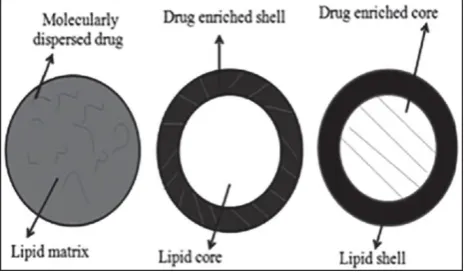
There are mainly 3 types of drug incorporated models which are describe the incorporation of drug in to SLN
1. Homogenous matrix model.
Crystallinity behavior of the lipid and high mobility of the drug lead to fast drug release. Crystallization degree and mobility of drug are inversely proportional to each other. Slow drug release can be achieved when drug is homogenously dispersed in the lipid matrix. It depends on the type and the drug entrapment model of SLN.
Higher surface area due to smaller particle size in the nanometer size range gives higher drug release.
METHODS OF PREPARATIONS
There many methods for the preparation of lipid nanoparticulate DDS. The method used is dictated by the type of drug especially its solubility and stability, the lipid matrix, route of administration, etc.
1. High Pressure Homogenization Technique A. High pressure homogenization technique B. Cold homogenization technique
2. Supercritical fluid technique
3. Solvent emulsification –diffusion technique 4. Emulsification solvent evaporation technique 5. Microemulsion based technique
6. Ultrasonication/high speed homogenization technique A. Probe ultrasonication technique
B. Bath ultrasonication technique 7. Precipitation technique
8. Double emulsion technique 9. Solvent injection technique 10. Membrane contractor technique 11. Spray drying technique
1. High Pressure Homogenization technique:
High pressure homogenization has been used as a reliable and powerful technique for the large-scale production of NLCs, lipid drug conjugate, SLNs, and parenteral emulsions. In High Pressure Homogenization technique lipid are pushed with high pressure (100-200bars) through a narrow gap of few micron ranges. So shear stress and cavitation are the forces which cause the disruption of particle to submicron range. Normally the lipid contents are in the range of 5-10%. In contrast to other preparation technique High Pressure Homogenization does not show scaling up problem. Two approaches for production by high pressure homogenization,
hot and cold homogenization techniques 27. For both the
techniques drug is dissolved in the lipid being melted at
approximately 510º C above the melting point. 8
A. Hot homogenization technique:
Hot homogenization is carried out at temperatures above the melting point of the lipid and can therefore be regarded as the homogenization of an emulsion. A preemulsion of the drug loaded lipid melt and the aqueous emulsifier phase (same temperature) is obtained by high shear mixing device (Ultra-Turrax). The quality of the final product is affected by the quality of pre-emulsion to a large extent and it is desirable to obtain droplets in the size range of a few micrometers. In general, higher temperatures result in lower particle sizes due to the decreased viscosity of the inner phase.[8] However, high temperatures also accelerate the degradation rate of the drug and the carrier. The
homogenization step can be repeated several times. It should always be kept in mind, that high pressure homogenization increases the temperature of the sample (approximately 10°C for 500 bar). In most cases, 3–5 homogenization cycles at 500– 1500 bar are sufficient. Increasing the homogenization pressure or the number of cycles often results in an increase of the particle size due to particle coalescence which occurs as a result high kinetic energy of the particles. The primary product is a nanoemulsion due to the liquid state of the lipid which on cooling at room temperature leads to solid particles. Due to the small particle size and the presence of emulsifiers, lipid crystallization may be highly retarded and the sample may remain as a super
cooled melt for several months.29, 30
B. Cold homogenization technique:
Cold homogenization method has been carried out to omit the following problems of the hot homogenization technique like temperature mediated drug and carrier degradation acceleration and consequently release of drug into the aqueous phase during homogenization. First stage in cold homogenization is the same with hot homogenization method but the next steps are different. The drug loaded lipid melt is cooled quickly by ice or emulsifier (e.g. PVA). Thereafter, the double emulsion was stirred and was isolated by filtration .After evaporation of organic solvent by rotary; SLNs were recovered by centrifugation at 12000 ×g for 30
min at 4°C. 8
2. Supercritical fluid technique:
Supercritical fluid has unique thermo-physical properties. As the pressure is raised, the density of the gas increases without significant increase in viscosity while the ability of the fluid to dissolve compounds also increases. A gas may have little to no ability to dissolve a compound under ambient condition can completely dissolve the compound
under high pressure in supercritical range.3 Therefore, its
solvation power is altered by careful control of changes in temperature and pressure. Many gases like, CO2, ammonia, ethane and CH2FCF3 were tried, but CO2 is the best option for SCF technique because, it is generally regarded as safe, easily accessible critical point [31.5ºC, 75.8 bar), does not causes the oxidation of drug material, leaves no traces behind after the process, is inexpensive, noninflammable, environmentally acceptable an easy to recycle or to dispose off. In the SCF phase or this technique generally use organic solvents (e.g. DMSO, DMFA) because they are fully miscible in SCF-CO2. This technology comprises several processes for nanoparticles production such as rapid expansion of supercritical solution (RESS), particles from gas saturated solution(PGSS), gas/supercritical anti-solvent (GAS/SAS), aerosol solvent extraction solvent (ASES), solution enhanced dispersion by supercritical fluid (SEDS),supercritical fluid extraction of emulsions (SFEE). Mainly SAS and PGSS were
used for SLN preparation. 7,2
3. Solvent emulsification-diffusion technique:
In solvent emulsification-diffusion technique, the solvent used (e.g. benzyl alcohol, butyl lactate, ethyl acetate, isopropyl acetate, methyl acetate) must be partially miscible with water and this technique can be carried out either in aqueous phase or in oil. Initially, both the solvent and water were mutually saturated in order to ensure the initial thermodynamic equilibrium of both liquid. When heating is required to solubilize the lipid, the saturation step was
performed at that temperature.3 Then the lipid and drug
using mechanical stirrer. After the formation of o/w emulsion, water (dilution medium) in typical ratio ranges from 1:5 to 1:10, were added to the system in order to allow solvent diffusion into the continuous phase, thus forming aggregation of the lipid in the nanoparticles. Here the both the phase were maintain at same elevated temperature and
the diffusion step was performed either at room temperature or at the temperature under which the lipid was dissolved. Throughout the process constant stirring was maintained. Finally, the diffused solvent was eliminated by vacuum
distillation or lyophilization. 7,3
4. Emulsification solvent evaporation technique:
Emulsification solvent evaporation for the production of nanoparticle dispersions by precipitation in o/w emulsions, the lipophilic material is dissolved in water-immiscible organic solvent (cyclohexane) that is emulsified in an aqueous phase (Sjostrom et al., 1992). Upon evaporation of the solvent nanoparticle dispersion is formed by precipitation of the lipid in the aqueous medium. The mean diameter of the obtained particles was 25 nm with cholesterol acetate as model drug and lecithin/sodium glycocholate blend as emulsifier. The reproducibility of the result was confirmed by Siekmann and Westesen (1996), who produced the cholesterol acetate nanoparticles of mean
size 29 nm.7
5. Microemulsion based technique:
This method is based on the dilution of microemulsions. As micro-emulsions are two-phase systems composed of an inner and outer phase (e.g. o/w microemulsion). They are made by stirring an optically transparent mixture at 65-70°C, which typically composed of a low melting fatty acid (e.g. stearic acid), an emulsifier (e.g. polysorbate 20), co-emulsifiers (e.g. butanol) and water. The hot microemulsion is dispersed in cold water (23°C) under stirring. SLN dispersion can be used as granulation fluid for transferring in to solid product (tablets, pellets) by granulation process, but in case of low particle content too much of water needs
to be removed. High-temperature gradients facilitate rapid lipid crystallization and prevent aggregation. Due to the dilution step; achievable lipid contents are considerably lower compared with the High pressure homogenization
based formulations.32,8
6. Ultrasonication/high speed homogenization technique:
The lipid and drug are added to suitable organic solutions, and after decompression, rotation and evaporation of the organic solutions, a lipid film is formed. The aqueous solution containing emulsifier is then added to lipid film and, using probe sonication, SLNs are formed. Oleanolic acid SLNs have been produced using soybean phospholipid as a carrier
using the film-ultrasound technique. 13,9
7. Precipitation technique:
Solid lipid nanoparticles can also be produced by a precipitation method which is characterized by the need for solvents. The glycerides will be dissolved in an organic solvent (e.g. chloroform) and the solution will be emulsified in an aqueous phase. After evaporation of the organic solvent
the lipid will be precipitated forming nanoparticles.1, 5.
8. Double emulsion technique:
In double emulsion technique the drug (mainly hydrophilic drugs) was dissolved in aqueous solution, and then was emulsified in melted lipid. This primary emulsion was stabilized by adding stabilizer (e.g. gelatin, poloxamer-407). Then this stabilized primary emulsion was dispersed in aqueous phase containing hydrophilic emulsifier (e.g. PVA). Thereafter, the double emulsion was stirred and was isolated by filtration. Double emulsion technique avoids the necessity to melt the lipid for the preparation of peptide-loaded lipid nanoparticles and the surface of the nanoparticles could be modified in order to sterically stabilize them by means of the incorporation of a lipid/-PEG derivative. Sterical stabilization significantly improved the resistance of these colloidal
systems in the gastrointestinal fluids 10. This technique is
9. Solvent injection technique:
Technique in which a solvent that distributes very rapidly in
water (DMSO, ethanol) is used 35. First the lipid is dissolved
in the solvent and then it is quickly injected into an aqueous solution of surfactants through an injection needle. The solvent migrates rapidly in the water and lipid particles precipitate in the aqueous solution. As shown in Figure 6 schematic overview of Solvent injection method. Particle size depends on the velocity of distribution processes. Higher velocity results in smaller particles. The more lipophilic solvents give larger particles which may become an issue. The method offers advantages such as low temperatures, low shear stress, easy handling and fast production process without technically sophisticated equipment (e.g. high-pressure homogeniser). However, the main disadvantage is
the use of organic solvents.10
10. Membrane contractor technique:
The membrane contactor allows one phase to be introduced through the membrane pores into another phase which flows tangentially to the membrane surface. The technique may rely on the formation of small droplets at the pore out-lets. The droplets formed are then solidified in the second phase flowing tangentially to the membrane surface. The process is similar to the “membrane emulsification” technique for which water in oil, oil in water and multi-phases emulsions have been prepared (Vladisavljević and Williams 2004). The membrane contactor method may also rely on mixing and reaction between the two phases inside the membrane device, with reactions such as polymerization and precipitation. The membrane contactor is used in a tangential configuration (one phase circulates tangentially to the membrane surface), although a frontal configuration may be chosen for membrane emulsification to prepare emulsions (Vladisavljević and Williams 2004).
11. Spray drying technique:
It is an alternative technique to lyophilization in order to transform an aqueous SLN dispersion into a drug product. This is a cost-effective method than lyophilization and recommends the use of lipid with melting point >70°C. This method causes particle aggregation due to high temperature shear forces and partial melting of the particle. According to Freitas and Mullera (1998) best results were obtained with SLN concentration of 1% in a solution of trehalose in water
or 20% trehalose in ethanol water mixtures (10/90 v/v).14
CONCLUSION
The aim has been to developed therapeutic nanotechnology undertaking, particularly for targeted drug therapy The smart NLCs as the new generation offer much more
flexibility in drug loading, modulation of release and improved performance in producing final dosage forms such as creams, tablets, capsules and injectables.
Lipid based nanocarriers have the greater importance in the developing field of nanotechnoloywith several advantages ap art from various carriers. Lipid based carriers are a promisin g nanoscaler delivery system for the pharmceutical industry due to the fact that
i. Large scale production possible, ii. No organic solvents needed
iii.High concentrations of functional compounds can be achieved
iv. Lyophilization possible.
Optimized solid lipid nanoparticle dispersions. A clear assessment of the importance of factors including the amount of stearic acid and the concentration of Tween®20 was provided by this analysis. Although this composition was the main factor influencing particle size and particle size distribution, it did not seem to affect the zeta potential. The addition of base or acid to alter the pH of the preparation before or after the process increased the particle size and zeta potential.
REFERENCES
1. Mukherjee S, Ray S, Thakur RS, Ind. J. Pharm. Sci., 2009; 349-358. 2. Jaiswal P, Kesharwani S, Kesharwani R, Patel D, Ethosome: A New
Technology Used As Topical & Transdermal Delivery System. Journal of Drug Delivery and Therapeutics, 2016; 6(3):7-17. 3. Muller RH, Mader K, Gohla S, Eur. J. Pharm. Biopharm., 2000;
50(1):161-177.
4. Souza LG, Silva EJ, Martins AL et al. Development of topotecan loaded lipid nanoparticles for chemical stabilization and prolonged release. Eur J Pharm Biopharm., 2011; 79(1):189-196. 5. Zhang C, Peng F, Jiangling WL et al. Nanostructured lipid carriers
as a novel oral delivery system for triptolide: induced changes in pharmacokinetics profile associated with reduced toxicity in male rats. Int J of Nanomedicine, 2014; 9:1049-1063. 6. Ochekpe NA, Olorunfemi PO, Ngwuluka NC. Nanotechnology and
Drug Delivery Part 2: Nanostructures for Drug Delivery. Trop J of Pharm Res., 2009; 8(3):275-287. 24
7. Wolfgang Mehnart and Karsten Mader, Adv. Drug. Deliv. Rev., 2001; 47:165-196.
8. Houli Li, Xiaobin Zhao, Yukun Ma and Guangxi Zhai, Ling Bing Li and Hong Xiang, Lou. J. Cont. Release, 2009; 133:238-244. 9. Melike Uner, Gulgun Yener, Int. J. Nanomedicine, 2007;
2(3):289-300.
10. Annette Zur Mehlen, Cora Schwarz and Wolfgang Mehnart, Eur. J. Pharm. Biopharm., 1998; 45:149-155.
11. Elena Ugazia, Roberta Cavalli and M. R. Gasco, Int. J. Pharm., 2002; 241:341-344.
12. Kaur IP, Bhandari R, Bhandari S, Kakkur. J. Cont. Rel., 2008; 127:97-109.
13. Abdelbary G, Fahmy RH, AAPS Pharm. Sci. Tech., 2009’10(1). 14. Al-Haj N, Rasedee A, Int. J. Pharmacol., 2009; 5(1):90-93. 15. Dong Zhi Hou, Chang Sheng Xie, Kaijn Huang and Chang Hong
Zhu, Biomaterials, 2003; 24:1781-1785.
16. Alessandro Bargoni, Roberto Cavalla, Otto Caputo and M. R Gasco, Pharm. Res., 1998; 15(5):745-750.
17. Milan Stuchlík and Stanislav Žák, Biomed, Papers, 2001; 145(2):17-26.
18. Olbrich C, Muller RH, Int. J. Pharm., 1999; 180:31-39. 19. Schwarz D, Mehnert W, Lucks JS, Muller RH, J. Cont. Release,
1994; 30:83-96.
20. Wei Liu, Meling Hu, Wehsuang Liu and Chengbin Xue, Huibi Xu, Int. J. Pharm., 2008; 364:141-146.
21. Chena, H., et al., "Podophyllotoxin-loaded solid lipid nanoparticles for epidermal targeting". Journal of Controlled Release, 2006; 110(2):296-306.
23. Maia C.S., Mehnert W, and Schaller M, "Drug targeting by solid lipid nanoparticles for dermal use". Journal of Drug Targeting, 2002; 10:489-495.
24. ERK N., Simultaneous determination of irbesartan and hydrochlorothiazide in human plasma by liquid
chromatography. J. Chromatogr. B., v.784, n.1, p.195201, 2003. 25. Ganapuram B.R.; Alle M.; Dadigala R.; Kotu G.M.; Guttena V.
Development, evaluation and characterization of surface solid dispersion for solubility and dispersion enhancement of irbesartan. J. Pharm. Res., 2013; 7(6):472-477.
26. Attama AA, Reichl S, Müller-Goymann CC. Diclofenac sodium delivery to the eye: in vitro evaluation of novel solid lipid nanoparticle formulation using human cornea construct. International journal of pharmaceutics. 2008; 355(12):307-313. 27. Li X, Nie Sf, Kong J, Li N, Ju CY, Pan WS. A controlled-release
ocular delivery system for ibuprofen based on nanostructured lipid carriers. Int J Pharm. 2008; 363(1-2):177-182.
28. Luo Q, Zhao J, Zhang X, Pan W. Nanostructured lipid carrier (NLC) coated with Chitosan Oligosaccharides and its potential use in ocular drug delivery system. Int J Pharm. 2011; 403(1-2):185191.
29. Vishvakrama P, Sharma S, Liposomes: An Overview. Journal of Drug Delivery and Therapeutics, 2014; 47-55.
30. Mehnert W, Mäder K. Solid lipid nanoparticles-production, characterization and applications. Advanced drug delivery reviews, 2001; 47:165–196.
31. Jawahar N, Meyyanathan SN, Reddy G, Sood S. Solid lipid nanoparticles for oral delivery of poorly soluble drugs.Journal of pharmaceutical science and research. 2012; 4(7):1848-1855. 32. Shah DP, Patel B, Shah C, Nanosuspension technology: A
innovative slant for drug delivery system and permeability enhancer for poorly water soluble drugs, Journal of Drug Delivery and Therapeutics, 2015; 5(1):10-23