
Stage Maturity Model of m-Government
(SMM m-Gov)
Improving e-Government performance by utilizing
m-Government features
MASTER THESIS
Business Information Technology
iii |
Eyla Alivia Maranny
S1018396
29th June, 2011
Master of Science in Business Information Technology
University of Twente
School of Management and Governance
Email: [email protected]
Graduation Committee:
dr. ir. Ton Spil dr. Maya Daneva
School of Management and Governance Faculty of Electrical Engineering, Mathematics Department of Information Systems and and Computer Science – Information System
Change Management Groups
University of Twente, University of Twente,
v |
Management Summary
As the need of the government for improving transparency and accountability in various government services, the government is aware of the imperative of using ICT to support the interaction between government and citizens concurrently with other government initiatives. The government started to invest huge capital into infrastructure when they started the e-government project and gradually shifting from traditional interactions to provision of e-services.
The deployment of e-Government is expected to improve the quality of service and reducing time delivery to the citizens. As the availability of multi channeling services as well as high penetration of mobile devices in developing countries , the use of mobile technologies is consider to be comprehensive way to helps government accelerate their performance, as an addition to e-government, known as mobile government.
Objective
In this thesis, we propose a stage maturity model of m-Government (SMM m-Gov) to measures the performance of m-Government implementation as a complementary of e-Government to provide better performances of the government to deliver services to citizens. With the stage maturity model, the government can assess in which level are their position in current situation and how to go to the next level of maturity.
Methodology
SMM m-Gov was designed based on exploratory literature studies and theoretical analysis. Qualitative meta-synthesis method is used and validated with experts that are active in the field of e-Government. The model applied within case studies together with the maturity assessment tool to determine its applicability in real-life context.
Main Conclusions of SMM m-Gov
vi | them.
- The SMM m-Gov addresses the m-Government maturity aspects in order to improve e-Government services by utilizing m-Government features, but the model also can be used in e-Government development, not limited to m-Government areas.
- The SMM m-Gov is a generic model and can be used in other developing countries, and can be adjusted to the needs and priorities of the government/organizations.
vii |
Acknowledgements
This thesis is the end product of my whole master study – Business Information Technology – that I followed at the University of Twente. Six months ago, I started this research project and I would say, is the most challenging and exciting time of my study, yet enhancing my knowledge and personal development. It is almost two years of my stay in The Netherlands and I am happy that I accomplishing my study earlier than what I expected. Thus, let me take this opportunity to acknowledge to all of you whose support, encourage and gave me inspiration throughout the whole years.
First of all, I would like to give thanks to God Almighty for his faithful love and protection. I would also like to give my deep gratitude to Ministry of Communication and Information Technology – Republic Indonesia and Nuffic Neso Indonesia for the scholarship given and opportunities to have these challenging experiences.
My sincere thanks to my supervisors: dr.ir. Ton Spil for his explanations of the concepts, valuable insights and professional comments, kept me in the right track and stay focused but also gave me a freedom. To my second supervisors, dr. Maya Daneva, for her great supports, critical views and spirit to motivated me to keep on improving my report, also for the nice afternoon-talk outside the research area. I would not have been able to finish this thesis project without all of your supports. I would also like to thanks dr. Diego Navarra and Prof. Jan Van Dijk for gave me valuable insight and input particularly about e-Government.
Thirdly, I would like to thanks my parents, families and the loved ones who always supported me whenever and wherever I am. Thanks to my lovely mom for always believe in me.
Fourth, I would like to thanks all the people here, who made me enjoying day by day and gave new colors in my life. My closest and lovely friend: Andra Balmus, who always supporting me and being sweet all the time. Michelle, Felix, Mario, who often be my team-mates. Big thanks to my flatmates: Nida, Nisa and Ema for all the cooking, cleaning, laughing, and shopping time. Not to forget to all big families of PPIE that I could not mentioned here one by one.
Finally, I hope you will enjoy reading and be able to take valuable insight. Please do not hesitate to contact me if you have further questions or feedback regarding this research.
~Eyla~
ix |
Table of Content
Management Summary ... v
Acknowledgements ... vii
Table of Content ... ix
List of Figure ... xii
List of Tables ...xiii
List of Abbreviations ... xiv
PART I: BACKGROUND ... 1
1 Introduction ... 3
1.1 Problem Statement ... 3
1.2 Research Goal ... 5
1.3 Research Questions ... 5
1.4 Research Methodology ... 6
1.5 Thesis Structure ... 8
2 Theoretical Foundations ... 11
2.1 E-Government ... 11
2.1.1 What is e-Government? ... 11
2.1.2 Types of e-Government Services ... 12
2.1.3 E-Government in Indonesia ... 13
2.2 M-Government ... 14
2.2.1 From E-Government to M-Government ... 15
2.2.2 Why M-Government ... 16
2.2.3 M-Government Challenges ... 17
2.3 Maturity Model ... 18
2.4 Summary ... 19
3 Related Work ... 21
3.1 E-Government Maturity Model ... 21
3.2 Reflections of the e-Government Maturity Model ... 22
3.3 M-Government Maturity Model ... 22
3.4 Summary ... 23
PART II: SOLUTION ... 25
4 M-Government Stage Model Development Process ... 27
4.1 Qualitative meta-synthesis (meta-ethnography) methodology ... 27
4.2 Result of Meta-synthesis of the stage model ... 29
4.2.1 Studies reviewed ... 29
4.2.2 Comparing the stages ... 31
4.2.3 Translating the studies - identifying underlying concepts ... 33
x |
5 SMM m-Gov Domains ... 37
5.1 Mobile Government Development Approach ... 37
5.1.1 Indonesia’s context ... 37
5.1.2 General Context ... 39
5.2 Model’s maturity aspects/domains ... 43
5.3 Validation processes ... 43
5.4 Validation results ... 44
5.5 Summary ... 46
6 Stage Maturity Model of Mobile Government (SMM m-Gov) ... 47
6.1 SMM m-Gov initial Model ... 47
6.2 Maturity Stages of SMM m-Gov ... 49
6.2.1 Stage 1: Initial Phase - Information Publishing ... 49
6.2.2 Stage 2: Enhance Phase - Interaction... 49
6.2.3 Stage 3: Reforming Phase - Transaction ... 50
6.2.4 Stage 4: Enrichment Phase - Fully Integration ... 50
6.2.5 Stage 5: Governance Phase -Transformation and Participation ... 51
6.3 Maturity Domains of SMM m-Gov ... 51
6.3.1 Technology Infrastructure ... 52
6.3.2 Security ... 52
6.3.3 Application Services ... 53
6.3.4 Policy ... 53
6.3.5 Knowledge Management ... 54
6.3.6 Human and Organizational Factor ... 54
6.3.7 Privacy ... 55
6.3.8 User needs ... 55
6.4 Stage Maturity Model of m-Government (SMM m-Gov) ... 56
6.5 Framework of e-Government and m-Government Development ... 59
PART III: EMPIRICAL RESULTS ... 61
7 Case Studies ... 63
7.1 Case Studies Method ... 63
7.2 Maturity Assessment Tools ... 64
7.3 Ministry of Communication and Information Technology ... 65
7.3.1 E-Government Program ... 65
7.3.2 Results of the Maturity Assesment ... 66
7.4 District of Sragen ... 68
7.4.1 e-Government program ... 68
7.4.2 Result of Maturity Assesment ... 69
7.5 Cross-Case Analysis ... 72
7.5.1 Technology Infrastructure ... 73
7.5.2 Security ... 73
7.5.3 Application Services ... 73
xi |
7.5.5 Knowledge Management ... 74
7.5.6 Organizational Factor ... 75
7.5.7 Privacy ... 75
7.5.8 User Needs ... 75
7.6 Summary ... 76
PART IV: CONCLUSION ... 77
8 Discussion and Future Work ... 79
8.1 Reviewing the research questions ... 79
8.2 Contributions ... 82
8.2.1 Theoretical contributions ... 82
8.2.2 Practical contributions ... 82
8.3 Recommendations ... 83
8.4 Limitations... 84
8.5 Further research ... 85
Bibliography ... 87
Appendices ... 91
Appendix A: Interview parts ... 91
Appendix B: Government Maturity Model ... 93
Appendix C: Maturity Assessment Tools ... 107
xii |
Figure 1: Research Framework ... 7
Figure 2: Outline of the Thesis ... 8
Figure 3: E-Government Maturity Model [10-12, 36-39] ... 21
Figure 4: m-Government Maturity Model [13, 28, 40] ... 23
Figure 5: Initial framework of m-Government ... 35
Figure 6: Gartner's four-stage model (cited from [50] ... 42
Figure 7: Stage Maturity Model with its Stages and Domains ... 48
Figure 8: Stage Maturity Model of m-Government ... 57
Figure 9: Framework of e-government and m-Government development ... 59
Figure 10: Result of Maturity Assessment in MCIT ... 67
Figure 11: Maturity Stages per Domains - MCIT ... 68
Figure 12: Result of Maturity Assesment in Sragen ... 70
Figure 13: Maturity Stages per Domains ... 70
Figure 14: Delloite’s six-stage model ... 94
Figure 15: UN five stages model with the number of country positions in 2001 [11] ... 95
Figure 16: : Layne and Lee’s dimensions and stages of e-Government development [10] ... 97
Figure 17: Gartner's four-stage model ... 99
Figure 18: Level of privacy concerns in e-Government stage [38] ... 101
Figure 19: M-Government Maturity Model based on Alijerban & Saghafi ... 103
xiii |
List of Tables
Table 1: literature review on government stage model……….. 30
Table 2: Comparison of stages models………. 31
Table 3: Underlying concepts of e-Government models to identify main stages……….. 33
Table 4: Synthesizing of translation………... 34
Table 5 : Initial stages in SMM m-Gov………. 35
Table 6: Initial domains in SMM m-Gov……….. 43
xiv |
ACM Association for Computing Machinery
e-Government Electronic Government
G2B Government to Business
G2C Government to Citizens
G2E Government to Employee
G2G Government to Government
GPS Global Positioning Services
ICT Information and Communication Technology
IT Information Technology
MCIT Ministry of Communication and Information Technology m-Government Mobile Government
MMs Maturity Models
PC Personal Computer
PDA Personal Digital Assistant
PI Presidential Instructions
SMSs Short Message Services
SMM m-Gov Stage Maturity Model of m-Government
PART I : BACKGROUND
1 |
2 |
~ Aim for success, not perfection. Never give up your
right to be wrong, because then you will lose the ability to
learn new things and move forward with your life.
Remember that fear always lurks behind perfectionism ~
INTRODUCTION
3 |
1
Introduction
This chapter aims to provide an introduction and background information regarding the research area. The objectives are to understand challenges and introduce ways to overcome those challenges. Section 1.1 discusses the problem statement related to the development of e government, section 1.2 presents the research goal of the thesis, section 1.3 presents the research questions, section 1.4 describes the research method used to answered the research questions and section 1.5 presents the outline of the thesis.
1.1
Problem Statement
With the growth and spread of the use of information technology in the society, changes may appear in government institution to improve services to the public. The government has realized that electronic service channels were not successful and move slowly, they are now searching for an ideal mix of channel to be able to fulfill citizens’ needs and to give citizens choices to use as many channels as possible, including the cheapest and the fastest ones. Therefore, the government needs to meet the demand and transform their activities to increase the efficiency and effectiveness as well as decreasing cost of transaction and time used. [1, 2].
In developing countries where internet access rates are low but mobile phone penetration is growing rapidly, has triggered the government to develop m-Government as an addition to e-Government [3]. The development of e-Government has begun since many years ago in many countries, some are successful, and some are still being developed, while m-Government nowadays, is in the early stage of development and may define as a new strategy to utilize all kinds of mobile devices, applications and services [4]. M-Government provides the additional features for the integration and exchange data communication, especially for the countries that have made a lot of investment in e-Government implementation. The synergy between both of them may become a new method for the interaction and communication between governments and citizens [5].
4 | their back-end processes as well as the front-end processes to be able to interact with the citizens and fulfill their needs.
Similar to other countries, the Government of Indonesia has a national strategy and policy to develop ICT and to deliver transparent and good services to the citizen. The e-Government developed with a long terms evolutionary framework over five phases. A lot of effort have been made, but the development is still in the phase 2 (presence) of the roadmap model [6] . Therefore, a new or modified strategy should be developed to accelerate the delivery of public services by various methods to greatly improve end user usability, decreasing transaction time and easy of navigation [7].
The initiative of e-Government in Indonesia has been introduced through Presidential Instruction (PI) no.6/2001 in 24 April 2001 about telematics which means that the government of Indonesia has to use Information, Communication and technology (ICT) to support good governance [8]. Moreover, e-Government is needed to support the government change towards democratic governance practice, to facilitate communication between central and local governments, to support transformation towards information society and to improve the productivity, efficiency, transparency and communication between citizens and governments.
To realize national ICT’s vision, the Government of Indonesia established The Ministry of Communication and Information Technology (MCIT) in 2001 that has several responsibilities: coordinate and formulate national policies and strategies for ICT’s development, increase the use of ICTs in people’s activities and supervise the implementation of the national ICTs policy and development in Indonesia. MCIT is formally in charge of e-Government implementation by focusing on the development of ICT infrastructure, creating blue print of Government, action plan and strategy to achieve the success of e-Government implementation. e-Government of Indonesia developed five-phased roadmap of activities and provide strategies (five critical steps) to increase the level of maturity, for better e-Government [8]. However, until now, the realization of e-Government in Indonesia is facing a number of challenges as follows: low internet penetration, financial constraint, inadequate human resources, insufficient infrastructure, and regulation.
INTRODUCTION
5 | them are using mobile phone, which are capable to access the internet. In some developing countries, m-Government has the potential of delivering information on demand and creating real time communications to satisfy public needs. Therefore, Indonesian government has big opportunities to create synergy between e-Government and m-Government plans to accelerate and facilitate the citizen needs due to high penetration of mobile phone users within the country.
To support the successfulness of m-Government, stage maturity model is used to improve understanding and guide the improvement processes. There have been some researches for e-Government maturity model [10-12], but lack of research in m-e-Government maturity model with its specific characteristics. Therefore, in this thesis, a stage maturity model of m-Government (SMM m-Gov) is developed and validated.
To develop a construction of SMM m-Gov, existing model of e-Government implementation and the development of m-Government framework are reviewed [13]. We translated the stages within different e-Government models into one another and developed the m-Government stage model [14].
1.2
Research Goal
The main goal of the research is to propose and validate a stage maturity model for m-Government implementation process. The stage maturity model of m-Government is intended to measures the performance of m-Government implementation and to provide the roadmaps and recommendations for the future directions.
For the Government of Indonesia especially Ministry of Communication and Information Technology, this research aims to provide brief findings of conceptual model and recommendations of the implementation m-Government as a complementary of e-Government to simplify the service delivery through different tools. The findings of this particular research is expected to increase the awareness of the government to deliver the most efficient and effective service to the citizens.
On the other hand, this research also can be used by other researchers as an analytical tool to help measure the m-Government development and behavior with the opportunities and challenges behind it.
1.3
Research Questions
To be able to meet the goal, we formulated a main research question as follows :
‘How can e-Government and m-Government be integrated to deliver government service in Indonesia?’
6 | RQ 1: How to develop an improved model to understand the linkages between e-Government and m-Government?
RQ 2 : Which stages and domains can be distinguished in the m-Government maturity model? RQ 3 : How can Stage Maturity Model of m-Government be measured and made operational?
1.4
Research Methodology
The research questions addressed on the previous subchapter are outlined into different research approaches:
1. Exploratory literature studies and theoretical analysis
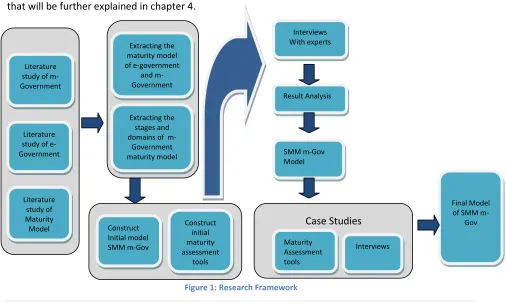
In-depth literature studies were conducted to have a fundamental understanding of the research. The construction of the stage maturity model is based on literature study by using a qualitative meta-synthesis methodology to synthesize different e-Government maturity models [14]. This process follows the step in the meta-ethnography approach. The result is used as the basis for the design of the construct of SMM-m-Gov framework.
2. Interviews
The data gathering was conducted through interview using semi-structured interview. The participants should answer the questions regarding the maturity model and development of e-Government and m-Government implementation. The interviews were also aimed to gain general understanding of maturity model, its use and its relation to different theories and standards. The strength of the interviews for both the interviewer and interviewees, is the ability to explore the meaning of the questions and answers involved [15]. It can deal with a variety of subject at different levels of complexity. The conversational mode has lead to many interesting variations of conclusions and in many cases, at least one party learns from others.
3. Case studies
Case studies are good technique of doing research to understand a complex issue or to add strength of the experience from the previous research. Case studies emphasize detailed contextual analyses of a limited conditions and their relationship. In his book, Yin [16] defines the case study research method as an empirical inquiry that investigates a phenomenon within its real-life context using multiple sources of evidence, and the boundaries between phenomenon and context are not clearly evident.
INTRODUCTION
7 | environment. An assessment tool was developed to assess the maturity of the government of Indonesia. The assessment is combined with a selected semi-structured interview with the people involved in the e-Government project in the Government of Indonesia.
From its result, the cross-case analysis was conducted and several key points are analyzed, the usefulness of SMM m-Gov and their willingness to implement the model are also evaluated. How we get to those research methods as written above is by:
Data gathering
The data gathering was conducted through interview using a semi-structured questionnaire and document analysis. The participants should answer the questions regarding the development of e-Government and m-e-Government implementation. The primary and secondary resources are used to gather the data. The primary sources were derived based on published articles, reviews, books and the government reports to gain the essential data, and the secondary sources were taken from the interviews and case study results.
Data Analysis
[image:21.612.65.571.427.731.2]The qualitative data were gathered from the analyses using interpretive research [17] and the qualitative meta-synthesis methodology. The process follows the steps used in meta-ethnography [18] that will be further explained in chapter 4.
Figure 1: Research Framework
Result Analysis
Final Model of SMM
m-Gov Extracting the maturity model of e-government and m-Government m-Government Extracting the stages and domains of
m-Government maturity model Construct initial maturity assessment tools Case Studies Literature study of e-Government
Literature study of m-Government Interviews With experts Literature study of Maturity
8 |
1.5
Thesis Structure
Figure 2: Outline of the Thesis
The remainder of this report is organized as follows and depicted in figure 2:
Chapter 2 presents the theoretical concepts of e-Government, m-Government and maturity model. The subchapter describes the present situation, challenges and the problem behind it. It also discusses what is a maturity model and how to implement it in m-Government areas.
Chapter 3 describes the available maturity models for e-Government and m-Government. There are seven existing maturity models reviewed in the fields of e-Government and three maturity models in the fields of m-Government. The maturity models come from different perspectives and points of view based on the research of individual researchers, consultant companies, international institutions and governments. These all models were reviewed for their context and applicability to propose a new model.
In Chapter 4, the construct of the Stage Maturity Model of m-Government (SMM m-Gov) is proposed. The chapter describes the development process of the construct and defines the maturity stages of the model.
I. Background 2. Literature review
7. Case Studies
6. Stage Maturity Model of M- Government (SMM m-Gov) 4.m-Government Stages model Development Process
8. Discussion and Future Work
RQ 1 & RQ 2
RQ 3 Main Research Question 5. SMM m-Gov Domains
INTRODUCTION
9 | In Chapter 5 we analyze the construct of the initial domains of the SMM m-Government, together with the validation process of the first initial model.
Chapter 6 defines and validates SMM m-Government model together with the maturity assessment tools used during the case studies.
Chapter 7 outlines the case studies to validate the research. Further interview with experts was conducted to generate rich understanding and extracting the data to validate findings. The case studies were used to validate the research in practices with the maturity assessment tools (see Appendix C). It presents general observations and analyzes the cases according to the maturity stages and maturity domains. This chapter also identifies the processing of the results, how the model works in real-life settings.
THEORETICAL FOUNDATIONS
11 |
2
Theoretical Foundations
This chapter gives an explanation and the situation of the current e-Government and m-Government services as well as several important definitions. Section 2.1 discusses the definitions of e-Government, the types of e-Government services and the implementation specifically in Indonesia. Section 2.2 defines the mobile government, and discusses the strengths and the challenges of m-Government implementation and followed by the discussion on maturity models in section 2.3. Section 2.4 presents the conclusion of this chapter.
2.1
E-Government
During few decades, government in all over the world has tried to take advantage of information and communication technologies (ICTs) to improve governmental administration and services. Increasing use of ICTs is leading to transformational shifts in public policy, to their processes and how they functioning. Electronic government is developing as one of the key channels to provide better services to the citizens as well as improving back offices processes and procedures in government operational and functions. These include items such as integration, service improvement and innovation, organizational, knowledge management and delivery services in terms of transparency, accountability, efficiency and effectiveness [19] .
2.1.1 What is e-Government?
Layne and Lee cited the definitions of e-Government as follows [10]:
“Electronic government refers to government’s use of technology, particularly web-based Internet applications to enhance the access to and delivery of government information and service to citizens, business partners, employees, other agencies, and government entities. It has the potential to help build better relationships between government and the public by making interaction with citizens smoother, easier, and more efficient. Indeed, government agencies report using electronic commerce to improve core business operations and deliver information and services faster, cheaper, and to wider groups of customers.”
12 | Furthermore, based on Moon [20], E-Government includes four major aspects: “(1) The establishment of a secure government intranet and central database for more efficient and cooperative interaction among governmental agencies; (2) web-based service delivery; (3) The application of e-commerce for more efficient government transaction activities, such as procurement and contract; (4) Digital democracy for more transparent accountability of Government.”
E-Government is known as one of the channel to improve the communication and services from government to the public or citizens. Services can be delivered through a wide variety of channels, ranging from traditional channel to the electronic channel. Face to face meeting, for example direct communications at the counter. Telephony, for example call centers. Paper media, for example sending the forms to the government agencies and web-based technologies, with the use of technologies like internet, email, short message services (SMSs) and using devices to access the application such as personal computer, mobile devices, and digital television [21].
Users have a free choice to use different channels to access the services depending on their needs by suitable and available means of accessibility, flexibility, cost efficiency and effectiveness. On the other hand, the government should increase the value of its services by integrating their service process and delivery, introduction of new access and service channels as an opportunity to improve the service delivery to become more accessible and flexible [22].
2.1.2 Types of e-Government Services
There are primarily four types of interactions of government deployment [23, 24]:
1. Government to Citizens (G2C), refer to the interaction between government and the citizens, including dissemination of information to the public, basic services in various sectors, such as healthcare, education, agriculture, administration and finance, public access, and so on.
2. Government to Government (G2G), refer to the interaction between the agencies within the department (inter-government relationship) and interactions between different government level and attached agencies and bureau (intra-government relationship). G2G also refers to the standard the being used in order to communicate with each other and streamline processes. 3. Government to Business (G2B), refer to interaction between government and business
THEORETICAL FOUNDATIONS
13 | 4. Government to Employee (G2E), refer to the relation between government and its employees, such as improving day-to-day functions, gives a training for the employees. This relationship also known as internal effectiveness and efficiency (IEE).
2.1.3 E-Government in Indonesia
In general, most of developing countries are lagging behind in e-Government development compared to developed countries. Like other developing countries, the Government of Indonesia, recognized the importance of establishing services to the citizens using electronic access. The government aim was to become more accessible and transparent to its citizens. Based on global e-Government survey conducted by united nations, for the e- government readiness, Indonesia was ranked 96th on 2005 and decreased into position 106th on 2008 [19].
Moreover, based on Furuholt and Wahid [25], there are huge disparities of e-Government implementation in Indonesia because of several factors, such as infrastructure, management and human factors [25, 26]. The government is facing a pressure to enhance the quality of the services to its citizens and to improve the dissemination of information; hence, the existing traditional government with the paper-based is left behind.
The transformation from traditional paper-based government services to electronic government has just started in the last few years. The terms of e-Government in Indonesia were officially introduced through the Presidential Instruction no 6/2001 regarding ICT and the implementation was followed by the presidential instructions no 3/2003 in July 2003 with the objectives to implement e-Government in all government institutions-central and local governments to improve transparency and accountability towards the implementation of good governance . The presidential instruction contains a national policy and strategy of e-Government development in Indonesia; therefore, MCIT develops a blue print and instruction to all central and local governments concerning e-Government implementation.
14 | Furthermore, as mentioned before, the development of e-Government in Indonesia is facing many challenges:
1. Human resources: the application of e-Government needs to be supported by the employees who understand technology. As the rapid development of information technology, the employees should be motivate and able to learn to manage the change. Moreover, Indonesia has severe problem regarding to the corruption and transparency of public services. The corruption practices need to be vanished first, so that government can deliver clean and transparency public services. In this point, e-Government is not just about technology but also about changing the culture.
2. Infrastructure: lack of public access and inadequate infrastructure is another challenges facing by the government of Indonesia. Indonesia consists of islands and separated by many seas, thus, making it harder to build public infrastructure spread evenly. Indonesia’s archipelago geography has high degree of diversity in population density, level of access and internet awareness. Internet penetration is increasing rapidly, but the widespread and dispersed nature of internet users is much larger than internet subscribers in households. Two thirds of internet users used public kiosk or internet cafes to access internet and these users are concentrated in larger cities [25].
3. Management: in a society of large power distance and culture like in Indonesia, inequality in power distribution has occurred. Good management, strong leadership can support the commitment and unify different notion so that they can collaborate to lead to government initiatives.
To address the challenges listed above, the government should make an attempts to improve the quality of human resources by providing training for the government officers, commitment from government officials, restructured organization if needed, such as vanished the corruption and collusion, the standardized policy for the manual of e-Government implementation. Government should create an innovative strategy according to the needs and condition (citizen needs)
2.2
M-Government
THEORETICAL FOUNDATIONS
15 | of them is the use of mobile devices to enhance government services and allow them to become more accessible and flexible.
With the advances in ICT and the demand from the public for the government to be more efficient and effective to deliver government services, it create opportunities for the government to offer new ways to interact with their users. These opportunities allow them to benefit from the various functions of information technologies, such as standardized format and tools, based on the requirements of users. One of the tools is mobile devices.
Mobile devices are now becoming part of our daily life. The advances in wireless and mobile technologies created a new channel or access method to deliver government services and improve efficiency. This access methods is called mobile government.
Mobile government is defined as the use of mobile and wireless technology for government administration and its delivery of information and services to the public. Moreover, m-Government may be defines as a strategy involving the utilizations of all kinds of wireless and mobile technology, services, applications and devices as a complimentary of e-Government for improving benefits to all parties involved in e-Government development, including citizens, business, employees and other institutions [7, 27, 28].
2.2.1 From E-Government to M-Government
M-Government and e-Government are not two separate entities. E-Government is using ICTs to deliver streamlined services and processes to improve activities of the government, whilst m-Government builds upon e-Government. M-Government provides an additional access tool to e-Government and its processes with the uses of wireless technologies and mobile devices such as mobile phones, Personal Digital Assistant (PDA), smart phone, net book, wi-fi enabled devices, and other mobile and wireless devices [4]. M-Government is the next direction of e-Government, it helps front-end processes as well as back end processes with the means of e-Government to accommodate the needs of users by interacting and delivering government services anytime and anywhere.
16 | Moreover, according to Karadimas and Papantoniou [29], there are two types of m-Government services. The first one is called push services, in which the citizens received the information without any interactions and interactive services. Example of this type is mostly using SMSs services. This services working as a reminders and alerts, for example in case of emergency such as disaster. Status information, for example information about status of the application or exam grades. Other various notifications, for example notifications of renewal the passport or national identity cards. The second type is interactive services, in which there are two-way communication between the government and citizens. For example mobile parking and mobile transport ticketing, which using financial procedures for paying for the services, complains to the authority or giving a suggestions. For example, citizens can report the conditions of the roads, or a crime happened in some places, etc. These complaints or suggestions will be following up by the appropriate government officers to give a feedback to those problems they were notified off.
E-Government has four kinds of interactions as mentioned above; likewise, mobile government also operates in the same level of interactions: G2C, G2B, G2E and G2G. In this report, we mainly focus and G2C interactions concerning the services delivery that mostly refer to the citizens needs, but in general, all types of interactions also explained later in the next chapter, for example, the G2G in the means of integration stages, which is vertically and horizontally integrate between and within governments.
2.2.2 Why M-Government
As mentioned before in chapter 1, the use of e-Government and m-Government is to improve the back-end and front-back-end processes of government. Back office process is refer to internal operations in the government that support the core processes. The process is not open to the public, while the front office, is refer to the interactions between the government and citizens to provided information and services [19]. To contribute to the transformation of good governance, government should enhanced their back-end processes first to increase the transparency and resulting in overall quality of internal work processes.
THEORETICAL FOUNDATIONS
17 | 1. Number of mobile users: More and more people have mobile devices that able to access
e-services and its contents. Higher penetration of mobile phone lead to higher number of accessing the government services
2. Mobility: enables citizens to access the content wherever they are, not limited to the wired connections with their desk computer.
3. Low cost: Use of mobile tools is easy and relatively low cost, which common people from lower to middle class can afford to have it, as the increasing of their needs of communication.
4. Easy of learning: The usage of mobile devices is easy and simple. The majority of citizens of all ages can use and access information with their mobile devices, especially when using mobile applications, this is more simple compare to computer-based applications.
5. Inclusiveness and remote area access: The ability of reaching rural areas. In which the infrastructures for wired internet or wired phone services is not yet set-up or difficult to develop. In the developing countries, m-Government may become useful methods to reach the citizens in disperse geography and remote area. It can reach different level of society and different zone of area.
6. Easy infrastructure setup: Mobile networks can be easily installed due to the simple architecture of mobile telephony. It useful in developing countries, where an infrastructure is an important issues.
7. Providing specific services: Some features are useful, such as mobile positioning or location based services.
2.2.3 M-Government Challenges
Besides the benefits of m-Government implementation, there are some challenges faced by the government in implementing m-Government. Major challenges of m-Government are mostly similar to the e-Government such as infrastructure, human resources and management. But there are some challenges specific to mobile technologies, such as security and privacy issues [30]. More specifically on these mobile issues, Alijerban described some challenges in m-Government implementations [28]:
18 | specific tools. Moreover, for the specific mobile devices, such as mobile phones, user can easily changes their mobile phone number or mobile phones, which can caused the undeliverable information.
3. Integration technology for mobile accessing to government services, the communication channels in m-Government is not just about mobile phone, but also other mobile devices and wireless technologies. The higher the maturity stages, the more sophisticated tools needed. PDA, netbook, satellite, Wifi enabled devices, bluetooth, should also interact and possible to be integrated.
4. Security of mobile government services, security in wireless network is quite vulnerable and became challenging issues, including the data protections, email security, access of wireless tools, security management tools, etc.
Other challenges arise is an issues of compatibility and interoperability [27], there is also about technical difficulties regarding to the compatibility of the mobile systems with the existing e-Government systems, including the legacy system.
2.3
Maturity Model
Maturity models (MMs) in general are designed to assess the maturity based on more or less a set of criteria, including competency, capability and level of sophistication. MMs are developed to assist the organizations as a basis for evaluating and comparative degree for the organizations improvement [31]. zIn his dissertation, Tapia [32] explained that MMs describe the evolution of specific entity over time in organizations, so the organizations recognize which activities in each area and possess desire to achieve potential outcomes. He also argued MMs are descriptive and normative, but not prescriptive. It describes each maturity level without prescribing on how to get there.
THEORETICAL FOUNDATIONS
19 | Moreover, there are some components that may or may not be present in the MMs as described by Haris in his thesis [35]: number of levels, description for each level, a general description of the characteristics of each level as a whole, numbers of dimensions or process area, numbers of activities for each dimensions and description of each activity at each maturity level. He also described an example of assessment framework of a maturity model, such as: a questionnaire with clear questions, a list of the dimensions the assessment addresses, a scoring scale, an explanation of how the model communicates the results and a list of potential interviewees for assessment.
In the following chapter, we will described several maturity model in the area of e-Government and m-Government. We also try to searching the literature about mobile maturity model, but until now, there is no specific scientific research of mobile maturity model available in the field, related to this thesis.
2.4
Summary
In this chapter, we provided definitions and overview of e-Government and m-Government together with the challenges and benefit that it provides. We started presenting the e-Government in general and specifically e-Government in Indonesia as an example of conditions in a developing country. The explanations followed by m-Government and the reason why we choose m-Government as further development of e-Government.
M-Government and e-Government are not two separate entities, but m-Government is developed as a complimentary of e-Government. The main difference is the use of mobile devices and wireless technologies so that the citizens can assess government services anywhere and anytime electronically. Finally, we presented the nature of maturity model. The definitions, general characteristic of the various types of maturity model, why the government uses maturity models, and how to make the assessment framework of maturity model.
RELATED WORK
21 |
3
Related Work
This chapter discusses several approaches of e-Government and m-Government maturity models that are available in the scientific and practical fields. The chapter is organized as follows: Section 3.1 presents different stage maturity models of e-Government proposed by different researcher both in the scientific and practical fields. Section 3.2 presents the reflections of the seven e-Government maturity models. Section 3.3 specifically discusses the M-Government stage maturity models. Finally, section 3.4 presents the summary of the chapter.
3.1
E-Government Maturity Model
[image:35.612.37.582.375.664.2]In this section, different e-Government maturity models are presented. Some of these were developed by individual researchers, government agencies and others by institutions and consultant companies. In this chapter, we explain each model briefly in the figure 3 below. For more detailed explanation of each existing model can be found in appendix B.
Figure 3: E-Government Maturity Model [10-12, 36-39]
Delloite's Model
Stage 1: Information
Publishing
Stage 2: Two way Transaction
Stage3: Multi-Purpose Portal
Stage 4: Portal Personalization
Stage 5: Clustering of
Common Service
Stage 6: Full integration
United Nations Model
Stage 1 : Emerging Stage 2: Enhanced Stage 3: Interactive Stage 4: Transactional Presence
Stage 5: Fully integrated
Layne and Lee Model
Stage 1: Cataloguing
Stage 2 : Transaction Stage 3: Vertical Integration Stage 4: Horizontal Integration West's Model
Stage 1: The billboard
stage
Stage 2: The partial- service-delivery stage
Stage 3: The portal stage
Stage 4: Interactive democracy
Gartner Model
Stage 1: Presence Stage 2: Interaction Stage 3: Transaction Stage 4: Transformation Hiller and Belanger Model Stage 1: Information dissemination
Stage 2: Two-way communication Stage 3: Transaction Stage 4: Integration Stage 5: Participation E-Government Stage Model of
Indonesia
22 |
3.2
Reflections of the e-Government Maturity Model
As described in appendix B, the widely used e-Government models presented are based on different point of view. First, we can see from the point of view of the researchers as explained by Layne and Lee, West, Hiller and Belanger and second is from the consultant companies such as Delloite and Gartner. Moreover, we also mentioned the e-Government maturity model from the United Nations, which is develop based on the research in various countries, especially developing countries. Followed by the Indonesian government, which has developed an e-Government stage model based on their own research and their practical implementation. All of the model address this theme from their respective view and conceptualize it in different aspects: social, technology, economic, political, etc.
Hiller and Belanger, West and Layne and Lee present a similar growth model. However, the authors combine their stages of growth model with the major types of electronic relationships between government and different level of constituents. First, government directly delivers the services to the citizen and government to the individual in the political or democratic process. It is categorized as G2C relationship. The second relationship is G2B, since the major portion of online transaction, could involved the business stakeholders, such as paying tax online. The third relationship is to another government agencies or employees, which they should collaborate to provide services to one another, as explained in the stage model as vertical and horizontal integration. This relationship is called G2G relationship.
As a new and rapidly growing field, some researchers extending the concepts and theories of e-Government to include mobile services with the aims to provide effective and efficient services and convenient access to the government services through mobile and wireless technologies [30, 40]. Moreover, there are limitations the number of research in m-Government maturity models. Some of the models we analyzed are describes in the following subchapters.
3.3
M-Government Maturity Model
RELATED WORK
[image:37.612.102.544.185.494.2]23 | Due to the limitations of the research related to m-Government maturity model, here, we could find and presented three m-Government maturity models that coming from the researcher point of view. The models it look similar with e-Government model, because all these models were constructed based on the development of e-Government that choose to utilize m-Government by looking at the rapid development of mobile technologies that could help the grown of e-Government implementation.
Figure 4: m-Government Maturity Model [13, 28, 40]
3.4
Summary
This chapter has examined seven different e-Government maturity models and three m-Government maturity models that are available in scientific and practical fields. The findings reflect from different perspectives from the fields of the individual researcher, IT consultant companies, international organizations and the government.
The seven different e-Government maturity models shown in section 3.1 together with m-Government maturity models explains in sections 3.3 are what we have used to create an unique SMM m-Gov. The new model will be explains in chapter 6, shown a development of e-Government that choose to utilize m-Government implementation.
Alijerban and Sahafi Model
Stage 1: Presence and dissemminating
information
Stage 2: Interaction
Stage 3: Transaction
Stage 4: Vertical and horizontal integration
Stage 5: Portal personalization
Stage 6: Electronic participation
Fasanghari and Samimi M-Government Framework
Stage 1: e-Government
Stage 2: Migration
Stage 3: Primary interaction
Stage 4: Fully interaction
Stage 5: Transaction
Stage 6: Ubiquity
Sandy and McMillan Model
Stage 1: Initial
Stage 2: Enhanced Stage 3: Interactive Stage 4: Transactional
24 | In the next chapter, we will describe the development of the SMM m-Gov by using qualitative meta-ethnography methodology in order to compare, interpret, translate and synthesize different research framework and summarize all the model and resulting into the new findings of designing the SMM m-Gov.
PART II : SOLUTION
25 |
M-GOVERNMENT STAGE MODEL DEVELOPMENT PROCESS
27 |
4
M-Government Stage Model Development Process
This chapter discusses the SMM m-Gov’s initial stages based on extensive literature review. The development of the stages was based on the qualitative meta-synthesis with meta-ethnography approach. It was also validated by the experts through interview to ensure that SMM m-Gov is applicable to use in real-work settings.
Meta-synthesis is a way to comparing, interpreting, translating and synthesizing different existing qualitative research findings to systematically come up with a design framework so that they can be ready to used [14, 41, 42]. Developing maturity model systematically is not widely covered in either scientific or practical literature. In this chapter, we explained the steps of constructing the stages of the maturity model systematically by using meta-ethnography approach.
4.1
Qualitative meta-synthesis (meta-ethnography) methodology
Qualitative meta-synthesis is a technique for synthesizing the findings of qualitative research [18, 43]. It provides various methods and procedures to conduct qualitative meta synthesis with the different approach and different name [44]. In this research, a meta-ethnography approach by Noblit and Hare is used to synthesize the studies. The meta-synthesis methods should be interpretive, to help the readers understand the meaning by translating the studies into one another. The methods aim to explain the findings of a similar qualitative studies [41].
Based on Noblit and Hare, “Meta-ethnography is intended to enable: more interpretive literature reviews, critical examinations of multiple accounts of an event, situation and so forth, systematic comparison of case studies to draw cross-case conclusion, a way of talking about our work and comparing it to the works of others and synthesis of ethnographic studies” [18]. In short, the meta-ethnography is a method to interpret a qualitative finding that has been extracted by integrating and comparing different related qualitative studies, and resulting in the summation of findings.
In this research, we used meta-synthesis with meta-ethnographic approach to compare, interpret, translate and synthesize different research framework. To summarize all the models and resulting into new findings, seven-step meta-ethnographic approach is used. This approach is described as follows:
Step 1: Getting Started
28 | Step 2: Deciding what is relevant to the initial interest or selects relevant studies
The current literature related to e-Government and m-Government maturity model was searched. Several different indexing engines such as Google Scholar, ACM Digital Library, Web of Science, EBSCO host, Scopus, were used to search the following combinations of terms : ‘e-Government’, ‘m-Government’, ‘maturity model’, ‘stages maturity model’, ‘framework’, ‘level’ and so on. The initial search, resulted hundreds of articles from all databases. For the first screening, the abstract reviewed one by one and for the articles that are not directly related to the e-Government or m-Government were removed. Second screening is to remove the articles with detail technical architecture. The third screening is to use citation analysis to support their argument and find other relevant literatures, books, white papers, government publication and so on.
Step 3: Reading the studies
After screening process, more than 50 articles were available to read on the subject. To identify the substantial concerns of the studies, comprehensive reading was carried out and the reading was repeated again to get further insight in the note and substantive parts. As a result, seven (7) studies about e-Government stages model and three (3) m-Government stages model were reviewed and details of each stage is described in section 3.1 and 3.2.
Step 4: Determining how the studies are related
Here, the various studies were investigated and by doing synthesis, each model was reviewed in detail to show the relationship between different studies. Each model was compared and contrasted to each other. After comprehensive reading, it shows the key metaphors, concepts and their relations. After understanding and analyzing all the models they showed that the developing stages of all the model is very similar, but with different perspectives. For example, the Delloite model is based on customer service perspective and defines the process as an evolution between governments and citizens. UN model focuses on web-based public services. Layne and Lee, Hiller and Belanger is based on integrated perspective combining technical and organizational feasibility. These two models were similar, while Hiller and Belanger model consider political participation as the last stages of the e-Government evolution. Gartner’s model is concise and argues that transformation stage is the last stage, in which the government is doing a transformation process into integrated, unified and personalized service.
M-GOVERNMENT STAGE MODEL DEVELOPMENT PROCESS
29 | Step 5: Translating the studies into one another – finding the linkages
To create a comparison to synthesize a comprehensive study, the concepts and metaphors identified in the previous step, are put into a translation, and the linkages between the models are identified. This study also compares both the concepts and metaphors and their interaction among different stages to find their corresponding relationship or link. Some analyses were used to identify other relationship between each stages of the model. For example, from the entire stage model presented in chapter three, the first stage of the models is to establish the websites and present basic information publishing online. Moreover, the corresponding relationship was found between the third stage of UN model and the second stage of Hiller and Belanger model, both these stages provide simple communication between government and the citizens, by email or downloadable forms.
Step 6: Synthesizing translation
Synthesis refers to the translation of the finding, its concepts and metaphors into one frame of reference. In this step, the relationships of different models are described within the table.
Step 7: Expressing the synthesis / presenting the finding
The synthesis of existing literature, sometimes biased toward the written word [44]. Other form may be preferable, for example via tables, charts, or diagram can be used to effectively illustrate the relationships. In this stage, the result of the research is presented in the table and will be further detailed in section 4.2 below.
4.2
Result of Meta-synthesis of the stage model
The seven models of e-Government and three models of m-Government as explained in Chapter three are qualitatively analyzed using meta-synthesized with meta-ethnography approach described in section 4.1. Followings are the detail explanation of the study.
4.2.1 Studies reviewed
30 | As can be seen from Table 1 below the models published within last ten years, from 2000 to 2010 are based on different perspectives. The number of stages in a model, as described by the authors below varies from one another and may comprise of four to six stages.
Author Year of Publication
Title Description
Delloite Group 2001 The citizen as customer Distinguish 6 stages of e-Government model based on service perspective (customer-centric model) and defines the process as an evolution between governments and citizens
UN 2001 Benchmarking
e-Government: A Global Perspective
Provide 5 stages of e-Government model. Primarily based on analyzing web-based public services
Layne and Lee 2001 Developing fully functional E-Government: A four stage model
Identified 4 stages of a growth model of e-Government based on integrated perspective (combines technological and organizational feasibility).
West 2004 E-Government and the
transformation of service delivery and citizen attitudes
Distinguish 4 stages of e-Government based on website content analysis
Gartner Group (Baum and Di Maio)
2000 Gartner four phases of
e-Government model
Present 4 stages of e-Government model
Hiller and Belanger 2001 Privacy strategies for electronic government
Deliver 5 stages of e-Government model based on integrated
perspective primarily in
technological perspective E-Government Stage
Model of Indonesia
2003 Panduan Penyusunan
Rencana Induk Pengembangan e-Government Lembaga.
Provide 4 stages of e-Government model based on G2G,G2C and G2B perspective.
Alijerban and Sahafi 2010 M-Government maturity model with technological approach
Provide 6 stages of m-Government model based on general perspective with technological feasibility.
Fasanghari and Samimi 2009 A novel framework for M-Government
Implementation
Present 5 phases or 6 stages of m-Government model based on the general perspective (technology, infrastructure, security )
Sandy and McMillan 2005 A Success Factors Model For M-Government
[image:44.612.60.550.145.664.2]Present 5 level of maturity model based on service functionality
M-GOVERNMENT STAGE MODEL DEVELOPMENT PROCESS
31 |
4.2.2 Comparing the stages
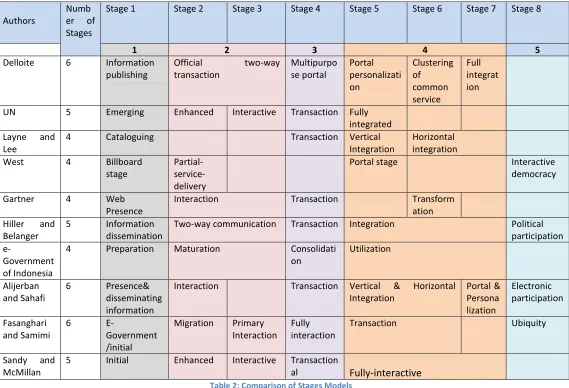
As presented in Table 2, detailed semantic comparison of the stage model is made against each other. As a comparison, eight specific stages are identified together with the concepts and metaphors.
Authors
Numb er of Stages
Stage 1 Stage 2 Stage 3 Stage 4 Stage 5 Stage 6 Stage 7 Stage 8
1 2 3 4 5
Delloite 6 Information
publishing
Official two-way
transaction Multipurpo se portal Portal personalizati on Clustering of common service Full integrat ion
UN 5 Emerging Enhanced Interactive Transaction Fully
integrated Layne and
Lee
4 Cataloguing Transaction Vertical
Integration
Horizontal integration
West 4 Billboard
stage
Partial- service-delivery
Portal stage Interactive
democracy
Gartner 4 Web
Presence
Interaction Transaction Transform
ation Hiller and
Belanger
5 Information
dissemination
Two-way communication Transaction Integration Political
participation
e-Government of Indonesia
4 Preparation Maturation Consolidati
on
Utilization
Alijerban and Sahafi
6 Presence& disseminating information
Interaction Transaction Vertical & Horizontal
Integration Portal & Persona lization Electronic participation Fasanghari and Samimi
6
E-Government /initial
Migration Primary Interaction
Fully interaction
Transaction Ubiquity
Sandy and McMillan
5 Initial Enhanced Interactive Transaction
[image:45.612.25.594.144.532.2]al Fully-interactive
Table 2: Comparison of Stages Models
1. Stage 1
As can be seen, in stage 1, all ten proposed models have the same underlying concept, which is basic information publishing in the website. This stage is an initial stage and is a prerequisite for going to the next stage.
2. Stage 2 and stage 3
32 | before going to the interactive stage, which is enhanced and migration stage. That is why the interactive stages are put together - a combination of stages 2 and stage 3 in the cell boundaries. This means the two different stages proposed by other authors, is within the same scope with the interaction stage.
3. Stage 4
In this stage, 8 out of 10 models placed their stages as a transaction stage, while Fasanghari and Samimi’s model placed fully interaction stages before transactional stages, which is quite different from other stage models. On the other hand, Delloite put the multi-purpose portal in this stage. Overall, Delloite did not specifically explain financial transactional processes in their model as others did.
4. Stage 5, 6 and 7
Details of the stage 5, 6 and 7 are primarily related to one another into the integration stage. This stage is an important development model that comes after the transaction stage. Two of the authors, Delloite and West, used portal personalization for naming this stage, which implies an integration stage. Their description of the stages is reference to the same services: one-stop services by integrating all the service between different levels and different structures of government to be clustered along common lines.
Some of the author, divided the integration stages into two stages - vertical and horizontal. Vertical integration will take place first before the horizontal integration. Vertical integration refers to the integration between different levels of government with different services within the similar function. Horizontal integration is an intra-governmental integration which integrate different levels and across different functions of government. Various functions of separate systems and different functional areas will communicate with each other and share information to provide citizens a one-stop services.
5. Stages 8
M-GOVERNMENT STAGE MODEL DEVELOPMENT PROCESS
33 |
4.2.3 Translating the studies - identifying underlying concepts
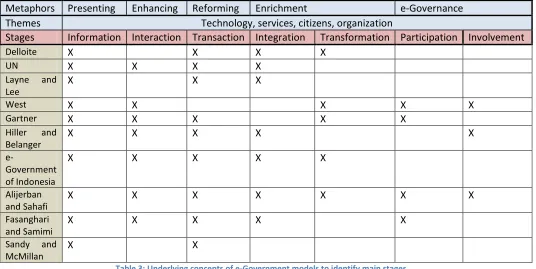
The next step of the qualitative meta-synthesis is to translate the studies into one another. Table 3 presents the underlying concepts and themes provided in each stage of the ten models. Tick marks in each cell represent the existence of the concepts in the model.
Metaphors Presenting Enhancing Reforming Enrichment e-Governance
Themes Technology, services, citizens, organization
Stages Information Interaction Transaction Integration Transformation Participation Involvement
Delloite X X X X
UN X X X X
Layne and Lee
X X X
West X X X X X
Gartner X X X X X
Hiller and Belanger
X X X X X
e-Government of Indonesia
X X X X X
Alijerban and Sahafi
X X X X X X X
Fasanghari and Samimi
X X X X X
Sandy and McMillan
[image:47.612.45.581.166.435.2]X X
Table 3: Underlying concepts of e-Government models to identify main stages
4.2.4 Synthesizing translation
In this step, all the underlying metaphors are explored. This step is used to confirm the finding of previous step. Based on in-depth literature review and compare all the models, five metaphors were identified to represent the seven concepts of the model.
1. Presenting metaphors
The presenting metaphors refer to the information publishing stage, which includes the establishment of the website to provide static and basic information, catalogues and published documents.
2. Enhancing metaphor
34 | 3. Reforming metaphor
Reforming metaphor correspond to the transaction stages in the model. The business process and services are engaged to provide new initiatives of transaction process. The reformation is appropriately managed to increase the efficiency of e-Government performances.
4. Enrichment metaphor
The Enrichment metaphor consists of integration and transformation stage. In this stage, the forms of the processes were transformed into more sophisticated services and technology and could be a completely different process. For example, the task of the government officers are transformed into service-oriented tasks and IT-based technologies with the automated process, so that the government can be focused on developing new services to fulfill citizen’s needs.
5. E-Governance
E-governance metaphor is refers to the integration and governance of the whole process. Participation and involvement from the citizens appeared. In this stage, citizens would be able to be more involved in change process, participate in real-time decision-making. In this stage, all the citizen’s involvement processes are facilitate with advanced and sophisticated technologies and transparency procedures. Stages / Concepts Metaphors Description
Information Presenting Publishing information in the website
Interaction Enhancing / Maturation Enhance the services in the information process. Provide two-way communication between citizens and government.
Transaction Reform Reform the process and services, enable user to complete transaction process
Integration Enrichment Change the form of the process more sophisticated to reach the effectiveness. Enable user to customize according to their need and seek to gather integration services. Transformation
Participation e-Governance Processes and services are manages sophisticatedly. Citizens involve in the change process.
[image:48.612.68.526.416.612.2]Involvement
Table 4: Synthesizing of translation
4.3
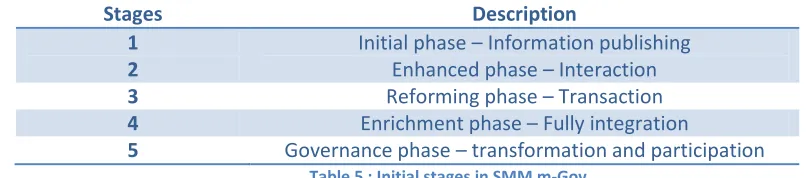
Model’s stages
M-GOVERNMENT STAGE MODEL DEVELOPMENT PROCESS
35 |
Stages Description
1 2
Initial phase – Information publishing Enhanced phase – Interaction
3 Reforming phase – Transaction
4 Enrichment phase – Fully integration
[image:49.612.82.487.81.170.2]5 Governance phase – transformation and p

![Figure 3: E-Government Maturity Model [10-12, 36-39]](https://thumb-us.123doks.com/thumbv2/123dok_us/1196800.643008/35.612.37.582.375.664/figure-e-government-maturity-model.webp)
![Figure 4: m-Government Maturity Model [13, 28, 40]](https://thumb-us.123doks.com/thumbv2/123dok_us/1196800.643008/37.612.102.544.185.494/figure-m-government-maturity-model.webp)


![Figure 6: Gartner's four-stage model (cited from [50]](https://thumb-us.123doks.com/thumbv2/123dok_us/1196800.643008/56.612.132.494.84.358/figure-gartner-s-stage-model-cited.webp)
