CryptosFS: Fast Cryptographic Secure NFS
Declan Patrick O'Shanahan
A dissertation submitted to the University of Dublin, in partial fulfilment of the requirements for the degree of
Master of Science in Computer Science
Declaration
I declare that the work described in this dissertation is, except where otherwise stated, entirely my own work and has not been submitted as an exercise for a degree at this or any other university.
Permission to lend and/or copy
I agree that Trinity College Library may lend or copy this dissertation upon request.
Signed: ___________________ Declan Patrick O'Shanahan
Acknowledgements
Summary
The issue of security in file-systems is as relevant today as when the first file system was developed. Current file system implementations rely heavily on centralised security
mechanisms such as access control lists. The problem of security in file systems was made more complicated by the introduction of remote access to files. Storing information on a remote server has the potential to introduce additional security weaknesses into the file system model. The client, the communication links and the server make up the file system model.
The Network File System (NFS) is a widely used and oft maligned file system. Developed by Sun Microsystems in the 1980s it introduced a means to access files remotely. It is by no means the only distributed file systems but it is one of the most widely used. Serious
security limitations were identified in the NFS protocol, as the original design did not include a security aspect. Security was added to the NFS protocol by the introduction of secure RPC. The security added was in the form of authentication of users. The distributed file system model that NFS uses is susceptible to attack in the following ways.
1. An attacker who can gain control of the NFS client has the ability to read data and can compromise the confidentiality of the data. If the NFS client has write access, an attacker can also compromise the integrity of the data stored on the server.
2. An attacker who can gain access to the NFS server can compromise the confidentiality of the data stored on the server. The attacker can also compromise the integrity of the data by modifying the data stored on the server.
can modify the data associated with the write operation and affect the integrity of the operation. The authenticity of information passing between a client and a server is not guaranteed as an attacker who can compromise the integrity of the information can also compromise the authenticity of the information by modifying the data on the fly.
CryptosFS is a distributed file system prototype that uses a combination of cryptographic techniques to provide confidentiality, integrity and authenticity of information. Blowfish symmetric-key cryptography is used to encrypt file system data and meta-data. The symmetric-key cryptography provides information confidentiality. Asymmetric-key cryptography and MD5 message digests are used to create digital signatures. Validation of the digital signatures provides authentication and integrity.
Table of Contents
1 Introduction ... 1
1.1 Granularity of File Encryption ... 3
1.2 An Overview of File System Development Options ... 3
1.2.1 User Process File System ... 4
1.2.2 Kernel Level Process File System ... 6
1.2.3 Stackable Layer Kernel Level Process File System ... 8
1.2.4 Stackable layers for the CryptosFS Architecture ... 10
2 State of the Art in Cryptographic File Systems ... 12
2.1 Cryptographic File System – (CFS) ... 12
2.2 Truffles ... 14
2.3 Transparent Cryptographic File System - (TCFS) ... 15
2.4 Cryptfs ... 16
2.5 Summary of properties of Cryptographic File Systems ... 17
3 Design of CryptosFS ... 19
3.1 Trusted Computer Base and CryptosFS ... 19
3.1.1 Lack of Trust in the components of CryptosFS... 20
3.2 Access Control Mechanisms ... 21
3.2.1 Access Control Lists ... 22
3.2.2 Role Based Access Control ... 23
3.2.3 Capability Access Control ... 24
3.2.4 Lack of Formal Access Control in CryptosFS... 25
3.3 CryptosFS Security Model and the use of Cryptography... 25
3.3.1 Confidentiality in CryptosFS... 25
3.3.2 Authentication in CryptosFS ... 26
3.4.1 Manual Encryption by the User... 27
3.4.2 Encryption at the Application Level... 28
3.4.3 Encryption at the File System Level... 28
3.4.4 Encryption at the System Level... 29
3.4.5 CryptosFS & Encryption at the file system level ... 30
3.5 CryptosFS - Design Goals ... 31
4 Implementation... 33
4.1 CryptosFS - Implementation goals ... 33
4.2 Architecture of CryptosFS... 34
4.2.1 Functionality in CryptosFS... 37
4.3 Key Structure for CryptosFS ... 38
4.3.1 Vnode stacking and Encryption... 39
4.3.2 Blowfish symmetric-key Generation for CryptosFS ... 40
4.3.3 Generating Large Integers in the Linux kernel... 40
4.3.4 RSA Asymmetric-key Encryption... 42
4.3.4.1 RSA asymmetric-key Generation in CryptosFS... 43
4.4 Storage of Keys Generated in CryptosFS... 43
4.4.1 Link-list Implementation in CryptosFS ... 43
4.4.2 Key Files in CryptosFS... 45
4.4.3 File Operations Implemented by CryptosFS in the Linux Kernel... 46
4.5 NFS Client ... 47
4.5.1 NFS Client Read Operations in CryptosFS ... 47
4.5.2 NFS Client Write Operations in CryptosFS ... 48
4.5.3 NFS Client Result Validation in CryptosFS... 49
4.6 NFS Server ... 50
4.6.1 NFS Server Validation of Read Operations in CryptosFS ... 51
4.6.3 NFS Servers Authentication of Results in CryptosFS... 52
4.7 XDR and RPC in NFS ... 52
4.7.1 Overview of Secure RPC in NFS ... 52
4.7.2 XDR/RPC in CryptosFS ... 55
5 Performance Evaluation of CryptosFS ... 57
5.1 Analysis of CryptosFS... 57
5.2 Micro Benchmark Process... 58
5.3 Results of Micro Benchmarks ... 59
5.3.1 RSA Asymmetric-key Generation... 59
5.3.2 Blowfish Symmetric-key Generation ... 59
5.3.3 Generation of 128-bit Message Digests... 60
5.3.3.1 Generation of Message Digest from 16 bytes of Input Data ... 60
5.3.3.2 Generation of Message Digest from 1024 bytes of Input Data ... 61
5.3.4 Encryption of message digest using 1024-bit Asymmetric-keys ... 61
5.3.4.1 Encryption of 128-bit message digest using 1024-bit public key ... 61
5.3.4.2 Encryption of 128-bit Message Digest Using a 1024-bit private key ... 62
5.3.5 Decryption of Digital Signature using 1024-bit public-key ... 62
5.3.6 Digital Signature Creation ... 63
5.3.6.1 Creation Of a Digital Signature For a Read Operation ... 63
5.3.6.2 Creation Of a Digital Signature For a Write Operation... 64
5.3.7 Digital Signature Validation ... 64
5.3.7.1 Validation of a Digital Signature For a Read Operation ... 64
5.3.7.2 Validation Of a Digital Signature For a Write Operation ... 65
6 Conclusion ... 66
6.1 Related work... 67
Table of Figures
Figure 1: File System Implemented as a User Level Process... 5
Figure 2: File System implemented in the kernel... 7
Figure 3: VFS Supports Multiple File Systems in the kernel... 8
Figure 4: New File System functionality added to the Kernel as a Stackable Layer. ... 9
Figure 5: CryptosFS uses ext2 and offers Services to the VFS Layer. ... 11
Figure 6: Summary of the properties of different cryptographic file systems... 18
Figure 7: General Architecture of the CryptosFS implementation... 35
Figure 8: Structure of components in the CryptosFS File System. ... 37
Figure 9: Structure for CryptosFS keys as stored in VFS vnode... 39
Figure 10: Structure of the key object used in CryptosFS... 44
Figure 11: Doubly linked-List implemented in CryptosFS to store the generated keys. ... 45
Figure 12: Field description of CryptosFS key file. ... 46
Figure 13: File operations implemented for key-files in CryptosFS. ... 47
Figure 14: NFS Client creates a digital signature for a read operation. ... 48
Figure 15: NFS Client validating result data from NFS Server. ... 50
Figure 16: NFS Server validates a digital signature for a write operation. ... 52
Figure 17: Secure RPC validation in Secure NFS. ... 54
Table of Tables
Table 1: Time to create a 1024-bit key RSA key. ... 59
Table 2: Time to create a 448-bit Blowfish key. ... 60
Table 3: Time to create a 128-bit message digest from 16-bytes input... 60
Table 4: Time to create a 128-bit message digest from 1024 bytes input. ... 61
Table 5: Time to encrypt a 128-bit message digest using a 1024-bit public-key. ... 62
Table 6: Time to encrypt a 128-bit message digest using a 1024-bit private-key... 62
Table 7: Time to decrypt a digital signature using 1024-bit public-key. ... 63
Table 8: Time to create a digital signature for a Read Operation... 63
Table 9: Time to create a digital signature for a Write Operation... 64
Table 10: Time to validate a digital signature for a Read operation. ... 64
Abbreviations
ACL Access Control List ACE Access Control Entity CFS Cryptographic File System DES Data Encryption StandardGNU MP GNU Multi Precision Arithmetic Library IP Internet Protocol
LIP Large Integer Package NFS Network File System PDA Personal Digital Assistant PEM Privacy Enhanced Mail RBAC Role Based Access Control RPC Remote Procedure Call SMS Short Messaging Service TCB Trusted Computing Base TCP Transmission Control Protocol
TCFS Transparent Cryptographic File System UFS UNIX File System
UMTS Universal Mobile Telecommunications System VFS Virtual File System
1 Introduction
The Internet has seen tremendous growth since its commercial inception early in the 1990's. New techniques are being continuously developed to access information over the Internet. The last couple of years have seen an explosion in the number of people using hand held devices such as personal digital assistants (PDA’s) and mobile phones. Convergence of voice and data services is starting to happen with the increased use of short messaging service (SMS) and the wireless access protocol (WAP). Connection by users to information and services stored on remote computers is on the increase.
Current GSM technology allows users to roam in a foreign network and to use the services on that network. The development of the third generation of mobile services Universal Mobile Telecommunications System (UMTS) and broadband services can only increase the numbers of users utilising mobile communication services. As data- services become increasingly important in the future, users will require access to information on remote computers safe in the knowledge that the information is secure from compromise.
information is stored in encrypted format. This means that the information is safe from all but sophisticated cryptanalysis. The use of encryption ensures security of the information as it makes it way from the local to the remote host avoiding problems of insecure communication links.
CryptosFS investigates the use of public-key cryptography to replace the access control mechanisms of NFS [1]. Traditionally NFS uses secure RPC [2] to provide authentication of users. This does not provide integrity or security of information stored on a server. CryptosFS replaces the existing access control mechanisms of NFS with asymmetric-key cryptography to allow users access information. Possession of the private-key allows a user to create, modify and remove files and directories. Correspondingly, possession of the public-key allows a user to read the files and directories.
Encrypting the file data and file meta-data with symmetric-key cryptography provides information confidentiality. The MD5 [3] algorithm is used in combination with asymmetric-key cryptography to produce digital signatures. The digital signatures are used as a form of access control that allows the server to validate clients requests for operations. The public-key of the asymmetric-key pair is used to create a digital signature for read operations, while the private-key is used to create a digital signature for write operations. This provides the integrity and authentication of the information on the server.
among trusted users. This form of access control provides strong security and is a distributed form of access control as the asymmetric-keys can be shared with other users. A distributed access control mechanism scales better than a centralised form and is not a single point of failure.
1.1 Granularity of File Encryption
Encryption of data in the file system is one of the most important aspects of the research. The level at which the encryption is to be applied to the file system data has important implications in terms of performance and security. By choosing to encrypt file system data at the individual file level, it provides a sufficiently low level of access control but more importantly, it also provides a higher level of security. Without individual keys for each file, it is not possible to replace the access control mechanism of the file system. Creating keys for each file increases the security of the file system by reducing the impact of a key being compromised to a single file.
It is easier to generate keys to encrypt the contents of a directory rather than each individual file. Several of the existing cryptographic file systems encrypt all of the file data for a single user with one key. Typically, a user is prompted for a pass-phrase that generates a key to encrypt the data. Relying on a user tool to generate the
password leaves the file system vulnerable to attack. An attacker can replace the key generation program with a Trojan horse that stores a copy of the keys generated for each user. Having the file system handle the keys transparently for the user eliminates this threat.
1.2 An Overview of File System Development Options
fitted in with relation to current and past file system development. Our experience with file system development is limited so the research served to identify the different techniques that can be used. The variety of file systems encountered show what an active area of research file system development is. The file systems researched fell in to one of the following three categories:
1. The file system is developed in user space and runs as a user process.
2. The file system is developed in the kernel and runs as a privileged process. The file system development implements all of the file system functionality.
3. The file system is developed in the kernel and runs as a privileged process. The new functionality that the file system provides is stacked on top of existing file system functionality using stackable layers.
Each of the three techniques outlined have peculiarities and advantages that are described in the following sections.
1.2.1 User Process File System
One of the most advantages of developing a file system as a user level process is that the file system can be installed by a user without the assistance of a system
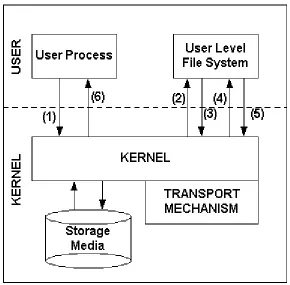
[image:18.595.153.443.190.475.2]administrator. This provides the user with greater flexibility in how they use files. Figure 1 illustrates how a file system developed to run in user space interacts with the local and remote operating systems.
Figure 1: File System Implemented as a User Level Process.
A user process requests access to a file from a user-space file system. The request is routed through the kernel. The steps in the communication show how a request by a user process results in a context switch in to and out of the kernel. Starting at (1) the user makes a request to read a file. This results in a call to the kernel that forwards the call on to the user level file system (2). The user level file system makes another call to the kernel (3) to retrieve the data required by the read from the storage media.
kernel completes the read command by delivering the data to the user process at (6). This results in two additional context switches to the kernel than a normal read.
There are many examples in the literature of file systems developed as user processes; these include CFS [4] and TCFS [5]. Please refer to section 2 for more a more detailed evaluation of these file systems. All of the file systems that are implemented as a user level process are susceptible to a major performance problem. The use of a user level process requires additional context switches that increase the overhead of every system call and thus reduce performance.
1.2.2 Kernel Level Process File System
To develop a file system in the operating system kernel means forgoing the simplicity of development that a user process provides. This increases development complexity because kernel level programming requires specialist knowledge of the specific operating system being used. When the file system resides in the kernel, a tight coupling exists between the file system and the kernel level services that it uses. This coupling reduces the ability of the file system developer to port the file system to another operating system.
Developing the file system from scratch inside the kernel allows the file system
developer greater freedom in the implementation process. Gaining experience with the internals of the kernel requires time and considerable knowledge of the underlying operating system structure. Developing a file system from first principles does not utilise any of the development previously done. Redeveloping all of the file system functionality in this way does not make any sense.
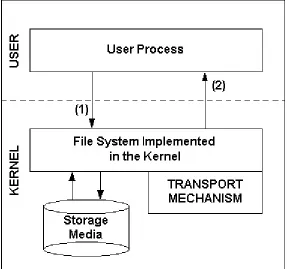
Examples of file systems developed in the kernel include the Echo Distributed File System [6] and NFS. Figure 2 illustrates how a typical user level process utilises the file system operations in the kernel. It requires two calls, (1) for the request and (2) for the response.
Figure 2: File System implemented in the kernel.
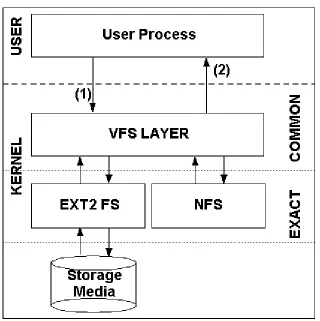
remote files. This serves to illustrate how multiple file systems are catered for in the same kernel.
Figure 3: VFS Supports Multiple File Systems in the kernel1.
1.2.3 Stackable Layer Kernel Level Process File System
Significant work has been done using stackable layers to leverage existing
the VFS interface and vnodes to layer functional operations one on top of the other. Stackable layers are described in more detail in “Vnodes: An architecture for Multiple File System Types in Sun UNIX” [12].
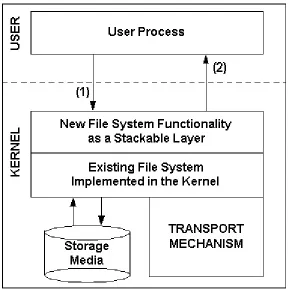
The process of developing file system functionality in the kernel is difficult due to the constraints that the kernel imposes. It is preferable to reuse existing code whenever possible as it has usually been thoroughly tested and is generally stable. The main idea behind stackable layers is to reuse existing functionality by layering new functionality on top of it. Developers can reap the benefits of previous work and concentrate on the problems associated with their required functionality.
[image:22.595.154.443.412.701.2]The following figure shows how a stackable layer is used inside the kernel to utilise existing functionality.
Figure 4: New File System functionality added to the Kernel as a
1.2.4 Stackable layers for the CryptosFS Architecture
Having reviewed the different development techniques available, stackable layers was selected to develop the prototype of CryptosFS. The reasons for choosing stackable layers are as follows.
1. A significant amount of work has been done on developing file systems such as ext2 or NFS. Stackable layers allow this existing functionality to be reused. This frees the developer to concentrate on the specific implementation problems. 2. By placing the prototype of CryptosFS as a stackable layer within the kernel, it is
possible to avoid the performance impact inherent in a user space implementation. 3. There was a limited amount of time available for the development of the
CryptosFS prototype. By reusing existing functionality in Cryptfs and NFS, this allowed us to concentrate on implementing the specific functionality of
CryptosFS.
As the CryptosFS file system is supposed to be fast it is more appropriate to place the file system in the kernel. Developing the file system, as a user process can’t provide the fast performance that is required. This is because of the additional context switches that a user process requires. Placing the file system functionality in the kernel complicates the development process because it requires specialist knowledge of the kernel. Creating the file system from scratch is not a realistic option as
sufficient time is not available to gain the necessary experience.
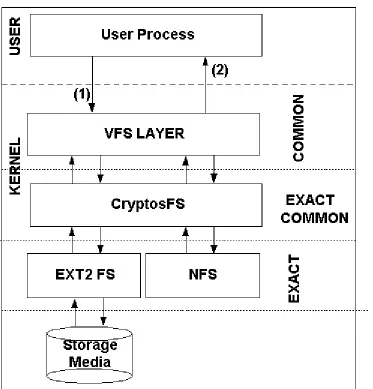
service to the user. CryptosFS uses the common services provided by ext2 and NFS, the underlying file systems as shown in Figure 5.
Figure 5: CryptosFS uses ext2 and offers Services to the VFS Layer2.
2 State of the Art in Cryptographic File Systems
The idea of applying encryption to data stored in the file system is not a new one. There are many examples in the literature and the commercial world of file systems that utilise encryption. These include:
1. CFS uses DES [13] cryptography to provide confidentiality of file data and file meta-data.
2. Truffles [14] uses DES to encrypt file data and asymmetric-key cryptography to exchange the DES keys.
3. TCFS uses DES encryption to provide confidentiality and authentication.
4. Cryptfs uses Blowfish [15] encryption and stackable layers technology to encrypt the file data and file meta-data.
Reviewing the literature for the reference file systems helped to identify the Cryptfs implementation. Cryptfs uses stackable layers to allow the fast implementation of file system functionality. Stackable layers exploit the ability to use vnodes to allow different file systems to use each other’s functionality. By selecting the Cryptfs implementation as a starting point to use for development, it provides a large amount of stable kernel code. Using the Cryptfs file system allows the development effort to be concentrated on the required cryptographic functionality without having to worry about the low-level details of the file system.
2.1 Cryptographic File System – (CFS)
system. Files stored in the directory are stored under a different mount point and a user-attached directory.
Files in CFS are encrypted using a series of user level programs. A specialised form of the “mkdir” command “cmkdir” is used to create encrypted directories. During the creation of a directory, the user is prompted to enter a key. To use an encrypted directory the user must attach the encrypted directory to a normal directory. This requires the key, the name of the encrypted directory and a directory name that is used as a mount point to access the encrypted directory during the attach process.
For example a user creates an encrypted directory “/home/oshanahd/myeyesonly” with a key “declan”. To access the encrypted directory the user enters the key
“declan”, the directory name “/home/oshanahd/myeyesonly” and the mount directory /mnt/oshanahd that is used to attach the encrypted directory. CFS determines whether a user has the right to access the attached directory based on the user id of the process trying to access the directory.
CFS encrypts file data and the meta-data. Encryption of the file meta-data results in path names and file names that are on average fifty percent bigger than the normal unencrypted equivalent. This reduces the size of valid file names that the user can use. CFS supports multiple directories allowing different keys and different cryptographic algorithms per directories. The additional context switches that CFS performs to service file requests limit the performance of the file system.
2.2 Truffles
The Truffles file system is a distributed file system that uses the Fiscus replicated file system and TIS/PEM [19]. The Truffles file system provides replication and sharing of file data. Privacy enhanced mail (PEM) provides security in the form of
authentication and encryption. Email is used to exchange the information required to share a file volume replica. Information in the email is encrypted using DES. To allow different users share information securely requires the exchange of the DES key. The key exchange uses the public-key contained in an X.509 digital certificate. Using DES to encrypt the information in email leaves the data open to brute force attack as
discussed in “Efficient DES Key Search”.
Each Truffles volume has a different DES key so that access to the each volume is restricted to only those users who possess a copy of the relevant DES key. The use of email to exchange DES keys allows users to share access to file volumes without the assistance of system administrators. System administrators can use policy to limit the abilities of certain users to share file volumes. This provides additional flexibility and security.
NFS. UFS provides local file system storage while NFS provides remote file system storage. As Truffles is built on top of Fiscus it is as readily available as NFS. Despite the fact that the file system capability of Truffles is in the kernel, the performance of Truffles is limited by the use of email to exchange information. Email can be lost in the Internet or can be delayed due to congestion, this seriously degrades the
performance of the file system.
2.3 Transparent Cryptographic File System - (TCFS)
TCFS is a modified client side NFS server that communicates with a remote NFS server and with a specialised RPC based attribute server. TCFS is only available for Linux and requires both its client and server run the Linux operating system. TCFS can use several different block ciphers including DES and IDEA [20].
TCFS provides transparent management of user keys. Instead of the user being prompted to enter a key by a specialised program, random keys are generated by the file-system. The random keys are encrypted with the password of the user and stored in a file called /etc/tcfspasswd. The user id is used as an index in to the key file to retrieve the key for the user process trying to access the file. This has the advantage of transparently handing the encryption of the file data. At the same time, it reduces the security provided by the system to the difficulty of decrypting the user password to retrieve the keys. Dictionary password programs can be used crack a user password with little difficulty, these programs are freely available on the Internet.
2.4 Cryptfs
Cryptfs is implemented as a kernel resident file system. Cryptfs can be mounted on any local or remote directory and can utilise any underlying file system such as UFS, ext2 or NFS. Cryptfs does not require any specialised daemon program to run as it layers itself on top of the existing underlying file systems. Cryptfs is implemented as a stackable code interface. Similar to CFS, users of Cryptfs are prompted to enter a pass phrase to generate a key for authentication. A message digest of the pass phrase is generated using MD5 and is stored in the memory used by Cryptfs. The keys to encrypt the file data are not stored in a file, this makes it more secure than TCFS. As the user must enter the pass phrase at the start of each new session that is started, this results in reduced flexibility but provides greater security.
Cryptfs uses Blowfish symmetric-key cryptography for encryption of file data and meta-data. A 128-bit key provides a balance between performance and encryption strength. Keys can be used in two different ways. The user id can be used to identify the key to use. Alternatively, a combination of the user id and the session id of the accessing process can be used to identify the key. The second method provides additional security, as a malicious user who can use the root user capability to forge the user id of the user can't attain the same session id as the user.
Encryption of the file name and path name attributes adds additional complexity. UNIX file names and path names have certain restrictions regarding valid names. Using certain characters such as “/” or null produces invalid file names. This is a problem in Cryptfs as encryption of filenames produces invalid filenames. Cryptfs solves this problem by uu-encoding the filename to convert them to valid values. It does not encrypt the “.” and “..” directories because it could provide malicious users with examples of encrypted strings to try a known plain text attack. Uu-encoding filenames results in the encrypted filenames being 25% larger on average than the corresponding unencrypted names.
The performance of Cryptfs is improved by the location of the encryption/decryption layer in the kernel. This results in the same number of context switches as file access in a regular file system.
2.5 Summary of properties of Cryptographic File Systems
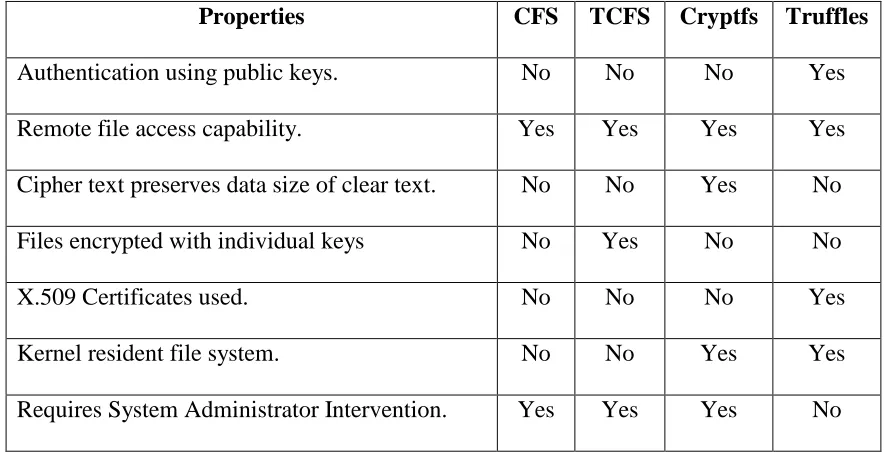
The table below summarises the properties of the different cryptographic file systems researched. The CryptosFS file system is supposed to be fast and secure and the size of the encrypted file data is required to be the same as the clear text. From the review of the available file systems, Cryptfs was selected for detailed analysis. Cryptfs is a kernel resident file system. This means that the performance of the file system is better than user level file systems. As Cryptfs uses stacking vnodes, the
Properties CFS TCFS Cryptfs Truffles
Authentication using public keys. No No No Yes Remote file access capability. Yes Yes Yes Yes Cipher text preserves data size of clear text. No No Yes No Files encrypted with individual keys No Yes No No
X.509 Certificates used. No No No Yes
Kernel resident file system. No No Yes Yes
[image:31.595.76.518.70.300.2]Requires System Administrator Intervention. Yes Yes Yes No
Figure 6: Summary of the properties of different cryptographic file
3 Design of CryptosFS
3.1 Trusted Computer Base and CryptosFS
Cryptography can be used in a distributed file system to provide confidentiality, integrity and authentication. A distributed system is by its very nature made up of many different components. Each of the components in a distributed system
potentially provides an avenue for an attacker to exploit, so as to gain unauthorised access to data and information. Depending on the application domain, the
requirements for information security are very different. The military typically places the highest priority on non-disclosure of information. The banking industry is more concerned with integrity of information and preventing attackers from modifying data. Utilities and service providers place a high priority on ensuring availability. An
attacker who can successfully interfere with the provision of a service can be extremely damaging to a service provider.
The use of components to produce a distributed system requires that the components of the system have to be evaluated with regard to security. The combination of components to produce a distributed system forms what is called the trusted
computing base (TCB). The trusted computing base is defined by Butler Lampson in “Requirements and Technology for Computer Security” [21] as
As part of the design process for CryptosFS it is important to evaluate how exactly CryptosFS fits in to the TCB. The different parts of the file system were evaluated to determine how they could be secured to provide the necessary level of protection.
3.1.1 Lack of Trust in the components of CryptosFS
CryptosFS is a fast secure version of NFS. Like other NFS implementations, it has the following components.
• Client
• Server
• Communication mechanism
The design of CryptosFS requires determining the level of trust required among the different components. The server should distrust the client and require that all of the operations it performs be validated. Validation of operations requests from a client requires the server to verify that the client has the authority to perform the requested operation. CryptosFS does not authenticate the clients identity but it does ensure that a valid client is performing the operation.
In CryptosFS a new access control mechanism is used to control access to file stored on the server. The new access control mechanism uses RSA asymmetric-key
encryption [22] to create digital signatures. This allows the server to verify that only valid clients are allowed to perform operations. It also allows the client to give other users the capability to perform operations. Trust is established between clients and servers by the ability of the server to validate the operations that the client requests.
not trust the server because someone unknown to the client administers the server. The server has the ability to disclose information without the authorisation of the client.
The client can prevent unauthorised access to data by using encryption. Even if the server discloses the data belonging to the client, the data is in encrypted format and so is useless without the corresponding key to decrypt it. The client encrypts all of the data with symmetric-key encryption before it sends it to the server. The data is never decrypted by the server. The server does not possess the key to perform the decryption of the data. This enforces trust between the client and the server even though there is no explicit trust.
The communication mechanism allows the client and server to pass requests and responses to each. The client and the server do not trust the communication
mechanism, as it is possible for an attacker to compromise it. CryptosFS is designed to try to overcome the problem of not trusting the communication mechanism. The problem with the communication mechanism is that an attacker can read and change the data being sent over it. The ability to change the data sent to a server negates the ability of a server to validate a client request for an operation. CryptosFS encrypts the data before it is sent over the network, this ensures confidentiality of the data. The server uses the digital signature created by the client to validate the client requests. This ensures the integrity of the data.
3.2 Access Control Mechanisms
control works on the LAN of an organisation but it is impractical for sharing objects in the global Internet. Centralised management of access control complicates the creation of new users, it prevents arbitrary once off access to files from non-trusted users and is a single point of failure.
3.2.1 Access Control Lists
Access Control Lists (ACL) as discussed in Pasc P1003.1e [23] provide a mechanism for secure access to objects in a distributed system. ACL’s are a form of discretionary access control as the end user determines who can access the object. Access control is defined in terms of objects and subjects. Objects are defined as what is controlled by the access control; a subject is defined as the entity that commences the access to the object.
Each subject is described by a collection of attributes. The attributes are used to identify the subject to the object and to control the access that the subject has to the object. Validating the subject involves authentication and authorisation.
Authentication involves acquiring and verifying the attributes of the subject. Authorisation validates the permissions of the subject by the object. Objects are governed by a set of rules called the access control entity (ACE). There are two types of ACE: authentication ACE and authorisation ACE.
ACE's are used to form ACL’s that can be stored in a centralised structure such as a file or a database. The ACL mechanism obtains the subjects ACE from the ACL to authenticate and authorise the subject’s access to the required object. As the ACL is stored on a single host, it is a potential single point of failure. Management and
administration of ACL’s is problematic when there are large numbers of changes to be made to the subject’s attributes.
3.2.2 Role Based Access Control
Role Based Access Control (RBAC) is an example of mandatory access control. The subject who has access to an object does not have the automatic right to distribute access to the object. RBAC seeks to differentiate between the subject and the task to be performed. A subject can perform a task only if it has the correct permissions to access the objects required to complete the task. By placing the permissions to access an object under a specific role, any subject can be assigned that role.
RBAC differs from ACL’s because a subject does not possess the ability to pass permissions on to another user. RBAC is pessimistic due to its restrictive nature. It assumes that subjects will attempt to pass on permissions and so by mechanism prevents it from happening. RBAC is group oriented because it relies on the
assignment of subjects to roles. Each role has the ability to perform a certain subset of transactions; RBAC mechanisms adhere to the Principle of Least Privilege as
3.2.3 Capability Access Control
Capabilities provide access control to an object in a system by restricting access to the object to only those users who possess a token. The token provides the token holder with permission to perform operations on the object. Capabilities provide a single mechanism for accessing, naming and securing all objects within a system. Dennis and Van Horn discuss capabilities in “Programming Semantics for Multiprogrammed Computations” [25]. Capabilities are used in the Amoeba operating system [26], in SFS [27] and in CapaFS [28].
Using capabilities provides improved flexibility as they can be shared out among subjects. Sharing the capability to read data from an object is possible by giving another subject a copy of the read capability. As copying capabilities provides a mechanism for sharing access to object, it is important that the capabilities are
difficult to forge. If it is not difficult to forge capabilities, malicious subjects can gain access to objects. Strong encryption provides protection against the arbitrary forgery of capabilities.
Capabilities come in several different forms, these include tagged, partitioned and sparse.
• Tagging is a computer-architecture-oriented technique; a number of bits are added
to each memory area, so a distinction can be made between the data and capabilities functionality.
•
Sparse capabilities do not need to be distinguished from data by tagging or partitioning; a simple bit string is used to represent them.3.2.4 Lack of Formal Access Control in CryptosFS
CryptosFS is designed as a distributed cryptographic file system that does not require the server to authenticate the identity of the user. CryptosFS does not use traditional access control for validating users. CryptosFS relies on creating digital signatures and using the digital signatures to verify requests for operations from clients. The server does not attempt to verify the identity of the user. Validations of read and write requests are performed by decrypting a digital signature received from the client making the request. To successfully read the data in the server the public-key for the file is required, conversely the private-key is required to perform a write operation.
3.3 CryptosFS Security Model and the use of Cryptography
The use of cryptography reflects the lack of trust between the components of
CryptosFS. The security model used for the CryptosFS prototype uses three different types of cryptography. These include Blowfish symmetric-key cryptography, RSA asymmetric-key cryptography and MD5 message digests. This combination of cryptographic algorithms is used to ensure confidentiality, integrity and authentication of file data and file meta-data.
3.3.1 Confidentiality in CryptosFS
The data that is transmitted across the network is always in encrypted format, this guarantees confidentiality of the data even if it is successfully retrieved from the network. Data stored on the server is stored in encrypted format. If an attacker can compromise the server, the confidentiality of the file data is maintained, as the data is stored in encrypted format.
3.3.2 Authentication in CryptosFS
Authentication in CryptosFS is achieved by the use of digital signatures. A client that tries to perform a remote read operation must prove to the server that it has the authority to perform the operation. When a file is created on the server the public-key for the file is stored. The authentication process for a read operation involves the creation of a digital signature by the client. The client creates a digital signature by first producing a message digest of the encrypted data. The message digest is then encrypted with the public-key of the file. The server possesses the same public-key as the client and creates its own digital signature. The server authenticates the client’s read request by comparing the digital signature received from the client against the digital signature that it creates. If the digital signatures match then the client has successfully authenticated itself to the server for a read operation.
server for a write operation. Only the client who possesses the private key can create the correct digital signature.
3.3.3 Integrity in CryptosFS
The integrity of files created on the server is maintained by the use of digital signatures. Write operations to modify the data stored on the server require the
private-key. The integrity of the file data is guaranteed because even if the public key is changed on the server, the comparison of the message digests stored in the digital signatures will fail.
3.4 Location of Cryptography in the System
The choice of the cryptographic system is important but it is also critical to implement the cryptography in the correct place in the system. Locating the cryptography in an inappropriate location in the system can negate the security offered by it. Refer to “A Cryptographic File System for Unix” by Matt Blaze for a thorough description of the options available for encrypting data.
3.4.1 Manual Encryption by the User
If a user encrypts the data manually, it is not possible to share the data with another user unless they possess a copy of the cryptographic key and the cryptography program used to encrypt/decrypt the data. Users are human and can make mistakes such as entering the wrong encryption key or worse losing the key. Many programs that are used in the UNIX environment create copies of data that they work with. An encryption program may make a temporary copy of the clear text being encrypted and may not delete it immediately once the encryption is finished.
3.4.2 Encryption at the Application Level
An alternative to applying encryption manually by the user is to embed the encryption in to the application that creates the data. An example of this is an editor that encrypts the data in the files that it creates. The user is prompted by the application program to enter an encryption key when the file is written to or to enter a decryption key when the file is read. This is a little more flexible than the manual approach because the encryption process is seamlessly integrated into the application.
Sharing of data between different applications requires that each application which accesses the data, must implement the same cryptographic algorithm. Multiple implementations of a cryptographic algorithm can introduce problems due to an error in an implementation. Bruce Schneier in “Data Guardians” [30] describes some of the problems encountered with different implementations of the DES algorithms. Failure on the part of the user to encrypt the file or to delete the clear text version of the file data can render useless the security provided by application encryption useless.
3.4.3 Encryption at the File System Level
do not have to worry about keys then the potential for problems from incorrect keys being used or the keys being mislaid is eliminated.
Entrusting the file system to perform encryption reduces the risks of security breaches due to multiple implementations of cryptographic algorithms. Cryptographic
algorithms are complex and mistakes in implementation are possible. Experiences with the DES algorithm provide evidence of problems encountered due to the complexity of coding cryptographic algorithms.
The end-to-end argument as specified by Saltzer et al in “End-to-end arguments in system design” [31] discusses the use of encryption to provide for secure transmission of file data. Saltzer et al argue that it is better to let the end application apply
encryption rather than let it be performed by the communication subsystem. It is not appropriate to trust the communication subsystem to manage the keys required for encryption. A further complication of applying encryption to the communication subsystem is that once data has cleared the communication subsystem on the target machine it will be in unencrypted format.
3.4.4 Encryption at the System Level
When file data is stored on a remote file system, the security of the communication link is important. Malicious users who can gain access to the link can read data sent in the clear to a remote site. Programs such as packet filters make this easy to do. A hardware device can be used to encrypt and decrypt data before it is stored on the physical media. Using hardware in this manner complicates back up and retrieval of information stored on the media. Adding an additional component to the system further increases the risk of failure of a component. Failure of the hardware can render the data inaccessible. The need to store keys at some location in the network whether at the local or remote site complicates matters and increases the risk of security breaches.
3.4.5 CryptosFS & Encryption at the file system level
The location in the operating system where cryptography is applied is important. Security of the generation, management and storage of keys can impact the overall effectiveness of encryption when it is applied to an operating system. During the design of CryptosFS the use of cryptography at the user and application level were rejected because of the problem with security of keys and scaling problems. It is preferable to let the file system take responsibility for the application of encryption. CryptosFS is designed to encrypt file data at the file system level. The keys for
The CryptosFS file system is responsible for managing the encryption keys. No other part of the system is required to manage keys. The file data is encrypted and
decrypted only by the CryptosFS file system application on the client. As no other part of the system needs to decrypt the file data, the need for complicated key-management is removed. This simplifies the key-key-management model and improves the security of the file system.
Efficient distributed system design dictates that as far as possible processing is transferred from the highly burdened server to the lightly burdened client. By passing the responsibility for encryption of file data to the client, a computationally expensive operation is removed from the server. This allows the server to concentrate on
performing other work and allows it to scale more effectively to handle additional client requests.
3.5 CryptosFS - Design Goals
The design of CryptosFS reflects a desire to add stronger security to NFS through the application of different cryptographic techniques. The use of RSA asymmetric-key encryption was considered to encrypt the file data. After consideration, this was rejected because the performance of file operations would have been very poor.
Blowfish symmetric key encryption is used in CryptosFS to perform the file data encryption. There are no references in the literature to show that the Blowfish algorithm has been successfully cryptanalysed. Blowfish offers a balance of strong encryption and high performance; this makes it ideal for encrypting data. The choice of encryption selected influenced the design of CryptosFS.
Keys produced in the file system are stored in the file system. User assistance is not required to produce the keys. Keys are generated from random information from within the operating system.
When a file is created, the file system automatically produces the required symmetric and asymmetric-keys. The keys generated by CryptosFS are saved somewhere in the file system.
Encryption of file data and file meta-data is performed by the client. The
encrypted file data and meta-data are stored on the server in encrypted format. No decryption of file data is performed by the server. The server only uses encryption to authenticate operations by manipulating the digital signatures produced by the client.
The design of CryptosFS follows efficient distributed system design principles as far as possible. By passing the encryption and decryption of data to the client, the computationally expensive work of encryption and decryption is transferred from busy server to the less lightly loaded client. This allows the server to scale more efficiently and handle an increase in the number of file operations.
4 Implementation
4.1 CryptosFS - Implementation goals
The following are the implementation goals were set for the implementation of CryptosFS.
- A combination of Blowfish symmetric-key encryption, RSA asymmetric-key Encryption and MD5 message digests algorithms are to be implemented. The different cryptographic algorithms are used to provide a mechanism for validating operation requests from clients on the server, as the server does not trust the client.
- Cryptography is expensive in terms of the additional time it adds to a file
operation. To offset the cost of the encryption and decryption the implementation of these three algorithms have to be implemented in the kernel to ensure that they are as fast as possible.
- The following bit sizes are used for the three different cryptographic algorithms.
Blowfish key size of 448-bits. A key size of 448-bits provides a good balance of strong encryption and high performance.
RSA key size of 1024-bits. A key size of 1024-bits provides strong encryption to protect the digital signatures against brute force attack.
MD5 message digests of 128-bits. The 128-bit message digest size is a standard size used for the creation of digital signatures.
encrypted format on the server. No symmetric-key encryption is performed by the server to improve security.
- The MD5 algorithm is used to generate the message digests. The message digests are used to produce a digital signature by signing them with the RSA public or private-key. The RSA public-key is used by the NFS server to validate the digital signatures and to authenticate the results returned to the NFS client.
- To implement the RSA asymmetric-key encryption in the kernel, a method for producing large integers in the kernel had to be found.
- The kernel NFS client and server implementation in Linux use kernel RPC as its transport mechanism. This RPC is hand coded, as there is no rpcgen program for the Linux kernel. The RPC code had to be analysed to determine how best to modify it. The modifications allow it to transport the digital signatures and associated asymmetric-keys from the client to the server and vice versa.
- CryptosFS is to be developed in Linux and has to use Linux kernel modules to allow the dynamic loading of the file system into the running kernel.
4.2 Architecture of CryptosFS
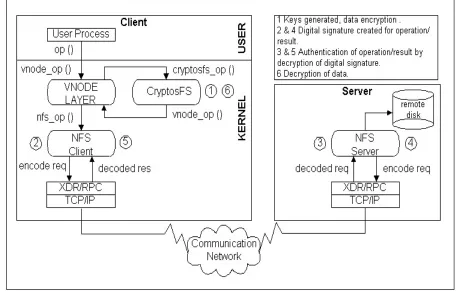
Figure 7: General Architecture of the CryptosFS implementation.
The steps numbered one to six describe how and where the different cryptographic algorithms in CryptosFS are implemented.
1 The symmetric and asymmetric-keys for each file are created when the file is created. The keys are stored in the vnode for the file. Data received from the user is encrypted before it is passed down to the underlying NFS client. The
encryption is performed using the symmetric-key stored in the file vnode.
digital signature, the public key and the encrypted data are encoded using XDR before they are sent to the server.
3 The NFS server decodes the request from the client. The decoded request contains the operation requested, the digital signature and the public-key for the file.
• If the client requests a write operation the server uses the public-key to decrypt
the digital signature to retrieve the message digest created by the client. The server creates its message digest from the encrypted data and compares it against the message digest retrieved from the client’s digital signature. If the message digest produced by the client matches that produced by the server, the server knows the client who created the digital signature is authorised to perform the write file operation.
• If the client requests a read operation, the server creates a message digest of the encrypted data. The server encrypts the message digest with the public-key to create a second digital signature. The server compares the two digital signatures and if they match the server knows that the client is authorised to perform the read operation.
4 The NFS server performs the operation if the request from the client is validated correctly. The results of the operation are used to create another digital signature by creating a message digest of the result data. The server uses the public-key of the file to sign the message digest. The result data and the digital signature are encoded using XDR and sent back to the client.
data and signs the message digest with the public-key of the file to create a digital signature. The client compares the digital signature it created against the one received from the server. If the digital signatures match, the client knows that the result data is correct and has not been modified as it passed over the network.
6 The NFS client passes the results data back up to the CryptosFS layer. The result data is decrypted with the symmetric-key from the vnode. The decrypted data is then passed to the user process.
4.2.1 Functionality in CryptosFS
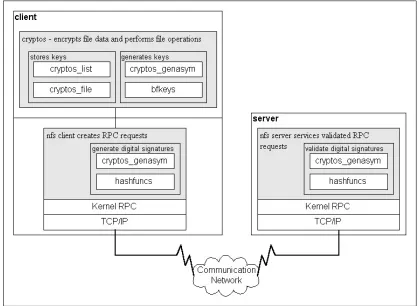
[image:50.595.124.543.432.738.2]Figure 8 illustrates how the different components of the CryptosFS implementation fit together. The key generation and storage is performed in the CryptosFS layer. Both the NFS client and server generate digital signatures for the validation of the different file operations.
There are four main components in CryptosFS that perform the key generation and management. The different components are discussed below.
1. cryptos_genasym generates the asymmetric-keys for each vnode; it also
produces the digital signatures from the message digests on both the client and the server.
2. bfkeys generates the symmetric-key for each vnode.
3. cryptos_list and cryptos_file store the generated keys in main memory and in flat files respectively.
4. hashfuncs generates the message digest of the encrypted data. This message digest is used in the generation of the digital signatures.
Refer to Appendix A for a complete list of the software components of CryptosFS.
4.3 Key Structure for CryptosFS
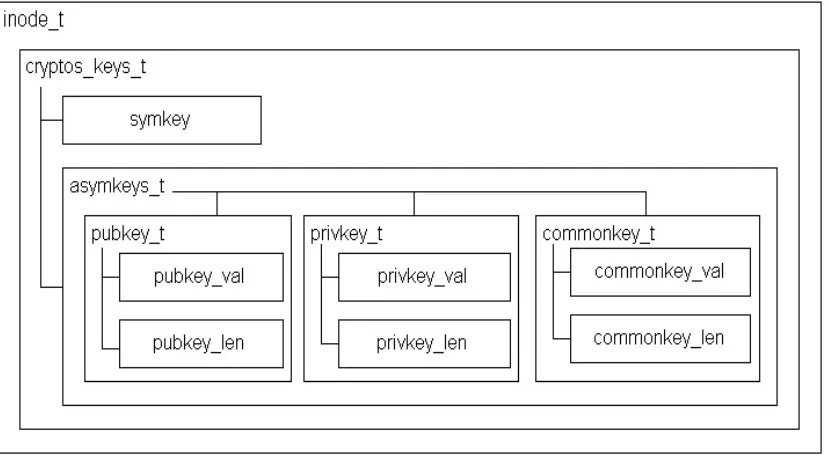
Figure 9: Structure for CryptosFS keys as stored in VFS vnode.
4.3.1 Vnode stacking and Encryption
The CryptosFS prototype encrypts and decrypts the file data and meta-data before passing it on to the underlying ext2 and NFS file systems. This is possible by using stackable layers and stacking vnodes. The vnodes of the VFS layer in the Linux operating system possess the capability to store arbitrary information. Stackable layers exploit this capability to store a pointer to another vnode (called a hidden vnode) in the higher-level vnode.
4.3.2 Blowfish symmetric-key Generation for CryptosFS
CryptosFS uses 448-bit Blowfish keys to encrypt file data and file meta-data. The Blowfish keys are created automatically when a file or directory is created. For each symmetric-key to provide sufficient entropy, it is produced using a seed value obtained from the system time in the Linux operating system. The system time in Linux is represented by jiffies. Linux Kernel Internals [33] describes jiffies as
"Jiffies represents the system time since the system was started up in, they are measured in ticks. Each tick represents 10 milliseconds".
The seed to the Blowfish key generator is generated from the following formula.
seed = (jiffies % HZ) * (1000000000/HZ)
jiffies = system time in milliseconds since the operating system was booted. HZ = 100
The number of seconds from the time of day is retrieved from the operating system and is combined with the seed value to produce the Blowfish key according to the following formula. The key is 448-bits in length (56 bytes) and so is produced in a loop.
for (i=0; i < SYMKEY_SIZE; i++)
symkey [i] = (unsigned char) ((seconds) * (seed * i)) % CHAR_RANGE);
The CHAR_RANGE is 255. Using the modulus function ensures that each of the characters produced is in the range 0 - 255.
4.3.3 Generating Large Integers in the Linux kernel
obtaining Digital Signatures and Public-Key Cryptosystems”. Without the ability to produce large numbers in the Linux kernel, it is not possible to implement the RSA asymmetric-key encryption algorithm in the kernel.
The kernel of the operating system is limited in the functionality that it provides. Once the kernel is loaded in to the memory of the machine it runs continuously without ever being swapped out to disk. This places a limit on the size of the kernel. The aim of the kernel is to provide low level services quickly and efficiently. Adding large integer capability to the kernel to generate large integers does seem to contravene the end-to-end argument. This is because the kernel does not have access to the functionality that a higher-level layer has. One of the implementation goals for CryptosFS is to use RSA asymmetric-key encryption in the kernel. This is not possible without a kernel
implementation of a large integer package.
Two large integer packages were evaluated to determine whether it is possible to use them in the Linux kernel. These included the Large Integer Package (LIP) [34] and the GNU Multi-Precision Arithmetic Package (GNU MP) [35]. A considerable amount of effort was concentrated on trying to port the LIP to the kernel. Efforts to port the LIP to the kernel failed as it relied too heavily on the functionality of the glibc library.
and free functions mapped to the kernel functions kmalloc and kfree respectively. A function implemented using kmalloc and kfree allows the correct simulation of the operation of realloc.
4.3.4 RSA Asymmetric-key Encryption
The security provided by RSA asymmetric-key encryption is due to the difficulty of factoring large prime numbers. The algorithm for RSA asymmetric-key encryption is discussed in “A method for obtaining Digital Signatures and Public-Key
Cryptosystems”. The details of the RSA algorithm implemented are as follows: 1. Select two large prime numbers p and q.
2. Compute n = p*q.
3. Select a value e that is relatively prime and is less than p*q. The public key is e, n.
4. The Extended Euclidean Algorithm is used to find a suitable d value, see the next section for more detailed information of how this is implemented. 5. To perform encryption, raise a value V to the power of e and obtain the
modulus n of the result to produce cipher text C. This looks as follows: C = ((V^e) mod n)
6. To perform decryption, raise the cipher text C to the power of d and obtain the modulus n of the result to produce the original value V. This looks as follows:
V = ((C^d) mod n)
4.3.4.1 RSA asymmetric-key Generation in CryptosFS
The GNU MP library provides almost all of the functionality necessary to produce the RSA asymmetric-keys with the exception of the Extended Euclidean Algorithm. This necessitated the design and implementation of a version of the Extended Euclidean Algorithm. The theoretical basis for the algorithm is obtainable from a description written by Bruce Ikenaga as detailed in “An Example Using the Extended Euclidean Algorithm” [36].
The RSA asymmetric-keys are generated using the algorithm as detailed in the previous section. The two prime numbers p and q are produced using the GNU MP prime number generator function. The prime number generator function uses a base number as a starting point. It retrieves the next prime number greater than the base number. The first base number is generated using the GNU MP random number generator seeded with the system time (jiffies). The second call to the prime number generator uses the first prime number generated as the base number. This allows two different prime numbers to be generated.
4.4 Storage of Keys Generated in CryptosFS
The keys generated in CryptosFS are stored in a structure called cryptos_keys_t that is located in the vnode in the VFS layer. The vnode information in the VFS layer is only active in the memory of the computer. Some means of storing the keys to provide persistence is needed.
4.4.1 Link-list Implementation in CryptosFS
in this way, a clean separation of the implementation of the link-list and the
[image:57.595.125.544.202.270.2]information that it stores is possible. Modification of the link-list implementation is possible without affecting the structure that stores the key details. The following diagram shows the structure of the key-object that is stored in each link of the link-list.
Figure 10: Structure of the key object used in CryptosFS.
The fields in the key object include:
c_ino - the vnode number of the file that the key is created for.
ruid - the user id of the user who created the file.
filename - the name of the file that the keys are created for.
keys - a cryptos_keys_t structure, this contains the symmetric and asymmetric-keys (see section 4.3 for more details).
Figure 11: Doubly linked-List implemented in CryptosFS to store the
generated keys.
By placing the generated keys in a link-list, it is possible to dump the contents of the link-list to a file and so store and retrieve the keys generated. The unloading of the link-list is performed when the kernel module for CryptosFS is removed from the system. Conversely, when the kernel module for CryptosFS is inserted in to the system a file is read to retrieve the keys for each vnode. Sufficient information is stored in each file to differentiate between each vnode and the user associated with it. The mounting of the CryptosFS file system is only possible by the root user and it is in the root users account that the file containing the mount keys is stored.
4.4.2 Key Files in CryptosFS
The doubly linked-list implemented in CryptosFS allows sufficient information about the keys generated for each vnode to be stored to ensure the persistence of the keys. Persistence of the keys is guaranteed by writing the contents of the link-list out to a file for each user id.
The contents of each cryptos_keyobject_t structure contained in the link-list in CryptosFS is written out to a file by user id and read in by user id. Concatenating the following pieces of information produces the key-file names.
. + passwd_dir - Set to ".gubu/"
. + hostname: - Hostname of the client set by the root user when installing the CryptosFS file system kernel module.
userid: - Operating system id of the user.
username - Operating system username of the user.
An example key filename for the root user on the host bonny is “/root/.gubu/.bonny:0:root".
The key information stored in the key-files is the same information that is stored in the key-objects of the link-list. The separator character "|" is used to delimit each field in the key-file. The following shows the field layout for the key-file.
Figure 12: Field description of CryptosFS key file.
The necessity to store the keys generated by CryptosFS could have been facilitated by modifying the underlying ext2 file system used by Linux. Modification of the ext2 file system code was considered but rejected because of the additional time to perform the necessary analysis.
4.4.3 File Operations Implemented by CryptosFS in the Linux Kernel
It is possible to perform system calls to execute the required file operation by creating a user process to perform the file operation. This results in an additional context switch from the kernel to the user process and then back in to the kernel. This approach is not practical because of the performance penalty it imposes. As the code for the VFS file is available, it is possible to copy sections of this code to implement the necessary file operations. The following file operations are implemented in CryptosFS.
open close
read write
[image:60.595.168.320.249.335.2]mkdir rm
Figure 13: File operations implemented for key-files in CryptosFS.
4.5 NFS Client
The Linux NFS client is implemented in Linux as a part of the kernel. The CryptosFS implementation modifies the NFS protocol used by the NFS client to pass digital signatures. The digital signatures are used by the server to validate client requests for file operations. The client uses the digital signatures to validate the results returned from the NFS server.
4.5.1 NFS Client Read Operations in CryptosFS
The NFS read operations on the client are modified to generate a digital signature as follows.
1. Pass an encrypted string of information to the MD5 message digest function. The string is in encrypted format because the CryptosFS layer encrypts the data before passing it to the NFS client.
3. Pass the message digest to the RSA encryption function.
[image:61.595.196.439.143.477.2]4. The RSA encryption function uses the public-key of the file to produce a digital signature.
Figure 14: NFS Client creates a digital signature for a read operation.
The client uses the public-key to create a digital signature which is used to
authenticate read operations as shown in the previous figure. Read operations include file reads and directory lookups. The NFS server validates the read operations by decrypting the digital signature3.
4.5.2 NFS Client Write Operations in CryptosFS
perform the encryption. The write operations include file writes, file creation, file removal, file copy, file move, directory creation and directory removal. The NFS server validates the write operations by decrypting the digital signature4.
4.5.3 NFS Client Result Validation in CryptosFS
When the NFS server validates and performs an operation requested by the NFS client, it creates a digital signature from the results of the operation. The server returns the results data and the digital signature to the client. The NFS client validates the results data received from the NFS server as follows.
1. The results data received from the server is passed to the MD5 message digest function on the client.
2. The MD5 message digest function creates a 128-bit message digest from the results data.
3. The 128-bit message digest is passed to the RSA encryption function.
4. The RSA encryption function uses the public-key of the file to create a digital signature. This digital signature is the client’s digital signature as the client created it.
5. The client’s digital signature and the server’s digital signature are passed to a comparison function to check whether they match.
6. The digital signatures do not match so the results data is not valid. 7. The digital signatures match so the results data is valid.
Figure 15: NFS Client validating result data from NFS Server.
4.6 NFS Server