2017
Information technology, competition, and their
impact on firm performance: Theoretical
development and empirical analyses
Inmyung Choi
Iowa State University
Follow this and additional works at:https://lib.dr.iastate.edu/etd Part of theDatabases and Information Systems Commons
This Dissertation is brought to you for free and open access by the Iowa State University Capstones, Theses and Dissertations at Iowa State University Digital Repository. It has been accepted for inclusion in Graduate Theses and Dissertations by an authorized administrator of Iowa State University Digital Repository. For more information, please [email protected].
Recommended Citation
Choi, Inmyung, "Information technology, competition, and their impact on firm performance: Theoretical development and empirical analyses" (2017).Graduate Theses and Dissertations. 17163.
Information technology, competition, and their impact on firm performance:
Theoretical development and empirical analyses
by
Inmyung Choi
A dissertation submitted to the graduate faculty
in partial fulfillment of the requirements for the degree of
DOCTOR OF PHILOSOPHY
Major: Business and Technology (Information Systems)
Program of Study Committee: Joey F. George, Major Professor
David E. Cantor Jacquelyn R. Ulmer
Kevin P. Scheibe Sekar Raju
Iowa State University
Ames, Iowa
2017
TABLE OF CONTENTS
Page
ABSTRACT………. ... iii
CHAPTER 1 INTRODUCTION ... 1
1.1 Motivation and Contributions ... 1
1.2 Summaries of the Chapters ... 4
CHAPTER 2 REVISITING THE IT CAPABILITY AND FIRM PERFORMANCE RELATIONSHIP FROM A COMPETITIVE DYNAMICS PERSPECTIVE ... 9
2.1 Introduction ... 9
2.2 Literature Review and Theoretical Foundation ... 12
2.3 Research Model and Hypotheses ... 17
2.4 Research Methods ... 21
2.5 Research Results ... 24
2.6 Discussion and Conclusion ... 31
CHAPTER 3 HOW INFORMATION TECHNOLOGY AND COMPETITIVE ACTIONS SHAPE FIRM PROFITABILITY? ... 51
3.1 Introduction ... 51
3.2 Literature Review... 55
3.3 Research Model and Hypotheses ... 60
3.4 Research Methods ... 64
3.5 Research Results ... 68
3.6 Discussion and Conclusion ... 73
CHAPTER 4 ONE QUESTION, TWO ANSWERS: MIXED FINDINGS OF INFORMATION TECHNOLOGY CAPABILITY AND FIRM PERFORMANCE AND THEIR IMPLICATIONS ... 90
4.1 Introduction ... 91
4.2 Hypotheses ... 94
4.3 Research Method ... 95
4.4 Research Result ... 98
4.5 Conclusion and Discussion ... 109
ABSTRACT
The business value of information technology (IT), research on testing and showing
the positive association between IT and firm performance, has been a critical issue in the
information systems (IS) area. The topic provides the reason why companies need to invest
in IT systems and motivate employees to use the systems. Additionally, prior studies have
suggested several mixed and inconsistent results of whether IT improves firm performance. It
is, therefore, important to examine the role of IT in improving firms’ competitiveness. This
dissertation explains the role of IT in increasing the competitiveness of firms based on two
theoretical lenses: competitive dynamics theory and the resource-based view. This
dissertation includes three essays, which have separate research questions and empirical
results. The three research questions were suggested based on two theories and were tested
using econometrics and text analyses. Through the three essays, this dissertation has
answered the following research questions: (1) How IT capability contributes to the supply
chain leanness and the profitability of firms? (2) How IT capability and investment support
the competitive actions of firms and subsequently improve firm performance? and (3) How
IT capability supports the financial performance of firms?
The first essay has examined how IT capability enhances the supply chain leanness
(i.e. a type of competitive actions) and firm performance. Especially, IT capability gap,
which captures the difference between a focal firm’s IT capability and a rival firm’s IT
capability, has been formulated. How IT capability gap improves firm performance has been
tested drawing upon the competitive dynamics literature as well as the resource-based view.
InformationWeek 500 lists were utilized to identify a firm’s IT capability. Empirical leanness
from 2002-2008 were analyzed. The essay demonstrates the positive influence of IT
capability gap on the leanness of firms and the mediating effect of the leanness of firms
between IT capability gap and financial performance of a firm. According to the result of this
essay, measuring the difference between two competing firms’ IT capabilities is critical to
show a firm’s superior financial performance through improved leanness.
The second essay has examined the impact of a firm’s IT (i.e., IT capability and IT
investment) on its competitive actions drawing upon competitive dynamics literature. This
study has sought to answer how competitive actions are associated with a firm’s profitability.
In this essay, IT capability was operationalized based on a text-analysis approach. IT
investment data were pooled from CI Technology Database. This research makes a first step
towards developing a comprehensive view on how IT enhances firm profitability by
supporting the exercise of competitive actions based on a large panel data set. Specifically,
the results of this essay has supported that IT capability and IT investment increase the
competitive actions of a firm. Additionally, competitive actions enhance firm profitability.
The results emphasize the need of considering competitive actions as a key factor to examine
the value of IT in developing a firm’s competitiveness. In addition, this work complements
prior studies, which have focused on the relationship among IT, organizational capabilities,
and firm performance.
The third essay presents a conceptual replication on three influential MIS Quarterly
papers, which have investigated the association between IT capability and firm performance.
Bharadwaj (2000) and Santhanam and Hartono (2003) have confirmed the positive impact of
IT capability on firm performance, but Chae et al. (2014) have suggested no significant
contradictory results is a timely and critical issue because a large body of the business value
of IS research has employed IT capability as a key construct. Chae et al. (2014) investigated
the link between IT capability and firm performance by comparing the performance of an IT
leader and that of single matched group from 2001-2004. On the other hand, this study
examined the relationship by building multiple comparison groups, which include all firms in
the same industry. As a result, this essay indicates that IT capability has a significant impact
on a firm’s financial performance contrary to Chae et al. (2014).
IT still has a critical role in enabling firms’ financial performance according to the
results of the three essays. IT capability has a positive impact on firm performance, but the
relationship is fully mediated by the competitive actions, such as supply chain leanness and
the number of competitive actions. In addition, the IT leading groups realize superior
financial performance over their rival firms. The results of this dissertation are the
paradigmatic examples for showing the relationship of IT with financial performance with
CHAPTER 1. INTRODUCTION
1.1 Motivation and Contributions
Understanding the economic and business value generated from information
technology (IT) has been a central issue in the information systems (IS) discipline (Kohli and
Grover, 2008). This stream of research is important to demonstrate the contribution of IS
studies to academia and practitioners by showing the transformational impact of IT (Agarwal
and Lucas, Jr., 2005). Prior studies have made important advances in understanding the value
of IT, and we have accumulated a substantial amount of evidence that IT contributes to firm
performance, which can be measured by tangible indices such as productivity and
profitability (Mithas et al., 2016). More specifically, IT generates business value and
improves firm performance in the way of supporting organizational complementary resources
and organizational capabilities (Melville et al., 2004). We do have a clear understanding of
whether IT improves firm performance and about direct association between IT and firm
performance (Bharadwaj, 2000; Mithas and Rust, 2016). However, little is known about the
internal mechanisms of firms in generating intangible value with IT, such as agility,
flexibility, and first-to-market (Kohli and Grover, 2008; Mithas et al., 2016). This
dissertation, therefore, focuses on examining and extending the result of prior studies by
empirically testing the indirect effect of IT to firm performance using IT-enabled variables,
such as competitive actions and supply chain leanness. The dissertation differentiates itself
by applying competitive dynamics framework (Smith et al., 1991; Chen and Miller, 2012)
and the resource-based view (Barney, 1991; Bharadwaj, 2000) jointly explain the business
business value of IT, and the results may be useful to understand what factors lead to
inconsistent results regarding IT and its business value (Carr, 2003; Chae et al., 2014).
Competitive dynamics theory (Smith et al., 1991; Chen and Miller, 2012), which got
relatively little attention from the IS area, was applied to the dissertation. Drawing upon the
theory, this dissertation suggests conceptual models and empirical results concerning how IT
is associated with the exercise of competitive actions and the subsequent impact of
competitive actions on firm performance. According to the competitive dynamics literature,
competitive action, which refers to a firm’s identifiable and detectable strategic movement
(i.e., new product introduction, price changing, and promotion and advertisement) carried for
improving its market position and financial performance, is a basic source of competitive
advantage of firms. When a firm undertakes more volume of competitive actions and more
complex actions than its rival firms, the firm might realize temporary competitive advantage
in the market (D’Aveni et al., 2010; Ferrier et al., 1999). This dissertation sheds light on the
context and the conditions where IT enables competitive actions and contributes to firm
performance by borrowing the competitive dynamic theory.
Another theoretical framework adopted in this dissertation is the resource-based
view, which suggests that the unique and idiosyncratic resources or capabilities are the
sources of sustainable competitive advantage of firms. Every firm has a different type and
level of resources and capabilities because they are heterogeneously distributed across firms.
When a focal firm has superior resources to its rival firms, the firm can realize a higher level
of financial performance than rivals. Bharadwaj (2000) introduced the concept of IT
capabilities, which means a firm’s ability to utilize IT systems in the way of improving firm
improve firm performance as long as the IT capabilities reside in firms unevenly. In this
dissertation, the impact of IT capabilities on firm performance through supporting the
competitive actions and enhancing supply chain leanness was examined.
Building on the competitive dynamics theory and the resource-based view, this
dissertation makes several contributions to the IS area. First, the enabling role of IT in
developing a firm’s competitiveness through competitive actions has been described. Prior
studies mainly tested the supporting role of IT for organizational capabilities and resources
and their subsequent impact on firm performance. However, few studies focused on the
effect of IT and competitive actions simultaneously (Chi et al., 2010; Joshi et al., 2010). The
competitive actions of a firm are key ingredients for developing a temporary competitive
advantage over its rivals firms. To exercise a firm’s competitive actions effectively and
efficiently, a firm needs to possess a sufficient level of resources and capabilities.This
research suggests that IT has a crucial role for developing competitive advantages. When a
firm has a sufficient level of IT capability, then the firm carries out more competitive actions
, takes a superior market position, and realize better financial performance. Prior studies have
not paid attention to the indirect relationship among IT, competitive actions, and firm
performance, and the link can be an explanation for the mixed and inconsistent results that
we have seen recently.
Second, the influence of a firm’s IT capability on firm performance was examined in
the context of competing firms. Prior studies on the business value of IT have tended to
concentrate on firm-specific resources and capabilities, such as IT capabilities, IT
investments, or IT assets, and how they are associated with the superior firm performance.
heterogeneously distributed across firms to contribute to the higher level of firm
performance. In addition, a firm’s competitive actions are highly influenced by its rival
firm’s actions and reactions. It is necessary, therefore, to compare the IT capability and
competitive actions of a focal firm and those of its rivals, and to examine how the differences
contribute to the level of financial performance of firms.
Third, this dissertation discusses the importance and necessity of replicating and
extending prior studies in the IS area. Especially, an essay of the dissertation dedicated to
replicate three MIS Quarterly papers (Bharadwaj, 2000; Chae et al., 2014; Santhanam and
Hartono, 2003) on IT capabilities and firm performance. This dissertation provides evidence
that IT capability has a positive effect on firm performance contrary to the findings by Chae
et al. (2014). Replication is one of the main approaches in science, and it will enhance our
confidence in the findings from our research and guide us to identify boundary conditions
(Dennis and Valacich, 2014). The result of this dissertation not just uncovers the mixed
findings in prior studies but also suggests the need for investigating the internal mechanisms
of firms in utilizing IT for the competitive advantages.
1.2 Summaries of the Chapters
This dissertation includes three essays with distinctive research models and data sets
showing the contribution of IT capabilities on firm performance. Each essay provides a
unique contribution to the IS area, and subsequent chapters of this dissertation correspond to
three essays. The detailed summarization is provided in the following section.
In Chapter 2 entitled “Revisiting the IT Capability and Firm Performance
Relationship From A Competitive Dynamics Perspective,” the concept of IT capability gap,
capability, was suggested drawing upon the competitive dynamics approach and the
resource-based view. A firm with a higher level of IT capability gap realizes superior
financial performance by enhancing its empirical leanness compared to its rival firms. To
validate the association among IT capability gap, supply chain leanness, and firm
performance, InformationWeek 500 lists from 2002-2008 were obtained to measure IT
capability of sample firms, and WRDS Compustat was utilized to attain financial
performance variables and supply chain leanness. Several regression analyses were
conducted to support the arguments. According to the empirical results, the IT capability gap
of a firm has a positive relationship with the supply chain leanness of the firm, and the
financial performance of firms was improved through the leanness of the firms.
In Chapter 3 entitled, “How Information Technology and Competitive Actions
Shape Firm Profitability?,” the impact of a focal firm’s IT (i.e., IT capability and IT
investment) on its competitive actions was examined by drawing upon competitive dynamics
literature. This essay answers how competitive actions improves a firm’s profitability (i.e.,
ROA). Text-analysis approach was applied to measure a firm’s IT capability, and IT-related
news articles of firms were scraped for the analysis. Additionally, IT investment data from CI
technology were utilized. This essay supports that IT capability and IT investment play a
pivotal role in increasing the number of competitive actions of firms, and the large volume of
competitive actions are related to the higher level of profitability of firms.
In Chapter 4 entitled, “One Question, Two Answers: Mixed Findings of Information
Technology Capability and Firm Performance and Their Implications,” a conceptual
replication on three influential MIS Quarterly papers was conducted. Bharajwaj (2000) and
performance, but Chae et al. (2014) provided a counter argument that IT has been
commoditized, and that does not have an influence on firm performance. Chae et al. (2014)
replicated two earlier papers with the early 2000s data sets and supported their arguments.
This essay investigates the same issue by comparing the performance of IT leaders and those
of all firms in the same industry and indicates that IT capability still has a considerable
impact on firm performance contrary to Chae et al. (2014). The differences in identifying an
IT leader and its rival firms could have resulted in the different outputs. This essay
emphasizes why replication is important in the IS area for understanding controversial topics
REFERENCES
Agarwal, R., and Lucas Jr, H. C. 2005. “The Information Systems Identity Crisis: Focusing
on High-visibility and High-impact Research,” MIS Quarterly (29:3), pp. 381-398.
Barney, J. 1991. “Firm Resources and Sustained Competitive Advantage,” Journal of
Management (17:1), pp. 99-120.
Bharadwaj, A. S. 2000. “A Resource-Based Perspective on Information Technology
Capability and Firm Performance: An Empirical Investigation,” MIS Quarterly
(24:1), pp. 169-196.
Carr, N. C. 2003. “IT Doesn’t Matter,” Harvard Business Review (81:5), pp. 41-49.
Chae, H.-C., Koh, C. E., and Prybutok, V. R. 2014. “Information Technology Capability and
Firm Performance: Contradictory Findings and Their Possible Causes,” MIS
Quarterly (38:1), pp. 305-326.
Chen, M.-J., and Miller, D. 2012. “Competitive Dynamics: Themes, Trends, and a
Prospective Research Platform,” Academy of Management Annals (6:1), pp. 135-210.
Chi, L., Ravichandran, T., and Andrevski, G. 2010. “Information Technology, Network
Structure, and Competitive Action,” Information Systems Research (21:3), pp.
543-570.
D’Aveni, R. A., Dagnino, G. B., and Smith, K. G. 2010. “The Age of Temporary
Advantage,” Strategic Management Journal (31:13), pp. 1371-1385.
Dennis, A. R., and Valacich, J. S. 2014. “A Replication Manifesto,” AIS Transactions on
Ferrier, W. J., Smith, K. G., and Grimm, C. M. 1999. “The Role of Competitive Action in
Market Share Erosion and Industry Dethronement: A Study of Industry Leaders and
Challengers,” Academy of Management Journal (42:4), pp. 372-388.
Joshi, K. D., Chi, L., Datta, A., and Han, S. 2010. “Changing the Competitive Landscape:
Continuous Innovation Through IT-Enabled Knowledge Capabilities,” Information
Systems Research (21:3), pp. 472-495.
Kohli, R., and Grover, V. 2008. “Business Value of IT: An Essay on Expanding Research
Directions to Keep up with the Times,” Journal of the Association for Information
Systems (9:2), pp. 23-39.
Melville, N., Kraemer, K., and Gurbaxani, V. 2004. “Review: Information Technology and
Organizational Performance: An Integrative Model of IT Business Value,” MIS
Quarterly (28:2), pp. 283-322.
Mithas, S., Krishnan, M. S., and Fornell, C. 2016. “Information Technology, Customer
Satisfaction, and Profit: Theory and Evidence,” Information Systems Research (27:1),
pp. 166-181.
Mithas, S., and Rust, R. T. 2016. “How Information Technology Strategy and Investments
influence firm performance: Conjecture and Empirical Evidence,” MIS Quarterly
(40:1), pp. 223-246.
Santhanam, R., and Hartono, E. 2003. “Issues in Linking Information Technology Capability
to Firm Performance,” MIS Quarterly (27:1), pp. 125-153.
Smith, K. G., Grimm, C. M., Gannon, M. J., and Chen, M.-J. 1991. “Organizational
Information Processing, Competitive Responses, and Performance in the U.S.
CHAPTER 2. REVISITING THE IT CAPABILITY AND FIRM PERFORMANCE
RELATIONSHIP FROM A COMPETITIVE DYNAMICS PERSPECTIVE
A paper to be submitted to a journal
Inmyung Choi, Joey F. George, and David E. Cantor
Abstract
By leveraging competitive dynamics, this paper theoretically and empirically
examines how information technology (IT) capability gap impacts supply chain leanness and
firm financial performance from a rivalry perspective. We conceptualize how a firm’s IT
capability gap impacts supply chain activities within firms and also improves financial
performance. IT capability gap refers to the situation when a focal firm has superior IT
capability relative to its rival firm. Our research model and hypotheses were tested using a
panel of United States (US) firms from 2002-2008. Interestingly, IT capability alone does not
influence the supply chain and financial performance of a focal firm, but IT capability gap
has an impact on firm performance. Our findings point to the importance of using the rivalry
view in the information systems (IS) area and the contribution of IT to the competitiveness of
firms.
2.1 Introduction
“Indeed, there is little doubt that, in a wide variety of circumstances, information
technology (IT) can add value to a firm. However, [...] IT adding value to a firm—by
reducing costs and/or increasing revenues—is not the same as IT being a source of
sustained competitive advantage for a firm. For example, when Wal-Mart adopted its
purchase-inventory-distribution system, it gained a competitive advantage over its
similar system. With respect to this system, Wal-Mart gained only a temporary, but not
sustained, competitive advantage” (Barney and Clark (2007), p. 145).
There is a steady stream of information systems (IS) research that is examining how
and why IT contributes to the competitiveness of firms (Agarwal and Lucas, 2005; Kohli and
Grover, 2008). However, relatively little attention has been given to studying the IT and firm
performance relationship from a rivalry perspective. According to the resource-based view
(Barney, 1991), Wal-Mart could sustain a competitive advantage because a
purchase-inventory-distribution system is valuable and rare. Contrary to the theory, Wal-Mart was only
able to take a temporary advantage from the IT system because its primary competitor,
K-Mart, utilized the same system. Therefore, using the competitive dynamics theoretical
perspective, it is important to improve our understanding of the role of rivalry when studying
the IT and firm performance relationship (Chen and Miller, 2012; Ferrier et al., 2010; Grimm
et al., 2006).
The purpose of this study, then, is to develop theoretical and empirical insight into
how competitive rivalry in IT capability influences firm performance. Based on theory from
the competitive dynamics literature, we seek to explain the critical role of rivalry between
competing firms. More precisely, we introduce the concept of IT capability gap, which refers
to the difference between two competing firms’ IT capabilities and in so doing draw upon the
rivalry view from the competitive dynamics approach (Chen and Miller, 2012; Grimm et al.,
2006). This theoretical approach is used to examine the extent to which IT capability
improves a firm’s supply chain management and financial performance. Our rivalry
perspective complements prior studies, which have adopted the resource-based view (Li and
theoretical background as to why the uneven distribution of IT capabilities impact firm
performance. In addition, we revisit whether IT capability has an impact on firms’ financial
performance because of the mixed results found in prior studies (Baker et al., 2017;
Bharadwaj, 2000; Chae et al., 2014) and because research on IT and supply chain
management remains nascent (Venkatesh, 2013). Specifically, this study seeks to answer two
research questions:
RQ1: Does IT capability gap between a focal firm and its rival firm enhance the supply
chain leanness of the focal firm?
RQ2: Does the enhanced supply chain leanness of a focal firm also improve the financial
performance of the focal firm?
This study contributes to the literature in the IS area in several ways. First, we
leverage the competitive dynamics framework to explain the role of the IT capability gap
between a focal firm and its rival firm in enabling the supply chain activities of the focal
firm. To date, the IT capability literature has primarily examined how a firm’s IT capability
impacts firm performance but has not theorized about the extent to which the rival firms’ IT
capabilities impact the focal firm’s performance. However, a firm’s strategic decisions and
actions are highly influenced by the rival firms’ IT resources and capabilities (Chen and
Miller, 2012). Thus, it is important to examine the influence of a rival firm’s IT capability on
a focal firm’s performance. By theorizing and empirically testing the concept of IT capability
gap, this study provides important insights regarding the uneven distribution of IT
capabilities across firms (Doherty and Terry, 2009) and the subsequent impact on firm
performance. Leveraging insights from a competition perspective, this research also theorizes
al., 2006). We empirically show that IT capability gap affects firm performance through a
focal firm’s supply chain lean inventory practices.
2.2 Literature Review and Theoretical Foundation
2.2.1 Competitive dynamics theory
The competitive dynamics literature serves as the theoretical framework for this study
(Chen and Miller, 2012; Grimm et al., 2006). According to the competitive dynamics
literature, firms take competitive actions because their competitive advantage in the
marketplace is temporary (D’Aveni et al., 2010). Examples of competitive actions include
the introduction of new products, the changes in product prices, and the investment into
marketing and advertising programs (Sambamurthy et al., 2003; Vannoy and Salam, 2010).
Therefore, the key ingredient in explaining the superior performance of firms in the
competitive dynamics framework is competitive actions rather than the unique and
idiosyncratic resources or capabilities as suggested in the resource-based view (Barney,
1991). In addition, competitive dynamics theory is different from the dynamics capabilities
literature (Teece et al., 1997) which emphasizes a firm’s capability to adjust to the rapidly
changing environments for taking competitive positions. However, competitive dynamics
theory does not deny the necessity of resources or capabilities because a firm needs to
possess sufficient resources and capabilities to effectively engage in competitive actions.
Another important concept of competitive dynamics theory is the rivalry view between
competing firms. A firm’s competitive actions are highly influenced by its rival firm’s
actions, and a firm’s action may cause its rival firm’s reactions. The temporary advantage of
a focal firm can be attained when the focal firm outperforms its rival firms in initiating
is able to realize superior financial performance (Ferrier et al., 1999), avoid market share
erosion, and maintain a market leading position (Derfus et al., 2008).
The competitive dynamics approach has been used in the IS area to mainly explain
how a firm’s IT resource and capability contributes to the superior performance of firms by
supporting competitive actions. Sambamurthy et al. (2003) conceptually examined the
strategic role of IT by suggesting the nomological network from IT competence to firm
performance. In particular, they argued that IT competence supports organizational
capabilities (i.e., agility, digital options, and entrepreneurial alertness) and strategic processes
(capability-building, entrepreneurial action, and coevolutionary adaptation), which are the
antecedent of competitive actions. The role of IT capabilities in enabling competitive actions
was widely examined in prior IS studies (Chan and Levallet, 2013). For instance, IT-enabled
capabilities (i.e., IT-enabled absorptive capacity, IT-enabled realized absorptive capacity, and
IT-enabled social integration capacity) have a pivotal role in enhancing firm innovation,
which is one type of competitive action (Joshi et al., 2010). IT-enabled capabilities positively
moderate the relationship between network structures and the competitive actions within
firms (Chi et al., 2010). A large volume of competitive actions increase the possibility of a
firm’s survival in software industries (Li et al., 2010). However, to the best of our
knowledge, no paper has examined the association between IT and supply chain leanness in
the context of competitive dynamics. In this study, we consider the supply chain leanness to
be a competitive action taken by a firm and examine the relationships among IT capability,
2.2.2 IT capability and the IT capability gap
Bharadwaj (2000, p. 171) suggested the concept of IT capability, which refers to “a
firm’s ability to mobilize and deploy IT-based resources in combination or copresent with
other resources and capabilities” based on the resource-based view. The capability is a
special type of resource embedded in a firm in a non-transferable, firm-specific form whose
purpose is to improve the productivity of other resources (Makadok, 2001). The
resource-based view (Barney, 1991) has an important assumption: the heterogeneity of capabilities.
According to empirical studies based on the resource-based view, IT capability influences a
firm’s sustained competitive advantage, but the result was only attained when scholars tested
the value, rare, inimitable, and non-substitutable aspect (Seddon, 2014).
To examine whether IT capability contributes to firms’ financial performance, we
should test whether IT capability heterogeneously resides in firms. However, prior IS studies
did not attempt to model the heterogeneity of the contribution IS resources (Doherty and
Terry, 2009). Inthis study, we developed the concept of IT capability gap, which measures to
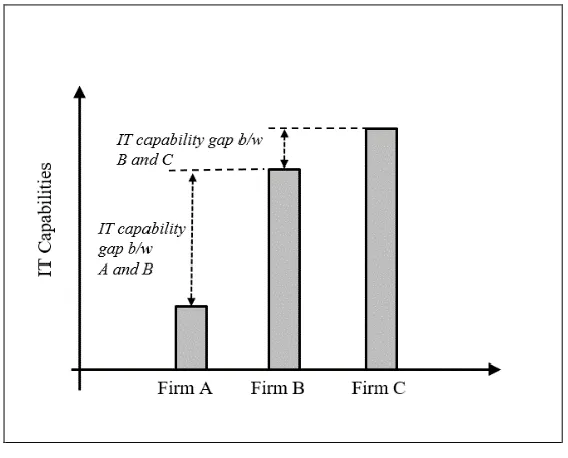
what extent a focal firm’s IT capability is superior to its rival firm’s IT capability. Figure 2.1
represents the graphical illustration of IT capability and the IT capability gap. The bar chart
represents the level of a firm’s IT capability. Firm A has the lowest IT capability, and firm B
and C have the higher level of IT capability. In this case, firm B and C can realize superior
financial performance when they compete with firm A. It may not be possible to utilize IT
capability for competitive advantage when firm B competes with firm C because the
difference between two firms’ IT capabilities is minimal. Thus, it is necessary to measure the
Especially, when we apply the concept of IT capability gap described in In Figure 2.1, it is
[image:21.612.178.462.125.354.2]much easier to understand the difference.
Figure 2.1 IT Capability and IT Capability Gap
Prior studies (Du, 2015; Mithas et al., 2013; Tanriverdi and Uysal, 2015) have
investigated a firm’s ability to use IT by subtracting the firm’s value from another company’s
value. However, none of these research papers used the competitive dynamics framework.
Therefore, measuring the difference between two firms’ IT use is not a new approach in the
IS research, but the current study is original in the sense that we captured the rivalry view in
IT capability and extended the concept based on the competitive dynamics approach.
2.2.3 The mediating role of supply chain leannessbetween IT and firm performance
IT improves firm performance and increases the competitiveness of firms by
supporting other processes, resources, or capabilities (Melville et al., 2004; Wade and
Hulland, 2004). Several organizational capabilities enabled by IT have been suggested in
prior studies. For instance, new product development capability (Pavlou and El Sawy, 2006),
customer management, and process management capability (Mithas et al., 2011), were
identified as mediated processes or capabilities between the IT capability and firm
performance. IT improves organizational performance by enhancing business operations,
such as sales, manufacturing, marketing, logistics, customer services, and research and
development (Peppard and Ward, 2004). Consequently, it is, therefore, reasonable to test the
mediated effect of other functional capabilities to understand the effect of IT capability on a
firm performance based upon supply chain leanness.
In this study, we tested the mediated role of supply chain leannessbetween IT and
firm performance. Whereas the mediating role of several organizational capabilities and
processes between IT and firm performance, there is a considerable lack of cross-fertilization
in research between IT and supply chain performance (Venkatesh, 2013). Rai et al. (2006)
suggested that IT improves the supply chain performance through information flow
integration, physical flow integration, and financial flow integration. A firm with a superior
IT capability can possess a wide reach of information flows across departmental units,
functional units, and suppliers and thereby improve inventory efficiency (Sambamurthy et
al., 2003). Dehning et al. (2007) demonstrated the effect of supply chain management (SCM)
systems on inventory turnover and profitability by conducting an event study. Dong et al.
(2009) indicated that digitally enabled SCM increases the process performance and
competitive positions of firms. Mishra et al. (2013) showed how IT capability improves sales
to inventory ratio and stock market returns of firms. However, Shah and Shin (2007) found
the partially mediated effect of inventory performance on the relationship between IT
investment and profitability, but they did not find a significant association between IT and
influence of IT intensity on inventory turnover and Tobin’s Q, and no significant association
was found. As Dong et al. (2009) emphasized, commodity-like IT resources diminish the
value of supply chain integration in a competitive environment. Therefore, it is still important
to validate the contribution of IT to firm performance through improved SCM especially
after the 2000s.
2.3 Research Model and Hypotheses
2.3.1 Research model
Figure 2.2 summarizes our research model. The overarching theoretical idea tested in
the research model is that the IT capability gap between a focal and a rival firm does have a
positive association with the supply chain leanness and firm performance of a focal firm.
Figure 2.2 A Research Model
2.3.2 Research hypotheses
IT improves the productivity of the supply chain through the integration of
information flows, physical flows, and financial flows (Rai et al., 2006). First, IT improves
the flow of information, including operational, tactical, and strategic information, between a
IT applications make it possible to share data immediately with partners in the supply chain
(Lee et al., 1997). IT allows firms to share customer demand and inventory data in
inexpensive ways (Cachon and Fisher, 2000). Second, IT enhances a firm’s ability to manage
the stock and flow of raw materials and products in its supply chain. Vendor management
inventory (VMI), automatic replenishments, and just-in-time delivery allow a firm to
maintain its optimal level of inventory (Chen et al., 2005; Rai et al., 2006). IT applications
have decreased the time and costs required to process an order and also helped to minimize
the excessive inventory (Eroglu and Hofer, 2011). Third, IT also enables a firm to have better
financial flow integration with its partner firms using electronic payment systems. Therefore,
we can reasonably assume that IT supports business processes within a firm and across
supply chains. Consequently, it can be argued that IT increases a firm’s supply chain
productivity.
In addition, IT capability is critical in competition because a firm needs to sense and
respond to environmental changes such as a competitor’s actions, and IT supports the sensing
and responding ability of firms (Overby et al., 2006). A firm’s IT capability improves its
awareness of a rival’s strategic actions. Indeed, Sambamurthy et al. (2003) suggested that
superior IT capability enables a firm to become more agile, which is helpful to the firm’s
ability to respond to a rival’s supply chain performance. For instance, Dong et al. (2009)
argued that a firm’s superior IT capability improves supply chain agility by proactively
enabling the initiation of competitive actions and a quick response to a rival firm’s
competitive actions. IT capability provides the firm with real-time or near real-time
competitive market status changes such as supply chain leanness. Prior research on
respond quickly to changes in markets and customer’s needs through monitoring (Lee et al.,
2015). The ability to scan data and understand information about the market is important to a
firm’s capacity to engage in competitive actions (Chen et al., 2015). A firm’s use of IT
capability enables the firm to analyze a rival’s supply chain leanness, which is helpful in the
leading firm’s preparation to take competitive actions. Thus, a leading firm can react to a
rival’s inventory action proactively when the leading firm has a higher level of IT capability.
Therefore, we present the following hypothesis:
Hypothesis 1 (H1): The IT capability gap between a focal firm and its rival firm has a
positive association with the supply chain leannessof the focal firm.
The primary purpose of investing in supply chain activities is to reduce waste and
eventually improve financial performance (Mishra et al., 2013). Prior research has examined
whether lean practices and lean strategy enhance firms’ operational performance (Shah and
Ward, 2003) and their financial performance (Jayaram et al., 2008). Several previous studies
have provided evidence that supply chain performance positively contributes to financial
performance (Capkun et al., 2009; Eroglu and Hofer, 2011). However, prior research has not
adopted a competitive dynamics perspective on showing how supply chain leanness affects
firm financial performance. According to competitive dynamics theory (Grimm et al., 2006),
when a firm exercises more competitive actions before its rival firm copies or initiates a
similar type of actions, the firm may take advantage of competitive actions. Ghemawat and
McGahan (1998) pointed out that a focal firm’s inventory stock-out situations are known to
rival firms, and that competitors capitalize on these poor inventory management situations to
enhance their own competitive position in the marketplace. In addition, Olivares and Cachon
well their competitors are able to provide strong customer service performance. A firm’s
operations are frequently affected by a rival firm’s actions, and the firm may need to
coordinate with its supply chain partners to modify a product’s design or launch a new
product (Dong et al. 2009). In this sense, a focal firm with superior supply chain leanness
relative to its rival firms will realize a higher level of financial performance. Thus, we posit
the following:
Hypothesis 2 (H2): With the supply chain leanness of a rival firm held constant, as the
supply chain leanness of a focal firm increases, the financial performance of the focal
firm increases.
IT (e.g., software, hardware, and capabilities) generates value with other
organizational factors but does not create value in isolation (Bharadwaj 2000; Kohli and
Grover 2008). According to the review of Wade and Hulland (2004), the business value of IT
studies provide strong evidence for the indirect role of IT in increasing firm performance; the
logic behind this argument is that IT affects other resources or processes, leading to a
competitive advantage. Melville et al. (2004) confirmed that IT impacts organizational
performance via intermediate business processes. We believe that IT enables the business
processes in supply chains; these processes are the mediating factors that link IT capability
and firm performance. It may not be possible to directly enhance a firm’s performance by
simply deploying and managing a higher level of IT capability, although the IT capability is
much greater than that of rival firms. Prior studies have reported an indirect association
between IT and firm performance through supply chain performance. Barua et al. (1995)
described a process model from IT to firm performance, which was mediated by inventory
contexts, but this value is created through digitally enabled supply chain integration at the
process level. Shah and Shin (2007) indicated that inventory performance as measured by
inventory to sales ratio had a significant mediation role between IT investment and financial
performance in the retail and manufacturing sectors. Banker et al. (2006) found that the
impact of EDI systems on the performance at the plant level is mediated by manufacturing
capabilities. Therefore, we expect the following:
Hypothesis 3 (H3): The supply chain leanness of a focal firm mediates the relationship
between the IT capability gap and the financial performance of the focal firm.
2.4 Research Methods
2.4.1 Sample and data
This study tested whether and how IT capability gap and the supply chain leanness of
a firm influence the financial performance of the firm. Our empirical analysis focused on the
two competing firms (i.e., a leader and a challenger) in each industry because our hypotheses
were framed in terms of a comparison between a firm and its primary competitor (Ferrier et
al. 1999). We identified a leading firm and its rival firm based on market share in a specific
industry using six-digit North American Industry Classification System (NAICS) codes1.
Data were collected from InformationWeek and COMPUSTAT (Lim et al., 2011; Mishra et
al., 2013; Tanriverdi and Uysal, 2015). The resulting data set includes 82 leaders and
challenger firms from 41 manufacturing, wholesaling, and retailing industries. To avoid
possible problems from the 2008 global economic crisis (Bamiatzi et al., 2015), we have
used data from 2002 to 2008. The sample comprised a total of 282 firm-level observations.
1We assumed that not every rival firm effectively competes with a leader. In some industries, the market share
2.4.2 Variables
Independent variables: IT capability and the IT capability gap
The first independent variable was IT capability, which is derived from the
InformationWeek (IW) 500 list. Every year since 1989, IW has announced the top 500 firms
with strong IT capabilities, and this data set were used as a proxy to assess a firm’s IT
capability (Bharadwaj, 2000; Chae et al., 2014; Lim et al., 2011; Lim et al., 2013; Tanriverdi
and Uysal, 2015). In this study, firms in our sample have an IT capability value equal to 1 if
they appear on the IW 500 list. Otherwise, the IT capability value of the firm in our sample is
equal to 0. We examined several issues with using the IW 500 list, such as the halo effect
(Santhanam and Hartono, 2003) and the binary aspect (Lim et al., 2011); these issues are
discussed in Appendix 2.A.
The key independent variable, the IT capability gap, was operationalized by
subtracting a rival firm’s IT capability from a firm’s IT capability. Tanriverdi and Uysal
(2015) suggested the concept of relative IT capability, which captures asymmetries between
IT capabilities of acquiring firms and their target firms in the M&A market, using binary
values from IW 500 list. Following Tanriverdi and Uysal (2015), Du (2015) investigated how
the IT gap between an acquirer and a target firm influenced the M&A performance. The gap
is calculated using the following formula:
IT capability gap of firm A = IT capability of firm A – IT capability of firm A’s rival
The IT capability gap was 1, if firm A was on the IW 500 list, but firm A’s rival was not. In
addition, the IT capability gap was 0 if both firms were on the IW list or if both firms were
Dependent variable: Supply chain leanness
To measure the performance of the supply chain, we calculated the empirical leanness
of the firm. Following Eroglu and Hofer (2011; 2014), we measured a firm’s supply chain
performance using an empirical leanness indicator (ELI). ELI has several advantages over
other inventory performance measures. Specifically, ELI captures the relative performance of
inventory management by comparing the position of a firm and other firms in the same
industry. Therefore, it is more appropriate to show a firm’s ability in managing inventory in
the context of rivalry. The detailed procedure for calculating ELI is shown in Appendix 2.B.
Dependent variable: Financial performance
Return on assets (ROA) and profit were calculated from the COMPUSTAT data. ROA
is the most widely used accounting measures of profitability (Bharadwaj, 2000; Brynjolfsson
and Hitt, 1996; Lim et al., 2013) and is also calculated with accounting measures
(Bharadwaj, 2000; Chae et al., 2014). Profit is the value of net income. The profit variable
allows us to easily interpret the results (Mithas et al., 2016; Tafti et al., 2015).
Control variable: The Herfindahl-Hirschman Index (HHI)
TheHHI captures industry concentration in the same manner as Han et al. (2011).
The HHI for a specific industry is calculated by using financial data from COMPUSTAT.
Specifically, we used the following formula:
𝐻𝐻𝐼𝑗 = ∑ 𝑆𝑖2 𝑛
𝑖=1
where 𝑠𝑖 represents the market share of firm i, and n is the number of firms in industry j to
which firm i belong. A higher value of HHI indicates that industry j is highly concentrated
and less competitive (Han et al., 2011). We used COMPUSTAT to calculate the HHI for each
Control variable: Firm size gap
Large firms have more resources for IT investment and supply chain management
(Mithas et al., 2013). Thus, it is necessary to control for the impact of firm size on IT
capability gap, supply chain leanness, and financial performance. Especially, we have
calculated the gap between the sizes of two firms because our research model is grounded in
dyadic relationships. We measured the difference between a focal firm’s size and a rival
firm’s size. Firm size was measured by the log-transformed value of sales of a firm for each
year (Lim et al. 2011).
Control variable: Market share gap
When a firm carries out more competitive actions, the firm is less likely to be exposed
to the erosion of market share (Ferrier et al., 1999). Thus, it is reasonable to control for the
effect of market share gap on dependent variables. We measured individual market shares for
both a focal and a rival firm using sales totals reported in the industry. Market share gap was
calculated by subtracting a focal firm’s market share by its rival firm’s market share (Ferrier
et al., 1999).
2.5 Research Results
2.5.1 Empirical specification
To test our hypotheses, we estimated two equations. Equation (2-1) tested whether the
IT capability and the IT capability gap impact a firm’s supply chain leanness. Additionally,
Equation (2-2) was examined to identify the positive influence of supply chain leanness on
the financial performance of firms. To address potential endogeneity concerns, we lag the IT
variables by one year (Atasoy et al., 2016; Im et al., 2013; Mithas et al., 2013). Specifically,
performance in year t. In addition, to account for the unobserved heterogeneity across
industries and years in our data, year dummies and industry dummies were added to our
models (Bardhan et al., 2013). Control variables for HHI, firm size gap, market share gap
were also included(Ferrier et al., 1999; Lim et al., 2013; Han et al., 2011). Financial
performance variables included ROA and profit of a firm. In the models, i, t, and m represent
firms, years, and industries, respectively.
𝑆𝐶 𝑙𝑒𝑎𝑛𝑛𝑒𝑠𝑠 𝑜𝑓 𝑎 𝑓𝑖𝑟𝑚𝑖𝑡 = 𝛼0+ 𝛼1𝐼𝑇 𝑐𝑎𝑝𝑎𝑏𝑖𝑙𝑖𝑡𝑦𝑖𝑡−1+ 𝛼2𝐼𝑇 𝑐𝑎𝑝𝑎𝑏𝑖𝑙𝑖𝑡𝑦 𝑔𝑎𝑝𝑖𝑡−1+
𝛼3𝑆𝐶 𝑙𝑒𝑎𝑛𝑒𝑠𝑠 𝑜𝑓 𝑎 𝑟𝑖𝑣𝑎𝑙𝑖𝑡+ 𝛼4𝐻𝐻𝐼𝑖𝑡+𝛼5𝐹𝑖𝑟𝑚 𝑠𝑖𝑧𝑒 𝑔𝑎𝑝𝑖𝑡 + 𝛼6𝑀𝑎𝑟𝑘𝑒𝑡 𝑠ℎ𝑎𝑟𝑒 𝑔𝑎𝑝𝑖𝑡
+ 𝛼7𝐹𝑃 𝑜𝑓 𝑎 𝑓𝑖𝑟𝑚𝑖𝑡−1+ ∑ 𝛼𝑚𝐼𝑛𝑑𝑢𝑠𝑡𝑟𝑦 𝑑𝑢𝑚𝑚𝑖𝑒𝑠𝑚+ ∑ 𝛼𝑡𝑌𝑒𝑎𝑟 𝑑𝑢𝑚𝑚𝑖𝑒𝑠𝑡+ 𝜀𝑖𝑡 (2-1)
𝐹𝑃 𝑜𝑓 𝑎 𝑓𝑖𝑟𝑚𝑖𝑡 = 𝛽0+ 𝛽1𝑆𝐶 𝑙𝑒𝑎𝑛𝑛𝑒𝑠𝑠 𝑜𝑓 𝑎 𝑓𝑖𝑟𝑚𝑖𝑡+ 𝛽2𝑆𝐶 𝑙𝑒𝑎𝑛𝑒𝑠𝑠 𝑜𝑓 𝑎 𝑟𝑖𝑣𝑎𝑙𝑖𝑡
+ 𝛽3𝐼𝑇 𝑐𝑎𝑝𝑎𝑏𝑖𝑙𝑖𝑡𝑦𝑖𝑡−1+ 𝛽4𝐼𝑇 𝑐𝑎𝑝𝑎𝑏𝑖𝑙𝑖𝑡𝑦 𝑔𝑎𝑝𝑖𝑡−1+ 𝛽5𝐻𝐻𝐼𝑖𝑡+ 𝛽6𝐹𝑖𝑟𝑚 𝑠𝑖𝑧𝑒 𝑔𝑎𝑝 𝑖𝑡
+ 𝑀𝑎𝑟𝑘𝑒𝑡 𝑠ℎ𝑎𝑟𝑒 𝑔𝑎𝑝 𝑖𝑡+ ∑ 𝛽𝑚𝐼𝑛𝑑𝑢𝑠𝑡𝑟𝑦 𝑑𝑢𝑚𝑚𝑖𝑒𝑠𝑚+ ∑ 𝛽𝑡𝑌𝑒𝑎𝑟 𝑑𝑢𝑚𝑚𝑖𝑒𝑠𝑡+ 𝜁𝑖𝑡 (2-2)
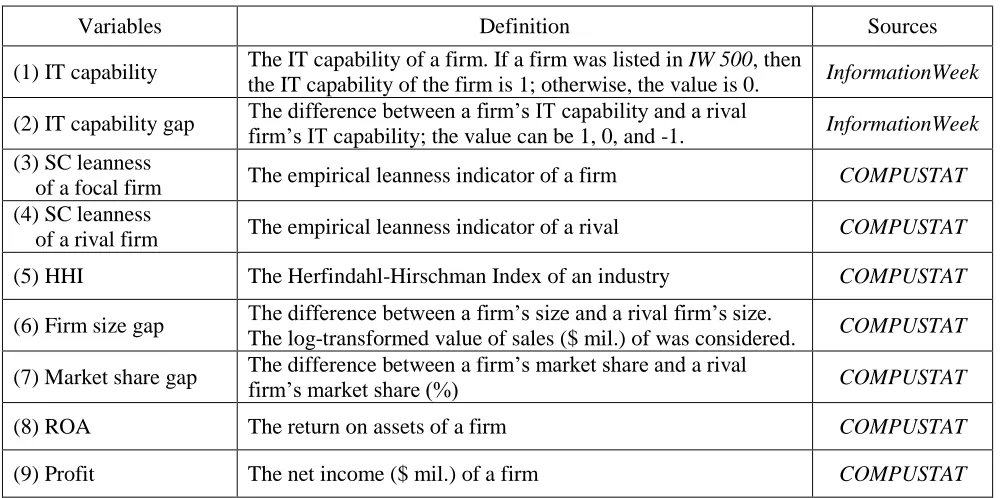
[image:31.612.84.588.430.679.2]Variables used in this research are summarized in Table 2.1.
Table 2.1 The Definition of Variables
Variables Definition Sources
(1) IT capability The IT capability of a firm. If a firm was listed in IW 500, then
the IT capability of the firm is 1; otherwise, the value is 0. InformationWeek
(2) IT capability gap The difference between a firm’s IT capability and a rival firm’s IT capability; the value can be 1, 0, and -1. InformationWeek
(3) SC leanness
of a focal firm The empirical leanness indicator of a firm COMPUSTAT
(4) SC leanness
of a rival firm The empirical leanness indicator of a rival COMPUSTAT
(5) HHI The Herfindahl-Hirschman Index of an industry COMPUSTAT
(6) Firm size gap The difference between a firm’s size and a rival firm’s size.
The log-transformed value of sales ($ mil.) of was considered. COMPUSTAT
(7) Market share gap The difference between a firm’s market share and a rival firm’s market share (%) COMPUSTAT
(8) ROA The return on assets of a firm COMPUSTAT
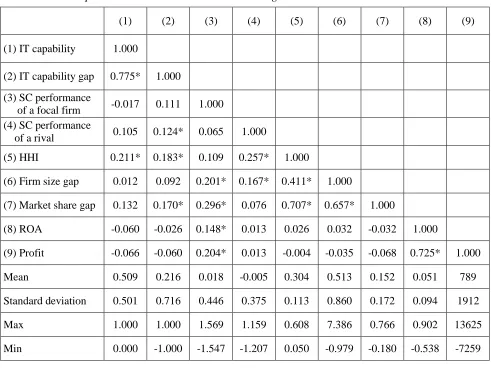
Table 2.2 contains the descriptive statistics and correlations among variables.
Multicollinearity was not a serious issue in Equations (2-1) and (2-2) since the variance
inflation factor (VIF) was lower than three (Wooldridge, 2010).
2.5.2 Empirical results
For equation (2-1), we used generalized least squares (GLS) and generalized estimate
equations (GEE) with a correction for the first-order autoregressive model, AR(1), because
the Wooldridge test (p< 0.009) for autocorrelation indicated a strong presence of AR(1) in
[image:32.612.76.567.309.678.2]Equation (2-1).
Table 2.2 Descriptive Statistics and Correlations Among Variables
(1) (2) (3) (4) (5) (6) (7) (8) (9)
(1) IT capability 1.000
(2) IT capability gap 0.775* 1.000
(3) SC performance
of a focal firm -0.017 0.111 1.000 (4) SC performance
of a rival 0.105 0.124* 0.065 1.000
(5) HHI 0.211* 0.183* 0.109 0.257* 1.000
(6) Firm size gap 0.012 0.092 0.201* 0.167* 0.411* 1.000
(7) Market share gap 0.132 0.170* 0.296* 0.076 0.707* 0.657* 1.000
(8) ROA -0.060 -0.026 0.148* 0.013 0.026 0.032 -0.032 1.000
(9) Profit -0.066 -0.060 0.204* 0.013 -0.004 -0.035 -0.068 0.725* 1.000
Mean 0.509 0.216 0.018 -0.005 0.304 0.513 0.152 0.051 789
Standard deviation 0.501 0.716 0.446 0.375 0.113 0.860 0.172 0.094 1912
Max 1.000 1.000 1.569 1.159 0.608 7.386 0.766 0.902 13625
Min 0.000 -1.000 -1.547 -1.207 0.050 -0.979 -0.180 -0.538 -7259
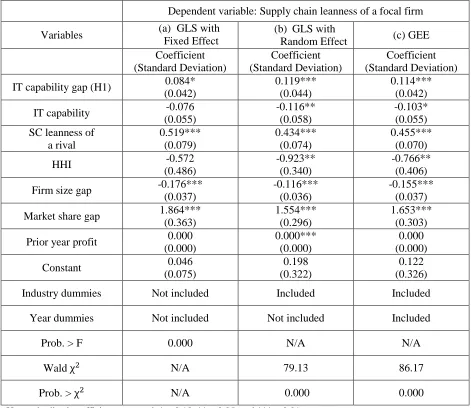
We reported the results of both a fixed effect model and a random effect model to show the
robustness of the results (Table 2.3). Hypothesis 1 assumed that the IT capability gap
between a firm and its rival has a positive influence on the supply chain leanness of a firm.
The coefficients (𝛼2a =0.084, 𝛼2b =0.119, and 𝛼2𝑐 =0.114) in columns (a), (b), and (c) in
Table 2.3 are all positive and significant at the 5%, 1%, and 1% level, respectively. Thus,
[image:33.612.89.560.259.667.2]Hypothesis 1 was supported.
Table 2.3 Results for IT Capability on the SC Performance of a Focal Firm
Dependent variable: Supply chain leanness of a focal firm
Variables (a) GLS with
Fixed Effect
(b) GLS with
Random Effect (c) GEE
Coefficient (Standard Deviation) Coefficient (Standard Deviation) Coefficient (Standard Deviation)
IT capability gap (H1) 0.084*
(0.042)
0.119*** (0.044)
0.114*** (0.042)
IT capability -0.076
(0.055)
-0.116** (0.058)
-0.103* (0.055) SC leanness of
a rival 0.519*** (0.079) 0.434*** (0.074) 0.455*** (0.070)
HHI -0.572
(0.486)
-0.923** (0.340)
-0.766** (0.406)
Firm size gap -0.176***
(0.037)
-0.116*** (0.036)
-0.155*** (0.037)
Market share gap 1.864***
(0.363)
1.554*** (0.296)
1.653*** (0.303)
Prior year profit 0.000
(0.000)
0.000*** (0.000)
0.000 (0.000)
Constant 0.046
(0.075)
0.198 (0.322)
0.122 (0.326)
Industry dummies Not included Included Included
Year dummies Not included Not included Included
Prob. > F 0.000 N/A N/A
Wald χ2 N/A 79.13 86.17
Prob. > χ2 N/A 0.000 0.000
Interestingly, IT capability does not have an effect on the supply chain leanness of a
focal firm. The coefficients of IT capability (𝛼1𝑏 =-0.116 and 𝛼1𝑐 =-0.103) in columns (b)
and (c) in Table 2.3 suggest that there is no positive association between IT capability and
[image:34.612.93.548.201.616.2]supply chain leanness.
Table 2.4 Regression Results for Return on Assets (ROA)
Dependent Variable: ROA of a Focal Firm
Variables (a) GLS with
Random effect (b) Feasible GLS (c) GEE
Coefficient (Standard Deviation) Coefficient (Standard Deviation) Coefficient (Standard Deviation) SC leanness of
a focal firm (H2)
0.042** (0.019) 0.027** (0.012) 0.033** (0.015) SC leanness of
a rival firm
-0.030 (0.028) -0.021 (0.014) -0.023 (0.019)
IT capability -0.041*
(0.020)
-0.001 (0.016)
-0.015 (0.017)
IT capability gap 0.032*
(0.015)
0.005 (0.011)
0.017 (0.012)
HHI index 0.228
(0.159)
0.069 (0.065)
0.036 (0.089)
Firm size gap 0.028**
(0.011)
0.000 (0.008)
0.010 (0.009)
Market share gap -0.150*
(0.106)
-0.021 (0.052)
-0.064 (0.069)
Constant 0.112**
(0.043)
-0.003 (0.034)
0.012 (0.051)
Industry dummies Included Included Included
Year dummies Included Included Included
Prob. > F 0.002 N/A N/A
Wald χ2test N/A 45.47 34.66
Prob. > χ2 N/A 0.001 0.010
Unstandardized coefficients reported. Standard errors are in parentheses. R-square of model (a) is 0.177. Log-likelihood of model (b) is 242.524. *p<0.10, **p<0.05, and ***p<0.01.
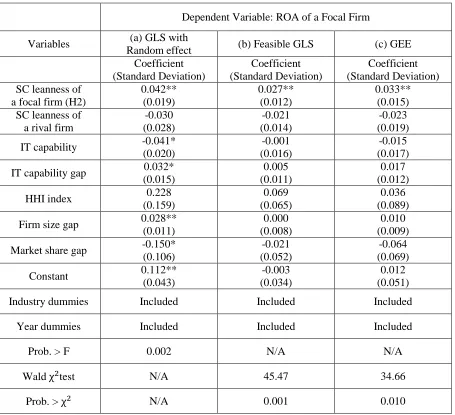
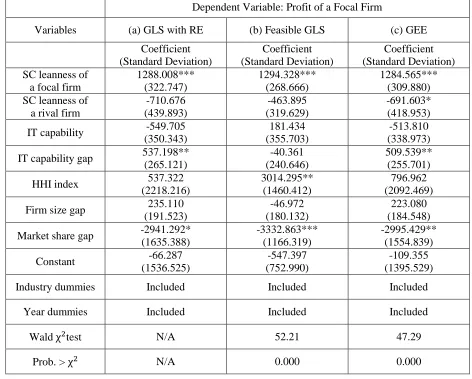
Hypothesis 2 suggests that the supply chain leanness of a firm improves the financial
models. Contrary to Equation (2-1), there was no autocorrelation in Equation (2-2)2. To
ensure the robustness of the results, we reported the output of GLS, feasible GLS, and GEE
simultaneously. Table 2.4 presents the regression results of ROA. All three coefficients
(𝛽2𝑎=0.042, 𝛽2𝑏 =0.027, and 𝛽2𝑐 =0.033) in the columns (a), (b), and (c) in Table 2.4 were
significantly positive at the 5% level. Thus, the supply chain leanness of a firm improved the
ROA of the firm. However, the IT capability gap did not have a significant relationship with
the ROA of a firm in the columns (b) and (c) in Table 2.4. Therefore, Hypothesis 2 was
supported.
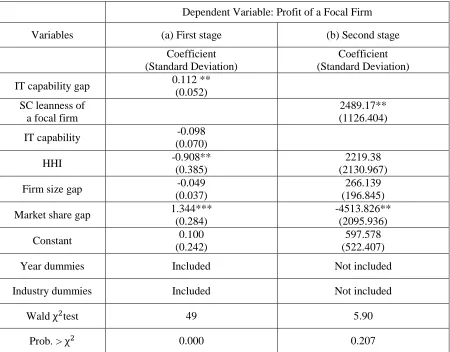
Hypothesis 3 argues that the IT capability gap improves a firm’s profitability through
enhanced supply chain leanness. To test the mediation effect of supply chain leanness
between the IT capability gap and firm profitability, we also conducted two-stage least
squares (2SLS) regression analyses as recommend by Shaver (2005). Specifically, we
assumed that the IT capability gap was exogenous, while the supply chain performance of a
firm was the endogenous variable. Instrumental variables also included industry and year
dummy variables as described by Ray et al. (2009). The simultaneous equation model was
specified as follows:
𝐹𝑃 𝑜𝑓 𝑎 𝑓𝑖𝑟𝑚𝑖𝑡 = 𝛾0+ 𝛾1𝑆𝐶 𝑙𝑒𝑎𝑛𝑛𝑒𝑠𝑠 𝑜𝑓 𝑎 𝑓𝑖𝑟𝑚𝑖𝑡+𝛾2𝐻𝐻𝐼𝑖𝑡+ 𝛾3𝐹𝑖𝑟𝑚 𝑠𝑖𝑧𝑒 𝑔𝑎𝑝𝑖𝑡
+𝛾3𝑀𝑎𝑟𝑘𝑒𝑡 𝑠ℎ𝑎𝑟𝑒 𝑔𝑎𝑝𝑖𝑡+ 𝜈𝑖𝑡
where (2-3)
𝑆𝐶 𝑙𝑒𝑎𝑛𝑛𝑒𝑠𝑠 𝑜𝑓 𝑎 𝑓𝑖𝑟𝑚𝑖𝑡 = 𝛿0+ 𝛿1𝐼𝑇 𝑐𝑎𝑝𝑎𝑏𝑖𝑙𝑖𝑡𝑦 𝑔𝑎𝑝𝑖𝑡−1+ 𝛿2𝐼𝑇 𝑐𝑎𝑝𝑎𝑏𝑖𝑙𝑖𝑡𝑦𝑖𝑡−1+
𝛿3𝐻𝐻𝐼𝑖𝑡+ 𝛿4𝐹𝑖𝑟𝑚 𝑠𝑖𝑧𝑒 𝑔𝑎𝑝𝑖𝑡 + 𝛿5𝑀𝑎𝑟𝑘𝑒𝑡 𝑠ℎ𝑎𝑟𝑒 𝑔𝑎𝑝𝑖𝑡 +
∑ 𝛿𝑚𝐼𝑛𝑑𝑢𝑠𝑡𝑟𝑦 𝑑𝑢𝑚𝑚𝑖𝑒𝑠𝑚+ ∑ 𝛿𝑡𝑌𝑒𝑎𝑟 𝑑𝑢𝑚𝑚𝑖𝑒𝑠𝑡+ 𝜉𝑖𝑡
2 Wooldridge test for autocorrelation in Model (2-2) was 0.177, which suggests that there is no AR1
Equation (2-3) captures how the IT capability gap influences financial performance through
the supply chain leanness of a firm; coefficient 𝛾1 estimates the effect size of the influence of
supply chain leanness, and 𝛿1 measures the effect of the IT capability gap on supply chain
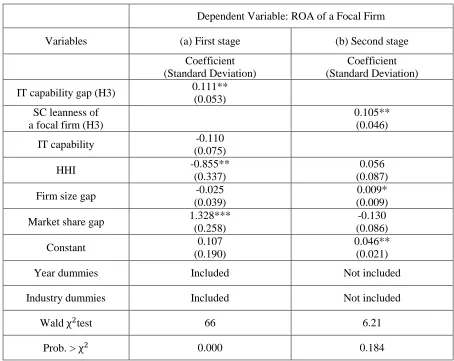
leanness. The results are summarized in Table 2.5 The coefficient (𝛿1=0.111) of the IT
capability gap and the coefficient (𝛾1=0.105) of the supply chain leanness of a firm in Table
2.5were positive at 5% significance level. Thus, the association between the IT capability
gap and the profitability of a firm, i.e., ROA, is fully mediated by the supply chain leanness
[image:36.612.87.541.312.673.2]of the firm. Consequently, Hypothesis 3 was supported.
Table 2.5 Results of Two Stage Least Squares Regression Analyses for ROA
Dependent Variable: ROA of a Focal Firm
Variables (a) First stage (b) Second stage
Coefficient (Standard Deviation)
Coefficient (Standard Deviation)
IT capability gap (H3) 0.111**
(0.053) SC leanness of
a focal firm (H3)
0.105** (0.046)
IT capability -0.110
(0.075)
HHI -0.855**
(0.337)
0.056 (0.087)
Firm size gap -0.025
(0.039)
0.009* (0.009)
Market share gap 1.328***
(0.258)
-0.130 (0.086)
Constant 0.107
(0.190)
0.046** (0.021)
Year dummies Included Not included
Industry dummies Included Not included
Wald χ2test 66 6.21
Prob. > χ2 0.000 0.184
2.5.3 Robustness checks
We conducted additional analyses to ensure that our research results were not driven
by a variable specification. More precisely, the association between supply chain leanness
and profit variables and the mediated effect of IT capability gap and profit were tested. We
found the same result as shown when we tested our model using ROA variable. The detailed
results are reported in Appendix 2.C.
2.6 Discussion and Conclusion
2.6.1 Discussion
This study provides several contributions to the IS literature. First, we have suggested
the concept of IT capability gap, which describes the difference between two competing
firms’ IT capabilities drawing upon the resource-based view (Barney, 1991) and the
competitive dynamics framework (Chen and Miller, 2012; Grimm et al., 2006). Any type of
firm-specific resource, which is not easily transferable to or imitable by rival firms, enables
the firm to develop a competitive advantage (Makadok, 2001). In a similar way, if IT
capability shapes a firm’s competitiveness, then the capability should heterogeneously reside
in the firms (Bhatt and Grover, 2005; Doherty and Terry, 2009). To date, only a few IS
studies have examined whether the IT capability is firm-specific (Lim et al., 2011) and to
what extent a firm’s IT practices deviate from other firms (Mithas et al., 2013). By
considering the rivalry view from competitive dynamics, we have assessed the gap in IT
capabilities between two competing firms, a focal firm and its rival in the same industry
because it has become more difficult to maintain a superior position in the use of IT systems
due to the commoditization of IT resources (Chae et al., 2014; Wang, 2010). However, our
performance. The IT capability gap is a more precise construct to use when assessing a firm’s
position and familiarity with using IT in dynamic business environments. Additionally, we
have observed that IT capability has a negative influence on supply chain leanness. This
might be the case because IT capability gap has more explanatory power than IT capability
when both variables were estimated together.
Second, this research builds upon and theoretically extends previous studies, by
investigating the mediating role of the supply chain leanness of a firm between its IT
capability and the overall performance of the firm. Previous literature has suggested an
indirect contribution of IT to firm performance through other business processes (Melville et
al., 2004; Wade and Hulland, 2004). The influence of IT on the performance in supply chains
(i.e., inventory turnover or sales-to-inventory ratio) has been tested (Mishra et al., 2013; Shah
and Shin, 2007). However, no study has investigated the influence of IT on supply chain
leanness in the context of the rivalry view based on the competitive dynamics literature. We
have shown that a firm’s superior ability in managing supply chain activities enabled by IT
has a strong influence on a firm’s competitiveness when a focal firm has superior IT
capability over its rival firm. This study has originality in the sense that we tested and
supported how supply chain performance mediates the positive influence of IT on a firm’s
competitiveness rather than evaluating the enhanced productivity from IT (Rai et al., 2006).
An important implication of our research results is that contrary to IT capability, the
IT capability gap has a positive impact on firm performance. We illustrated that the
heterogeneous distribution of IT-related resources and capabilities among firms is the key
premise of the business value of IT studies, and the IT capability gap is a valuable concept
variable to measure a firm’s IT capability based on IW 500. Future studies may evaluate a
firm’s IT capability gap in a different way. In addition, Im et al. (2013) suggested that when
we measure the IT stock of a firm, we need to consider the depreciation of IT applications. In
a similar way, the IT capability gap can either decay or be reinforced due to the depreciation.
Other data sources, which include information about IT applications or IT investment in
firms (Baker et al., 2017), may be useful to extend the IT capability concept and its impact on
firm performance.
Another implication of our research study is that supply chain leanness represents an
important mediating factor that links IT capability to firm performance. While this study
demonstrates the mediating role of the leanness of a firm between IT and firm performance,
we did not account for any inter-firm relationships in the supply chain or the role of IT in
these relationships. It could be, therefore, insightful to investigate the impact of IT on the
performance of all firms in a supply chain. Rai et al. (2012) described inter-IT capability as
“the ability of a grouping of inter-firm relationships to execute inter-firm business processes
based on a set of IT functionalities that is implemented and used in combination with other
business resources” (p. 238). The IT capability gap may support the business processes of
firms in a same supply chain network, and the aggregated value of the leanness of firms in
the supply chain can be used to assess the influence of IT.
2.6.2 Implication for practice
Practically, the findings of this study justify the value of investment in IT applications
for businesses. Prior studies have suggested that IT is not a resource which determines the
competitiveness of firms. Carr (2003) guided managers to spend less money, follow other
opportunities. Wang (2010) argued that there is a tendency to pursue a new and forefront IT
among top managers and that those hottest IT applications do not improve firm performance.
This research also agrees with the idea that simply possessing more IT applications and
without utilizing IT applications with other organizational resources does not guarantee the
superior performance of firms. However, we can also make a counter argument to this belief
using the rivalry view. In the very beginning of developing a business strategy, firms identify
their rival firms’ resources and competitive actions in the market and prepare for the possible
strategy based on their resources. IT is no exception. Depending on the level of IT systems
that rival firms have installed, a firm can invest the appropriate amount of budget in IT
systems. Specifically, when every firm in a specific industry spends a substantial amount to
fund IT, a firm should assign more budget than its rivals to sustain its current position. On
the other hand, a firm easily takes advantage of IT systems if rivals do spend less money on
IT systems.
The rivalry view is applicable not only to determine the volume of the IT budget but
also to install the IT applications. A firm should effectively manage its IT portfolio and be IT
savvy, which refers to the ongoing use of a set of business practices and competencies that
collectively derive superior value from IT investments, to get returns from IT investment
(Weill and Aral, 2006). Each type of IT investment represents a different IT asset and
supports a different business dimension (Gregor et al., 2006). An IT application can be used
for its own business process and cannot support others. Therefore, a firm needs to evaluate