2014
Individual differences in the impact of
odor-induced emotions on consumer behavior
Meng-Hsien Lin
Iowa State University
Follow this and additional works at:https://lib.dr.iastate.edu/etd
Part of theAdvertising and Promotion Management Commons,Cognitive Psychology Commons, and theMarketing Commons
This Dissertation is brought to you for free and open access by the Iowa State University Capstones, Theses and Dissertations at Iowa State University Digital Repository. It has been accepted for inclusion in Graduate Theses and Dissertations by an authorized administrator of Iowa State University Digital Repository. For more information, please [email protected].
Recommended Citation
Lin, Meng-Hsien, "Individual differences in the impact of odor-induced emotions on consumer behavior" (2014).Graduate Theses and
Dissertations. 13722.
by
Meng-Hsien (Jenny) Lin
A dissertation submitted to the graduate faculty
in partial fulfillment of the requirements for the degree of
DOCTOR OF PHILOSOPHY
Major: Business and Technology (Marketing)
Program of Study Committee:
Terry L. Childers, Co-major Professor Samantha N.N. Cross, Co-major Professor
Russell Laczniak Robert West Douglas Bonett
Iowa State University
Ames, Iowa
2014
TABLE OF CONTENTS
ABSTRACT ... iv
CHAPTER 1: INTRODUCTION ... 1
CHAPTER 2: LITERATURE REVIEW AND HYPOTHESES ... 13
Literature review ... 13
Olfaction ... 13
Emotions... 26
Research framework ... 31
Hypotheses ... 33
CHAPTER 3: MATERIALS AND METHODS ... 40
Overview of studies ... 40
Experiment 1: Odor-elicited emotions ... 41
Experiment 2: Emotions-elicited in odor-associated images and olfactory mental imagery .. 45
Experiment 3: The “contagion effects” of odors on judgment and decision making ... 48
Experiment 4: Are emotions enhanced by smell cues in ads? ... 54
Data analyses ... 57
CHAPTER 4: RESULTS ... 59
Experiment 1: Odor-elicited emotions ... 60
Experiment 2: Emotions-elicited in odor-associated images and olfactory mental imagery .. 65
Experiment 3: The “contagion effects” of odors on judgment and decision making ... 68
Experiment 4: Are emotions enhanced by smell cues in ads? ... 84
APPENDIX A ... 116
APPENDIX B ... 118
APPENDIX C ... 120
APPENDIX D ... 123
APPENDIX E ... 125
APPENDIX F ... 127
APPENDIX G ... 129
APPENDIX H ... 130
APPENDIX I ... 131
APPENDIX J ... 133
ABSTRACT
The focus of this dissertation is to understand the role of olfaction (sense of smell) in
consumer behavior. The close relationship between olfaction and emotions is the center of
this dissertation, examining not only the impact of odors or olfactory imagery induced
emotions, but also the downstream influences on consumer decision making and judgment.
Another important focus of study is to explore how individual differences in olfaction,
specifically hyperosmics (or so called sensitives) and normal, respond similarly or differently
to odors. A series of four experiments, including a combination of event-related potential
(ERP) studies and behavioral studies, were executed to address these research questions.
Both expected and unexpected results were uncovered in this dissertation. As
expected, there was a negativity bias for both olfactory groups, as stronger emotions,
reflected in stronger Late Positive Potential (LPP) were detected during unpleasant odor
conditions compared to pleasant. Additionally, olfactory imagery enhanced emotions for
normal individuals through pleasant odor- associated pictures. Also, for sensitive individuals,
unpleasant odors have a stronger influence on behavioral outcomes resulting in more severe
moral judgment, negative personal evaluations. Unexpectedly, pleasant odors appear to have
a negative impact on sensitive individuals, as more health-related symptoms were reported.
Furthermore, emotions during olfactory imagery of pleasant odor associated pictures or ads
were attenuated. Also, both pleasant and unpleasant odor conditions resulted in increased
probability of healthy food choice. Possible explanations and implications are discussed. Call
Finally, the role of olfactory imagery was investigated along with sniffing motions.
Explained by embodied cognition, sniffing motions resulted in increased emotions, even for
sensitive individuals in this case. The effect of sniffing enhanced emotions further impacted
advertised product ratings and likelihood to buy ratings for sensitive but not normal
individuals. In the end of the dissertation, theoretical and marketing implementations, future
CHAPTER 1: INTRODUCTION
Olfaction (sense of smell) is one of the senses that are often taken for granted by
individuals. The role of olfaction can be seen as two fold. The first is a functional role,
rooted in the survival of the species, including staying away from hazards, food ingestion and
social relationships (Stevenson 2010). The other role of olfaction is a more modern role,
associated with the enjoyment of activities and has gained attention recently in the consumer
behavior literature (Krishna, 2011). In the consumer setting, the role of olfaction has been
connected with product memory (Krishna, Lwin and Morrin 2010; Morrin, Lwin and Krishna
2011), and product evaluation (Bosmans, 2006; Spangenberg, Crowley and Henderson,
1996). It is well documented in the neuroscience and chemosensory literature that the role of
olfaction is not only closely related to the memory of odor-related events (Herz and Engen,
1996), but emotions are also closely related to the detection and processing of odors in the
brain (Cahill et al., 1995). The neuroanatomy of the brain provides insight into the close
connection between olfactory processing and emotions processed in the brain. There are
only two synapses between the olfactory nerve and the amygdala which is known as the
control center for emotion processing (Herz and Engen, 1996). Most researchers examine
the dual dimensions of emotions, differentiating pleasant and unpleasant. However, some
studies have investigated specific odor-elicited emotions in individuals (Chrea et al., 2009;
Porcherot et al., 2010) identifying five emotional dimensions, such as disgust-irritation,
happiness-well-being, awe-sensuality, soothing-peaceful and energizing-refreshing.
Different dimensions have been identified for different countries such as Britain and
Singapore (Ferdenzi et al., 2011). Emotions often influence how individuals make purchase
Lerner and Keltner 2000). It is posited in these studies that the influence of emotions on
behavior is determined by their valence (positive or negative). Hence, different positive
emotions should exert a similar positive influence on behavior because they share the same
positive valence. The relationship between emotions and decision making is also supported
by neuroscience data (Bechara 2005).
However, what has not been examined in-depth is how emotions elicited from odors
can influence further decisions and judgments consumers make in the marketplace. The
consumption environment, whether it is the retail place or restaurant, is filled with different
olfactory stimuli and cues. It could be in the actual chemical format, often called scent or
odor. Or it could be presented as cues in the form of words or pictures. This dissertation
investigates how emotions elicited from processing different types of olfactory stimuli can
influence downstream consumer behavior.
Past research studying the role of olfaction in consumer behavior has focused on
investigations of the normal population (Krishna, Lwin and Morrin 2010; Morrin, Lwin and
Krishna 2011), recruiting from the average undergraduate population. However, we know
from medical studies that smell impairments can be due to aging (Murphy et al., 2002),
cigarette smokers (Vennemann, Hummel and Berger, 2008), side effects from drug
treatments (Bromley 2000) and other diseases (Le Floch et al., 1993). Similarly, medical
journals have investigated the other end of the olfactory continuum where studies have been
conducted on enhanced olfactory sensitivity in patients undergoing chemotherapy
(Bernhardson et al., 2008; Steinbach and Hummel, 2009) and pregnant women (Cameron
on these populations are under researched and almost absent in consumer research. This is in
contrast to other senses which have gained attention in consumer research by including
individual differences in preferences in terms of reliance and usage of senses, for example
haptic (touch) (Peck and Childers 2003; Krishna and Morrin 2008). Other studies have
focused on vulnerable groups of consumers such as individuals with impaired vision (Baker
2006; Childers and Kaufman-Scarborough 2009) and the concerns of these groups in the
marketplace. Individual differences in capability based on the sense of smell have been less
explored and are commonly taken for granted.
In this dissertation, individual differences in olfaction processing will be discussed by
considering consumers with varying capabilities and sensitivity to smell. Specifically,
individuals who are sensitive to smell often self-report that they process odor-related
information more intensely and often detect odors at a lower threshold compared to others.
Consequences of this include physical reactions and other irritations that affect individuals’
selection of products. Scent also triggers memories and can enhance consumption
experiences for individuals. However, “amplification” of these olfactory messages could
become overwhelming for sensitive individuals. Preliminary insights about these different
groups of individuals stemmed from in depth interviews conducted for a prior study.
Extending the concept of odor-elicited emotions, instead of physically presented
odors, the literature on mental imagery has provided some interesting evidence on olfactory
imagery (Djordjevic et al., 2004). Odor imagery, along with visual imagery, can be
developed and processed in the brain similarly to sensory processing occurring during actual
olfactory imagery can affect the perception of odor. What has not been explicitly examined
is whether odor imagery can also affect the emotions of individuals.
The possibility of odor imagery was highly debated in the 90’s, where some
researchers provided evidence of the effect of odor imagery (Carassco and Ridout, 1993),
while others had difficulty showing this effect (Crowder & Schab, 1995; Engen, 1982, 1987).
Later, accumulating studies showed high variation in odor imagery across individuals, thus
measures of odor imagery capabilities were developed. A subjective measure of the
vividness of odor imagery questionnaire was developed by Gilbert et al. (1998), modifying a
visual vividness imagery questionnaire (Marks, 1973). Later, an objective measurement of
odor imagery index (OII) was developed by Djordjevic et al. (2004). OII represents the
difference between matched (imaged and presented odors were the same) and mismatched
(imaged and presented odors were not the same) detection during odor imagery. The authors
compared the two measures and they do not seem to align. The relationship between odor
imagery capabilities and actual sensitivity to smell has not been documented in the literature
to our knowledge. A close but different relationship between odor detection threshold and
the objective odor imagery index was examined by Djordjevic et al (2002). The relationship
was not significant overall, but was moderated by gender. Females made more accurate
self-judgments of their odor imagery capabilities than males. Associated with this stream of
literature supporting the concept of individual differences in olfactory imagery, the
relationship between individual differences in sensitivity to smell and odor imagery
examine whether odor imagery can perform similarly to actual odors in terms of triggering
emotions among individuals.
Finally, if emotions can indeed be triggered by odors, is it possible to regulate these
emotions? The emotions literature has extended to intervention strategies that have been
proposed to regulate emotions, especially negative emotions (Gross 1998). Such emotion
regulations include cognitive reappraisal, which has been reported to be more effective and
successful in regulating emotions; and suppression, which is a down-regulating strategy
implemented after emotions have been elicited. These strategies have been used widely in
picture stimuli, word stimuli and scenario-type events, which involve the visual sense. What
has not been reported in the existing literature is whether such strategies can be effectively
implemented in regulating odor-elicited emotions.
Research questions
In this dissertation, the main question of interest is to understand whether individual
differences in sense of smell affects the level or intensity of emotions associated with
odorants. In other words, (1) are the emotions of individuals with higher sensitivity to smell
affected more by odors than the emotions of individuals with a normal sense of smell? The
emotions elicited via odors are expected to be closely associated with the valence
(pleasantness) and intensity of the odors. Considering the hedonic dimension, odorants can
be presented as either pleasant or unpleasant odorants. Both directions are investigated in
In addition, neuroimaging studies research has shown that imagery odors can be
perceived and processed similar to real odors in the olfactory cortex (Gonzalez et el, 2006),
as evidenced in grounded cognition (Barsalou, 2008). Consumers often encounter triggers
that resemble certain odors associated with memories in the marketplace or in daily situations.
Another research objective looks at whether imaged odors can trigger similar emotional
responses in individuals. If so, (2) is the intensity of emotions perceived to be stronger for
individuals who are sensitive to smell, compared to individuals with a normal sense of smell?
Furthermore, (3) will instructional cues to “sniff” or “smell” embedded in the ad trigger
olfactory imagery and enhance olfaction –related emotions?
Research on emotions has moved toward the next level, which involves
understanding the reactance to emotions, i.e., can individuals regulate emotions that are
elicited by odorants? Two types of regulation systems have been proposed and researched
over the past 15 years (Gross and John 1998), namely, cognitive reappraisal and the
suppression strategy. The main differentiating factor between the two is the timing.
Specifically, the former is initiated before the onset of emotions and the latter is introduced
after the emotions have formed. The question I ask is (4) how would the effectiveness of
these mechanisms differ among individuals varying in sensitivity to smell?
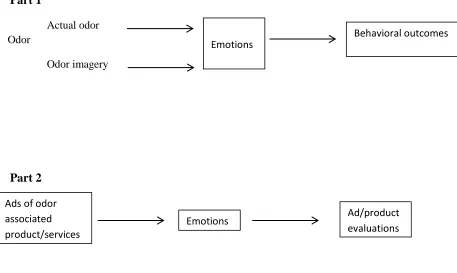
Research outline
The figure below outlines the research framework included in the dissertation which
is composed of three parts. Each part consists of several studies, discussed in detail in
Chapter 3, which will investigate the research questions in more detail. Part 1, investigates
examined, either associated with a product, infused into the environment as ambient scent, or
used as stimuli in an experimental setting. Two possible mechanisms for odor processing
will be examined. First, bottom up processing will be tested and reported via subjective
self-reports of emotions and objective measures using neuroscientific methods. Second,
top-down processing, which includes cognitive processing of odors, will be examined via both
explicit and implicit processing of odors.
Another form of odor, imagined odors, are investigated. Similarly, its effect on
triggering emotions is further examined. Instead of using ambient scent as a trigger,
olfactory imagery is induced with picture or verbal stimuli. Olfactory imagery is relevant in
terms of its applications in consumer behavior. Consumers’ daily activities involve
encountering cues in environments that may trigger odor memories and associated odors.
The impact of imaged odors and their influence on emotions will be investigated using
neuroscientific methods, specifically with ERP methods. Next, odor-induced emotions are
examined in terms of their downstream influence on decisions and judgments made by
consumers, such as product evaluation, odor-unrelated product choice and moral judgment.
The issue of individual differences in sense of smell will be explored. Specifically,
individuals with high sensitivity to smell, their responses to odors, odor-induced emotions
and downstream decision making processes, will be compared with individuals who have a
normal sense of smell. As an application of findings in the grounded cognition research
(Barsalou, 2008; Bensafi, 2006), I investigate the effects of olfactory imagery in the context
of advertisements portraying products with embodied cognition cues in the message. These
verbal information in the ads. On the other hand, it can also provide evidence for marketers
to understand how sensory information can be perceived by consumers through grounded
Figure 1. Overview of framework
Part 1
Odor
Actual odor
Odor imagery
Part 2
Behavioral outcomes Emotions
Ads of odor associated product/services
Emotions Ad/product
Contributions
Marketers have long discovered the power of scent and have tried to take advantage
of the 20,000 breaths people take each day to connect the product and consumer. Steven
Semoff, acting co-president of the Scent Marketing Institute (SMI) and technical director at
US-based Belmay Fragrances, says that while the scent industry is still in its infancy, it is
growing. In 2006, founder of the SMI, the late Harald Vogt, told the LA Times he expected
the market could grow into a $1billion business by 2014. Marketers have started to invest in
finding a signature scent for the brand. Recently, Forbes (2012) commented on how luxury
hotels are designing signature fragrances and pumping it into the lobby to subtly influence
the moods’ of customers. Marketers are capitalizing on scent and its close relationship with
memory and emotion. However, the research side of marketing has only recently, in the last
ten years, started to pay attention to the role of scent. There has also been a notable lack of
attention on individual differences among consumers. This dissertation fills this gap by
focusing on individual differences in olfactory ability and the impact of odors on emotions.
Four specific contributions are described below.
The primary objective of this research is to understand individual differences in sense
of smell. More importantly, the focus is on individuals who have higher sensitivity to smell.
From self-reported survey data, this group is estimated at 20% of the population, yet has been
under researched. In addition, event-associated increased sensitivity to smell include patients
undergoing chemotherapy (Bernhardson et al., 2008; Steinbach and Hummel, 2009) and
pregnant women (Cameron 2007; Nordin et al., 2004). Among pregnant women, up to 60%
Furthermore, the effect of odors on emotions and downstream influence on purchase
decisions and judgments of consumers are investigated in this dissertation. Past research has
focused on the role of olfaction in consumers.
This research also examines the relationship between olfaction and emotions and its
impact on consumer behavior. Evidence from biological and neuroanatomy research
suggests that olfaction is closely connected to memory and emotions. I will focus on
odor-elicited emotions and the influence of these emotions on further purchase decisions and
behavior. In prior research, Krishna et al (2010) reported that scented products resulted in
better memory of the brand and attributes of the product. On the other hand, studies have
also investigated the impact of ambient scent, and found that the effect of ambient scent in a
retail environment increased product evaluation and increased time spent in-store
(Spangenberg, Crowley and Henderson 1996). However, the effects of odors on emotions
are less investigated in the consumer behavior research with an exception of a few studies
related to ambient scent and the shopping environment. The effects of ambient scented cues
on emotions and spending behaviors of mall shoppers were found to be regulated by the
perception of product and environment quality (Chebat and Michon 2003). A field study
found that contemplative shoppers are found to be affected by ambient scent while impulsive
shoppers are affected by atmospheric music (Morrin and Chebat 2005). In another field
study, the positive effect of pleasant scents on shopping evaluations was moderated by
shopping density (Michon, Chebat and Turley 2005). However, the measurement of
emotions in these studies are loosely defined and operationalized. The authors used explicit
the third contribution, I plan to focus on both explicit and implicit associations between odors
and emotions and objective measurement of emotions using neuroscientific methods.
Accumulating evidence in neuroscience has suggested a strong relationship between
olfaction and emotions (Zald and Pardo, 1997; Royet et al., 2000). I believe the
implementation of neuroscientific methods will provide direct and objective evidence for
odor elicited emotions and supplement our understanding of the role of odor-elicited
emotions in consumers.
The impact of visual imagery on individuals’ behavior has been explored and
discussed in consumer research (MacInnis and Price 1987) and advertising (Burns et al.,
1993). However, other types of sensory imagery have not been investigated. My fourth
contribution is to understand the effects of olfactory imagery on consumer evaluations of ads
and products. Olfactory imagery is relevant to marketing as consumers frequently encounter
visual image cues or verbal cues in a shopping environment or in an online shopping setting
where the actual scent or odor is not present or accessible. In such cases, we suspect the
impact of odor imagery may have similar effects as the physical presence of an odor stimulus.
Thus, given the close relationship between olfaction and emotions, this dissertation assesses
the impact of olfactory imagery on emotions. This research will contribute to our knowledge
of sensory and mental imagery in consumer research, providing evidence and insight into the
CHAPTER 2: LITERATURE REVIEW AND HYPOTHESES
Literature review
Olfaction
The roles of olfaction include the enhancement of both functional and hedonic
experiences which are fundamental in affecting the daily lives of human beings. As
discussed in detail in Stevenson’s (2010) review paper, the three main functions of olfaction
include ingestive behavior, avoiding environmental hazards and social communications.
These functions all work towards the same goal of maintaining the survival of individuals
and sustaining the longevity of the human species. From the consumer viewpoint,
researchers and marketers are interested in understanding how the evaluation of odors
associated with a product or experience will affect the shopping behavior and decision
making of consumers. Two aspects of the human brain are closely related to the processing
of odors: memory and emotions. Neuroanatomy provides evidence suggesting the processes
involved in olfactory information processing are closely tied with the memory function (Herz
and Engen 1996). In addition, emotions and olfaction are closely linked as they both share
several limbic regions (Royet et al., 2003).
However, there are also reports of varying capabilities among individuals in terms of
odor detection, identification and threshold (Larsson, Finkel and Pedersen 2000; Doty,
Shaman and Dann 1984) due to age, gender and personality. In clinical medicine, there are
also cases of clinical diagnosis of anosmics where individuals are olfactory impaired and do
not have the functions of normal odor detection. On the other end of the continuum, there
termed hyperosmics, the detection of odors is enhanced and odors are more strongly
experienced relative to normal individuals. The discussion below provides a review of the
literature on individual differences in sense of smell, focusing on the sensitive end of the
continuum. The discussion includes a description of the neuroscientific method, EEG, and
chemosensory event-related potentials (CSERP) which are often used in understanding the
processing of odors, including sensory and cognitive processes.
Processing of olfactory information
Smeets et al (2005) proposed an information-processing model of chemosensory
perception which describes the two processes that have been noted and discussed in several
empirical papers (Dalton 2002). The bottom-up process involves detection of the stimulus
and then interpretation of the stimulus to form a hypothesis regarding odor detection. This
interpretation is often influenced by prior experience, beliefs, or the context of the encounter.
The decision involves “approach-or-avoidance” (rather than the fight-or-flight) response.
Bottom-up processing begins with odor perception and/or trigeminally mediated sensory
irritation. The perceived odor of the chemical, especially when perceived as unpleasant, can
cause alarm, stress and anxiety. Factors that influence top-down processing include
pre-existing knowledge, perceived risks, bias, psychosocial factors and personality. These
factors determine what types of information will be retrieved from memory.
Studies show cognitive and behavioral responses from odors resulting from
psychological mechanisms, such as behavioral manipulations (Dalton et al, 1997; Dalton 1996) and implicit associations (Bulsing et al, 2009). Dalton et al’s (1997) study investigates
Individuals subjectively perceive the effects of odors and there exists a wide variability
across individuals exposed to the same chemical odor. In addition, there is an observed shift
in sensitivity within the individual to the same concentration of the chemical. Perception is
driven by both sensory and non-sensory processing, suggesting a dual route of bottom-up and
top-bottom processes when the same chemical odor was present. However, when
manipulating the description of the odor from the chemical, people were led to believe the
chemical was harmful and reported more health symptoms than when the same chemical was
described as being beneficial to the individual.
Some individuals ascribe health symptoms to odor exposure, even when there is no
present relationship of the odor and toxicological effect. These symptoms are believed to
have been mediated by beliefs regarding the health effects from the odors. Building on the
dual olfaction information processing model proposed by Dalton and Hummel (2000),
Bulsing et al (2009) investigated the issue of misconceptions and beliefs individuals have
about odors using an implicit association test. The implicit attitude test has the advantage of
capturing the response underlying the autonomic or also known as the involuntary route.
Such a pathway would rely on quick associations between odors and health effects. In their
first experiment odor was categorized as either healthy or sick, house was used for the neutral
reference category. Results showed more difficulty (longer reaction time) for participants to shift from “odor and sick” to “odor and healthy”, while the reaction time was not
significantly longer when they shifted from “odor and healthy” to “odor and sick”. In
conclusion, this study provides evidence that there is a strong association between the
converges with the previous behavioral study (Dalton et al, 1997) where cognitive processing
can be triggered by manipulating the information associated with the odor. Odor perceptions
and beliefs are examined. Other studies, show how cognitions or beliefs can modulate the
sensory perception of odor exposure (Dalton 1999), increasing individuals’ association of
odors with risk.
In another study (Olofsson et al., 2005), the authors provided neuroscience evidence
for the possibility of cognitive involvement of processing the input of odorous substances.
This study examined the possible explanations for self-reported increase in sense of smell in
pregnant women when exposed to odor stimuli. Results revealed an increase in P3 compared
to non-pregnant women, which indicates a cognitive mechanism in process. There was no
significant difference between N1 and P2, which reflects sensory processing, compared to
non-pregnant women under exposure to odors. This suggests the processing of odors is
enhanced by cognitive processing (top-bottom response) in pregnant women who have
self-reported to be sensitive to smell.
Associated with misperceptions of odor processing, cues from one sensory modality,
such as visual cues, can create biases for olfactory perception. An example of this is the
impact of colors on odor perception. Colors led individuals to misjudge the presence of odor
even when it was absent (Engen 1972). Odorless colors added to foods or drinks led to these
products being perceived as more flavorful with taste rated as more intense (Dubose,
Cardello and Maller 1980). Similarly, color-appropriate combinations with odors were rated
colored with odorless and tasteless red coloring, as more similar to red wine than white wine
(Morrot et al. 2000).
In sum, people carry misbeliefs about odors and make judgments about odors based
on other sensory cues. Are these beliefs and biases stronger in individuals with higher
sensitivity to smell? We will now review what is known about individual differences in
sense of smell.
Individual differences in olfaction
There is evidence across different sensory modalities that show individual differences
in the ability to perceive and process information via different senses. Research on sensory
abilities has focused on the disability or impairment of a specific sensory ability. Congenital
prosopagnosia or face blindness is a recently realized condition where individuals lack the
ability to recognize human faces, which is apparent from birth in the absence of brain
damage (Behrann and Avidan 2005); aguesia (taste blindness), is diagnosed by the
individuals’ impaired ability to detect or insensitivity to a bitter chemical known as PROP
(6-n-propylthioracil) (Lim, Urban and Green, 2008) ; and congenital amusia (tone deafness) is
characterized by a lifelong deficit in melody perception and production that cannot be
explained by hearing, brain damage or intellectual deficiencies (Peretz, 2008; Sloboda, Wise
and Peretz, 2005; Peretz, Brattico and Tervaniemi, 2008). As opposed to researching
disabilities, recently there have also been different streams of literature focused on
extraordinary sensory abilities. This includes, super recognizers, people who are diagnosed
as having superior ability in facial recognition (Russell, Duchaine and Nakayama, 2009);
perceive taste signals as stronger and more intense (Danielle, 2008; Lim, Urban and Green,
2008); ideal listeners, referring to individuals who are skilled in detecting pitch violations
(Semal and Demany, 2006). Olfaction is one of the senses that has not been well researched
in terms of the extraordinary abilities of individuals. Deficit or impaired olfactory abilities
are discussed in literature focused on anosmics (Hummel and Nordin 2005) which address
the consequences of olfaction impairment on the well-being and quality of life. However, in
this dissertation, our focus is directed to individuals with extraordinary or above average
sense of smell, or so-called sensitivity in the sense of smell.
The sense of smell is one of the most important senses human beings rely upon on a
daily basis, whether it is salient or not (Bushdid, Magnasco, Vosshall, Keller, 2014). Several
of the important functions of the sense of smell are related to the fundamental functions of
human beings (Stevenson 2010), including being safe (such as detecting fire and smoke),
selecting foods and preventing intake of poisoned or spoiled foods, and mate selection, which
are all important functions in keeping the human species alive. The functions of olfaction
expand from the basic functional properties into more hedonic experiences (Royet et al.,
2003; Warrenberg 2005), such as enjoyment of foods, product and scent preferences and
other complimentary experiences that are enhanced with the addition of olfaction. Thus,
based on the varying levels of ability to detect and identify odors, odor-associated memory
and emotions may vary. Similarly, the enjoyment level or preferences likely varies among
individuals depending on the capability of smell.
Some of these individual differences exist as a relatively stable state and could be
very few studies focusing on individual differences in sense of smell in comparison to the
other senses described above. However, looking at a wider spectrum of studies, individual
differences could extend or result from life events such as smoking (Vennemann, Hummel
and Berger, 2008; Katotomichelakis et al., 2007; Frye, Schwartz and Doty, 1990; Wack and
Rodin, 1982) and aging (Cain and Gent 1991; Murphy et al., 2000), leading to decreased
olfactory capabilities; or pregnancy (Nordin et al., 2004) or chemotherapy (Bernhardson et
al., 2008; Comeau, Epstien and Migas, 2001; Steinbach et al., 2009), which are often
associated with increased sensitivity to smell. The increased or decreased sensitivity in smell
occurring during these life phases can be seen as event-dependent changes. Event-related
change in sensitivity to smell is often temporary and accompanies the event. To understand
the consequences of varying levels in sensitivity to smell, reviewing literature on life event
influences on sense of smell can provide insights into the concerns and behaviors of
individuals. In prior studies (Childers, Cross and Lin 2014), sampling from various
subpopulations, including undergraduates in a Midwestern university and faculty and staff,
approximately 20% of the population self-reported to be sensitive in their sense of smell.
This suggests that a relatively large proportion of the population self classifies as sensitive.
The percentage of pregnant women who have reported observing an increase in their
sensitivity to smell during the first trimester of pregnancy is as high as 61-67% of pregnant
women (Cameron 2007; Nordin et al., 2004). Most of these reports include describing
enhanced sensitivity to unpleasant odors. These odors can be classified into 3 categories: 1)
social odors, such as body odor, perfume and pets; 2) food-related odors such as eggs, fish
These complaints were most common during the first trimester of pregnancy. Reports note
declines in sensitivity in the third trimester and a return to normal ability postpartum.
Individuals undergoing chemotherapy also report changes in their sense of smell. A common “side-effect” reported in chemotherapy patients is increased sensitivity to smell.
This was reported as the 5th most common complaint among chemotherapy patients, with
distortion of taste ranked at 2nd (see Bernardson et al., 2008). Changes in olfaction and taste
often occur side by side and are self-reported in 66% of chemotherapy patients (Bernhardson
et al., 2009). Side effects from olfaction and taste changes during chemotherapy include
decreased appetite, and a feeling of disgust and nausea (Bernhardson et al., 2008). This gives
rise to the concerns of malnutrition, weight loss and decreased quality of life in these patients
(Comeau, Epstien and Migas, 2001; Steinbach and Hummel, 2009). However, similar to the
increased sensitivity to smell in pregnant women, this change in olfaction during
chemotherapy returns to normal after the chemotherapy is over (Bernhardson et al., 2008).
Taken together, pregnancy and chemotherapy are life events that many individuals may
experience.
Studies point out some of the most common concerns and consequences of being
above average in sensitivity to smell, such as physical reactions and illness resulting from
exposure to odorous sources. Physical reactions include nausea, headache, tightening of the
chest or other allergic reactions, as evidenced in pregnant women (Cameron 2007; Nordin et
al., 2004) and chemotherapy (Bernhardson et al., 2008; Steinbach and Hummel, 2009).My
co-authors and I also find similar results from our own in depth interview studies with
The discussion above includes evidence showing how individuals process
olfaction-related information through two different pathways, bottom-up (sensory-driven) pathway and
the top-down (cognitive-driven) pathway, and also individual differences in sensitivity to
smell. However, understanding whether individuals with higher sensitivity to smell process
odor-related stimuli more intensively or automatically has yet to be researched and will be
one of the main foci in this thesis. Furthermore, there is neuroscientific evidence supporting
the different mechanisms associated with the processing of odors. Thus, another aim in this
thesis is to explore individual differences in sense of smell and the downstream brain
processes of olfactory information using event-related potentials. I will now focus on the
prior literature on chemosensory event-related potentials.
Chemosensory event-related potentials (CSERPs)
Chemosensory research has utilized EEG along with olfactometer to present odor
stimuli and record brain activity simultaneously. These studies have identified
sensory-related components, N100 and P100, for indicators for detection of exogenous odorous
stimuli (Bulsing et al., 2010; Lundstrum et al., 2006) and others have also included P200 to
the list of indicators (Geisler and Murphy 2000; Olofson et al., 2006). Some studies focused
on comparing the sensory indicators with cognitive processing indicators of the odors using
P300 to investigate attention allocation toward the sensory stimuli (Geisler and Murphy
2000). The authors found that P300 amplitude was greater in the attended than ignored
condition in olfactory stimuli. Others used CSERPs to investigate individual differences in
perception of odors (Lundstrum et al., 2006). In this study, the authors used androstenone as
valence ratings. The group difference in N1 and P1 was nonsignificant. There was also no
difference between explicit ratings on intensity and sensitivity to androstenone.
Analyses of CSERPs include the latency and magnitude of the components to indicate
the speed of onset and the intensity of activation respectively. One of the common analyses
and findings presented in these studies are the similarities and differences in sensory
detection and cognitive processing. This dissociation is used to explain the cognitive biases
and inferences people tend to make. This becomes especially interesting in incidences where
there are effects in P300 under different conditions, but no differences are shown in odor
detection.
The studies mentioned have used the chemicals such as H2S and PEA (phenyl ethyl
alcohol), amyl acetate or CO2 for odor stimuli. Another form of odor related stimuli, induced
through olfactory imagery, is discussed in the section below. The ability of odors to
influence perceptions in individuals is not only confined to presentation of chemicals and
actual scents. The impact of odors can also be presented in mental imagery form.
Olfactory imagery
The literature on odor imagery is often discussed along with visual imagery, which
has been researched more extensively than odor imagery. Mental imagery, volitional
imagery specifically, refers to the evocation or creation of mental representations that are initiated by external stimuli but controlled by the imager’s will. One of the earliest studies
providing evidence for the existence of mental imagery is Segal and Fusella (1970). Since
auditory (De Volder et al. 2001), taste (Triggemann and Kemps 2005) and olfactory
(Carrasco and Ridout 1993). Especially with the advancement of neuroscience technologies,
studies have been able to provide evidence connecting mental imagery and perception. Yoo
et al. (2003) reports neural substrates of tactile imagery using fRMI. In a different sensory
modality, Bensafi et al. (2003) demonstrated that olfactomotor activity (through sniffing)
during imagery mimics olfactory perceptions and enhances imagery vividness.
In the consumer research literature, imagery-related studies are mostly conducted
with regards to visual imagery (Dahl, Chattopadhyay and Gorn 1999; Babin and Burns 1997),
investigating the impact on memory and attitude. In Krishna’s (2011) recent review on
sensory marketing, she draws on Barsalou (2008) who describes how perception affects
cognition, also called grounded cognitions. According to Barsalou (2008), grounded
cognitions, what some call embodied cognition, includes bodily state, situated action and
mental simulation. The last of this category is mental simulation or mental imagery which is
enough to drive cognitions. Next is a brief review of the development of olfactory imagery
(Rinck, Rouby and Bensafi 2009; Stevenson and Case 2005).
Stevenson and Case (2005) defined olfactory imagery as “being able to experience
the sensation of smell when an appropriate stimulus is absent.” They noted how this resulted
from cumulative evidence, mostly self-reported data, in three forms: 1) participants report
such experiences; 2) descriptions of these experiences are similar to those of actual smelling;
and 3) their reactions to certain forms of these experiences involve appropriate behavioral
response. One of the earlier debates surrounded the issue of whether odors can be imagined.
general population (Gilbert, Crouch and Kemp, 1998) but there are researchers who are
unable to find this phenomenon in their studies (Crowder and Schab, 1995; Engen, 1987).
This is not surprising, as early studies comparing imagery across different sensory modalities
showed that rating for clarity and vividness for olfactory items were poorest (Betts 1909).
However, the accumulating research points to the conclusion that there are individual
differences among olfactory imagery abilities and that the variability is considerably wide
according to the odor imagery index (OII) developed by Djordjevic et al. (2004). The OII is
proposed as an objective measure of an individual’s odor imagery ability. A self-reported
scale that has been developed by Gilbert, Crouch and Kemp (1998) is a subjective measure of
individual differences in the vividness of odor imagery. This was based on the vividness of
visual imagery questionnaire developed by Marks (1973). The mean scores for visual and
olfactory imagery scales were similar and olfactory experts reported more vivid olfactory
images than did non-experts (Stevenson and Case 2005).
More recent investigations look at the basis for the formation of mental imagery.
Two schools of research have been proposed; one proposing that only propositional
representation is used in imagery (Pylyshyn 2003) while the other argues that sensorial-type
representations are involved in imagery (Kosslyn et al., 2001). Neuroscientific methods have
provided evidence to support the latter proposition, showing the primary visual cortex is
activated during visual mental imagery (Kosslyn and Thompson 2003). Similarly, brain
regions involved in odor processing, such as orbitofrontal cortex, anterior insula and piriform
cortex, are activated during mental imaging of odors, evidenced in positron emission
evidence using functional magnetic resonance imaging (fMRI) showing hedonic patterns for
differences in mentally imaging pleasant odors compared to unpleasant odors, which matches
activity in the brain when exposed to real odorants (Bensafi et al. 2007).
Visual imagery has been used in consumer behavior research, but other senses may be
involved other than vision. Several neuroimaging studies have provided evidence for mental
stimulation where the processing of a sensory perception is reflected in the corresponding
regions in the brain. Seeing pictures of chocolate chip cookies can activate the taste cortices
(Rolls, 2005; Simmons, Martin, and Barsalou, 2005); reading strong smell associated words such as “cinnamon” and “garlic” can also activate the primary olfactory cortex (Gonzalez et
al, 2006).
The next question then involves understanding the mechanism behind the brain
activities triggered in the absence of odors. This issue was studied in visual imagery.
Researchers found that eye movements during visual imagery follow those enacted during
visual perception (Spivey and Geng 2001; Laeng and Teodorescu 2002). Later, olfactory
imagery was linked to the motor component of sniffing (Sobel et al 1998), which is also
linked to the activation of the olfactory cortex. Bensafi et al (2005) found that sniffing was
related to better olfactory imagers who took bigger sniffs when imagining pleasant odors
compared to unpleasant odors. They also found a distinction between good and bad olfactory
imagers (Besafi, Pouliot and Sobel 2005). Therefore, both visual and olfactory modalities
have a sensory component and a motor component.
The importance of understanding and researching olfactory imagery has been
McDaniel 1990) and odor detection (Djordjevic et al. 2004). In a more recent study, Bensafi
and Rouby (2007) examined the relationship between individual differences in odor imagery
and emotional perception. However, emotional perception is operationalized as an individual
difference in the ability to experience positive emotions. Individual differences were
measured by the anhedonia questionnaire (Chapman et al. 1976), which is the measure that
identifies people with inability to experience pleasure from activities normally found to be
pleasurable.
To reiterate, this study examines the relationship between olfactory imagery and
perception of emotions, linking individual differences in olfaction to emotions. In the next
section, we will discuss the main aspects of emotions and the association between olfaction
and specific emotions, such as disgust and fear. Evidence of emotion processing in the brain
is presented and researched using ERP methods. Finally, regulation of emotions is discussed
and reviewed.
Emotions
What is emotion and how is it related to other affective experiences, which involve
feelings of good or bad (Russell, 2003)? Emotion is the third level of affective experiences,
where traits is the broadest level, and moods come second, considered to be more long
lasting than emotions. The third level, emotions, is considered to be more brief, more
context specific (Ekman, 1992; Schwarz, 1990). There are many debates on how to
categorize emotions or define the basic emotions, often termed as the discrete approach. For
instance, Smith and Ellsworth (1985) defined the eight dimensions of appraisal which
approach in defining emotions, both assume automaticity in emotion elicitation. In other
words, emotions can be elicited automatically, fast and may be less subject to deliberate
control (Winkielman, Zajonc, and Schwarz, 1997; Russell, 2003).
Evidence from brain activity has located the region, amygdala, which is responsible
for this automaticity in the generation of emotions (Cardinal et al., 2002). Neuroanatomy
supports the idea that sensory processing inputs to the amygdala are faster than semantic
processing from the hippocampus and cortex (LeDoux, 1996).
In the following review, I will focus specifically on odor-induced emotions related to
associations from odor stimuli that may result in elicitation of emotions. Furthermore, in the
recent decade, emotions have been studied using neuroscientific methods such as EEG
(Hacjak, MacNamara and Olvet, 2010). Findings from ERP studies applying this technique
will be reviewed and discussed. Finally, reappraisal and suppression strategies (Gross 1998;
Gross 2002) have been proposed and introduced in the field of emotional regulation. The
effectiveness and advantages of these intervention strategies will be examined.
Odor-induced Emotions
One of the powerful functions of olfaction, aside from the functionality purposes that
are essential for human survival (Stevenson 2011), is the hedonic experiences and emotions
associated with detection of odors (Yeshurun and Sobel, 2010). Odors can elicit pleasant or
unpleasant emotions (Herz, Schankler and Beland, 2004) and memories (Ehrlichman and
2003). These odor-induced emotions can then be stored in memory and assessed later when
the “odor” is presented to trigger the memories associated with the odor.
As described in the emotions literature, emotions can be defined in hedonic valence in
terms of pleasant emotions, such as happiness and relaxing; and unpleasant emotions such as
disgust, fear and anxiety (Porcherot et al., 2010; Chrea et al., 2009). These emotions can be
associated with or induced by odors that represent different hedonic valences. For example,
unpleasant odors such as sulfate-based chemicals can induce disgust. Disgust has been
described as a fundamental emotion in human beings and serves as a super guard for the
survival of human beings by preventing certain life threatening behaviors such as ingesting
spoiled or inedible foods (Stevenson 2011). A current stream of psychological studies
investigates the role of disgust emotions in moral judgments and behavior (Schnall et al.,
2008). The induction of disgust emotions are shown to result in more severe judgment of
moral-related issues, such as attitudes toward gay men (Inbar, Pizzaro and Bloom 2009) and
purity of the body and soul (Horberg et al., 2009). Another form of negative emotions is the
fear associated with odors as evidenced by the implicit associations of odor and illness
(Bulsing, Smeet and Vande Hout 2009), the belief that unpleasant odors are hazardous to
health (Dalton 1996). According to Oaten, Stevenson and Case (2009), the disgust emotion
is a biological mechanism that can help humans avoid disease. The connection of odor and
these associations seems to be regulated by negative emotions. On the other hand, positive
emotions are elicited by odors that are perceived as pleasant, e.g. hedonic scents such as
fragrances (Warrensburg 2005), can create positive emotions. The associations between
pleasant scent and positive emotions may either attract us and unpleasant odors may elicit
This dissertation links the literature on odor-induced emotions and individual
differences in olfaction, examining the varying degrees to which odors can affect the
emotions of individuals and further influence decision making and behavior.
ERP and emotions
Research in emotions using neuroscientific methods have been gaining attention over
the past two decades. Of the multiple dimensions of emotions or affective experiences
(Ekman, 1992), researchers applying EEG technique in studying emotions have focused on
two primary parameters of emotions (Hajcak et al., 2012): direction (movement toward or
away from a stimulus) and intensity (strength, speed or vigor of the movement, Bradley,
2000). This is based on the assumption that emotions are rooted in the motivational states
which are governed by the above dimensions. It is important to point out that no specific
ERP component has been identified for a certain type of emotion. The stimuli used for ERP
related emotion studies, such as the often used International Affective Picture System (IAPS;
Lang et al., 2005) involve the valence (pleasantness or unpleasantness) and arousal (intensity
of emotions). Other forms of stimuli include words and sounds. Both are based on the
motivational systems that support either pleasantness, which reflect appetitive activation, or
unpleasantness ratings, which reflect defensive activation (Bradley et al., 2001; Lang et al.,
1998). The automaticity of emotions is associated with the unconscious formation of
emotions. Therefore, the utilization of ERP methods to evaluate emotions have received
much attention as a form of objective measure, in addition to other physiological measures
including heart rate, skin conductance, facial muscle activity and functional neuroimaging
Some of the ERP identified components related to emotional responses include the
P100, which is one of the early poststimulus components, occurring at 100-130ms after the
stimulus. Another early emotional component is a relative negativity often observed between
200 to 300 ms following emotional stimuli at the occipital sites is the early posterior
negativity (EPN). EPN has been reported to be sensitive to perceptual aspects of the stimuli,
including emotional content (Bradley et el., 2007; Schupp et al., 2006). More recent work
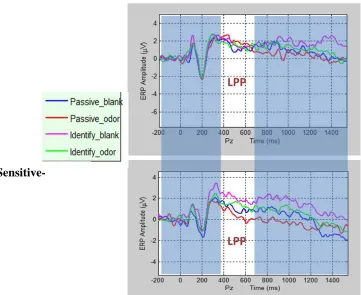
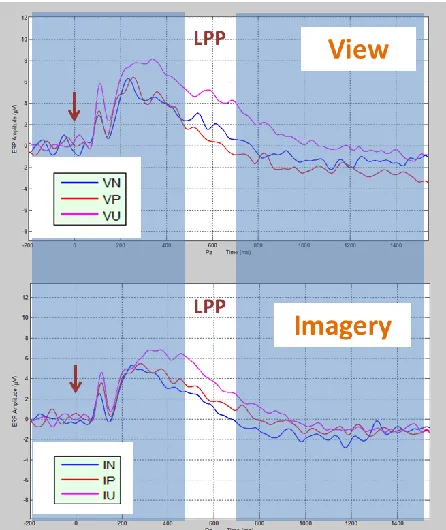
has focused on the late positive potential (LPP), which is commonly identified as a midline
centroparietal occurring after 300ms and may last up to 1500ms. The sustained positive
deflection of LPP is present in both pleasant and unpleasant images. It is also important to
point out, as discussed in one of the earlier studies by Ito et al., (1998), (the relevance of the
negativity bias) where deflection for negative stimuli is stronger than positive stimuli.
In the next section, I have outlined the framework to be investigated in this
dissertation, followed by hypotheses formation. The framework starts with the investigation
of the theoretical relationship between odors and emotions. Odors are represented in both
“real” and “imagined” form. The odor-emotions relationship in each form is investigated in
Experiments 1 and 2 respectively. Furthermore, the impact of individual differences in sense
of smell on this relationship is explored. Next, examined in the framework is the application
of this odor-emotion relationship in an applied context: using ads as odor imagery cues
(Experiment 4). Additionally, the downstream behavioral consequences of odor-induced
emotions, such as product evaluation and choice, moral judgment and health associations are
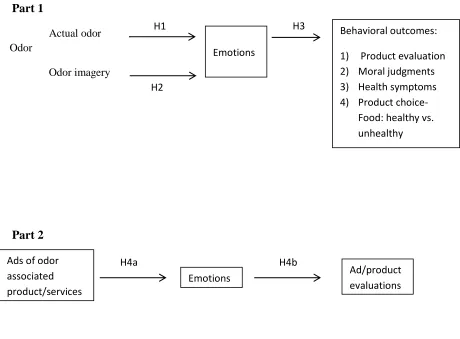
Research framework
This dissertation contains three parts. In Part 1, we depict the relationship between
odors and emotions using actual odors (H1) and imagined odors (H2). Furthermore, the
downstream effects of odor-induced emotions are further understood in the behavioral study
(H3). In particular, odor-induced emotions on behavioral-related outcomes such as purchase
decisions, product evaluation, food choices and moral judgments are hypothesized and tested.
In Part 2, we focus on the role of olfactory imagery and its influence on emotions in
an advertisement context. Imagined odors using odor-associated ads are hypothesized to
affect evaluation of ads and products through the mediating role of emotions (H4). The role
of individual differences in sense of smell is investigated and included in the design of all the
studies included in this dissertation. Two groups are identified and studied: hyperosmics,
individuals with increased sensitivity to smell, are compared to individuals with a normal
Figure 2. General hypotheses framework
Part 1
Odor
Actual odor
Odor imagery
Part 2
Emotions
Behavioral outcomes:
1) Product evaluation 2) Moral judgments 3) Health symptoms 4) Product choice-
Food: healthy vs. unhealthy H1
H2
H3
Ads of odor associated product/services
Emotions Ad/product
evaluations
Hypotheses
Odor-induced emotions
To establish the fundamental relationship between odors and emotions, we attempt to
examine the emotions elicited by odor stimuli, in the form of actual odors and imagined
odors. Based on neuroanatomy and previous research, emotions and olfaction are closely
linked as they both share several limbic regions (Royet et al., 2003). In the presence of
pleasant odors, we expect congruency effects and see positive emotions associated with
pleasant odors and negative emotions triggered by unpleasant odors. Furthermore, we expect
explicit emotions to be reported in both normal individuals and individuals with sensitivity to
smell. However, due to the sensitive nature of these individuals in the latter group, we
expect that individuals with high sensitivity to smell will report higher intensity in emotions
to post odor stimuli, compared to individuals with the normal sense of smell. In addition to
explicit self-reported emotions used in behavioral design, an objective measurement of
emotions will be captured using EEG methods. Emotion-related responses are assessed by
the generation of brain activity during processing of odor stimuli. Specifically, ERP
components related to olfactory sensory stimuli (N1 and P1/P2) will be induced in the
presence of odor stimuli. Additionally, cognitive processing of odor stimuli is expected to be
increased and reflected in P300 and emotional processing of pleasant and unpleasant
odorants are expected to be reflected in the increased LPP. The latter has been extensively
shown to be associated with emotion processing (Schupp et al. 2006; Hajcak, Namara and
H1a: Enhanced attention will be directed toward odors for hyperosmics in
comparison to individuals with a normal sense of smell, reflected in P100.
H1b: Actual odors, both pleasant and unpleasant, will elicit emotions in both
olfactory groups, reflected in LPP.
H1c: These emotions will be perceived as more intense for hyperosmics in
comparison to individuals with a normal sense of smell, reflected in LPP.
Olfactory imagery induced emotions
Olfactory imagery is another form of odor presentation investigated in the dissertation.
Odors associated with a product are not necessarily accessible in the marketplace. Typically,
products are packaged or boxed and shown visually through pictures or ads. The relationship
and performance between olfactory imagery and real odors have been shown to be very
similar (Carrasco and Ridout 1993; Lyman 1988). These studies used multidimensional
scaling (MDS) to identify the qualitative dimensions that underlie similarity judgments
between real and imagined odors.
According to Krishna’s (2012) review on sensory marketing research, imagery is
described as a form of embodied cognition. Neuroimaging studies have shown evidence for
embodied cognition, where reading scent-associated words such as “cinnamon” is associated
with increased activity in the primary olfactory cortex (Gonzalez et al, 2006). Other brain
imaging studies show substantial overlap in areas activated by real odors and imagined odors
(Levy et al., 1999; Henkin and Levy 2002). However, the activations were reduced in the
research has relied on words as stimuli when studying olfactory imagery (Royet et al. 2003;
Gonzalez et al. 2006). We argue that text and words are more abstract or less concrete in
terms of eliciting olfactory imagery. We expect the intensity of emotions to be stronger when
elicited by picture rather than word presentations (Holmes et al. 2008) as reflected through
enhanced magnitude of LPP. First, the emotion systems in the brain evolved earlier than
language systems which suggests images may more readily trigger emotions than language
stimuli (Ohman and Mineka 2001). Second, mental imagery shares the neural process
involved in perceiving real events (Kosslyn, Granis and Thompson 2001). Finally, it has
been shown that autobiographical episodic memories are stored in the form of images,
associated with emotional states (Conway 2001).
H2: Pictures of items or products associated with either pleasant or unpleasant odors
will induce emotions, reflected in LPP, through olfactory imagery.
H2a: The negativity bias will result in stronger emotions in the unpleasant odor
associated pictures, reflected in larger LPP magnitude, compared to pleasant odor associated
pictures and non-odor associated pictures (control condition).
Finally, individual differences in sense of smell are expected to influence the
magnitude of emotions elicited from the process of odor imagery. Stronger experiences and
memories may be associated with the generation of stronger olfactory imagery. In fact, our
preliminary data show that there is a positive correlation between olfactory imagery,
measured with the vividness of olfactory imagery questionnaire (VOIQ; Gilbert, Crouch and
Kemp 1998) and levels of sensitivity to smell. Individuals with higher sensitivity to smell
both groups scored higher in olfactory imagery than hyposmic individuals. This is similar to
what the authors reported- olfactory experts reported more vivid olfactory images. Levy et al.
(1999) compared anosmics with normal participants and showed that olfactory imagery
induced similar brain activity. However, in a later fMRI study (Henkin and Levy 2002), the
authors compared congenital anosmics- individuals who are born with no sense of smell-
with normal participants, and found that attempts for olfactory imagery in the former group
produced little activity. This supports the argument where odor memories and experiences
are associated with successful generation of vivid olfactory imagery.
H2b: The effect of olfactory imagery induced emotions, reflected in LPP, will be
stronger in hyperosmics compared to individuals with a normal sense of smell.
Contagion effects of odors on behavior
Emotions have been shown to play an important role in consumer purchase decisions
and choices by affecting cognitive thoughts (Shiv and Fedorikhin 1999) and have been
shown to influence impulsive purchase behaviors (Weinberg 1982). The
Appraisal-Tendency Framework (ATF., Lerner & Keltner 2000, 2001; Lerner & Tiedens 2006) as a
general theory describes emotion-specific influences on consumer judgments and choices. In
our study, negative emotions such as disgust and fear are induced from unpleasant odors
while positive emotions are induced from pleasant odors. Furthermore, the downstream
effects on consumer-related decisions such as willingness to purchase and product-type
choice are expected to be affected by the odor-elicited emotions and moral judgments. Past
research has shown that disgust is removed by “rituals” such as washing hands after
consumer behavior research, disgust is seen as having a “contagion effect” where products
placed in shopping carts are organized so “disgusting products” such as cat litter are not
touching other products (Morales and Fitzsimons 2007).
Individuals have the need and tendency to maintain a “moral identity,” which is
conceptualized as the importance of being a moral person to maintain a moral identity
(Aquino and Reed 2002; Hart el al. 1999). One of the actions taken to restore or maintain
this moral identity is to engage in virtuous behavior called moral cleansing. It allows one to
cleanse the self of negative feelings due to immoral acts of thoughts (Tetlock et al. 2000).
Embodied cognition theory (Barsalou 2008) uses metaphors to link abstract concepts to
physical and sensory experiences and can be used to explain findings in moral cleansing.
Zhong and Loljenquist (2006) found the act of hand washing resembling cleansing of an
individual’s past moral transgression. Other concepts such as smelling a citrus scent is
related to cleanliness (Holland, Henriks and Aarts 2005; Schnall, Benton and Harvey 2008).
Based on these past findings, we expect that individuals under a disgusted state are more
likely to choose snacks representing “fresh and clean” such as mints compared to chocolate.
In addition, moral and ethical issues are expected to be judged more severely under disgust
states versus normal states. Inversely, individuals put into an emotional pleasant state via
positive odors are expected to be less judgmental of moral issues and will select product and
activity choices that are more indulging and hedonic-focused compared to more practical and
or healthy options.
Furthermore, unpleasant odors have been investigated in implicit associations, such as
2009). Individual differences in sensitivity to smell and corresponding decisions are
expected to be reflected in stronger implicit associations of illness with unpleasant odors.
Dalton et al. (1997) manipulated the description of a chemical odor- describing it as either
bad for health or good for health-for the same odor-to show that cognitive interpretation of
chemical odors can influence reported health related symptoms. Thus, we expect
odor-induced emotions to be stronger in individuals with higher sensitivity to smell compared to
normal individuals.
H3: Odor-elicited emotions will influence the downstream judgment on moral
severity, product choices and product evaluations.
H3a: This “contagion effect” is expected to be stronger in hyperosmics compared to
individuals with a normal ability to smell.
H3b: Unpleasant odor conditions will induce negative emotions, resulting in more
severe moral judgments, more negative evaluation of products, increased reports of health
symptoms, and the choice of healthy food items (e.g. raisin) compared to the condition where
there is no ambient odor (control condition).
H3c: Pleasant odors conditions will induce positive emotions, resulting in less severe
moral judgments, more positive evaluation of products, no reports of health symptoms, and
the choice of hedonic or unhealthy food item (e.g. Snicker bar) compared to the condition
Sniffing effects and olfactory imagery in ads
In H2, we predict the relationship between olfactory imagery induced by
odor-associated pictures to influence emotions. We further explore this relationship in a context
associated with consumer experience, where ads promoting products or services associated
with odors are tested. The pictorial ads are expected to function similarly to images of
odor-associated products, inducing olfactory imagery and in turn eliciting emotions. Therefore,
we make the same argument from H2 here in H4a for this relationship:
H4a: Ads of products or services associated with pleasant odors will induce emotions,
reflected in the LPP, through olfactory imagery compared to ads not associated with odors
(control). Sniffing motions will further enhance the emotions and reveal an additive effect on
LPP.
Bensafi (2005) showed that people tend to generate better olfactory imagery when
explicitly instructed to take “sniffs” during olfactory imagery tasks. We further demonstrate
how this effect can be applied in consumers’ processing of advertisements, containing
images of target products where “sniff” messages are embedded. The “sniff” cues are used
to activate olfactomotor which will enhance olfactory imagery. Improved olfactory imagery
should result in more vivid imagery and is therefore expected to result in more positive
evaluations of the ad and its associated product.