Design and development of novel self-assembled
luminescent lanthanide complexes in solution and in
responsive soft materials
Samuel J. Bradberry, MChem
March 2017
Trinity College Dublin
The University of Dublin
Based on research carried out under the direction of
Prof. Thorfinnur Gunnlaugsson
A thesis submitted to the School of Chemistry,
“I'm always learning something. Learning never ends.”
Declaration
This thesis is submitted for the degree of Doctor of Philosophy to the University of Dublin, Trinity College and has not been submitted before for any degree or examination to this or any other university. Other than where acknowledged, all work described herein is original and carried out by the author alone. Permission is granted so that the Library may lend or copy this thesis upon request. This permission covers only single copies made for study purposes, subject to normal conditions of acknowledgment.
i
Abstract
This thesis, entitled “Design and development of novel self-assembled luminescent lanthanide complexes in solution and in responsive soft materials” describes the design, synthesis and characterisation of naphthyl-dipicolylamide (naphthyl-dpa) ligands for sensitisation lanthanide (LnIII) emission, particularly for EuIII, in a range of solvent environments as well as soft materials.
Chapter 1 provides an introduction to the fundamental physical and chemical properties of LnIII ions with particular focus on the photophysical properties. The characteristic spectral features of the emissive LnIII ions will be reviewed, an overview given to the mechanisms available to access this f-metal-centred luminescence and the key design features for ligands highlighted. This is followed by a review of the available literature, describing recent advances in acyclic ligands for sensitising LnIII emission in solution and the solid-state. The later sections will concentrate on the inclusion of emissive LnIII complexes in soft matter, soft- and polymer-based materials. As a conclusion to the survey of research from the wider scientific community, the immediate prior art from the Gunnlaugsson laboratory will be highlighted.
Chapter 2 will describe the design and synthesis of naphthyl-dpa derivatives functionalised with sulfonate (SO3-) solubilising groups. A pair of enantiomeric ligands will be presented, the photophysical properties of these ligands and their complexes with EuIII are probed in both aqueous and organic solutions, showing Φtot enhancements in the aqueous environment. The self-assembly behaviour of the ligands is investigated in H2O through spectroscopic titrations using a range of techniques including UV-visible absorption, fluorescence and time-gated emission spectroscopy. Chiral spectroscopy (circularly polarised luminescence and circular dichroism) is exploited to analyse the photophysical properties and self-assembly in greater depth and global stability constants (β) determined by non-linear regression analysis, indicating logβML3 ca. 18.5 – 20.0 for the saturated (ML3)
assemblies. This chapter concludes by discussing the self-assembly and aggregation behaviour of the ligands in solution and in the formation of gelled soft matter at higher concentration, using insights from dynamic light scattering (DLS), isothermal titration calorimetry (ITC) and scanning electron microscopy (SEM).
ii
CH3OH, showing similar processes between ligands (logβML3 ca. 19.0). However, these differ significantly in their emission properties during self-assembly and this is discussed in the context of PET. The PET response is exploited in the development of acidity probes and one complex is calibrated in 5% CH3OH:H2O as a pH probe, showing a sensitive pH response in both ligand- and metal-centred emissions. This chapter concludes by describing the fabrication of a hydrogel-based pH sensor using EuIII-centred luminescence, clear spectroscopic and visual responses are demonstrated to both solution and vapour stimuli.
Chapter 4 presents an extension to the responsive complexes described in Chapter 3 and focusses on the design of molecular logic gate mimics (MLGMs) in solution and polymer gels. This example represents one of the first soft materials-based MLGMs using LnIII luminescence. Firstly, a brief introduction will present the fundamentals of logical analysis and the limited examples of exploiting LnIII luminescence. A mixed EuIII:TbIII system combining both naphthyl-dpa and 2,6-bis(1,2,3-triazol-4-yl)pyridine (btp) ligands will be discussed showing luminescence responses to H+ and F-. These responses are characterised in CH3OH and p(HEMA-co-EGMDA-co-MMA) organogels and parameterised as logic functions; both clear logical and visual outputs are demonstrated to unambiguously identify input states. This chapter concludes by highlighting the key limitations of this proof-of-concept and approaches to address these are set out.
iii
demonstrated and the emission properties characterised to elucidate the nature of the crosslinking complexes, showing preference of ML3 and ML2 in the symmetrical and
asymmetrical cases, respectively. The chapter concludes by presenting the preliminary mechanical analysis, showing inconclusive results, is described along with the limitations; approaches to address, extend and exploit these preliminary results are presented.
iv
grateful for the assistance and understanding offered to me when times were tough both in and out of the lab.
I am grateful for the opportunities to work with others and the warm reception by collaborators, to Prof. Amir Khan (TCD) and Prof. Colin McCoy (QUB) who have been a pleasure to work with, inspring in their individual weays and engaged even at the times when the collaborations were slow. I hope we can continue to work together in the future.
To Prof. A.P de Silva, many thanks for being welcoming to general discussion on my visit to Belfast and the hospitality shown to myself and Anna out of pure interest in science, friendship and concern for others.
Mr. Aramballi Jayant Savyasachi and Ms. Amy Lynes are thanked for their help with DSC and SEM, coming to help at the last minute and at the expense of their own time so many times. There are many people without whom this work could have been completed, who work behind the scenes: to Dr. Robert D. Peacock, for CPL measurements used throughout this thesis for the expedience of turnaround and advice. Drs. Gary Hessman and Martin Feeny for keeping the mass spec running vital to our work. To Dr Manuel Reuther for keeping the instrumentation from falling apart and technical assistance. Dr. John O’Brien, as always, must be singled out for the high-quality NMR, never-ending enthusiasm to help us solve our problems and coming to my rescue, particularly near the end! I thank, from the past, Prof. Phil Gale, Dr. Nathalie Busschaert and Dr. Kate Howell for preparing me for the opportunity to complete a PhD and making me the scientist I am today.
v
to keep me thinking straight and to talk about crazy ideas whether in the same room or hundreds of miles apart.
I extend thanks to those in College who have come to my aid when in trouble, the health and counselling services, Dr. Lawless and Dr. Paris, who helped me out of some scary and difficult times; I had never expected to need to meet you both but I am better for having done so. I thank those who I have met that have made me a life away from the lab. To Hans for the friendship that helped me through the first years here and I hope will continue going forward. To Joao, Australian Sarah, American Sarah, James, Alex, Giangi and Gianna who welcomed me into their homes; to Viola, Fergus and Fergus’ Mum for the friendship to help me when I was briefly homeless. I am thankful for, and to, those friends who have been supportive and inspiring in their own ways: Frs. Terence, John, Philip, Alan and the other Dominicans, Aileen, Maria, Pietro, Claudia, and Chiara.
I thank my family for the patience of a workaholic, never-in-contact son living abroad for four years. I thank Mum and Dad for having put up with this, and always being there to help when I was in trouble and needed help; knowing you have been there has been more help that you can imagine. To Rachel and Daniel for being the best sibling-hotels you could imagine, always available when I have been visiting the UK, and I hope you know we don’t just come to you for the free bed…it’s a bonus to getting to see everyone. I thank Ethan for letting me come play cars and electricity sets when times got tough. I am thankful to the new family which I have been lucky to inherit, to Attilio, Emanuela, Luca and Nonna, who have made me feel welcome in their home many, many times over the last three years; and have trusted me to look after their daughter and sister. Grazie mille!
vi 3T triplet excited state
Ȧ angstrom
acac acetylacetonate
AIBN azobissisobutyronitrile
AMP adenosine monophosphate
app apparent
ar aromatic
atm. atmosphere(s)
ATP adenosine triphosphate ATR attenuated total reflection
bbpy 2,6-bis(benzimidazol-2-yl)pyridine
bipy bipyridine
Boc2O di-tert-butyl dicarbonate BODIPY boron dipyrromethene br s broad singlet
btp 2,6-bis(1,2,3-triazol-4-yl)pyridine BYzBP bis-1,2,3-triazole-bipyridine CB[n] cucurbit[n]uril
CD circular dichroism
CLSM confocal laser scanning microscopy COSY correlation spectroscopy
CPL circularly polarised luminescence CP-NPs coordination polymer nanoparticles CuAAC copper(I)-catalysed alkyne-azide 'click' cyclen 1,4,5,10-tetraazacyclododecane
d doublet
vii
DEPT distortionless enhancement by polarisation transfer DLS dynamic light scattering
DMF N,N-dimethylformamide
DMSO dimethylsulfoxide
DOPC 1,2-Dioleoyl-sn-glycero-3-phosphocholine DOTA 1,4,5,10-tetraazacyclododecane
dpa pyridine-2,6-dicarboxamide DSC dynamic scattering calorimetry
E energy
ED electric dipole
ED electron donating
EDCI 1-ethyl-3-(3-dimethylaminopropyl)carbodiimide EDTA ethylenediamine tetra acetate
EGDMA ethylene glycol dimethacrylate equiv. equivalent(s)
ES excited state
ESI electrospray ionisation Et2O diethyl ether
EtOAc ethyl acetate
EW electron withdrawing
EWC equilibrium water content (%) FLIM fluorescent lifetime microscopy fluor fluorescence
FT-IR fourier-transform infrared spectroscopy glum luminescence dissymmetry factor
GMP guanosine monophosphate
GS ground state
gY greeny yellow (CIE colour description) HEMA (2-hydroxylethyl)methacrylate
hfac hexafluoroacetylacetone
HMBC heteronuclear multiple-bond correlation spectrscopy HOBt 1-hydroxybenzotriazole hydrate
viii ILCT intra-ligand charge transfer
INH INHIBIT
IR infrared
ISC inter-system crossing
ITC isothermal titration calorimetry
J NMR coupling constant
J total angular momentum quantum number
K formation equilibrium constant
K kelvin
L total orbital angular momentum quantum number
L ligand
LA lactic acid
LB Langmuir-Blodgett
LbL layer by layer
LCs liquid crystals
LIS lanthanide induced shifts
Ln lanthanide
LOD limit of detection
logP octanol:water partition coefficient LUMO lowest unoccupied molecular orbital
M molar (mol.dm-3)
MD magnetic dipole
MES 2-(N-morpholino)ethanesulfonic acid
ml orbital angular momentum quantum number
ix MLCT metal-to-ligand charge transfer MLGM molecular logic gate mimic
MMA methyl methacrylate
MR magnetic resonance
MRI magnetic resonance imaging
ms spin angular momentum quantum number
NAND inverse AND
NEt3 triethylamine
NIPAM N-isopropylacrylamide NMR nuclear magnetic resonance
NOR NOT OR
NOTA 1,4,7-triazacyclononane-N,N',N''-triacetate OLED organic light emitting diodes
OPV oligo(phenylenevinylene)
p- para
p( ) poly( )
PAA poly(acrylic acid)
PAAm poly acrylamide
PAMPSA poly(2-acrylamide-2-methyl propane sulfonic acid) PDDA poly(diallyldimethylammonium)
PDI poly dispersion index
PE polyethylene
PEG polyethylene glycol
PET photo-induced electron transfer
pH -log10[H+]
phen 1,10-phenanthroline phosph phosphorescence
PLIM phosphorescent lifetime microscopy PMT photo-multiplier tube
pO2 partial pressure of O2
PS polystyrene
x S1 singlet excited state
sal salicylic acid
SDS sodium dodecyl sulfate SEM scanning electron microscopy
SOMO singularly occupied molecular orbital T1 triplet excited state
TBA tetrabutyl ammonium
tBu tert-butyl
TFA trifluoroacetic acid Tg transition temperature
THF tetrahydrofuran
TL total luminescence
TRD time resolved detection
TRIS tris(hydroxymethyl)aminomethane tta 2-thenoyltrifluoroacetone
UV ultra-violet
UV-Vis ultra-violet and visible
v/v volume/volume
VA vinyl acetate
VdW van der waals
WOLED white organic light emitting diodes
wt% weight percent
XNOR exclusive NOT OR
XOR exclusive OR
y yellow (CIE colour description) YG yellow green (CIE colour description)
xi β global stability constant
β-CD beta cyclodextrin
δ chemical shift (NMR)
ΔH enthalpy
ΔS change in entropy
ε molar extinction coefficient
ηsens efficiency of sensitisation of lanthanide luminescence ηsens sensitisation efficiency (%)
λ wavelength
λabs absorbance wavelength λem emission wavelength λexc excitation wavelength
λmax absorbance maxima wavelength
ν frequency (cm-1)
τ luminescence lifetime
τ1 luminescence lifetime 1
τ2 luminescence lifetime 2
τem emission lifetime
τobs observed luminescence lfetime τOD luminescence lifetime in D2O τOH luminescence lifetime in H2O
τR radiative lifetime
ϕ quantum yield (%)
xii
directed synthesis” co-authored with Aramballi Jayant Savyasachi, Miguel Martínez-Calvo and Prof. Thorfinnur Gunnlaugsson in Coordination Chemistry Review (Coord. Chem. Rev
2014, 273, 226 – 241).
Chapter 2 was mostly described in the article “Quantifying the formation of chiral luminescent lanthanide assemblies in an aqueous medium through chiroptical spectroscopy and generation of luminescent hydrogels” co-authored with Aramballi Jayant Savyasachi, Dr. Robert. D. Peacock and Prof. Thorfinnur Guannlaugsson in Faraday Discussions. (Faraday Discuss. 2015, 185, 413 – 431)- The same article was presented at the Faraday Discussions meeting on “Supramolecular Photochemistry” in Cambridge, UK (2015).
In Chapter 3, reference is made to a publication on pH sensing hydrogels published as the article “Luminescent lanthanide cyclen-based enzymatic assay capable of diagnosing the onset of catheter-associated urinary tract infections both in solution and within polymeric hydrogels” co-authored with Dr. Esther Surender, Dr. Sandra A. Bright, Prof. Colin P. McCoy, Prof. D. Clive Williams and Prof. Thorfinnur Gunnlaugsson in the Journal of the American Chemical Society (J. Am. Chem. Soc. 2017, 139, 381 – 388)
Table of Contents
Abstract ... i
Acknowledgements ... iv
Abbreviations ... iv
Note on publications ... xii
1. Introduction 1.1 Lanthanide Metal Cations ... 3
1.2 Electronic Structure and Physical Properties of Ln ions ... 4
1.2.1 Lanthanide s, p, d and f orbital configurations ... 4
1.2.2 Electrostatic ligand-field effects and spectroscopic term symbols ... 5
1.3. f-f electronic transitions in LnIII ions ... 7
1.3.1 Magnetic and Induced Electric Dipole Transitions – Selection Rules ... 7
1.3.2 Hypersensitive f-f transitions ... 7
1.3.3 Selected spectral features of luminescent LnIII ions ... 8
1.4 Sensitised LnIII Emission - The “Antenna Effect” ... 9
1.4.1 Approaches to Antenna Sensitisation –3T, ILCT, MLCT ... 9
1.4.2 Energy Transfer Mechanisms ... 12
1.4.3 Ligand design considerations – efficiency and quenching of luminescence . 14 1.5 Discrete luminescent LnIII complexes ... 15
1.5.1 Acyclic ligands and their luminescent LnIII complexes ... 16
1.6 Luminescent LnIII-containing assemblies and soft matter ... 23
1.6.1 Supramolecular assemblies and frameworks in solution and soft matter ... 24
1.6.2 Supramolecular coordination polymers ... 27
1.6.3 Self-assembled soft gel materials ... 30
1.7 Organic polymer-based luminescent LnIII-containing materials ... 34
1.7.1 Hard LnIII-doped polymer films and assemblies ... 35
1.7.2 Polymers containing covalently-attached coordinating sites ... 40
1.7.3 Polymer-based soft gel materials ... 43
1.8 Recent advances from Gunnlaugsson and co-workers... 47
2.3 Photophysical characterisation of ligands 120(S,S) and 120(R,R) ... 66
2.4 Photophysical parameterisation of EuIII complexes of 120(S,S) and 120(R,R) .... 68
2.4.1 UV-visible absorption, fluorescence and phosphorescence emission ... 68
2.4.2 Luminescence emission lifetimes and EuIII hydration states ... 71
2.4.3 Photophysical parameters, quantum yields and sensitisation efficiencies ... 73
2.4.4 Circular dichroism and circularly polarised luminescence of [Eu.(120(S,S))3]
and [Eu.(120(R,R))3] ... 76
2.5 Solution self-assembly studies of 120(S,S) and 120(R,R) with EuIII in H2O ... 81
2.5.1 UV-visible absorption and luminescence titrations ... 81
2.5.2 EuIII-centred luminescence titrations (emission and time-gated emission) ... 83
2.5.3 Chiroptical titrations using CD spectroscopy ... 84
2.5.4 Estimation of stability constants by data fitting to theoretical models ... 86
2.5.5 Towards thermodynamic characterisation of the self-assembly between 120
and EuIII ... 92
2.5.6 Dynamic light scattering and SEM assessment of solution soft-assemblies . 94
2.6 Formation and characterisation of hydrogels of 120(S,S) and EuIII ... 97
2.7 Conclusions and future work ... 103
3. Photophysical behaviours of responsive naphthyl-dpa derivatives and their complexes with EuIII in solution and soft materials
3.1 Introduction ... 108
3.2 Design, synthesis and structural characterisation of ligands 121 - 125... 110
3.3 Photophysical characterisation of ligands 121 - 125 ... 115
3.3.1 UV-visible absorption, CD and fluorescence characteristics of ligands 121 - 125 ... 115
3.3.3 Circularly Polarised Luminescence measurements of EuIII complexes with ligands 121 - 125 ... 126
3.3.4 Luminescence lifetimes and EuIII hydration states in EuIII complexes of ligands 121 - 125 ... 128
3.3.5 Quantum yields, sensitisation efficiency and photophysical parameterisation of EuIII complexes of ligands 121 - 125 ... 129
3.3.6 pH Calibration of [Eu.(122)3]3+ in 5% CH3OH in H2O ... 134
3.4 Solution self-assembly studies of 121 – 125 in CH3CN ... 136
3.4.1 UV-visible absorption titrations of the self-assembly of EuIII with ligands 121
- 125 in CH3CN ... 136
3.4.2 Luminescence titrations of the self-assembly of EuIII with ligands 121 - 125 in CH3CN ... 139
3.4.3 Time-gated luminescence titration of the self-assembly of EuIII with ligands
121 - 125 in CH3CN ... 142
3.4.4 Chiroptical titrations of the self-assembly of EuIII with ligands 121 - 125 in CH3CN using CD spectroscopy ... 145
3.5 Solution self-assembly studies of 121 – 125 in CH3OH ... 148
3.5.1 Absorption titrations (UV-visible and CD) of the self-assembly of EuIII with ligands 121 - 125 in CH3OH ... 148
3.5.2 Fluorescence titrations of the self-assembly of EuIII with ligands 121 - 125 in CH3OH ... 151
3.5.3 Time-gated luminescence titration of the self-assembly of EuIII with ligands
121 - 125 in CH3OH ... 153
3.6 Fitting self-assembly titration data to determine stability constants for the EuIII complexes of ligands 121 - 125 ... 154
3.7 Emissive EuIII-luminescent poly(HEMA) hydrogels and responsive pH probes 158
3.7.1 Synthesis and characterisation of [Eu.(122)3]3+@p(HEMA-co-EGDMA) . 159
3.7.2 Photophysical characterisation of [Eu.(122)3]3+@p(HEMA-co-EGDMA) as
hard polymers and soft polymer gels ... 162
3.7.3 pH calibration of [Eu.(122)3]3+@p(HEMA-co-EGDMA) polymer gels in
aqueous media ... 164
4.3.1 Synthetic details ... 178
4.3.2 Photophysical summary in CH3OH solution ... 179
4.4 ... Responsive behaviours of [Eu.(122(S,S))3]3+ and [Tb.(126)3]3+ in mixed CH3OH
solution ... 181
4.4.1 Solution model of a molecular logic circuit ... 183
4.4.2 Logical Analysis & Parameterisation ... 186
4.5 Hydrogel and Organogel Inclusions ... 188
4.5.1 Synthesis and characterisation of organogels ... 189
4.5.2 Spectroscopic Responses of organogel-based MLGMs ... 191
4.5.3 Logical Analysis & Parameterisation ... 194
4.5.4 Operational Robustness and Switching... 196
4.6 Conclusions and future perspectives ... 198
5. Preliminary studies of naphthyl-dpa methacrylate monomers for the synthesis of Rehahn Type II supramolecular co-polymer gels
5.1 Introduction ... 202
5.2 Design, synthesis and structural characterisation of monomers 127(S,S) and
128(S) ... 204
5.3 Photophysical characterisation of 127(S,S) and 128(S) and their EuIII complexes formed under thermodynamic conditions ... 207
5.4 Observing kinetic assemblies of 127(S,S) and 128(S) through self-assembly titration in CH3CN ... 209
5.5 Luminescence lifetimes measurements of EuIII complexes of ligands 127(S,S) and
128(S) in solution ... 211
5.6.1 Photophysical characterisation of swelled and dried polymer gels p(HEMA-co-EGDMA-co-127(S,S)) and p(HEMA-co-EGDMA-co-128(S)) ... 216
5.6.2 p(HEMA-co-EGDMA-co-127(S,S)) and p(HEMA-co-EGDMA-co-128(S)): dry and in H2O ... 216
5.6.3 p(HEMA-co-EGDMA-co-127(S,S)) and p(HEMA-co-EGDMA-co-128(S)): swelled in aqueous EuIII ... 217
5.7 Mechanical analysis of p(HEMA-co-EGDMA-co-127(S,S)) polymer gels in H2O and aqueous EuIII solution ... 219
5.8 Conclusions and future perspectives ... 222
6. Experimental Details
6.1 General methods and materials ... 226
6.1.1 NMR Spectroscopy ... 226
6.1.2 Mass Spectrometry ... 226
6.1.3 Photophysical measurements ... 227
6.1.3.3 pH measurements ... 227
6.1.4 Microscopy ... 228
6.1.5 Compressive and tensile modulus testing ... 229
6.1.6 Thermal calorimetry ... 229
6.2 Synthesis ... 230
6.2.1 Ligand synthesis & characterisation ... 230
6.2.2 Complexes with EuIII ... 244
6.2.3Polymer gels ... 245
7. References ... 248
A2 Chapter 2 Appendix ... 268
A3 Chapter 3 Appendix ... 282
A4 Chapter 4 Appendix ... 314
A5 Chapter 5 Appendix ... 326
2
In recent times, developments in molecular photochemistry and photophysics have progressed from the study and application of discrete molecules and molecular materials to larger structures, and modular assemblies of interest to supramolecular chemistry.1 For example, there has been increasing interest in the fundamental efficiency of the photosynthetic light harvesting systems, other natural supermolecules and the desire to mimic these principles in a controlled manner to build new optical chemical technologies. 2-5 Such interest has also grown extensively from coordination chemistry, along with the
popularity of supramolecular chemistry, and supramolecular approaches are found addressing the behaviour of discrete complexes6 and coordination polymers.7-11
Broadly, supramolecular chemistry involves the development of complex architectures through the directed- or templated-assembly of subcomponents through non-covalent interactions such as from ordered hydrogen bonding arrays,12,13 electrostatic attraction,14 various types of π-π interactions15-17 and metal coordination.18 An alternative approach is through the use of dynamic covalent bonding.19 The first examples of supramolecular chemistry were shown by Lehn, Pederson Vögtle and Sauvage in the 1960s with the inception of crown ethers,20 cryptands21 and podands.22 Of significant interest in recent supramolecular chemistry has been the assembly of extended frameworks,13,23 interlocked,24 and mechanically-active systems25,26 as well as host receptors for small guest species (e.g. anions,27 cations,28,29 neutral organic molecules30) in pursuit of selective sensing molecules.
3
as "an appropriate assembly of suitable molecular components capable of performing light-induced functions" and "a field where interactions between light and matter are controlled by intermolecular forces", respectively. This brief encompasses both chemical and physical functions that may be static or dynamic in nature and supramolecular approaches have been taken up by researchers in photocatalysis,34 energy conversion,35 sensing and imaging,36 and notably by 2016 Nobel Laureates Feringa, Sauvage and Stoddart within the “design and synthesis of molecular machines.”37,38 The approaches adopted have been vast and varied invoking traditional organic chromophores,39 extended conjugates40 and transition metal ions6 to produce systems of various emissive and responsive character with equally various control and functionality.
Of the approaches in coordination chemistry those involving lanthanide complexes have converged neatly with supramolecular chemistry to provide a versatile platform for photophysically-rich materials, supermolecules and self-assembled architectures. This lanthanide supramolecular chemistry41-44 and ligand engineering allows the intrinsically inactive lanthanide ions to be taken advantage of to great effect.45-48
The research described in this thesis is centred on the use of emissive lanthanide ions (particularly EuIII) in discrete complexes as well as in supramolecularly-engineered materials. This introduction will first set out the principle which underlie the research, such as the physical properties of the LnIII ions in addition to the mechanisms which allow access to their characteristic emissions. The later sections provide a survey of key and recent literature in the development of acyclic lanthanide-based complexes, supramolecular architectures and soft materials as well as specific attention to the contributions of the Gunnlaugsson Group.
1.1 Lanthanide Metal Cations
4
behaviour or reactivity.45 These notable phenomena arise from the electronic structure of the LnIII ions and presents electronic behaviour entirely different from that familiar from transition metal chemistry.61
1.2.1 Lanthanide s, p, d and f orbital configurations
The trivalent cations of the lanthanoid elements have a common electron configuration of [Xe]4fn where n = 0, 2 - 11 and, the case of Ce3+, a [Xe]5d1 configuration.62 The 4f orbitals, shown in Figure 1.1a, represent seven possible 4f wavefunctions and therefore may accept 14 electrons with spin ± 1/2 and fill naturally following Hund’s rule. Therefore, with the notable exceptions of LaIII and LuIII, which have empty and full 4f orbitals respectively, the LnIII ions are characterised by partially filled f-orbitals and are paramagnetic.63 This nature results in variable ground-state degeneracies and magnetic moments throughout the lanthanide series. The early ions (Ce – Eu) have small magnetic moments, while the later ions (Gd – Yb) have large overall moments.64 Exploiting these properties, GdIII has been employed extensively as MRI contrast agents because of the half-filled 4f orbitals giving a total of S = +7/2, a non-degenerate ground-state and strong magnetic moment.65
Figure 1.1 a) 3D representations of the shapes of 4f orbitals, showing the various lobes and high angular nodality of the orbital set, reproduced from Ref. 62; b) Schematic representation of the radial distribution functions for 4f, 5s, 5p and 6s orbitals showing the core nature of the 4f orbitals and external screening by 5p,
[image:28.595.68.487.534.692.2]5
The 4f orbitals are in fact contracted, as shown by the schematic radial distribution function in Figure 1.1b, so that they are situated within the [Xe] core and are closer to the nucleus than the 5s and 5p orbitals. As a result, there is inefficient ‘shielding’ of electrons associated with the 4f orbitals against the increasing nuclear charge from LaIII to LuIII and substantial contraction (termed the ‘lanthanide contraction’) in the ionic radii is observed (from 103 – 86 ppm for LaIII– LuIII, respectively).63 Therefore, due to the increasing charge density across the lanthanide series there is some variation in the inorganic chemistry and physical properties of the ions.
It is often noted that the coordination chemistry of the LnIII ions is broadly invariant across the series, particularly in comparison to the diversity found across the transition metals61 as the 4f electrons rarely participate in bonding. This phenomenon is also understood from the core nature of the LnIII valence electrons. These electrons are not only held increasingly close to the nucleus but are also shielded from the external chemical environment by the electrons associated with 5s and 5p orbitals. As a result those phenomena associated with orbital overlap such as coordination and exchange interactions are weaker64 compared to those with d-orbitals. Therefore, coordination interactions are mostly electrostatic in nature and the role of covalent interaction in first-sphere LnIII-ligand interactions is small.66 Despite this screening of 4f electrons from a ligand environment, it is a misconception that LnIII are devoid of ligand field effects and, while indeed small, the effects of electrostatic ligand-field effects on LnIII ions have been established.62,64,67
1.2.2 Electrostatic ligand-field effects and spectroscopic term symbols
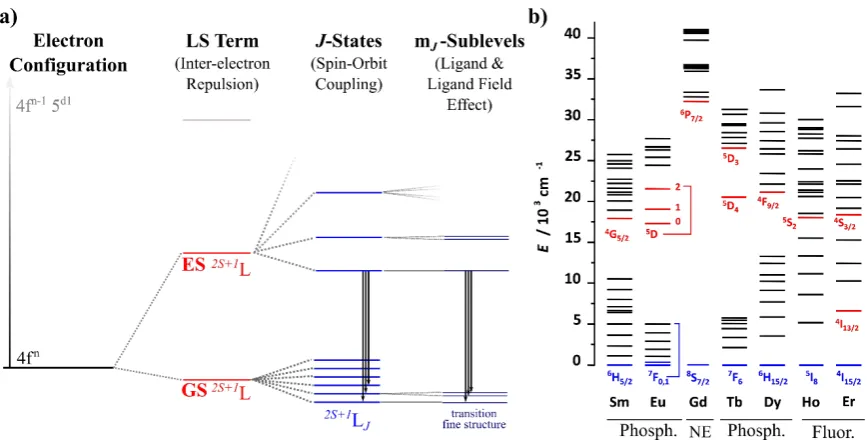
As the theoretical free ion, LnIII can be viewed as spherically symmetrical and the electronic structure is subsequently established as shown schematically in Figure 1.2a. Term symbols of LS (or Russell-Saunders) nomenclature are used regularly, and will appear throughout this thesis, to describe LnIII-centred electron configurations.
The valence electronic configuration has been established as 4fn and becomes split into ground- and excited-states by the inter-electron repulsion between those electrons situated within the seven available 4f orbitals. These seven 4f orbitals have orbital angular momentum quantum numbers (ml) ± 0,1,2,3 and therefore combine to give the total orbital angular momentum (L). The distribution of spins (ms, ± ½ ) within the degenerate orbitals sum to give the total spin quantum number (S) from which the base LS term is constructed in the form 2S+1L. The ground-states of EuIII and TbIII are both 7F (6 unpaired electrons).63
6
(μ) associated with the spin and orbital angular momenta (ms and ml respectively) for each individual 4f electron. This coupling serves to lifts the degeneracy of 4f energy levels and each 2S+1L level is split by quantum number J to give electron configurations of the form 2S+1LJ- The possible values for J are between L+S and |L-S| and for the ground state, J is
given by L+S or |L-S| for ions with less than and over half-filled f-orbitals, respectively. The ground-state configurations of EuIII and TbIII are therefore given as 7F0 and 7F6, respectively. The determination of the ground-state terms for LnIII are straightforward while the excited-states derivation is a more involved process, however these have been determined68 extensively as can be seen from the examples shown in Figure 1.2b.49
Further sublevels (mJ) are induced by electrostatic ligand-field effects from coordinated organic ligands. The coupling interactions between electrons on ligands and the metal-centre result in small perturbations to the energy levels in 2S+1LJ and further non-degeneracy arises. The extent of the splitting and non-degeneracies are also influenced by the symmetry of LnIII ions and the ligand-field parameters vary with point group of the LnIII site69 and in magnetic fields, Zeeman splitting64 may also contribute. The extent of microstates is large with f6,8 and f7 electron species providing 119 possible LS-type terms and over 3,000 microstates for each.62 Overall, the J and m
J states are fundamental to the characteristic absorption and emission spectroscopies of the LnIII series.
Figure 1.2 a) Schematic representation of the effects on the energy levels arising from 4fn electron
configurations by inter-electronic repulsion, spin-orbit coupling and electrostatic ligand-field effects along with the LS-type terms that correspond to each state. Potential emissive transitions are shown as arrows (black). Adapted from Ref. 64. b) Partial energy level diagram of [Ln.(H2O)6]3+ ions showing the term symbols for
key excited (red) and ground (blue) states and the types of emission observed when sensitised by the “antenna effect”. Phosphorescence ions (ΔS ≠ 0) are SmIII, EuIII, TbIII and DyIII, fluorescent ions (ΔS = 0) are HoIII and
[image:30.595.61.495.68.288.2]7
1.3. f-f electronic transitions in LnIII ions
As a result of the energy separation of over 32,000 cm-1 between the [Xe]4fn and the [Xe]4fn-15d1 electron configurations,62 transitions from f→d occur only at high energy and are rarely observed.70 Therefore, the main accessible electronic transitions are magnetic dipole (MD) and electric dipole (ED) f-f transitions. Unlike the potential f→d ED transitions which are u→g transitions and parity allowed, f→f ED transitions are u→u and conversely parity forbidden.71 The f-f transitions therefore directly absorb very weakly and their absorption spectra are characterised by narrow bands with ε < 4 M-1cm-1.72 This fundamental selection rule also underpins the emission spectroscopy of LnIII ions and are considered advantageous for a number of applications across many disciplines, as highlighted above.
1.3.1 Magnetic and Induced Electric Dipole Transitions – Selection Rules
The electronic transitions of LnIII ions are governed by certain selection rules for intra-configurational f-f transitions based upon the total quantum numbers described in the LS-type coupling scheme above, namely ΔS, ΔL and ΔJ.45,62,67 Electron transitions fall within two categories: magnetic dipole (MD) and electric dipole (ED) transitions.
Those electronic transitions with MD character are associated with the magnetic component of electromagnetic radiation and, as such, are transitions of even parity and allowed; these transitions obey the selection rules of ΔS = 0, ΔL = 0 and ΔJ = 0, ±1 (except for J→J’being 0→0). The intermediate coupling scheme relaxes the selection rules of ΔS and ΔL and transitions of MD character are observed.73 However, often these have intrinsically low intensity as a result of the nature of the magnetic dipole vector.74
ED transitions are forbidden since they are of odd parity and becomes allowed only due to the relaxed selection rules by mixing of other opposite parity states or vibronic coupling to other species. These transitions are much weaker than true ED transitions on account of the Laporte selection rule and therefore the term of “induced” electric dipole transitions is applied.75These “induced” ED transitions obey the selection rules of |ΔS| = 0, |ΔL| = ≤ 6 and |ΔJ| = ≤ 6 (or in the case of J or J’= 0, |ΔJ| = 2, 4, 6). Again, the intermediate coupling scheme relaxes the selection rules. The transition selection rules become relaxed further due to the phenomenon of J-mixing allowing both MD and “induced” ED transitions of various types to gain intensity and be observed in absorption and emission spectra.
1.3.2 Hypersensitive f-f transitions
8
While in emission spectra hypersensitivity is observed in EuIII and ligand-induced pseudo-hypersensitivity in TbIII ions.62 Beyond the physical curiosity, hypersensitivity has been employed to probe structural properties of complexes, site symmetries69 and LnIII–ligand bond strengths through resolved vibronic coupling to hypersensitive transitions.79
1.3.3 Selected spectral features of luminescent LnIII ions
The unique electronic structure of the LnIII ions gives rise to characteristic features to the luminescence spectra. The various energy gaps, Figure 1.2b, between excited- and ground-state configurations results in emission with UV emission for GdIII (6P7/2 → 8S7/2, ΔE = 32,200 cm-1) through visible emissions from EuIII (5D0 → 7F0, ΔE = 12,300 cm-1), TbIII (5D4 → 7F6, ΔE = 14,800 cm-1), SmIII (4G5/2 → 6F11/2, ΔE = 7,400 cm-1) and DyIII (4F9/2 → 6F3/2,
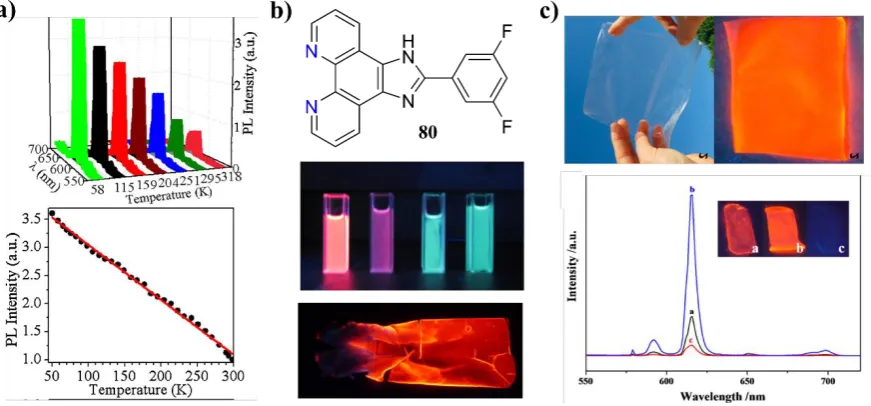
ΔE = 7,850 cm-1) to near infrared (NIR) for NdIII (4F3/2 → 4I9/2), YbIII (2F5/2 → 3F7/2) and ErIII (2F5/2 → 2F7/2).45 These spectra are characterised by sharp line-like emission bands (with small linewidths), as a result of the forbidden nature of the transition and, therefore, colour purity is high. Some example spectra80 of the visibly emissive lanthanides and solutions of emissive complexes81 are shown in Figure 1.3a and Figure 1.3b, respectively.
Figure 1.3 Luminescence features of selected emissive LnIII ions; a) Luminescence spectra of UV and
visible-emitting LnIII ions, TbIII-centred emission spectrum highlighted (green). Adapted from Ref. 80; b) Observed
emission from LnIII-IAM complexes under λ
exc = 365 nm by Raymond et. al. Reproduced from Ref. 81; c)
9
EuIII and TbIII are the most commonly used ions and give pure red and green emissions, respectively. The line-like emission spectra give the LnIII ions predictable and structured spectra which can reveal differences in solid and solution structure or behaviour from the splitting or relative intensities of the transitions.67,69,73,82,83 This has been established in Judd-Ofelt theory84,85 and is particularly well-developed in the case of EuIII where the spectra can possess rich information due to both MD transitions (5D0 → 7F0,1) and true “induced” ED hypersensitivity (5D0 → 7F2).67
For the same physical reasons, LnIII ions display much longer luminescence lifetimes compared to the nanosecond (ns) lifetimes of organic dyes and biological media. The lifetimes are found in the millisecond (ms) range for EuIII and TbIII and microsecond (μs) range for SmIII and DyIII ions. These long-lived excited-states enable the use of LnIII-centred luminescence in time-resolved detection (TRD) in biological media, where LnIII-emission can be distinguished from background auto-fluorescence by imposing a time-delay after the excitation pump before measurement, as shown schematically in Figure 1.3c. In TRD fluorescence emissions with ns and sub-microsecond lifetimes are able to decay prior to measurement and, therefore, the detected LnIII-centred signal has an improved signal-to-noise ratio. Small complex probes that operate in this fashion have been established for various applications in biological media.52,86,87
1.4 Sensitised LnIII Emission - The “Antenna Effect”
Despite the inefficiency of direct excitation of f-f electronic transitions, emission from LnIII -centred excited states is observed as sensitised emission. Sensitised emissions are those which arise from radiative deactivation of metal-centred excited states which were initially populated indirectly by an energy transfer mechanism from a donor species rather than direct absorption by the metal centre.88 This approach was first observed in 1942 by Weissman89 and later became termed the “antenna effect”.90 Various aspects of this effect are described in the following sections. From various theories, this was refined into the readily accepted mechanism of Crosby and Whan invoking a ligand-centred triplet-excited-state energy transfer mechanism to populate the LnIII excited state.91 This has now been successively developed, extended and exploited for a range of novel LnIII-based systems in recent years.62
1.4.1 Approaches to Antenna Sensitisation –3T, ILCT, MLCT
ligand-10
sensitisation. Antenna sensitisation is tuneable to different situations and the efficiency depends upon the competition of these radiative and non-radiative processes and therefore is influenced by the balance of various factors in ligand design, chromophore moieties, target lanthanide and conditions of use.47
Classically, energy transfer occurs from an organic triplet excited-state, this mechanism is elaborated in the Jablonski diagram shown in Figure 1.4b. The direct excitation of the chromophore moieties of the ligands gives an initial singlet excited state (S1) which does not interact with the LnIII centre. However, due to the heavy atom effect the intersystem crossing (ISC) of S1 → T1 is promoted in most chromophores.92,93 In brief, ‘heavy atoms’, such as those of the f-block, which hold higher nuclear charge (Z = 57 – 71 for La - Lu) possess proportionally larger nuclear magnetic field strength and consequently a larger spin-orbit coupling is observed. In turn, more substantial singlet-triplet mixing is achieved which produces excited states of mixed multiplicity, allowing a respective increase in the rate of forbidden processes such as ISC in the perturbed molecules. Moreover, in the case of all the LnIII ions (excluding the diamagnetic ions LaIII and LuIII) their paramagnetic nature, and therefore increased overall angular momentum, may also contribute to the promotion of these effects.94
Figure 1.4 a)Schematic representation of the “antenna effect” showing various deactivation pathways of the
antenna excited-state; b) Summary Jablonski energy level diagram demonstrating the sensitisation of Eu(5D0) via excitation of the ligand from the ground-state (S0) to the first excited-state (S1) subsequent ligand-centred
ISC to the triplet excited-state (T1) and energy transfer (ET) to the lanthanide ion; shown also are the
11
These longer-lived triplet excited-states can effectively relax to their ground-state through an energy transfer process leaving the metal-centre in an excited state (the LnIII becomes excited indirectly). The excited-states of various LnIII ions were presented in Figure 1.2b and, in most cases, upon sensitisation internal non-radiative relaxation will arrive at emissive excited-states (i.e. 5D1,2 for EuIII, 5D4 for TbIII or 5I4 For HoIII). As discussed above, in all cases, f-metal emissive transitions are parity forbidden and furthermore, in many of those cases, also spin-forbidden which results in a smaller overall rate constant. As a result of this, sensitised LnIII emissions can be both intense and have long luminescence lifetimes. Simple and conjugated organic chromophores are often used for this mechanism.95
In a number of scenarios, the use of energy transfer from alternative donors such as triplet-based metal-to-ligand charge transfer (3MLCT) excited-states have been utilised.96,97 Hybrid and dyad complexes have been used which combine d- and f- block metals coordinated by chromophore-containing ligands.98,99 Much like the classical triplet mechanism, a singlet excited-state (1MLCT) is achieved by excitation of the MLCT band followed by 1MLCT → 3MLCT intersystem crossing that is achieved efficiently in second- and third-row transition metal complexes.100 Energy transfer from the 3MLCT then can occur in a similar manner as from a ligand-centred T1 excited-state.101,102 For example, amongst others, transition metal complexes of CrIII, CoIII and RuII, 1, have been used to sensitise the emission from YbIII and NdIII ions.101,103,104 The 3MLCT sensitisation mechanism, however, highlights the ever-present subtleties in ligand design for individual application and tends to be notably inefficient for the sensitisation of EuIII and TbIII-centred emissions.105 In fact, even in d-f dyads of CrIII paired with YbIII or NdIII, the MLCT was used as a mechanism to quench EuIII luminescence via Eu(5D0) → Cr(4A2) energy transfer.106
Despite the accepted dismissal of Kleinerman’s proposed S1 → LnIII energy transfer mechanism.107 Importantly, sensitisation of LnIII emission directly from singlet excited-states has recently been reported. However, these occur specifically via energy transfer from intra-ligand charge transfer (1ILCT) singlet excited-states.88 The extension of the classical
Figure 1.5 Example donor chromophore types suitable for sensitised LnIII-centred emission via: a) 3MLCT
sensitisation. Compound 1 sensitises YbIII and NdIII emission from RuII-bipy 3MLCT; and b) ILCT
12
1.4.2 Energy Transfer Mechanisms
The energy transfer from chromophore excited-state to the LnIII ion generally will take place through the classical energy transfer mechanisms that are termed Förster or Dexter-type.101,109 However, Horrocks110 and Faulkner111 have noted that in cases of EuIII and YbIII, a third redox-mediated mechanism is possible since readily accessible LnII oxidation states are available. The Förster- and Dexter-type mechanisms are quite different in nature and this should not be overlooked since optimisation of energy transfer efficiency often serves to dictate many aspects of antenna and ligand design.
The traditional schematics of these energy transfer mechanisms are perhaps confusing and ambiguous in the context of LnIII sensitisation since the excited-states of the ligand and the LnIII ion should be considered in different terms, as electron promotions within molecular orbitals and atomic orbital configurations, respectively. Therefore, in Figure 1.6, the Förster- and Dexter-type energy transfer mechanisms are represented in terms
Figure 1.6 Schematic representations of Förster- and Dexter-type energy transfer in LnIII complexes. a) Förster
mechanism, the dipole-dipole coupled relaxation of ligand triplet excited-state to a singlet ground-state gives intra-configurational promotion of the LnIII ground state (GS) to *LnIII excited state (ES) Energy scale
represents those of electronic configurations for Ligand (blue boxes) and LnIII (red boxes); b) Dexter-type
mechanism, simultaneous electron exchange of a 4f electron from LnIII quenching ligand triplet excited state
(blue) and an electron from the ligand to 4f orbital (green box) to generate a *LnIII ES configuration; only
13
of electron configurations which correlate more appropriately with the reality of LnIII sensitisation.
The Förster mechanism of coulombic energy transfer, shown in Figure 1.6a, follows a dipole coupling mechanism where the donor transition dipole (ligand T1 → S0 relaxation) is coupled with the acceptor transition dipole (the *LnIII ES LnIII GS excitation) and allows population of the metal-centred excited-state indirectly. The rate of energy transfer (kET) can be described by Equation 1.1:
𝑘
𝐸𝑇= 𝑘
𝜅2𝑘𝐷𝑜𝑟𝐷𝐴6
𝐽(𝜖
𝐴)
Equation 1.1Where k is a condition dependent constant, k°D describes the oscillator dipole strength while κ2 reflects their respective orientation. The J(ϵA) term relates to the overlap integral of the donor chromophore emission and LnIII absorption spectra. Appropriate spectral overlap is required for this mechanism of ET, with a larger overlap giving rise to a faster energy transfer rate. However, the narrow linewidth and low-extinction coefficients of f-f transitions are restrictive and highly efficient ET of sensitised emission can be challenging to achieve, even when overlap exists. The mixed multiplicity of the antenna excited-state, by the HA effect, can be understood to allow this formally forbidden relaxation (ΔS ≠ 0) to function efficiently for energy transfer through the dipole mechanism. The subsequently radiative relaxation of the *LnIII ES, assuming there is no reverse energy transfer (see Section 1.4.3), will take the form of LnIII-centred luminescence. Furthermore, this mechanism is distance (r) dependent with the strength of the electric fields associated with both the donor and acceptor transition dipoles and falls off as r-6. These restrictions can be addressed in ligand design.
14
to maximise the LnIII-ligand bond strength and shorten the LnIII-ligand distance.53
For organic chromophores, in the T1 excited-state mechanism consideration of the HOMO-LUMO gap is required. Despite the HA effect of the LnIII resulting in easier S1 → T1 intersystem crossing, in order to ensure efficient T1 population, the HOMO-LUMO gap should ideally be ΔE = 5,000 cm-1.72 Furthermore, the relative energy of the ligand-centred T1 and the LnIII excited-state configuration will influence the efficiency of ligand-to-metal energy transfer. An energy gap which is too large (i.e. E(T1) ≫ LnIII ES) will likely result in ligand fluorescence and poor energy transfer efficiency. On the other hand, should the energy gap be too small (i.e. E(T1) ≈ *LnIII ES) then thermal back-energy transfer results in desensitisation of the LnIII centre via repopulation of the ligand-centred excited state and, again, poor energy transfer efficiency. In general terms, the ΔE(T1 - LnIII ES) should be between 2500 – 3500 cm-1 to balance these two effects.72
15
Furthermore, the influence of second-coordination sphere oscillators can be minimised through supramolecular approaches and hydrophobic exclusion of water molecules from the antenna and sensitisation process, for example through micellar structures.116-118
With these ideas in mind, researchers have designed and developed versatile LnIII -containing systems. Recent developments in the design of luminescent LnIII complexes formed from acyclic ligands are reviewed in the following section. In order to place the novel materials described later in this thesis into more specific context, the hierarchical self-assembly of small LnIII complexes into solution-based and bulk soft matter will be introduced and is described in Section 1.6. The extension to the synthesis of composite, blended and doped luminescent organic polymers and polymer-gels containing emissive LnIII complexes is of distinctive interest and will be reviewed separately in Section 1.7.
1.5 Discrete luminescent LnIII complexes
The hard Lewis acid character of the LnIII series has led to the use of the corresponding hard oxygen donors and heterocyclic nitrogen donors in a variety of different ligand classes.47 The coordination of LnIII tends to be demanding with high and variable coordination numbers needed. For example, EuIII and TbIII have coordination numbers of 9 – 10 and this requirement can range from 6 to 12 within the LnIII series. This demanding coordination has often required polydentate macrocyclic or chelating ligands to saturate the ion with thermodynamic stability and kinetic inertness. The use of 1,4,5,10-tetraazacyclododecane (3, cyclen) and NOTA (4, 1,4,7-triazacyclononane-1,4,7-triacetic acid) as macrocyclic chelates for LnIII ions with coordinating pendent arms for ion saturation and, where appropriate, sensitisation of the LnIII excited states have been reported in a range of photophysical and magnetic applications.119 Raymond and co-workers have extended ligand structures to open poly-dentate structures that bind with strong chelating and cooperative effects.81 The motifs such as IAM, HOPO and ligands of the form of 5 have permitted the design of extremely luminescent and strongly coordinated complexes and probes.120
Figure 1.7 Structures of a) classical macrocyclic cyclen 3 and NOTA 4 ligands for LnIII coordination; and b)
16
of small acyclic ligands to promote LnIII-directed self-assembly and supramolecular chemistry.44,46,47,66,95 In recent years, it has been found that small bi- and tri-dentate structures can afford kinetically stable systems yet, unlike the corresponding macrocycles are dynamic, reversible and able to form with more varying stoichiometry.124 These have been applied as probes and materials to great effect with recent developments which has led to a rapid progress in LnIII-directed self-assembly; key and contemporary examples are discussed in the following section.
1.5.1 Acyclic ligands and their luminescent LnIII complexes
For the formation of LnIII complexes with acyclic ligands small molecules have been developed with appropriate donor moieties and of various denticities. Weismann89 first described the antenna-sensitised emission of LnIII ions from bidentate chromophore-containing β-diketonate ligands - a system which has been used extensively to date.125
Perhaps the most frequently used acyclic structures are terdentate ligands and therein the dipicolinate motif has been shown to be a versatile terdentate binding motif. The non-derivatised dipicolinic acid 6 forms various saturated complexes with emissive LnIII ions (i.e. EuIII and TbIII) through a O-N-O binding site formed from the pyridine nitrogen and anionic carboxylate oxygen atoms. Werts showed the formation of complexes of various stoichiometry with EuIII, demonstrating from the emission spectra the existence of [Eu.(6)]+,
[Eu.(6)2]- and [Eu.(6)3]3-in aqueous solutions.126
The saturated complexes of Cs3[Eu.(6)3] and Cs3[Tb.(6)3] were parameterised by
Chauvin and Bünzli in TRIS-buffered solutions as a quantum yield standard for pyridine-based EuIII and TbIII complexes.127 Recently, Chauvin and co-workers showed the parent M3[Ln.(6)3] complexes (M = Li+, Na+, K+, Cs+ or Rb+, Ln = Eu, Tb) alongside the
commercial luminescent cyan ink Firefly™ (Vermont PhotoInkjet, LLC) as a RGB inkjet ink for the preparation of anti-counterfeit documents. The water-based inkjet printing produced invisible images under ambient light and full-colour images visible only under irradiation with appropriate UV light.128 The complexes of 6 have been shown to adopt D
17
of simple [Eu.(6)3]3- for analytical purposes through Pfeiffer effect perturbation of the Λ
Δ equilibrium by amino acids and showed the determination of absolute configuration from polarised emission measurements.129,130
Discrete complexes have been reported using dipicolinic acid structures functionalised from the pyridine 4-position. Gassner, Bünzli and Grossel showed the ‘remarkable’ fine-tuning of photophysical properties of ML3 stoichiometry in
tri(ethyleneglycol) substituted structures 7 - 13 with varying terminal functionalities.131,132 The total quantum yield could be varied between ca. 13 and 30 % between the OMe and -NH2 terminated ligands, while the structure of the EuIII-centred emission spectrum demonstrated that the coordination structure was unperturbed by the 4-position substituent. Andres and Borbas showed chelidamic acid 7 as a readily functionalised platform in the screening of antenna chromophores for eventual use in NOTA-derived systems.133 Ligand 14 was synthesised with appended visibly absorbing dyes and screened for the
Figure 1.9 a) Structure of dipicolinic acid, 6; b) inkjet printed images on A4 paper using Cs3[Eu.(6)3], Cs3[Tb.(6)3] and Firefliy™ inks under ambient (left) and UV (right) light. Reproduced from Ref. 128; and c) the Λ and Δ stereochemistry of LnIII centres in tris-(dipolinate) complexes.
Figure 1.8 Structures of a) derivatised dipicolinic acids 7 - 9; b) PEG-functionalised dipicolinic acids 10 - 13
[image:41.595.102.527.516.726.2]18
were determined from the respective GdIII complexes. The results from the dipicolinate analogues were used to estimate the efficiency of sensitisation when linked to NOTA through a triazoyl linkage and 4-methyl-7-O-alkylcoumarin was demonstrated as a promising antenna which indeed translated to the cyclen platform. This approach has been further developed by the authors to realise the nucleotide-functionalised dipicolinate-based ligands. A uridine derivative 15 was synthesised and complexes of the form [Eu.(15)3] gave
exclusively EuIII-centred emission with a total quantum yield of 3% without residual ligand fluorescence. The system was proposed as a precursor to oligonucleotide-attached LnIII probes of interest to biochemical studies; however, example oligomers have yet to be demonstrated.134
Further derivatives have been reported from the basic dipicolinate scaffold to append chromophores with lower energy absorbance suitable for sensitisation. Piguet and Bünzli utilised N,N,N’,N’-tetraethylpyridine-2,6-dicarboxamide, 16, as a ternary ligand, rather than
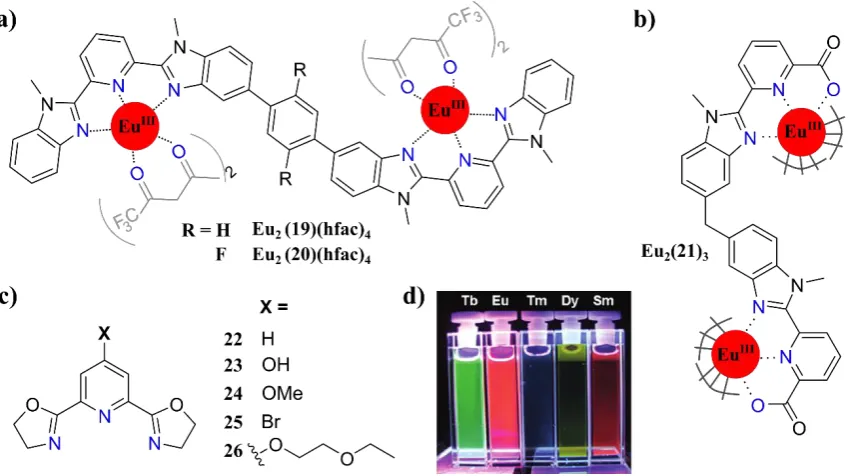
Figure 1.11 a) Structure of ditopic bbpy edifices [Eu2(19)](hfac)4 and [Eu2(20)](hfac)4; b) structure single strand of a triple-stranded dimetallic helicate with EuIII from three ligand 21; c) structure of Pybox (22) and
[image:42.595.61.486.475.713.2]19
sensitising chromophore in order to optimise the geometry of triple-stranded helicates in organic solution.135 Müller and co-workers, in parallel with Gunnlaugsson,136 extended the use of dipicolylamide (dpa) derivatives and synthesised ligands 17 and 18 attaching chiral phenyl chromophores.137,138 Efficient sensitisation of both visible and NIR emitting LnIII ions was observed from these systems and circularly polarised luminescence was recorded from the complexes implying a Λ or Δ excess directed by enantiomer configuration. The dpa
motif has been developed by Gunnlaugsson et al. in great depth and is specifically discussed in Section 1.7 below. Bünzli and Piguet introduced the terdentate 2,6-bis(benzimidazol-2-yl)pyridine (bbpy) ligand which was synthesised by heterocyclic condensation of benzimidazole from dpa precursors. Piguet used bbpy in bimetallic Eu2.(19)(hfac)4 and
Eu2.(20)(hfac)4 to demonstrate the benefit of perfluorinated aromatics spacers for extending
π-conjugation length of the chromophore units in the improvement of sensitisation efficiency of EuIII-centred emission.139 The balance of non-radiative deactivation was shown to optimise the efficiencies of ISC and in turn the intrinsic quantum yields of the EuIII centre. This binding site has mostly been used in the formation of triple-stranded helicates,140 such as those formed from ligand 21, and thermodynamic properties of their formation studied in detail.124 The cooperative stability, kinetic inertness and favourable millisecond lifetimes of EuIII-containing methylene-bbpy triple-stranded helicates have been investigated for cellular staining.82,141-144 The various options for functionalisation were highlighted for specific targeting and solubilisation for staining cellular cytoplasm, late endosomes or lysozomes, and therefore have been hypothesised for use in monitoring cellular processes using time-gated luminescence imaging.
Another direct dpa derivative binding site pyridine bis(oxazoline), or Pybox, 22 was reported by de Bettencourt-Dias145 and showed that the ligand could be functionalised, 23 -
20
fluids152 since tpy sensitises EuIII (red emitting), TbIII (green emitting) and itself has a blue fluorescence.
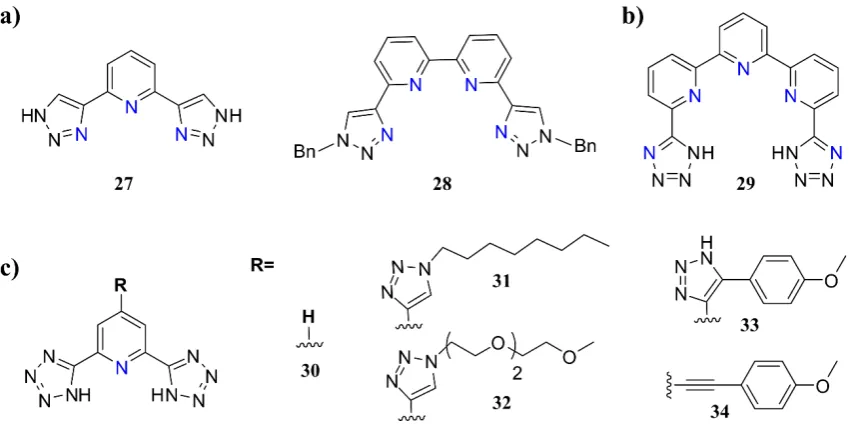
Expanding upon the tpy moiety, Byrne and Gunnlaugsson introduced bis(1,2,3-triazolyl)pyridine (btp, 27) for LnIII coordination, see Section 1.7, while Nash and co-workers used this triazole isomer in the synthesis of bis-1,2,3-triazole-bipyridine (28, BYzBP). Ligand 28 was synthesised containing triazole-attached phenyl substituents and were found to aid in the selective separation of lanthanide and actinide salts in the presence of suitably lipophilic anions.153 However, despite being a chromophore-rich species, the sensitisation efficiency of these ligands for emissive LnIII ions have not been explicitly explored. A similar approach was taken by Mazzanti et al. using tetrazoles and an extended
tpy central core. Ligand 29 was reported as a poly-dentate scaffold which could assemble into complexes of various topologies and was shown to form highly luminescent double- and triple-helical complexes with various LnIII ions (Ln = Eu, Tb or Nd).154 The use of tetrazoles has been further developed by Mazzanti with the familiar pyridine ligand core.155,156 The self-assembly of pyridine-2,6-bis-tetrazolates was demonstrated with various substitutions, 30 - 34, with triazoles and other π-conjugated chromophores. The parent scaffold, 30, was able to sensitise visible emission from EuIII and TbIII ions in water with quantum yields of 18% and 63%, respectively. Substitution of the pyridine 4-position with triazolyl units was not disruptive of self-assembly and photophysical properties and, in fact, demonstrated enhancement in the luminescence quantum yields to 43% and 98% for EuIII and TbIII, respectively.
[image:44.595.60.490.69.281.2]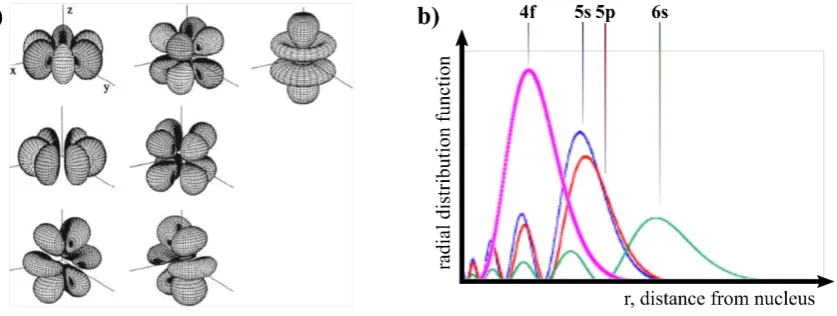
![Figure 1.9 a) Structure of dipicolinic acid, 6; b) inkjet printed images on A4 paper using Cs3[Eu.(6)3], Cs3[Tb.(6)3] and Firefliy™ inks under ambient (left) and UV (right) light](https://thumb-us.123doks.com/thumbv2/123dok_us/979984.611537/41.595.102.527.516.726/figure-structure-dipicolinic-inkjet-printed-images-firefliy-ambient.webp)