
IMAGINE Final Report
62
0
0
Full text
(2) Page ii. Deliverable 6.2 – Final Report. Executive Summary IMAGINE project aimed to design and develop software technology that allows the interaction with electronic business applications by using a multi-lingual natural language interface from mobile devices and other appliances. The full potential given by electronic business-to-consumer markets can be made available to a broader audience by providing e-commerce on mobile phone. The project is based on the results of a previous project that already delivered the basic technology, a sophisticated software architecture and an advanced natural language system for all the languages that will be dealt with in this project. The realisation requires improvements and adaptations of linguistic modules, adaptation of application modelling, integration with voice recognition, integration with e-business applications and testing and validation. This report describes the results obtained at the end of the project, which are summarised next: The project has created two products: A voice-enabled natural interface to two specific e-business applications, for an English and a Spanish e-business site. The interface includes an experimental German module. In addition, the project has developed some tools to facilitate the process of knowledge acquisition and adaptation of IMAGINE to new applications. The project has been carried out with the participation of six European companies, four of them involved in the development (Software AG España, the University of Southampton/ T Innovation, Gesellschaft zur Förderung der Angewandten Informationsforshung e.V. and Teléfonica Investigación y Desarrollo) and two users (Royal National Institute of the Blind, Iniciativas Digital Media). The report provides an overview of: •. General project results including prototypes, run time details and developer tools.. •. A summary of the work completed per work-package and task.. •. Administrative information including resources usage, results obtained in terms of deliverables, etc.. The report is intended for internal use within the Consortium and the European Commission.. IMAGINE. Interfacing Mobile Applications with Voice Natural Language Interactivity. IST-2000-29490.
(3) Deliverable 6.2 – Final Report. Page iii. Table of Contents 1. INTRODUCTION. 6. 1.1. IMAGINE Project. 6. 1.2. Situation. 7. 1.3. Purpose. 7. 1.4. Overview. 7. 2. IMAGINE PRODUCTS. 9. 2.1 Overall goals 2.1.1 Integration of speech with a NL-Understanding System 2.1.2 Naturally interfacing e-business applications 2.1.3 Improvement and Extension of Available Language Processing Module 2.1.4 Interfacing Specific Applications 2.1.5 Generalisation 2.1.6 Exploitation. 9 9 9 9 10 10 10. 2.2 The demonstrator 2.2.1 The Online Shop 2.2.2 The city guide –Viapolis 2.2.3 IMAGINE Web Site 2.2.4 Dummy application. 10 11 12 14 15. 2.3. 15. How it works. 2.4 Developer subsystem 2.4.1 Methodology for integrating IMAGINE 2.4.2 Knowledge Manager (KNM) 2.4.3 The English Speech Tool (EST). 16 16 17 19. 2.5 Other results 2.5.1 Software AG 2.5.2 IT Innovation 2.5.3 IAI 2.5.4 Telefónica I+D 2.5.5 Royal National Institute of the Blind 2.5.6 Iniciativas Digital Media. 20 20 20 21 21 22 22. 3. RESULTS AND ACHIEVEMENTS. 23. 3.1 WP1. Preparation 3.1.1 T11. Def of User & System requirements 3.1.2 T12. Lingware preparation 3.1.3 T13. Func Specs & Architectural Design. 23 23 24 25. 3.2 WP2. Natural language interface 3.2.1 T21. Linguistic processor 3.2.2 T22. Mobile device & Voice Integration 3.2.3 T23. Semantic Analyser & e-dialog management 3.2.4 T24. Linguistic resources. 27 27 27 30 34. 3.3. 35. IMAGINE. WP3. e-commerce applications integration. Interfacing Mobile Applications with Voice Natural Language Interactivity. IST-2000-29490.
(4) Page iv. Deliverable 6.2 – Final Report. 3.3.1 3.3.2 3.3.3 3.3.4. T31. Ontology e-Business Model formalisation. T32. Front-end integration T33. Development & Integration Tools T34. E-commerce secure transactions. 35 37 39 42. 3.4 WP4. Pilots validation 3.4.1 T41. Integration & support 3.4.2 T42. Evaluation and assessment 3.4.3 T43. NL usability studies. 43 43 44 47. 3.5 WP5. Exploitation & Dissemination 3.5.1 T51. Initial market studies 3.5.2 T52. Exploitation Plans 3.5.3 T53. Dissemination. 48 48 50 52. 3.6 WP6. Management 3.6.1 T61. Administration 3.6.2 T62. Technical mgmt, QA, CMB, HD & rep. 52 52 53. 4. MANAGEMENT INFORMATION. 55. 4.1. Statement of progress. 55. 4.2. Resources usage. 56. 4.3. Deliverables Summary. 57. 4.4. Problems encountered. 57. 4.5. Project Meetings. 58. 4.6. Updated Project Snapshot. 61. IMAGINE. Interfacing Mobile Applications with Voice Natural Language Interactivity. IST-2000-29490.
(5) Deliverable 6.2 – Final Report. Page v. Figures and Tables FIG 2.2.1 - COMPARATIVE LOOK UP TABLE BETWEEN IMAGINE PROTOTYPES.............................................................. 11 FIG 2.2.1.1 - DIALOG TO GET THE BASKET CONTENTS THROUGH IMAGINE. .................................................................. 12 FIG 2.2.1.2 - BASKET CONTENTS THROUGH THE RNIB ONLINE SHOP. ............................................................................ 12 FIG 2.2.2.1 - ACTIVITIES FOR TODAY THROUGH IMAGINE. ........................................................................................... 13 FIG 2.2.2.2 - VIAPOLIS WAP ACCESS. .............................................................................................................................. 13 FIG 2.2.3.1 - IMAGINE PROJECT OBJECTIVES ASKED THROUGH IMAGINE. ................................................................. 14 FIG 2.2.3.2 - GERMAN VERSION OF THE IMAGINE WEB SITE. ....................................................................................... 14 FIG 2.2.4.1- DUMMY APPLICATION RESOURCES PROVIDED.............................................................................................. 15 FIG 2.3.1 - IMAGINE FUNCTIONAL COMPONENTS.......................................................................................................... 16 FIG 2.4.2.1 - DEVELOPER TOOL: DISPLAYING LOGICAL FUNCTIONS ................................................................................. 18 FIG 2.4.3.1 – EST ROLE IN IMAGINE. ........................................................................................................................... 19 FIG 3.1.3.1 - IMAGINE ARCHITECTURE SUMMARY....................................................................................................... 26 FIG 3.2.2.1.1 – ENGLISH SPEECH TOOL DEPLOYMENT..................................................................................................... 28 FIG 3.2.2.1.2 – COMPARATIVE GRAMMAR TABLE............................................................................................................ 30 FIG 3.2.3.1 – LPM OUTPUT EXAMPLE 1........................................................................................................................... 31 FIG 3.2.3.2 – LPM OUTPUT EXAMPLE 2........................................................................................................................... 32 FIG 3.2.3.2 – DIALOG ACTIVITY DIAGRAM. .................................................................................................................... 33 FIG 3.2.3.3 – SEMANTIC STRUCTURE OF USER UTTERANCES. .......................................................................................... 34 FIG 3.3.3.1.1 – FULL SET OF KNOWLEDGE IN THE KNM. ................................................................................................. 40 FIG 3.3.3.1.2 – TWO SCREENS OF KNM TOOL. ................................................................................................................ 41 FIG 3.3.3.2.1 – GRAMMAR WORKBENCH POSITION. ......................................................................................................... 41 FIG 3.3.3.2.2 – GRAMMAR WORKBENCH INTERFACE. ..................................................................................................... 41 FIG 3.3.3.2.3 – RECOGNITION PACKAGE USAGE. ............................................................................................................. 42 FIG 3.4.1.1 – PROTOTYPES DELIVERY.............................................................................................................................. 44 FIGURE 3.4.2.1 ORIGINAL VALIDATION TIMELINE .......................................................................................................... 44 FIGURE 3.4.2.2 FINAL VALIDATION TIMELINE ................................................................................................................ 46 FIG 3.5.1.1 – IMAGINE POSITION AT THE MARKET. ....................................................................................................... 48 FIG. 3.5.2.1.1 – EXPLOITATION PLAN PHASES ................................................................................................................. 51 FIG 3.6.2.1 – MEMBERS IMAGINE WEB SITE. ............................................................................................................... 53 FIG 4.1.1 – PROJECT WORK PLAN. ................................................................................................................................... 55 FIG 4.2.1 – RESOURCES USAGE.................................................................................. ERROR! BOOKMARK NOT DEFINED. FIG 4.2.1 – RESOURCES USAGE BY PERIOD. ..................................................................................................................... 56 FIG 4.3.1 – THE FULL LIST OF IMAGINE DELIVERABLES. .............................................................................................. 57. IMAGINE. Interfacing Mobile Applications with Voice Natural Language Interactivity. IST-2000-29490.
(6) Deliverable 6.2 – Final Report. Page 6. 1. Introduction 1.1 IMAGINE Project The major players in the field of information technology share the vision of using natural language to interact with computers and other telecommunication devices. Natural language access to the Internet, information systems, and computer software will become even more essential if the benefits of ecommerce and the internet are to become available to the whole society and not just to some privileged parts of it. The Internet is changing many areas of life. Set top boxes and other devices are taking the Internet into the homes of ordinary people via TV-cable, satellite and digital media and will enable them to experience the potential of e-commerce. The IMAGINE project aims to provide a new means to interface with e-business applications, by providing a voice driven interface, and thus making them more accessible to the user. The solution provided by IMAGINE requires the correct integration of different key technologies e.g. speech recognition, natural language understanding, and a solid know-how of e-business architectures and solutions. The project started from the technological basis established in a previous project, MELISSA (ESPRIT 22252), and built on this through the expertise of the key partners in the essential supporting technologies.. Project Objectives The ultimate objective is to exploit the full potential of electronic business-to-consumer markets through a broader audience by providing e-commerce through a speech driven interface on a variety of devices. This objective has been approached through the design and development of software technology that allows the interaction with electronic business applications by providing a multi-lingual natural language interface for mobile devices and other appliances.. Expected Results The project has created two products, a voice-enabled natural interface to two specific e-business applications for an English and a Spanish e-business site. In addition, the project developed some tools to facilitate the process of knowledge acquisition and adaptation of IMAGINE to new applications.. Benefits IMAGINE’s goal is to facilitate e-commerce by providing a voice driven interface and accessibility via a variety of devices e.g. mobile phones. It will thus enable large user groups not familiar with computers and computer technology to benefit from e-commerce opportunities. The full potential of e-commerce is a long way from being realised. In this context, IMAGINE will contribute to make e-commerce: more accessible, in the way that everyone can use the device that is more convenient, easier to use: users simply say what they want without having to learn to use new technologies, affordable as it becomes available through telephone, there is no need for buying a computer.. IMAGINE. Interfacing Mobile Applications with Voice Natural Language Interactivity. IST-2000-29490.
(7) Deliverable 6.2 – Final Report. Page 7. 1.2 Situation After two years working in IMAGINE project, this report summarises the work and achievements get from the project. Consequently, the report outlines the results obtained from the different project tasks, and special attention is paid to describe the overall results of the project as a whole, both in terms of software and supporting documentation. All the partners responsible of one task have contributed to this document providing the summary of the task that they are responsible of. The coordinator, has translated and gathered the rest of the information to create the administrative and general section of the document.. 1.3 Purpose The objective of this report is to compile all the results of the IMAGINE project. It can serve also as index to find other documentation where concrete tasks have been more detailed or completely developed. It has three different points of view according to the possible interest of the readers: •. From a non technical point of view, the first section IMAGINE products, gives an good idea of what is IMAGINE and what is the concrete stuff result of the project.. •. A second section Result and achievements, is more devoted to technical and interested parties in the project, explaining task by task what are the concrete achievements and where to find the complete results within the project documentation.. •. Finally, the Management information is more addressed to the commission readers or even to other technical readers, in order to know what are the more consuming tasks, what problems the consortium run into, etc.. 1.4 Overview The contents of this document are organised in three main sections: : Chapter 2. IMAGINE products gives a general overview of the achievements in IMAGINE. It is structured in the following way: -. Overall goals: summary of IMAGINE goals.. -. The demonstrator: practical cases tackled during the IMAGINE project.. -. How it works: high level description of the IMAGINE system.. -. Developer subsystem: explanation of the maintenance tool for getting the information for a new application.. -. Other results: partner general experience of the IMAGINE project.. Chapter 3. Results and achievements details task by task what has been the works done during the project: -. WP1 Preparation: previous to the development phase, it is necessary to state the user requirements and review the MELISSA architecture for the adaptations required to e-commerce and speech input and output. Then, the architectural design can be tackled.. -. WP2 Natural Language Interface: design and development of the components close of the natural language management, either written or spoken: linguistic processor, semantic analysis, dialog, English Speech tool and Spanish speech tool.. -. WP3 e-commerce apps integration: design and development of the components related with the interfaced application: knowledge database and its maintenance, front end and answer adapter.. -. WP4 Pilots validation: task related with the real application of IMAGINE to the two pilot sites: integration reports, validation activities and usability studies.. IMAGINE. Interfacing Mobile Applications with Voice Natural Language Interactivity. IST-2000-29490.
(8) Page 8. Deliverable 6.2 – Final Report. -. WP5 Exploitation & dissemination: the final objective of IMAGINE is to have a pre-commercial product. In order to have this product well positioned for market adequate market studies, dissemination and exploitation plans have be made.. -. WP6 Management: the correct administration of the project requires some material, document, communication areas (Web site), and in general resources that are developed in this work package. Chapter 4. Management information aims to give a summary of the administrative details for the complete project, namely: -. Statement of progress: summary of the project evolution according to the plan.. -. Resources usage: summary of resources consumed resources.. -. Deliverables summary: complete list of deliverables.. -. Problems encountered: summary of the main problems found during the project life cycle.. -. Project meetings: list of consortium meetings.. -. Updated Project Snapshot: make a short card with the definition of the project.. IMAGINE. Interfacing Mobile Applications with Voice Natural Language Interactivity. IST-2000-29490.
(9) Deliverable 6.2 – Final Report. Page 9. 2. IMAGINE Products 2.1 Overall goals From the technical annex, we recover the original objectives for IMAGINE: “IMAGINE will provide easy access to e-commerce by mobile phone and other appliances through a NL interface”. The objectives are summed up in the following goals:. 2.1.1 Integration of speech with a NL-Understanding System The project expected to integrate speech with language understanding. The speech module for IMAGINE would have to satisfy a range of market and user requirements: •. Accept continuous natural language. Continuous natural language has well known and documented characteristics in comparison to for example isolated work speech. Most current front-end products support continuous speech with some greater error rate than for isolated words.. •. Require minimal training to be operational, although training is possible for the mobile and Internet based applications (personal access or access devices). If many hours of training are required the users will not persevere with the device.. •. Be operational in multiple languages. The languages of immediate choice are those represented in the consortium (Spanish and English).. • Be lightweight in the client device so that existing mobiles can accommodate the technology. In the practice the IMAGINE project has integrated two speech systems with Natural Language processing mechanisms. An explanation of this integration is provided at section 2.3, and a more detailed explanation about how to integrate the speech machinery is detailed at section 2.4.3.. 2.1.2 Naturally interfacing e-business applications The main project objective was to facilitate the access and usage of e-business applications. From a technical perspective this is translated into the following goals: •. Analysis of the communication requirements for humans to get the data in terms of interactivity and dialogue acts analysed in the context in which humans move, and the knowledge that is tacitly assumed in contexts and thus be omitted in requests (elliptical and anaphoric interactions).. •. On this basis, the system will be able to understand queries for given domains. It will cover the dialog and communication acts like: 'Give me the prices for carpets below 4000 $', 'Upcoming special offers for next month', 'Where can I find tea pots?', 'Please, show me the price list for mobile phones'.. •. Provision of methods for accessing directly the right entry function-point of a specific application i.e. choosing the right entry point among several ones available in a Web site. This needs to be complemented with functionalities to manage the execution of several actions from a single sentence, simple standard disambiguation procedures, passing of parameters to the application, etc.. This goal has been approached through the cooperation and coordination of diverse modules (Linguistic processing, dialog handling, answer adapter module, etc) as it is explained in chapter 2.3 How it works.. 2.1.3 Improvement and Extension of Available Language Processing Module The improvement and the adaptation of the available language module were a major task. •. The linguistic resources had to be adapted to cover the sub-language relevant for doing e-commerce (such as ordering, asking for information, doing payment, seeking assurance, etc.). The NL system provides ‘deep’ understanding, i.e. it maps each utterance on a generic language-independent semantic representation that has been specified in a previous project in the wake of a trend towards ‘flat’ semantic representations.. •. ‘Robust’ processing has to be provided by integrating a NL parser that is able to provide a shallow analysis for unlimited text into the foreseen deep understanding system. So, it is always possible to. IMAGINE. Interfacing Mobile Applications with Voice Natural Language Interactivity. IST-2000-29490.
(10) Page 10. Deliverable 6.2 – Final Report. provide a basic understanding of NL input even if the NL understanding system is not able to provide a full semantic representation. •. User acceptance had to be improved by introducing discourse-based elements:. -. Covering sentences with ellipsis and anaphora referencing previous discourse elements.. -. Base linguistic coverage on dialogue modelling.. -. Base linguistic coverage on a concept of user sub-language.. -. Integrate modelling of illocutionary force.. •. Linguistic resources had to be adapted to e-commerce model by efficient integration of lexical material, conceptual ontological modelling of commercial domain.. As result, the project counts with specific Linguistic modules for English, Spanish and German, which after refinement in the different lines above explained, are prepared for the purpose of interfacing software applications, allowing a quicker adaptation to a new application.. 2.1.4 Interfacing Specific Applications In IMAGINE, it was expected to apply this technology to interface two pilot e-commerce applications for two different users, the Royal National Institute of the Blind (RNIB), and Viapolis (IDM). Both pilots would provide e-commerce with a natural language interface. Both users would take benefit from the integration of the voice-enabled Natural Language Interface to their e-business application. The application chosen by the Royal National Institute of the Blind (RNIB) is the RNIB Online Shop – an e-commerce site that allows RNIB customers to browse for and purchase RNIB products via the Internet. The Viapolis application is an Internet site that allows users to find out what’s going on where and when in Spain. It is a valuable resource for residents of Spain and visitors alike to find restaurants, cinemas, etc. The potential that this solution could bring to end users, citizens and disabled people, is enormous.. 2.1.5 Generalisation IMAGINE has been designed with the aim of providing an environment allowing developers of e-commerce applications a general solution for creating Natural Language interfacing to e-business applications. This objective is managed thanks to a modular architecture, relying on an ontology model, which makes the modules behaviour independent from the concrete data of an application. Additionally, the project provides tools to developers, allowing them an easy integration and configuration of IMAGINE with their own applications, by using different mechanisms (applets, JBeans, IIOP, DCOM, …). 2.1.6 Exploitation From a market perspective, the objectives of IMAGINE were: 1. To validate the results at the pilot sites. A user-centred methodology has been applied for the various project stages. The pilot applications used as demonstration of the technology in dissemination activities. It was expected that a close relationship with users provide the best recipes to follow in order to deliver a useful and widely adopted tool. 2. To comply as much as possible with open software and non-proprietary tools, with the focus on the widest and simplest possible distribution. This will help open the target market for IMAGINE. 3. To build a set of tools to facilitate the integration of further applications, that would open the market of third party products for IMAGINE, to be included easily in new e-commerce application. The project has concluded with an exploitation plan, which depicts the approach for a further exploitation of the project results.. 2.2 The demonstrator The project has concluded with the integration of the Voice Natural Language Interface with two eBusiness applications: •. IMAGINE. Access to the RNIB Online Shop Web site.. Interfacing Mobile Applications with Voice Natural Language Interactivity. IST-2000-29490.
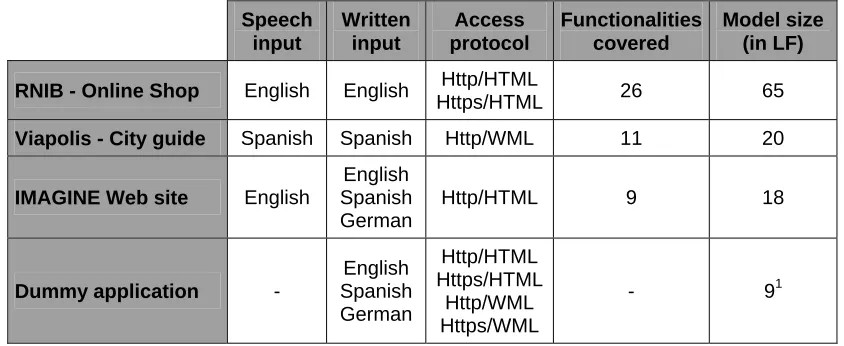
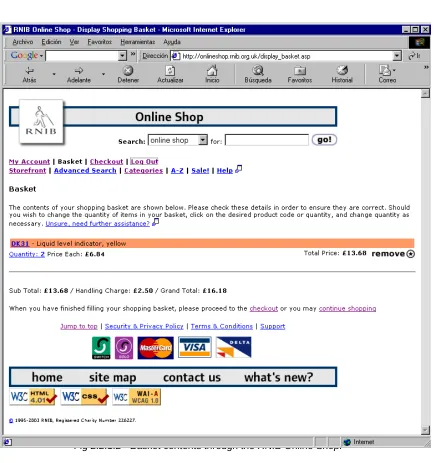
(11) Deliverable 6.2 – Final Report. •. Page 11. Access to the Viapolis Wap city guide.. With the aim of proving the concept of an easy to integrate interface, and as an step to dissemination, the project has concluded with two additional prototypes: •. Access to the IMAGINE home site.. •. The creation of a customisable package ready to be downloaded and adapted for easy Web applications similar to the IMAGINE Web site.. Following table shows a comparative summary of the prototypes characteristics:. Speech input. Written input. Access protocol. Functionalities covered. Model size (in LF). RNIB - Online Shop. English. English. Http/HTML Https/HTML. 26. 65. Viapolis - City guide. Spanish. Spanish. Http/WML. 11. 20. IMAGINE Web site. English. English Spanish German. Http/HTML. 9. 18. -. English Spanish German. Http/HTML Https/HTML Http/WML Https/WML. -. 91. Dummy application. Fig 2.2.1 - Comparative look up table between IMAGINE prototypes.. 2.2.1 The Online Shop The application chosen by the Royal National Institute of the Blind (RNIB) is the RNIB Online Shop, an ecommerce site that allows RNIB customers to browse for and purchase RNIB products via the Internet. It is a very new site and was launched in March 2002. The adaptation of IMAGINE to this site, is the main outcome of the IMAGINE project. Most of the efforts have been devoted to this prototype for various reasons: -. The Online Shop is a real working system;. -. The Online Shop is a very good representative of an e-commerce application.. -. The English spoken market is a very promising area in world wide market.. -. The great interest from the very beginning in the project from RNIB partners.. As a result of these efforts, a very refined prototype has been delivered. Sixteen versions have culminated in the production of a very evolved prototype covering a high percentage of the Online Shop functionality. D23 – Dialog and Interaction model gives a detailed idea about the model supporting the Online Shop system. The system can support most of the functionality of the visual Online Shop. In the next picture, a dialogue between the user and IMAGINE can be seen, along with the corresponding Online Shop screen.. User > my basket please. 1. Basic functionality: Help, Quit, Stop, etc. IMAGINE. Interfacing Mobile Applications with Voice Natural Language Interactivity. IST-2000-29490.
(12) Page 12. Deliverable 6.2 – Final Report. IMAGINE > What do you mean? 1 Add to Basket or 2 Show the basket or 3 Remove products from the basket Please choose one of them by saying its number or stop if you don't want any of them User > two IMAGINE > You have 1 type of product in your basket. Product code DK31 is a - Liquid level indicator, yellow which costs £8.04 each. Your basket contains 2 of them, therefore the cost for this is £16.07. To summarise, the products you have selected costs £16.07 altogether. A handling fee of £2.50 is added. This makes a total sum of £18.57 Would you like to update the quantities in your basket, remove products from your basket, browse for products, checkout or change your delivery address for this order?. Fig 2.2.1.1 - Dialog to get the basket contents through IMAGINE.. Fig 2.2.1.2 - Basket contents through the RNIB Online Shop.. 2.2.2 The city guide –Viapolis The Viapolis application is an Internet site that allows users to find out what’s going on where and when in Spain. It is a valuable resource for residents of Spain and visitors alike to find restaurants, cinemas, etc. and the WAP version can directly allow the user to get in contact with, say, the restaurant of their choice, for example, to book a table. Given the wide scope of the entire Viapolis application, the objective of the project is to provide a voice enabled interface to retrieve information for a concrete selected city in Spain.. IMAGINE. Interfacing Mobile Applications with Voice Natural Language Interactivity. IST-2000-29490.
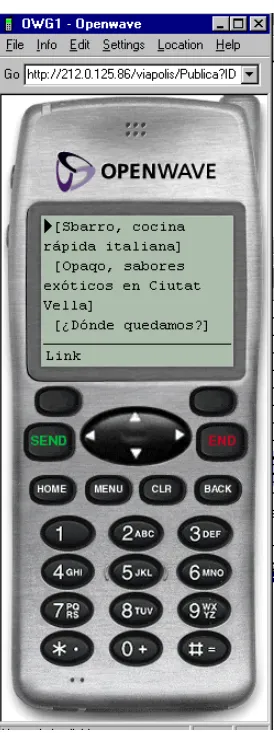
(13) Deliverable 6.2 – Final Report. Page 13. Unfortunately, during the project time, Viapolis has finished their commercial activities and the co-owner Iniciativas Digital Media take the role of Viapolis in the project. As the system is no longer active for external user but most of the work for model the system has been done, it was decided to maintain a test system, with non updated data. The interest for IMAGINE is high in this system also, because it is representative of a huge set of entertainment, leisure, etc sites. The difficulties with a so volatile information, teach the consortium for managing this information through different mechanism that a previously known information.. User > Actividades para hoy IMAGINE > de entre las siguientes opciones elija una de ellas diciendo sunumero: 1 Eventos por fecha y categoria o 2 Eventos por fecha User > 2 IMAGINE > 1 - Sbarro, cocina rápida italiana; 2 - Opaqo, sabores exóticos en Ciutat Vella; 3 - ¿Dónde quedamos?; 4 - Glamour y modernidad en el Schilling; 5 - Solidaridad y compromiso en La Cerería; 6 - Más;. Fig 2.2.2.1 - Activities for today through IMAGINE.. Fig 2.2.2.2 - Viapolis Wap access.. IMAGINE. Interfacing Mobile Applications with Voice Natural Language Interactivity. IST-2000-29490.
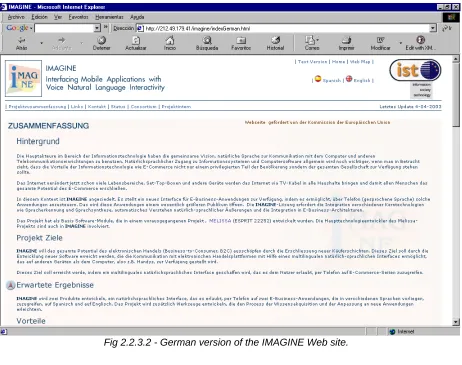
(14) Page 14. Deliverable 6.2 – Final Report. 2.2.3 IMAGINE Web Site The access to the IMAGINE Web site is part of the dissemination activities, although it has not been until the end of the project, when it has been included as a third prototype. The learning during the previous months with the other prototypes, make that the model of this prototype has been very quick designed and supported. Only the English will support the speech access to the site. In the example, a German query and response is got from the IMAGINE site. Also the IMAGINE site hard copy shows the corresponding German version of the site IMAGINE > Dieses System kann Ihnen über die folgenden Projekte erklären: IMAGINE, OPAL, ALFANET, COVAX, MELISSA and EFIS. Welches Projekt werden Ihnen an interessiert? User > Ich moechte gerne etwas ueber die Projektziele IMAGINE 2 IMAGINE > IMAGINE will das gesamte Potential des elektronischen Handels (Business-to-Consumer, B2C) ausschöpfen durch die Erschliessung neuer Käuferschichten. Dieses Ziel soll durch die Entwicklung neuer Software erreicht werden, die die Kommunikation mit elektronischen Handelsplattformen mit Hilfe eines multilingualen natürlich-sprachlichen Interfaces ermöglicht, das auf anderen Geräten als dem Computer, also z.B. Handys, zur Verfügung gestellt wird. Dieses Ziel soll erreicht werde, indem ein multilinguales natürlichsprachliches Interface geschaffen wird, das es dem Nutzer erlaubt, per Telefon auf E-Commerce-Seiten zuzugreifen. Fig 2.2.3.1 - IMAGINE Project objectives asked through IMAGINE.. Fig 2.2.3.2 - German version of the IMAGINE Web site.. 2. The default project is IMAGINE. Also the previous prompt, the so-called Welcome prompt, can be easily changed to conduct the user inputs to known functionalities. IMAGINE. Interfacing Mobile Applications with Voice Natural Language Interactivity. IST-2000-29490.
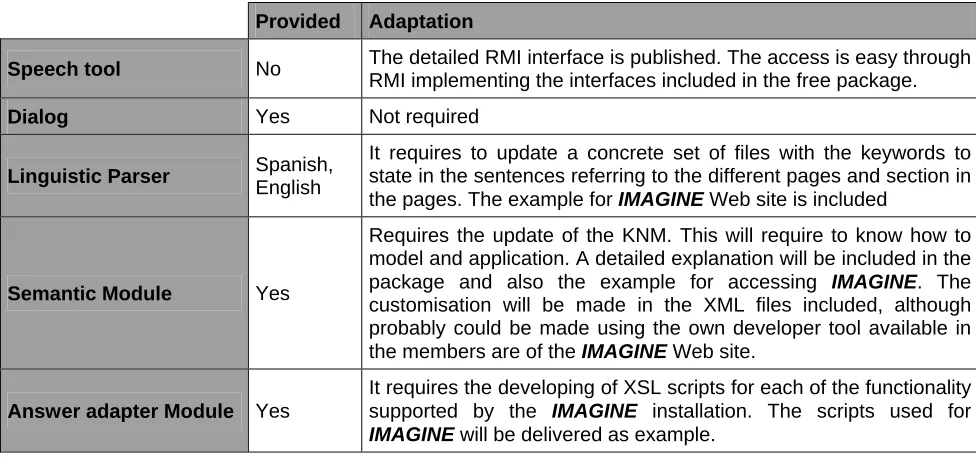
(15) Deliverable 6.2 – Final Report. Page 15. 2.2.4 Dummy application As an extra result of the third prototype, the model for it has been solved in a general way in such a way that it can be applied to other static sites with similar structure to IMAGINE. The structure is a simple page with concrete sections that can be directly addressed by the user through their name as part of a natural language sentence. The basic stuff in the free package includes all the software required to make an access in different languages (English, Spanish or German) to a site with the stated characteristics. No speech input mode is provided with this but written mode. The complexity of the hardware and software required for a new application with IMAGINE make very difficult to give by free anything really useful. Anyhow, the detailed interfaces for the connection of external speech tools is provided also for making easy the adaptation to IMAGINE of another speech tool. The summary of updates required in this free package to access to a new Web suite are summarised in the following table:. Provided. Adaptation. Speech tool. No. The detailed RMI interface is published. The access is easy through RMI implementing the interfaces included in the free package.. Dialog. Yes. Not required. Linguistic Parser. Spanish, English. It requires to update a concrete set of files with the keywords to state in the sentences referring to the different pages and section in the pages. The example for IMAGINE Web site is included. Semantic Module. Yes. Requires the update of the KNM. This will require to know how to model and application. A detailed explanation will be included in the package and also the example for accessing IMAGINE. The customisation will be made in the XML files included, although probably could be made using the own developer tool available in the members are of the IMAGINE Web site.. Answer adapter Module. Yes. It requires the developing of XSL scripts for each of the functionality supported by the IMAGINE installation. The scripts used for IMAGINE will be delivered as example.. Fig 2.2.4.1- Dummy application resources provided.. 2.3 How it works The detailed IMAGINE architecture is the focus of the deliverable D1.3 – Functional Specifications & Validation Plan, although a summary is given in this section. The IMAGINE voice enabled interface is a novel solution constructed upon the integration of key technologies for voice processing, natural language understanding, dialog handling, Web interfacing, etc. The below diagram depicts the basic architecture of the IMAGINE solution as a three layered service. At the top level Mobile device and voice integration, are the modules in charge of the direct interaction with the user. The two speech tools will support the two involved languages in the system. The English Speech Tool is based on a Nuance solution and follows a grammar-based approach; the Spanish Speech Tool is provided by Telefónica I+D, member of the consortium, and corresponds with a stochastic paradigm (linguistic model), with concrete grammars included for concrete purposes.. Mobile Device and Voice Integration. IMAGINE. English Spanish Speech Speech Interfacing Mobile Applications with Voice Natural Language Interactivity Tool Tool. IST-2000-29490.
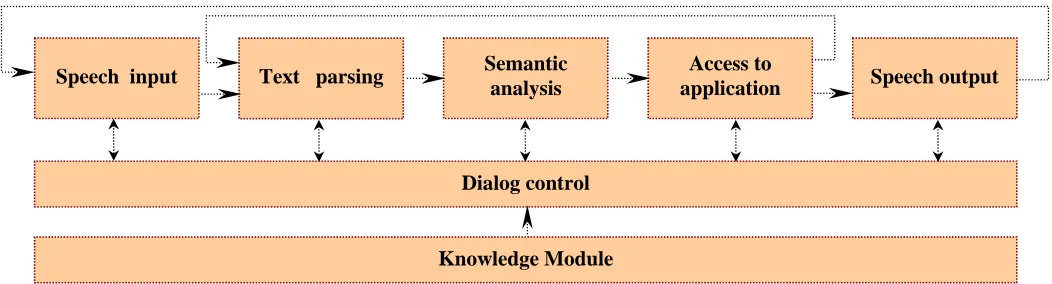
(16) Page 16. Deliverable 6.2 – Final Report. Fig 2.3.1 - IMAGINE functional components.. At the middle layer are those modules in charge of controlling the interaction with the user (dialog interaction, natural language processing and the generation of the output corresponding with the user request): •. The Linguistic Module is in charge of translating the user input transformed in written mode to a set of semantic facts, that represent the user utterance in an independent reference model, and from this model translate to the concrete application meaning.. •. The Dialog Handling Module is the core of the IMAGINE system, every action happening in the system is orchestrated by the dialog. Its objective is to determine the functionality that the user is referring to, and then, to complete all the parameters related with the concrete request. Once the understanding is complete, the Executive Module is called for getting the concrete response.. •. The Executive Module is the Back-End of IMAGINE. It takes control of minor details in communication activities through the real media (by now http/https with HTML and Http with WML) It also recovers the results of the “out world”, and translates them to terms of user understanding, i.e. sentences.. Finally, in the third level, the Ontology e-Business Model that represents the application to be interfaced in terms of a general formalism, not dependent on the current application interfaced but able to support new applications.. 2.4 Developer subsystem 2.4.1 Methodology for integrating IMAGINE IMAGINE is designed in such a way that it can be adapted to multiple applications that are already in existence, or that are in the development phase, if they are “reasonably manageable” with natural language either in written or speech model. If it is considered feasible to use IMAGINE with the application, then the rest of the phases are followed in order to get the adequate model of the application that IMAGINE can use to interface it. The complete process is the following: 1. Initial Analysis: general analysis of the application in order to see if the NL integration with the application is feasible, before going on to a more detailed study. Applications with a mainly graphical interchange of information with users are not suitable to be interfaced via speech mode. 2. User Needs Analysis: determines the user requirements that will be the basis for the integration activities.. IMAGINE. Interfacing Mobile Applications with Voice Natural Language Interactivity. IST-2000-29490.
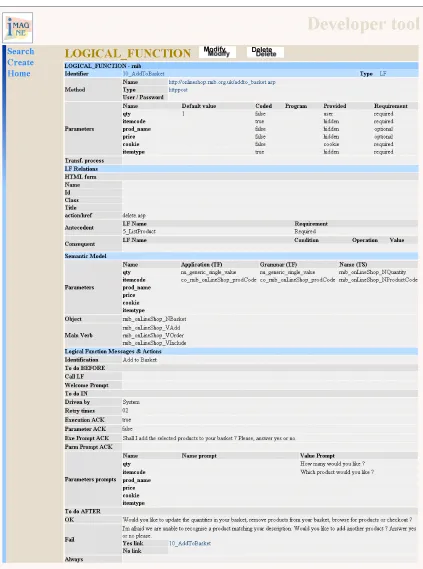
(17) Deliverable 6.2 – Final Report. Page 17. 3. Selection of Integration Solution: analyses the application features and decides the way of integrating IMAGINE with the application, giving software and communication guidelines. Typical methods are HTTP, HTTPS, RMI, Web Services, etc 4. Acquisition of the Application Knowledge: analyses the system to extract the set of functionalities that the application offers, their dependencies, etc. Main work for the KNM (Knowledge Management Module) maintenance tool. On this basis, the AAM (Answer Adapter Module) can define the ad hoc scripts that parse the application’s responses. 5. Acquisition of Linguistic Information: acquires the linguistic information necessary to meet with the NL coverage requirements of the application. The LPM (Linguistic Processing Module) and the ST (Speech Tool) are the main components requiring this information. 6. Acquisition of Semantic Application Knowledge: enables results of the LPM to be mapped onto the correct function calls. The LPM output is analysed by the SAM (Semantic Analysis Module), translating it into terms understood by the application. 7. Integration with the Application: the implementation of the specific modules that are necessary for the system to function (FEM). This is carried out via HTTP/HTTPS protocols, which are the most common nowadays. With little effort, it can be adapted to new paradigms such as Web Services, etc. if required. 8. Test & Validation: A test process to verify that the interface fulfils all specified requirements and to guarantee the final quality of the interface and user satisfaction. 9. Maintenance: provides the methods to follow when the interfaced application changes its functionality or environment.. 2.4.2 Knowledge Manager (KNM) The core of IMAGINE is the dialogue. This component reads the model of the application to be interfaced and interprets the user utterances after being analysed by linguistic components. Those linguistic components translate the user sentence into semantic terms managed in the interfaced application. It is then when the dialogue manages the possible functionalities supported by the application, selecting among ambiguous functions and asking the user for non-provided parameters. An adequate maintenance of the KNM is therefore the key for the adaptation of IMAGINE to the application interfaced from a functional point of view. For this purpose, a developer tool has been provided, giving access to every detail related with this model. A Logical Function represents a compact and concrete functionality. In the prototypes covered during the IMAGINE project time, example of Logical Function are: 10_AddToBasket, 5_ListProduct, 2_EventCategory, 5_directoryName, 6_RelatedLinks, etc All those LFs, can be directly found in the three different prototypes, and performed using the original interfaces provided by the applications. The LFs contains at the same time various types of knowledge: -. the information about how to get the functionality in the application, i.e. in the case of Http/Https protocol, the concrete URI; the type of call (Get, Post,…),. -. the parameters required for the method to call.. -. the form that should be parsed to get details for next step in the LF execution process,. -. the antecedents or consequents LFs that have relation with the current LF, or the relations with other steeps that all together compose the full functionality covered by the LF,. -. the semantic model of the LF representing, this is based on the use of IMAGINE Type Formats and IMAGINE Type Synonyms,. -. the dialog details like the prompts to ask the parameter values, the actions to do before or after the LF is executed, etc.. The main work with the KNM is done before IMAGINE starts to work with the interfaced application. Then, when the IMAGINE core starts, the full KNM is loaded in main memory, avoiding access to external systems, what imply a better performance rate. The work with the KNM, once the application has been modelled, is mainly to maintain the prompt texts, to tune the details of the parameter requirement, (values, requirement, etc), … There is another delicate task that is started with the first model of the application but requires a more refined work, it is the Semantic Model.. IMAGINE. Interfacing Mobile Applications with Voice Natural Language Interactivity. IST-2000-29490.
(18) Page 18. Deliverable 6.2 – Final Report. Fig 2.4.2.1 - Developer tool: displaying logical functions The Semantic Model represents a high level of representation of the application functionality. It supposes a medium step between the result of the Linguistic tools and how this Linguistic tools results could be understood, or lets say mapped, into the functionality of the application. The semantic model represents, for example, the mechanism to map the word basket, with the functionality, or functionalities that are related with the basket. In this case three LFs: 6_Basket, 7_RemoveFromBasket and 10_AddToBasket. In order to see more details about Logical Functions and semantic model, it is recommended to read the documents D23 – Dialog and Interaction Model and D4.2 – Second prototype Integration Delivery Report.. IMAGINE. Interfacing Mobile Applications with Voice Natural Language Interactivity. IST-2000-29490.
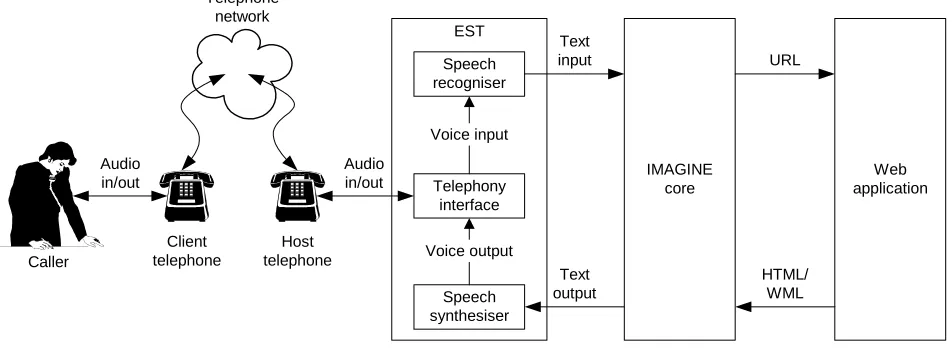
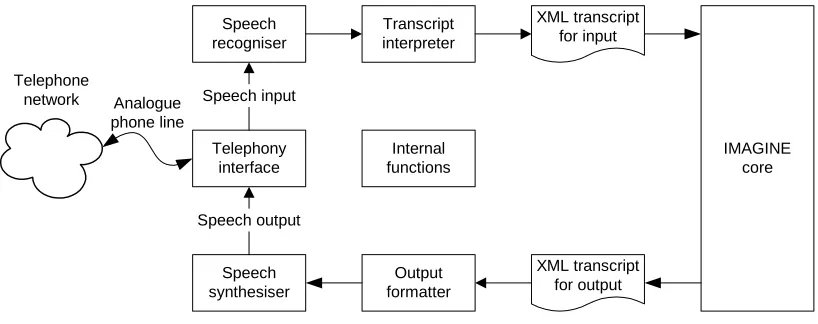
(19) Deliverable 6.2 – Final Report. Page 19. 2.4.3 The English Speech Tool (EST) The English speech tool (EST) is responsible for connecting IMAGINE to a telephone line, interpreting voice input and synthesising speech output. Its role in the overall system is illustrated in the following diagram. Telephone network EST Speech recogniser. Text input. URL. Voice input Audio in/out. Caller. Audio in/out. Client telephone. Host telephone. IMAGINE core. Telephony interface. Web application. Voice output Speech synthesiser. Text output. HTML/ WML. Fig 2.4.3.1 – EST role in IMAGINE. Telephony Interface The telephony interface connects the EST to an ordinary analogue telephone line via a Dialogic telephony card, i.e. the card acts as a telephone on the telephone network. When the module detects an incoming call, it answers the call by “picking up the telephone”, connects the audio input from the caller to the speech recogniser and the audio output to the caller to the speech synthesiser. Speech Recogniser The speech recogniser is responsible for converting spoken words in an audio signal into text. The module is built on a commercial speech recogniser. Recognition grammars have been developed to customise the recogniser such that it understands typical utterances that are relevant to the RNIB Online Shop application, e.g. “I want to place an order”. The module applies basic interpretation to the transcription to filter out superfluous words (e.g. “I want to um place an er order” is interpreted and converted into “I want to place an order” for output), simplify complex input (e.g. “Freddy f r e d d y” is interpreted as “Freddy”) and adds markup to complex types such as postcode and date (e.g. “s o fourteen seven n p” is interpreted as “<postcode>so14 7np</postcode>”). This approach to recognition improves the interpretation accuracy of the IMAGINE core as the linguistic modules within the core was primarily designed for written text which does not include speech acts and complex types in transcription form. The implemented speech recogniser can interpret the following types of information as well as utterances that are relevant to a range of requests. • Date, day, month, year • Letter and spelling • Credit card details including credit card number, expiry date, card holder name • Telephone number, number, VAT registration number • Title (e.g. Mr.), email address, password, gender, post code, house number, number • Popular (top 95%) first names and surnames in the UK • Product name, product code, product category and section names for RNIB products • Request for login, product search, shopping, registration, changing stored details • Request for help, changing speech output preference, hang up, transfer call Recognition grammar Utterances that are understood by the speech recogniser are defined in a recognition grammar. Experiments were conducted to assess several approaches to grammar writing. The first used hand crafted rules to define exact linguistic structures that can be transcribed by the recogniser. This approach IMAGINE. Interfacing Mobile Applications with Voice Natural Language Interactivity. IST-2000-29490.
(20) Page 20. Deliverable 6.2 – Final Report. generated a large grammar that became increasingly difficult to maintain as the interaction between the different rules became intractable as the grammar grows. The second used a statistical language model that was automatically derived from example text. The method is easy to maintain as a novice to add new utterances to the grammar by providing example utterances. However, recognition accuracy and speed performance were poor as the method requires a vast amount of training data to obtain an accurate statistical model. The third adopted a hybrid approach where the recognition grammar was partitioned according to function (e.g. add product to basket, registration, etc.) and each function was described by a statistical language model. A proprietary grammar editing tool was developed to enable a novice user to modify the grammar. The result is a maintainable grammar with improved accuracy. However, the interaction between sub-grammars also became intractable as the grammar grows. The final approach used an proprietary grammar specification method that maps utterance fragments to complete sentences. The result is a highly flexible recognition grammar which has the best accuracy and speed performance. However, all maintenance has to be carried out by an expert grammar writer. This is the approach that is used in the final system. Speech Synthesiser The speech synthesiser is responsible for converting written text into spoken form. The module is build on a commercial speech synthesiser which is capable of generating speech in different voices, speed and volume. The synthesiser takes the text output from IMAGINE core, applies basic formatting (e.g. such that currency value is read out correctly) and generates the spoken words as an audio signal which is sent to the caller via the telephony interface. Internal Functions The EST has a selection of functions that are triggered by speech input and handled within the EST. First, the module analyses the transcription generated by the speech recogniser to determine whether the transcription is sufficiently accurate for output. If the confidence value is low, the EST will automatically prompt the caller to repeat or rephrase the last utterance for improved transcription accuracy. Speech synthesiser preferences are also handled internally within the EST. The caller can ask the system to speaker louder, quieter, faster and slower by voice. The EST analyses the transcription to determine whether the request is relevant to speech synthesis control, if so, the request action is carried out internally within the EST. The prompts associated with EST internal functions are defined in a proprietary prompt definition language which facilitates the use of randomly selected alternative prompts to add variety to the EST response.. 2.5 Other results 2.5.1 Software AG The IMAGINE project has been until now the latest EU funded project about Natural Languages interfaces in which SAGE has been involved. The current results gathers the experience of many years in the Natural Language interfaces arena and seems from SAGE point of view a very good result very near of a commercial product. The collaboration among partners has been especially good with some of them, what helps a lot in the current results. The use of XML, XSL, Java, RMI, as widely accepted standards have helped very much in the coordination of a very interconnected system, where the fail of only one component, gives the fail of the full system. From technical point of view, there are no doubts until now, that platforms, languages and paradigms selected have been the correct, and no problems with them has been stated. It is considered that an extension of three months, based on the own non expended IMAGINE resources, probably would provided the indispensable feedback from end users to make the final tuning of the system. At the moment, this feedback will not be possible by the short remaining time between the end of prototype and the end of the project.. 2.5.2 IT Innovation The IT Innovation Centre is an autonomous industry-facing part of the Department of Electronics and Computer Science at the University of Southampton. Some of the core competencies include the ability to. IMAGINE. Interfacing Mobile Applications with Voice Natural Language Interactivity. IST-2000-29490.
(21) Deliverable 6.2 – Final Report. Page 21. architect, engineer and integrate innovative IT systems. We deliver strategies, road maps, proofs-ofconcept, demonstrators and novel operational systems. IT Innovation has participated in 46 ESPRIT and IST projects over the past decade, managing 14 of them. The IT Innovation Centre employs world-class experts in their fields and most qualified to PhD level. Our facilities are dedicated solely to our own projects, including our computer systems, which are based on a secure LAN. IMAGINE represents our track record in the area of delivery e-commerce applications within a multimodal and multi-lingual infrastructure. We provide an interface for existing e-business applications so that can be accessed via wireless communication devices via voice. The key aim is: Interfacing Mobile Applications and Voice Natural Language Interactivity. IT Innovation provides the core functionality and implementation expertise for the development of the English Speech Tool and the integration for the English e-business application. In IT Innovation our core competency in this area has been further enhanced by working with the other technology providers and software developers in the consortium and the alliance formed with Nuance communications. It also allowed us to further continue our collaborative work with IBM UK and the results of this work have already been exploited in terms of consultancy ‘for the financial sector’ on the basis of the knowledge and understanding acquired through our work in IMAGINE. We intend to follow up the work done in a variety of potential proposals under the current IST Framework VI work programme in the areas of cognitive systems, mobile and collaborative working and GRID based technologies.. 2.5.3 IAI IAI’s major task was to design and develop the linguistic processing modules. The linguistic processing had to be developed for two languages and two different applications. From a technological point of view, the most challenging aspect of the IMAGINE project was to cope with the output of a speech recognition system by having this output undergo a deep linguistic analysis the result of which being meant to be the input for an application specific interpretation by a knowledge based module. It was actually this hypothesis that drove the IMAGINE project as a whole, namely that it is feasible, beneficiary and innovative to exactly try this, the deep analysis of utterances and thereby achieve better results as available commercial software that is currently sold on the market place. Commercial systems in this area like those by Nuance or other vendors that are already installed in commercial applications like the United Airline’s flight ticket booking system generally work with much simpler techniques like a combination of application specific knowledge and keyword spotting techniques that try to guess from the keywords that are spotted and the knowledge which step in the application is now required at this stage. They do not try to model a kind of (basic) understanding as it was done in IMAGINE. In betting on full analysis, IAI tried out two strategies. One was to use a full fledged NLP platform that provides a full typed feature unification system and to integrate a concept of chunk parsing into this. The other was to use a robust language checker based on a flat syntax analysis and enhance it in a way that it allows for the (robust) calculation of predicate argument structures that can be processed further by the application specific modules without giving away its robustness. From a non-technical point of view the most interesting experience was to work together with potential users of this (emerging) technology. The work gave very useful insights into what the specific user requirements actually are and the conditions for the feasibility of establishing a service based on the technology developed in the IMAGINE project.. 2.5.4 Telefónica I+D IMAGINE project has caused an important impact at TID, although we had a very limited participation in the project, then it has been a very rewarding experience working together with Technology Providers and specially with potential real Users. Thanks to this project, we have broadened our views, usually limited to Telefonica’s internal market and known the problems of another users. Following similar working lines to that used in IMAGINE project but more focused on our proprietary platform, that is able to manage scores of simultaneous calls and has its own Dialogue Manager, we will apply information management techniques to ongoing commercial services belonging to different companies at Telefónica Group. With the experience acquired in the project, we will also be able to update real services and creating new ones for our customers in Spain and Latin America.. IMAGINE. Interfacing Mobile Applications with Voice Natural Language Interactivity. IST-2000-29490.
(22) Page 22. Deliverable 6.2 – Final Report. We already have products based on Speech Technology working in the market and consider that Speech Technology will play a very important role in the near future with the developing of third generation mobile communications, where an important number of voice-based services could be launched.. 2.5.5 Royal National Institute of the Blind As lead partners in coordinating the provision of the user requirements for the development of the project’s prototypes, RNIB provided information for their own system, and collated information from the other user partner and research from the development partners into the technical requirements for the systems, e.g. security issues. The system that RNIB provided is a web based e-commerce application. This would be the base application to which a prototype IMAGINE interface could be applied. As owners of the RNIB Online Shop, a detailed technical description could be provided to the IMAGINE developers as part of the user requirements task. Along side the technical documentation, a full description of what was required from a voice interface was detailed as a set of use cases. In order to produce as comprehensive a corpus as possible for the system, telephone calls between RNIB Customer Services staff and RNIB customers were recorded and transcribed so that types of grammatical structures and vocabulary used by people ordering RNIB products were available. In addition to this, comprehensive lists of RNIB product names, product name synonyms, product category names, RNIB business customer names and others were provided. For the purposes of validating the prototypes produced, RNIB led this stage by producing validation plans, which would be used by both user partners in the project. The evaluations themselves as an iterative process provided insights for both users and developers into the usability of these types of systems. They also provided insight into the viability of producing voice systems that interact directly with established web applications and the pros and cons of this approach. By working with the developers to produce the interface to the requirements given in the first stages, and by carrying out usability evaluations on the system produced, far more knowledge of how voice applications work and develop has grown. The knowledge gained from this work is extremely useful to the RNIB in its research of voice systems. Research into improving technological access to information and services for visually impaired people is one of the main objectives of the iSys department at the RNIB, and the ever increasing interest in voice systems in this area means that any knowledge gained from this project will be invaluable to the RNIB’s future efforts.. 2.5.6 Iniciativas Digital Media IDM is the digital company of a mass media communication group. As a communication company our goal is to give information to all the people. For this reason we think that the information that we produce has to be available when the people want. Is for this reason that we have to deliver the information in a wide range of channels (www, wap, sms, mms, telephone, tv, radio, etc…) IMAGINE is our first experience involved in voice natural language technology and we consider it very interesting to research and provide information by telephone in the future. Not everybody is connected by PC’s to the Web but almost all the population have access and know how to use a telephone. Although, Viapolis it’s not running nowadays in a real context, IMAGINE technology allow us develop new products running in Web using voice natural language interactivity. This technology allows us to make new business in the future (classifieds ads, access to news information, newspaper history, …) As a users, to be involved in the IMAGINE project and to work with developers, help us to understand the wide range of possibilities that with voice natural language technologies can achieve.. IMAGINE. Interfacing Mobile Applications with Voice Natural Language Interactivity. IST-2000-29490.
(23) Deliverable 6.2 – Final Report. Page 23. 3. Results and Achievements 3.1 WP1. Preparation 3.1.1 T11. Def of User & System requirements This task culminated in the production of the D11 User & System Requirements document which became the reference for producing the Spanish and English prototypes for the systems provided. Both user partners provided an application to be interfaced by an Imagine prototype – the RNIB providing the RNIB Online Shop, a web based ecommerce application, and Viapolis providing Viapolis.com, a WAP information service. In order to complete the task, RNIB, as experts in the field, provided a list of general user requirements to be considered when developing any system, but tailored to highlight their application to voice based systems. The aim was to highlight the issues surrounding user acceptance and usability of systems. The topic of system acceptability was covered, identifying it as a measure of how well a system satisfies the needs and requirements of its users and other potential stakeholders i.e. service providers and intermediaries. Acceptability was shown to be mainly determined by a system’s usability, among other things, being the degree to which a user can make use of the functionality of a system. The topic of usability was discussed, pointing out the measures that can be used to determine how usable a system is – learnability, efficiency, memorability, errors and satisfaction, along with other contributory factors. A look at system acceptability from the user perspective was then provided, the analysis considering the three groups – end users, service providers and intermediaries – highlighting general characteristics and typical tasks for each, based on Imagine. The conclusions for the general user requirements included making sure that a user is satisfied with their use of the system, and the benefits the user accrues are greater than the costs they endure; from the service provider’s perspective, success was deemed to be a measure of both satisfied customers and increased numbers of transactions; for the intermediary, the primary measure of success was deemed to be derived from the satisfaction of the users. As user partners in the project, RNIB and Viapolis provided details required by the developers about their base applications. From RNIB, an architectural description and a functional description of the Online Shop were provided. The architectural description presented the technical set up of the system with regard to platforms, network structure, any constraints and future plans in this area. The functional description presented a detailed description of the functionality of the application and a proposed set of functionalities to be included as part of the voice interface to be developed. Example dialogues illustrating this functionality were also supplied, developed from analysis of Customer Response telephone calls between RNIB Customer Services representatives and customers. Use case scenarios of the proposed system were also developed from this analysis. From Viapolis, architectural and functional descriptions of their system were supplied including the platforms and specifications used for Viapolis.com. The functional description described the differences between the web based application and the WAP version, which would be utilised in the scope of this project. The current WAP functionalities were described and an overview of the functionalities to be emulated by the voice interface was provided. Viapolis carried out a user survey for the voice system, and the results of the survey and the use case scenarios to come out of the analysis were supplied. Brief example dialogues were also presented as a result of this research. Although dialogues and discussions surrounding the type of natural language expected to be used within the proposed systems were researched and presented as part of this task, further work was required to produce more comprehensive corpora. Therefore, the task of providing further corpus data was extended into task T21 of the project, a more extensive collaboration between the user partners and IAI resulting in larger quantities of data being used. Research by the developers into the system requirements was also detailed during this task, covering voice processing requirements, natural language processing requirements, interactivity requirements and accessibility and security requirements. For voice processing, requirements included large-vocabulary speech recognition and synthesis, the ability to recognise conversational speech and speaker independent recognition, among others. Details specific IMAGINE. Interfacing Mobile Applications with Voice Natural Language Interactivity. IST-2000-29490.
(24) Page 24. Deliverable 6.2 – Final Report. to the English Language SpeechTool and the Spanish Language SpeechTool were presented separately. For the English tool, technology supplied by Nuance Communications was identified as meeting the core functional requirements. A discussion of the form and content of the English corpus was presented and an issue surrounding the use of proper names for the RNIB application was highlighted. For the Spanish tool, constraints and requirements determined by the specific architecture of the tool were highlighted, including the ability to adjust articulation speed and volume and the need for correct labelling of different variable fields in the corpus construction. The natural language processing requirements involved mainly a discussion into the Linguistic Processing Module (LPM) that maps word strings on a semantic representation. For linguistic processing, a preprocessing module was deemed to be required along with a module that covers syntactic and semantic analysis of natural language strings. With regard to interactivity requirements, a discussion into how Imagine must support different interaction mechanisms with users was presented. The discussion pointed to the fact that the most important part of interaction would be adequate dialogue management, and this would be covered by the Dialog Manager (DM). It also included methods for dealing with ill-formed or incomplete input and confirmation and verification strategies in recognition of the fact that the DM would have to deal with determining what the user wants to know or do, even though the information elicited from the user may not be sufficient to enable the system to interface the target application. In order to support the user requirements for both user partners, ideas were presented surrounding how he dialogue control would cope with ill-formed or incomplete input. It was also shown that the DM would specify a set of functions as part of the environment available in all dialogue states e.g. contextual help, session start and transfer of calls to a human operator. For accessibility and security requirements, a discussion of issues surrounding communication with the target application and output processing was presented. Web application security was pointed out to be the responsibility of the application provider, not the Internet carriers. Also discussed was the way in which speaker verification technology can aid in security over the telephone, pointing out that it can enhance customer convenience by eliminating the need for PINs/passwords, or can augment the PIN/password process if the PIN/password process is required. For the Viapolis application, it was concluded that Imagine must have an interface that makes HTTP requests to the Viapolis WAP server, parses output (WML) and converts it to text. For the RNIB application, Imagine must have an interface that makes HTTP requests to the RNIB web server, parses the output (HTML) and converts it to text. As a conclusion to the security requirements, a discussion of IP security was supplied. This presented opinion that for quality of service to be maintained, the system should protect itself from Denial of Service (DoS) attacks. It was pointed out that IP security’s key objective is to ensure that traffic between the client and the server is safe from data modification, interception and access by unauthenticated third parties. With IP Security implemented, interactivity via an internal firewall and a DMZ would provide the infrastructure for an overall secure architectural framework.. Results in deliverables D11 – User & System requirements. 3.1.2 T12. Lingware preparation The task of this work package was to do the specification work for the subsequent implementation of the IMAGINE system. For the linguistic processing module this meant that the structure of the lexicon, the structure of the grammar, the strategy for the grammatical analysis and the strategy for parsing had to be defined. Last but not least, two corpora had to be built. This was done by IAI in this work package. All the work had to be done for two linguistic modules, one for the English application, the other for the Spanish application. The Spanish lingware module is based on a previous system that was developed in the MELISSA project. The platform for which the Spanish module was designed for is called ALEP. Its main characteristics are that it is unification based, that it provides full flegded typed feature structures. ALEP is very flexible and could be enhanced by and integrated with an implementation of a chunk parsing strategy that was. IMAGINE. Interfacing Mobile Applications with Voice Natural Language Interactivity. IST-2000-29490.
(25) Deliverable 6.2 – Final Report. Page 25. developed in another context. The preparation of the implementation and the specification of the system on the basis of these prerequisites was done successfully in the first 6 months of the project. The specification work comprised the design of the whole processing chain from text handling to deep (partial) parsing of the specific text sort to be expected as utterances by the users of the Spanish application. The design work had to bear in mind two major constraints: One was to specify the whole sequence of processing under the specific assumptions of the chunk parsing. Another one was to design the system under the assumption that the input to the parser was text that resulted from a speech recognition module. Spoken language is different to written language in many respects. Among the differences are that there are different syntactic structures to be expected, slightly defective input, sometimes different vocabulary. The English system was based on a grammar checking formalism that allows for identifying items that occur in form of a complex feature structure and process these structures. The system (which includes a formalism and an implementation) is called KURD which denotes the actions on feature structures that can be performed by this system (kill, unify, replace, delete). KURD is a formalism for shallow postmorphological processing. It expects input from the morphological analyser MPRO. This input is modified according to a number of rules. KURD-rules are specified in a rule-file and sequentially applied to objects read from the input stream. (KURD is the basis for a number of successfully marketed products in the area of language checking). There were two prerequisites for using the KURD system the availability of which for IMAGINE was investigated during the preparation phase. The first prerequisite was that the output of a tagger is available (which is the case). The MPRO system provides an English tagger for unlimited text. The second condition was a bit more problematic, namely that the KURD formalism and the implementation is enhanced by an operation that was not available at that time. This operation is the building of a tree over a sequence of items to be defined in a condition part of a KURD rule. Both prerequisites were provided during the preparation phase. However, the tree building operation has a number of limitations that have to be borne in mind in the design work of the preparation phase. These limitations are deliberate to keep the system robust and efficient. One of these limitations is that no recursion is available. This requires a very careful design of the linguistic module. Apart from designing the processing chain from text handling to semantics it was a task to determine an interface structure for the output of the linguistic processing that is common to both the Spanish as well as the English module and that can be handled by the system that introduces application specific knowledge, the SAM module. This required careful specification for the representation of all kinds of linguistic phenomena, such as predicate – argument –structure, semantic class systems for modalities, time, aspect, quantification and determination. Another major task for both was to specify the user specific resources. An elaborate type system for both user specific resources, catalogue items etc. had to be defined.. Results in deliverables D12 – Lingware specifications. 3.1.3 T13. Func Specs & Architectural Design The goal of this task has been to obtain the IMAGINE architecture based in two premises: •. The MELISSA architecture.. •. The results of task 1.1: user requirements.. From the former meetings, it was stated that the MELISSA architecture needs a more robust SAM and a more elaborated Dialog (called controller at MELISSA), and an updated FEM able to access trough Http protocol. Although the rest of the components are near of the current IMAGINE architecture, most of them, has been redesigned and developed again. The following figure shows the complete IMAGINE architecture.. IMAGINE. Interfacing Mobile Applications with Voice Natural Language Interactivity. IST-2000-29490.
Figure
+7
Related documents
The research thus contributes to understandings of the gendered effects of the occupation of Palestine and the ways that the Israeli state induces precarity
The bitwise XOR operation (pixel by pixel) between two images is initiated from the initial pixel position of both images. The XOR operation may vary from
Planning for Enrichment and Equity in Dual Language Education: A Study of Eight Program Master Plans
Planning for Enrichment and Equity in Dual Language Education: A Study of Eight Program Master Plans..
In this work, experiments were performed with several alternative current excited plasma 共 streamwise and spanwise 兲 actuators to control flow-induced noise from a cavity.. It was
Students may hand in their answers as a paper on or before 2400h on the official day of the final, or they may answer the same questions in a blue book at the in-class
education courses and conclude this instructional alternative is in the best interests of student learning, it is imperative to hire state certified physical education teachers,
The association between RAI treatment failure and various clinical parameters includ- ing age, sex, height, weight, body mass index (BMI), thyroid gland volume, and isthmus length
Explain process and benefits to suppliers Suppliers submit invoice for discounting Achieve understanding and good volumes Provide instant service to ensure repeat invoice
