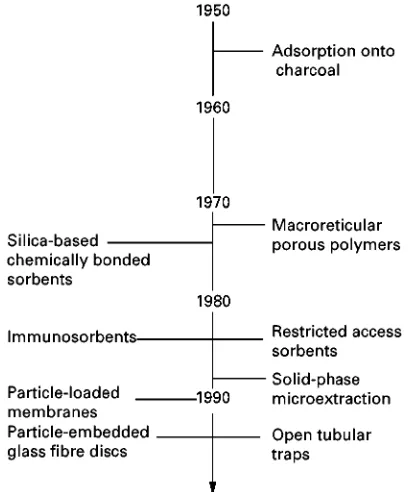
Figure 1 Time line showing the general evolution of solid-phase extraction techniques.
Biological membranes, cell organelles, whole cells and viruses can be fractionated by CCD in the same kind of systems. In this case, however, the particles partition between the two liquid phases and the inter-face between them. The CCD is therefore usually carried out using a stationary interface. This is achieved by using a smaller volume of the lower phase than is needed toRll the lower cavities. There-fore, a portion of the upper phases will also be sta-tionary. TheGvalue satisfying eqn [5] is in this case deRned as the amount of a pure compound, at equi-librium, in the mobile part of the upper phase divided by the amount of the compound in the rest of the system (stationary upper phase, interface and lower phase). Examples of CCD of proteins and of chloro-plasts, the photosynthetic organelle in green plant cells, are given inFigure 7.
See also: II/Chromatography: Countercurrent Chroma-tography and High-Speed Countercurrent Chromato-graphy: Instrumentation.
Further Reading
A>kerlund H-E and Albertsson P-A> (1994) Thin-layer countercurrent distribution and centrifugal countercur-rent distribution apparatus. Methods in Enzymology
228: 87}99.
Craig LC (1962) Countercurrent distribution. In: Florkin M and Stotz EH (eds) Comprehensive Biochemistry, vol. 4, pp. 1}31. Amsterdam: Elsevier.
Hecker E (1995) Verteilungsverfahren im Laboratorium. Weinheim: Verlag Chemie.
Morris CJOR and Morris P (1976)Separation Methods in Biochemistry, 2nd edn, pp. 638}702. London: Pitman.
Solid-Phase Extraction
C. F. Poole, Wayne State University, Detroit, MI,
USA
Copyright^ 2000 Academic Press
Solid-phase extraction is a method used to isolate analytes from a gas,Suid or liquid by their transfer to and retention on a solid-phase sorbent. After separ-ation of the sorbent from the sample the analytes are recovered by elution using a liquid or Suid, or by thermal desorption into the gas phase. If the analytes are recovered from the sorbent in aRnal volume that is only a fraction of the sample volume, then concen-tration as well as isolation is achieved. In addition, if the sorption step, any subsequent rinse steps, and the elution conditions are selective for retention and re-covery of the analyte, then matrix simpliRcation is achieved. Isolation, concentration and matrix simpli-Rcation are the primary goals of solid-phase extrac-tion.
Probably the earliest application of solid-phase ex-traction was the use of charcoal-Rlled columns in the 1950s to isolate organic contaminants from surface waters for toxicity evaluation. The large volume of water generally sampled (more than 1000 L over sev-eral days) precluded the use of liquid}liquid extrac-tion techniques. The subsequent evoluextrac-tion of solid-phase extraction techniques is summarized in Figure 1.
The introduction of macroreticular porous poly-mers in the early 1970s was responsible for rekindling interest in solid-phase extraction and extending its scope to air sampling and the isolation of drugs from
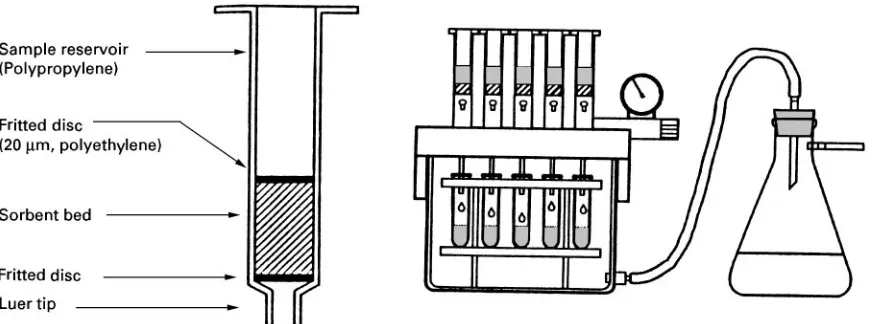
Figure 2 Schematic diagram showing the typical construction of a solid-phase extraction cartridge and a vacuum manifold for parallel sample processing.
properties, together with a reduction in the amount of material needed for identiRcation due to improved instrumentation, resulted in the general use of small columns, similar in size to those in use today. Porous polymers with high thermal stability and low water retention revolutionized the room temperature sorbent extraction of volatile organic compounds from air or purge gas from water samples. Trapped compounds were thermally desorbed directly into a gas chromatograph for analysis. Automated sys-tems based on the above process are used for routine analysis today.
Solid-phase extraction for liquid samples became a widely used laboratory technique with the intro-duction of disposable sorbent cartridges containing porous, siloxane-bonded silica particles, sized to allow sample processing by gentle suction (Figure 2). A typical solid-phase extraction cartridge consists of a short column (generally an open syringe barrel) containing a sorbent with a nominal particle size of 50}60m, packed between porous metal or plastic frits. A large number of sorbents are in use today corresponding to the desire for general purpose, class-speciRc and even compound-speciRc extractions.
Slow sample processing rates for large sample vol-umes, low tolerance to blockage by particles and sorbed matrix components, and problems arising from the low and variable packing density of car-tridge devices spawned the development of alterna-tive sampling formats based on disc technology. At least three different designs for solid-phase extraction discs are offered commercially today. The particle-loaded membranes consist of a web of polytetraf-luoroethylene (PTFE) microRbrils, suspended in which are sorbent particles of about 8}10m dia-meter. The membranes areSexible with a
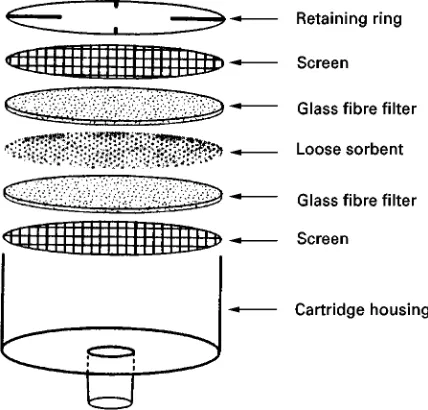
homogene-ous structure containing 80% (w/w) or more of sorbent particles formed into circular discs 0.5 mm thick with diameters from 4 to 96 mm. For general use they are supported on a sintered glass disc (or other support) in a standardRltration apparatus using suction to generate the desiredSow through the mem-brane (Figure 3). Particle-embedded glassRbre discs contain 10}30-m sorbent particles woven into a glassRbre matrix. The small diameter discs are rigid and self-supporting, while the larger diameter discs require a supporting structure. Speediscs] (Figure 4) consist of a sandwich of 10-m sorbent particles held between two glass-RbreRlters, with a screen to hold theRlters in place. Disc technology has contributed directly to the automation of solid-phase extraction through the development of the multiwell extraction plate (Figure 5), which is used for the clean-up of samples in high-throughput screening techniques for drug development. Direct coupling of solid-phase ex-traction and high pressure liquid chromatography for on-line sample processing and analysis is now routine and the direct coupling of solid-phase extraction and gas chromatography for the analysis of liquid samples has moved beyond the research phase. Several research groups have demonstrated the direct coupling of solid-phase extraction and electrophor-etic and thin-layer chromatographic separation techniques.
Replacement for Liquid
+
Liquid
Extraction
Figure 3 Typical cartridge and vacuum filtration formats for solid-phase extraction using discs.
[image:3.568.294.514.458.644.2]Figure 4 Exploded-view of the Speedisc]used for solid-phase, extraction.
Figure 5 Multiwell plate for automated solid-phase extraction. (Reproduced with permission from Plumb RS, Gray RDM, and Jones CM (1997). Use of reduced sorbent bed and disc mem-brane solid-phase extraction for the analysis of pharmaceutical compounds in biological fluids, with applications in the 96-well format.Journal of Chromatography B 694:123}133.)
intensive, difRcult to automate, and frequently plagued by practical problems, such as emulsion formation. Liquid}liquid extractions also tend to consume large volumes of high purity solvents, which may have signiRcant health hazards and disposal costs associated with their use. In contrast, solid-phase extraction beneRts from lower intrinsic costs, reduced processing times, low solvent consumption and simpler processing procedures. Solid-phase ex-traction procedures are easily automated using ro-botics, or special purposeSow processing units that
simultaneously extract samples and prepare them for automatic injection, or by using centrifugal analysers, which can batchwise process multiple samples. Solid-phase extraction is convenient forReld sampling since it minimizes the transport and storage problems of bulk samples, which have to be returned to the labor-atory for processing.
[image:3.568.57.271.479.684.2]extraction. The sorption properties of manufactured sorbents are not as reproducible as solvent properties. Basic drugs, for example, are often retained on silica-based, chemically bonded sorbents by a mixed reten-tion mechanism involving non-speciRc sorption by the bonded phase and ion exchange interactions with accessible, dissociated silanol groups. The mixed re-tention mechanism can interfere in the recovery of analytes since solvent elution may be ineffective for removing ionically bound analytes, and the extent of binding through ionic sites can vary for different sorbent lots. Sorbents tend to have a higher level of contamination by manufacturing and packaging ma-terials than do solvents. The chemical background from impurities may interfere in the subsequent anal-ysis of the sample. Solvent rinsing of cartridges and discs and the running of blanks to establish back-ground contamination levels diminishes sample throughput and adds signiRcantly to solvent con-sumption and processing costs. Sample processing problems, such as column overloading, displacement and blocking of sorbent pores, easily go unnoticed, resulting in changes in analyte recovery. Sample over-load and displacement are more important for extrac-tion based on adsorpextrac-tion than for extracextrac-tion based on absorption.
When choosing between liquid}liquid or solid-phase extraction for a particular problem, economic, as well as technical features, should be taken into consideration. In this sense, liquid}liquid and solid-phase extraction techniques should be considered complementary approaches, and although the general trend is towards the replacement of liquid}liquid ex-traction methods by solid-phase exex-traction, this is never likely to be a complete replacement.
Disc Versus Cartridge Format
Cartridges have a small cross-sectional area, a slow sample processing rate, and a low tolerance to block-age by particles and adsorbed matrix components. For large sample volumes containing suspended par-ticles, discs are likely to function better. Discs provide shorter sample processing times due to their larger cross-sectional area and decreased pressure drop, en-abling higher sampleSow rates to be used. The larger cross-sectional area also reduces problems with plug-ging. For example with a high particle burden, discs with integral or separate depthRlters are available, as well as different materials that can be added to the surface of the disc asRlter aids.
Because of the low packing density of typical car-tridge devices, longer sorbent beds than are needed for extraction are used to compensate for reduced retention resulting from channelling. Increased bed
mass results in increased non-speciRc matrix adsorp-tion and dirtier extracts. The use of smaller particles and the greater mechanical stability of discs reduces channelling, and the optimized use of bed mass re-sults in a cleaner background and lower interferences due to reduced matrix adsorption. For small sample sizes it is easier to miniaturize discs than cartridges, and several disc devices (e.g. microdiscs, pipette tips, etc.) that contain only a few milligrams of sorbent for processing small samples are available. Immoblilized analytes on microdiscs facilitate integrated sample processing techniques such as in-vial extraction and on-disc derivatization.
Inorganic Oxide Adsorbents and
their Applications
The most important adsorbents for extraction and matrix simpliRcation are silica gel, alumina, Florisil and diatomaceous earths. Silica gel, prepared from sodium silicate using the sol-gel procedure, is the most widely used general-purpose adsorbent. Silica gels used for solid-phase extraction have surface areas of about 300}800 m2g\1, pore sizes from 4}10 nm, and an apparent pH of 5.5}7.5. The apparent sorbent pH is characterized as the observed pH of a 5% (w/w) aqueous suspension. Alumina is prepared by the low temperature dehydration ((7003C) of alumina trihydrate and is a mixture of-alumina with small amounts of-alumina (less active form) and sodium carbonate. Depending on processing conditions, alumina is available as neutral (pH 7.5$0.5), weak-ly acidic (pH 6.0$0.5), acidic (pH 4.5$0.5) and basic (pH 9.5$0.5) forms. Adsorbents used for ex-traction and matrix simpliRcation have a surface area of about 150 m2g\1 and a pore size of 6 nm. Florisil is a magnesium silicate prepared by precipitation from a mixture of magnesium sulfate and sodium silicate solutions followed by calcining at about 12003C. It has a surface area of about 250}300 m2g\1 and an apparent pH of about 8.5. Diatomaceous earths areSux-calcined forms of natural silica with very small surface areas. They are used as a Rlter aid and as a dispersant for liquid extraction using matrix dispersion techniques (see matrix dispersion).
Table 1 General applications of solid-phase extraction
(1) Inorganic oxide adsorbents
E Isolation of low and medium polarity analytes from non-aqueous solutions
E Isolation of cations (alumina and silica) and anions (alumina) from buffered aqueous solutions
E Matrix simplification by fractionation into groups containing a similar number and type of functional group
Examples
N Isolation of organochlorine pesticides and polychlorinated biphenyls from transformer oil, animal fats and oils, etc. using Florisil. N Isolation of lipids by chromatography over silica gel using chloroform to elute simple lipids, acetone to elute glycolipids and
methanol to elute phospholipids.
N Group fractionation of polycyclic aromatic compounds (hydrocarbons,N-containing and OH-containing) in synthetic fuels over alumina using a step solvent gradient.
N Isolation of paraquat and diquat from high moisture crops in a pH 9 aqueous extract using silica gel N Mycotoxins in feeds using silica gel
N Pesticides in foods, feeds and soil extracts; alkaloids, pigments and flavour compounds from plants; sugars and caffeine in cola beverages, inorganic anions and organic acids in aqueous solution using alumina; steroids and vitamins from creams and oil-based suspensions.
(2) Low speci\city sorbents (aqueous solutions)
E Isolation of neutral and ionizable analytes from aqueous solution. Weak acids and bases by ion suppression. Strong acids and bases using ion pair extraction (alternative to ion exchange)
E Retention increases with solute size and is reduced by polar interactions (particularly hydrogen-bonding) and ionization
E Polar bonded phases provide only weak retention and are not particularly useful unless elution of the analyte is a problem from non-polar sorbents
Examples
N Isolation of agricultural and industrial chemicals from surface waters using C18, carbon or poly(styrene-divinylbenzene) (PS-DVB)
N Isolation of drugs from biofluids using C18, C8, PS-DVB or cyanopropyl (CN)
N Isolation of macromolecules from biofluids and fermentation broth using C4
N Isolation of pigments and colouring materials from beverages and food extracts using C18
N Isolation of carbohydrates and nucleosides from biofluids using AMINO N Isolation of proteins, peptides and surfactants using DIOL
(3) Low speci\city sorbents (organic solvents)
E Retention depends on the type and number of functional groups. Solute size is not important CN Strong dipole-type interactions and weak hydrogen-bond acidity
AMINO Strong hydrogen-bond base and weak hydrogen-bond acid. Weak dipole interactions
DIOL Strong hydrogen-bond acid and weak hydrogen-bond base with significant capacity for dipole-type interactions
Examples
N Isolation of polar pesticides from fats and oils
N Isolation of polycyclic aromatic compounds from fuel oils N Active ingredients from ointments and suppositories
(4) Ion-exchange sorbents
E In general strong ion exchangers are used to isolate weak acid/bases of opposite charge and weak ion exchangers strong acid/bases
E Retention selectivity can be adjusted by manipulating the sample pH and ionic strength
E Choice of competing ion, its concentration and eluent pH controls selectivity for matrix simplification and elution
E Isolation of macromolecules in an active form may require special non-denaturing sorbents based on cellulose, agarose or dextran
Examples
N Isolation of carboxylic, sulfonic and phosphoric acids, phenols, amines and inorganic ions from water N Isolation of amino acids, organic acids, nucleosides and nucleotides from biofluids
N Isolation of organic acids and bases from coal-derived and synthetic fuels
N Isolation of organic acids, phenols and amines from wine, fruit juices and food extracts sodium sulfate connected in tandem with the
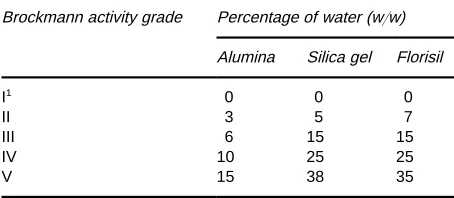
adsor-bent cartridge can be used as an additional pre-caution. The Brockmann scale (based on the relative retention of test dyes, seeTable 2) provides a widely used standardized scale of adsorbent activity. Adsor-bents of deRned activity are prepared by adding a known amount of water to the adsorbent, shaking to avoid clumping, and then allowing the adsorbent to equilibrate overnight in a closed container. Analyte properties that increase retention depend on the
Table 2 Standardization of adsorbent activity
Brockmann activity grade Percentage of water (w/w) Alumina Silica gel Florisil
I1 0 0 0
II 3 5 7
III 6 15 15
IV 10 25 25
V 15 38 35
1Activate sorbents by heating alumina at 4003C for 8}12 h, silica
gel at 1803C for 8}12 h, and Florisil at 1303C for 8}12 h.
Coating silica or alumina with chemical reagents, such as sulfuric acid, sodium hydroxide, alkaline po-tassium permanganate, silver nitrate, etc., is used to improve the selectivity of the isolation of some analytes from their matrix. Silver nitrate, for example, improves the isolation of oleRns from hy-drocarbons due to formation of charge-transfer com-plexes. Acids can be used for the selective isolation of bases and vice versa. Silica impregnated with 2,4-dinitrophenylhydrazine is widely used for the selec-tive isolation of volatile ketones and aldehydes from air for analysis by high pressure liquid chromatography.
Low Speci
\
city Sorbents and
Their Applications
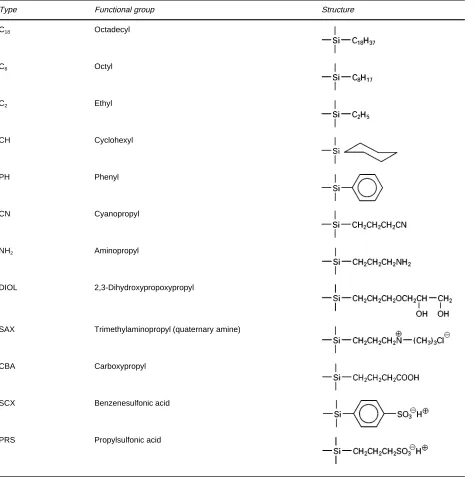
Low speciRcity sorbents include silica-based, chemic-ally bonded sorbents, macroreticular porous poly-mers and various forms of carbon. Silica-based, chemically bonded sorbents are derived from mater-ials developed for high pressure liquid chromatogra-phy. They are generally prepared by reaction of monofunctional or trifunctional silanes with silica gel followed by end-capping in some cases. Trifunctional reagents result in sorbents with a polymeric-bonded layer of higher carbon loading and greater acid stabil-ity and are the more common type of sorbent in general use. Chemically bonded sorbents can be pre-pared with a wide range of bonding densities, pore sizes and functional group types. Some common examples are given in Table 3. Chemically bonded sorbents with large surface areas, long alkyl chains and high phase loading maximize retention of small analytes from aqueous solution, while wide-pore ma-terials with low phase loading and short alkyl chains are generally used to isolate macromolecules. Chem-ically bonded sorbents with immobilized polar func-tional groups are used to isolate analytes from or-ganic solutions, based on their selective interactions with analyte polar functional groups (see Table 1).
The macroreticular porous polymers are co-polymers of styrene-divinylbenzene or acrylic esters, prepared by suspension polymerization to yield par-ticles consisting of agglomerates of randomly packed microspheres permeated by a network of holes and channels (Table 4). They are used exclusively for extraction from aqueous solution and are more reten-tive than most chemically bonded phases. They pos-sess a high sample capacity and are frequently used in large-scale isolation studies and for the puriRcation of industrial products. Tenax], a polymer based on 2,6-diphenyl-4-phenylene oxide, revolutionized the sorbent trapping of volatile organic compounds from air and the purge-and-trap analysis of volatile organic compounds in water. It exhibits strong retention of semivolatile organic compounds ('C7) at room tem-perature with little adsorption of water vapour and can be rapidly heated to high temperatures, without thermal breakdown, for the recovery of analytes by thermal desorption. Since no single adsorbent is ideal for trapping all analytes it is common practice to use cartridges packed with several adsorbent beds in series, so that a broad range of compounds with different molecular weight and polarity can be trap-ped on a single cartridge. Besides Tenax, different forms of carbon, silica gel and liquid-coated sorbents are used. In a multiple bed cartridge, each bed pro-tects the next, increasingly active bed, by preventing compounds from being held so strongly that they cannot be desorbed quickly without decomposition. During thermal desorption the carrier gas passes through the trap in the reverse direction to the sample Sow and the desorbed compounds are swept onto the separation column in a gas chromatograph. A cryogenic interface may be used to refocus the desorbed sample to improve the chromatographic separation. The complete processes of desorption and separation can be automated for sample cartridges stored in an autosampler.
Table 3 Structures of silica-based chemically bonded sorbents
Type Functional group Structure
C18 Octadecyl
C8 Octyl
C2 Ethyl
CH Cyclohexyl
PH Phenyl
CN Cyanopropyl
NH2 Aminopropyl
DIOL 2,3-Dihydroxypropoxypropyl
SAX Trimethylaminopropyl (quaternary amine)
CBA Carboxypropyl
SCX Benzenesulfonic acid
PRS Propylsulfonic acid
are then eluted with carbon disulRde or another sol-vent, or can be thermally desorbed by microwave heating, for separation by gas chromatography. Poor reproducibility of activated carbons and their vari-able chemical and catalytic activity result in limited laboratory use. Graphitized carbon blacks are more reRned and generally nonporous, with surface areas between about 5}100 m2g\1. They are used prim-arily for the room temperature trapping of volatile organic compounds ('C4), either separately or in combination with Tenax]. Carbon molecular sieves have small pores and large surface areas ('500 m2g\1
with some'1200 m2g\1). They are used primarily for the room temperature trapping of volatile organic compounds (C1 and C2), usually as a component of a multiple-bed sorbent trap for air sampling and purge-and-trap analysis.
Table 4 Characteristic properties of some macroreticular porous polymer sorbents Amberlite sorbents Mean pore diameter
(nm)
Specific surface area (m2g\1)
Pore volume (mL g\1)
Sample molecular weight limit
XAD-2 (STY-DVB) 9 300 0.65 20 000
XAD-4 (STY-DVB) 4 725 0.98
XAD-7 (MMA) 9 450 1.14 60 000
XAD-16 (STY-DVB) 10 800 1.82 40 000
XAD-2010 (STY-DVB) 28 660 1.80
DAX-8 (MMA) 22.5 160 0.79 150 000
STY-DVB, styrene-divinylbenzene; MMA, methylmethacrylate.
account of their low pressure drop compared with standard sorbent cartridges. They are used less fre-quently for water analysis where macroreticular por-ous polymers are considered a better choice.
Compound and Class-speci
\
c
Sorbents and their Applications
Various forms of selective sorbents for solid-phase extraction based on ion exchange, bioafRnity, mo-lecular recognition, and restricted access are used to supplement the general class of sorbents discussed above. Ion exchange is used to isolate ionizable com-pounds (usually) in aqueous solution with sorbents containingRxed ionic sites of opposite charge to the analytes of interest. Ion-exchange sorbents are usu-ally classiRed as weak or strong depending on the identity of the ionic group and whether its charge is independent of the sample pH (strong ion exchanger) or can be manipulated by changing the pH (weak ion exchanger). Some examples of typical silica-based ion-exchange sorbents are indicated in Table 3. Ion-exchange sorbents with a porous polymer backbone are also commonly used and have a higher exchange capacity and a wider pH-operating range than based sorbents. For many applications either silica-based or porous polymer ion-exchange sorbents with the same immobilized ionic groups can be used inter-changeably, although, because of non-speciRc ad-sorption of matrix components, the chemical back-ground of the extracts might be different. Ion-ex-change sorbents are particularly attractive for the isolation of ionizable substances since the neutral molecules, which may interfere in theRnal chromato-graphic analysis, are easily rinsed from the sorbent without affecting the recovery of the ionized compo-nents. Mixed-mode sorbents containing ion-ex-change sites and alkyl groups co-bonded to silica in either cartridge or disc format are popular in clinical and pharmaceutical laboratories, where they are used for the isolation of ionized drugs and their metab-olites from biologicalSuids. Standard protocols using
mixed-mode sorbents have been developed for the isolation of most drugs of abuse (e.g. amphetamines, barbiturates, cocaine, opiates, etc.). The strong reten-tion and the use of efRcient rinse solvents results in cleaner extracts compared with single-mode sorbents, suitable for screening by thin-layer chromatography and conRrmation by gas chromatography}mass spec-trometry.
Resin-bound phenylboronic acids are used for the isolation of compounds with vicinal diol groups such as steroids, catecholamines and nucleotides. Surface-bonded macrocyclic ligands, cryptands, can be used for the selective isolation of metal ions. The cryptands can be synthesized with a variety of cavity sizes suit-able for the isolation of different metal ions. The metal ion is sorbed in the cavity of the cryptand until released by elution with a solution of a complexing agent with a high binding constant for the metal.
Immunosorbents have been used for a long time for sample pretreatment in medicine and biology, but more general applications, such as to environmental analysis, are relatively recent. In part, this is due to the difRculty of making antibodies selective to small molecules, as well as a lack of familiarity among analytical chemists of the procedures used to make speciRc antibodies. Immunosorbents are prepared by covalently bonding a suitable antibody to an appro-priate sorbent. A high degree of molecular selectivity is obtained based on the speciRcity of the anti-body}antigen (analyte) interaction. Because speciR -city is high, immunosorbents are able to isolate target analytes from complex matrices in a single step with minimal co-extraction of matrix interferences. By taking advantage of cross-reactivity, class-speciRc im-munosorbents for the isolation of mycotoxins, phenylurea herbicides and polycyclic aromatic hydro-carbons have been developed. Manufactured im-munosorbents have been available for only a short time and the range of products is still narrow. A la-boratory familiar with the techniques for raising and isolating antibodies is required.
having a predetermined selectivity for a speciRed analyte. The imprint is obtained by arranging poly-merizable functional monomers around a template (the analyte). Template}monomer complexes are for-med in solution through molecular interactions and subsequentlyRxed in place by cross-linking. Removal of the template from the resulting polymer matrix creates vacant recognition sites that exhibit afRnity for the analyte. For the time being, it is impossible to predetermine the experimental conditions for suc-cessful imprinting of target analytes. The template molecule may be difRcult to leach from the imprinted polymer, reducing the binding capacity of the poly-mer, but more seriously, it may lead to contamination of sample extracts. Only a few practical applications using molecularly imprinted polymers for solid-phase extraction have been demonstrated so far, most of which are for the isolation of drugs from biological Suids, but the future for this technology looks very promising. Molecularly imprinted polymers should be easier and cheaper to produce in chemical laborat-ories than antibodies while, at least in theory, they should be capable of similar speciRcity.
Restricted access sorbents have been developed for the isolation of low molecular weight compounds, generally drugs, directly from biological Suids with minimum sample pretreatment. They work by pre-venting access of macromolecules (proteins) to those regions of the sorbent where retention of the analyte occurs. Restricted access to the retentive part of the sorbent is provided by either a physical diffusion barrier, such as a pore diameter, or by a chemical diffusion barrier, such as a polymer network at the outer surface of the particle. In addition, the outer surface of the particles must be non-adsorptive and protein-compatible. Restricted access sorbents are commonly used for automated on-line sample pro-cessing in liquid chromatography. In this case, a short precolumn packed with the restricted access material is interfaced to a separation column by a six-port switching valve. The bioSuid is injected directly onto the precolumn, which retains the analytes of interest. Potentially interfering sample constituents are then Sushed to waste. Macromolecules (proteins) pass through the precolumn unretained and do not inter-fere in the subsequent separation of the analytes. The analytes retained on the precolumn are eluted on-line to the separation column and detected. Simulta-neously the precolumn is reconditioned (or ex-changed) before processing the next sample. An im-portant consideration for automated sample process-ing is the ability of the restricted access sorbent to repeatedly extract the analyte without change in properties or accumulation of sample matrix compo-nents.
Sample Processing Considerations
Solid-phase extraction cartridges are available in a range of sizes containing from about 35 mg to 10 g of sorbent, with the 100 mg and 500 mg sorbent cartridges (or discs) being the most widely used for extraction and the larger cartridge sizes for sample clean up. As a rough guide, the sorbed sample capacity of a solid-phase extraction device is about 1}5% of the sorbent mass. The sample volume that can be processed depends primarily on the break-through volume of the analyte, the concentration of the analyte matrix, sampleSow rate, and the sorbent mass. The sample volume is often selected to conform to the needs of the instrumental detection step, and as instrumental methods of determination have im-proved in sensitivity, sample volumes have decreased in size. Regulatory authorities often indicate action levels in concentration units, which can also be used to deRne an adequate sample volume for analysis.
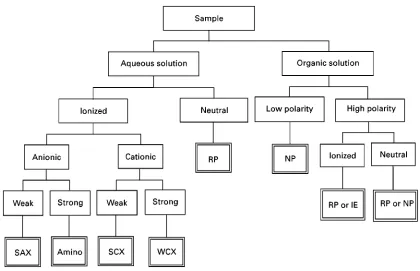
Sorbent selection is based on the considerations summarized inFigure 6. The sample solvent (aqueous or organic), the analyte type (non-polar, polar or ionized), and whether it is ionized (strong or weak, acid or base) provides a logical guide for method selection. Organic compounds soluble in polar or-ganic solvents but difRcult to dissolve in solvents of intermediate polarity, can be extracted in the rever-sed-phase mode if they can be reconstituted in aque-ous solution.
Figure 6 Method development guide for the isolation of organic compounds from liquid samples. SAX, strong anion exchanger; SCX, strong cation exchanger; WCX, weak cation exchanger; RP, reversed-phase sampling mode; NP, normal-phase sampling mode; IE, ion exchange sampling mode.
sampleSow rate. The drying step between processing aqueous samples and eluting the retained analytes with a water-miscible organic solvent is also impor-tant. The purpose of the drying step is to reduce the volume of water co-eluting from the sampling device permitting further concentration of the eluent by the gas-blow down method. Drying, by suction or stor-age in a vacuum desiccator, should be sufRcient to remove water trapped in the pores, but excessive drying can result in low analyte recovery from evap-oration or inefRcient elution. A new porous polymer sorbent, prepared by copolymerization of divinylben-zene andN-vinylpyrrolidone (Oasis HLB), and sol-vated by water alone, has been suggested as a solution to this problem. Recently, it was shown that all sample-processing steps are amenable to computer-aided method development, replacing the traditional experimental trial-and-error approach by fast com-puter simulations.
Automation
Automation provides a better utilization of laborat-ory resources, unattended and out-of-hours operation and improved precision compared with manual methods. Common approaches to automation differ signiRcantly. Using robotics, samples are processed
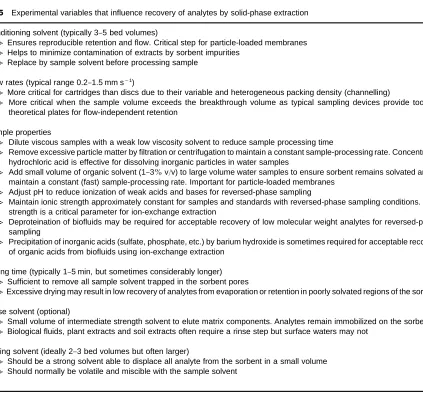
Table 5 Experimental variables that influence recovery of analytes by solid-phase extraction
E Conditioning solvent (typically 3}5 bed volumes)
NEnsures reproducible retention and flow. Critical step for particle-loaded membranes NHelps to minimize contamination of extracts by sorbent impurities
NReplace by sample solvent before processing sample
E Flow rates (typical range 0.2}1.5 mm s\1)
NMore critical for cartridges than discs due to their variable and heterogeneous packing density (channelling)
NMore critical when the sample volume exceeds the breakthrough volume as typical sampling devices provide too few theoretical plates for flow-independent retention
E Sample properties
NDilute viscous samples with a weak low viscosity solvent to reduce sample processing time
NRemove excessive particle matter by filtration or centrifugation to maintain a constant sample-processing rate. Concentrated hydrochloric acid is effective for dissolving inorganic particles in water samples
NAdd small volume of organic solvent (1}3%v/v) to large volume water samples to ensure sorbent remains solvated and to maintain a constant (fast) sample-processing rate. Important for particle-loaded membranes
NAdjust pH to reduce ionization of weak acids and bases for reversed-phase sampling
NMaintain ionic strength approximately constant for samples and standards with reversed-phase sampling conditions. Ionic strength is a critical parameter for ion-exchange extraction
NDeproteination of biofluids may be required for acceptable recovery of low molecular weight analytes for reversed-phase sampling
NPrecipitation of inorganic acids (sulfate, phosphate, etc.) by barium hydroxide is sometimes required for acceptable recovery of organic acids from biofluids using ion-exchange extraction
E Drying time (typically 1}5 min, but sometimes considerably longer) NSufficient to remove all sample solvent trapped in the sorbent pores
NExcessive drying may result in low recovery of analytes from evaporation or retention in poorly solvated regions of the sorbent
E Rinse solvent (optional)
NSmall volume of intermediate strength solvent to elute matrix components. Analytes remain immobilized on the sorbent NBiological fluids, plant extracts and soil extracts often require a rinse step but surface waters may not
E Eluting solvent (ideally 2}3 bed volumes but often larger)
NShould be a strong solvent able to displace all analyte from the sorbent in a small volume NShould normally be volatile and miscible with the sample solvent
Future developments
Solid-phase extraction is approaching maturity and is a familiar laboratory operation for many analytical chemists. Advances are expected in the area of speci-Rc sorbents based on molecular imprinting or bioaf-Rnity designed for the convenient isolation of target compounds in complex matrices. Advances are also expected in the use of computer-aided method devel-opment for the prediction of sampling and recovery conditions by simulation to replace tedious experi-mental trial-and-error approaches. A wider use and further development of automated solid-phase ex-traction systems can be expected, particularly in those industries where high sample throughput or round-the-clock process monitoring are important.
See also: II/Affinity Separation: Immobilised Boronates and Lectins; Imprint Polymers. Extraction: Solvent Based Separation. III/Airborne Samples: Solid Phase Extrac-tion. Immunoaffinity ExtracExtrac-tion. Immobilised Boronic
Acids: Extraction. Molecular Imprints for Solid-Phase
Extraction. Restricted-Access Media: Solid-Phase Ex-traction. Solid-Phase Extraction with Cartridges. Solid-Phase Extraction with Disks. Solid-Phase Matrix Dispersion: Extraction. Sorbent Selection for Solid-Phase Extraction. Appendix 2 / Essential Guides to
Method Development in Affinity Chromatography.
Further Reading
Dean JR (1998)Extraction Methods For Environmental Analysis. Chichester: John Wiley.
Hennion M-C and Pichon V (1994) Solid-phase extraction of polar organic pollutants from water.Environmental Science and Technology28: 576A}583A.
Masque N, Marce RM and Borrull F (1998) New polymeric and other types of sorbents for solid-phase extraction of polar organic micropollutants from environmental water.
Trends in Analytical Chemistry17: 384}394.
Pinchon V, Bouzige M, Miege C and Hennion M-C (1999) Immunosorbents: natural molecular recognition mater-ials for sample preparation of complex environmental matrices.Trends in Analytical Chemistry18: 219}235. Poole CF, Poole SK, Seibert DS and Chapman CM (1997) Determination of kinetic and retention properties of cartridge and disk devices for solid-phase extraction.
Journal of Chromatography B689: 245}260.
Poole CF and Poole SK (1991) Chromatography Today. Amsterdam: Elsevier.
Seibert DS and Poole CF (1998) A general model for the optimization of sample processing conditions by
solid-phase extraction applied to the isolation of estrogens from urine.Journal of High Resolution Chromatogra-phy21: 481}490.
Sellergren B (1999) Polymer- and template-related factors inSuencing the efRciency in molecularly imprinted solid-phase extractions. Trends Analytical Chemistry
18: 164}174.
Simpson NJK (2000)Solid Phase Extraction: Principles,
Strategies, and Applications. New York: Marcel Dekker.
Thurman EH and Mills MS (1998)Solid-Phase Extraction,
Principles and Practice. New York: John Wiley.
Solid-Phase Microextraction
J. Pawliszyn, University of Waterloo, Waterloo,
Canada
Copyright^ 2000 Academic Press
Introduction
Solid-phase microextraction (SPME) was introduced as a solvent-free sample preparation technique in 1990. The basic principle of this approach is to use a small amount of the extracting phase (usually less than 1L) compared to the sample matrix. Sample volume can be very large, when the investigated sys-tem, for example air or lake water, is sampled directly. The extracting phase can be either a high molecular weight polymeric liquid, similar in nature to chromatographic stationary phases, or it can be a solid sorbent, typically of a high porosity to increase the surface area available for adsorption.
To date the most practical geometric conRguration of SPME utilizes a small fused silica Rbre, usually coated with a thinRlm of polymeric phase. TheRbre is mounted for protection in a syringe-like device (Figure 1A). The analytes are absorbed or adsorbed by theRbre coating (depending on the nature of the coating) until an equilibrium is reached in the system. The amount of an analyte extracted by the coating at equilibrium is determined by the magnitude of the partition coefRcient (distribution ratio) of the analyte between the sample matrix and the coating material. In SPME, analytes typically are not exhaustively extracted from the matrix. However, equilibrium methods are more selective because they take full advantage of the differences in extracting phase/ matrix distribution constants to separate target analytes from interferences. Exhaustive extraction can be achieved in SPME when the distribution con-stants are large enough. This can be accomplished for most compounds by cooling the Rbre coating. This
concept was tested using a piece of microtubing coated on the outside instead of a solid rod and supplying liquid carbon dioxide into the tube to achieve an internally cooledRbre. In exhaustive ex-traction, selectivity is sacriRced to obtain quantitative transfer to target analytes into the extracting phase. One advantage of this approach is that, in principle, it does not require calibration, since all the analytes of interest are transferred to the extracting phase. On the other hand, the equilibrium approach usually requires calibration through the use of surrogates or standard addition to quantify the analytes and com-pensate for matrix-to-matrix variations and their ef-fect on distribution constants.
Since equilibrium rather than exhaustive extraction occurs in microextraction methods, SPME is ideal for Reld monitoring. It is unnecessary to measure the volume of the extracted sample and therefore the SPME device can be exposed directly to the investi-gated system for quantitation of target analytes. Thin coatings of extracting phase result in fast separations. In addition, extracted analytes are introduced to the analytical instrument inlet system by simply placing theRbre in the desorption unit (Figure 1B and 1C). This convenient, solvent-free sample introduction process facilitates sharp injection bands and rapid separations. These features of SPME result in the integration of theRrst steps in the analytical process: sampling, sample preparation and introduction of extracted mixture to the analytical instrument. For example, total analysis time inReld applications can be as low as a few minutes when portable instrumen-tation is used.