JOURNAL
OF THESTATISTICAL AND SOCIAL INQUIRY SOCIETY OF
IKELAND.
PAET LXX.
I.—President's Address. By T. W. Grimshaw, M.D. Registrar-General for Ireland.
[Read Tuesday, 26th November, 1889.]
I HAVE to thank you for the honour you have done me, in again electing me as your President for another year.
It is a great satisfaction to me to feel that during the first session in which I have had the honour of presiding over your meetings, a large amount of valuable work has been done in varying branches of Statistical and Social Science. Besides the lengthy address which you so kindly permitted me to deliver at the opening meeting of last session (and which was so laden with figures, that I feared you would almost dread a repetition on this occasion), we have had a most interesting paper on " French Rural Economy" by MR. MURROUGH O'BRIEN. I believe papers of this character possess a peculiar value of their own, no matter what divergence there may be from the opinions expressed by their authors, or with how much or how little favour we may view the institutions of other countries as compared with our own.
The value of such papers as this, and some previous papers of MR. O'BRIEN'S, consists in the clear and concise manner in which we are told how institutions established in other countries have solved, or endeavoured to solve, difficulties which beset us so often and seriously at home.
MR. J. J. MURPHY was brave enough to face the difficult and dangerous question of currency. No doubt he only intended to deal with one portion of the subject, but the man who will even study one portion of so great and complicated a question and pub-lish his conclusions, deserves more than the usual amount of credit for statistical and social work.
Next we had from DR. INGRAM his promised memorial paper on our lamented friend Dr. Hancock, and the Society cannot but view with the greatest satisfaction, the manner in which DR. INGRAM performed his task.
440 President1 s Address. [Part 70,
DR. FLINN ventured to deal with a question which may, I think, be considered as difficult as the currency or the land questions— namely the " Geographical Distribution of Irish Intellect," and brought together many interesting facts on a question which scarcely admits of exact treatment.
MR. GEORGE COFFEY presented us with a most valuable and suggestive paper on the Technical Education Bill. I regret I was unable to be present at the meeting at which the paper was read, but I had the pleasure of perusing it in print, and fully appreciated its value.
One of our active Honorary Secretaries gave us a paper on "Forestry in Ireland," in which MR. W. F. BAILEY furnished many useful hints and important warnings as to the treatment of trees in this country. MR. E. E. MATHESON brought under our notice in a most practical paper, a subject hitherto little discussed or dealt within the Society. I am glad to say that to my own knowledge MR. MATHESON'S paper on " The Mechanism of Statistics " has attracted the well deserved attention of many statistical departments in all parts of the world.
DR. WENTWORTH ERCK read, what probably in the present state of the country was the most important paper of the session—cer-tainly the most important from a practical point of view—proving as it did the great decrease in the rate of interest of money since the year 1870, and showing the widespread influence that this de-crease in the value of capital must have on many of the practical affairs of life.
I myself had the honour of again addressing the Society, this time on the sad subject of the "Child Mortality in Dublin," and thus bringing to a close what may, I think, be considered a prolific ses-sion. While our printer's bill has reached unprecedented propor-tions, and rather straightened our means, we can comfort ourselves with the reflection that the result is a fruitful one, and likely to confer some lasting benefits on our fellow-men.
When I had the honour of addressing you this time last year, I took the opportunity of presenting you with an abstract of the prin-cipal Statistics of Ireland for half a century, and in doing so, I analysed generally the leading features of that abstract. I abstained, as far as possible, from going into detail on any point. In that ana-lysis I gave the statistics of agriculture a prominent place, stating as my reason for doing so, that Ireland was mainly an agricultural country. The plan of my address last year did not permit of my devoting as much time to the statistics of agriculture as the subject deserves, and I purpose on the present occasion to consider specially some of the more important information afforded by the statistics of agriculture in Ireland, as published in abstract in the tables attached to my last year's address, and discussing some of the questions which arose therein.
1890.] By Dr. Grimxhaiv, Registrar-General. 441
of the country. Allowing, therefore, for disturbing causes during the first five years of the collection of the Agricultural Statistics, I consider it advisable to commence this review with the figures fur-nished in the year 1851, thus giving us thirty-eight clear years of agricultural returns, which, I believe, are as accurate as any such large series of figures are likely to be in this or any other county.
{3
w •H
q
02 00 S R M c3
• O
5
"< i n '53
-<2 5
g
§ 1 00 0 VO oo H in 5, w Is Pri c oun t duce . 13 t> Price . Amoui : of Produ cJ
© Pri c a §8 ° 2
<1 PH
I
o o •-J3 Descri p 02^ 8
<N*6 °
• ro ^ O vn 00 ro ro vO ^ v o ro ^ O vO vn
i
: 1 Wheat , O N 00 vn (^ vO oi
ro ro O N O o ^t 20,6 5 vn & vn O vn vO1 O" ro Oats , O N HH VO O vO vn O ON O rj-O* ro VO 00 M 00 0 vO vO vn Barley , 0 0 ro O O O O 00 PH Ber e an d vO 0 ro O8
HI vO O O N IN vO M 0 ro1
Bean s a n M ro O N hH O ro 99 5 M VO vO ro O ro ^j. ro ^. vn vn ^. ON M vns
Potatoes , N VO 0i?
0 vO ro vO 00 N O O ro 00 ro o5
O^7
0 0 o\ vn Turnips , vO ro vO£r
0 % ro vO j? O vO O vO Mangel , 00 O^ ro vn O N vo O O OO <s ro O O^ O ON vn • ro vn ro ros
VO IN ro "*" ON3"
ro vo 00" 00 roin t
TABLE II.
AVERAGE NUMBER, PRICE, AND VALUE OF LIVE STOCK IN IRELAND IN THE QUINQUENNIA 1851-5, 1866-70, and 1884-8.
000 omitted from Numbers and Values.
Description of Live Stock.
Horses and Mules,
Asses,
Cattle,
Sheep,
Pigs,
Goats,
Poultry,
Total,
1851-5-Number.
559
147
3,3oi
3,041
1,165
281
8,261
—
Price.
£ S. d.
15 O O I O O
7 5 0
1 12 0
1 5 6
O 7 6
O I O
—
Value.
£
8,385
147
23,927
4,882
1,489
105
413
39,348
1866-70.
Number.
549
171
3,727
4,600
1,229
199
10,758
—
Price.
£ s. d.
1 5 O O I O O 10 10 9
2 0 7 160
0 7 6
0 1 9
—
Value.
£
8,235
171
39,276
9,34O
i,592
75
941
59,630
1884-8.
Number.
579
197
4,156
3,4i9
1,329
270
13,881
—
Price.
£ S. d.
15 O O I O O 9 3 0
1 18 6
0 18 6
0 7 6 0 1 6
—
Value.
£
8,685
197
3§.-003
6,564
1,236
IOI
1,041
55,827
1890.] By Dr. Grimshaw, Registrar-General. 443
I propose to analyse these figures, and from the results thus arrived at, in combination with information regarding standard prices of agricultural produce, to lay before you materials by which an approximate opinion may be formed as to the relative value of Irish agriculture in past and present times—first, as regards the total value of Irish agricultural produce; secondly, as regards its relation to the population. In order to do this, and as far as possible to obviate the disturbing elements of good and bad seasons, I have divided the years under consideration into a series of five year periods, thus obtaining seven such periods out of the thirty-eight years already referred to. Having ascertained the annual average amount of agricultural produce, and of live stock in Ireland, during each of these five year periods, I take as standard prices those pub-lished in Pur dons Almanack, and when these are not available, then trustworthy figures from some other sources, and treating them in a similar manner, apply the average prices thus obtained to the average produce and to the stock, and obtain an average annual value for the agricultural produce of Ireland during each of the five year periods.
In order to obtain a clear view of the question, I shall deal with three only of the five year periods—namely, the first, 1851-55 ; the last, 1884-88 ; and the medium, 1866-70. In the first period there is a distinct disturbing cause which influenced prices during the years 1854-5—namely, the high prices caused by the Crimean War. The other periods appear to be only under the influence of ordinary meteorological and commercial causes. On the whole, I think I may claim that these three quinquennia are fair periods for which to strike averages, from which reliable conclusions may be deduced.
In the address I have already referred to, I pointed out the great change that has come over Irish agriculture during the last forty years, and how tillage was decreasing, and the production of live stock increasing, both absolutely and in relation to the population. I shall not recapitulate the statements I made on that occasion, but refer to the tables of my last year's address for full particulars.* This change having been admitted, it now seems desirable to consider its economic effects, using the data I have pointed out as available for the purpose.
I am quite aware of the difficulties and fallacies with which such an investigation is surrounded, and I do not in the least underrate these elements of doubt. I am satisfied* that the agricultural sta-tistics of Ireland are as accurate as any similar stasta-tistics anywhere. The main difficulty arises in the applying of prices and estimating the results. When the Cowper Commission was engaged in inves-tigating the questions relating to the Land Acts in Ireland, it became my duty to collect for that Commission the most reliable information available regarding agricultural prices. At that time I gave the question my most careful consideration, and I came to the conclusion that the most reliable, in fact the only reliable, series of prices
444 President's Address. [Part 70,
[image:6.362.73.328.221.434.2]able, was that compiled for the Irish Farmers' Gazette, and published in PurdovbS Almanack.* These prices are for all the more important articles of agricultural produce for the year 1840 to the present time, excepting the years 1841-45, inclusive. I consider myself justified, in reply to question one hundred and forty-seven, in handing in this table of prices, on the ground that it was " believed to be the best information to be had in Ireland," and was " very much used." On the same occasion I handed in other lists of prices, compiled from Corn Exchange returns, etc., and these, together with Purdon's table, are appended to the Commissioners' Report.f
I would now direct your attention to the abstracts given in Tables I. and II., and ask you to consider the conclusions which may be drawn therefrom.
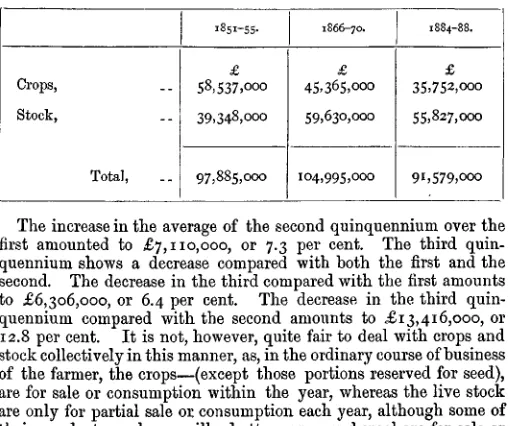
Taking these three quinquennia, and adding together the stock and crops for each, we have the result shown in Table III.
TABLE III.
Crops,
Stock,
Total,
1851-55.
£ 58,537,000
39,348,000
97,885,000
1866-70.
£ 45,365,000
59,630,000
104,995,000
1884-88.
£
35,752,000
55,827,000
91,579,000
The increase in the average of the second quinquennium over the first amounted to £7,110,000, or 7.3 per cent. The third quin-quennium shows a decrease compared with both the first and the second. The decrease in the third compared with the first amounts to £6,306,000, or 6.4 per cent. The decrease in the third quin-quennium compared with the second amounts to £13,416,000, or 12.8 per cent. It is not, however, quite fair to deal with crops and stock collectively in this manner, as, in the ordinary course of business of the farmer, the crops—(except those portions reserved for seed), are for sale or consumption within the year, whereas the live stock are only for partial sale or consumption each year, although some of their products such as milk, butter, eggs, and wool are for sale or consumption every year.
If we take crops by themselves, we find that their average annual value decreased from the first to the second quinquennium to the amount of £13,172,000, or 22.5 per cent.; between the second and third, to the extent of £9,613,000, or 21.2 per cent.; and between
* Purdon's Irish Farmers' and Gardeners' Almanac. Dublin, Farmers'
Gazette Office.
t Report of the Royal Commission on the Land Law (Ireland) Act, 1881, and
the Purchase of Land (Ireland) Act, 1885, vol. 11. Dublin, Alex. Thorn & Co.
1890.]
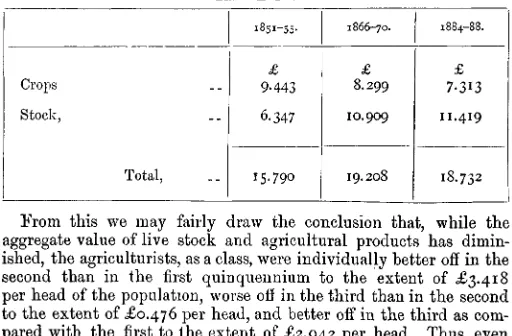
By Dr. Grimshaw, Registrar-General. 445 [image:7.363.35.291.351.519.2]the first and third to the amount of £22,785,000, or 38.9 per cent. As it was the production of these crops which atforded employment for the greater portion of the population of Ireland in former times, it is interesting to note that the population decreased about 21.0 per cent, during the period between the census of 1851 and that of 1881. As the great decrease of the population commenced immediately on and after the great famine of 1846-47, while the change of tillage land into stock-producing land cannot be said' to have been estab-lished until some years later, it is an interesting fact that the esti-mated population decreased from 8,295,000 in the year 1845, before the famine, to 4,778,000 in 1888, or to the extent of 3,517,000, or 42.4 per cent.—a ratio very closely corresponding with that (38.9 per cent.) representing the decrease of the value of tillage products. Turning to the value of live stock, we find that the rise in the average annual value between the first and second quinquennia amounted to £20,282,000, or 51.5 per cent. ; but when we compare the second and third periods, we find there is, in the latter, a dimi-nution in the value to the extent of £3,803,000, or 6.4 per cent. Comparing the first period with the third, we find the increase in the latter over the former amounts to £16,479,000, or 41.9 per cent. Thus the gain in the total value of live stock, amounting to £16,479,000, has been more than counterbalanced by the loss in the annual value of tillage products, amounting to £22,785,000, leaving a net loss of £6,306,000, or 6.4 per cent., as I have already stated. I have thus pointed out how these annual averages have varied during the selected periods. Let us now see how they are related to the population. Assuming the figures to be reasonably correct, we find that the value of agricultural produce per head of the popula-tion would be as stated in Table IV.
TABLE IV.
Crops
Stock,
Total,
1851-55-£
9-443
6-347
15.790
1866-70.
£
8.299
10.909
19.208
1884-88.
£ 7.313
11.419
18.732
446 President's Address. [Part 70,
We know that the labour expended in stock raising is much less than the labour expended on tillage, and that all other things being equal, the cost of working an acre for tillage purposes is much greater than that of working an acre for the growth of live stock. On the other hand we know that there has been a rise in wages during the period we are considering, and again, we know that a large amount of hand labour has been replaced by the use of agricultural machinery of many kinds. I t is quite impossible to make reasonably accurate estimates of these changing elements, and I have not attempted to do so; but I am informed by persons whose opinions are of great value, that the increase of wages in the aggregate may be taken to counterbalance, or nearly counterbalance, the savings by the use of machinery, and the lesser number of hands employed on the present as compared with the past system of farming in Ireland.
I have mentioned the fact that in dealing with the money value of live stock, and combining it for general estimates of value with the produce of the crops, only a portion of the value is in the nature of an annual crop, so far as the animals themselves are con-cerned. We know, however, that live stock yield annual crops in the form of wool, milk, and its products, and eggs, all of which are either sold or consumed during the year.
In the year 1886 I made estimates of the value of the out-put of Irish agriculture in 1885, with the view of providing the means of estimating the annual profits derived therefrom. These estimates were, of course, only approximate. They were founded partly on published figures, such as I have used in compiling this paper, and partly on statements and information supplied by experienced agri-culturists, salesmasters, and others, whose opinions were considered to be of especial value. Assuming that a certain proportion of the live stock are sold off each year at a certain value, and placing values on certain products of live stock, such as milk, etc., already men-tioned, sold or consumed during the year, and deducting from these the value of the crops consumed by those animals in producing these saleable articles, we reduce both the value of crops, as given in Table I., and the value of our live stock, as given in Table II. Having done this we arrive at the results shown in Tables V. and VI.
TABLE Y.
AVERAGE ANNUAL VALUE OF CROPS, STOCK, ETC., DISPOSED OF.
Crops,
Stock, etc. . .
Total,
Average Annual Value in the Years
1851-55-£ 43,663,000
28,325,000
71,988,000
1866-70.
£
27,935,00°
44,279,000
72,214,000
1884-88.
£
16,466,000
37,548,000
1890.] By Dr. Grimshaw, Registrar-General. 447
This table is arrived at by estimating the elements already referred to, as dealt with by me in 1886, and applying estimates to the aver-ages for each of the selected quinquennial periods. We see here that, after allowing for the portion of the crops consumed by the stock, the estimated average value of the crops, and stock, and pro-ducts of stock sold or otherwise disposed of, was, in the first period, £71,988,000 per annum, in the second, £72,214,000 per annum, showing an increase of £226,000, or 0.3 per cent.; and in the third, £54,014,000 per annum, which amount is £18,200,000, or 25.2 per cent., under the average value for the second period, and £17,974, 000, or 25.0 per cent., under that for the first.
Dealing with these estimates, as with the previous series of figures in Tables I., II., and III., and making estimates of the average annual value per head of the population, we have Table VI.
TABLE VI.
AVERAGE ANNUAL VALUE PER HEAD OF THE POPULATION.
Crops,
Stock, etc.
Total,
Average Annual Value in tlie Years
1851-55.
£ 7.044
4-569
11.613
1866-70.
£
5.111
8.101
13.212
1884-88.
£ 3.368
7.680
11.048
From this table it will be observed that there was a substantial though not very great, increase in the average value per head in the second of the selected periods as compared with the first, and that in the third quinquennium the average value was slightly under that for the first, and considerably below that for the second, or
1866-70 period.
I quite admit the crudeness of these estimates, and in making them wherever I have had a doubt, I have cast that doubt against the value of agriculture. I admit that the estimates made on the prin-ciples adopted in the construction of Tables V. and VI. tend to exag-gerate the depression of agriculture in the third of the selected quinquennia.
cal-448 President's Address. [Part 70,
culated on the principles I have adopted. "We know, however, that but a small portion of the potato crop ever reached the market, and that had the whole of that large crop been placed on the market no such price as £4 19s. 4c!. per ton could possibly have been realised. Bearing this in mind, a large portion of the decline in the value of the crops between the first and the third period is accounted for. This affords a marked illustration of the difficulty of dealing with the subject under consideration. Again, while it is only the value of live stock consumed or sold, and the products of live stock consumed or sold during the year which are taken, not the total, it must be remembered that a considerable capital in live stock has accumulated which would have no existence if the land used for pasture land remained under tillage. It also happens that the prices in the first selected period were favourably affect-ed by the Crimean war, and that the period 1866-70 was a most favourable time for agriculturists.
In bringing these remarks before the Society, I do so more for the purpose of suggesting lines of investigation, and how these lines, may, I think, be followed up, than with any intention of insisting on the exactness of the methods I have pursued, or draw-ing any positive conclusions from my estimates.
I know there are many persons, some of them members of this Society, who can test by their practical knowledge the correctness of the lines I have followed, and there are also some who combine with their practical knowledge, scientific attainments and statistical abilities which would enable them to investigate more thoroughly than I possibly can, this most difficult, intricate, and important question.
II. A Description of the System of Registration and Transfer
of Land Titles and Securities in the Canton Vaud. By
Murrough O'Brien, Esq.
[Read Tuesday, 28th January, 1890.]
THE introduction of a Land Transfer Bill for England, and of a Bill to establish Local Eegistries of Title in Ireland, mark a distinct ad-vance in public opinion on this important question, which, though often the subject of papers here, may be usefully re-discussed by our Society when a radical change in the law is imminent.