
Research on Location Routing Problem (LRP) Based on
Chaos Search (CS) and Empirical Analysis
Qian Zhang1, Zhongming Shen1, Xianji Zhang2
1School of Economics and Finance, HuaQiao University, Quanzhou, China 2BPS Global Group, Hong Kong, China
Email: [email protected], [email protected]
Received November 21, 2012; revised December 22, 2012; accepted January 8,2013
ABSTRACT
Due to the problem complexity, simultaneous solution methods are limited. A hybrid algorithm is emphatically pro- posed for LRP. First, the customers are classified by clustering analysis with preference-fitting rules. Second, a chaos search (CS) algorithm for the optimal routes of LRP scheduling is presented in this paper. For the ergodicity and ran- domness of chaotic sequence, this CS architecture makes it possible to search the solution space easily, thus producing optimal solutions without local optimization. A case study using computer simulation showed that the CS system is simple and effective, which achieves significant improvement compared to a recent LRP with nonlinear constrained optimization solution. Lastly the pratical anlysis is presented relationship with regional logistics and its development in Fujian province.
Keywords: Clustering Analysis; Chaos; Chaotic Behavior; Location Routing Problem (LRP);Logistics Distribution;
Optimization; Regional Logistics
1. Introduction
All companies that aim to be competitive on the market have to pay attention to their organization related to the entire supply chain. In particular, companies have to in- crease the efficiency of their logistics operation. It is es- sential that reasonable optimal systems of logistics dis- tribution for enterprises with the development of e-com- merce and integrated logistics. Location-routing problem (LRP) is an important branch of routing optimization in integrated logistics systems, which has been solving for every logistics distribution corporations.
The conceptual foundation of LRP studies dates back to Von Boventer (1961), Maranzana (1965), Webb (1968), Lawrence and Pengilly (1969), Christofids and Eilon (1969) and Higgins (1972) [1]. Although these earlier studies are far from capturing the total complexity of LRP, they first recognized the close interface between location and transportation decisions. Watson-Gandy and Dohrn(1973)may be some of the first authors credited to consider the multiple-drop nature of the vehicle routes within the location-transportation framework [2]. Many scholars have developed more efficient problem solving techniques using the concept of integrated logistic sys- tems, which include optimal models and their algorithms. Due to its complexity, it is models and algorithms that are core for solving LRP, which is NP-hard. More and more scientists have been interested in these works. Ex-
act algorithms and heuristics are given in some articles. Exact algorithms for LRP can be classified into four cate- gories: direct tree search (branch-and-bound), dynamic programing, integer programming, and non-linear pro- gramming. Heuristic includes location-allocation-first, route-second, route-first, and location-allocation-second, savings/insertion, and improve/exchange [3].
Chaotic system is a common phenomenon exiting in nonlinear dynamical system with popular characteristic of dynamics. Due to the ergodicity and randomness of chaotic sequence, the chaos search (CS) architecture can be solved the traditional optimization [4]. Much of engi- neering is concerned with the topic of optimization, and at the heart of much of the optimization are dynamical systems. Dynamical systems can be thought of either nonlinear continuous-time differential equation. Chaos occurs in dynamical systems, and frequently in engi- neering, which becomes the central fascination. Some of domestic scholars use chaos search for nonlinear optimi-zation with constraints. The main advantage is to search the solution in certain field regardless of the continuous and difference of the function that can be solved complex optimization with constrains. Furthermore, it is easy to seek the optimal solutions (or near optimal solutions) without local optimization.
chaos search, together with a proof of their correctness [5]. Several clusters are divided by preference-fitting rules. Then the optimal route has been found using chaos in every cluster [6]. The simulation results show that it is an effective method. The paper is organized as follows.
Section 2 introduces the meaning and descriptions of LRP and describes the mathematical model of LRP. Sec- tion 3 emphasizes on the hybrid algorithm based on clustering analysis and chaos search for LRP. Section 4 shows the computational results and analysis. Finally, the last section gives conclusions and future work.
2. Description of LRP
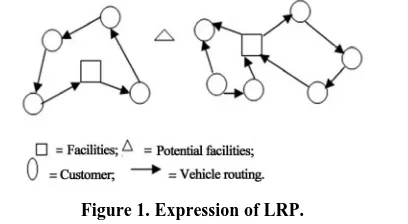
Location-routing problem (LRP) is one of the problems in integrated logistics optimizations. The LRP can be defined as follows. A feasible set of potential facility sites and location; and expected demands of each cus- tomer are given. Each customer is to be assigned to a facility, which will supply its demand. The shipments of customer demand are carried out by vehicles, which are dispatched from the facilities and operated on routes that include multiple customers. There is a fixed cost associated with opening a facility at each potential site, and a distribution cost associated with any routing of vehicles that includes the cost of acquiring the vehicles used in the routing, and the cost of delivery operations. The cost of delivery operations is linear in the total dis- tance traveled by the vehicles [7]. The LRP is used to determine the location of the facilities and the vehicle routes from the facilities to customers, with the aim of minimizing the sum of the location and distribution costs, while ensuring that the vehicle capacities are not ex- ceeded [8]. The expression of LRP is given in Figure 1.
A constraint-based model is presented in this paper for the location routing problem. The hypotheses are as fol- lows:
The transportation is just in time.
The facility is both starting point and destination of circular vehicle routing; each facility serves more than two customers.
[image:2.595.76.280.607.719.2]Nature of demand/supply: deterministic.1 There are multiple facilities.
Figure 1. Expression of LRP.
Size of vehicle fleets: single vehicle (A facility is serv- ed by one vehicle; meanwhile, it is satisfied that the total demand of the route is no less than one vehicle’s capac- ity).
Vehicle capacities are determined. The total quantity (amount) of goods is limited in every route by each vehi- cle’s capability.
Facility capacities are undetermined; not all facilities have been chosen in every decision.
Each customer is served by one and only one vehicle. Considering the complexity of supply/demand markets, it is assumed that they are retail markets.
Each facility is considered a separate entity, not linked to the other facilities.
Objective: minimize total costs.
2.1. Decision Variables Considered Are as Follows
1,if vehicle goes from customer to customer
, , , , ,
0, otherwise
1,if a facility is establishe atsite , 0, otherwise
ijk
r
k i
x j i S j S k V i j
d r r G
Z
2.2. Model Parameters Are Given as Follows
1, ,
G r r m
is the set of m feasible sites of candidate facility,
1 ,
H i i m , m N
is the set of N customers to be served,
S G H
is the set of all feasible sites and customers (it is also referred to nodes),
k 1, ,
V v k K
ij
C
node to node ,i j i S j S , ,
is the set of K vehicles available for routing from the facilities, average annual cost per distance traveling from
r
F annual cost of establishing and operating a facility at site r r
1, , m
, qj average number of units de- mands by customer j j H
, Qk capacity of vehi- clek k
1, , K
, dij,
rik rjk
distance from node i to node j,
X X
The objective function of LRP is
traveling by vehicle k from node r to customer
i or to customer j, respectively.
2.3. Model of a Special LRP Is Defined as Follows
min ij ijk ij r r r G i S j S k Vf x
C X d F Z
(1)Subject to
1, ,
ijk k V i S
X j H (2)
, ,
k
Q k V
(3)
, ,
j ijk i H j S
q X
0,ipk pjk
i S j S
X X k V p S (4)
,
1,
G rjk
r j H
X k V (5)
1, , , ,
2, rjk r j
k V
X Z Z
m R r G (6)0, ,
rik r k V j H
X Z r G (7)
, ,
0,
rik r j H
X Z k V r G (8)
, , ,
0 or 1,
ijk
X i j S k V (9)
.
0 or 1
r
Z r G unctio ta
orithm Based on Clustering
3.1
r techniques in pat-
In this model, the objective f
(10) n minimizes the to- l cost of routing, and establishing and operating the facilities. Constraint (2) ensures that each customer is served by one and only one vehicle. Constraint (3) en- sures that the vehicle capacity constraints are not ex- ceeded for any of the vehicles used in routing, while (4) is the route continuity constraint, which implies that the same vehicle should leave every point that is entered by a vehicle. Constraint (5) guarantees that each vehicle is routed from one depot. Constraint (6) guarantees that there are no links between any two depots. Constraints (7) and (8) require that a vehicle can only from a depot if that depot is opened. The last two of constraints are the integer constraints.
3. A Hybrid Alg
Analysis and Chaos Search for LRP
. Clustering Analysis of LRP Clustering analysis is one of the majo
tern recognition. It is a technique for grouping data and finding where similar data are assigned to the same clus- ter whereas dissimilar data should belong to different clusters. The conventional clustering methods generate partitions, in a partition; each pattern belongs to one and only one cluster.
The customer aggregate C is divided to cluster by the euclidean measure. The steps of optimal facility location are performed in the following way, which have exten- sively analyzed and used in location theory to approxi- mate distances between two spatial coordinates. For the sake of simplicity, it is assumed that each facility has its
own set m of their coordinates of candidate sites for fa- cility location, and no two facilities share the same loca- tion, which are denoted by
1 1 1 2 2, 2 , ,
, , , , .
i i i m m m
F X Y PF X Y PF X Y
Every two coordinates of candidates sites for facility
lo i i
, ,
PF X Y P
cations are denoted by PF X Yi
,
and PF X Yj
j, j
,and which satisfied with
1 2ij i j i j
R1 2 X X 2 Y Y 2
(11)
where Rij is one half of the distance between
,
i i
PF X Yi and PF X Y . j
j, j
given as
Rules for classification are follows.
(12)
Cp can only be divided if form
fe
max
Rule1 rip Rij
into PFi ula (12) is true.
Rule 2 The coordinates of customers on the circum-
rences are satisfied that the distance to the nearest two customers is less than that to the sub nearest two points. sub-nearest meaning that they are not included a cluster by reason of distance).
Rule 3 If jq ij (13)
whe jq any custom
e numbers of customers,
r R
re r is the distance from er Cq to any facility PFj, maxRij is half of the most distance between
any two facilities. Either these customers will not be served, or else the candidate’s facility location will be abolished. Last two rules only relate to abnormal cus- tomers points.
where N is th
1 1 , , , , , ,
N
p p p N N N
C x y C x y
1 2 1
are expressed the points and their coordinates, respec-
the distance between any candidate facility PF
an
3.2. An Algorithm of Chaos Search Optimization
The l idea is that chaotic sequences belonging , , , , ,
C C C C C x y
tively.
rip is i
d any customer p. The tangent cycles O1, O2, …, Oi,
Oj, …, Om are drawn with the radius Rij, where R1, R2, …,
Ri, Rj, …, Rm are their radiuses, respectively.
for LRP
fundamenta
1
: k k 1 k
f x x x (14)
where is the so called driving param g
eter(a parameter capturin such factors as fertility rate) initial living area, etc. The initial value, or seed x is in
0,1 .
2,4
, There f
0,1 0,1 if 0 4.Fromrestricted
about x is to
0,1 and to
The characteristic of ogistic map is given as follow: 0, 4 .
L
1) When λ to
2,3 , there are stable points in Logis- tic map.2) When λ to
3,3.57
erge vet in stabl
that is
, two sequences with seeds only slightly apart div ry rapidly, that is to say, there exists in the period-doubling bifurcation of the solutions.
3) When λto
3.57, 4
, chaos start to come out, and Logistic map isn’ e cycling orbit. It is difficult to decide which points with Lebesgueis more than zero in chaotic sequences.4) When λto 4, there is a stable chaotic sequence. In the stable chaotic sequence, any orbit f is dense, to say, the points of one orbit f is included in open ball
,B x , when 0, and x
0,1 . On the con- trary, all points that belong to
0,1
ares po
pressed on to- wards any orbit f as precision a ssible. In this paper when 4, the population sequence
Xk is chaotic and erg and gives search optimal solutions (or near optimal solutions) solutions. A chaotic system is defined as one where two different, but close, seeds result in widely different population sequences. An ergodic sys- tem is one where the sequences
kodic
X will approach every possible point arbitrarily, littl y little (more for- mally, for every pair of element of
e b
0,1 , there is an xk
between them). Thus, an ergodic sy is one that is “trying to converge to everything”. The Logistic model can be solved not only for the continuous variable opti- mization, but also discrete variable optimization.
3.3. A Hybrid Algorithm for LRP stem
ps. First, prefer-
1
1 , r
i i d C C
(15)where
The hybrid algorithm includes two ste
ence-fitting rules to solve location-allocation cluster the customers. Second, the optimal routes is obtained by chaos search to be minimized the function. The Logistic chaotic model is transformed for discrete optimization of LRP [11]. A legal route will be determined with the numbers customer of r in one cluster, that is to say, the order of the customer clusters will be arranged [12]. The variable d indicates the route distance in any cluster to be minimized.
min i
1 1, , 1
i d C Ci i (16)
denoted the distance betwe custom C C
en er Ci and cus-
tomer Ci1.
Steps with the hybrid algorithm based on clustering an
fitting ru
itial calculations for Rij and rip are performed. i.
alysis and chaos search are described as follow. Step 1 Customers are clustered by preference-les.
1) In
2) If rip<Rij, the customer p is divided into cluster O
3) Otherwise, return step (1.1).
Step 2 X i i
1, 2, , r
is given by initial random value. The best optimal value of the function opt f_ 0, given with the control parameter k gifted wi r value.Step
th a large
3 Put the results of order arranged X
i into
i . It is obtainable to a current searching route, and to rent legal route by hybrid algorithm, compared with Ya cur
, X i Y i .Step 4 Calculate the function values f of the current le
emember the minimum function values gal route.
Step 5 R
_ : _ ,
pt f f opt f
o and opt f_ f, step 0, and also resent
Step 6 Decide whether the cycle is remembering the p legal route.
stopped or not. If st
f ep = k, stop.
Step 7 A set o X
1,m is generated by Logistic map, stteps 3, and cycling.
4. Analysis of the Computational Results
and
ulation results are shown in Table 2. As seen
in
5. Empirical Analysis
iven in relationship between ep = step + 1.
Step 8 Return s
In the following example three potential facilities, ten customs were analyzed. Each was served. With the same type of distribution vehicle that had a carrying ca- pacity equal to 30 ton. The annual cost establishing and operating a facility Fr is equal to 160 yuan/each, The
transportation cost Cij is equal to 2 yuan per ton, per km.
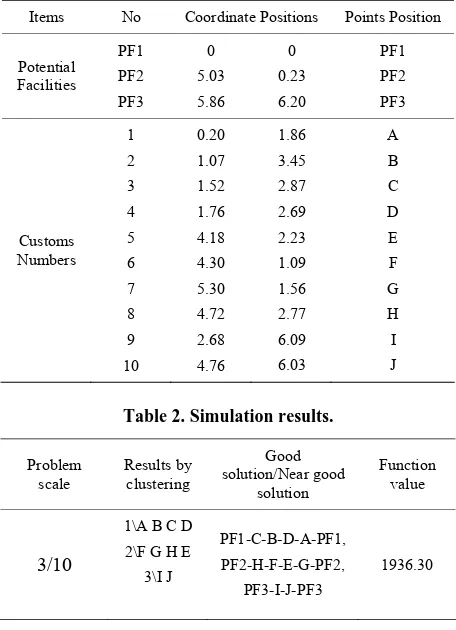
The hybrid algorithm has been discussed to search the optimal route based on the data in Table 1.The pro-
gramming is edited by VC++. The results of clustering analysis and running by 50,000 times are given in Table 2.
The sim
this table, it is an effective method based on clustering analysis and chaos search proposed in this paper. This method can be sought optimal solution (or near optimal solutions) adaptively and quickly for many candidate facilities and customers. Thecomputational cost is dra- matically reduced by chaos search to solving the small- scale question. The proposed optimal algorithm provides a new path for large-scale optimization in practical inte- grated logistics
The empirical analysis is g
Table 1. Coordinate position of three potential facilities and ten customs.
Items No Coordinate Positions Points Position
Potential 5. 0.
Facilities
PF1 PF2 PF3
0 0
03 5.86
23 6.20
PF1 PF2 PF3
Customs Numbers
1 2 3 4 5 6 7 8 9 10
0.20 1.07 1.52 1.76 4.18 4.30 5.30 4.72 2.68 4.76
1.86 3.45 2.87 2.69 2.23 1.09 1.56 2.77 6.09 6.03
[image:5.595.309.535.82.281.2]A B C D E F G H I J
[image:5.595.58.286.112.427.2]Figure 2. The trend of each variable.
Table 3. ADF unit root test results of each variable.
Test type ADF Test 5% level 10% level
Table 2. Simulation results.
Problem Results by solutio ood Function scale clustering
Good n/Near g
solution value
3/10
1\A B C D
PF1-C-B-D-A-PF1,
1936.30 2\F G H E
3\I J PF2-H-F-E-G-PF2, PF3-I-J-PF3
ith analysis is proposed for the relationship with mod-
5.1. Unit Root Test
e letters of C, T, K means inter-
tim
5.2. Co-integration Test
test is accepted for GDP,
Table 4, refused to no co-integration variables
of w
ern logistics and GDP. The factors are chosen include GDP, logistics production value (WLCZ), freight turn- over (HZL), logistics mileage (WLC), and which the data is chosen from 1978 to 2010. The unchangeable price in1978 is given with each variable. The quantitative software is accepted with EVIEWS 6.0, and which the trend of each variable is give in Figure 2 including GDP,
WLCZ, HZL,WLC.
Test type (C, T, K), Th
cept, Trend, lagging numbers. The first four are contains intercept and trend; The after four are not contains trend.
From the Table 3, it is known that the original data in
e trend, after an order difference or second order dif- ference, the data is smooth.
The Johansen co-integration
WLCZ, HZL, WLC. This test results is presented in Ta- ble 4.
From
the null hypothesis in 5% level of trace statistics.
(C, T, K) statistic
GDP (C, T, 1) 3.28 –3.56 –3.21 WLCZ (C, T, 1) –1.11 –3.55 –3.21 HZL (C, T, 1) 2.14 –3.55 –3.21 WLC (C, T, 1) –0.28 –3.55 –3.21 D2GDP (C, T, 1) –4.45 –3.57 –3.22
[image:5.595.309.537.309.474.2]DWLCZ (C, T, 8) –5.58 –3.56 –3.21 DHZL (C, T, 8) –4.96 –3.56 –3.21 D2WLC (C, T, 8) –6.65 –3.59 –3.23
Table 4 Johansen test results.
Null hypothesis Trace statistic 5% level Eigenvalue
r = 0* 52.09 47.85 0.58
r≤ 1 2.85 29.79 0.41
r≤ 2 18.14 15.49 0.23
r≤ 3 0.04 3.84 0.001
Note: Th rs of r means ers of co-i ion equa eans
his demonstrates that the variable is at least one co-
DP 1.784WLCZ 1.364WLC 1.91HZL
e lette numb ntegrat tion, *m
reject null hypothesis.
T
integration equation between the relationships, that there is a long-term equilibrium relationship between vari- ables.
G
(2.22) (0.88) (0.24) )
ru
[image:5.595.313.537.500.587.2]HZL ECMt 1
(3.01) (6.84)
18)
From the equation, T statistics test of al si
W
6. Conclusions
r, it has been proposed that the
effec-rial optimization
7. Acknowledgments
part by National Natural
REFERENCES
[1] J. H. Bookbi “Vehicle Routing
between variables. Therefore, it is necessary to establish Science Foundation of China under grant number 71040009, in part by Program for New Century Excellent Talents in University under grant number NCET-10- 0118, in part by Youth Foundation of Chinese Education by HuoYing-dong under grant number 104009.
the error correction model (ECM), to estimate short-term changes between variables. Estimated ECM is give as following:
GDP 4.141 WLCZ 0.498 0.846 WLC 0.472
(1.90) (–2.58) (
AdjustedRsquared 0.747 Considerations in Distribution System Design,” nder and K. E. Reece, European Journal of Operation Research, Vol. 37, No. 2, 1988, pp. 204-213. doi:10.1016/0377-2217(88)90330-X
[2] D. B. Bruno, F. Vincent, S. Paul, K. Philip an l variables are
gnificant in level 10%, the error correction of ECMt-1 coefficient is negative, accord with reverse revision mechanism, thus further shows that the error correction model is good, with residual sequence is the white noise.
By comparing the co-integration equation and ECM,
d P. Pat- rick, “Solving Vehicle Routing Problems Using Constr- aint Programming and Metaheuristics,” Journal of Heu- ristics, Vol. 6, No. 4, 2000, pp. 501-523.
doi:10.1023/A:1009621410177 [3] V. Campos and E. Mota, “Heu e can conclusion that t compared on short-term, freight
turnover (HZL) have negative influence on the GDP in long term, but its elasticity coefficient is greater than the short-term elastic coefficient; Output value of logistics (WLCZ) have short-term elastic significantly greater than its long-term flexibility to GDP, and both have dif- ferent symbols, changes of direction that does not accor- dance, it indicates that in recent years the logistics infra- structure investment lead to the logistics industry close to a saturation stage in Fujian province, although output value of logistics (WLCZ) promote the growth of GDP in short-term, but due to the expansion of the regular, the GDP growth plays a role of obstacles in the long term.
ristic Procedures for the Capacitated Vehicle Routing Problem,” Computational Optimization and Applications, Vol. 16, No. 3, 2000, pp. 265-277. doi:10.1023/A:1008768313174
[4] L. Cooper, “The Transportation-Location Problem,” Op- erations Research, Vol. 20, No. 1, 1972, pp. 94-108. doi:10.1287/opre.20.1.94
[5] G. Dijin, “Hybrid Evolutionary Method for Capacitated
in In-
Design of Supply-Chain Logistics Sys- Location-Allocation Problem,” Computer and Industrial Engineering, Vol. 33, No. 3-4, 1997, pp. 577-580. [6] V. Fernando and A. Joaquin, “Homoclinic Chaos
verted Pendula,” Proceeding of the 39th IEEE Conference On Decision and Control, Sydney, 12-15 December 2000, pp. 4821-4822.
[7] H. Heung-Suk, “
tem considering Service Level,” Computers and Indus- trial Engineering, Vol. 43, No. 7, 2002, pp. 283-297. doi:10.1016/S0360-8352(02)00075-X
[8] G. Laporte, “Hamiltonian Location Pro In this present pape
tive method for LRP using a hybrid algorithm based on clustering analysis and chaos search. Through computer simulations the method has been shown to solve large- scale LRP. Using the clustering technique, the computa- tional cost is dramatically reduced. Due to the feature of chaotic global ergodicity, the optimal routes are random- ly seeked in one cluster, which ensures search efficiently and produces optimal solutions (or near optimal solu- tions) without local optimization. Thus, the emphasis is directed towards developing a methodology, which has been improved the quality of solution.
The application to other combinato
blems,” European Journal of Operation Research, Vol. 12, No. 1, 1983, pp. 80-87. doi:10.1016/0377-2217(83)90182-0
[9] G. Laporte and Y. Nobert, “An Exact Algorithm for Minimizing Routing and Operating Costs in Depot Loca- tion,” European Journal of Operation Research, Vol. 6, No. 2, 1986, pp. 224-226.
doi:10.1016/0377-2217(81)90212-5
[10] J. Ra, “Dissipative Enterprises, Chaos, and the Principles
Gandy and P. Dohrn, “Depot Location with of Lean Organizations,” Omega, Vol. 26, No. 6, 1998, pp. 397-340.
[11] C.
Watson-van Salesmen—A Practical Approach,” Omega, Vol. 1, No. 3, 1973, pp. 321-329.
doi:10.1016/0305-0483(73)90108-4 [12] P. N. William and J. B. Wesley, “So problems should be investigated in integrated logistics.
The relationship is given with regional logistics and its development. There exists a long-term equilibrium rela- tion between economics growth and logistics develop- ment in Fujian province.
lving the Pickup and
9)00016-8
Delivery Problem with Time Windows Using Reactive Tabu Search,” Transportation Research Part B, Vol. 34, No. 2, 2000, pp. 107-121.
doi:10.1016/S0191-2615(9
![5 Bromospiro[1,2 dioxane 4,4′ tricyclo[4 3 1 13,8]undecane] 3′ ol](data:image/gif;base64,R0lGODlhAQABAIAAAP///wAAACH5BAEAAAAALAAAAAABAAEAAAICRAEAOw==)