Exploiting Morphological, Grammatical, and Semantic Correlates for
Improved Text Difficulty Assessment
Elizabeth Salesky, Wade Shen†
MIT Lincoln Laboratory Human Language Technology Group, 244 Wood Street, Lexington MA 02420, USA
{elizabeth.salesky, swade}@ll.mit.edu
Abstract
We present a low-resource, language-independent system for text difficulty as-sessment. We replicate and improve upon a baseline by Shen et al. (2013) on the Interagency Language Roundtable (ILR) scale. Our work demonstrates that the ad-dition of morphological, information the-oretic, and language modeling features to a traditional readability baseline greatly benefits our performance. We use the Margin-Infused Relaxed Algorithm and Support Vector Machines for experiments on Arabic, Dari, English, and Pashto, and provide a detailed analysis of our results. 1 Introduction
While there is a growing breadth of reading mate-rials available in various languages, finding perti-nent documents at suitable reading levels remains difficult. Information retrieval methods can find resources with desired vocabulary, but educators still need to filter these to find appropriate diffi-culty levels. This task is often more challeng-ing than manually adaptchalleng-ing the documents them-selves. Reading level assessment systems can be used to automatically find documents at specific Interagency Language Roundtable (ILR) levels, aiding both instructors and learners by providing proficiency-tailored materials.
While interest in readability assessment has been gaining momentum in many languages, the majority of previous work is language-specific. Shen et al. (2013) introduced a baseline for language-independent text difficulty assessment, based on the ILR proficiency scale. In this work, we replicate and extend their results.
† This work is sponsored by the Defense Language In-stitute under Air Force Contract FA8721-05-C-0002. Opin-ions, interpretatOpin-ions, conclusions and recommendations are those of the authors and are not necessarily endorsed by the United States Government.
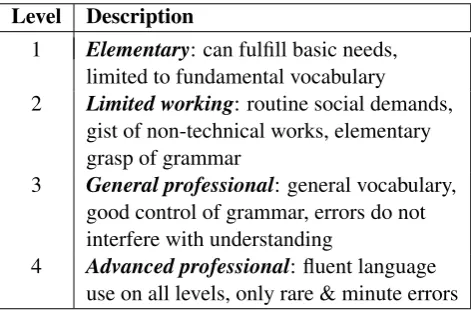
The ILR scale is the standard language profi-ciency measure for the U.S. federal government. It ranges from no proficiency to native proficiency on a scale of 0-5, with half-level denotations where proficiency meets some but not all of the criteria for the next level (Interagency Language Roundtable, 2013). For second language learners, it is sufficient to use up to ILR level 4. Since profi-ciency is a continuous spectrum, text difficulty as-sessment is often treated as a regression problem, as we do here. Though the ILR levels may ap-pear to be discrete categories, documents can fall between levels. The degree to which they do is important for us to measure.
Level Description
1 Elementary: can fulfill basic needs, limited to fundamental vocabulary
2 Limited working: routine social demands, gist of non-technical works, elementary grasp of grammar
3 General professional: general vocabulary, good control of grammar, errors do not interfere with understanding
[image:1.595.308.544.384.539.2]4 Advanced professional: fluent language use on all levels, only rare & minute errors
Table 1: Description of proficiency at ILR levels
The ILR scale addresses semantic and gram-matical capabilities, and to model it appropri-ately, a system needs to reflect both. The base-line system developed by Shen et al. (2013) uses both term frequency log-weighted (TFLOG) word-usage features and z-normalized word, sen-tence, and document length features. However, their results are not equally significant across its set of test languages, which this paper addresses with additional features.
The utilization of types for TFLOG weighted vectors is not as representative for morpholog-ically rich languages, where multiple types can represent different word-forms within a single
paradigm. By incorporating morphology, we can improve our TFLOG vectors’ representation of semantic complexity for these languages. We employ the Morfessor Categories-MAP algorithm for segmentation (Creutz & Lagus, 2007). Rela-tive entropy and statistical language models (LMs) can also measure semantic complexity, and class-based language models (cLMs) can give us a mea-sure of the grammatical complexity of the text. All of these methods are low-resource and unsuper-vised; they can be easily applied to new languages. We have compared their performance to language-specific methods where possible.
The remainder of this paper is structured as fol-lows; Section 2 summarizes previous research on readability assessment. Section 3 introduces our corpus and approach, while Section 4 details our results and their analyses. Section 5 provides a summary and description of future work.
2 Background & Related Work
Early work on readability assessment approxi-mated grammatical and lexical complexity us-ing shallow features like sentence length and the number of syllables in a word, like the promi-nent Flesch-Kincaid measure, in large part due to their low computational cost (Kincaid et al., 1975). Such features over-generalize what makes a text difficult; it is not always the case that longer words and sentences are more grammatically com-plex than their shorter counterparts. Subsequent work such as the Dale-Chall model (Dale & Chall, 1995) added representation on static word lists: in this case, one of 3,000 words familiar to 4th graders. Such lists, however, are not readily avail-able for many difficulty scales and languages.
Ensuing approaches have employed more so-phisticated methods, such as word frequency es-timates to measure lexical complexity (Stenner, 1996) and statistical language models to measure semantic and syntactic complexity, and have seen significant performance gains over previous work (Collins-Thompson & Callan, 2004; Schwarm & Ostendorf, 2005; Petersen & Ostendorf, 2009). In the case of Heilman et al. (2007), the combina-tion of lexical and grammatical features specifi-cally addressed the order in which vocabulary and grammar are acquired by second language learn-ers, where grasp of grammar often trails other markers of proficiency.
The extension of readability research to
lan-guages beyond English necessitated the introduc-tion of new features such as morphology, which have long been proven useful in other areas. Dell’Orletta et al. (2011) developed a two-class readability model for Italian based on its verbal morphology. Franc¸ois and Fairon (2012) built a six-class readability model, but for adult learners of French, utilizing verb tense and mood-based features. Most recently, Hancke et al. (2012) built a two-class German reading level assessment sys-tem heavily utilizing morphology. In addition to traditional syntactic, lexical, and language model-ing features used in English readability research, Hancke et al. (2012) tested a broad range of fea-tures based on German inflectional and deriva-tional morphology. While all of these systems were very effective, they required many language-specific resources, including part-of-speech tags.
Recent experiments have several noteworthy characteristics in common. While some systems discriminate between multiple grade-level cate-gories, most are two- or three-class classifica-tion tasks between ‘easy’ and ‘difficult’ which do not require such fine-grained feature discrimina-tion. Outside of English, there are few multi-level graded datasets; for those that do exist, they are very small, averaging less than a hundred labeled documents per level. Further, though recent work has been increasingly motivated by second lan-guage learners, most systems have only been im-plemented for a single language (Schwarm & Os-tendorf, 2005; Petersen & OsOs-tendorf, 2009); Va-jjala & Meurers, 2012). The language-specific morphological and syntactic features used by many systems outside of English would make it difficult to apply them to other languages. Shen et al. (2013) address this problem by using language-independent features and testing their work on four languages. In this work, we extend their sys-tem in order to improve upon their results. 3 Approach
3.1 Corpus
200 documents per level per language. We use an 80/20 train test split.
Lang. Tokens Types Stems Morphs/ Word
[image:3.595.72.301.100.191.2]Arabic 593,113 84,160 14,591 2.60 Dari 761,412 43,942 13,312 2.61 English 796,406 44,738 35,594 1.80 Pashto 840,673 59,031 20,015 2.34
Table 2: Corpus statistics
The documents were chosen by language in-structors as representative of a particular level and range from news articles to excerpts from philos-ophy to craigslist postings. Three graders hand-leveled each document. The corpus is annotate only with the aggregate scores; we use only this score for comparison. The creation of the corpus took 70 hours per language on average. We as-sume the ILR scale is linear and measure perfor-mance by mean squared error (MSE), typical for regression. MSE reflects the variance and bias of our predictions, and is therefore a good measure of performance uniformity within levels.
3.2 Experimental Design
We compare our results to the best performing Su-port Vector Machine (SVM) and Margin-Infused Relaxed Algorithm (MIRA) baselines from Shen et al. (2013). Both of these baselines have the same features: TFLOG weighted word vectors, average sentence length by document, average word length by document, and document word count. We used an implementation of the MIRA algorithm for regression (Crammer & Singer, 2003). We embedded Morfessor for unsupervised morphological segmentation and preprocessed our data as required by this algorithm (Creutz & La-gus, 2007). To verify our results across classifiers, we compare with SVM (Chang & Lin, 2001). We also compare Morfessor to ParaMor (Mon-son 2009), an unsupervised system with a differ-ent level of segmdiffer-entation aggression, as well as to language-specific analyzers.
Our experiments apply word-usage features, shallow length features, and language models. For the first, we compare TFLOG vectors based on word types, all morphemes, and stems only. For the second, we tested the three baseline shallow length features (average word length in characters per document, average sentence length per
docu-ment, and document word count) as well as mea-sures of relative entropy, average stem fertility, av-erage morphemes per word, and the ratio of types to tokens. Of these, only relative entropy posi-tively impacted performance, and only its results are reported in this paper. All length features were z-normalized. We compare both word- and class-based language models. We trained LMs for each ILR level and used the document perplexity mea-sured against each as features.
Optimal settings were determined by sweeping algorithm parameters, and Morfessor’s perplexity threshold for each language. We conducted a fea-ture analysis for all combinations of word, length, and LM features across all four languages. 4 Results & Analysis
We first replicate the baseline results of Shen et al. (2013) using both the MIRA and SVM algo-rithms. We find there is very overall little perfor-mance difference between the two algorithms, and the difference is language-dependent. It is incon-clusive which algorithm performs best.
Algorithm AR DA EN PA MIRA 0.216 0.296 0.154 0.348
SVM 0.198 0.301 0.147 0.391 Table 3: Baseline results in MSE, SVM vs. MIRA
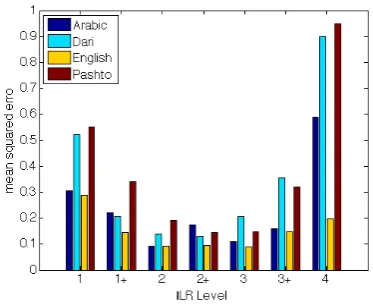
[image:3.595.318.505.520.672.2]Table 3 shows the average MSE across the seven ILR levels for each language. Figure 1 depicts MSE performance on each individual ILR level.
Figure 1: MSE by ILR level, baseline
4.1 Morphological Analysis
they have not been researched for this task until recently. Morphology has long been shown to be useful in other areas; it is unsurprising that seg-mentation should help with this task for morpho-logically rich languages. What we demonstrate is that unsupervised methods perform similarly to language-specific methods, at a lower cost.
Language TYPES MORPHS STEMS
Arabic 0.216 0.198 0.208
Dari 0.296 0.304 0.294
English 0.154 0.151 0.151
Pashto 0.348 0.303 0.293
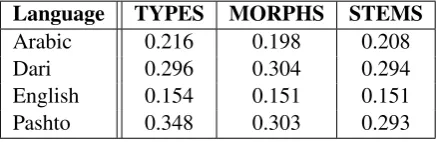
Table 4: Average MSE results comparing the use of types, all morphs, and stems for TFLOG vec-tors. Morfessor algorithm used for segmentation.
Table 4 compares the performance of the base-line, which utilizes types for its TFLOG weighted word vectors, to our configurations that alterna-tively use all morphemes or stems only. We see that morphological information improves perfor-mance for all cases but one, all morphs for Dari, and that using stems only shows the greatest im-provement.
Our greatest improvement was seen in Pashto, which has the most unique stems in our dataset both outright and compared to types (see Table 4). Without stemming, TFLOG word vectors were heavily biased by the frequency of alternate word forms within a paradigm. With stemming, which reduced overall MSE compared to the baseline by 16%, the number of word vectors in the optimized configuration increased by 18%, and were much more diverse, reflecting the actual semantic com-plexity of the documents. We posit that the rea-son Dari, which has a similar ratio of morphemes per word to Pashto, does not improve in this way is due to its much smaller and more uniform vo-cabulary in our data. Our Pashto documents have 1.5 times as many unique words as our Dari, and in fact, with stemming, the number of word vec-tors utilized in our optimized configuration was reduced by 20%, as fewer units were necessary to reflect the same content.
We compare our results using Morfessor to an-other unsupervised segmentation system, ParaMor (Monson 2009). ParaMor is built on a differ-ent mathematical framework than Morfessor, and so has a very different splitting pattern. Morfes-sor has a tunable perplexity threshold that
dic-tates how aggressively the algorithm segments. Even set at its highest, ParaMor still segments much more aggressively, sometimes isolating sin-gle characters, which can be useful for down-stream applications (Kurimo et al. 2009). This is not the case here, as shown in Table 5. All further results use Morfessor for stemming.
Algorithm AR DA EN PA Morfessor 0.208 0.294 0.151 0.293
[image:4.595.72.291.170.241.2]ParaMor 0.227 0.321 0.158 0.301 Table 5: Comparison of unsupervised segmenters
To our knowledge, no Pashto-specific morpho-logical analyzer yet exists for comparison. How-ever, in lacking both a standardized writing system and spelling conventions, one word in Pashto may be written in many different ways (Kathol, 2005). To account for this, we normalized the data us-ing the Levenshtein distance between types. We swept possible cutoff thresholds up to 0.25, eval-uated by the overall MSE of the subsequent sults. Using normalized data did not improve re-sults; in many cases the edit distance between al-ternate misspellings is just as high or higher as the distance between word types.
We believe that the limited change in Dari per-formance is primarily related to corpus character-istics; relatively uniform data provides low per-plexity, making it more difficult for Morfessor to discover all morphological segmentations. Using the Perstem stemmer in place of Morfessor, the number of word vectors in the optimized system rose 143% and our results improved 8%. This increase affirms that Morfessor is under-splitting. Perstem is tailored to Farsi, and while the two di-alects are mutually intelligible, they have gram-matical, phonological, and loan word differences (Shah et al. 2007).
We highlight that the overall MSE of all config-urations in Table 4 vary only 2% for English, with identical results using all morphs and only stems. This is expected, as English is not morphologi-cally complex. Given the readily available rule-based systems for English, we compared results with Morfessor to the traditional Porter and Paice stemmers, as well as the multi-lingual FreeLing stemmer, as seen in Table 6.
Baseline Morf. Porter Paice FreeLing 0.154 0.151 0.149 0.148 0.153
Table 6: Comparison of English segmenters stems and affixes to be found in English. Topical similarities in our data are also possible.
Like Pashto, Arabic has a rich morphologi-cal structure, but in addition to affixes it con-tains templatic morphology. It is difficult for un-supervised analyzers not specifically tailored to templatic morphology to capture non-contiguous morphemes. Here, Morfessor consistently seg-ments vowelized types into sequences of two char-acter stems. When compared with MADA, a rule-based Arabic analyzer (Habash, 2010), we found that Morfessor outperformed MADA by 10%. This is likely because the representations present in the dataset are what is significant; if a form is ‘morphologically correct’ but perpetuates a sparsity problem, linguistically-accurate stem-ming will not help. Neither stemmer contributes much to Arabic results, however, as MIRA does not weight word-usage features very heavily for either Arabic analyzer.
4.2 Relative Entropy and Word LMs
As mentioned in Section 2, traditional features like document word count and average sentence length overstate the importance of length to diffi-culty. To capture the significance of the length of the document, rather than merely the length itself, we utilized relative entropy. Relative entropy, also known as the Kullback-Leibler divergence (KL), is a measure of the information lost by using one probability distribution as compared to another. Expressed as an equation, we have:
D(p, q) =X
x2"p(x) log
p(x)
q(x). (1)
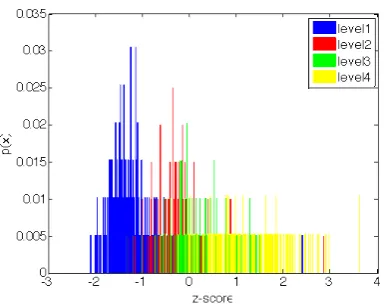
In this work, we are comparing a unigram prob-ability distribution of a document q(x) to a uni-form distribution over the same lengthp(x). This provides both a measure of the semantic and struc-tural complexity of a document, allowing us to differentiate between documents of similar length. Figure 2 shows the normalized distribution of the relative entropy feature for Pashto.
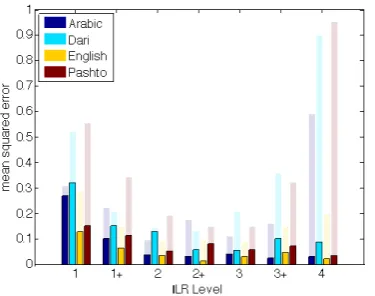
The separability of ILR levels suggests we will be able to discriminate between them. As demon-strated by the improved performance in Figure 3, where the inclusion of relative entropy is
[image:5.595.313.506.68.220.2]super-Figure 2: Pashto, normalized KL distribution imposed over the baseline, this feature greatly con-tributes to the separability of outlier levels of our corpus. Common z-scores between levels 2 and 3 explain the system’s poorer performance on the ILR levels 2.0 and 2.5 (Figure 3). Adding the rel-ative entropy feature to the baseline produced an average MSE reduction of 15%.
Figure 3: MSE by ILR level, baseline +stems +KL
[image:5.595.319.505.363.516.2]coun-terparts. This may be due to data similarity be-tween level 3+ and 4 documents, or MIRA may have been overfit during training. In contrast, the variance for English and Pashto is much smaller; overall, the variance has been greatly reduced.
Statistical language models (LMs) are a proba-bility distribution over text. An n-gram language predicts a word wn given the preceding context w1...wn 1. We used the SRI Language
Model-ing Toolkit to train LMs on our trainModel-ing data for each ILR level (Stolcke, 2002). To account for unseen n-grams, we used Kneser-Ney smoothing. To score documents against these LMs, we calcu-late their perplexity (PP), a measure of how well a probability distribution represents data. Perplex-ity represents the average number of bits neces-sary to encode each word. For each document in our dataset, we use the perplexities against each ILR level LM as features in MIRA. We compared n-gram orders 2-5, and while we found an aver-age decrease of 3% MSE between orders 2 and 3 across languages, there was a difference of less than 1% between 3-gram and 5-gram LMs.
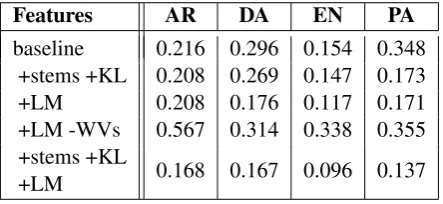
Features AR DA EN PA baseline 0.216 0.296 0.154 0.348
+stems +KL 0.208 0.269 0.147 0.173 +LM 0.208 0.176 0.117 0.171 +LM -WVs 0.567 0.314 0.338 0.355 +stems +KL
[image:6.595.305.525.344.447.2]+LM 0.168 0.167 0.096 0.137 Table 7: Average MSE results comparing features from Sections 4.1 and 4.2. LMs are order 5.
As we can see from Table 7, the addition of lan-guage models alone can provide a huge measure of improvement from the baseline. For Arabic and Pashto, it is the same improvement seen by stem-ming TFLOG vectors and adding relative entropy. For Dari and English, however, the performance improvement is unmatched by any other features presented thus far. We compare these results to the same configuration without TFLOG vectors, in order to measure the overlap between these fea-tures; see Table 7. Based on the relative results, it seems that word vector and LM features are or-thogonal. The addition of all three new features (stemmed word vectors, relative entropy, and lan-guage models) provides considerable further im-provement upon any previous configuration. It ap-pears that the interactions between these features
have a further positive influence on our discrimi-native ability.
4.3 Class-Based LMs
It is possible to group words based on similar meaning and syntactic function. It is reasonable to think that the probability distributions of words in such groups would be similar (though not the same). By assigning classes to words, we can calculate the probability of a word based not on the sequence of precedingwords, but rather,word classes. Doing so decreases the size of resulting models and also allows for better predictions of unseen word sequences. Sparsity is a concern with language models, where we rely on the frequency of sequences, not just words. Using word classes assuages some of this concern. These word classes are generated in an unsupervised manner. We train our class-based language models (cLMs) using c-discounting to account for data sparsity.
Features AR DA EN PA baseline 0.216 0.296 0.154 0.348
+LM 0.208 0.176 0.117 0.171 +cLM 0.130 0.286 0.144 0.211 +LM +cLM 0.094 0.155 0.051 0.084 +stems +KL
+LM +cLM 0.092 0.152 0.049 0.079
Table 8: Average MSE results comparing all fea-tures. LMs and cLMs are order 5.
Class-based and word-based LMs each help different languages in our test set. The two types of LMs model different information, with word-based LMs providing a measure of semantic complexity and class-based modeling grammati-cal complexity. As seen in Table 8, the combina-tion of this complementary informacombina-tion is highly beneficial and strongly correlated to ILR level. We see average MSE reductions of 56%, 48%, 67%, and 77% in Arabic, Dari, English, and Pashto, re-spectively, using both types of language model.
Algorithm AR DA EN PA MIRA 0.091 0.156 0.049 0.079
[image:6.595.72.294.386.488.2]Figure 4: Comparison of final configuration with all features to baseline by MSE, MIRA algorithm
The further inclusion of TFLOG stemming and relative entropy reduces average MSE an addi-tional 1%. Figure 4 reflects this configuration’s performance across the seven ILR levels.
Figure 4 superimposes our final error results over those of the baseline. It is clear that error has become much less language-specific; performance on all seven ILR levels has become considerably more consistent across the four languages, as has the accuracy at each individual ILR level. It seems likely that our error measures would be similar to inner-annotator disagreement, a measure that we would like to quantify in the future.
We find that our results are significant across classifiers. Table 9 shows the performance of our final feature set with both MIRA and SVM. The MSE exhibits the same trends across ILR levels and languages with both algorithms. The average difference in error between the algorithms remains the same as it was with the baseline features. 5 Conclusions and Future Work
Our experiments demonstrate that language-independent methods can improve text difficulty assessment performance on the ILR scale for four languages. Morphological segmentation for TFLOG word vectors improves our measure of semantic complexity and allows us to do topic analysis better. Unsupervised methods perform similarly to language-specific and linguistically-accurate analyzers on this task; we are not sac-rificing performance for a language-independent system. Relative entropy gives structural con-text to more traditional shallow length features, and with word-based LM features provide another way to measure semantic complexity. Class-based
LM features measure grammatical complexity and to some degree account for data sparsity issues. All of these features are low-cost and require no language-specific resources to be applied to new languages. The combination of all these features significantly improves our performance as mea-sured by mean square error across a diverse set of languages.
We would like to expand our work to more di-verse languages and datasets in future work. There is room to improve upon features described in this paper, such as new frequency-based measures for word vectors and unsupervised morphological segmentation methods. In the future, we would like to directly compare inner-annotator error and well-known formulas with our results. It would also be interesting to look at performance on sub-sets of the corpus to test dependence on dataset size. We would also like to investigate the ILR scale; while we assume that it is linear, this is not likely to be the case.
Acknowledgments
This paper benefited from valuable discussion with Jennifer Williams.
References
J. Chall, E. Dale. 1995. Readability revisited: The new Dale-Chall readability formula. Brookline Books, Cambridge, MA.
C-C. Chang, C-J. Lin. 2001. LIBSVM: a library for support vector machines. Software available at http://www.csie.ntu.edu.tw/ cjlin/libsvm.
K. Collins-Thompson, J. Callan. 2005. Predicting reading difficulty with statistical language models.
Journal of the American Society for Information Sci-ence and Technology56(13), 1448-1462.
K. Crammer, Y. Singer. 2003. Ultraconservative On-line Algorithms for Multiclass Problems. Journal of Machine Learning Research, 3(2003):951-991. M. Creutz, K. Lagus. 2007. Unsupervised models for
morpheme segmentation and morphology learning.
Association for Computing Machinery Transactions on Speech and Language Processing (ACM TSLP), 4(1):1-34.
T. Franc¸ois, C. Fairon. 2012. An AI readability formula for French as a foreign language. Pro-ceedings of the 2012 Joint Conference on Em-pirical Methods in Natural Language Processing (EMNLP) and Computational Natural Language Learning (CoNLL). 466-477.
N. Habash, O. Rambow, R. Roth. 2010. Mada+Tokan: A toolkit for arabic tokenization, diacritization, mor-phological disambiguation, pos tagging, stemming and lemmatization. Proceedings of the 2nd Inter-national Conference on Arabic Language Resources and Tools (MEDAR).
J. Hancke, S. Vajjala, D. Meurers 2012. Readability Classification for German using lexical, syntactic, and morphological features. Proceedings of CoL-ING 2012: Technical Papers, 1063-1080.
K.S. Hasan, M.A. ur Rahman, V. Ng. 2009.
Learning-Based Named Entity Recognition for Morphologically-Rich, Resource-Scarce Lan-guages. Proceedings of the 12th Conference of the European Chapter of the Association for Computational Linguistics (EACL), 354-362. M. Heilman, K. Collins-Thompson, J. Callan, M.
Es-kenazi. 2007. Combining Lexical and Grammat-ical Features to Improve Readability Measures for First and Second Language Texts. Proceedings of NAACL HLT, 460-467.
Interagency Language Roundtable. ILR Skill Scale.
http://www.govtilr.org/Skills/ ILRscale4.htm. 2013.
A. Jadidinejad, F. Mahmoudi, J. Dehdari. 2010. Eval-uation of perstem: a simple and efficient stemming algorithm for Persian. Multilingual Information Ac-cess Evaluation Text Retrieval Experiments. A. Kathol, K. Precoda, D. Vergyri, W. Wang, S.
Riehe-mann. 2005. Speech translation for low-resource languages: The case of pashto. Proceedings of IN-TERSPEECH, 2273-2276.
J.P. Kincaid, R.P Fishburne Jr., R.L. Rodgers, and B.S. Chisson 1975. Derivation of new readability formu-las for Navy enlisted personnel. Research Branch Report, U.S. Naval Air Station, Memphis, 8-75. M. Kurimo, V. Turunen, M. Varjokallio. 2009.
Overview of Morpho Challenge 2008. Evaluating Systems for Multilingual and Multimodal Informa-tion Access, Springer Berlin Heidelberg, 951-966. C. Monson. 2009. ParaMor: From Paradigm Structure
to Natural Language Morphology Induction. PhD thesis. Carnegie Mellon University.
R. Munro, C.D. Manning. 2010. Subword Variation in Text Message Classification. The 2010 Annual Con-ference of the North American Chapter of the Asso-ciation for Computational Linguistics, 510-518.
M. Padr. 2004. FreeLing: An Open-Source Suite of Language Analyzers. Proceedings of the 4th In-ternational Conference on Language Resources and Evaluation (LREC’04).
C.D. Paice. 1990. Another Stemmer. SIGIR Forum, 24:56-61.
S. E. Petersen and M. Ostendorf. 2009. A ma-chine learning approach to reading level assessment.
Computer Speech and Language, 23(2009):89-106. M.F. Porter. 1980. An algorithm for suffix stripping.
Program, 14(3): 130-137.
A. Ratnaparkhi. 1997. A simple introduction to max-imum entropy models for natural language process-ing.IRCS Technical Reports Series, 81.
S. E. Schwarm and M. Ostendorf. 2005. Reading Level Assessment Using Support Vector Machines and Statistical Language Models. In Proceedings of the 43rd Annual Meeting of the Association for Computational Linguistics (ACL).
M.I. Shah, J. Sadri, C.Y. Suen, N. Nobile. 2007. A New Multipurpose Comprehensive Database for Handwritten Dari Recognition. 11th International Conference on Frontiers in Handwriting Recogni-tion, Montreal, 635-40.
W. Shen, J. Williams, T. Marius, E. Salesky. 2013. A language-independent approach to automatic text difficulty assessment for second-language learners.
Proceedings of the 2nd Workshop on Predicting and Improving Text Readability for Target Reader Popu-lations (PITR) 2013.
A. Stolcke. 2002. SRILM - an extensible language modeling toolkit. Proceedings of the ICSLP, vol. 2, 901-4.