Bacteria Biotope Detection, Ontology-based Normalization, and Relation
Extraction using Syntactic Rules
˙Ilknur Karadeniz
Department of Computer Engineering Bo˘gazic¸i University
34342, Bebek, ˙Istanbul, Turkey [email protected]
Arzucan ¨Ozg ¨ur
Department of Computer Engineering Bo˘gazic¸i University
34342, Bebek, ˙Istanbul, Turkey [email protected]
Abstract
The absence of a comprehensive database of locations where bacteria live is an im-portant obstacle for biologists to under-stand and study the interactions between bacteria and their habitats. This paper re-ports the results to a challenge, set forth by the Bacteria Biotopes Task of the BioNLP Shared Task 2013. Two systems are ex-plained: Sub-task 1 system for identifying habitat mentions in unstructured biomedi-cal text and normalizing them through the OntoBiotope ontology and Sub-task 2 sys-tem for extracting localization and part-of relations between bacteria and habitats. Both approaches rely on syntactic rules designed by considering the shallow lin-guistic analysis of the text. Sub-task 2 system also makes use of discourse-based rules. The two systems achieve promising results on the shared task test data set.
1 Introduction
As the number of publications in the biomedical domain continues to increase rapidly, information retrieval systems which extract valuable informa-tion from these publicainforma-tions have become more important for scientists to access and utilize the knowledge contained in them.
Most previous tasks on biomedical informa-tion extracinforma-tion focus on identifying interacinforma-tions and events among bio-molecules (Krallinger et al., 2008; Kim et al., 2009). The Bacteria Biotope Task (Bossy et al., 2011; Bossy et al., 2012) is one of the new challenges in this domain, which was firstly presented in the BioNLP 2011 Shared Task. The main goals of the Bacteria Biotope Task were to extract bacteria locations, categorize them into one of the eight types (Environment, Host, Host-Part, Geographical, Water, Food, Medical, Soil),
and detect Localization and PartOf events between bacteria and habitats. Automatically extracting this information from textual sources is crucial for creating a comprehensive database of bacteria and habitat relations. Such a resource would be of great value for research studies and applications in several fields such as microbiology, health sci-ences, and food processing.
Three teams participated in the Bacteria Biotope Task using different methodologies (Bossy et al., 2011; Bossy et al., 2012). Bibliome INRA (Ratkovic et al., 2012), which achieved the best F-score (45%) among these teams, imple-mented a system which used both linguistic fea-tures and reasoning over an ontology to predict lo-cation boundaries and types. Bibliome also uti-lized some resources such as NCBI Taxonomy1, list of Agrovoc geographical names2, and an in-house developed ontology for specific location types. UTurku (Bj¨orne et al., 2012), presented a machine-learning based system which can be used to find solutions for all main tasks with a few al-teration in the system. UTurku used this generic system with additional named entity recognition patterns and external resources, whereas JAIST (Nguyen and Tsuruoka, 2011) used CRFs in order to recognize entities and their types.
UTurku and JAIST treated event extraction as a classification problem by using machine learning approaches, while Bibliome created and utilized a trigger-word list. Bibliome tried to find events by checking if a trigger-word and entities co-occur in the scope of the same sentence. Bibliome was the only team that considered coreference resolu-tion. Not considering coreference resolution de-teriorated the performance of JAIST’s system less than that of UTurku’s system, since JAIST’s sys-tem operated in the scope of a paragraph, while UTurku’s system operated in the scope of a
sen-1
http://www.ncbi.nlm.nih.gov/Taxonomy/
2http://aims.fao.org/standards/agrovoc/about
tence.
The Bacteria Biotope Task (BB) in the BioNLP 2013 Shared Task (Bossy et al., 2013) gives an-other opportunity to scientists to develop and com-pare their systems on a reliable platform. This task contains three subtasks. For Sub-task 1, partici-pants are expected to detect the names and posi-tions of habitat entities, as well as to normalize these habitats through the OntoBiotope (MBTO) Ontology concepts. For Sub-task 2, when the names, types, and positions of the entities ( bacte-ria, habitat, geographical) are given, participants are expected to extract relations which can be ei-ther between bacteria and habitat pairs (Localiza-tion event) or between host and host part pairs (PartOf event). Sub-task 3 is the same as Sub-task 2, except that the gold standard entities are not provided to the participants.
In this paper, we present two systems, one for Sub-task 1 (Entity Detection and Categoriza-tion) and one for Sub-task 2 (Localization Rela-tion ExtracRela-tion) of the Bacteria Biotope Task in the BioNLP 2013 Shared Task. Both systems are rule-based and utilize the shallow syntactic analy-sis of the documents. The Sub-task 2 system also makes use of the discourse of the documents. The technical details of our systems are explained in the following sections.
2 Data Set
The corpus provided by the organizers was cre-ated by collecting documents from many differ-ent web sites, which contain general information about bacteria and habitats. The data set, consist-ing of 52 trainconsist-ing, 26 development, and 26 test documents, was annotated by the bioinformati-cians of the Bibliome team of MIG Laboratory at the Institut National de Recherche Agronomique (INRA).
For the training and development phases of Sub-task 1, document texts with manually annotated habitat entities and the concepts assigned to them through the OntoBiotope ontology were provided, while in the test phase, only the unannotated docu-ment texts were given by the task organizers. The OntoBiotope ontology which contains 1,700 con-cepts organized in a hierarchy of is-a relations was also provided by the organizers for this task.
For the training and development phases of Sub-task 2, document texts with manually annotated bacteria, habitat and geographical entities, as well
as the localization and part-of relations were pro-vided, while in the test phase, document texts an-notated only for bacteria, habitat and geographical entities were given.
3 Bacteria Biotope Detection and Ontology-based Normalizaton
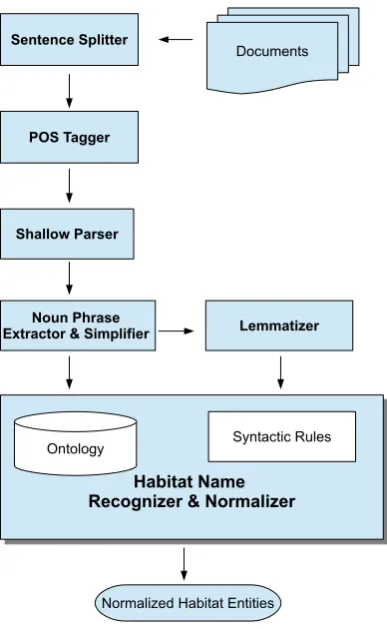
For Sub-task 1 (Entity Detection and Categoriza-tion), we implemented a system which applies syntactic rules to biomedical text after a pre-processing phase, where a given text is split into sentences and parsed using a shallow parser. The workflow of our Sub-task 1 system is shown in Figure 1. Firstly, each input file is split into sen-tences using the Genia Sentence Splitter (Geni-aSS) (Saetre et al., 2007). The outputs of the splitter are given to the Genia Tagger (Tsuruoka et al., 2005; Tsuruoka and Tsujii, 2005) as input files with the aim of obtaining the lemmas, the part-of-speech (POS) tags, and the constituent cat-egories of the words in the given biomedical text
(e.g., surface form: ticks; lemma: tick; POS tag: NNS; phrase structure: I-NP). We utilized these syntactic information at the following steps of our system.
In the following subsections, a detailed expla-nation for the detection of habitat boundaries and their normalization through the OntoBiotope On-tology concepts is provided.
3.1 Entity Boundary Detection
Entity boundary detection, which is the first step of Sub-task 1, includes automatic extraction of habi-tat entities from a given natural language text, and detection of the entity boundaries precisely. In other words, the habitat boundaries that are re-trieved from the texts should not include any un-necessary and non-informative words. In order to achieve this goal, we assume that bacteria habitats are embedded in text as noun phrases, and all noun phrases are possible candidates for habitat entities. Based on this assumption, our system follows the steps that are explained below by using the mod-ules that are shown in Figure 1.
As explained before, the Sentence Splitter,
POS Tagger, and Shallow Parser are the mod-ules that are utilized in the pre-processing phase.
The Noun Phrase Extractor & Simplifier
syn-POS Tagger Sentence Splitter
Noun Phrase Extractor & Simplifier
Habitat Name Recognizer & Normalizer
Habitat Name Recognizer & Normalizer
Syntactic Rules
Shallow Parser
Lemmatizer
Documents
Ontology
[image:3.595.96.290.73.388.2]Normalized Habitat Entities
Figure 1: Workflow of the Sub-task 1 System
tactic rules. The functions of this module include the removal of some unnecessary words from the noun phrases, which are not informative for envi-ronmental locations of bacteria. To distinguish in-formative words from non-inin-formative ones, our system utilizes the POS Tags of each word that compose the noun phrases in question. For ex-ample, words that have determiners or possessive pronouns as their POS Tags should not be included to the boundaries of the candidate habitat enti-ties. For example, the in the noun phrase “the soybean plant Glycine max” and its in the noun phrase “its infectious saliva” are eliminated from the candidate noun phrases, restricting the habi-tat boundary, and creating new candidate noun phrases.
The Noun Phrase Extractor & Simplifier mod-ule also includes a mechanism to handle noun phrases that contain the conjunction“and”. First, such noun phrases are separated from the conjunc-tion“and”into two phrases. Next, each sub-phrase is searched in the OntoBiotope ontology. If the ontology entries matched for the two
sub-phrases have the same direct ancestor (i.e., the two ontology entries have a common is-a relation), then the noun phrase consisting of the two sub-phrases connected with the conjunction“and”is identified as a single habitat entity. On the other hand, if the ontology entries matched for the two sub-phrases don’t have a common direct ances-tor, then each sub-phrase is identified as a sepa-rate habitat entity. For example, each of the entity boundaries of the phrases “nasal and oral cav-ity” , “fresh and salt water”, and “human and sheep”are handled differently from each other as described below.
• For the first phrase,“nasal”is the first sub-phrase and“oral cavity” is the second sub-phrase. The direct ancestor (i.e., the first level is-a concept) of the first sub-phrase“nasal”
is “respiratory tract part” and that of the second sub-phrase“oral cavity”is“buccal”. Since“respiratory tract part”and“buccal”
is-a concepts are not the same, “nasal cav-ity” and“oral cavity” are generated as two separate habitats. In other words, if there is not a direct common is-a concept between the matching terms for the sub-phrases in the OntoBiotope ontology, then one habitat entity “nasal cavity” is generated from the noun phrase by adding the second part of the second sub-phrase “cavity” to the first sub-phrase“nasal” and another entity is gener-ated by taking the second sub-phrase as a whole“oral cavity”.
• For the second sample phrase,“fresh”is the first sub-phrase and“salt water”is the sec-ond sub-phrase. The first sub-phrase“fresh”
matches with an ontology entry whose direct ancestor is“environmental water with chem-ical property” and the second sub-phrase
“salt water”matches with an ontology entry that has two different direct ancestors “en-vironmental water with chemical property”
and “saline water”. Since “environmental water with chemical property”is a common ancestor for both sub-phrases in the ontology, a single habitat entity“fresh and salt water”
• For the third phrase, “human” is the first sub-phrase and “sheep” is the second sub-phrase. In this case, two separate habitat en-tities‘human”and“sheep”are generated di-rectly from the two sub-phrases since they don’t have a common ancestor in the ontol-ogy.
At the end of these phases, purified sub-noun phrases, which are habitat entity candidates whose boundaries are roughly determined by the deletion of non-informative modifiers from noun phrases, are obtained.
To determine whether a candidate noun phrase is a habitat entity or not, theHabitat Name Rec-ognizer & Normalizer module searches all on-tology entries, which compose the OntoBiotope Ontology, to find an exact match with the candi-date noun phrase or with parts of it. In this step, the names, exact synonyms, and related synonyms of ontology entries (ontology entry features) are compared with the candidate noun phrase.
[Term]
id: MBTO:00001828
name: digestive tract
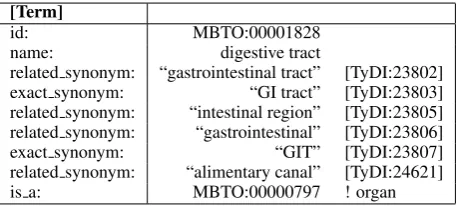
related synonym: “gastrointestinal tract” [TyDI:23802] exact synonym: “GI tract” [TyDI:23803] related synonym: “intestinal region” [TyDI:23805] related synonym: “gastrointestinal” [TyDI:23806] exact synonym: “GIT” [TyDI:23807] related synonym: “alimentary canal” [TyDI:24621]
is a: MBTO:00000797 ! organ
Table 1: First ontology entity match for human gastrointestinal tract.
For example, if our candidate noun phrase is
“the human gastrointestinal tract”, after the post-processing phase, the purified candidate phrase will be “human gastrointestinal tract”. When the search step for this simplified candidate entity is handled, two different ontology entries are re-turned by our system as matches (see Table 1 for the first ontology entry match and Table 2 for the second one). These two ontology entries are re-turned as results by our system because the first one contains therelated synonym: “gastrointesti-nal tract”and the second one contains the name: human. Since the system returns matches for the candidate noun phrase“human gastrointesti-nal tract”, it is verified that one or more habitat entities can be extracted from this phrase.
To detect the exact habitat boundaries, manually developed syntactic rules are utilized in addition to
[Term]
id: MBTO:00001402
name: human
[image:4.595.309.528.61.154.2]related synonym: “person” [TyDI:25453] related synonym: “individual” [TyDI:25454] exact synonym: “subject” [TyDI:25374] exact synonym: “homo sapiens” [TyDI:26681] related synonym: “people” [TyDI:25455] is a: MBTO:00001514 ! mammalian
Table 2: Second ontology entity match forhuman gastrointestinal tract.
the ontology entry matching algorithm, which is used for entity verification of a candidate phrase. Our system determines the boundaries according to the following syntactic rules:
• If an ontology entry matches exactly with the noun phrase, take the boundaries of the noun phrase as the boundaries of the habitat, and use the whole phrase to create a new habitat entity.
• If an ontology entry matches beginning from the first word of the noun phrase, but does not match totally, take the boundaries of the matched parts of the phrase, and create a new habitat entity using the partial phrase.
• If an ontology entry matches beginning from an internal word of the noun phrase, take the boundaries of the noun phrase as the bound-aries of the habitat, and use the whole phrase to create a new habitat entity. For exam-ple, in Table 1, the match of the noun phrase
“human gastrointestinal tract” with the re-lated synonym: “gastrointestinal tract” gen-erates “human gastrointestinal tract” as a habitat entity.
In many cases habitat entity names occur in dif-ferent inflected forms in text. For example, the habitat name“human”, can occur in text in its plu-ral form as“humans”. We used theLemmatizer
module in order to be able to match the differ-ent inflected forms of habitat names occurring in text against the corresponding entires in the Onto-Biotope ontology. This module applies the rules described above to the lemmatized forms of the candidate noun phrases, which are obtained using the Genia Tagger.
[image:4.595.73.302.366.469.2]sur-face and lemmatized forms of the noun phrases in order to create an output file, which contains the predicted habitat entities and their positions in the input text.
3.2 Ontology Categorization
For Sub-task 1, detection of the entities and their boundaries is not sufficient. In order to obtain normalized entity names, participants are also ex-pected to assign at least one ontology concept from the OntoBiotope Ontology to all habitat en-tities, which are automatically extracted by their systems from the input text.
While our system detects entities and their boundaries (as explained in detail in Section 3.1), it also assigns ontology concepts to the re-trieved entities. All assigned concepts are ref-erenced by the MBTO-IDs of the matched on-tology entries (e.g, MBTO:00001402 for human
andMBTO:00001828 for human gastrointestinal tract) (see Table 3).
4 Event Extraction
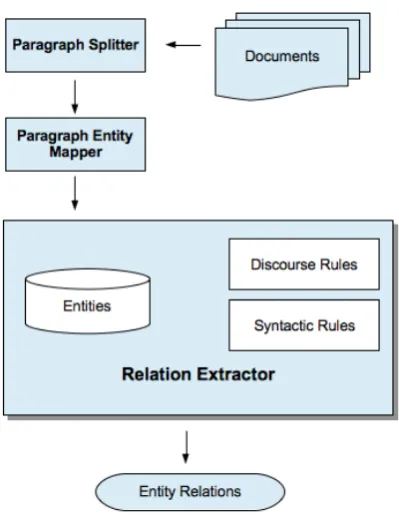
For Sub-task 2 (Localization Event Extraction Task), we used different methods according to the relation type that we are trying to extract. The workflow of our system is shown in Figure 2. The details of our approach are explained in the fol-lowing sub-sections.
4.1 Localization Event Extraction
In order to extract localization relations, we as-sume that discourse changes with the beginning of a new paragraph. Our system firstly splits the in-put text into paragraphs. Next, the entities (bacte-ria and habitats) that occur in the given paragraph are identified. We assume that the paragraph is about the bacterium whose name occurs first in the paragraph. Therefore, we assign all the habitat en-tities to that bacterium. If the name of this bac-terium occurs in previous paragraphs as well, then the boundary of the bacterium entity is set to its first occurrence in the document.
We also have a special case for boundary de-termination of bacteria in the localization rela-tion. If a bacterium name contains the word
[image:5.595.318.518.59.317.2]“strain” , we assign the first occurrence of its name without the word “strain” (e.g, Bifidobac-terium longum NCC2705 instead of Bifidobac-terium longum strain NCC2705).
Figure 2: Workflow of the Sub-task 2 System
4.2 PartOf Event Extraction
In order to detect partOf relations between hosts and host parts in a given biomedical text, we as-sumed that such relations can only exist if the host and the host part entities occur in the same paragraph. Based on this assumption, we pro-pose that if a habitat name is a subunit of the term which identifies another habitat that passes in the same discourse, then they are likely to be related through a partOf relation. In other words, if one habitat contains the other one, and obeys some syntactic rules, then there is a relation. For exam-ple,“respiratory track of animals”is a habitat and
“animals”is another habitat, both of which are in the same paragraph. Since the“respiratory track of animals”phrase contains the“animals”phrase and the word“of”, and the“animals”phrase is on the right hand side of the“respiratory track of ani-mals”phrase, our system detects a partOf relation between them.
5 Evaluation
The official evaluation results on the test set are provided using different criteria for the two sub-tasks by the task organizers3.
3
EntityID Boundary Entity
T1 Habitat 113 118 human
T2 Habitat 113 141 human gastrointestinal tract
ID EntityID Reference
[image:6.595.135.467.63.146.2]N1 OntoBiotope Annotation:T1 Referent:MBTO:00001402 N2 OntoBiotope Annotation:T2 Referent:MBTO:00001828
Table 3: Detected entities and boundaries from thehuman gastrointestinal tractnoun phrase
For Sub-task 1, submissions are evaluated con-sidering the Slot Error Rate(SER), which depends on the number of substitutionsS, deletionsD, in-sertions I, and N. N is the number of habitats in the reference, while D and I are the number of reference and predicted entities that could not be paired, respectively.
SER= S+D+I
N (1)
The number of substitutions Sis calculated by using Equation 2. HereJis the Jaccard index be-tween the reference and the predicted entity, which measures the accuracy of the boundaries of the predicted entity (Bossy et al., 2012).Wis a param-eter that defines the semantic similarity between the ontology concepts related to the reference en-tity and to the predicted enen-tity (Wang et al., 2007). This similarity is based on the is-a relationships between concepts, and used for penalizing ances-tor/descendent predictions more compared to sib-ling predictions as it approaches to 1.
S =J·W (2)
For Sub-task 2, precision, recall, and f-score metrics are used for evaluation. In the following subsections, our official evaluation results for Sub-task 1 and Sub-Sub-task 2 are given.
5.1 Results of Sub-task 1
Our official evaluation results on test set are shown in Table 4. Our system ranked second according to theSERvalue among four participating systems in the shared task.
The official results of our system on the test set for entity boundary detection are shown in Table 5. Our system obtained the smallest SER value for detecting the entity boundaries (i.e., the best per-formance) among the other participating systems.
Our ontology categorization evaluation results on the test set, which do not take into account the
Main Results
S 112.70
I 43
D 89
M 305.30
P 520
SER 0.48
Recall 0.60
Precision 0.59
[image:6.595.368.468.193.296.2]F1 0.59
Table 4: Main results on test set for Sub-task 1 (En-tity Boundary Detection & Ontology Categoriza-tion)
Entity Boundary Evaluation
S 82.71
M 335.29
SER 0.42
Recall 0.66
Precision 0.64
F1 0.65
Table 5: Entity boundary detection results on the test set for Sub-task 1
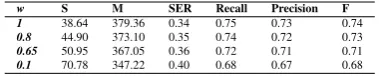
entities’ boundaries are shown in Table 6. Our sys-tem ranked second on the main evaluation where the parameterw (described in Section 5) was set to0.65. As shown in the table, as thewvalue in-creases, our results get better. According to the of-ficial results, our system ranked first forw = 1with the highest f-score, and ourSERresult is same as the best system forw = 0.8.
The parameter w can can be seen as a penal-ization value for the false concept references. As
wincreases, the false references to distant ances-tors and descendants of the true reference concepts are penalized more, whereas as w decreases the false references to the siblings are penalized more severely.
[image:6.595.336.495.364.440.2]w S M SER Recall Precision F 1 38.64 379.36 0.34 0.75 0.73 0.74
0.8 44.90 373.10 0.35 0.74 0.72 0.73
0.65 50.95 367.05 0.36 0.72 0.71 0.71
[image:7.595.86.276.62.100.2]0.1 70.78 347.22 0.40 0.68 0.67 0.68
Table 6: Ontology Categorization results for Sub-task 1 on the test set
5.2 Results of Sub-task 2
The precision, recall, and f-measure metrics are used to evaluate the Sub-task 2 results on the test set. Our main evaluation results, which consider detection of bothLocalizationandPartOfevent re-lations for Sub-task 2 are shown in the first row of Table 7, whereas our results that are calculated for the two event types separately are shown in the Lo-calizationandPartOfrows of the table. Accord-ing to the official results, our system ranked third for detecting all event types. On the other hand, it achieved the best results for detecting thePartOf
events.
Recall Precision F
All 0.21 0.38 0.27
Localization 0.23 0.38 0.29
PartOf 0.15 0.40 0.22
Table 7: Main results on test set for Sub-task 2
6 Conclusion
In this study, we presented two systems that are implemented in the scope of the BioNLP Shared Task 2013 - Bacteria Biotope Task. The aim of the Sub-task 1 system is the identification of habi-tat mentions in unstructured biomedical text and their normalization through the OntoBiotope on-tology, whereas the goal of the Sub-task 2 system is the extraction of localization and part-of rela-tions between bacteria and habitats when the enti-ties are given. Both systems are based on syntactic rules designed by considering the shallow syntac-tic analysis of the text, while the Sub-task 2 system also makes use of discourse-based rules.
According to the official evaluation, both of our systems achieved promising results on the shared task test data set. Based on the main evaluation where the parameterwis set to0.65, our Sub-task 1 system ranked second among four participating systems and it ranked first for predicting the entity boundaries when ontology categorization outputs are not considered. The results show that our sys-tem performs better as w increases and achieves
the best performance whenw = 1andw = 0.8. Our Sub-task 2 system achieved encouraging results by ranking first in predicting the PartOfevents, and ranking third when all event types are considered. The proposed systems can be enhanced by in-corporating a stemming module and including more syntax and discourse based rules.
Acknowledgments
This work has been supported by Marie Curie FP7-Reintegration-Grants within the 7th Euro-pean Community Framework Programme.
References
Jari Bj¨orne, Filip Ginter, and Tapio Salakoski. 2012. University of Turku in the BioNLP’11 Shared Task. BMC Bioinformatics, 13 Suppl 11:S4.
Robert Bossy, Julien Jourde, Philippe Bessi`eres, Maarten van de Guchte, and Claire N´edellec. 2011. Bionlp shared task 2011: bacteria biotope. In Pro-ceedings of the BioNLP Shared Task 2011 Work-shop, BioNLP Shared Task ’11, pages 56–64, Stroudsburg, PA, USA. Association for Computa-tional Linguistics.
Robert Bossy, Julien Jourde, Alain P. Manine, Philippe Veber, Erick Alphonse, Maarten van de Guchte, Philippe Bessieres, and Claire Nedellec. 2012. BioNLP Shared Task - The Bacteria Track. BMC Bioinformatics, 13(Suppl 11):S3+.
Robert Bossy, Wiktoria Golik, Zorana Ratkovic, Philippe Bessi`res, and Claire N´edellec. 2013. BioNLP shared task 2013 - an overview of the bac-teria biotope task. InProceedings of BioNLP Shared Task 2013 Workshop, Sofia, Bulgaria, AUG. Associ-ation for ComputAssoci-ational Linguistics.
Jin-Dong Kim, Tomoko Ohta, Sampo Pyysalo, Yoshi-nobu Kano, and Jun’ichi Tsujii. 2009. Overview of bionlp’09 shared task on event extraction. In Proceedings of the Workshop on Current Trends in Biomedical Natural Language Processing: Shared Task, BioNLP ’09, pages 1–9, Stroudsburg, PA, USA. Association for Computational Linguistics.
Martin Krallinger, Florian Leitner, Carlos Rodriguez-penagos, and Alfonso Valencia. 2008. Overview of the protein-protein interaction annotation extraction task of biocreative ii.Genome Biology, pages 2–4.
[image:7.595.94.269.350.393.2]Zorana Ratkovic, Wiktoria Golik, and Pierre Warnier. 2012. Event extraction of bacteria biotopes: a knowledge-intensive NLP-based approach. BMC Bioinformatics, 13:S8+.
Rune Saetre, Kazuhiro Yoshida, Akane Yakushiji, Yusuke Miyao, Yuichiro Matsubayashi, and Tomoko Ohta. 2007. AKANE System: Protein-Protein Interaction Pairs in the BioCreAtIvE2 Challenge, PPI-IPS subtask. In Lynette Hirschman, Martin Krallinger, and Alfonso Valencia, editors, Proceed-ings of the Second BioCreative Challenge Workshop.
Yoshimasa Tsuruoka and Jun’ichi Tsujii. 2005. Bidi-rectional inference with the easiest-first strategy for tagging sequence data. In HLT ’05: Proceedings of the conference on Human Language Technology and Empirical Methods in Natural Language Pro-cessing, pages 467–474. Association for Computa-tional Linguistics.
Yoshimasa Tsuruoka, Yuka Tateishi, Jin-Dong Kim, Tomoko Ohta, John McNaught, Sophia Ananiadou, and Jun’ichi Tsujii. 2005. Developing a Ro-bust Part-of-Speech Tagger for Biomedical Text. In Panayiotis Bozanis and Elias N. Houstis, editors, Advances in Informatics, volume 3746, chapter 36, pages 382–392. Springer Berlin Heidelberg.