ISSN Online: 2152-7393 ISSN Print: 2152-7385
DOI: 10.4236/am.2018.97060 Jul. 31, 2018 874 Applied Mathematics
A Knowledge Measure with Parameter of
Intuitionistic Fuzzy Sets
Zhenhua Zhang
1,2*, Shenguo Yuan
3, Jing Zhang
4*, Chao Ma
5, Jinhui Xu
6, Xiaolong Lin
11School of Mathematics and Statistics, Guangdong University of Foreign Studies, Guangzhou, China 2Department of Informatics, University of Leicester, Leicester, UK
3School of Finance, Guangdong University of Foreign Studies, Guangzhou, China
4Education Technology Center, Guangdong University of Foreign Studies, Guangzhou, China 5Department of Computer Science and Technology, University of Cambridge, Cambridge, UK 6School of Mathematical & Statistical Sciences, Arizona State University, Tempe, USA
Abstract
A new knowledge measure with parameter of intuitionistic fuzzy sets (IFSs) is presented based on the membership degree and the non-membership degree of IFSs, which complies with the extended form of Szmidt-Kacprzyk axioms for intuitionistic fuzzy entropy. And a sufficient and necessary condition of order property in the Szmidt-Kacprzyk axioms is discussed. Additionally, some numerical examples are given to illustrate the applications of the pro-posed knowledge measure and some conventional entropies and knowledge measures of IFSs. The experimental results show that the results of the para-metric model proposed in this paper are more accurate than those of most of the classic models.
Keywords
Intuitionistic Fuzzy Sets, Knowledge Measure, Entropy, Uncertainty, Order Property
1. Introduction
Entropy is a basic parameter that characterizes the state of matter launched by Shannon [1], which is used to characterize the degree of disorder in the system, the uncertainty of the system structure and movement, and the degree of irregu-larity. In 1965, Zadeh launched fuzzy sets (FS) [2], and Atanassov proposed in-tuitionistic fuzzy sets (IFS) in 1986 by introducing the degree of hesitation, which means that the research of intuitionistic fuzzy sets is more complex than
How to cite this paper: Zhang, Z.H., Yu-an, S.G., Zhang, J., Ma, C., Xu, J.H. and Lin, X.L. (2018) A Knowledge Measure with Parameter of Intuitionistic Fuzzy Sets. Applied Mathematics, 9, 874-889. https://doi.org/10.4236/am.2018.97060 Received: June 28, 2018
Accepted: July 28, 2018 Published: July 31, 2018 Copyright © 2018 by authors and Scientific Research Publishing Inc. This work is licensed under the Creative Commons Attribution International License (CC BY 4.0).
DOI: 10.4236/am.2018.97060 875 Applied Mathematics
that of fuzzy sets [3]. Fuzzy entropy is one of the most important methods to measure the degree of disorder in fuzzy sets, and knowledge measure is one of the most important bases for measuring the degree of order between fuzzy sets
[4] [5] [6]. In 1972, De Luca and Termini put forward an axiom system of fuzzy entropy in terms of Shannon’s entropy function [4] [6]; Yager proposed some fuzzy entropy formulas according to fuzzy distance measure [5]. Since then, many scholars began to use various methods to study fuzzy entropy and intui-tionistic fuzzy entropy [6]-[11]. Because intuitionistic fuzzy sets are an extension of ordinary fuzzy sets, many scholars focus on entropy and knowledge measure of intuitionistic fuzzy sets [7]-[16]. In the past 20 years, based on the study of fuzzy sets, many scholars have proposed a variety of methods to calculate intui-tionistic fuzzy entropy and knowledge measure [7]-[16]. Based on the axioms of intuitionistic fuzzy entropy [10] [11], Szmidt and Kacprzyk presented a standard judgment of intuitionistic fuzzy knowledge measure with a relatively wide ap-plication [12]: non-negative boundedness, symmetry and order. Some research-ers also studied Szmidt and Kacprzyk’s axiom system and introduced some clas-sic knowledge measure formulas [13] [14] [15]. According to the order property, Guo put forward a new knowledge measure with order [13], Nguyen presented a model from a classic distance measure [14], and Das et al. proposed a new model based on a series of similarity measures [15]. However, most of the existing re-search only focused on knowledge measure based on membership degree and non-membership, lack of the research of the known extent for information amount. In order to make full use of intuitionistic fuzzy information to con-struct information measurement tools, this paper studies a fractional knowledge measure.
Taking into account the extensive application and its rationality of the axiom system by Szmidt and Kacprzyk [12], we first put forward a simple necessary & sufficient condition of order property in Section 2. And then, we comprehen-sively analyze the differences among some classic models of intuitionistic fuzzy knowledge measure. Hence, in Section 3, we bring about a new construction method consisting of the decision-making advantages and the known extent and theoretically prove that this knowledge measure satisfies all the conditions of Szmidt & Kacprzyk’s axiom system. It is proved theoretically that the operators with the order condition in Szmidt & Kacprzyk axiom system will be better than those without the order condition. In Section 4, combined with the research re-sults of De et al. [17], an experimental case construction and empirical test scheme are put forward. Experimental results show that the performance of the presented model with parameters is better than that of the majority of classical operators, and the operators with the order condition will be more accurate than those without the order condition.
2. Intuitionistic Fuzzy Sets
DOI: 10.4236/am.2018.97060 876 Applied Mathematics
form:
( )
{
,
A|
}
,
A( )
[ ]
0,1 .
A
=
x
µ
x x X
∈
µ
x
∈
where µA
( )
x X: →[ ]
0,1 , x→µA( )
x .( )
{
, C |}
{
,1( )
|}
,C
A A
A = x µ x x X∈ = x −µ x x X∈
where µAC
( )
x X: →[ ]
0,1 ,x→ −1 µA( )
x .Definition 2 An intuitionistic fuzzy sets (IFS) A in a finite set X is an object with the following form:
( ) ( )
{
,
A,
A|
}
A
=
x
µ
x
ν
x x X
∈
( )
[ ]
( ) ( )
[ ]
( )
( )
( )
[ ]
: 0,1 , ; : 0,1 , ,
0,1 .
A A A A
A A
x X x x x X x x
x x
µ µ ν ν
µ ν
→ → → →
+ ∈
( )
A x
µ and νA
( )
x are the degree of membership and non-membership, re-spectively. πA( )
x = −1 µA( )
x −νA( )
x ∈[ ]
0,1 , πA( )
x is the degree of hesitancy.Definition 3 Let A and B be two IFSs, then we have:
1) A B= if and only if µA
( )
x =µB( )
x ,νA( )
x =νB( )
x . 2) A⊆B if µA( )
x ≤µB( )
x and νA( )
x ≥νB( )
x .3) AC =
{
x,µAC( )
x ,νAC( )
x |x X∈}
{
x,νA( )
x ,µA( )
x |x X∈}
.3. Entropy and Knowledge Measure of IFS
Claudius’s entropy is one of the important parameters in physics that character-ize the state of matter. It is a measure of the degree of chaos in the physical sense and describes the disorder degree of matter in an isolated system. In 1948 Shan-non first launched entropy into information theory in the “Mathematical Prin-ciples of Communication”, which characterize the degree of disorder, and un-certainty and irregularity of system structure and motion [1]. After the creation of fuzzy sets, many scholars proposed a series of fuzzy entropies and its formulas, which are used to express fuzzy uncertainty. Since Atanassov proposed intuitio-nistic fuzzy sets [3], many scholars presented many intuitionistic fuzzy entropy formulas and knowledge measures [7]-[16]. Next some classic entropy formulas and their knowledge measures will be introduced.
Fuzzy entropy is defined as follows [4] [5] [6]:
Definition 4 A fuzzy set A in the domain X, for each x X∈ , E A
( )
= fE( )
µAis the entropy of A with the following properties:
(EP1) E A
( )
= ⇔0 µA( )
x =0 or µA( )
x =1.(EP2) E A
( )
= ⇔1 µA( )
x =0.5. (EP3) E A( )
=E A( )
C .(EP4) For another fuzzy set B, E B
( )
= fE( )
µB denotes the entropy of B, andthen we have: If µB
( )
x ≤0.5 and A B⊆ , E A( )
≤E B( )
; If µB( )
x ≥0.5 andB A⊆ , E A
( )
≤E B( )
.DOI: 10.4236/am.2018.97060 877 Applied Mathematics
sets A and B, respectively. EP1 and EP2 denote the property of non-negative boundedness, EP3 is the property of symmetry, andEP4 is the property of order.
Intuitionistic fuzzy entropy is defined as follow [7]-[11]:
Definition 5 For IFS A in the domain X, E A
( )
= fE(
µ ν πA, ,A A)
is the en-tropy of A with the following properties for x X∈ :(EP1) E A
( )
= ⇔0 µA( )
x =0 &νA( )
x =1 or µA( )
x =1&νA( )
x =0.(EP2) µA
( )
x =νA( )
x = ⇒0 E A( )
=1.(EP3) E A
( )
=E A( )
C .(EP4) For another IFS B, E B
( )
= fE(
µ ν πB, ,B B)
denotes the entropy of B,and we have: If µB
( )
x ≤νB( )
x and A B⊆ , E A( )
≤E B( )
; If( )
( )
B x B x
µ ≥ν
and B A⊆ , E A
( )
≤E B( )
.Where µ ν πA, ,A A are the degree of membership, non-membership and
hesi-tancy of IFS, respectively.
EP1 and EP2 are the property of non-negative boundedness, EP3 is the prop-erty of symmetry, and EP4 is the propprop-erty of order.
In terms of EP4, we obtain the following necessary and sufficient conditions: (EP4I)
If µA
( )
x ≤µB( )
x ≤νB( )
x ≤νA( )
x or µA( )
x ≥µB( )
x ≥νB( )
x ≥νA( )
x , thenwe have E A
( )
≤E B( )
.Proof.
( )
( )
( )
( )
A B
B A
x x
A B
x x
µ µ
ν ν
≤
⊆ ⇔ ≤
, and µB
( )
x ≤νB( )
x , then( )
( )
( )
( )
A x B x B x A x
µ ≤µ ≤ν ≤ν .
And if µA
( )
x ≤µB( )
x ≤νB( )
x ≤νA( )
x , then we have:( )
( )
&( )
( )
&( )
( )
B x B x A x B x B x A x
µ ≤ν µ ≤µ ν ≤ν ,
and then we get µB
( )
x ≤νB( )
x and A⊆B.Similarly,
( )
( )
( )
( )
A B
B A
x x
B A
x x
µ µ
ν ν
≥
⊆ ⇔ ≥
, and µB
( )
x ≥νB( )
x , then( )
( )
( )
( )
A x B x B x A x
µ ≥µ ≥ν ≥ν .
And if µA
( )
x ≥µB( )
x ≥νB( )
x ≥νA( )
x , then we have:( )
( )
&( )
( )
&( )
( )
B x B x A x B x B x A x
µ ≥ν µ ≥µ ν ≥ν , and then we have
( )
( )
B x B x
µ ≥ν
and B⊆A.
EP4 is equivalent to EP4I, thus we obtain E A
( )
≤E B( )
.According to Definition 5, intuitionistic fuzzy knowledge measure can be de-fined as follows [12] [13]:
Definition 6 For IFS A, K A
( )
= fK(
µ ν πA, ,A A)
is an intuitionistic fuzzy knowledge measure of A if K A( )
have the following properties:(KP1) µA
( )
x =νA( )
x = ⇒0 K A( )
=0.(KP2) K A
( )
= ⇔1 µA( )
x =0 &νA( )
x =1 or µA( )
x =1&νA( )
x =0.(KP3) K A
( )
=K A( )
C .DOI: 10.4236/am.2018.97060 878 Applied Mathematics
( )
( )
K A ≥K B ; If µB
( )
x ≥νB( )
xand B A⊆ , K A
( )
≥K B( )
.KP1 and KP2 are the property of non-negative boundedness, KP3 is the prop-erty of symmetry, and KP4 is the propprop-erty of order.
In terms of EP4, we obtain the following necessary and sufficient conditions KP4I:
(KP4I)
If µA
( )
x ≤µB( )
x ≤νB( )
x ≤νA( )
x or µA( )
x ≥µB( )
x ≥νB( )
x ≥νA( )
x , thenwe have K A
( )
≥K B( )
.Obviously, KP4Ⅰmeans that for µA
( )
x −νA( )
x ≥ µB( )
x −νB( )
x , we infer( )
( )
K A ≥K B . Hence, knowledge measure K A
( )
can be considered to be a positive relation to µA( )
x −νA( )
x .From the concept of entropy and knowledge measure above, we can define the knowledge measure of IFS A by:
( )
1( )
K A = −E A (1)
Some intuitionistic fuzzy knowledge measure formulas can be defined ac-cording to some classic intuitionistic fuzzy entropy formulas as follows:
( )
( )
1 1 n
BB A i
i
E A x
n =
π
=
∑
(2)( )
{
{
( ) ( )
( ) ( )
}
}
( )
( )
( )
1 min , 12 max ,
n A i A i A i
SKB A i
i A i A i A i
x x x
E A x
n x x x
µ ν π
π
µ ν π
= + = + +
∑
(3)( )
(
( )
( )
)
(
( )
)
1
1 1 1
2
n
G A i A i A i
i
E A x x x
n =
µ
ν
π
=
∑
− − + (4)( )
( )
( )
( )
(
)
(
)
( )
(
( )
)
( )
(
( )
)
(
( )
(
( )
)
)
1 11 , 1 0
1
1 log log
log , 1
n
A i A i A i
i n HC
A i A i A i A i
i
A i A i
x x x
n E A
x x x x
n
x x
α α α
α
µ ν π
α α
α
µ µ ν ν
π π α
=
=
− − −
≠ >
− = − + + =
∑
∑
(5)
( )
(
( )
( )
( )
)
1
log
1
,0
1
1
n A i A i A i
R
i
x
x
x
E A
n
β β β
β
µ
ν
π
β
β
=
+
+
=
< <
−
∑
(6)( )
( )
1 1 1 n
BB A i
i
K A x
n =
π
= −
∑
(7)( )
(
)
( ) ( )
{
}
( )
( ) ( )
{
}
( )
( )
1 1 , min , 1 12 max ,
SKB DGM
n A i A i A i
A i
i A i A i A i
K A S U V
x x x
x
n x x x
µ ν π
π
µ ν π
= = + = − + +
∑
(8)( )
(
( )
( )
)
(
( )
)
1 1
1 1 1
2
n
G A i A i A i
i
K A x x x
n =
µ
ν
π
DOI: 10.4236/am.2018.97060 879 Applied Mathematics
( )
( )
( )
( )
( )
(
)
(
)
( )
(
( )
)
( )
(
( )
)
(
( )
(
( )
)
)
1 1 1 11 , 1 0
1 1
1 log log
log , 1
HC HC
n
A i A i A i
i n
A i A i A i A i
i
A i A i
K A E A
x x x
n
x x x x
n
x x
α α
α α α
µ ν π
α α
α
µ µ ν ν
π π α
=
=
= −
− − −
− ≠ >
− = + + + =
∑
∑
(10)( )
( )
(
( )
( )
( )
)
1
log
1
1
1
,0
1
1
n A i A i A i
R R
i
x
x
x
K A
E A
n
β β β
β β
µ
ν
π
β
β
=
+
+
= −
= −
< <
−
∑
(11)( )
( )
( )
(
( )
)
2 2 2 11
1
2
n A i A i A i
N
i
x
x
x
K A
n
µ
ν
π
=
+
+ −
=
∑
(12)
( )
2(
)
{
( )
( )
(
( )
)
}
1 1
, n max p, p, 1 p
SK DGM A i A i A i
i
K A S U V x x x
n =
µ
ν
π
= =
∑
− (13)In 1996, Bustince and Burillo proposed an entropy formula EBB
( )
A [7]. In 2014, Szmidt and Kacprzyk introduced an improved knowledge measure for-mula KSKB( )
A , which is derived from the entropy ESKB( )
A [12]. In terms ofthe Szmidt and Kacprzyk’s axiom system [10] [11] [12], in 2016 Guo put for-ward KG
( )
A , which is the basis of E AG( )
[13]. Moreover, Huang and Yangpresented EHCα
( )
A and E ARβ( )
in 2006 [9]. In [14], Nguyen introduced a knowledge measure formula KN( )
A according to distance measure proposed by Szmidt and Kacprzyk [18], and Szmidt and Kacprzyk presented a knowledge measure KSK( )
A from similarity measure [16]. Both K AN( )
and KSK( )
Aare proved to be equivalent to knowledge measure SDGM
(
U V,)
introduced by Das, Guha, and Mesiar [15].It is easy to prove that the classic knowledge measure formulas above meet the property of non-negative boundedness and symmetry. For the property of order, we have the following Lemma 2.
Lemma 2 KG
( )
A meet the property of order KP4I, while( )
,( )
,( )
,( )
,( )
,( )
BB SKB HC R N SK
K A K A Kα A K A K A Kβ A
and S U V
(
,)
don’t meet KP4I.Proof: According to KP4I, KG
( )
A meet the property of order.(
)
(
)
2 2
2 2
3 , ,
1 1 2
1
2 3 , .
2
G
K
µ
µ ν
ν
µ ν
µ ν
π
µ
µ ν ν
µ ν
− − + ≤ − − + = − = − + + − ≥ For µA
( )
x ≤µB( )
x ≤νB( )
x ≤νA( )
x , according to( )
( )
0≤µA x +νA x ≤1, 0≤µB
( )
x +νB( )
x ≤1, we have:( )
( )
( )
( )
( )
( )
( )
( )
( )
& 1 1
1
2 1 .
2
B B B B B
B B B B
x x x x x
x x x x
µ ν µ ν π
µ µ ν µ
≤ + = − ≤
⇒ ≤ + ≤ ⇒ ≤
DOI: 10.4236/am.2018.97060 880 Applied Mathematics
Similarly, We also have:
When µA
( )
x ≥µB( )
x ≥νB( )
x ≥νA( )
x , 0≤νA( )
x ≤νB( )
x ≤0.5. Thus weget:
( )
( )
(
)(
) (
)(
)
(
)(
) (
)(
)
1 1 3 0, ,
2
1 3 1 0, .
2
G G
A B A B A B A B
A B A B A B A B
K A K B
µ µ µ µ ν ν ν ν µ ν
µ µ µ µ ν ν ν ν µ ν
− − + − + − − − ≥ ≤ = − − − + − + − ≥ ≥
Thus we obtain: For µA
( )
x ≤µB( )
x ≤νB( )
x ≤νA( )
x , K AG( )
≥K BG( )
.Similarly, we also have:
For µA
( )
x ≥µB( )
x ≥νB( )
x ≥νA( )
x , K AG( )
≥K BG( )
.Therefore, KG
( )
A meet the property of order.According to KP4I, KBB
( )
A K, SKB( )
A K, HCα( )
A and( )
R
K Aβ don’t meet KP4I.
For µA
( )
x ≤µB( )
x ≤νB( )
x ≤νA( )
x , KBB( )
A = −1 πA=µA+νA,( )
1BB B B B
K B = −π =µ +ν . We cannot have KBB
( )
A ≥KBB( )
B .( )
(
)
(
)
( ) ( ) ( )
(
)
, 1 0
1
1 log log log , 1
, 1 0
1
1 log A A A , 1
A A A
HC
A A A A A A
A A A
A A A
K A
α α α
α
α α α
µ ν π
µ ν π α α
α
µ µ ν ν π π α
µ ν π α α
α
µ ν π α
+ + ≠ > = − + + + = + + ≠ > − = + =
( )
(
)
(
)
( ) ( ) ( )
(
)
, 1 0
1
1 log log log , 1
, 1 0
1
1 log B B B , 1
B B B
HC
B B B B B B
B B B
B B B
K B
α α α
α
α α α
µ ν π
µ ν π α α
α
µ µ ν ν π π α
µ ν π α α
α
µ ν π α
+ + ≠ > = − + + + = + + ≠ > − = + =
Obviously, we cannot get KHCα
( )
A ≥KHCα( )
B .( )
1 log(
( ) ( ) ( )
)
,0 1; 1A A A
R
K A
β β β
β µ ν π β
β
+ +
= − < <
−
( )
1 log(
( ) ( ) ( )
)
,0 1; 1B B B
R
K B
β β β
β µ ν π β
β
+ +
= − < <
−
We cannot obtain K ARβ
( )
≥K BRβ( )
too.( )
1 1 min{
{
,}
}
1 1 , ,2 max , 2 1
A A A A
SKB A A A A
A A A A
K A µ ν π π π ν µ ν
µ ν π µ
+ −
= − + + = + − ≤
( )
1 1 min{
{
,}
}
1 1 , ,2 max , 2 1
B B B B
SKB B B B B
B B B B
K B µ ν π π π ν µ ν
µ ν π µ
+ −
= − + + = + − ≤
DOI: 10.4236/am.2018.97060 881 Applied Mathematics
not meet the property KP4I.
For µA
( )
x ≤µB( )
x ≤νB( )
x ≤νA( )
x , we have( )
p( )
p,( )
p( )
p,A x B x B x A x
µ ≤µ ν ≤ν
and we cannot have
( )
p( )
p&( )
p( )
pA x B x B x A x
π ≤π π ≤π . Hence, We cannot
have KN
( )
A ≥KN( )
B and KSK( )
A ≥KSK( )
B , Hence, K KN, SK and(
,)
DGM
S U V do not meet the property KP4I.
4. Intuitionistic Fuzzy Knowledge Measure Model
with Parameter
According to KP4I, knowledge measure K A
( )
can be considered to be a posi-tive relation to µA( )
x −νA( )
x . In addition, when µA( )
x −νA( )
x is a con-stant, due to the same difference between membership and non-membership, the greater the minimum value of the degree of membership and non-membership is, the greater the maximum value of the degree of member-ship and non-membermember-ship will be, the higher the degree of known information will be, and hence the larger the knowledge measure value should be under the same difference between membership and non-membership. Thus, the know-ledge measure should be positively correlated to( )
(
( )
)
1 min ,
A A
A A
x x
µ ν
µ ν
−
− .
Based on the definition of knowledge measure of IFSs and the analysis above, a model can be achieved:
( )
( )
(
( ) ( )
( )
)
1
1 , 0.
1 min ,
p
n A i A i
p
i A i A i
x x
K A p
n x x
µ ν
µ ν
=
−
= >
−
∑
(14)( )
p
K A is proved to meet all four properties of Definition 6.
Proof: For each
0
<
p
and for each A ∈ IFSs, obviously, 0≤K Ap( )
≤1.(KP1)µA
( )
x =νA( )
x = ⇒0 K Ap( )
=0.(KP2) K Ap
( )
= ⇔1 µA( )
x =0 &νA( )
x =1 or µA( )
x =1&νA( )
x =0.(KP3)
( )
(
)
(
1 min ,)
(
1 min(
,)
)
( )
p p
A A A A C
p p p p
A A A A
K A µ ν ν µ K A
µ ν ν µ
− −
= = =
− − .
(KP4I) For µA
( )
x ≤µB( )
x ≤νB( )
x ≤νA( )
x ,( )
(
)
(
)
(
)
( ) (
)
(
)
, .
1 min , 1 1
p p p
A A A A B B
p p p p
A A A B
K A µ µ νν ν µ K B ν µ
µ µ
− − −
= = =
− − −
( )
( )
( )
( )
A x B x B x A x
µ ≤µ ≤ν ≤ν
(
)
(
)
(
)(
)
(
)(
)
(
)(
) (
)(
)
(
) (
)
(
) (
)
0, 0
1 0, 1 0
1 1 0
0 0
A B B A
A B B B A B
A B B B A B
A B B A A B B A A A B B A B B A
ν ν µ µ
ν ν µ µ µ ν
ν ν µ µ µ ν
ν ν µ µ µ ν µ ν
ν µ ν µ µ ν µ ν
⇒ − ≥ − ≥
⇒ − − ≥ − − ≥
⇒ − − + − − ≥
⇒ − + − + − ≥
DOI: 10.4236/am.2018.97060 882 Applied Mathematics
(
)(
) (
)(
)
(
)(
) (
)(
)
(
)(
)
(
)
(
)
(
)
(
)
( )
( )
1 1 0
1 1
0
1 1
0
1 1 1 1
1 1
A A B B B A
A A B B B A
A B
A A B B A A B B
A B A B
p p
A A B B
p p
A B
p p
K A K B
ν µ µ ν µ µ
ν µ µ ν µ µ
µ µ
ν µ ν µ ν µ ν µ
µ µ µ µ
ν µ ν µ
µ µ
⇒ − − − − − ≥
− − − − −
⇒ ≥
− −
− − − −
⇒ − ≥ ⇒ ≥
− − − −
− −
⇒ ≥
− −
⇒ ≥
Similarly, we also have:
For µA
( )
x ≤µB( )
x ≤νB( )
x ≤νA( )
x , K Ap( )
≥K Bp( )
.Hence, for each
p
>
0
, K Ap( )
is a knowledge measure of IFSs A.4.1. Comparison between
Kp( )
Aand
K
G( )
A
According to Lemma 2 and the analysis above, KG
( )
A and K Ap( )
meet theproperty of order, while KBB
( )
A K, SKB( )
A K, HCα( )
A K A K A K, Rβ( )
, N( )
, SK( )
Aand S U V
(
,)
don’t meet KP4I. Hence, we compare K Ap( )
with KG( )
A asfollows.
( )
(
)
1 min ,
p
A A
p
A A
K A = µ −µ νν −
(15)
( )
p
K A is affected by the difference between membership and non-membership
degree with the positive correlation, which is the same as KG
( )
A . Meanwhile, when µA−νA , the difference between membership and non-membershipde-gree, is a constant, K Ap
( )
is also affected with the positive correlation by the minimum of membership and non-membership degree, while KG( )
A the negative correlation.( )
1(
1)
(
1)
1(
1)
(
2)
2 2
A A A A A A A
G
K A = − − µ ν− +π = − − µ ν− −µ ν− .
From practical significance, K Ap
( )
will be more reasonable than K AG( )
. Ifd
µ ν− = is a constant, then the greater the minimum value of membership
and non-membership, the greater the amount of knowledge. For example, if 0
A A B B d
µ −ν =µ −ν = ≥ and min
(
µ νA, A)
=νA≥min(
µ νB, B)
=νB≥0, then we have µA≥µ νB, A≥ν µB, A≥ν µA, B≥ν πB, A≤πB, and hence we know that theknown extent of A is more than that of B under the same difference between membership and non-membership degree. Thus, it means that K A
( )
≥K B( )
, which is the same as K Ap( )
and different from KG( )
A .4.2. Analysis of Parameter
p
for
Kp( )
ALet 1
( )
( )
(
( ) ( )
( )
)
11
1 min ,
n A i A i
i A i A i
x x
K A
n x x
µ ν
µ ν
=
− =
−
∑
.DOI: 10.4236/am.2018.97060 883 Applied Mathematics
( )
(
1( )
)
p pK A
=
K A
.According to the nature of the power function, we obtain: 1) Whenp
=
1
, K Ap( )
=K A1( )
is linear function of 1 min(
,)
A A
A A
µ ν
µ ν
−
− .
2) When
0
< <
p
1
, K Ap( )
is a convex function on the defined domain( )
[ ]
1 0,1
K A ∈ , which means that if K A1
( )
is close to 0, the amount ofinfor-mation K Ap
( )
decreases rapidly; when K A1( )
approaches 1, the amount of information K Ap( )
increases slowly.3) Contrary to 2), when
p
>
1
, K Ap( )
is a concave function on the defined domain K A1( )
∈[ ]
0,1 , which means that if K A1( )
is close to 0, the amount of information K Ap( )
decreases slowly; when K A1( )
approaches 1, the amount of information K Ap( )
increases sharply.According to the analysis above, in practical applications, people can find suitable information measurement models based on parameter adjustments.
5. Experimental Example and Result Analysis
Example 1. Consider five IFSs,
{
}
{
}
{
}
{
}
{
}
1 2 3
4 5
,0,0.5 , ,0.1,0.5 , ,0.2,0.5 ,
,0.3,0.5 , ,0.4,0.5 .
D x D x D x
D x D x
= = =
= =
It is clear that
( )
( )
( )
( )
( )
( )
( )
( )
( )
( )
( )
( )
( )
( )
( )
1 2 3 4 5
5 4 3 2 1
1 2 3 4 5
0
0.5 .
D D D D D
D D D D D
D D D D D
x x x x x
x x x x x
K x K x K x K x K x
µ µ µ µ µ
ν ν ν ν ν
= < < < <
= = = = = =
⇒ > > > >
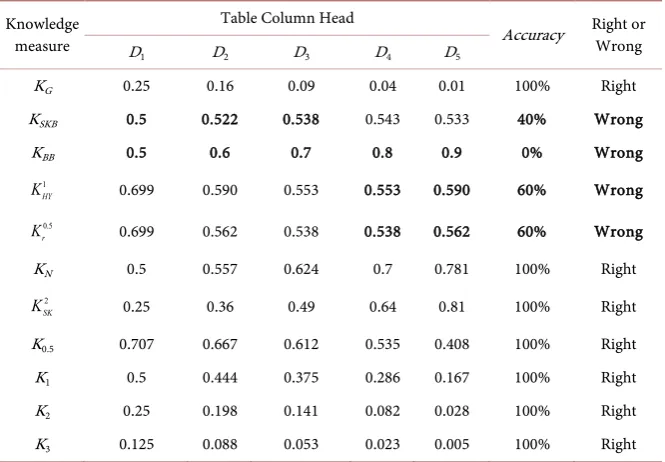
From Equations (7)-(14), we obtain Table 1. The evaluation index Accuracy
Table 1. Comparison of experimental results of K (Di), (i = 1, 2, 3, 4, 5).
[image:10.595.207.540.479.710.2]Knowledge measure
Table Column Head
Accuracy Right or Wrong D1 D2 D3 D4 D5
KG 0.25 0.16 0.09 0.04 0.01 100% Right KSKB 0.5 0.522 0.538 0.543 0.533 40% Wrong
KBB 0.5 0.6 0.7 0.8 0.9 0% Wrong 1
HY
K 0.699 0.590 0.553 0.553 0.590 60% Wrong 0.5
r
K 0.699 0.562 0.538 0.538 0.562 60% Wrong KN 0.5 0.557 0.624 0.7 0.781 100% Right
2 SK
DOI: 10.4236/am.2018.97060 884 Applied Mathematics
can be defined as follows:
(
)
( )
Number Entropies with Right Order in Accuracy
Number
i i
D D
=
(16) Results show that for the knowledge measures with the order property, such as KG and Kp, the order of their results is completely correct, while the order of
the results for the knowledge measures without the order property, such as KSKB, KBB, K1HY, Kr0.5, KN, KSKand S(U, V), do not meet the property KP4I. According
to Table 1, KG and Kp will be better than the others. Hence, we conclude that KG
and Kp are better than the others.
A type of classic intuitionistic fuzzy sets Am are used to compare and analyze
the difference of results among the proposed K Ap
( )
and all those traditional knowledge measure formulas [18].Example 2. Let
A
=
{
x
,
µ
A( ) ( )
x
,
ν
Ax x X
|
∈
}
be an IFS in X. For any posi-tive real number m, De et al. define the IFS Am as follows [18]:( )
(
)
(
( )
)
{
, m,1 1 m |}
m A A
A = x µ x − −ν x x X∈ .
Obviously, we have 0≤ ≤s t, 0≤
(
µA( )
x)
t ≤(
µA( )
x)
s≤1,( )
(
)
(
( )
)
0 1 1≤ − −νA x s≤ − −1 1 νA x t ≤1, and a series of IFSs for contrast experi-ments can be constructed.
Using the operation above, they defined the concentration and dilation of A as follows:
Concentration: CON A
( )
= A2 ={
x,(
µA( )
x)
2,1 1− −(
νA( )
x)
2 |x X∈}
. Dilation: DIL A( )
=A1 2={
x,(
µA( )
x)
1 2,1 1− −(
νA( )
x)
1 2 |x X∈}
.Like fuzzy sets, CON A
( )
and DIL A( )
can be treated as “Very (A)” and “More or less (A)”, respectively.In the next, we consider an IFS A in X = {6, 7, 8, 9, 10} defined in reference [9] [13] [17] as follows:
Taking into account the characteristics of the value of language variables, De
et al. define IFS A A A A A0.5, , , ,2 3 4 in X to be “More or Less Large”, “Large”, “Very Large”, “Quite Very Large”, “Very Very Large”. In the same way,
0.5, , , ,2 3 4
B B B B B and C C C C C0.5, , , ,2 3 4 can be defined [17].
{
6,0.1,0.8 , 7,0.3,0.5 , 8,0.6,0.2 , 9,0.9,0.0 , 10,1.0,0.0 ,}
A=
{
}
0.5 6,0.316,0.553 , 7,0.548,0.293 , 8,0.775,0.106 ,
9,0.949,0.0 , 10,1.0,0.0 ,
A =
{
}
2 6,0.01,0.96 , 7,0.09,0.75 , 8,0.36,0.36 ,
9,0.81,0.0 , 10,1.0,0.0 ,
A =
{
}
3 6,0.001,0.992 , 7,0.027,0.875 , 8,0.216,0.488 ,
9,0.729,0.0 , 10,1.0,0.0 ,
DOI: 10.4236/am.2018.97060 885 Applied Mathematics
{
}
4 6,0.000,0.998 , 7,0.008,0.938 , 8,0.13,0.59 ,
9,0.656,0.0 , 10,1.0,0.0 .
A =
{
6,0.1,0.8 , 7,0.3,0.5 , 8,0.5,0.4 , 9,0.9,0.0 , 10,1.0,0.0 ,}
B=
{
}
0.5 6,0.316,0.553 , 7,0.548,0.293 , 8,0.707,0.225 ,
9,0.949,0.0 , 10,1.0,0.0 ,
B =
{
}
2 6,0.01,0.96 , 7,0.09,0.75 , 8,0.25,0.64 ,
9,0.81,0.0 , 10,1.0,0.0 ,
B =
{
}
3 6,0.001,0.992 , 7,0.027,0.875 , 8,0.125,0.784 ,
9,0.729,0.0 , 10,1.0,0.0 ,
B =
{
}
4 6,0.000,0.998 , 7,0.008,0.938 , 8,0.062,0.870 ,
9,0.656,0.0 , 10,1.0,0.0 .
B =
{
6,0.1,0.8 , 7,0.3,0.5 , 8,0.5,0.5 , 9,0.9,0.0 , 10,1.0,0.0 ,}
C=
{
}
0.5 6,0.316,0.553 , 7,0.548,0.293 , 8,0.707,0.293 ,
9,0.949,0.0 , 10,1.0,0.0 ,
C =
{
}
2 6,0.01,0.96 , 7,0.09,0.75 , 8,0.25,0.75 ,
9,0.81,0.0 , 10,1.0,0.0 ,
C =
{
}
3 6,0.001,0.992 , 7,0.027,0.875 , 8,0.125,0.875 ,
9,0.729,0.0 , 10,1.0,0.0 ,
C =
{
}
4 6,0.000,0.998 , 7,0.008,0.938 , 8,0.062,0.938 ,
9,0.656,0.0 , 10,1.0,0.0 .
C =
From the data above, for each x X∈ =
{
6,7,8,9,10}
, we obtain:( )
( )
( )
( )
( )
( )
( )
( )
( )
( )
0.5 2 3 4
0.5 2 3 4
, ;
A
A A A A
A
A A A A
x x x x x
x x x x x
µ µ µ µ µ
ν ν ν ν ν
≥ ≥ ≥ ≥
≤ ≤ ≤ ≤
( )
( )
( )
( )
( )
( )
( )
( )
( )
( )
0.5 2 3 4
0.5 2 3 4
, ;
B
B B B B
B
B B B B
x x x x x
x x x x x
µ µ µ µ µ
ν ν ν ν ν
≥ ≥ ≥ ≥
≤ ≤ ≤ ≤
( )
( )
( )
( )
( )
( )
( )
( )
( )
( )
0.5 2 3 4
0.5 2 3 4
, .
C
C C C C
C
C C C C
x x x x x
x x x x x
µ µ µ µ µ
ν ν ν ν ν
≥ ≥ ≥ ≥
≤ ≤ ≤ ≤
According to the definition of knowledge measure of IFSs, obviously we get:
( )
( )
( )
( )
( )
0.5 2
3 4
Knowledge Knowledge Knowledge Knowledge Knowledge ;
A A A
A A
< <
< <
( )
( )
( )
( )
( )
0.5 2
3 4
Knowledge Knowledge Knowledge Knowledge Knowledge ;
B B B
B B
< <
DOI: 10.4236/am.2018.97060 886 Applied Mathematics
( )
( )
( )
( )
( )
0.5 2
3 4
Knowledge Knowledge Knowledge Knowledge Knowledge .
C C C
C C
< <
< <
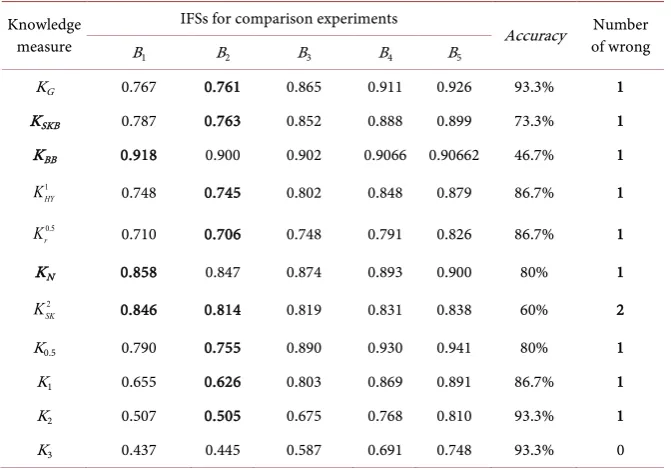
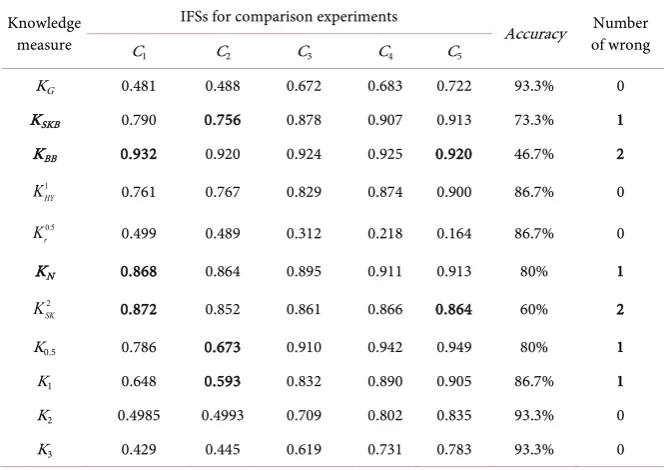
The results are shown in the following Tables 2-4.
Where the evaluation index Accuracy is defined as follows:
(
)
(
)
Number Entropies with Right Order in Accuracy
Number
i i i i i i
A B C A B C
+ +
=
[image:13.595.207.543.203.436.2]+ +
(17)
Table 2. Comparison of experimental results from Ak.
Knowledge measure
IFSs for comparison experiments
Accuracy of wrong Number A1 A2 A3 A4
KG 0.785 0.788 0.805 0.854 1 93.3% 0 KSKB 0.794 0.786 0.783 0.827 1 73.3% 2 KBB 0.908 0.880 0.868 0.866 1 46.7% 5
1 HY
K 0.754 0.744 0.783 0.816 1 86.7% 1 0.5
r
K 0.713 0.704 0.737 0.773 1 86.7% 1 KN 0.856 0.835 0.839 0.847 1 80% 1
2 SK
K 0.827 0.780 0.764 0.765 1 60% 2 K0.5 0.805 0.814 0.746 0.874 1 80% 1 K1 0.681 0.693 0.699 0.788 1 86.7% 0 K2 0.542 0.549 0.621 0.679 1 93.3% 0 K3 0.472 0.470 0.559 0.613 0 93.3% 1 Note. Each bold data means the wrong prediction result and the corresponding method.
Table 3. Comparison of experimental results from Bk.
Knowledge measure
IFSs for comparison experiments
Accuracy of wrong Number B1 B2 B3 B4 B5
KG 0.767 0.761 0.865 0.911 0.926 93.3% 1 KSKB 0.787 0.763 0.852 0.888 0.899 73.3% 1 KBB 0.918 0.900 0.902 0.9066 0.90662 46.7% 1
1 HY
K 0.748 0.745 0.802 0.848 0.879 86.7% 1 0.5
r
K 0.710 0.706 0.748 0.791 0.826 86.7% 1 KN 0.858 0.847 0.874 0.893 0.900 80% 1
2 SK
[image:13.595.206.542.478.713.2]DOI: 10.4236/am.2018.97060 887 Applied Mathematics
Table 4. Comparison of experimental results from Ck.
Knowledge measure
IFSs for comparison experiments
Accuracy of wrong Number C1 C2 C3 C4 C5
KG 0.481 0.488 0.672 0.683 0.722 93.3% 0 KSKB 0.790 0.756 0.878 0.907 0.913 73.3% 1 KBB 0.932 0.920 0.924 0.925 0.920 46.7% 2
1 HY
K 0.761 0.767 0.829 0.874 0.900 86.7% 0 0.5
r
K 0.499 0.489 0.312 0.218 0.164 86.7% 0 KN 0.868 0.864 0.895 0.911 0.913 80% 1
2 SK
K 0.872 0.852 0.861 0.866 0.864 60% 2 K0.5 0.786 0.673 0.910 0.942 0.949 80% 1 K1 0.648 0.593 0.832 0.890 0.905 86.7% 1 K2 0.4985 0.4993 0.709 0.802 0.835 93.3% 0 K3 0.429 0.445 0.619 0.731 0.783 93.3% 0 Note. Each bold data means the wrong prediction result and the corresponding method.
Based on the theoretical derivation, KG
( )
A and K Ap( )
satisfy theproper-ty of order KP4I, while
( )
,( )
,( )
, 1( )
,( )
,( )
,BB SKB HC HC R N
K A K A Kα A K A K A K Aβ
( )
SK
K A and S U V
(
,)
do not Satisfy this property. From the comparative analysis of the results in Tables 2-4, we found that the overall order accuracy of( )
p
K A is 89%, and that of K A2
( )
&K A3( )
&KG( )
A is 93.3%, owning thehighest accuracy among all methods. Moreover, From Example 1 - 2, the order of all the results from K A2
( )
and KG( )
A is exactly the same. And for theorder of all the results from K A3
( )
and KG( )
A , there is only slightdifferenc-es in Example 2 between them. Hence the overall performance of K Ap
( )
is ac-ceptable.In conclusion, the above theoretical and experimental results show that the proposed parametric algorithm is simple and feasible, and it is an effective tool for knowledge measure. In future research, we will apply the constructed know-ledge measure model to calculate the information volume of uncertain variables, study the information-based sorting and decision operators, and apply them to the research of management science decision making like references [19] [20], such as supply chain management and risk management.
6. Conclusion
DOI: 10.4236/am.2018.97060 888 Applied Mathematics
those formulas satisfying the order property will be higher than that of those not satisfying.
Funds
This paper is funded by the National statistical research key projects (No. 2016LZ18), Natural Science Projects (No. 2016A030310105, 2018A030313470) & Soft Science Project (No. 2015A070704051, 2016A030313688) & Quality engi-neering and teaching reform project (No. 125-XCQ16268) of Guangdong Prov-ince, Philosophy and Social Science Project of Guangzhou (No. 2017GZYB45), Team Project Guangdong University of Foreign Studies (No. TD1605), National Undergraduate Training Program for Innovation and Entrepreneurship of Chi-na (No. 201511846058, 201711846004).
Conflicts of Interest
The authors declare no conflicts of interest regarding the publication of this pa-per.
References
[1] Shannon C.E. (1948) A Mathematical Theory of Communication. The Bell System Technical Journal, 27, 379-423, 623-656.
https://doi.org/10.1002/j.1538-7305.1948.tb00917.x
[2] Zadeh, L.A. (1965) Fuzzy Sets. Information and Control, 8, 338-353.
https://doi.org/10.1016/S0019-9958(65)90241-X
[3] Atanassov, K. (1986) Intuitionistic Fuzzy Sets. Fuzzy Sets and Systems, 20, 87-96.
https://doi.org/10.1016/S0165-0114(86)80034-3
[4] De Luca, A. and Termini, S. (1972) A Definition of Non-Probabilistic Entropy in the Setting of Fuzzy Sets Theory. Information and Control, 20, 301–312.
https://doi.org/10.1016/S0019-9958(72)90199-4
[5] Yager, R.R. (1979) On the Measure of Fuzziness and Negation, Part 1: Membership in the Unit Interval. International Journal of General Systems, 5, 221-229.
https://doi.org/10.1080/03081077908547452
[6] Higashi, M. and Klir, G. (1982) On Measures of Fuzziness and Fuzzy Complements. International Journal of General Systems, 8, 169-180.
https://doi.org/10.1080/03081078208547446
[7] Bustince, H. and Burillo, P. (1996) Entropy on Intuitionistic Fuzzy Sets and on In-terval-Valued Fuzzy Sets. Fuzzy Sets and Systems, 78, 305-316.
https://doi.org/10.1016/0165-0114(96)84611-2
[8] Bustince, H., Barrenechea, E., Pagola, M., Fernandez, J., Guerra, C., Couto, P.A. and Melo-Pinto, P. (2011) Generalized Atanassov’s Intuitionistic Fuzzy Index: Con-struction of Atanassov’s Fuzzy Entropy from Fuzzy Implication Operators. Interna-tional Journal of Uncertainty, Fuzziness and Knowledge-Based Systems, 19, 51-69. https://doi.org/10.1142/S0218488511006885
[9] Hung, W.L. and Yang, M.S. (2006) Fuzzy Entropy on Intuitionistic Fuzzy Sets. In-ternational Journal of Intelligent Systems, 21, 443-451.
https://doi.org/10.1002/int.20131
DOI: 10.4236/am.2018.97060 889 Applied Mathematics
and Systems, 118, 467-477. https://doi.org/10.1016/S0165-0114(98)00402-3 [11] Szmidt, E. and Kacprzyk, J. (2007) Some Problems with Entropy Measures for the
Atanassov Intuitionistic Fuzzy Sets. Lecture Notes in Computer Science, 4578, 291-297. https://doi.org/10.1007/978-3-540-73400-0_36
[12] Szmidt, E., Kacprzyk, J. and Bujnowski, P. (2014) How to Measure the Amount of Knowledge Conveyed by Atanassov’s Intuitionistic Fuzzy Sets. Information Sciences, 257, 276-285. https://doi.org/10.1016/j.ins.2012.12.046
[13] Guo, K.H. (2016) Knowledge Measure for Atanassov’s Intuitionistic Fuzzy Sets. IEEE Transactions on Fuzzy Systems, 24, 1072-1078.
https://doi.org/10.1109/TFUZZ.2015.2501434
[14] Nguyen, H. (2015) A New Knowledge-Based Measure for Intuitionistic Fuzzy Sets and Its Application in Multiple Attribute Group Decision Making. Expert Systems with Applications, 42, 8766-8774. https://doi.org/10.1016/j.eswa.2015.07.030 [15] Das, S., Guha, D. and Mesiar, R. (2018) Information Measures in the Intuitionistic
Fuzzy Framework and Their Relationships. IEEE Transactions on Fuzzy Systems, 26, 1626-1637. https://doi.org/10.1109/TFUZZ.2017.2738603
[16] Szmidt, E. and Kacprzyk, J. (2011) Intuitionistic Fuzzy Sets-Two and Three Term Representations in the Context of a Hausdorff Distance. Acta Universitatis Matthiae Belii, 19, 53-62.
[17] De, S.K., Biswas, R. and Roy, A.R. (2000) Some Operations on Intuitionistic Fuzzy Sets. Fuzzy Sets and Systems, 114, 477-484.
https://doi.org/10.1016/S0165-0114(98)00191-2
[18] Szmidt, E. and Kacprzyk, J. (2000) Distances between Intuitionistic Fuzzy Sets. Fuzzy Sets and Systems, 114, 505-518.
https://doi.org/10.1016/S0165-0114(98)00244-9
[19] Chen, L., Peng, J., Liu, Z.B. and Zhao, R.Q. (2017) Pricing and Effort Decisions for a Supply Chain with Uncertain Information. International Journal of Production Re-search, 55, 264-284.https://doi.org/10.1080/00207543.2016.1204475