COMPARATIVE STUDY OF RC STRUCTURE WITH DIFFERENT INFILL
MATERIALS
Basavaraj M. Malagimani
1, Prashant B. Bhaganagare
2, Ravikant S. Sathe
3, Sonali P. Patil
41,2,3,4
Assistant Professor, Dept. of Civil Engineering, SVERI’s College of Engineering Pandharpur, Solapur, India
---***---Abstract - This is research work on comparison of seismicanalysis and design of G+5 building using ALC (Aerated light weight concrete block) and conventional bricks. The study includes understanding the main consideration factor that leads the structure to perform badly during earthquake in order to achieve their behavior under future earthquakes. The analyzed structure is symmetrical, G+5, Special RC Moment-Resting frame (SMRF). Modelling of the structure is done as per STAAD Pro.V8i software.
In the present study an effort is made to study the behavior of RC frame structure using conventional bricks, and light weight bricks infill. Linear static analysis has been carried out for fixed in hard soil condition, to know the effect of earthquake loading. The various results such as base shear, top storey displacement, natural period results are compared to know the suitable infill material in seismic prone zones. From the results obtained the light weight brick system gives better performance than the other infill materials.
Key Words: conventional bricks, Aerated light weight concrete block, Linear static analysis, base shear, top storey displacement, natural period.
1. INTRODUCTION
It has always been a human aspiration to create taller and taller structures. Due to the development of metro cities in India there is increasing demand in High Rise Building. The reinforced cement concrete moment resisting frames infilled with unreinforced brick masonry walls are very common in India and in other developing countries. Masonry is a commonly used construction material in the world for reason that includes accessibility, functionality, and cost. The primary function of masonry is either to protect inside of the structure from the environment or to divide inside spaces, normally considered as architectural elements. Engineer’s often neglect their presence because of complexity of the problem, their interaction with the bounding frame is often neglected in the analysis of building structures. When masonry infills are considered to interact with their surrounding frames, the lateral load capacity of the structure largely increases. This assumption may lead to an important inaccuracy in predicting the response of the structure. This occurs especially when subjected to lateral loading. Role of infill’s in altering the behavior of moment resisting frames and their participation in the transfer of loads has been established by decades of research.
1.1 Conventional Brick Infill Structures
In the world most commonly R.C. building with infill of brick masonry is used including in region of earthquake zone. In India brick infill walls are widely used and they are usually treated as non-structural components. They include both structural and non-structural performance of structures. During earthquake the buildings are subjected to maximum lateral forces. Engineering have recognized this kind of building perform poor and even collapse also.
The lateral force resisting capacity and stiffness of structure can be increase by infill also up to a same level of response. The structures initial period is decreased because of increased initial stiffness of structures. Infill with brick masonry is verge to brittle failure, for evaluation of seismic. The infill wall modeling should be proper within the structure is beneficial and also to reduce the damage and consequences for proper solution of retrofit.
The technology of autoclaved aerated concrete was invented by Swedish scientist Mr. John Axel Ericson during 1920’s.
1.2 AAC Block as Infill Material
India is having a tropical climate and most of the time during the year the temperature remains quite high and hence we require materials which are highly insulating in nature. Hence the designers go for green and eco-friendly material .One of the widely use material is AAC blocks. Dr. Johan Eriksson developed Autoclaved Aerated Concrete block in 1923 and was patented for manufacturing in 1924. These blocks lower the environmental impact. It is very new to Indian markets. The density of AAC is around 1/3rd of conventional clay bricks hence reduces the seismic forces on the structure. Experiments show that much lesser deflections takes in the structure when AAC blocks are used instead of clay bricks. Fly ashes are used as the raw material for manufacturing of the AAC blocks. Fly ashes are the waste generated from the thermal power plants and their disposal is a major issue these days, hence the AAC blocks could help significantly in this direction. AAC blocks are far more durable when compared to clay bricks.
2. Analysis and Design of G + 5 building using STAAD. Pro.
Step – 1: Modeling
Step - 3: 3D rendering view.
Step - 4: Assigning of dead loads.
Step - 5: Assigning of live loads.
Step - 6: Assigning of seismic loads.
Step - 7: Adding of load combinations.
Step - 8: Run Analysis.
Step - 9: Design.
Methods used for design:
1) Equivalent static method
2) Response spectrum method
3. Description of Building
3.1 Property of Building
Type of structure: Multistory RC framefixed at the base.
Size of building: 18 X 18m Floor height: 3m
Size of Beam: 300 X 450mm Size of Column: 450 X 450mm Slab thickness: 150mm
Materials: Concrete grade- M20 Steel grade- Fe500
3.2 Data of infill frame
Density of conventional brick infill: 20kN/m3 Density of AAC infill: 6.5kN/m3
Main wall thickness:230mm Partition wall thickness:100mm
3.3 Earthquake Load
Type of soil: Hard soil Seismic zone: IV Zone factor, Z=0.1
[image:2.595.35.540.31.843.2] Response reduction factor:5 Importance factor: I=1 Damping of structure: 5%
Table 1: Load Combinations
SR. NO. LOAD COMBINATIONS 1. 1.5 (DL+LL)
2. 1.2 (DL+LL+EQX) 3. 1.2 (DL+LL+EQZ) 4. 1.2 (DL+LL- EQX) 5. 1.2 (DL+LL- EQZ) 6. 1.5 (DL+EQX) 7. 1.5 (DL+EQZ) 8. 1.5 (DL- EQX)
9. 1.5 (DL- EQZ) 10. 0.9 DL+1.5 EQX 11. 0.9 DL+1.5 EQZ 12. 0.9 DL- 1.5 EQX 13. 0.9 DL- 1.5 EQZ
4. MODELING AND ANALYSIS
4.1 Modeling
The RC framed structure is modeled by using Staad Pro. Software for the following cases.
Model 1: Conventional brick infill frame
Model 2: Conventional brick infill frame with partition wall
Model 3: AAC infill frame
[image:2.595.359.517.343.494.2]Model 4: AAC infill frame with partition wall
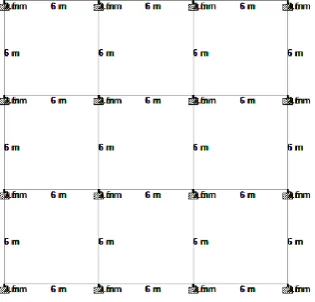
Fig.1 Plan of the Building
Fig.3 Rendering view
Fig. 4 Showing Loading Detail
5. RESULTS AND DISCUSSIONS
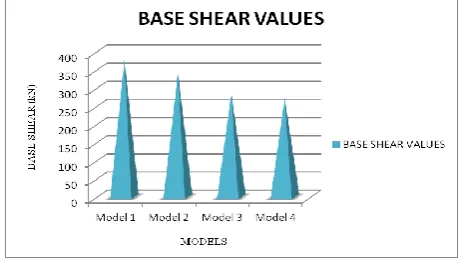
Following table shows the base shear values obtained from the equivalent static method for G+5 storey building for all the four models.
[image:3.595.48.275.85.502.2]5.1) Base shear
Table 2: Base Shear Values
Sr. No. Model Base shear (kN)
1 Model 1 376.59
2 Model 2 343.87
3 Model 3 285.75
4 Model 4 272.87
Table no.2 shows the base shear values for conventional brick infill (with and without partition) and light weight brick infill (with and without partition). From the above table we can say that the base shear for conventional brick infill is more as compared to Light weight
[image:3.595.318.548.152.284.2]brick infill. The conventional brick infill gives higher value since its mass and stiffness are more and the light weight brick infill gives lower value since its mass and stiffness are less.
Fig. 5 Graph Showing Base Shear Values for G+5 Building
Above graph shows the variation of base shear values for all the four cases of G+5 building. From the graph we observe that the base shear values are goes on reducing from model 1 to model 4.
5.2) Reinforcement Details:-
Table 3: Reinforcement Details
Model Beam No. 201 Column No. 25
Model 1 2052 1620
Model 2 2052 1620
Model 3 1512 1620
Model 4 1080 1620
Table 3 shows area of steel required for selected beam and column for all the above four models. Quantity of steel required for conventional brick model is more compared to light weight brick model.
5.3) Footing Reactions:
Below Table 4 shows the footing reactions for various models in G+5 building.
Table 4: Reactions of Footing (kN)
Sr.
No. Footing Model 1 Model 2 Model 3 Model 4 1. F1, F4,
F13, F16
1713.61 1704.42 1258.80 466.64
2. F2, F3, F5, F8, F9, F12
2797.05 2613.43 2128.15 519.74
3. F6, F7,
[image:3.595.60.264.641.709.2]Fig. 6 Plan Showing Reactions of Footing (Model 1)
[image:4.595.32.291.329.590.2]5.4) Displacements:
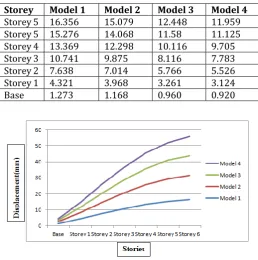
Table 5: Displacement values of various models
Storey Model 1 Model 2 Model 3 Model 4 Storey 5 16.356 15.079 12.448 11.959 Storey 5 15.276 14.068 11.58 11.125 Storey 4 13.369 12.298 10.116 9.705 Storey 3 10.741 9.875 8.116 7.783 Storey 2 7.638 7.014 5.766 5.526 Storey 1 4.321 3.968 3.261 3.124
Base 1.273 1.168 0.960 0.920
Fig. 7 Comparison of Displacement
Table 5 shows the displacement values of different types of infill material. And Fig. 7 gives the comparison plot between conventional brick (with all main walls and with partition wall), light weight brick (with all main wall and partition wall). Here the conventional brick model gives the larger value as compared with light weight brick model. Since base shear of conventional brick model is large and hence larger will be the displacement values as compared with light weight brick model.
6. CONCLUSIONS
The behavior of structures such as buildings with conventional burnt clay brick and light weight blocks is studied for 5 storey building. The buildings are modeled and analyzed using STAAD Pro software by both equivalent static method and response spectrum method. Comparisons have been made among the different cases such as buildings with full conventional bricks, buildings with full light weight blocks, buildings with outer main walls with light weight blocks & buildings with partition walls with light weight blocks. All the results of all the cases have been studied and compared. The buildings with light weight blocks have shown better results as compared to one with clay bricks. Based on the analysis data the following conclusions are made as follows.
1) The dead weight of the structure is almost 32.47% reduced in case of Light Weight bricks as compared to conventional clay bricks. So that economy in the design can be achieved.
2) The bending moments, shear forces for LWB have been reduced almost by 34.30% as that of conventional bricks, so that there is a reduction in the member sizes and ultimately steel quantity can be saved.
3) There is almost 24% reduction in the base shear for Light Weight bricks as compared to conventional clay bricks. Lesser base shear will result in lesser lateral forces and storey shear.
4) Due to reduction in the building weight there will the reduction in the member sizes, mainly reduction in the column sizes, which increases lateral displacements of the building. These displacements can be reduced by using shear wall or dampers.
5) Overall the performance of the light weight blocks such as AAC blocks is found to be superior to that of conventional bricks in the buildings.
6) For conventional brick infill model it has been observed that the base shear, lateral forces and storey shear are large as compared with other infill models. Hence design with conventional brick infill is non-conservative.
7) The light weight brick infill model is having significantly smaller base shear as compared with conventional brick model which results in decrease in reinforcement to resist member forces, hence economy in construction can be achieved.
REFERENCES
2. Ms. Rajashri A.Deshmukh, Dr. P.S. Pajgade, “A Study of Effect of Infill Material on Seismic Performance of RC Buildings”, International Journal of Engineering Sciences and Research Technology, ISSN: 2277-9655, 2015.
3. Munde P.K, Magarpatil H.R, “Seismic Response of RC Framed Masonry Infilled Buildings With Soft First Storey”, International Journal of Engineering Research andTechnology, ISSN: 2278-0181, 2012.
4. Er. Puneet Sharma, Er. Ankit, Er. Ismit Pal Singh, “Soil Structure Interaction Effect on an Asymmetrical R.C.Building with Shear Walls”, IOSR Journal of Mechanical and Civil Engineering, ISSN: 2278-1684, 2014.
5. M Roopa, H. G. Naikar and Dr. D. S. Prakash, “Soil Structure Interaction Analysis on a RC Building With Raft Foundation Under Clayey Soil Condition”, International Journal of Engineering Research & Technology, ISSN: 2278-0181, 2015.
6. D. Gauney and E. Aydin, “The Nonlinear Effect of Infill Walls Stiffness to Prevent Soft Storey Collapse of RC Structures”, The Open Construction and Building Technology Journal, 2012.
7. Mr.Aslam Faqeer Mohammad, Ms.Najmus Sahar Zafer and Ms.Tehimna Ayub and Dr.Rishid Khan, “6-Storey Mixed Use Building in Karachi”, A Pilot Case Study of Seismic Assessment and Retrofit Design
8. Applied Technology Council, ATC-40: Seismic Evaluation and Retrofit of Concrete Buildings volume 1.1996: California.
9. American Society of Civil Engineers, ASCE-41: Seismic Rehabilitation of Existing Buildings. 2006: Virginia.
10. Diptesh Das and C.V.R. Murty, “Brick Masonry Infill in Seismic Design of RC Frames”, part 1 and part 2, The Indian Conrete Journal, 2004.
BIOGRAPHIES
Prof. Basavaraj M. Malagimani
M.Tech (Structural Engineering), B.E (Civil), Assistant Professor, Department of Civil Engineering, SVERI’s College of Engineering Pandharpur, Solapur, India-
Prof. Prashant B. Bhaganagare
M.Tech (Structural Engineering), B.E (Civil), Assistant Professor, Department of Civil Engineering, SVERI’s College of Engineering Pandharpur, Solapur, India-
Prof. Ravikant S. Sathe
M.E (Structures), B.E (Civil), Assistant Professor, Department of Civil Engineering, SVERI’s College of Engineering Pandharpur, Solapur, India-
Prof. Sonali P.Patil