THE PLANING OF DISTRIBUTION GENERATION (DG) BASED ON MULTI
PARTICLE SWARMS OPTIMIZATION (QPSO)
Wang Yong
North
ARTICLE INFO ABSTRACT
According to economic generation is added, a multi
construction investment and operation fee, network loss, relia and then puts forward the multi
and the distributed power supply after installation position and capacity for the comprehensive planning research. The
and keeping the population diversity. Compared to Particle Swarms Optimization (PSO), QSPO shows high efficiency and robustness.
Copyright © 2014 Wang Yong-mei et al. This is an open access article distributed under the Creative Commons Att distribution, and reproduction in any medium, provided the original work is properly cited.
INTRODUCTION
Because of the advantages of low investment, flexible power generation method and environmental compatibility, distributed generation (DG) is being paid more and more attention. That it operates with combining with the power grid can improve the economy, safety, reliability and flexibility of the system, and meet the requirement of sustainable development, and greatly reduce the environmental protection pressure. Under the promotion for clean energy development from government, the rapidly developing trend of new energy industry has increased the need of research on DG planning (Liang et al., 2001 and Lv et al., 2011) which causes a concern from increasing scholars. The referece (He
proposed that partheno genetic algorithm (PGA) was applied to the generation planning, which can greatly simplify calculation of generation planning, and avoid premature convergence, and improve the computational efficiency. References (Kannan et al., 2004 and Tsukada
used the global optimization method of particle swarm optimization when solving the generation planning problem. Although the method’s stability is poor, the local extremum problem can be avoided, to a certain extent.
computing is a product of quantum theory combining with information theory and computer science, which makes full
*Corresponding author: Jiang xue-li, North China Electric Power University, China.
ISSN: 0975-833X
Vol. 6, Issue,
Article History:
Received 19th September, 2014
Received in revised form 04th October, 2014
Accepted 17th November, 2014
Published online 30th December,2014
Key words:
Distributed Generation,
Multi-objective Planning,
Quantum Particle Swarms Algorithm,
Environmental Factor.
RESEARCH ARTICLE
THE PLANING OF DISTRIBUTION GENERATION (DG) BASED ON
MULTI-PARTICLE SWARMS OPTIMIZATION (QPSO)
Wang Yong-mei, Yao wan-ye and *Jiang xue-li
North China Electric Power University, China
ABSTRACT
According to economic-technical optimization objective of distribution network to which distributed generation is added, a multi-objective model is proposed in this paper. The model contains DG construction investment and operation fee, network loss, reliability, as well as environmental factor. and then puts forward the multi-objective quantum particle swarm optimization (QSPO) algorithm, and the distributed power supply after installation position and capacity for the comprehensive planning research. The result proves that QPSO has advantages of speedy searching for the optimum and keeping the population diversity. Compared to Particle Swarms Optimization (PSO), QSPO shows high efficiency and robustness.
an open access article distributed under the Creative Commons Attribution License, which distribution, and reproduction in any medium, provided the original work is properly cited.
Because of the advantages of low investment, flexible power generation method and environmental compatibility, (DG) is being paid more and more attention. That it operates with combining with the power grid can improve the economy, safety, reliability and flexibility of the system, and meet the requirement of sustainable he environmental protection pressure. Under the promotion for clean energy development from government, the rapidly developing trend of new energy industry has increased the need of research on DG planning which causes a concern He et al., 2003) proposed that partheno genetic algorithm (PGA) was applied to the generation planning, which can greatly simplify the calculation of generation planning, and avoid premature onvergence, and improve the computational efficiency. Tsukada et al., 2003) has used the global optimization method of particle swarm optimization when solving the generation planning problem. lity is poor, the local extremum problem can be avoided, to a certain extent. Quantum computing is a product of quantum theory combining with information theory and computer science, which makes full
use of the superposition, parallelism and entanglement properties of quantum system, and has high computing capability beyond the classical calculation and great potential in the aspect of information processing.
the quantum particle swarm optimization (QPSO) which intergrates particle swarms optimization (PSO) into the quantum evolutionary algorithm. This algorithm uses the qubit to encode the current position of particle, and searches for the best position of particle by quantum revolving gate, and performes the mutation of particle position in order to avoid the premature phenomenon by quantum non gate. Showing the QPSO algorithm by an example can greatly improve the global optimization ability and optimization efficiency of PSO algorithm.
DG Planning Multi-Objective Mathematical Model
With optimizing the power flow and improving the power quality, reasonable DG planning can take into account economic benefit. Its objective functions include techni economic objectives (Xu et al., 2010 and
DG Construction and Operation Costs
N
i
n n
i DG
r
r
r
X
C
DG
1
1
1
1
International Journal of Current Research Vol. 6, Issue, 12, pp.10994-10999, December, 2014
-OBJECTIVE QUANTUM
technical optimization objective of distribution network to which distributed objective model is proposed in this paper. The model contains DG bility, as well as environmental factor. objective quantum particle swarm optimization (QSPO) algorithm, and the distributed power supply after installation position and capacity for the comprehensive result proves that QPSO has advantages of speedy searching for the optimum and keeping the population diversity. Compared to Particle Swarms Optimization (PSO), QSPO
ribution License, which permits unrestricted use,
use of the superposition, parallelism and entanglement properties of quantum system, and has high computing capability beyond the classical calculation and great potential in the aspect of information processing. This paper presents the quantum particle swarm optimization (QPSO) which intergrates particle swarms optimization (PSO) into the quantum evolutionary algorithm. This algorithm uses the qubit to encode the current position of particle, and searches for the osition of particle by quantum revolving gate, and performes the mutation of particle position in order to avoid the premature phenomenon by quantum non gate. Showing the QPSO algorithm by an example can greatly improve the global optimization efficiency of PSO
Objective Mathematical Model
With optimizing the power flow and improving the power quality, reasonable DG planning can take into account economic benefit. Its objective functions include technical and
., 2010 and Wang et al., 2009).
DG Construction and Operation Costs
DGi i OM i
az
C
P
C
, ,
Here, the value of
X
i
is 0 or 1.X
i
0
indicates that DG is not installed in the corresponding position, and Xi 1indicates that DG is installed in the corresponding position; n is the service life of equipment. r is the discount rate; Caz,i andi OM
C , respectively mean the operation maintenance cost and safety investment cost of DG from node i, RMB ten
thousand/(kW, h); PDGi means the rated capacity of DG from node i.
Network Loss Cost
Accessing DG into distribution network has changed the power grid, which makes the distribution network change from passive network to active network, and affects the network loss of system. The renewable distributed-energy output is random. According to the probability model of distribution network load and distributed generation output, the annual network loss can be gained accurately. Considering unit electricity price, the annual network loss can be transformed into economic measure index.
puN
g
g loss
loss P P C C
C
g
90
1
T
l h
n
l i
n
i j
l
j ij
ij ij
loss
Z
V
R
P
gWhere,
g loss
P is the loss of electricity quantity of system in
state g; P
Cg is the probability of distributed generation output in state g; Rijis the branch resistance on both ends; Zijis branch impedance on both ends; Vijis the branch voltage drop on both ends; Cpuis unit electricity price.
Reliability Economic Costs
The evaluation method about electricity outage cost adopts the weighted average between the average electricity price conversion ratio method and the electricity production ratio method. The formula is:
K
bd
EENS
C
r
1
2Where, EENS is the expectation about lack of electricity quantity;
1and
2are the weighting coefficient of electricityproduction ratio method and average electricity price conversion ratio method, respectively; K is the proportion of electricity production; b is the ratio which is obtained from unit electricity outage price divided by average price; d is the average price of electricity.
Environmental Factors Cost
Environmental cost generally includes two aspects: 1) Environmental loss, namely consumption of environmental
resources including the environmental degradation caused by water pollution and the ecological environmental damage caused by excessive consumption of natural resources; 2) Fine from the discharge of pollutants. The calculation formula is as follows:
een
k
k k ek
e
V
Q
V
C
C
1
ek
V
is the environmental value of pollutant from item k and
k
Q is the emission of pollutant from item k; n means the types of pollutants; Vkis the discharge fee of pollutant from item K;
ee
C is the subsidies provided by government for encouraging the development of DG.
Constraint Condition
The constraints include equality and inequality constraints, and equality constraint is the power flow equations (Wang et al., 2011).
n
j
ij ij ij ij j i DGi Gi
n
j
ij ij ij ij j i Li DGi Gi
B G
U U Q Q
B G
U U P P P
1 1
0 ) cos sin
(
0 ) sin cos
(
Inequality constraints include:
1) The upper limit constraint of DG penetration power
DG
N
i
l DGi
i
P
P
X
1
Where,
P
lis the active load of planning level years;
is theupper limit of proportion that DG total capacity accounts for in the total system load.
2) The upper limit constraint of DG active power
imasx
DGi
P
P
0
,i
1
,
2
,
,
N
DGWhere,
P
i
max
is the upper limit of active power for DG from group i.3) The voltage constraint
max , min
V
V
V
gi
Where,
V
minis the voltage lower bound andV
maxis the powersource upper bound.
4) The branch transmission power constraint
max
i
i
P
Where,
P
imaxis the upper limit of transmission power frombranch i.
This paper comprehensively takes consideration of DG construction and operation costs, network loss cost, reliability economic cost and environmental factors cost, and achieves the overall optimization based on satisfying the various constraints on the power grid. The normalized objective function is:
e r
loss
DG
w
C
w
C
w
C
C
w
F
1
2
3
4Where,
w
1,w
2,w
3andw
4express the weight whichdecision-makers give each sub-objective, respectively.
Quantum Particle Swarm Algorithm
Quantum Encoding
In QPSO, we directly use the probability amplitude of qubit as the current location code of particle. In consideration of the randomness of population initialization code, the coding scheme that we adopt is:
)
sin(
)
sin(
)
sin(
)
cos(
)
cos(
)
cos(
2 1
2 1
in i
i
in i
i i
p
Where,
ij
2
rnd
; rnd is a random number in [0,1];m
i
1
,
2
,....,
;j
1
,
2
,....,
n
;m
is the number of particles;n
is the space dimensions; Thus, each particle in the population occupies two positions in the ergodic space. They respectively correspond to the probability amplitudes of quantum state|0
and
|
1
which are:
cos(
i1),
cos(
i2)
cos(
in)
ic
P
sin(
i1),
sin(
i2)
sin(
in)
is
P
Solution Space Conversion
Initialize the particles in [-1,1], and then according to the niche theory, map the initialization solution to the solution space of optimization problem. Each probability amplitude of qubit corresponds to an optimization variable of solution space. Note qubit
j
on particlep
i
as[
i
j
,
i
j
]T, and so the corresponding solution space variables are:
(
1
)
(
1
)
2
1
ji i j i i j
ic
b
X
(
1
)
(
1
)
2
1
ji i j i i j
is
b
X
j
i
, the probability amplitude of qubit|
0
, corresponds toj
ic
X
,and
i
j
, the probability amplitude of qubit|
1
, corresponds toX
is
j
. where,i
1
,
2
,....,
m
andi
1
,
2
,....,
m
.i
b
and
iare the upper and lower limits of search range ofparticle
p
i, respectively.Particle State Update
In this algorithm, the particle state update learns from the basic PSO algorithm and in PSO algorithm, convert the movement speed update of particles into the revolving door corner update of quantums. Presume that the optimal location which the particle has searched currently is cosine. The following formula is:
cos(
il1),
cos(
il2)
cos(
iln)
il
p
The optimal location that the entire population has searched for now is:
cos(
g1),
cos(
g2)
cos(
gn)
g
p
Based on the above assumptions, the particle state update rules can be described as follows:
(1) The argument increment update of qubit on the particle
p
i)
(
)
(
)
(
)
1
(
t
w
ijt
c
1r
1 iljt
c
2r
2 gjt
ij
2
2
ij ilj
ij ilj
ij ilj
l
ij ilj
ij ilj
ij ilj
2
2
ij gj
ij gj
ij gj
g
ij gj
ij gj
ij gj
Where,
ij
(
t
1
)
is the amount of phase shift for particlei
from iterationt1in dimension
j
;
ij
(
t
)
is the current phase;
ilj
(
t
)
is the history optimal phase for particlei
from iterationt
in dimensionj
;
gj
(
t
)
is the global optimal phase for particlei
from iterationt
in dimensionj
;w
is the inertiafactor;
c
1andc
2are the learning factors;r
1andr
2are randomnumbers in [0, 1].
))
1
(
)
(
sin(
))
1
(
)
(
cos(
))
1
(
sin(
))
1
(
cos(
t
t
t
t
t
t
ij ij ij ij ij ij
))
(
sin(
))
(
cos(
))
1
(
cos(
))
1
(
sin(
))
1
(
sin(
))
1
(
cos(
t
t
t
t
t
t
ij ij ij ij ij ij
Where,
cos(
ij
(
t
1
))
andsin(
ij
(
t
1
))
are the probability amplitudes for particlei
from iterationt1 in dimensionj
.Mutation Treatment
The main reason why the PSO algorithm is easy to fall into local optimum lies in the loss of population diversity in the process of search. In the QPSO algorithm, that mutation operation is performed by the quantum non gate can significantly increase the diversity of population, and effectively avoid the premature phenomenon. The operation process is shown in the following formula:
)
2
sin(
)
2
cos(
)
sin(
)
cos(
0
1
1
0
ij ij ij ij
Realization of Quantum Particles Swarm Optimization Algorithm
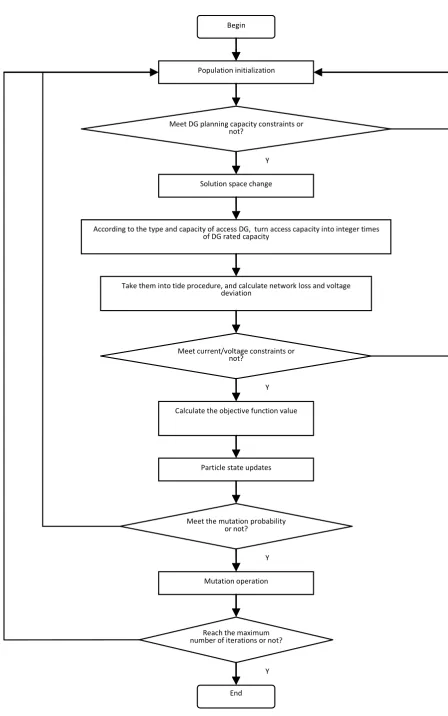
According to the above algorithm, the realization process of algorithm is shown in Figure 1.
Example Analysis
[image:4.595.44.554.471.548.2]This paper regards a north area with rich wind and light resources as an example. In this area, annual wind speed, light radiation record as well as specific parameters of DG are known. Use the standard IEEE16-node-three-feeder system, and the source voltage is 10.5 kV, and the total load of entire network is 28.7 + j7.75 MVA. Put QPSO algorithm into programming calculation, and analyze the results. Algorithm parameters selection: population size takes 50, and inertial factor range varies from 0.4 to 0.8, and mutation probability takes 0.04, and learning factor takes 2.0, and the number of iterations takes 150.Through using matlab7.0 to program and calculate algorithm, the running results are shown in Table 1. In order to reflect the contribution of DG on environment and in view of the higher cost for adding DG in current market situation, we reduce the weight of DG construction operation cost and increase the environmental factors weight. The results are shown in Table 2. Compared with PSO, use the network loss single objective function to optimize the location and capacity of DG, and the results are shown in Table 3. Figure 2 is the best fitness comparison between QPSO and PSO. As can be seen from the figure, in the early iteration, The QPSO algorithm has a fast convergence speed which is less than the PSO algorithm iterations over 30 times to achieve the same calculation accuracy. In the later iteration, the optimal results found by QPSO algorithm are superior to ones found by PSO algorithm. After 90 iterations, the population diversity of PSO algorithm loss serious, but QPSO algorithm remains good. Therefore, with using the encoding mechanism and mutation strategy of qubits probability amplitude, the search capabilities and optimization efficiency of QPSO algorithm are superior to PSO algorithm.
Table 1. The optimization results of comprehensive objective function 1
Access DG
location Access DG Type
Access DG capacity Access DG operating costs Network loss cost Reliability economic costs Environmental factors cost Compreh-ensive objective function values
7 Fan 1.1 MW
10 Gas turbine 4.05 MW
1.15*103 ten thousand, RMB 6.49 ten thousand, RMB 6.64 ten thousand, RMB 3.91 ten thousand, RMB 291.76 ten thousand, RMB 15 Photovolt-aic cells 0.6 MW
[image:4.595.50.553.578.656.2]16 Fan 1.1 MW
Table 2. The optimization results of comprehensive objective function 2
Access DG
location Access DG Type
Access DG capacity Access DG operating costs Network loss cost Reliability economic costs Environmental factors cost Compreh-ensive objective function values
7 Fan 1.1 MW
10 Gas turbine 4.05 MW
1.67*103 ten thousand, RMB 7.94 ten thousand, RMB 10.31 ten thousand, RMB 4.64 ten thousand, RMB 252.691 ten thousand, RMB 11 Photovolt-aic cells 0.6 MW
[image:4.595.70.530.688.757.2]15 Fan 2.2 MW
Table 3. The comparison of optimization results between QPSO and PSO
Algorit- hm
Optimal
position Access DG Type
Optimal capacity Optimal network loss Average network loss Number of converge-nce Average number
QPSO 8 Fan 2.2MW 1098.9MW 1142.5MW 50 52.48
10 Gas turbine 4.05MW
PSO 10 Gas turbine 4.05MW 1256.7MW 1374.8MW 43 89.64
15 Fan 1.1MW
Figure 1. Algorithm flow chart
Population initialization
Meet DG planning capacity constraints or not?
Solution space change
According to the type and capacity of access DG, turn access capacity into integer times of DG rated capacity
Take them into tide procedure, and calculate network loss and voltage deviation
Meet current/voltage constraints or not?
Begin
Calculate the objective function value
Particle state updates
Meet the mutation probability or not?
Mutation operation
Reach the maximum number of iterations or not?
End Y
Y
Y
Figure 2. The best fitness comparison between QPSO and PSO
Summary
This paper has comprehensively considered the technical and economic planning problems of distribution network with accessing DG, and in other words, with taking reducing the DG investment, DG operation cost and system network loss as a objective and taking into account environmental factors, DG programming model has been established. And it has also proposed the quantum particle swarm optimization (QPSO) algorithm, and integrated the PSO algorithm into the quantum evolutionary algorithm, and used the qubit to encode the current position of particle, and used the quantum revolving gate to search the optimal position of particle, and used quantum non gate to realize the mutation of particle position to avoid the premature phenomenon. Thus, the global optimization ability and optimization efficiency of PSO are improved greatly. Meantime, the case analysis has verified that the performance of QPSO is more superior to the ordinary optimization algorithm, and the QPSO is more suitable for the power system planning field with higher real-time and accuracy requirements. This paper has only considered the three kinds of DG: fan, photovoltaic cells and micro gas turbine, and did not consider the biomass power generation and the fuel cell. And each node can only access a type of DG,
therefore, it is necessary that the subjects about distribution network accessed through multi-type and mixed combination should be studied more deeply.
REFERENCES
Liang, C.H., Duan, X., and Zhong, 2001. Distributed generation and its impact on power system [J]. Automation of Electric Power System,25(12): 53-56.
Lv, C., Q. Li, Y. mei., Liu, H.Z. et al. 2011. Mechanism Research on Renewable Energy Generation and Integration in Smart Grid [J]. East China Electric Power, 39(9):
1405-1409.
He, F., Xiong, X.Y. and Wu, Y.W. 2003. Generation Expansion Planning of Power System by Partheno-genetic Algorithm[J]. RELAY, 31(6): 26-34.
Kannan, S., Slochanal, S. Mary, R. et al. 2004. Application of particle swarm optimization technique and its variants to generation expansion planning problem[J]. Electric Power Systems Research, 70(3): 203-210.
Tsukada, T., Tamura, T., Kitagawa, S. et al. 2003. Optimal operational planning for cogeneration system using particle swarm optimization[C]. Proceedings of the 2003 IEEE Swarm Intelligence Symposium, SIS’ 03 (Cat.
No.03EX706), 138-143.
Gandomkar, M., Vakilian, M. and Ehsan, M. 2005. A genetic based Tabu search algorithm for optimal DG allocation in distribution networks[J]. Electric Power Components and Systems, 33(12): 1351-1362.
Khattam, W., Bhattacharya, K., Hegazy, Y. et al. 2004. Optimal investment planing for distributed generation in a competitive electricity market[J].IEEETrans onPower Systems, l9(3):1674—1684.
Xu, Y.Q. and Li, X.D. 2010. An improved immune clonal selection algorithm based planning method for distribution network with distributed generators[J]. Power System Technology, 34f8): 97-101(in Chinese).
Wang, X., Wang and Qiu, X., Y. 2009. Distributed generation planning in distribution system based on modified particle swarm optimization algorithm[J]. Power System Protection and Control, 7:16-22.
Wang, R., Q. Li, K. Zhang, C.H. Du, C., S. and Chu, X. G. 2011.Distributed Generation Planning Based on Multi-Obj ective Chaotic Quantum Genetic Algorithm[J]. Power System Technology, 12:183-189.