ASSESSMENT STANDARDS IN BUSINESS STUDIES PROGRAMS:
A CASE STUDY FROM MIDDLE EAST
*
Dr. Reji D. Nair and Rashid Ashraf
Faculty Members, Business Department, Higher College of Technology, Women’s College, Al Ain, UAE
ARTICLE INFO ABSTRACT
The paper analyzes the assessment systems practiced in the business studies program in Yanbu Industrial College in Saudi Arabia, based on the fundamental principles of assessment. It is based on a primary survey conducted among all the teaching staff of IMT Department using a structured questionnaire. The study reveals the need for improvement sp
and inclusiveness in assessment along with academic integrity and authenticity.
highlights the significance of constructive alignment between learning outcomes, learning activities and assessment.
Copyright©2017, Dr. Reji D. Nair and Rashid Ashraf.
unrestricted use, distribution, and reproduction in any medium, provided the original
INTRODUCTION
Assessment is one of the most important elements of teaching learning process; the educational, emotional, and formative ramifications of judging students’ work can weigh heavily on the mind of a teacher. There are differences of opinion among the educationists, researchers and policy makers on the meaning of assessment and its purposes. Even students often perceived it as a means of competing with classmates for the higher grade instead of treating assessment as a stepping stone on the journey to higher level of knowledge and understanding
(Guskey, 2005). The higher education sector in the modern day
is directed by outcomes-based education and criteria referenced assessment, with associated requirements to make curriculum objectives and assessment criteria
students. Assessment refers to all those activities undertaken
by teachers—and by their students in assessing themselves that provide information to be used as feedback to modify teaching and learning activities. There are different modes of assessment having different purposes, which ranged from diagnosing learning, to identify remediation, or to determine achievement of targeted goals in courses.
*Corresponding author: Dr. Reji D. Nair,
Faculty Members, Business Department, Higher College of Technology, Women’s College, Al Ain, UAE.
ISSN: 0975-833X
Article History:
Received 07th February, 2017 Received in revised form 29th March, 2017 Accepted 02nd April, 2017 Published online 23rd May,2017
Key words:
Assessment methods, Constructive alignment,
Industrial Management Technology department,
Principles of assessment, Summative assessment,
Teaching experience, Teaching load, Yanbu Industrial College.
Citation: Dr. Reji D. Nair and Rashid Ashraf, 2017.
Journal of Current Research, 9, (05), 50846-50853.
RESEARCH ARTICLE
ASSESSMENT STANDARDS IN BUSINESS STUDIES PROGRAMS:
A CASE STUDY FROM MIDDLE EAST
Dr. Reji D. Nair and Rashid Ashraf
Faculty Members, Business Department, Higher College of Technology, Women’s College, Al Ain, UAE
ABSTRACT
The paper analyzes the assessment systems practiced in the business studies program in Yanbu Industrial College in Saudi Arabia, based on the fundamental principles of assessment. It is based on a primary survey conducted among all the teaching staff of IMT Department using a structured questionnaire. The study reveals the need for improvement specifically the revitalization of reliability and inclusiveness in assessment along with academic integrity and authenticity.
highlights the significance of constructive alignment between learning outcomes, learning activities and assessment.
. This is an open access article distributed under the Creative Commons Attribution License, which permits unrestricted use, distribution, and reproduction in any medium, provided the original work is properly cited.
Assessment is one of the most important elements of teaching-learning process; the educational, emotional, and formative ramifications of judging students’ work can weigh heavily on the mind of a teacher. There are differences of opinion among nists, researchers and policy makers on the meaning of assessment and its purposes. Even students often perceived it as a means of competing with classmates for the higher grade instead of treating assessment as a stepping stone vel of knowledge and understanding
The higher education sector in the modern day based education and criteria-referenced assessment, with associated requirements to make curriculum objectives and assessment criteria explicit to
Assessment refers to all those activities undertaken and by their students in assessing themselves— that provide information to be used as feedback to modify teaching and learning activities. There are different modes of sessment having different purposes, which ranged from diagnosing learning, to identify remediation, or to determine
Faculty Members, Business Department, Higher College of
However, no single assessment serves all of these purposes; summative assessments are designed to provide information on the performance of students, where
give feedback on the instructions required for students to master the learning objectives. Different forms of assessment have got different objectives and accordingly it operates at different levels as well. Summative assessment i
to summarize student learning at some point in time, say at the end of a course. Most standardized tests are summative, but formative assessment occurs when teachers feed information back to students in ways that enable the student to learn b or when students can engage in a similar, self
process. Sound assessment requires clarity in purpose, targets, methods, sample of the targets, and also elimination of bias and distortion in measurement (Stiggins, 2004). transformation from teachers as passive deliverers of curriculum to makers and users of assessment data reflects the shift from teacher as assembly line worker to lifetime learner. Teachers find themselves transforming their teaching as ongoing assessment reveals how s
helps them learn most effectively, and what strategies support their learning. The more teachers understand about what students know and how they think, the more capacity they leave to reform their pedagogy, and the more opport
International Journal of Current Research
Vol. 9, Issue, 05, pp.50846-50853, May, 2017
OF CURRENT RESEARCH
2017. “Assessment standards in business studies programs: a case study from middle
ASSESSMENT STANDARDS IN BUSINESS STUDIES PROGRAMS:
Faculty Members, Business Department, Higher College of Technology, Women’s College, Al Ain, UAE
The paper analyzes the assessment systems practiced in the business studies program in Yanbu Industrial College in Saudi Arabia, based on the fundamental principles of assessment. It is based on a primary survey conducted among all the teaching staff of IMT Department using a structured ecifically the revitalization of reliability and inclusiveness in assessment along with academic integrity and authenticity. The study also highlights the significance of constructive alignment between learning outcomes, learning activities
This is an open access article distributed under the Creative Commons Attribution License, which permits
However, no single assessment serves all of these purposes; summative assessments are designed to provide information on the performance of students, where as formative assessments give feedback on the instructions required for students to master the learning objectives. Different forms of assessment have got different objectives and accordingly it operates at Summative assessment is the attempt to summarize student learning at some point in time, say at the end of a course. Most standardized tests are summative, but formative assessment occurs when teachers feed information back to students in ways that enable the student to learn better, or when students can engage in a similar, self- reflective process. Sound assessment requires clarity in purpose, targets, methods, sample of the targets, and also elimination of bias and distortion in measurement (Stiggins, 2004). The n from teachers as passive deliverers of curriculum to makers and users of assessment data reflects the shift from teacher as assembly line worker to lifetime learner. Teachers find themselves transforming their teaching as ongoing assessment reveals how students approach tasks, what helps them learn most effectively, and what strategies support their learning. The more teachers understand about what students know and how they think, the more capacity they leave to reform their pedagogy, and the more opportunities
OF CURRENT RESEARCH
they create for student success. Authentic assessments require students to be effective performers with acquired knowledge. Yanbu Industrial College (YIC), an affiliate of the Royal Commission for Jubail and Yanbu was established in 1989 to provide Saudi nationals with the technical, scientific and academic skills required by the industrial and other economic sectors it serves. The Industrial Management Technology (IMT) Department, which was established in 1996 is offering business studies education in YIC, at Associate Degree level along with Baccalaureate programs in management (Since 2005) and accredited by the ACBSP. The paper is intended to analyze the assessment practices in the IMT Department, based on the fundamental principles of assessment as highlighted by Race (2010).
The specific objectives of the pages are the following.
To analyze the standard of assessment practices in IMT
Department;
To evaluate the designation-wise variation in the
assessment standards, if any;
To assess the implications of teaching experience on the
assessment standards; and
To examine the effect of teaching load on the
assessment practices.
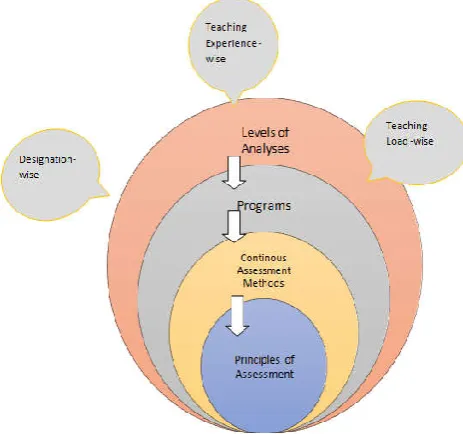
[image:2.595.44.276.557.774.2]The study is based on a primary survey conducted among all the teaching staff of IMT Department using a structured questionnaire. The questionnaire was designed to embrace the ramification of fundamental principles of assessment practiced in different modes of assessment exists in YIC. The structured questionnaire used in the study is based on Figure: 1. Application of nine fundamental principles of assessment (Race, 2010) are reviewed in the survey across all summative/formative assessment methods. Five point Likert scale was used to report the opinion of teaching staff on the set assessment standards (principles). The implication of variance among different designations, teaching experience and teachers’ work load on assessment are analyzed in the study. Correlation analysis is also used to assess the interrelations among the designed standards of assessment.
Figure 1. Method of Study
The paper composed of six sections including the introduction, which discusses the objective and methodology of the study. Important studies in the area of assessment are reviewed in section two and the existing assessment practices in YIC are discussed in section three. Evaluation model used in the study to appraise the assessment systems followed by analyses results are presented in the next two sections. The final section concludes the important findings and offer suggestions for improvement in the existing practices of assessment.
IMPORTANCE OF ASSESSMENT IN HIGHER
EDUCATION
In the field of assessment at the higher education, there are a number of studies that confirm the central role played by assessment in academics. Different forms of assessment would affect the students in their studies and career in different ways. Black and William (1998) illustrate that classroom formative assessment is a powerful means to improve student learning; however, summative assessments such as standardized exams can have multiple effects. It means strengthening formative assessment can raise overall student achievement, especially of slow learners or low-achieving students.
Stiggins (2004) advocate the need for using
assessment of learning along with assessment for learning.
That is, teachers should use assessment not only to actively and continuously measure a learner’s progress but also to acquire useful data to inform their own instructional practice. He even envisions environments in which students use assessments to understand what success looks like and how to do better next time. Lewis’ (2011) study suggests that awareness training can result in significant attitude changes while, impairment simulations have a moderate effect on
student attitudes. Ramsden (2003) begins his discussion of the
effects of assessment on learning with ‘hidden curriculum’ to support the primacy of assessment in students’ perceptions. Bloxham and Boyd (2007) support their contention that the assessment strategy of a particular course has a major impact on student activity.
other. The nature and quality of the learning outcomes are central to learning and for the assessment of these outcomes it is required to articulate in some way the constructs on which such judgments are based (Race, 2010). For the assessment of outcomes the inferences drawn from the evidence of learning should be demonstrably aligned to the learning outcomes. Progression is of key concern in the design and implementation of learning programmes, and in particular for the implementation of assessment for learning. However, its relevance to summative assessment depends on the structure of
the assessment system1. Wilson and Black (2007) draw
attention to the phenomenon that a more tightly prescribed curriculum might be more helpful to learners; if the sequence of progression is well founded in relation to models of learning in each subject discipline, and then there could be better synergy between assessment and effective pedagogy. These studies point to the relevance of assessment procedures on the alignment between intended outcomes of learning and those outcomes which actually emerge. Lack of alignment between assessment instruments and intended learning outcomes represent a threat to the reliability of inferences from assessment results.
Frederiksen and Collins (1989) pointed out that a coherent assessment is one that induces in the education system curricular and instructional changes which foster the development of the cognitive skills that the assessment is designed to measure. Sometimes, an assessment is designed to assess certain intended learning outcomes, but fails to assess them in practice. A different type of impact attributable to the design of an assessment instrument occurs when success of the assessment can be optimized by the acquisition of undesirable, construct-irrelevant learning outcomes. The most obvious of undesirable learning outcomes is cheating behavior. Herman and Haertel (2005) through their study highlighted that the main policy driver of assessment at the higher education level is system accountability. Accountability takes very different forms, has different purposes and stakeholders, and has different effects on the interpretation of learning outcomes.
ASSESSMENT PRACTICES IN YIC
The assessment practices exist in the higher education sector in Saudi Arabia is a continuous one and follows the credit and semester system. In YIC the prevailing assessment systems comprises both formative and summative assessments, which are continuous as well. The business studies in the IMT department also follow the continuous assessment patterns for its Associate degree and Baccalaureate programs. All these programs are accredited by the ACBSP.
All courses offered from the department are instructed to have the following modes of assessment on a continuous basis (See Figure: 2).
Quizzes: Minimum five quizzes are to be conducted
having equal marks with total weightage of 15% of the aggregate marks; of which two quizzes are to be conducted before the mid semester.
Assignments: Two assignments are to be given of
equal marks with total weights of 10%; one assignment before the mid semester.
Presentations: It is required only for research based
courses in place of quizzes and assignments (not always applicable to theoretical courses).
Lab Examination: The technical courses, for which
computer based labs are used and its weights are in correspondence to the mid and final exams.
Mid Semester Exams: There will be a mid semester
exam covering half of the course in the middle of the semester, as announced by the department and its weight should not exceed 25% of the total marks.
Final Examination: The final examination will cove
entire syllabus having a weightage of 50%.
Among these six assessment methods, except the final examination, all others are summative as well as formative and will give sound feedback to students to improve their learning. The Head of the Department through the department examination committee with the support of Course Coordinators and Program coordinators will monitor the progress of assessment throughout the semester. The Education Development Centre (EDC) of YIC is offering different training programs for maintaining the standard of teaching learning process in YIC for the last two years in liaison with the Christchurch Polytechnic Institute of Technology (CPIT), New Zealand. In a series of training programs, such as Teaching – Learning Methods, Assessment Drives Learning, and Design for Effective Learning, EDC has trained the staff in redesigning the assessment practices to the advanced levels.
Source: IMT Department
EVALUATION MODEL OF ASSESSMENT
The evaluation model designed to analyze the assessment pattern in higher education should set standards towards which to assess the prevailing systems of assessment. The model used in this study is as shown in Figure: 3. The standards of assessment are set through the fundamental principles of assessment as advocated by Race (2010), and are briefed below. These nine core principles of assessment would cover almost all the basic requirements of a sound assessment system.
Validity: Assessment should demonstrably measure
that which it sets out to measure.
Reliability: Assessment should be independent of
which assessor is involved (inter-assessor reliability) and independent of where and when a particular
assessor marks students’ work (intra-assessor
reliability).
Transparency: This is about the targets being clearly
evidences required to demonstrate their achievement of the intended learning outcomes.
Authenticity: The assessment should relate to the
real-world requirements of the profession, students will enter beyond the course being assessed.
Academic integrity: It needs to be striving to measure
the students’ achievement, in ways where it is certain that the achievement belongs to the student, by avoiding plagiarism.
Manageability for Students: The assessment should
be efficient and manageable for students (valuable use of their time).
Manageable for Teachers: Efficient systems of
assessment should be manageable for teachers by effectively using their time and resources.
Constructive Alignment: All assessments are to be
properly linked to the learning outcomes and learning activities.
Inclusiveness: The assessment should provide a level
[image:4.595.317.550.53.201.2]playing field for students with learning disabilities, whether it is visual, reading or hearing.
Figure 3. Evaluation Model of Assessment
Source: Primary Survey
All the assessment methods that are widely used in the department are appraised to the above mentioned standards and program wise. The study objectives are analyzed in this model - designation-wise, teaching experience-wise and teaching load wise.
RESULTS AND DISCUSSION
Among the nine set standards (principles) of assessment, only transparency and students’ manageability could rate at outstanding level in the study in general.
Source: Primary Survey
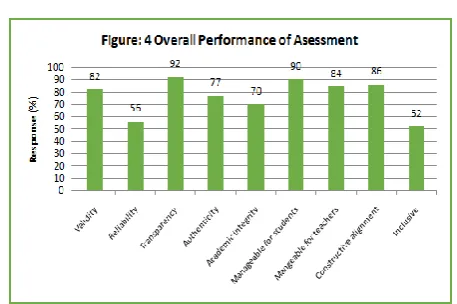
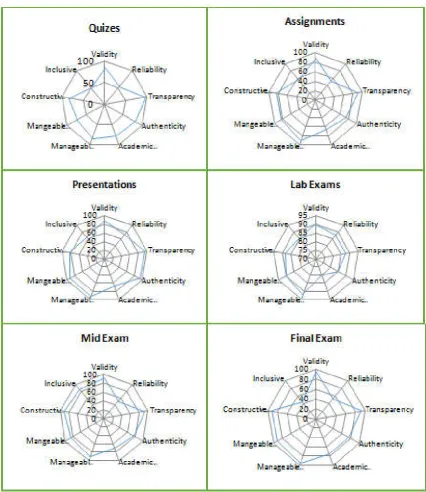
The overall response of teachers on the set standards of assessment are as shown in Figure: 4. It point to the need for revival of reliability and inclusiveness, as the performance ratings are recorded poorly. Academic integrity and authenticity also need improvements. As seen earlier, the IMT Department is offering Associate degree programs and Baccalaureate programs. Program-wise performances of assessment are as depicted in Figure: 5. The assessment standards at Associate degree level need improvements in reliability, academic integrity and inclusiveness, even though it performed better than that of Baccalaureate program. Detailed analyses of assessment are given in Figure: 6. The analyses reveal that the quizzes and assignments conducted in the
department requires improvements in reliability and
inclusiveness; lab exams require modification in academic integrity, mid exams requires enhancement in reliability, and final exam requires revival at the reliability and inclusiveness ground. Program-wise Chi-square test results are illustrated in Appendix Table: 1. One of the major objectives of the study was to analyze designation-wise inconsistency, if any, in assessment standards. As seen in Figure: 7, the reliability and inclusiveness standards are comparatively poor for instructors; whereas for Asst. Professors, academic integrity was recorded at low levels. Designation-wise Chi-square test results are
exemplified in Appendix Table: 2. Experience-wise
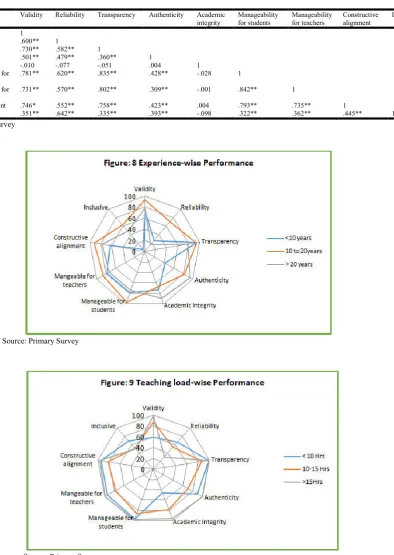
performance of teachers on assessment standards, as illustrated in Figure: 8, reveal that young teachers are comparatively weak in adopting inclusiveness and authenticity in their assessments, whereas the senior are poor in following reliability standards. Experience-wise Chi-square test results are shown in Appendix Table: 3
[image:4.595.52.282.307.470.2] [image:4.595.48.277.498.650.2]Source: Primary Survey
Figure 6. Assessment Method-wise Performances
Table 1. Descriptive Statistics Results
Principles Mean Standard Deviation N
1. Validity 2. Reliability 3. Transparency 4. Authenticity 5. Academic integrity 6. Manageability for students 7. Manageability for teachers 8. Constructive alignment 9. Inclusive
4.3643 3.7287 4.5039 4.1532 4.2339 4.4574 4.3256 4.3721 3.8062
0.99952 1.05143 0.90246 0.85582 3.82782 0.93548 0.96956 0.96881 0.89336
129 129 129 124 124 129 129 129 129 Source: Primary Survey
Table 2. Correlation Matrixes
Validity Reliability Transparency Authenticity Academic integrity
Manageability for students
Manageability for teachers
Constructive alignment
Inclusive
Validity 1
Reliability .600** 1
Transparency .730** .582** 1
Authenticity .501** .479** .360** 1
Academic integrity -.010 -.077 -.051 .004 1
Manageability for students
.781** .620** .835** .428** -.028 1
Manageability for teachers
.731** .570** .802** .309** -.001 .842** 1
Constructive alignment .746* .552** .758** .423** .004 .793** .735** 1
Inclusive .351** .642** .335** .393** -.098 .322** .362** .445** 1
Source: Primary Survey
Source: Primary Survey
[image:6.595.117.512.209.765.2]When the assessment is constructively aligned with learning outcomes and academic activities, such assessment also corroborates transparency, manageability (teachers and students alike) and validity. The analysis also disclosed a negative association between inclusiveness and academic integrity, which point to the need for further research in this area.
Conclusion
The quality of teaching-learning process is highlighted only when the assessment standards are set and followed properly. The business education in YIC always pursued the set standards of teaching-learning process along with the assessment. The present study reveals that the overall rating for the set standards of assessment was recorded at 77% and it point to the need for space for improvement. The revitalization of reliability and inclusiveness along with promotion of academic integrity and authenticity need special mention. The assessment standards at Associate degree level performed better than that of Baccalaureate program. The study also discloses the following on the individual assessment methods.
Quizzes and assignments conducted in the department
requires improvements in reliability and inclusiveness;
Lab exams need modification in academic integrity;
Mid exams necessitate enhancement in reliability; and
Final exams entail revival at the reliability and
inclusiveness ground.
Teachers’ designation-wise response on assessment divulge that reliability and inclusiveness standards are comparatively neglected elements among instructors; whereas for Asst. Professors, academic integrity was reported to be a weak element in their assessment. The influence of experience factor on assessment was also analyzed in the study and found that young teachers are comparatively feeble in adopting inclusiveness and authenticity in their assessments, whereas the highly experienced ones did not give proper attention to reliability standards. It is commonly believed that when the work load increases, correspondingly the efficiency standards also diminish is not observed to be true for the analyses of the assessment standards in this study, except reliability and inclusiveness as set standards. There is high correlation between transparency and validity along with an appealing connection between transparency, validity, and manageability for teachers as well as students. The study also highlights the significance of constructive alignment between learning outcomes, learning activities and assessment.
Based on the foregone discussion the following suggestions are offered.
Develop manifold measures to design a rational
assessment system that links learning outcomes, classroom activities and continuous assessment.
Promote staff development through continuous training
programs in effective learning and assessment backed by follow ups.
Creation of awareness among teachers and students
alike on the standards of assessment and give focused feedback to teachers on how their classroom efforts support these standards.
Promotion of students’ involvement in assessment for
deeper level learning.
Equip the students self reflective skills which include
the ability to see how their work meets the standard and how to improve.
NOTES
If the only high-stakes summative test is a terminal one
then the desired final outcomes are laid down, the test constructors have to reflect these in as valid a way as they can, and the teachers discern, from study of a syllabus and of examples of the test instruments and procedures, how best to focus their work.
REFERENCES
Black, P. and Wiliam, D. 1998. Inside the black box: Raising
standards through classroom assessment. Phi Delta
Kappan, 80(2).
Bloxham, S. and P. Boyd 2007. Developing effective
assessment in higher education: A practical guide. Open
University Press. Maidenhead. Conference, August, in Durham, UK.
Elton, L and Laurillard, D.M. 1979. Trends in research on
student learning. Studies in Higher Education. Vol:4.
Frederriksen, J.R and Collins, A. 1989. A systems approach to
education testing. Educational Researcher Vol:18, No. 9.
Guskey, T. R. 2005. Formative classroom assessment and
Benjamin S. Bloom: Theory, research, and
implications. Paper presented at the annual meeting of the
American Educational Research Association, Montréal, Québec, Canada.
Herman, J and E. Haertel, eds. 2005. Uses and misuses of data
for educational accountability and improvement: 104th
yearbook of the National Society for the Study of Education. NSSE. Chicago
Joughin, G. 2006. Students’ experience of assessment in Hong
Kong higher education: Some cultural considerations.
Paper presented at Northumbria/EARLI SIG Assessment Lewis, John, L. 2011. ‘Student attitudes toward impairment: an
assessment of passive and active learning methods in urban
planning education’. Teaching in Higher Education. Vol.
16, No. 2, April.
Nightingale, P. et al. 1996. Assessing learning in universities.
University of New South Wales Press. Sydney.
Popham, W. J. 2006. ‘All about accountability /those
[fill-in-the-blank] tests!’ Educational Leadership, 63(8).
Race, P. 2010. Making Learning Happen: A Guide for
Post-Compulsory Education, Sage Publications, Second Edition.
Ramsden, P. 2003. Learning to teach in higher education. 2nd
ed. London: Routledge.
Scouller, K. 1998. The influence of assessment method on students’ learning approaches: Multiple choice question
examination versus assignment essay. Higher Education
35.
Stiggins, R. 2004. ‘New assessment beliefs for a new school
mission.’ Phi Delta Kappan, 86(1).
Struyven, K., F. Dochy, and S. Janssens. 2005. Students’ perceptions about evaluation and assessment in higher
education: A Review. Assessment and Evaluation in
Higher Education.Vol:30, No. 4.
Tang, K.C.C. 1994. Effects of modes of assessment on
learning: Theory and practice, ed. G. Gibbs. Oxford Centre for Staff Development. Oxford.
Thomas A. and Patricia Cross, K. 1993. Classroom Assessment
Techniques: A Handbook for College Teachers, Second
Edition. Jossey-Bass Publishers. San Francisco.
Wilson, M., and Black, P. 2007. The idea of a learning
progression as a core for both instruction and assessment. Paper presented in the Annual Meeting of the American Educational Research Association, San Francisco.