SIMULTANEOUS LAYOUT AND PIPE SIZE OPTIMIZATION OF WATER DISTRIBUTION NETWORKS
1, *
Lahiouel Yasmina,
1
Process Engineering’s Institute, LSPN, Guelma University, B.P. 401, Guelma, Algeria
2Physic’s Institute, GPL, Guelma University, B.P. 401, Guelma, Algeria
3
Process Engineering’s Institute, LSPN, Guelma University, B.P. 401, Guelma, Algeria
ARTICLE INFO ABSTRACT
In this paper, we address the development of a designin
requirements. The proposed approach significantly improves upmon a previous method of Lahiouel
et al. (2004) by way of adopting a simultaneous layout and pipe size otimization of water
networks. The necessity of a coupled solution of the layout and pipe sizing problem is shown. The method does not start with a predefined layout which includ
designing a layout of predefined reliability, including tree
of the model for optimization of pipe networks with predefined reliability is illustrated by testing the method against on benchmark example in the literature.
Copyright©2016, Lahiouel Yasmina et al. This is an open access article distributed under the Creative Commons Att use, distribution, and reproduction in any medium, provided the original work is properly cited.
INTRODUCTION
Water distribution networks represent one of the largest infrastructure assets of an industrial society. The design of water distribution systems has consistently received a great deal of attention because of its importance to society. Even so, many of the existing pipe networks in older urbanized areas function at severely reduced levels of efficiency, and in some cases, are inadequate with respect to meeting the required pressure and flow demands. The investments associated with the installation, expansion and maintenance of water distribution systems are very high. Design of water distribution networks is often viewed as a least-cost optimization problem. An important component in this process of designing a cost effective water distribution network is to design the sizes of the various pipes that are capable of satisfying the flow demand, in addition to satisfying the minimum pressure head and hydraulic redundancy requirements.
*Corresponding author: Lahiouel Yasmina,
Process Engineering’s Institute, LSPN, Guelma University, B.P. 401, Guelma, Algeria
ISSN: 0975-833X
Article History:
Received 14th March, 2016 Received in revised form 23rd April, 2016 Accepted 19th May, 2016 Published online 30th June,2016
Key words:
Water distribution network, Least cost network-design, Global optimization,
Optimal design of distribution networks, Layout optimization distribution networks, Pipe size optimization distribution networks.
Citation: Lahiouel Yasmina, Lahiouel Rachid and Beddiaf Souad
International Journal of Current Research, 8, (06), 33229
RESEARCH ARTICLE
SIMULTANEOUS LAYOUT AND PIPE SIZE OPTIMIZATION OF WATER DISTRIBUTION NETWORKS
Lahiouel Yasmina,
2Lahiouel Rachid and
3Beddiaf Souad
Process Engineering’s Institute, LSPN, Guelma University, B.P. 401, Guelma, Algeria
Physic’s Institute, GPL, Guelma University, B.P. 401, Guelma, Algeria
Process Engineering’s Institute, LSPN, Guelma University, B.P. 401, Guelma, Algeria
ABSTRACT
In this paper, we address the development of a global optimization procedure for the problem of designing a water distribution network that satisfies tat specified flow demands as stated pressure head requirements. The proposed approach significantly improves upmon a previous method of Lahiouel
(2004) by way of adopting a simultaneous layout and pipe size otimization of water
networks. The necessity of a coupled solution of the layout and pipe sizing problem is shown. The method does not start with a predefined layout which includes all possible links; it is capable of designing a layout of predefined reliability, including tree-like and looped networks. The applicability of the model for optimization of pipe networks with predefined reliability is illustrated by testing the
d against on benchmark example in the literature.
is an open access article distributed under the Creative Commons Attribution License, which use, distribution, and reproduction in any medium, provided the original work is properly cited.
Water distribution networks represent one of the largest infrastructure assets of an industrial society. The design of distribution systems has consistently received a great deal of attention because of its importance to society. Even so, many of the existing pipe networks in older urbanized areas function at severely reduced levels of efficiency, and in some nadequate with respect to meeting the required pressure and flow demands. The investments associated with the installation, expansion and maintenance of water Design of water distribution cost optimization problem. An important component in this process of designing a cost effective water distribution network is to design the sizes of the various pipes that are capable of satisfying the flow demand, in mum pressure head and
Process Engineering’s Institute, LSPN, Guelma University,
Optimization of water distribution networks is a multidisciplinary task, involving hydraulics, quality, reliability and availability of the components' requirements. In spite of all the progress made, the optimization of pipe networks fulfilling all these requirements seems to be ou
present time. In recent years a number of optimization techniques have been developed primarily for the cost minimization aspect of network planning, although some reliability studies and stochastic modeling of demands have been attempted (Walters et al.,
requirement, on the one hand, is usually addressed by considering a predefined fixed, usually looped, layout for the networks to be designed (Murphy
1996; Halhal et al., 1997; Savic Sousa, 1999; Boulos et al., 2000;
investigations neglect the influence of the layout on the pipe sizing of the pipe networks. Some studies, on the other hand, have addressed the layout geometry optimization of the pipe networks, neglecting the influence of the pipe sizing on layout determination. Early work in this area focused on branched networks, which are of little use in water distribution networks, due to poor reliability. Walters and Lohbeck
International Journal of Current Research
Vol. 8, Issue, 06, pp.33229-33235, June, 2016
INTERNATIONAL
Lahiouel Yasmina, Lahiouel Rachid and Beddiaf Souad, 2016. “Simultaneous layout and pipe size optimization of water distribution networks
33229-33235.
SIMULTANEOUS LAYOUT AND PIPE SIZE OPTIMIZATION OF WATER DISTRIBUTION NETWORKS
Beddiaf Souad
Process Engineering’s Institute, LSPN, Guelma University, B.P. 401, Guelma, Algeria
Physic’s Institute, GPL, Guelma University, B.P. 401, Guelma, Algeria
Process Engineering’s Institute, LSPN, Guelma University, B.P. 401, Guelma, Algeria
global optimization procedure for the problem of that satisfies tat specified flow demands as stated pressure head requirements. The proposed approach significantly improves upmon a previous method of Lahiouel (2004) by way of adopting a simultaneous layout and pipe size otimization of water distribution networks. The necessity of a coupled solution of the layout and pipe sizing problem is shown. The es all possible links; it is capable of like and looped networks. The applicability of the model for optimization of pipe networks with predefined reliability is illustrated by testing the
ribution License, which permits unrestricted
Optimization of water distribution networks is a task, involving hydraulics, quality, reliability and availability of the components' requirements. In spite of all the progress made, the optimization of pipe networks fulfilling all these requirements seems to be out of reach at the ent years a number of optimization techniques have been developed primarily for the cost minimization aspect of network planning, although some reliability studies and stochastic modeling of demands have
et al., 1993). The reliability requirement, on the one hand, is usually addressed by considering a predefined fixed, usually looped, layout for the Murphy et al., 1993; Dandy et al.,
Savic and Walters, 1997; Cunha and 2000; Wu et al., 2002). All these investigations neglect the influence of the layout on the pipe Some studies, on the other hand, have addressed the layout geometry optimization of the pipe , neglecting the influence of the pipe sizing on layout determination. Early work in this area focused on branched networks, which are of little use in water distribution networks, Walters and Lohbeck (Walters and
INTERNATIONAL JOURNAL OF CURRENT RESEARCH
Lohbeck, 1993), for instance, proposed two Genetic Algorithms (GA) using binary and integer coding for layout determination of tree-like networks and compared their storage and computation time requirements with those of dynamic programming. (Davidson and Goulter, 1995) proposed an evolution programming method for layout optimization of rectilinear branched networks. They replaced crossover and mutation of the GA with two operators, named recombination and perturbation that ensured the feasibility of the children. (Walters and Smith, 1995) combined graph theory with conventional crossover and mutation operators to ensure that non-feasible solutions are avoided in the reproduction stage. Geem et al. (2000) proposed a heuristic algorithm, namely harmony search, mimicking the improvisation of music players for optimal design of branched networks. They used a tree-growing algorithm from the base graph to restrict the search space to feasible solutions during the search process. Davidson, (1999) was the first to address the layout optimization of looped networks. Emphasizing the need for joint optimization of layout and pipe sizing, (Davidson, 1999) restricted his research to layout determination, due to the difficulty in selecting optimal component sizes, while maintaining a sufficient level of reliability. An evolution program was devised, incorporating the concept of the preference and threshold method into the conventional GA. (Lahiouel et al., 2003; Lahiouel et al., 2005) have proposed a minimal length algorithm for the optimization of the design of water distribution networks. The proposed algorithm connects the nodes and the sources using the shortest path to obtain a final looped configuration. All these works assume that pipe network optimization, considering hydraulics, reliability and availability requirements can be reduced to two separate optimization problems, in which the layout optimization is followed by a pipe size optimization. The aforementioned assumption is weak because of strong coupling between pipe sizing and layout determination for pipe networks.
The joint problem of layout and pipe design of water distribution networks has been addressed for the much easier problem of branched networks (Mays et al., 1976; Martin,1980). Such systems, however, are not favored in practice, mostly because they lack reliability. Failure or scheduled maintenance of any of the pipes would lead to a part of the network being cut out from the source nodes. The problem of layout optimization for looped water distribution networks has received even less attention, mostly because of its complexity. (Rowel et al., 1982) were the first to consider the joint problem of layout and size design for looped water distribution networks. They developed a two-level model, in which a least cost branched layout is first determined. The looping requirement is, then, provided by the inclusion of redundant pipes interconnecting the branches of the network. (Morgan and Goulter, 1982) developed a model, using two linked linear programs, to solve the least cost solution of looped networks. In this mode, one linear program solves the layout, while the other determines the optimal pipe design. This problem was recognized and removed by Morgan and Goulter (1985) in a new model that was based on a linear programming method linked to a network solver. The linear model designs pipe sizes, while the network solver balances flows and pressures. Within the linkage between these two
steps is a means for removing uneconomical pipes from the network. The procedure is continued until no pipe can be removed without undermining the looping of the network. More recently, Kessler et al., (1990) and Cembrowicz (1992) proposed models for the underlying problem, in which the design of the layout geometry was based on the inclusion or exclusion of the links chosen from a predefined base graph. (Tanyimboh, 2013) developed an iterative two-stage approach such that, in the first stage, the optimal diameters for a predefined layout is determined using a non-linear programming method. Afshar (2007) also proposed several approaches that basically restricted the evolutionary algorithms used to feasible solutions. These included a genetic algorithm using three modified roulette wheel selection schemes, the conventional roulette wheel and a max-min ant algorithm. However, this method started with a predefined layout, which included all possible links. (Tanyimboh, 2013) describes a new penalty-free multi-objective evolutionary approach to the simultaneous layout and pipe size optimization of water networks. He adopted an approach in which the entire solution space that consists of both feasible and infeasible solutions is exploited in full. On the one hand, the complexity feature in the development of an algorithm capable of addressing this subject is the strong coupling between the layout and pipe size determination. On the other hand, the layout determination of pipe networks is very much dependent on reliability considerations. The aim of the present work is to establish a new algorithm for the optimization of the design of water distribution networks, the problem of least-cost layout and size design is first formulated. The importance of obtaining the best network layout and the optimal pipe diameter for each pipe emphasized by the fact that the decision made during the layout and design phases will determine the ultimate operation costs. Hence the necessity of a coupled solution of the layout and pipe sizing problem is shown. The paper describes the development of a computer model that involves the resolution of least-cost design problem of water distribution network. The method does not start with a predefined layout which includes all possible links; it is capable of designing a layout of predefined reliability, including tree-like and looped networks. The developed procedure uses two linked programs, minimal length algorithm for a layout optimization and linear method for the designing pipes’ sizes, to solve the least cost solution of looped networks. The applicability of the model for optimization of pipe networks with predefined reliability is illustrated by testing the method against one benchmark example in the literature.
MATERIALS AND METHODS
Network and graph theory
The solution of fluid distribution network problems requires a graph representation of the network that facilitates the necessary calculations. Graph theory permits the representation of the network structure by means of the incidence matrix of the network and allows, therefore, explicit representation. The nodes represent the points on the pipelines where exists a discontinuity: intersection of pipes, change of section, fluid injection point (source) and fluid consumption point. The branches represent the pipes that join nodes together. The
incidence matrix is a compact mathematical concept of the network (Lahiouel et al., 2003; Lahiouel et al., 2005). The network configuration can be condensed in the incidence matrix that allows to establish the connectivity of the graph, and therefore of the network. The network connection can, therefore be described by the node-to-node incidence matrix. This matrix is square and its elements are defined as:
j node to connected not
is i node if 0,
j node to connected is
i node if , 1
aij ... (1)
The loops of the network can also be deduced from the incidence matrix. While summing the elements on the matrix ranges, the number of connections for each node can be obtained and it allows sorting out the nodes with less than two connections, the floating nodes.
Mathematical formulation
Considering the basic case of a water distribution system without pumping stations, reservoirs, and break pressure devices, the design is based on the following basic criteria. Design demand: one or more demand rates may be specified for design representing different operational states. Demand is assumed to occur at the nodes of a network.
Flow velocities: minimum and maximum flow velocities are mainteained in order to prevent solids deposition, deterioration of the water quality and unacceptable noise development. Neverthless, the minimum flow velocity is in most cases the limiting factor for design.
Flow formulae: the most common formulae for hydraulic design of water distribution systems are the Prandtl-Colebrook equation and the Hazen-Williams equation. Pipe diameters and materials: a minimum diameter of 80
mm is frequently used for public water distribution system. Available diameter sizes are defined by standards. The selection of pipe materials finds expression in design models in the roughness coefficient of the flow formulae, the maximum allowable pipe pressure, and in cost items of the objective function.
Minimum and maximum pressures: the minimum pressure mainly depends on the type of service area and the level of service. The maximum pressure is limited by the pipe materials and the quality of construction of a distribution system.
Flow state: steady state is assumed for design.
A set of equations is used to minimize the total cost of the network design. The most important is the objective function, assumed to be a cost function of the pipe lengths:
=
N
i
i i
L
C
1
... (2)
i
C
is the cost per unit length for the pipe i,L
i its length andN the number of pipes constituting the network. Since the costs are constant quantities, the decision variables become the
pipe lengths. The objective function can be simplified to the following form:
= ( ) =
E
i i
L
1
... (3)
This function is hence subjected to the three main constraints for the hydraulic design of water distribution systems which are continuity of flow at nodes, maintaining minimum and maximum pressures, and the head in a loop.
for each junction node the flow continuity equation must be satisfied:
∑ + ∑ = ... (4)
in
Q is the inflow at the node, Qout is the outflow, is the node demand;
The head loss through different paths between any two points of a network must be equal. For each loop, the constraint of head loss is as follows:
∑∈ = 0 , = 1, , ... (5)
L is the number of existing loops in the network, and Hj is the
head loss in the ith pipe.
The Hazen-Williams is used in relating the flow to the head in pipe:
= . . . ( ⁄ ) ... (6)
is the Hazen-Williams coefficient for the ith pipe and
= 2.63, = 0.54 and = 0.281 for q in cubic meters and
d in meters. These constraints, therefore, describe the flow continuity at nodes, head loss balance in loops and the Hazen-Williams equation.
for each source, the constraint of flow availability is as follows:
∑ ≤ ... (7)
Cap is the capacity of the source or the quantity of fluid available at the source node;
for each junction node the reliability constraint must be satisfied:
( ) ≥ 2
... (8)
( ) represents the connection degree of the node i, i.e. the number of branches connected to the node and the reliability level is then 2:
( ) =
N
ns j
ij
a
1
Equation (9) is used for all critical nodes. This constraint ensures that there exist at least two arc disjoint paths connecting any demand node to its associated source node and is thus a requirement for ensuring sufficient reliability for the network.
Maintaining pressure between minimum and maximum values at each node reads:
≤ ≤ , = 1, , ... (10)
where M is the number of existing pipes, Hi is the head in ith
pipe, Hmin is the minimum service pressure head and Hmax is
the maximum allowable pressure head. The maximum pressure occurs as hydrostatic pressure for the case of no demand in the system.
Since the pipes of a water distribution network are flowing full, the candidate diameters of an individual link are given by the pipe size availability constraint as:
< < ………... (11)
where dmin and dmax are the minimum and maximum
commercially available pipe diameters.
The sum of lengths of all sections must be equal to the total length of the link:
∑ = ... (12)
Where Lj is the length of section j and li is the length of link i,
m.
The length of each pipe is defined by the relative positions of its start and end nodes:
= ( ) + ( ) ... (13)
where:XND,XNF,YND,YNF, Cartesian coordinates (positions) of the start and end nodes of the pipe. The obtained model is a set of non linear equations and where the section lengths Lij are the decision variables, hence the solution is not
possible without some assumptions. Thus we can try one simplification via the determination of flow distribution and the equation’s solution can then be made.
Solution technique
The topology of the urban water system is generally imposed by the structure of the urban context: roads, buildings, industrial areas, hospitals, etc. Therefore, the optimal design of water distribution network to be solved proceeds by defining the topology based on some assumptions related to the coordinates of the sources and demand nodes provided and, then assumes a set of constraints in terms of amount of water to be delivered at the nodes. The algorithm proposed in this paper is implemented in friendly useful program. The algorithm is developed into two joint parts, which are the optimization of the total length and the optimization of the pipe
size of the network. These two parts are independent but can be used simultaneously. Hence, we can proceed to the verification of the hydraulic equilibrium. The sources and demand nodes, in terms of positions, are connected the first time as a branched network. The basic principle of the algorithm is to join the demand nodes directly to the sources of energy in order to ensure a good distribution and availability of the fluid. The reliability system is considered as an important part of the design. The planning process involves consideration over time of the resources available, anticipated demands, location of facilities and accessories, and other economic issues. The planner can then foresee the recourse to the use of two parallel paths between two nodes in order to increase availability. These are called protected paths. The reliability constraint in pipe network optimization problems is subsequently enforced by assuming a looped layout for the network (Equation 8). It is well-known that relaxing this constraint in the absence of any reliability requirement would lead to a branched network as the optimal solution of the problem. The second time the design demands in terms of quantity of water to be delivered are preliminarily established and the minimum head distribution is defined on the basis of the delivery pressure needs taking into account the topographical elevation. The available commercial diameters and the relevant costs complete the required information. The procedure proposed here starts from an initial set of diameters determined by the designer on the basis of his/her experience.
RESULTS
Model applications and results
The first example to be considered is that of a simple network. This example has been considered as a test network, to test the performance of the model proposed in this study. The network consists of one source and six demand nodes, and is proposed for simultaneous layout geometry and size optimization. This example is frequently used in most works related to water distribution networks design, and reference is made there as “the two loops network” as benchmark (Savic et al., 1997; Walters and Smith, 1995; Lahiouel et al., 2003; Morgan and Goulter, 1982; Alperovits and Shamir, 1977; Sonak and Bhave, 1993). The data are summarized in table 1 and Table 2 shows the data regarding available pipe sizes and their costs.
DISCUSSION
The example treated above is a simple case of water distribution network, but is a reference for validation. The obtained results for this first case study are summarized in table 3 and figure 1. The network has been used as an appropriate test example for the simultaneous layout and size optimization algorithm proposed. This would also make it possible to compare the results of layout geometry optimization with that of joint layout and size optimization. The results obtained are in accordance with those reported in the literature. They clearly show that layout geometry optimization leads to the optimum network, similar to those previously obtained (Savic et al., 1997; Walters and Smith, 1995; Lahiouel et al., 2003; Morgan and Goulter, 1982; Alperovits and Shamir, 1977; Sonak and Bhave, 1993).
Figure 1. The two loops network
Table 1. Features of the two loops network
Node X-coordinate (m) Y-coordinate (m) Capacity/Demand m3/s) Elevation (m) Minimal pressure
1 3100 100 1120 210 00
2 2100 100 100 150 30
3 1100 100 100 160 30
4 2100 1100 120 155 30
5 1100 1100 270 150 30
6 2100 2100 330 165 30
7 1100 2100 200 160 30
Table 2. Cost data for the two loops Network
Diameter (inch) 2 3 4 6 8 10 12 14 16 18 20 22 24 Cost ($/inch) 5 8 11 16 23 32 50 60 90 130 170 300 550
Table 3. Results of the simultaneous optimization
[image:5.595.58.541.575.749.2]Pipe First Node Final Node Flow (m3/h) Diameter (in.) Associated Length (m) 1 2 3 4 5 6 7 8 1 2 2 4 4 6 3 5 2 3 4 5 6 7 5 7 -1120.00 177.00 843.00 121.39 601.60 271.60 77.00 71.61 18 10 16 6 14 10 8 4 1000.00 1000.00 1000.00 1000.00 1000.00 1000.00 1000.00 1000.00
Table 4. Comparison of results published in literature
Pipe Alperovits and Shamir (1977) Goulter et al., (1986) Kessler and Shamir (1989) Savic (1997) Proposed method
L (m) D (in) L (m) D (in) L (m) L (m) D (in) L (m) D (in)
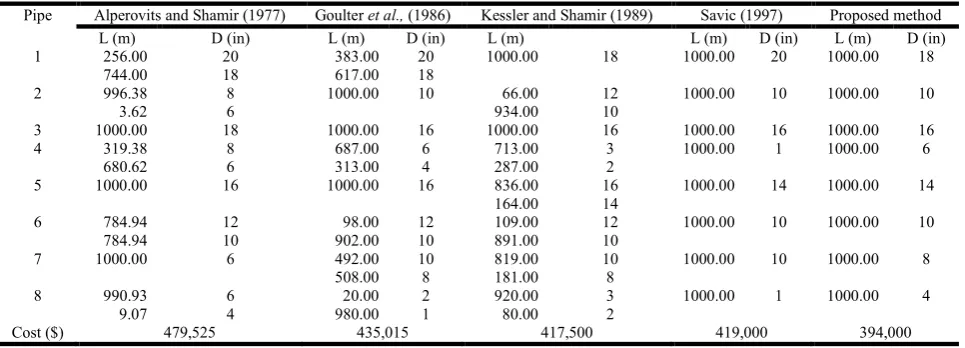
1 2 3 4 5 6 7 8 256.00 744.00 996.38 3.62 1000.00 319.38 680.62 1000.00 784.94 784.94 1000.00 990.93 9.07 20 18 8 6 18 8 6 16 12 10 6 6 4 383.00 617.00 1000.00 1000.00 687.00 313.00 1000.00 98.00 902.00 492.00 508.00 20.00 980.00 20 18 10 16 6 4 16 12 10 10 8 2 1 1000.00 66.00 934.00 1000.00 713.00 287.00 836.00 164.00 109.00 891.00 819.00 181.00 920.00 80.00 18 12 10 16 3 2 16 14 12 10 10 8 3 2 1000.00 1000.00 1000.00 1000.00 1000.00 1000.00 1000.00 1000.00 20 10 16 1 14 10 10 1 1000.00 1000.00 1000.00 1000.00 1000.00 1000.00 1000.00 1000.00 18 10 16 6 14 10 8 4
Cost ($) 479,525 435,015 417,500 419,000 394,000
Branches connection
Loop’s connection Source Node Demand Node 1 2 3 4 5 6 7 18 10 16 84 14
6
So, the present method does not start with a predefined layout, which includes all possible links. The network is obtained from only the node’s positions and their demand and capacity. Table 4 shows the comparison between the results obtained in the present method and those published in the literature. Regarding both layout and pipe sizes, it is seen that the best solution of simultaneous layout and size optimization, with a cost of $ 394,000, is about 5% cheaper than the best solution corresponding to the supposedly optimum design obtained by Kessler and Shamir, and about 6% cheaper than the optimal solution obtained by Savic.
Conclusion
A simultaneous layout and pipe size optimization algorithm of water distribution networks is presented. An engineering concept of reliability is used, in which the number of independent paths from source nodes to each of the demand nodes indicates reliability. The method does not use a predefined maximum layout, which includes all possible links but starts with only series of sources and nodes defined by their coordinates. Additional information is needed and concerns the demand flow at nodes and capacity at sources. The method proposed in this paper, using the minimal length algorithm, is conceived as a simple way to respond to the needs imposed by the constraints relative to the design of fluid distribution looped networks. The method is capable of designing a layout of predefined reliability, and gives the sizes of links included in the resulting looped networks. The method is used for layout and pipe size design of a benchmark example, for which the optimum layout geometry is available. The optimal pipe size solution to the optimum layout is obtained and compared to the results of the proposed method to show the superiority of the joint layout and pipe size optimization process, illustrating the ability of the proposed method to design fully-looped networks. This clearly illustrates the need for simultaneous optimization of layout and pipe size, if an optimal solution to a water distribution network is desired. Since looped networks present the advantage of the availability of the transported fluid and the reliability of the network in case of rupture or failing of one pipe. The length minimization ensures the reduction of the installation cost, the maintenance and operational cost directly related to losses, which are proportional to the total length.
REFERENCES
Afshar, M.H. 2007. Evaluation of Selection Algorithms for Simultaneous Layout and Pipe Size Optimization of Water Distribution Networks, Scientia Iranica, 14(1): 23-32 Alperovits, E. and Shamir, U. 1977. Design of optimal water
distribution systems, water Resour. Res., 13(6): 885-900 Boulos, P.F., Wu, Z.Y., Orr, C.H. and Ro, J.J. 2000. Least-cost
design and rehabilitation of water distribution systems using genetic algorithms: Proceeding of the AWWA IM Technical Conference, Seattle, WA, USA
Cembrowciz, R.G. 1992. Water supply systems optimization for developing countries, Pipeline Systems, B. Coulbeck and E. Evans, Eds., Kluwer Academic, London, UK
Cunha, M. and Sousa, J. 1999. Water distribution network design optimization: Simulated annealing approach, J. of Water Resour. Planning and Management, 125: 215-221 Dandy, G.C., Simpson, A.R. and Murphy, L.J. 1996. An
improved genetic algorithm for pipe network optimization,
Water Resour. Res., 32: 449-458
Davidson, J.W. 1999. Evolution program for layout geometry of rectilinear looped networks, J. of Computing in Civil Eng., 13: 246-253
Davidson, J.W. and Goulter, I.C. 1995. Evolution program for design of rectilinear branched networks, J. of Computing in Civil Eng., 9: 1-10
Geem, Z.W., Kim, J.H. and Yoon, Y.N. 2000. Optimal layout of pipe networks using harmony search, Proc. of 4th Int. Conf. on Hydro-Science and Engineering, Seoul, South Korea
Halhal, D., Walters, G.A., Quazarm D. and Savic, D.A. 1997. Water network rehabilitation with structured messy genetic algorithm, J. of Water Resour. Planning and Management, 123: 137-146
Kessler, A., Ormsbee, L. and Shamir, U. 1990. A methodology for least-cost design of invulnerable water distribution networks, Civil Engineering Systems, 1: 20-28
Lahiouel, Y., Chaoui, K., Khezzar, L., Haddad, A. and Azari, Z. 2005. Optimization of water distribution networks design by minimizing the total length, Eng. Trans. J.,
53(2): 165-183
Lahiouel, Y., Haddad, A., Khezzar, L., Chaoui, K. and Kondratas, A. 2003. Development of a Method of Routing Fluid Distribution Networks, MECHANIKA, 42(4): 27-34 Martin, W. 1980. Optimal design of water conveyance
systems, J. of the Hydraulics Div., ASCE, 106: 1415-1432 Mays, L.W., Wenzel, H.G. and Liebman, J.C. 1976. Model for
layout and design of sewer systems, J. of Water Resour. Planning and Management, 102: 385-405
Morgan, D.R. and Goulter, I.C. 1982. Least cost layout and design of looped water distribution systems, Proc. of Ninth Int. Symp. on Urban Hydrology, Hydraulics and Sediment Control, University of Kentucky, Lexington, KY, USA, pp. 27-30
Morgan, D.R. and Goulter, I.C. 1985. Optimal urban water distribution design, Water Resour. Res., 21: 642-652 Murphy, L.J., Simpson, A.R. and Dandy, G.C. 1993. Design of
a network using genetic algorithms, Water, 20: 40-42 Rowel, W.F. and Barnes, J.W. 1982. Obtaining layout of water
distribution systems, J. of the Hydraulics Div., ASCE, 108: 137-148
Savic, D.A. and Walters, G.A. 1997. Genetic algorithms for least-cost design of water distribution networks, J. of Water Resour. Planning and Management, 123: 67-77
Sonak, V. V. And Bhave, P. R. 1993. Global optimal tree solution for single-source looped distribution networks subjected to a single loading pattern, Water Resour. Res., 29(7): 2437-2443
Tanyimboh, S. 2013. Topology & Pipe Optimization, Water Resources Management, 27(14): 4795-4814
Walters, G.A. and Lohbeck, T.K. 1993. Optimal layout of tree networks using genetic algorithms, Engineering Optimization, 22: 27-48
Walters, G.A. and Smith, D.K. 1995. Evolutionary design algorithm for optimal layout of tree networks, Engineering Optimization, 24: 261-268
Walters, G.A., and Cebrowicz, R. G. 1993. Optimal design of water distribution networks, Water supply systems, state of the art and future trends, E. Cabrera and F. Martinez eds.,
Computational Mechanics Publications: 91-117
Wu, Z.Y. and Simpson, A.R. 2002. A self-adaptive boundary search genetic algorithm and its application to water distribution systems, J. of Hydraulic Res., 40: 191-203