STUDY ON DIFFERENT SLEEP SCHEDULING MECHANISM
*
Jigisha Parmar, Ashishgoud Purushotham
7, Angan Bunglows, Near
ARTICLE INFO ABSTRACT
A wireless sensor network (WSN) is a very large collection of sensor nodes which organized into different form like tree,
is essential for its communication
synchronized. Main purpose of any sleep scheduling algorithm is to maintain networ
save the power of the network we used the scheduling technique with WSN to increase the life of the network. In sleep scheduling most of the nodes are put into sleep mode to increase the lifetime of the network. Sleep scheduling is very i
aim of sleep scheduling algorithm is to live the network for long period of time. The different technique is used with the sleep scheduling like routing and tree based algorithm which is really improve the performance of the network
Copyright © 2015 Jigisha Parmar et al. This is an open access article distributed under the Creative Commons Att use, distribution, and reproduction in any medium, provided the original work is properly cited.
INTRODUCTION
A wireless sensor network is a set organized into different types of networks etc. A Wireless Sensor Network (WSN) hardware part for sensing and computation which group to detect and monitor environmental forests, oceans, etc. WSN devices are limited processing, and communication capabilities. The are work when it having the power which is battery which is placed in remote area so it
to replace and recharge the battery after deployment. the design and development of low-energy
protocols are essential for sensor networks. energy consumption of wireless exchange nodes strongly dominates other node functions sensing and processing.
WSN Scheduling
Scheduling is necessary for improving the life of network which save the time and energy so the network becomes more robust flexible and efficient. In the Multiprogramming operating system scheduling is used with the processes to increase the
*Corresponding author:Jigisha Parmar,
7, Angan Bunglows, Near Aditya Nagar, Bhadkodara Village, City, Ankleshwar, India.
ISSN: 0975-833X
Article History:
Received 04th February, 2015
Received in revised form 19th March, 2015
Accepted 07th April, 2015
Published online 31st May,2015
Key words:
Sensor network, Battery power, Energy Efficient routing, Sleep Scheduling.
Citation: Jigisha Parmar, Ashishgoud Purushotham and
International Journal of Current Research, 7, (5),
RESEARCH ARTICLE
STUDY ON DIFFERENT SLEEP SCHEDULING MECHANISM
Jigisha Parmar, Ashishgoud Purushotham and Usha Rani
Near Aditya Nagar, Bhadkodara Village, City, Ankleshwar
ABSTRACT
A wireless sensor network (WSN) is a very large collection of sensor nodes which organized into different form like tree, mesh etc. This sensor nodes are work on the power source i.e. battery which is essential for its communication There are to main approaches to sleep scheduling i) random ii) synchronized. Main purpose of any sleep scheduling algorithm is to maintain networ
save the power of the network we used the scheduling technique with WSN to increase the life of the network. In sleep scheduling most of the nodes are put into sleep mode to increase the lifetime of the network. Sleep scheduling is very important to become a network more efficient and flexible. Main aim of sleep scheduling algorithm is to live the network for long period of time. The different technique is used with the sleep scheduling like routing and tree based algorithm which is really improve the performance of the network.
is an open access article distributed under the Creative Commons Attribution License, which use, distribution, and reproduction in any medium, provided the original work is properly cited.
of sensor nodes networks like tree, mesh contain different which working in a changes in plains, limited in their energy, capabilities. The sensor nodes is provided by the it is not very easy deployment. Thus, energy algorithms and networks. Especially, the of data between functions such as
Scheduling is necessary for improving the life of network which save the time and energy so the network becomes more robust flexible and efficient. In the Multiprogramming operating system scheduling is used with the processes to increase the
7, Angan Bunglows, Near Aditya Nagar, Bhadkodara Village, City,
through put of the system. Such operating systems run multiple processes which is to be loaded inside the executable memory at the same time and that process shares the CPU by using the technique called multiplexing. Different schedulers are available for the every operating system.
collection of a many number of sensor nodes which communicate using the radio channel.
The WSN is developed for sensing a certain physical variable, gathering data and forwarding them to the base station where the information is processed for further purposes. Wireless sensor network is used with the scheduling which definitely increases the network validity for the long period of time.
All the waiting processes are stored into the queue execution. When the process
stored into the job queue. This queue is a collection of all processes of the system which is handling properly by using scheduling for improving the performance of
Scheduling in WSN, is called as the packet scheduling, which is used for manages the sequencing of packets in wireless sensor network of the transmit and receive
network interface controller.
Available online at http://www.journalcra.com
International Journal of Current Research Vol. 7, Issue, 05, pp.16093-16097, May, 2015
INTERNATIONAL
Jigisha Parmar, Ashishgoud Purushotham and Usha Rani, G. 2015. “Study on different sleep scheduling mechanism 7, (5), 16093-16097.
z
STUDY ON DIFFERENT SLEEP SCHEDULING MECHANISM
Usha Rani, G
Ankleshwar, India
A wireless sensor network (WSN) is a very large collection of sensor nodes which organized into This sensor nodes are work on the power source i.e. battery which There are to main approaches to sleep scheduling i) random ii) synchronized. Main purpose of any sleep scheduling algorithm is to maintain network connectivity to save the power of the network we used the scheduling technique with WSN to increase the life of the network. In sleep scheduling most of the nodes are put into sleep mode to increase the lifetime of the mportant to become a network more efficient and flexible. Main aim of sleep scheduling algorithm is to live the network for long period of time. The different technique is used with the sleep scheduling like routing and tree based algorithm which is really
ribution License, which permits unrestricted
Such operating systems run multiple processes which is to be loaded inside the executable memory at the same time and that process shares the CPU by using the technique called multiplexing. Different schedulers are available operating system. Wireless sensor networks are collection of a many number of sensor nodes which communicate using the radio channel.
The WSN is developed for sensing a certain physical variable, ta and forwarding them to the base station where the information is processed for further purposes. Wireless sensor network is used with the scheduling which definitely increases the network validity for the long period of time.
are stored into the queue for execution. When the process are load into the system, it is stored into the job queue. This queue is a collection of all processes of the system which is handling properly by using scheduling for improving the performance of the system. A Scheduling in WSN, is called as the packet scheduling, which is used for manages the sequencing of packets in wireless sensor transmit and receive queues of the wireless
INTERNATIONAL JOURNAL OF CURRENT RESEARCH
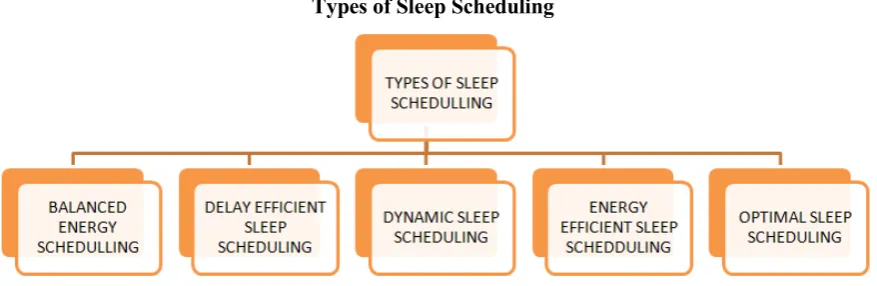
Balanced Energy Sleep Scheduling
The sleeping technique has been used to conserve energy of battery powered sensors. Rotating active and inactive sensors in the cluster, some of which provide redundant data, is one way that sensors can be intelligently managed to extend network lifetime. Some researchers even suggest putting redundant sensor nodes into the network and allowing the extra sensors to sleep to extend the network lifetime. This is made possible by the low cost of individual sensors. When a sensor node is put into the sleep state, it completely shuts itself down, leaving only one extremely low power timer on to wake itself up at a later time and energy costs of both computation and communication activities were considered in the task allocation problems for wireless networked embedded systems with homogeneous elements. In order to extend the network lifetime, the authors' goal is to balance the energy dissipation of the elements during each period of the application with respect to the remaining energy of elements. We use a probabilistic approach to balance the energy consumption of the sensor nodes while maintaining the balance the energy consumption of a large fraction of the sensor nodes in a cluster, we need to manipulate the sleeping probability of each sensor node according to its distance from the cluster head. However, unlike the DS scheme where the only criterion was to choose the sleeping probabilities to reduce overall energy consumption, the goal here is to ensure the average energy consumption of a large number of the nodes is the same. Assuming that the nodes start with approximately the same initial energy, this will ensure that these energy-balanced nodes run out of energy at approximately the same time, thereby extending network lifetime while maintaining adequate sensing coverage. To accomplish this goal, we propose and analyze the balanced energy Scheduling (BS) scheme.
Advantage
Redundant sensor nodes and using the extra sensors to sleep to extend the network lifetime.
To balance the load in network which improve the efficiency of the WSN Network.
Disadvantage
While balancing the load in network which cannot pass data to long distance because some route require more energy and some route require less energy
Delay Efficient Scleep Scheduling
Wireless sensor networks (WSN) are expected to operate for months if not years on small inexpensive batteries with limited lifetimes. Typically the primary goal of these networks is energy efficiency. Previous works have identified idle listening of the radio Which conserve more energy. Measurements on existing sensor device radios show that idle listening consumes nearly the same power as receiving. In sensor network applications where the traffic load is very light most of the time, it is therefore desirable to turn off the radio when a node does not participate in any data delivery. The S-MAC medium access protocol introduced synchronized periodic duty cycling of sensor nodes as a mechanism to reduce the idle listening energy cost. In S-MAC each node follows a periodic active/sleep schedule, synchronized with its neighboring nodes. During sleep periods, the radios are completely turned off, and during active periods, they are turned back on to transmit and receive messages Although the synchronized low duty cycle operation of a sensor network is energy efficient, it has one major deficiency: it increases the packet delivery latency. At a source node, a sampling reading may occur during the sleep period and has to be queued until the active period. An intermediate node may have to wait until the receiver wakes up before it can forward a packet received.
This approach provides some reduction in sleep latency at the expense of greater energy expense due to extended activation and overhearing, but is not sufficient for long paths. In a recent work, we investigated an alternate approach to delay-efficient sleep scheduling, designed specifically for wireless sensor networks where the communication pattern is restricted to an established unidirectional data gathering tree. In this case, we showed that the sleep latency can be essentially eliminated by having a periodic receive-transmit-sleep cycle with level-by-level offset schedules, in which data cascades in step by step from the leaves of the tree towards the sink, with nodes going to sleep as soon as they transmit their packets to the next level, and waking up just in time to receive the next round of packets.
Advantages
Avoid collision while broadcasting in WSN.
To Reduce the Energy Consumption and delay in communication.
[image:2.595.82.521.59.202.2]Types of Sleep Scheduling
Disadvantages
It is very difficult to minimizing the delay in communication while broadcasting the message.
Difficult to maintain latency parameter
Dynamic Sleep Scheduling
The dynamic sleep Energy conservation is important during periods with no activity and also during occurrence of events. It is critical to reduce traffic overhearing since the transceiver consumes similar energy for idle listening as transmission. The overhearing can be minimized if nodes can determine when they are expected to send and receive packets. To facilitate energy savings during event occurrence, smart sleeping schedule can allow nodes to sleep for short periods when a node is neither transmitting nor receiving. Although sleep-scheduling in sensor networks has been an active area of research, scheduling to conserve energy for nodes carrying traffic has not received much attention. MAC layer protocols that put nodes to low duty-cycle usually lead to low throughput and high event reporting latency. While for some applications like event tracking, throughput and latency are also important metrics besides energy saving. To save energy on nodes carrying traffic, TDMA based link scheduling is widely studied to put nodes to sleep when they do not transmit or receive packet while it is in the way of traffic. The per-packet scheduling is based on information collected from all links. For the global coordination excessive messaging is neccessory which cause delays in link scheduling. Minimizing the limitation of centralized scheduling, TRAMA proposes distributed scheduling at each node based on information collected within a fixed number of hops. Although TRAMA can conserve energy, the conservative local coordination results in latencies that exceed 100 times the latency of CSMA based approaches. Thus TRAMA is useful only in scenarios where latency and throughput are not critical metrics of performance, which is hardly the case in most sensor networks. The contribution of this paper is an energy efficient MAC layer sleep scheduling protocol for sensor networks that maintains high through put as well as low latency. (Chong and Kumar, 2003) (Akyildiz et al., 2003)
Advantages
To avoid the packet loss while communication In the wireless sensor network.
With dynamic sleep scheduling used with the MAC layer which improve the high throughput.
Disadvantage
To control the traffic is very difficult.
Large network may cause the problem of data loss.
Energy Efficient Sleep Scheduling
Basically, there are two classes of energy efficient ad hoc and sensor network routing protocols employing a sleep mode in the literature, cluster-based and flat (Chong and Kumar, 2003)
(Akyildiz et al., 2003). Both of them achieve energy efficiency by employing different topology management techniques. This section presents a brief review of these two classes of routing to provide a better understanding of the current research issues in this area.
[image:3.595.335.536.127.420.2]
Figure 2. Flat structure
Figure 3. Cluster structure
In cluster-based routing protocols, all nodes are organized into clusters with one node selected to be cluster-head for each cluster. This cluster-head receives data packets from its members, aggregates them and transmits to a data sink. In some cluster-based routing protocols, the cluster-head assigns TDMA slots to its members to schedule the communication and the sleep mode. Low-Energy Adaptive Clustering Hierarchy (LEACH) (Potties and kaiser 2001) is designed for proactive sensor networks, in which the nodes periodically switch on their sensors and transmitters, sense the environment and transmit the data. Nodes communicate with their cluster-heads directly and the randomized rotation of the cluster-cluster-heads is used to evenly distribute the energy load among the sensors. Threshold sensitive Energy Efficient sensor Network protocol (TEEN) is designed for reactive networks, where the nodes react immediately to sudden changes in the environment. Nodes sense the environment continuously, but send the data to cluster- heads only when some predefined thresholds are reached. Adaptive Periodic Threshold sensitive Energy Efficient sensor Network protocol (APTEEN) protocol combines the features of the above two protocols by modifying TEEN to make it send periodic data. The cluster-based routing protocols can arrange the sleep mode of each node to conserve energy. However, the high complexity and overhead are incurred.
Advantage
To maximize the life of wireless sensor network.
To reduce packet loss during Sleep Scheduling.
Disadvantage
This scheme requires much more time slots than necessary, which increases the delay and reduces the channel utilization significantly.
Overlapping of data may be occur in this techniqueOptimal Sleep Scheduling
A wireless sensor network whose nodes sleep periodically; however, rather than evaluating the system with a given sleep control policy; we impose a cost structure and search for an optimal policy amongst a class of policies. In order to approach the problem in this manner, we need to consider a far simpler system than those used in the mentioned studies. Thus, we consider only a single sensor node and focus on the tradeoffs between energy consumption and packet delay. As such, we do not consider other quality of service measures such as connectivity or coverage. The single node under consideration in our model has the option of turning its transmitter and receiver off for fixed durations of time in order to conserve energy. Doing so obviously results in additional packet delay. We attempt to identify the manner in which the optimal sleep schedule varies with the length of the sleep period, the statistics of arriving packets, and the charges assessed for packet delay and energy consumption.
Advantage
This technique is used to minimize the delay in Communication.
Optimal sleep scheduling improves the lifetime of the WSN.
Disadvantage
In this technique do not maintain the quality of service such as connectivity or coverage
Conclusion
We have study the WSN scheduling with the different type of wireless sensor network scheduling. We have focus on sleep scheduling in WSN schemes and obtained their study in proposes a cross-layer organizational approach based on sleep scheduling, called Energy-efficient Scheduling, Energy Efficient TDMA Sleep Scheduling, Balanced-energy Sleep Scheduling, Optimal Sleep Scheduling, and Dynamic Sleep Scheduling, Sense- Sleep Trees (SS-Trees). All the sleep scheduling patterns such as Low-Energy Adaptive Clustering Hierarchy Centralized Sleeping Protocol (LEACH-CS), Comparing LEACH-CS to the famous LEACH-C protocol and we also introduced new energy efficient sleep patterns such as crossed-ladders pattern which outperforms other methods. We also presented the new cross-layer idea, called multi- parent technique, where by assigning multiple parents with different
wakeup schedules to each node in the network, significant performance improvement is achieved. The Sleep scheduling algorithm is developed completely distributed, does not need to know the coordinates of any sensor, and provides provable guarantees on the attained lifetimes
REFERENCES
Akyildiz, I. F., Su, W., Sankarasubramaniam, Y and E. Cayirci, ” 2003. Asurvey on wireless sensor networks”, IEEE Common. Mag. 41 (8) 102–114.
Aslam, J. Li, Q and Rus, D. 2007. “Three power aware routing algorithms for sensor networks”, Wireless Common.Mobile computer. 2 (3).
Bonnet, P. Gehrke, J and Seshadri, P 2003. “Querying the physicalworld,” IEEE personal Commns.pp. 10-16, Oct 2000. [19]Y. Yao, J. Gehrke, “Query Processing for SensorNetworks, “Proc. of CIDR,
Boukerche, A., Cheng, X and J. Linus, 2004. “Energy-aware data-centric routing in microsensor networks”, in: Proceedings of the ACM MSWiM’03, pp.
Cetintemel, U., A. Flinders and Y. Sun, 2003. “Power-efficient data dissemination in wireless sensor networks”, in: Proceedings of the ACMMobiDE’03.
Chang, J. H and L. Tassulas, 2006. “Maximum lifetime routing in wireless sensor networks”, IEEE/ACM Trans.Network. 12 (4) 2006.
Chong, C.Y and Kumar, S.P. 2003. “Sensor networks: evolution, opportunities, and challenges”, Proc. IEEE 91 (8) 1247–1256.
Demers, A. Gehrke, J. Rajaraman, R. Trigoni N. and Y.Yao, “The Cougar Project: A Work In Progress Report,”Tech.Report, Cornell University, USA.
Du, K. Wu, J and Zhou, D. 2003. “Chain-based protocols for data broadcasting and gathering in the sensor networks”, in: Proceedings of the International Parallel Distributed Processing Sym.
Gehrke, J and Madden, S. “Query Processing in SensorNetworks,” Pervasive Computing, pp. 46-56, Jan-Mar 2004. [21] Y.Yao, J.Gehrke, “The Cougar approach to in-networkquery processing in sensor Networks,” ACM SIGMOD 2003.
Hein Zelman, W.B., Chandrakasan, A.P and H. BalaKrishnan, 2002. “Application specific protocol architecture for wireless micro sensor networks”, IEEE Trans. Wireless Common. 1 (4) .
Hein, C. F and Liu, M. 2004. “Network coverage using low duty-cycled sensors: random and coordinated sleep algorithms” in: Proceedings of the IPSN’04, pp.
LAN MAN Standards Committee of the IEEE ComputerSociety. IEEE Std 803.11- 1999, “Wireless LAN MediumAccess Control (MAC) and Physical Layer (PHY) specifications.” IEEE, 1998.
Lindsey, S., C. Raghavendra and K.M. Siva lingam, 2002. “Data gathering algorithms in sensor networks using energy metrics”, IEEE Trans. Parallel Diatribe. Syst. 13 (9).
Potties, G. J and Kaiser, W. J., 2001. “Wireless integrated network sensors”, Common. ACM 43 (5) 51–58.
Rajendran, V. Obraczka, K. Garcia-Luna-Aceves, J.J., 2002. “Energy-Efficient CollisionFree Medium AccessControl for Wireless Sensor Networks,” Proc. of ACMSenSys, Nov. Reason, J.M. and Rabies, J.M. 2004. “A study of energy consumption and reliability in a multi-hop sensor network”, ACM Mobile Computer. Common. Rev. 8 (1).
Sadagopan, N. Krishnamari, B and Helmy, A. 2 0 0 7 . “Active queryforwarding in sensor Networks,” Elsevier, Ad hoc Networks.
Sichitiu, M. L. 2004. “Cross-layer scheduling for power efficiency in wireless sensor networks”,in: Proceedings of the IEEE INFOCOM.
van Dam, T and K. Langendoen, 2003 ”An adaptive energy-efficient MAC protocol for wireless sensor networks”, in: Proceedings of the ACM Conference on Networked Sensor Systems, pp.
Xing, G. Lu, C. Zhang, Y. Huang, Q and Pless, R. 2004. Minimum power configuration in wireless sensor networks, in: Proceedings of the ACM Mob Hoc.
Ye, W. Heinemann, J and Estrin, D.2003. “An energy-efficient MAC protocol for wireless sensor networks”, in: Proceedings of the IEEE INFOCOM, vol. 3.