Protected And Effective Keyword Arranged Search Program On Cypher
Cloud
Ramya Sri Pegallapati& M.Sridevi
1M-Tech, Dept. of CSE,Laqshya Institute of Technology and Sciences, Khammam
2HOD, Dept. of CSE,Laqshya Institute of Technology and Sciences, Khammam
Abstract
Due to the augmenting ubiquity of distributed
computing, an ever increasing number of
information proprietors are boosted to outsource
their information to cloud servers for
extraordinary accommodation and lessened cost
in information administration. In any case,
delicate information ought to be encoded in
advance of outsourcing for protection essentials,
which obsoletes information usage like
catchphrase predicated record recovery. In this
paper, we display a protected multi-catchphrase
positioned seek conspire over scrambled cloud
information, which at the same time strengthens
dynamic refresh operations like destruction and
inclusion of archives. Solidly, the vector space
display and the generally utilized TF×IDF
demonstrate are amalgamated in the list
development and inquiry era. We build an
extraordinary tree-predicated record structure
and propose a "Ravenous Depth-first Hunt"
calculation to give proficient multi-catchphrase
positioned look. The safe kNN calculation is used
to encode the file and inquiry vectors, and then
learn exact congruity score count between
scrambled file and inquiry vectors. With a specific
end goal to stand up to factual assaults,
apparition terms are coordinated to the file vector
for optically crippling query items . Because of
the use of our uncommon tree-predicated list
structure, the proposed plan can accomplish
sub-straight inquiry time and manage the expunction
and addition of reports adaptably. Broad analyses
are led to exhibit the proficiency of the proposed
conspire.
Key words: - Searchable Encryption,
Multi-Keyword Ranked Search, Dynamic Update, Cloud
Computing
1. INTRODUCTION
Cloud computing Uproarious registering has
been considered as an early model of big business
IT foundation, which can arrange hugely epic
asset of processing, stockpiling and applications,
furthermore, empower clients to savor
omnipresent, helpful furthermore, on-request
organize access to a mutual pool of configurable
processing assets with extraordinary productivity
Polarized by these engaging components, the two
people and ventures are boosted to outsource
their information to the cloud, in lieu of
obtaining programming and equipment to deal
with the information themselves. Regardless of
the sundry points of interest of cloud housing,
outsourcing delicate data, (for example, messages,
individual wellbeing records, organization back
information, administration reports, and so on.) to
remote servers brings security concerns. The
cloud convenience suppliers (CSPs) that keep the
information for clients may get to clients' delicate
data without endorse. A general way to deal with
defense the information privacy is to scramble the
information in advance of outsourcing [2].
Notwithstanding, this will cause a monstrously
giant cost in terms of information convenience.
For instance, the subsisting procedures on
watchword predicated data recovery, which are
generally used on the plaintext information, can't
be straightforwardly connected on the encoded
information. Downloading all the information
from the cloud and decode locally is prominently
unfeasible.
2. RELEGATED WORK
2.1Existing System
A general way to deal with forfend the
information privacy is to encode the information
up to outsourcing. Searchable encryption plans
empower the customer to store the encoded
information to the cloud and execute watchword
look over ciphertext area. Up until now, plenteous
works have been proposed under various risk
models to accomplish sundry hunt usefulness, for
example, single watchword look, homogeneous
property seek, multi-catchphrase boolean inquiry,
positioned seek, multi-watchword positioned
look, and so on. Among them, multi-catchphrase
positioned look accomplishes increasingly
consideration for its reasonable relevance. As of
late, some powerful plans have been proposed to
strengthen embeddings and canceling operations
on archive aggregation. These are noteworthy fills
in as it is very conceivable that the information
proprietors need to refresh their information on
the cloud server.
2.2Proposed System
This paper proposes a safe tree-predicated seek
conspire over the scrambled cloud information,
which invigorates multi-watchword positioned
pursuit and dynamic operation on the record
gathering. Solidly, the vector space demonstrate
and the generally utilized "term recurrence (TF) ×
backwards record recurrence (IDF)" show are
cumulated in the file development and question
era to give multi-watchword positioned look.
Keeping in mind the end goal to acquire high
pursuit productivity, we develop a tree-predicated
list structure and propose a "Covetous Depth-first
The secure kNN calculation is used to scramble
the list and question vectors, and in the interim
find out exact congruity score estimation between
encoded file and inquiry vectors. To oppose
distinctive assaults in various danger models, we
develop two secure inquiry plots: the simple
dynamic multi-watchword positioned look
(BDMRS) conspire in the key need cipher text
display, and the improved dynamic
multi-catchphrase positioned seek (EDMRS) conspire in
the kenned foundation show.
3. IMPLEMENTATION
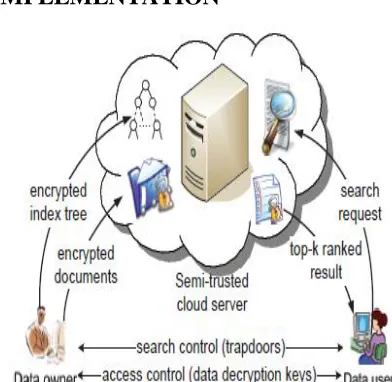
Fig 1: Architecture
3.1 Information Owner Module
This module benefits the proprietor to enlist those
points of interest and withal incorporate validate
subtle elements. This module profits the
proprietor to transfer his record with encryption
using RSA calculation. This discovers the
documents to be bulwarked from unapproved
utilizer. Information proprietor has an
accumulation of records F ={f1; f2; :::; fn} that he
needs to outsource to the cloud server in encoded
shape while as yet keeping the capacity to test on
them for solid usage. In our plan, the information
proprietor initially manufactures a safe accessible
tree file I from archive collection F, and afterward
incites an encoded record gathering C for F.
Thereafter, the information proprietor outsources
the encoded gathering C and the safe record I to
the cloud server, and safely disseminates the key
data of trapdoor era and archive unscrambling to
the authorized information clients. In addition, the
information proprietor is in charge of the refresh
operation of his reports put away in the cloud
server. While refreshing, the information
proprietor incites the refresh data locally and
sends it to the server.
3.2 Information Utilizer Module
This module incorporates the utilizer enlistment
confirm subtle elements. This module is used to
profit the customer to test the record using the
different catchphrases idea and get the exact
outcome list predicated on the utilizer question.
The utilizer will winnow the required document
and enlist the utilizer points of interest and get
initiation code in mail email in advance of enter
the enactment code. After utilizer can download
the Zip record and concentrate that document.
Information clients are endorsed ones to get to the
watchwords, the authorized utilizer can incite a
trapdoor TD as indicated by test control
components to get k scrambled records from
cloud server. At that point, the information utilizer
can unscramble the records with the mutual
mystery key.
3.3 Cloud Server and Encryption Module:
This module is used to profit the server to
scramble the report using RSA Algorithm and to
change over the encoded archive to the Zip
document with enactment code and after that
actuation code send to the utilizer for download.
Cloud server stores the scrambled record
gathering C and the encoded accessible tree list I
for information proprietor. After accepting the
trapdoor TD from the information utilizer, the
cloud server executes look over the file tree I, and
determinately restores the comparing store of best
k positioned scrambled records. Moreover, after
getting the refresh data from the information
proprietor, the server needs to refresh the list I and
record gathering C as per the got data. The cloud
server in the proposed conspire is considered as
"fair however inquisitive", which is utilized by
heaps of takes a shot at secure cloud information
look
3.4 Rank Search Module
These modules determine the utilizer to test the
records that are examined every now and again
using rank pursuit. This module authorizes the
utilizer to download the document using his
mystery key to decode the downloaded
information. This module authorizes the Owner to
see the transferred records and downloaded
documents. The proposed plot is intended to give
not just multi-watchword inquiry and exact
outcome positioning, yet furthermore powerful
refresh on report gatherings. The plan is intended
to deter the cloud server from learning
supplemental data about the report gathering, the
list tree, and the inquiry.
4. EXPERIMENTAL RESULTS
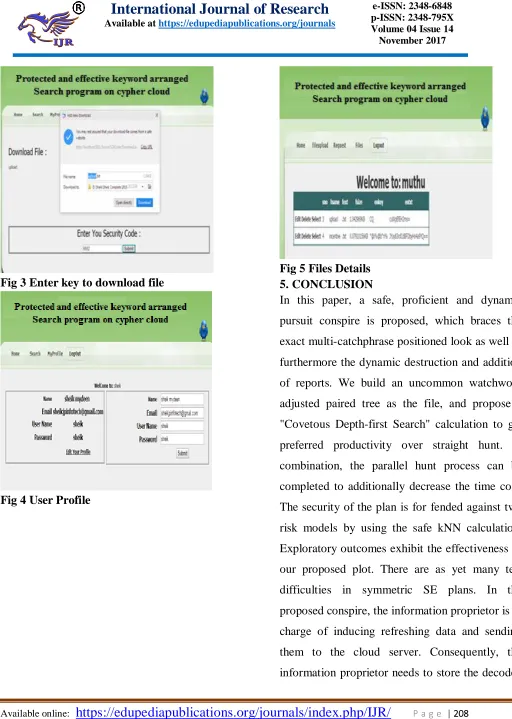
Fig 3 Enter key to download file
Fig 4 User Profile
Fig 5 Files Details 5. CONCLUSION
In this paper, a safe, proficient and dynamic
pursuit conspire is proposed, which braces the
exact multi-catchphrase positioned look as well as
furthermore the dynamic destruction and addition
of reports. We build an uncommon watchword
adjusted paired tree as the file, and propose a
"Covetous Depth-first Search" calculation to get
preferred productivity over straight hunt. In
combination, the parallel hunt process can be
completed to additionally decrease the time cost.
The security of the plan is for fended against two
risk models by using the safe kNN calculation.
Exploratory outcomes exhibit the effectiveness of
our proposed plot. There are as yet many test
difficulties in symmetric SE plans. In the
proposed conspire, the information proprietor is in
charge of inducing refreshing data and sending
them to the cloud server. Consequently, the
file tree and the data that are key to recalculate the
IDF esteems. Such a dynamic information
proprietor may not be exceptionally fitting for the
distributed computing model. It could be a
principal yet strenuous future work to plan a
dynamic accessible encryption plot whose
refreshing operation can be culminated by cloud
server just, in the interim holding the staff to
sustain multi-watchword positioned seek. In
additament, as the a large portion of works about
accessible encryption, our plan chiefly considers
the test from the cloud server. Really, there are
many secure difficulties in a multi-utilizer
conspire. Right off the bat, every one of the
clients routinely keep the same secure key for
trapdoor era in a symmetric SE plot. For this
situation, the repudiation of the utilizer is
cosmically tremendous test. On the off chance
that it is expected to repudiate an utilizer in this
plan, we require to reconstitute the file and
disseminate the early secure keys to all the
endorsed clients. Also, symmetric SE plots
expectedly hypothesize that every one of the
information clients are dependable. It is not down
to earth and a deceptive information utilizer will
prompt many secure problems. For instance, a
duplicitous information utilizer may test the
records and disperse the decoded reports to the
unapproved ones. Much more, a duplicitous
information utilizer may disperse his/her protected
keys to the unapproved ones. Later on works, we
will attempt to alter the SE plan to deal with these
test dilemmas.
6. REFERENCE
[1] Zhihua Xia, Member, IEEE, Xinhui Wang,
Xingming Sun, Senior Member, IEEE, and Qian
Wang, Member, IEEE A Secure and Dynamic
Multi-keyword Ranked Search Scheme over
Encrypted Cloud Data IEEE TRANSACTIONS
ON PARALLEL AND DISTRIBUTED
SYSTEMS VOL: PP NO: 99 YEAR 2015
[2]S. Kamara and K. Lauter, “Cryptographic
cloud storage,” in Financial Cryptography and
Data Security. Springer, 2010, pp. 136–149.
[3]C. Gentry, “A fully homomorphic encryption
scheme,” Ph.D. dissertation, Stanford University,
2009.
[4]O.Goldreich and R. Ostrovsky, “Software
protection and simulation on oblivious rams,”
Journal of the ACM (JACM), vol. 43, no. 3, pp.
431–473, 1996.
[5]D. Boneh, G. Di Crescenzo, R. Ostrovsky, and
G. Persiano, “Public key encryption with keyword search,” in Advances in Cryptology-Eurocrypt
2004. Springer, 2004, pp. 506–522.
[6] D. Boneh, E. Kushilevitz, R. Ostrovsky, and
W. E. Skeith III, “Public key encryption that allows pir queries,” in Advances in
[7] D. X. Song, D. Wagner, and A. Perrig,
“Practical techniques for searches on encrypted data,” in Security and Privacy, 2000. S&P 2000.
Proceedings. 2000 IEEE Symposium on. IEEE,
2000, pp. 44–55.
[8] E.-J. Goh et al., “Secure indexes.” IACR
Cryptology ePrint Archive, vol. 2003, p. 216,
2003.
[9] Y.-C. Chang and M. Mitzenmacher, “Privacy
preserving keyword searches on remote encrypted
data,” in Proceedings of the Third international
conference on Applied Cryptography and
Network Security. Springer-Verlag, 2005, pp.
442–455.
[10] R. Curtmola, J. Garay, S. Kamara, and R.
Ostrovsky, “Searchable symmetric encryption: improved definitions and efficient constructions,”
in Proceedings of the 13th ACM conference on
Computer and communications security. ACM,
2006, pp. 79–88.
Authors Profiles
RAMYA SRI PEGALLAPATI
She received Bachelor degree in Information
Technology from Laqshya Institute of Technology
and Sciences, Khammam in 2015 and persuing
Master’s degree in Computer Science from
Laqshya Institute of Technology and Sciences,
Khammam. Aggregate percentage of Bachelor
degree was 72 and scored 8 out of 10 points in 1st
year of my Master’s degree.
MRS. M. SRI DEVI
She did M-Tech in Computer Science and
Engineering from G.Narayanamma Institute of
Technology and Sciences for Women, Hyderabad
and pursuing Ph.D(Web Security) from JNTUH,
Hyderabad. She has 18 years of total work
experience. Mrs. Sridevi has been working for
LITS since its inception in 2008. As Head –
Department of CSE, She maintains the facilities in
the department and teaches CSE subjects, like
Computer Programming, Java, Operating
Systems, Software Engineering, Data Structures,
DBMS, Information Security, and Web