FIBRIN NETWORK PATTERN CHANGES OF PLATELET RICH
AGE GROUPS AND
1
Dr. Triveni Kale,
2,*Dr. Varsha
1
Professor, P. G guide MGV’s KBH Dental College and Hospital, Nashik, Maharashtra
2,3,4,5
P.G Student MGV’s KBH Dental College and Hospital, Nashik, Maharashtra
ARTICLE INFO ABSTRACT
Background
therapy. The factors that affect fibrin formation and structure may be: Genetic factors, acquired factors and other parameters including the age and gender of the patien
arrangement of fibrin networks within the PRF clot, their capacity to entrap platelets and wbcs and the impact of age and gender of the patient on fibrin network patterns and arrangement have not been highlighted till date.
Aims:
from individuals of different age groups and g Materials and method
distribution. PRF was prepared from blood samples of all patients and were subjected to cell block cytology method of histological analysis and slides will be p
and gender related changes in
(i) Fibrin network patterns in terms of density and
(ii) Entrapment of platelets and white blood cells (wbcs) within fibrin meshwork. Result
Furthermore, variation in a number of platelets and wbcs entrapped within fibrin network in relation to age was noticed.
Conclusion
fibrin network pattern and hence,
Copyright © 2017, Triveni Kale et al. This is an open access
distribution, and reproduction in any medium, provided
INTRODUCTION
The factors that affect fibrin formation and structure may be: Genetic factors, acquired factors like and other parameters including the age and gender of the patient. In relation to PRF various studies till date have been performed for a better understanding of the characteristic features of platelets, wbcsand their role in regeneration. Introduction:
disease is defined as a complex, multifactorial disease characterized by the loss connective tissue attachment with destruction of periodontal tissues.Hence the aim of periodontal treatment is to arrest disease progression and also to regenerate the lost periodontal tissue (Preeja, 2014
regeneration is a complex multifactorial process involving biologic events like cell adhesion, migration, proliferation, and differentiation in an orchestrated sequence.
*Corresponding author: Dr. Varsha Ranmare,
Professor, P. G guide MGV’s KBH Dental College and Hospital, Nashik, Maharashtra.
ISSN: 0975-833X
Vol.
Article History:
Received 05th September, 2017 Received in revised form 23rd October, 2017
Accepted 08th November, 2017 Published online 31st December, 2017
Citation: Dr. Triveni Kale, Dr. Varsha Ranmare, Dr. Govind changes of platelet rich fibrin in different age groups and 63301.
Key words:
Microleakage,
Class II Composite Restorations, Polyethylene fiber Inserts, Glass Fiber Inserts.
RESEARCH ARTICLE
TTERN CHANGES OF PLATELET RICH FIBRIN IN DIFFERENT
AGE GROUPS AND GENDER: A CELL BLOCK CYTOLOGY STUDY
Dr. Varsha Ranmare,
3Dr. Govind Bhartiya,
4Dr.
and
5Dr. Rutuja Sankhe
P. G guide MGV’s KBH Dental College and Hospital, Nashik, Maharashtra
MGV’s KBH Dental College and Hospital, Nashik, Maharashtra
ABSTRACT
Background: Regeneration of the destroyed periodontal tissues is the ultimate goal of periodontal therapy. The factors that affect fibrin formation and structure may be: Genetic factors, acquired factors and other parameters including the age and gender of the patien
arrangement of fibrin networks within the PRF clot, their capacity to entrap platelets and wbcs and the impact of age and gender of the patient on fibrin network patterns and arrangement have not been highlighted till date.
The study is to evaluate the variations in the fibrin network patterns of the PRF clot, isolated from individuals of different age groups and gender.
Materials and method: Ninety patients were divided in three age groups with equal gender distribution. PRF was prepared from blood samples of all patients and were subjected to cell block cytology method of histological analysis and slides will be prepared to histologically assess the age and gender related changes in
(i) Fibrin network patterns in terms of density and
(ii) Entrapment of platelets and white blood cells (wbcs) within fibrin meshwork.
Result: In males and younger individuals more dense pattern seen compared to females and old age. Furthermore, variation in a number of platelets and wbcs entrapped within fibrin network in relation to age was noticed.
Conclusion: So the age and gender can be one of the important factor on quality of PRF i fibrin network pattern and hence, platelet and WBC’s entrapment within these fibrin network.
access article distributed under the Creative Commons Attribution the original work is properly cited.
The factors that affect fibrin formation and structure may be: Genetic factors, acquired factors like and other parameters including the age and gender of the patient. In relation to PRF various studies till date have been performed for a better ing of the characteristic features of platelets, Introduction: -Periodontal disease is defined as a complex, multifactorial disease characterized by the loss connective tissue attachment with issues.Hence the aim of periodontal treatment is to arrest disease progression and also to regenerate , 2014). Periodontal regeneration is a complex multifactorial process involving ration, proliferation, and
Professor, P. G guide MGV’s KBH Dental College and Hospital,
Periodontal regenerative procedures include soft tissue grafts, bone grafts, root biomodifications, guided tissue regeneration, and combinations of these procedures. Periodontal wound healing requires a sequence of interactions between epithelial cells, gingival fibroblasts, periodontal ligament cells, and osteoblasts. The disruption of vasculature during wound healing leads to fibrin formation, platelet aggregation, and release of several growth factors into tissues from platelets through molecular signals which are primarily mediated by cytokines and growth factors. There is evidence that the presence of growth factors and cytokines in platelets play key roles in inflammation and wound healing
natural blood clot is seen to contain 95%
(RBCs), 5% platelets, <1% white blood cells (WBCs) and numerous amounts of fibrin strands
natural blood clot is seen to contain only a small percentage of platelets which, however, are seen to have a central role in the process of regeneration.
International Journal of Current Research
Vol. 9, Issue, 12, pp.63297-63301, December, 2017
Ranmare, Dr. Govind Bhartiya, Dr. Mitali Thamke and Dr. Rutuja Sankhe
fibrin in different age groups and gender: a cell block cytology study”, International Journal of Current Research
Available online at http://www.journalcra.com
FIBRIN IN DIFFERENT
STUDY
Dr. Mitali Thamke
P. G guide MGV’s KBH Dental College and Hospital, Nashik, Maharashtra
MGV’s KBH Dental College and Hospital, Nashik, Maharashtra
Regeneration of the destroyed periodontal tissues is the ultimate goal of periodontal therapy. The factors that affect fibrin formation and structure may be: Genetic factors, acquired factors and other parameters including the age and gender of the patient. The patterns and arrangement of fibrin networks within the PRF clot, their capacity to entrap platelets and wbcs and the impact of age and gender of the patient on fibrin network patterns and arrangement have not been
The study is to evaluate the variations in the fibrin network patterns of the PRF clot, isolated
Ninety patients were divided in three age groups with equal gender distribution. PRF was prepared from blood samples of all patients and were subjected to cell block repared to histologically assess the age
(ii) Entrapment of platelets and white blood cells (wbcs) within fibrin meshwork.
pattern seen compared to females and old age. Furthermore, variation in a number of platelets and wbcs entrapped within fibrin network in relation
So the age and gender can be one of the important factor on quality of PRF in terms of platelet and WBC’s entrapment within these fibrin network.
License, which permits unrestricted use,
Periodontal regenerative procedures include soft tissue grafts, bone grafts, root biomodifications, guided tissue regeneration, and combinations of these procedures. Periodontal wound healing requires a sequence of interactions between epithelial ngival fibroblasts, periodontal ligament cells, and osteoblasts. The disruption of vasculature during wound healing leads to fibrin formation, platelet aggregation, and release of several growth factors into tissues from platelets which are primarily mediated by cytokines and growth factors. There is evidence that the presence of growth factors and cytokines in platelets play key roles in inflammation and wound healing (Deodhar, 1997).The natural blood clot is seen to contain 95% red blood cells (RBCs), 5% platelets, <1% white blood cells (WBCs) and numerous amounts of fibrin strands (Sunitha Raja, 2008). This natural blood clot is seen to contain only a small percentage of platelets which, however, are seen to have a central role to play
INTERNATIONAL JOURNAL OF CURRENT RESEARCH
63297-Various biomaterials used for tissue healing and bone regeneration like fibrin glue, PRP, PRF. Fibrin glue was first described in 1970 and is formed by polymerizing fibrinogen with thrombin and calcium (Sunitha Raja, 2008). However the quality and stability of fibrin glue is low due to low concentration of fibrinogen in plasma. Platelet rich fibrin was first introduced by Marx et al. (1998) as it is a autologous modification of fibrin glue.PRP is a platelet concentrate which contains plasma and three proteins (fibrin, fibronectin and vitronectin). Which act as cell cell adhesion molecules for osteoconduction and epithelial migration. As it is constituted with strong thrombin concentrations, allows the thickening of fibrin polymers which leads to a rigid network, not very favorable to cytokine enmeshment and cellular migration (Prakash et al., 1995). Platelet rich fibrin (PRF) was first developed in France by Choukroun et al in 2001. This second generation platelet concentrate. Its advantages over platelet rich plasma include ease of preparation, ease of application, minimal expense, and lack of biochemical modification (no bovine thrombin or anticoagulant is required).
This considerably reduces the biochemical handling of blood as well as risks associated with the use of bovine derived thrombin. PRF blood clot contains platelet concentration (>97%), high enough to accelerate the soft and hard tissue healing. PRF consist of a fibrin matrix polymerized in a tetra molecular structure, with the incorporation of platelets, leukocytes, cytokines, and circulating stem cells. The factors that affect fibrin formation and structure may be: Genetic factors, acquired factors like (abnormal concentration of thrombin and factor XIII in plasma, blood flow, platelet activation oxidative stress, hyperglycemia, hyper- homocysteinemia, medications, and cigarette smoking) and other parameters (such as microgravity, ph, temperature, reducing agents and concentration of chloride and calcium ions).[6] including the age and gender of the patient. In relation to PRF various studies till date have been performed for a better understanding of the characteristic features of platelets, WBCs and their role in regeneration. However, the patterns and arrangement of fibrin networks within the PRF clot, their capacity to entrap platelets and WBCs and the impact of age and gender of the patient on fibrin network patterns and arrangement have not been highlighted. Thus,this is study aims to evaluate the variations in the fibrin network patterns of the PRF clot, isolated from individuals of different age groups and gender. Subjects and Methods: The study protocol involved blood sample collection, PRF preparation and preparation of slides for histological analysis. Patient were selected from “MGV’s KBH dental college and hospital” Nashik. subjects were randomly selected from those attending the department of period otology and department of oral pathology. The inclusion criterion for this study was patients with a normal platelet count for all age groups. The exclusion criteria included tobacco smoking and chewing habits, platelet and coagulation disorders, systemic diseases/conditions, medications affecting the blood, pregnant and lactating women. Ninety patients were divided into three groups thirty samples in Group 1 (20–39 years) (M/F = 15/15); 30 samples in Group 2 (40–59 years) (M/F = 15/15), and 30 samples in Group 3 (60 years and above) (M/F = 15/15).
Platelet-rich fibrin (second generation) preparation
Intravenous blood 3–4 ml (by venipuncture the antecubital vein) was collected with a 5ml disposable syringe and was
immediately transferred to disposable vacuum test tube without adding anticoagulant so the platelets of blood sample react with the glass particles of glass test tube and the release of coagulation cascades so thrombin is converted into fibrin. Centrifugation done at 3000 rpm (approximately 400gms) for 10 min in the centrifugation machine (REMI). Because of differential densities, it resulted in the separation of three basic fractions:
A base of RBCs at the bottom, acellular plasma on the surface, and finally a PRF clot between the two The PRF clot thus formed was obtained with the help of sterile tweezer and scissors by cutting it in such a manner as to preserve a small RBC layer since the platelets and WBCs are concentrated in an intermediate layer located between RBCs and the PRF clot.
Cell Block Cytology Method
Cell block cytology is method of analyzing fine needle aspiration cytology fluids by Cytopathologists. So the isolated clots of PRF were prepared into slides by cell block cytology method.
Steps of Cell Block Cytology
Fixing: the isolated PRF clots were transferred into
perforated stainless steel cassette which is containing small chit with patient no. for ease of identification and the cassette is transferred to the 10% formalin where they were fixed for 24 hrs.As it helps to preserve biologic tissue in a life like state thereby preventing autolysis.
Tissue processing: after 24 hrs,from the 10%formalin
it is passed through various processing solutions such as 10% formalin, 60%, 70%, 80%, 90%, and 100% isopropanol alcohol, xylene (two changes) and paraffin wax in an orderly manner. The aim of tissue processing is to remove water from tissues and replace with a medium that solidifies to allow thin sections to be cut.
Embedding: tissues were embedded in mould which is
leucher blocks with paraffin wax.It support to the tissue section for sectioning and production of a slide.
Tissue staining
Tissue sectioning: sectioning was done using
Dewaxing: dewaxing done by heating slide for 550C and then immersed into xylene to eliminate wax. Main aim of dewaxing is to allow tissue to be stain.
Tissue staining: sections were stained using
hematoxylin and eosin stain. It gives contrast to the tissue as well as highlighting particular features of interest.
After staining slide numbering done according to the order of patients maintained in the register of deparment of oral pathology and histological slide analysis done by using compound microscope 20x, 40x, 100x magnification.
RESULTS
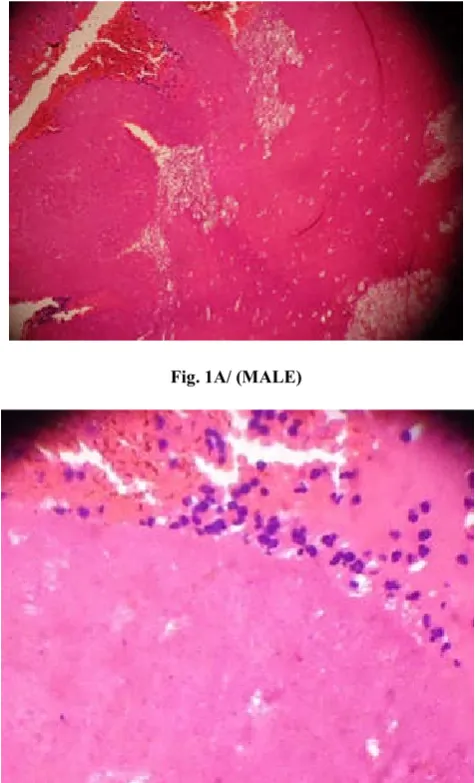
Stained sections were assessed according to various age and gender for 1) dense or loose fibrin pattern network,2)the entrapment of platelet and WBC’s within dense and loose fibrin pattern networks. The histologic section of all age groups and gender shows outermost layer of RBC’s followed by fibrin network pattern with entrapment of platelets and WBC’s. The result of study shows that patients belonging to the age group 20yrs to 40 yrs shows both type of fibrin network pattern with domination of dense fibrin pattern and it also shows that the homogenous distribution of platelets and WBC’s. In males more dense pattern of fibrin network seen compared to females (Fig1. a & 1b).
Fig. 1A/ (MALE)
Fig 1B. (FEMALE)
Patients belonging to 40yrs to 60yrs shows equal distribution of dense and loose fibrin network pattern.There were some areas within dense network fibrin were assessed with loose fibrin pattern.Entrapment of platelets and WBC’s in dense pattern is more compared to loosely arranged fibrin in which scattered distribution of platelets and WBC’S were assessed.Males and females shows homogenous distribution of dense and loose fibrin pattern (Fig. 2a & 2b).
Fig. 2A. (MALE)
Fig. 2B (FEMALE)
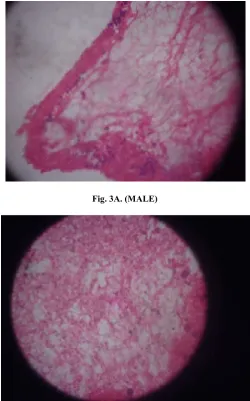
Patients more than 60yrs of age equal distribution of fibrin pattern were assessed with dominant loose fibrin network pattern and minimal entrapment of platelets and WBC’s. Males and females shows loose fibrin pattern compared to dense fibrin pattern but it is less dense in males compared to females (Fig. 3a & 3b)
DISCUSSION
[image:3.595.319.550.158.329.2] [image:3.595.315.550.170.545.2] [image:3.595.44.282.380.772.2] [image:3.595.48.279.380.549.2]Fig. 3A. (MALE)
Fig. 3B. (FEMALE)
In current we found two types of fibrin pattern network:-1) dense fibrin pattern.2) loose fibrin pattern; the dense fibrin pattern associated with RBC layer withsite of platelet distribution and its quality and quantity reduced in older patients and in females. The area which is away from the platelet distribution is loose type of fibrin pattern. It shows that in younger age group and males there is dense fibrin pattern with more no. Of platelet and WBC’s and in older age group and females less dense pattern seen with minimum no. Of platelets and WBC’s. The biochemical analysis of the PRF composition indicates that this biomaterial consists of an intimate assembly of cytokines, glycanic chains, structural glycoproteins enmeshed within a slowly polymerized fibrin network. These biochemical components have well known synergetic effects on healing processes.
Tissue injury causes blood vessels disruption with continuous extravasation of blood constituents. Blood coagulation and platelet aggregation generate a fibrin rich clot that plugs severed vessels and fills any discontinuity in the wounded tissue (Clark, 2001). The formation of a platelet thrombus is dependent on the platelet glycoprotein iib-iiia, which binds to its bivalent ligand fibrinogen and thereby cross-links the platelets (Phillips, 1988). This results in the generation of thrombin on the platelet surface and the formation of a fibrin network. Thus, this step throws light on a very important function of platelets, i.e., “procoagulant activity” which the
collagen adherent platelets exhibit and hence mediate the fibrin network formation at the site of injury (Kirchhofer et al., 1995). Soluble factors that may be responsible for wound angiogenesis that is process of formation of new blood vessels include basic fibroblast growth factor (bfgf), vascular endothelial growth factor (VEGF), angiopoietin, PDGF, and many other. Several isoforms of VEGF and angiopoietins have been identified that effect endothelial cell growth and angiogenesis differentially. Thus, correlating the interactions between platelets and fibrin network in the natural process of wound healing, with that of biochemical analysis of the PRF composition indicates that, the fibrin network density and distribution is directly proportional to the distribution of platelets in association with them.
Laurens et al. Stated that the outcome of wound healing depends largely on the fibrin structure, such as the thickness of the fibers, the number of branch points, the porosity, and the permeability (Laurens, 2006). Second, wound healing also depends upon the platelet concentration and their functions. Hence, focusing on the fibrin network functions in wound healing and their interaction with platelets and wbcsbecome very important for us to know in detail, the factors which can influence the fibrin network structure. Shravanthi et al studied the fibrin pattern network changes in various age groups and concluded that age can be considered as one of the influencing factors on quality of PRF in terms of fibrin network patterns (Yajamanya et al., 2016). This article shows that age and gender can influence the pattern of fibrin network. Graph A and Graph B shows the comparison of different fibrin pattern in various age group and gender. As it is a influential factor in the efficacy of PRF clot in regeneration and wound healing. Study done by using cell block cytology method as the advantages are cost effective, easily available, and less complicated and PRF is derived from patients own blood. However it is difficult to preserve the PRF.
This method has been performed by using hematoxyline and eosin stain, proved to be satisfactory in identifying the variations in the fibrin network pattern and distribution with age and gender and also the variations in platelet– wbcsconcentrations entrapped within them. However some of the drawbacks were assessed inability to correctly appreciate the changes in the individual fibrin strand morphology and thickness, difficulty in identifying and separating out the platelets and wbcsfrom each other represented by hematoxylin staining and exact counting of the platelets entrapped within the fibrin meshwork. This study can conclude that age and gender can play important role in altering the fibrin pattern network and in turn entrapment of platelets and WBC’s and influcencing the quality of the PRF clot. However, futher studies focusing on finding out the influence of nutrition in association with the age on fibrin pattern network and platelets, WBC’s entrapment.
Conclusion
[image:4.595.37.288.53.455.2] [image:4.595.40.287.53.235.2]REFERENCES
A review. J Postgrad Med 1997;43:52−6.
Clark RA. 2001. Fibrin and wound healing. Ann N Y Acad Sci., 936:355-67.
Deodhar AK, Rana RE. Surgical physiology of wound healing: Kirchhofer D, Tschopp TB, Steiner B, Baumgartner HR. 1995.
Role of collagen-adherent platelets in mediating fibrin formation in flowing whole blood. Blood.,86:3815-2 Laurens N, Koolwijk P, De Maat MPM. 2006. Fibrin structure
and wound healing. J Thromd Haemost., 4:932–9.
Marx RE, Carson ER, Eichstaedt RN, et al. 1998. Platelet-rich plasma: Growth factor enhancement for bone grafts. Oral
Surg Oral Med Oral Pathol Oral Radiol Endod.,
85:638-46.
Nunes, C. R., M. T. Roedersheimer, M. W. Luttges. 1995. Effect of Microgravity, temperature, and concentration on fibrin and collagen Assembly. Microgravity Sci. Technol. 8:125–130
Phillips, D.R., Charo, I.F., Parise, L.V. and Fitzgerald, L.A. 1988. The platelet membrane glycoprotein iib-iiiacomplex. Blood 71, 831–843
Prakash S, Thakur A. 2011. Platelet concentrates: past, present and future. J Maxillofac Oral Surg. 10(1):45–9.
Preeja C, Arun S. Platelet-rich fibrin: Its role in periodontal regeneration. Saudi J Dent Res. 2014;5:117–22.
Sunitha Raja V, Munirathnam Naidu E. Platelet-rich fibrin: Evolution of a second-generation platelet concentrate.
Indian J Dent Res., 2008;19:42-6.
Yajamanya SR, Chatterjee A, Babu CN, Karunanithi D. 2016. Fibrin network pattern changes of platelet-rich fibrin in young versus old age group of individuals: A cell block cytology study. J Indian Soc Periodontol. 20:151–156.