LOW FREQUENCY INFRARED AND OTHER STUDIES OF COORDINATION COMPLEXES
A thesis presented for the
degree of Doctor of Philosophy in Chemistry in the University of Canterbury~
Christchurch, New Zealand.
by
A.Mo BRODIE
ACKNOWLEDGEMENTS
The author is most grateful to Professor C.J. Wilkins for his guidance and encouragement. He also thanks Dr G.A. Rclley for many helpful
discussions.
ABSTRACT
This thesis is divided into two main sections. Section I is concerned with oxygen and sulphur ligand complexes o~ the divalent first row transition metals, and oxygen and nitrogen ligand complexes o~ the Group VB trihalides are described in Section II.
Section I
(1) The preparation of new tertiary phosphine sulphide and arsine sulphide complexes of cobalt (II) is
reported.. Comparative spectral and magnetic data ar•e presented for the tetrahedral oxo- and thio-ligand complexes o~ the types [CoL
4
J(Cl04
)
2 and CoL2x
2 (X=
Cl, Br and I). ( L=
Me3Po and Me3Ps; Me3As 0 and
Me
3AsS)e In the perchlorate complexes corresponding oxo- and thio-ligands ~roduce similar ligand field
splitting energies, but lower
p
values o~ the sulphides and higher intensities of their spectral oands point to their greater covalent charactere The considerably lower magnetic moments of [CoL4
](Cl04)
2 thio-complexes as compared with their oxo-analogues is further evidence for differenc~in metal-oxygen and metal-sulphur bonding. Electronic spectra fo:r the [CoLcomplexes. /(P) transition band shapes
I .
and intensity distributions are virtually identical for both the phosphine and arsine sulphides. In contrast the characteristic profiles produced by phosphine oxides are different from those produced by arsine oxid~s. Metal-ligand vibrations have been assigned for cobalt and corresponding zinc complexes.
(2) Spectral and magnetic results show that
trimethylarsine sulphide continues to give tetrahedral [M(Me
3
Ass)4
J
(Clo4
)
2 and M(Me3
Ass)2 x2 (X= Cl1 Br) complexes with iron (II) and nickel (II)~ The low (3value and magnetic moment of [Ni(Me
3AS s)
4
J
(Clo4
)
2 again demonstrates the high metal~ligand covalencyproduced by thio-ligandse Metal-ligand vibrations fall in the same frequency range as observed for cobalt (II) complexes.
By contrast trimethylarsine oxide reacts with the dihalides of iron, cobalt and nickel to give bridged octahedral M(Me
suggest that polymerisation is being achieved via oxo- rather than halogen bridges w Further evidence
is obtained from the infra-red spectra of the anGllogous M(Me
3As o)2 (NOS )2 th:tocyopmte con1J?lGxee o
(3) The preparation of high-spin five-co-ordinate [ML
5
J
2+ and [ML
4
(clo4
)J + complexes with trimethylarsineoxide is described for a number of first-row, divalent, transition metal ionso The electronic spectra of these complexes more closely resemble the spectra obtained for other complexes known~ from X-ray analysis~ to have a basically square pyramidal structure rather than those of the trigonal bipyramidal classD Five co~ordination is considered to be stabilised by the steric requirements of the ligande Metal-ligand stretching vibrations are assigned and their
frequencies compared with values for related tetra-hedral complexes.
Section II
Metal-ligand stretching frequencies have been assigned for Mx
3 dipy and MX3L2 ( L := py, pyO and Ph
3As 0) complexes of arsenic,. antimony and bismuth. For the arsenic and antimony MX
germanium and tiny MX
4
L2 compoundso However, v(Sb -X) values are signH'ican"tly lower than }J(Sn - X).Terpyridyl complexes are varied. Their compositions and constitutions were elucidated by spectral and
conductivity studies. Antimony complexes are f'ormulated
+
2-as [SbX2terpyJ 2 SbX
5 and arsenic complexes as [As 01
2 terpy] + As 014 - and [As Br2 terpy] + Br- .. The 'bismuth complex [Bi 01
CONTENTS
GENERAL INTRODUCTION
SECTION I Me
3As0 and Me3AsS, and related ligand
complexes of the divalent first-row transition elements Introduction to Section I
1. Tetrahedral Cobalt(II) Complexes Introduction
Results and Discussion 2. Bridged octahedral Me
3As0 complexes and tetrahedral Me
3AsS complexes Introduction
Results and Discussion
3.
High-spin 5~coordina te (ML5
J
2+ and [ML
4
(
Clo4
)]
+ complexes 1 5 814
4244
Introduction 76
Results and Discussion 80
4.
ExperimentalPreparation of Complexes 100
Preparation of Ligands 117
Physical Methods 121
Appendices I Attempted oxo-thio comparisons 126
SECTION II
REFERENCES
II Spectral Parameter Calculations 129
Some complexes of the Group VB trihalides Introduction
Results and Discussion Experimental
134
140
SECTION I Fts;ur~ 1 2 3
4
5 6 7 8 9 10LIST OF FIGURES
After Page
Calculated energy levels for oobalt(II) in a T d field
v~ band profiles for solution spectra of -LCoL
4
J
2+ species.Electronic spectra of iron(II) complexes Electronic spectra of cobalt(II) complexes Electronic spectra of nickel(II) complexes Structures of bridged octahedral complexes Infrared spectra in the As-0 stretching region
Calculated energy levels for nickel(II) in
a Td field
Geometries for 5-coordinate species
Electronic spectra of 5-coordinate complexes 18
26
46
46
46
53
53
65
7884
SECTION II
1 2 SECTION Table 1 2 3 4a I
Structures of (NH
4)2SbC15 and SbC132Ph3AsO Infrared spectra of terpyridyl complexes
LIST OF TABLES
134 142
page
Tetrahedral Co(II) complexes (Chapter 1) 12 d values for X-ray powder lines 13 Electronic spectra of Td Co(II) complexes 16 Spectral parameters for Td (CoL
LIST OF TABL.ES (Contd)
Table
4b Spectral parameters for Td CoL2X2 complexes 18
5
Spectral parameters for Td thio-complexes 236
Magnetic data for Td Co(II) complexes 24 7 Infrared spectra of the ligands 338' Infrared spectra of Co(II) and Zn Td conplexes 34 9 Shifts in Y(P-S) and V(As-S) on coordination 40 10 P-O, P-S and As-S stretching frequencies 41 11 Me
3As0 and Me3AsS complexes 4.3 12 Electronic spectra of bridged octahedral
M(Me
3Aso) 2
x
2 complexes · 47 13 Spectral parameters of bridged octahedralcomplexes 48
14 Magnetic data for bridged octahedral complexes 49 15 Infrared spectra of bridged octahedral
complexes 54
16 Infrared spectra of thiocyanate complexes 55 17 Infrared spectra of Co(Me
3Aso) 2
x
2 complexes 60 18 Electronic spectra of Fe(II) and Nl(II)Me
3AsS complexes 62
19 Spectral parameters of [Ni(Me
3Ass)J (Clo4)2 66 20 Spectral parameters for Td Me~sS complexes 67 21 Magnetic data for Td Me
3AsS complexes 68 22 Infrared spectra of Td Me
3AsS complexes
.71,
23 v(M-S) frequencies for Td Me3AsS complexes 72
24 M(Me~so)
2
x2
complexes 7525 5-coordinate Me
3As0 complexes 79
26 Electronic spectra of 5-coordinate complexes 85 27 Magnetic data for 5-coordinate complexes 86 28 Infrared spectra of 5-coordinate complexes 91 29 )/(M-0) for 4- and 5-coordinate complexes 90 30 5-coordinate [ML
SECTION II Table
1
2 3
4
5 6 7 8
9
10
LIST OF TABLES (Contd)
Reported Group VB pyridine complexes Group VB terpyridyl complexes
Reflectance spectra of Sb017. complexes
..J
Group IVB terpyridyl complexes Conductivities of oxo-complexes Infrared spectra of nitrogen ligand
complexes
Infrared spectra of oxygen ligand complexes Infrared spectra of Group lVB complexes
V(M-X) and
V(M-1)
for Group IVB and VBcomplexes
Y(M-L)
for GroupVB
and transitionmetal
halide complexes137 142 1 L1.4 145 147 154 156 158 161
The prenent work ie primarily a comparative study
involving a variety of coordination compounds which
all can be regarded as being of' the general type
MXa~' where M is a central metal ion- X a coordinated or uncoordinated anion and L a neutral ligand.
Examples are Ni01
2(Me3AaS)2, SbBr3(pyo) 2 and
Mn(Clo
4
)
2 (Me3Aso)5
.
In a given series either M, X or L have been systematically varied and the resultantchanges in stereochemistry and the nature of the M-L
bond investigated. A comparison of the effects of
changing the 1 donor atom from oxygen to sulphur, using
trimethylarsine oxide and sulphide, and related ligand
complexes of the divalent first row transition elements
has been made (Section I). The effects of varying M
and X, using some Group VB trihalide complexes has
also been studied (Section II) and comparisons made
with related Group IVB and transition element complexes.
The present work involved the use of a number of physical methode. Electronic spectra have been used
to distinguish between four~ five and six-coordinate complexes and also to give information about the
found to be significantly lower for the tetrahedral
cobalt(II) thio-complexes than for their
oxo-analogues demonBtrating the greater metal-ligand
covalency produced by the thio-11gands.
In certain cases, such as the nickel and cobalt
halide complexes, magnetic moments distinguish between
octahedral and tetrahedral stereochemistries, thus
complementing spectral information. Electron
delocalisa tion may a.lso effect magnetic momenta, as was observed for the tetrahedral cobalt(II)
thio-complexes.
In cases where electronic spectra and magnetic
measurements fail to distinguish between possible coordination nu~bers, X-ray powder photographs may establish isomorphism with a complex of known
stereo-=1
In the region above 500 em ~ infrared spectros= copy has been used to establish ligand coordination.
Certain changes in ligand frequencies, such as a
decrease in the arsenic-oxygen stretching frequency for arsine oxide complexes~ are indicative of complex formationp and may also be characteristic of the
coordination environment.
Finally, extensive use of low frequency infrared
spectroscopy has been made in the present work.
This technique is being used increasingly in the
study of inorganic compounda 1 , 2
,3.
Metal-ligand andmetal-halogen stretching frequencies, which occur in
-1
the region below 500 em , frequently give information
about the nature of bonding and the structure of
complexes. Although B'Uch absorptions have been
assigned as
y(M-0), Y(M-N)
or Y(M-Cl) for example,it is realised that these may not be pure stretching modes but may involve bending components or coupling
with ligand modes. However in a closely related
serieo of complexes the degree of mixing of vibrations
will probably be approximately constant, and changes
in metal-ligand stretching frequencies can therefore
be correlated with changes in metal-ligand bond stretching force constants. Metal-h~logen and
metal-ligand frequencies are often characteristic of
structure and stoichiometry. For example the
differentiation of the tetrahedral and bridged
octa-hedral isomers of the formula MX2L2 has been
accom-plished.
Far infrared spectroscopy is of particular value when neither electronic spectra nor magnetic
measure-menta give structural i·nformation, as is the case for
complexes of metal ions involving filled d shells.
However, whenever possible, low frequency infrared
spectroscopy has been employed in conjunction with
the other physical methods to provide the fullest
information about the bonding and structures of the
coordination complexes.
SECTION I
TRIMETHYLARSINE OXIDE, TRIMETHYLARSINE SULPHIDE
AND RELATED LIGAND COMPLEXES OF THE DIVALENT FIRST
INTRODUCTION
In this section a comparison of the effects produced by related oxo- and thio-ligands has been made. Such ligands are often mutually exclusive in their reactivity; oxo-ligands generally forming
stable complexes with 11claas a" or "hard" metal ions,
and thio-ligands forming stable complexes with "class b11 or 11 soft" metal ions4' 5. Therefore in order to ·obtain comparative data, the divalent metal ions of
manganese~ iron, cobalt, nickel, copper and zinc, which lie on the boundary between the "class a" and
11 class b" acceptors, were chosen· for study.
To avoid any possible complications arising from chelation, only monodentate ligands have been considered, those used being of the type
n
3
zy
(where R = Ph, Me; Z = P,As; andY= o,s). Several other systems were investiga-ted but found to be unsuitable. (Appendix I).Whereas the tertiary phosphine and arsine oxides (R
3
Po andn
3
As0) are known to react readily with thedivalent ions of the first row transition elements
6-9
stable complexes of the corresponding sulphides (R3
Ps
and R
3
As8) have been reported mainly with typical11 class b11 elements 10
= 1 6• . Previous workers 13
~
16have found no evidence for complex formation between the sulphides Me
3Ps, Ph3Ps and Ph3AsS, and the
dihalides of cobalt and nickel. However, the phos-phine sulphidL complexes11 ,1
7
ZnL2
x
2 (where L=
Me
3Ps, Ph3
Ps
and Ph~sS) and (zn(Me3Ps)4J(Clo4)2,and a triethylaraine sulphide complex18 Co(Et
3Ass) 2cl2 have been described briefly. No
trimethylarsine sulphide, Me
3AsS, complexes have been reported previously.
In the present work structurally analogous oxo-and thio-ligoxo-and complexes have been obtained thus facilitating a direct comparison of the effects
produced by these ligands. Spectroscopic and magnetic properties of the corresponding pairs of tetrahedral
complexes formed between cobalt(II) and the ligands Me
3Po and Me3Ps, Me3As0 and Me3AaS, and Ph3As0 and
Ph
3AsS have been compared (Chapter 1). (Results in Chapter 1 were jointly analysed with Miss S.H.Hunter, who prepared the tetrahedral cobalt(II) oxo-ligand complexes.) The work was then extended (Chapter 2) to include an investigation of the coordination properties of divalent manganese, iron, nickel and copper towards trimethylarsine oxide and sulphideu These ligands were chosen to represent tho Me
3zy class,
since preliminary investigations indicate4 that their complexes were more readily isolated and less hygro-scopic than the corresponding Me
3
Po
and Me3Ps
compounds. It was found that although both the oxo-and thio-complexes have the same general formulae, ML
4
(olo4
)
2 and ML 2x2 , they are structurally dirterent. Finally the complexes of trimethylarsine oxide andthe divalent porchloratea were investigated in more detail because they were found to be five-coordinate (Chapter 3)e
Although the metal-ligand stretching frequencies for oxo-ligand complexes are well established9 '19•20, lese is known about the corresponding
thio-1
frequencies o Mainly bidentate sulphur ligand
1
complexes have been investigated , and so the identification of the Y(M-S) mode for a series of monodentate sulphur ligand complexes was of interest,
the usual. difficulties and uncertainties associated with chelate ligands being avoided. The simplicity of the spectra of the Me
3zy ligands makes the infrared apectra of their complexes particularly attractive for study.
CHAPTER 1
INTRODUCTION
In contrast to earlier reporta13
,i4
it is found that both tertiary phosphine and arsine.sulphides react with cobalt(II) salts. With trimethylphos-phine and arsine sulphides a full range oftetrahedral [CoL
4
J(Ol04
)
2 and OoL2x
2 (where L=
MejPS and Me3AsS; X
=
01, Br I and NOS) compounds were obtained. Triphenylarsine sulphide, Ph3AsS, also reacts, although only impure products could be
isolated (p.115"). There was no definite indication of complex formation between triphenylphosphine
sulphide~ rh
3
Ps,
and cobalt(II).Me
3As0 and Ph3As0 all react with cobalt perchlorate and halides to give the corresponding tetrahedral oxo~
complexes [OoL
4
J
(0104
)
2 and OoL2x
2,B,i9,
21 an
opportunity is provided tr make a direct comparison of the effects produced by monodentate oxo~ and
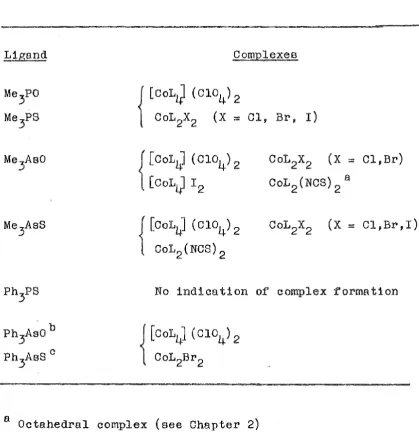
thio-ligands. The complexes studied are listed in Table 1. Only in the cobalt iodide and thiocyanate complexes of Me 3Aso and Me
3AsS are there significant structural differenceso Trimethylarsine sulphide gives the
tetrahedral Co(Me3Ass) 2
r
2 complex while trimethylarsine oxide gives an ionised complex [Co(Me3
Aso)4
Jr
2, witha tetrahedral cation.
coordinate through bridging in the crystalline state, (see Chapter 2), in contrast to Co(Me
3As8) 2(NCS) 2 which is tetrahedral.
Examples of corresponding pairs of stable complexes with monodentate oxo- and thio-ligands, such as those studied in the present work, are not
common. Both hexamethylphosphoramide, (Me2N)
3Po22 , 23
and tris(dimethylamino)phosphine sulphide, (Me2N)
3
Ps
2
4
have been reported to give tetrahedral [OoL4
]
(0104
)
2 and OoL2X2 complexes. Other oxo-thio pairs ofcobalt(II) complexes involve the
::c=
0 and .::::0= S donor groups, but comparisons obtainable from such complexes appear to be limited. Dimethylacetamide.(dma) 25 ,26 and dimethylthioacetamide (dmta) 27 give a full range of tetrahedral [OoL
4
J(Cl04
)
2 and CoL2x
2 complexes. However, it has been suggested fromspectroscopic data, that although the oxygen is acting as the donor atom in the (co(dma)
4
J
(Clo
4
)
2 complex, the nitrogen may also be weakly bonded25.
A similar aeries of complexes can also be obtained with tetra-methylurea (tmu) 28•29
and tetramethylthiourea (trntu) 29,3°,
but the electronic spectra of the thio-complexea have not been reported and since the tetramethylureacomplexes are very hygroscopic, difficulty was found in obtaining reliable magnetic measurements from
) 28
[Co(tmu)L~)(Clo
4
2 .Corresponding pairs of oxo- and thio=ligand
0 10
complexes with metal atoms having a d or d
configuration are more common. Triphenylarsine ox1de9 and sulphide17 both react with zinc halides giving ZnL2
x
2 complexes. Tin tetrahalides react
with Me
3Po
19 and Me
3Ps31 to give sn.x
4
~2L complexes,which are presumably octahedral. With mercuric chloride, 1:1 adducts are formed with Ph
3As0 3
2 and
Ph
3Ass 1
4;
however9 the oxo-complex is dimeric withbridging arsine oxide liganda33 , whereas the
structure of the thio-complex is not knowno Ethers and th:1.oethers react with the trihalides of aluminium and gallium
3
4
and with the pentachlorides of niobium and tantalum35,
giving MX3
L and MC15
L complexesrespectively. Such correspondi~g pairs of oxo- and thio-11gand complexes have the same stoichiometry, but often no evidence is presented to indicate that
the compounds are structurally similar.
In this chapter a direct comparison of the effects produced by corresponding oxo- and
thio-ligands has been made using the structurally analagous
pairs of tetrahedral [CoLL~J(Cl0
4
)2
and CoL2X2complexes (where L :::: Me
3
Po
and Me3Ps,
Me3As0 and Me3AsS ·and Ph3Ao0 and Ph3AaS). Zinc complexes have been included as reference compounds.
12
TABLE 1
Tetrahedral.Cobalt{II) Com~lexes Studied in Chanter 1
Ligand ComplexeE!_
Me
3
Po
{ [OoLJ (0104)
2Me
3Ps CoL2X2 (X
=
Cl, Br, I) Me3
As0 { [ooLJ (0104)
2 CoL2x
2 (X=
Cl, Br) [CoLJ I 2 CoL2(NCS)2a
Me
3AsS { [ooLJ ( 010
4)
2 CoL2X2 (X = Cl,Br,I) CoL2(NCS)2 Ph
3PS No indication of complex formation Ph
3As0 b { [ OoL
4] (
0104)
2Ph_,AsS 0 CoL
2Br2
a Octahedral complex (see Chapter 2) b Ph
3As0 complexes described in ref. 8
[image:24.596.94.514.207.651.2]TABLE 2
d values for X-ray powder lines of ML
2
x
2 tetrahedral comnlexes8
Co(Me
3Aso) 2cl2 7 .. 86m 6.51 s b 5.24s 4.76m 4.07m 3.82s 3.06s
Zn(Me
3As0)2c12 7.,98m 6 .. 53s b 5.26s 4.93m 4.08m 3.83s 3.1 Os
Co(Me
3.Aso)2Br2 8.11m
6 ..
65s b 5.34s 5.01m 4.17m 3.89s 3.14sCo(Me
3AsG) 2c12 b 6.68s 5.89m 5.20s b 4.02m 3.88s 3.1 Os
Zn(Me3AsS) 2C12 b 6'. 71 s 5 .. 91m 5.22s b 4.05m 3.90s 3.11 s
Co(Me
3.Ass)2Br2 b 6.,84s 6.02m 5. 31s b 4.11m 3.95s 3.16s
a
s
=
strong, m=
mediumb
line not observed.
....
[image:25.843.183.747.101.314.2]RESULTS AND DISCUSSION
The new thio-complexes were obtained from hot
acetone or ethanol solutions of the ligand and the
metal salt (p.ioO). For the Me
3AsS complexes, use
of the anhydrous salt was found unneceasary. The
addition of ethylorthoformate considerably
increased the yields of the Me
3
Ps
complexes, andwas essential for the isolation of Ph
3AsS complexes
with cobalt(II). The dehydration of the metal
ions by ethylorthoformate (p.i15) facilitates the
formation of the sulphide complexes. The
tetra-hedral cobalt oxo-complexes were prepared by Miss
S.H. Hunter, and tho correbponding zinc oxo-complexes
were isolated from ethanol solutions of the ligand
and metal salt.
X-ray powder photographs show that groups of
isomorphous compounds are:
(i) CoL
2c12, CoL2Br2w ZnL2c12 and znt2Br2 where L : Me
3Po and Me3AsO. (ii) CoL2c12i CoL
2Br2, CoL2r2, ZnL2c12 and
ZnL2Br2 where L
=
Me3
Ps
and Me3AsS. (iii) [CoL4
J
(Clo4)
2 and [ZnL4
J
(Clo4
)
2 where L=
Me
3
Po and Me3
AeO.( iv) [CoL
4
]
(0104
)
2 and [znL4
]
(0104
)
2 where L =Me
3Ps and Me3AsS. (v) [OoLJ (010
4
)
2 and [ZnL4
]
(0104
)
2 where L =Ph
3AsS.
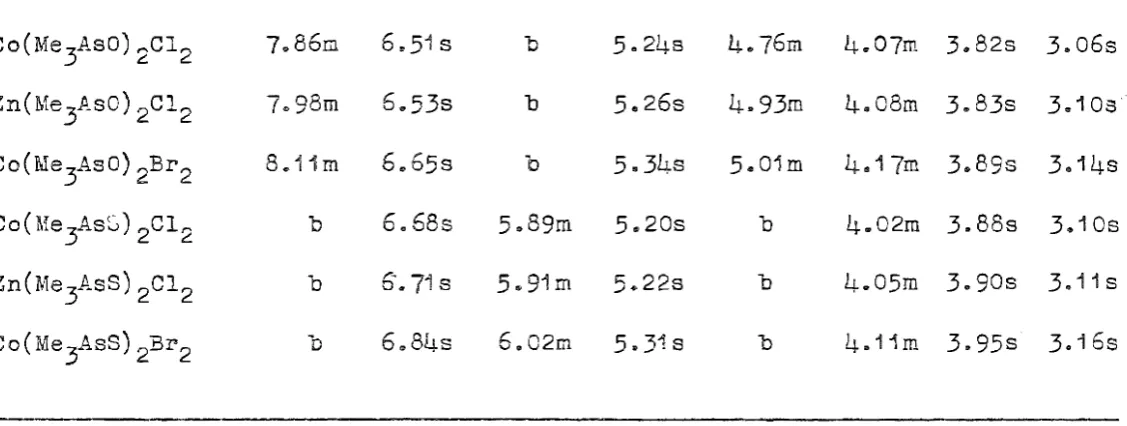
The similarity in the diameters of the stronger lines in the photographs of the group
(1)
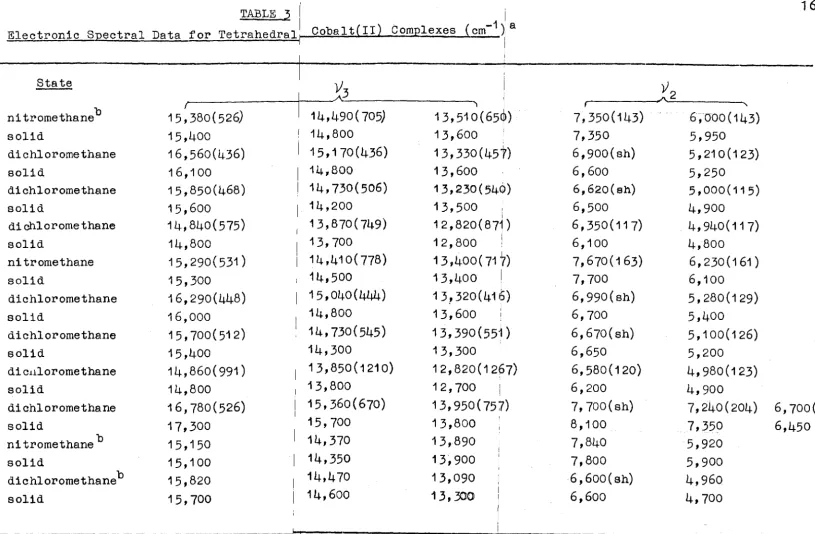
and (ii) compounds (Table' 2) suggests that they are of closely similar structure,Electronic Spectra
The electronic spectra of the thio-complexes
(Table 3) are characteristic of tetrahedrally coordina-ted cobalt(II)
36 ,38.
The positions of the bands are similar in the reflectance and solution spectra and generally the molar absorbances of the solutions obey Beer's Law. However, for the relatively unstablecomplexes, [Co(Me
3
Ps)4
J
(Clo4
)
2, [Oo(Ph3
Aas)4
]
(0104
)
2and Co(Ph
3
AaS)2Br2, which show ligand dissociation insolution, free ligand was added to restore band
intensities to their maximum values. Molar conduct-1vities of the Co(Me
3
Ass)2x
2 compounds in nitrobenzene are all low (for X=
01, Br andI,Am
<
2; for X =TABLE ,2
Electronic S ectral Data for Tetrahedral
Compound State
(Co(Me
3PS) 41 ( Clo4) 2 nitromethaneb 15,380(526)
solid 15,400
Co(Me
3Ps)2cl2 dichloromethane 16,560(436)
solid 16,100
Co(Me
3Ps)2Br2 dichloromethane 15,850(468)
solid 15,600
Co(Me
3Ps)2
r
2 dichloromethane 14,840 ( 575)solid 14,800
[Co(Me
3Ass)41(Clo4)2 nitromethane 15,290(531)
solid 15,300
Co(Me
3AsS)2cl2 dichloromethane 16,290(448)
solid 16,000
Co( Me
3AsS) 2Br2 dichloromethane 1 5, 700 (51 2)
solid 15,400
Co(Me
3AsS) 2I2 dic11loromethane 14,860(991)
solid 14,800
Co(Me
3AsS) 2(NCS)2 dichloromethane 16,780(526)
solid 17' 300
[Co(Ph
3AsS)4J(Cl04)2 ni tromethane b 15,150
solid 15,1 00
Co(Ph
3AsS) 2Br2 dichloromethaneb 15,820
solid 15,700
a For corresponding oxo-complexes see refs 21,37; molar extinction coefficients in parentheses.
b Plus excess ligand.
i
1)3
14,490(705) 14,800 1 5, 1 70 ( 436) 14,800
14, 730(506) 14,200
1 3 , 8 70 ( 74 9) 13,700 14,410(778) 14,500 15,040(444) 14,800 14, 730(545) 14,300 13,850(1210) 13,800
1 5 , 360 ( 6 70)
15' 700 14,370 14,350 14,4 70 14,600
16
I -1 )'a em 1I ! i )}2 I I
13,510(65J) 7,350(143) 6~-ooo
(
143)13,600 7,350 5,950
13,330(457) 6,900(sh) 5, 21 0 ( 123)
13,600 6,600 5,250
13,230(.540) 6,620(sh) 5, 000 ( 11 5) 13,500
i 6,500 4,900
12, 820( 871) 6, 350 ( 11 7) 4, 940( 11 7) 12, BOO ! 6,100 4,800
I
13,400( 717) 7, 670( 163) 6,230(161)
13,400 I 7,700 6,100
I
13_,320(416) 6,990(sh) 5, 280( 129)
13' 600 6,700 5,400
I
13,390(551) 6, 670( sh) 5,100(126)
13,300 6,650 5,200
12,820(1267) 6,580(120) 4,980(123)
1 2' 700 6,200 4,900
13,950(757) 7, 700( sh) 7,240(204) 6, 700( sh)
1 3 '800 8,100 7,350 6,450
13,890 7,840 5,920
13 ~ 900 7,800 5,900
1 3, 090 6, 600( sh) 4,960
[image:28.1207.284.1099.94.628.2]TABLE ha
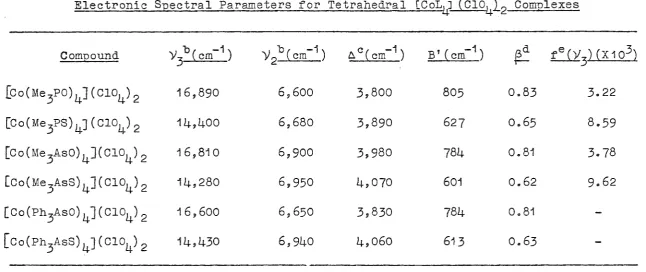
a
Electronic Spectral Parameters for Tetrahedral [CoL~ (Clo
4
l
2 ComnlexesComnound 'Y3 b( cm-1) J)2 b (em -1) ~em c( -1) B'(cm-1 )
~
f 8 (Y3) (X103) [co(Me
3Po)4](clo4)2 [Co(Me
3Ps)4J(Clo4) 2 [co(Me
3Aso)4](Clo4) 2 [co(Me
3Ass)4](Clo4) 2 [Co(Ph
3Aso)4J(Cl04)2 [co(Ph
3Ass)4J(Cl04) 2
16 '890 14,400 16' 810 14,280 16,600 14,430
a Oxo-complexes from refs 21,37
6,600 3,800 6,680 3,890 6,900 3,980 6,950 4,070 6, 650 3,830 6,940 4,060
805 0.83 3.22
627 0.65 8 .. 59
784
o.
81 3.78601 0.62 9.62
784
o.
81 613 0.63b Evaluated from the centre of gravity of the intensities c Calculated by the methods described in ref.36;
d ~
=
B'/967; reliable to± 0.02e Oscillator strength, f, evaluated graphically.
-1
considered reliable to± 150cm
-lo
[image:29.841.110.757.83.355.2]TABLE 4b
a Electronic Spectral Parameters for Tetrahedral CoL2
x
2, ComnlexesCompound Co(Me
3Po) 2cl2 Co(Me
3Po) 2Br2 Co(Me
3Po) 2
r
2Co(Me3Ps) 2Cl
2
Co(Me3
Ps)
2Br2Co(Me3Ps) 2r 2 Co(Me1-so) 2cl2 Co(Me
3
Aso) 2Br2 fCo(Me3AsO)JI2
Co(Me1-sS)2cl2 Co(Me3.AsS)2Br2 Co(Me
3.AsS) 2I2 Co(Me3AsS)
2(NCS) 2
Co(Ph
3.Aso)2Br2
Co(Ph
3AsS) 2Br2
") b( -1) 3 em 15' 750 15' 590 15,300 14,990 14,540 13' 710 15' 880 15,600 15,900 14, 920 14,580 13~ 760 15,200 15,000 14,510
a Oxo-complexes from refs 21 ,37
)7 b( -1)
2 em
6,440 6,230 6,000 5,810 5,700 5,650 6,660 6~340 6s;r700 5,900 5, 750 5,770 7,220 5,670 5,600 6c(cm:::1) 3, 730 3,590 31'450 3' .34.0
3,280 3,260 3,840 3,650 3,880 3,390 3' 310 3,340 4,220 3,250 3,220
b Evaluated from the centre of gravity of the intensities
B' ( cm-1 ) 735 737 730 719 693 639 735 732 730 710 693 634 651 727 696
f->d
0.76 0.760. 75 0.74 0.72 0.66 0.76
o.
75o.
76 0.730. 72 0.66 0.67
0. 75 0.72
fe(Y
3) (X1o3 ) 4.54 4.63
6 ..
28 6.80 7-429 .. 18 4.06
4.
78 5 .. 64 7.15 7.67 13,981 1 • 61
c Calculated by the methods described in ref.36; considered reliable to± 150cm-1. d ~
=
B'/967; reliable to± 0.02e Oscillator strength, f, evaluated graphically.
...
.30
20
. 2o
-
I •~ u
z
>-l!l
0:: 15
w
z
w
FIGUFU. Calculated energy levels for cohalt(II)
i~ a tetrahedral field with and without
spin-XIO
--- re
- - r 7
---re
~ =-400
B
=
120£=4 6 B .
-
I •~ u z >-l!) 0:: w z w 30
~ = 0
B 720
£=4.6
B· 2r1 orbit 2r2
2A2 coupling. (ref. 38)
0~~~--L-~~~
300 0 100 200
NCS, ~ = 3.2 cm2 ohm=1 mole-1) thus excluding m
alternative ionic formulations. The electronic
spectra of the tetrahedral oxo-complexes of cobalt(II) are reported in detail elsewhere21
,37.
A consideration of the energy level diagram (Figure 1) for tetrahedral cobalt(!!) predicts three spin-allowed electronic transitions from the 4A2
4
4
,}
ground state. The first, A2----7 T2, r 1, would be -1
expected to occur in the 5000 - 3000 em region but although searched for was not observed. The
-1
structured banda in the regions 8000 - 4500 em and -1
18,000 - 12,500 em have been assigned to the
4A
2
~ L~T
1
(F), Y 2 and 4A2 ---7 4T1 (P),v
3 transitionsrespectively3
6 ,3
8 _8Rectral Parameters
Single energy values for the
Y
2 andY
3 bands
were evaluated from the centre of gravity of the total absorptions. The spectral parameters~ and B' were
then calculated from the energies of
v2
and y3 using the equations36
derived from the matrices of Tanabe and Sugano39 (Appendix II). The nephelauxeticparameter,
f3,
is the ratio B' to B, the free ion value. Since the spectra usually involve broad bands,assignment of single energy valuee for Y 2 andY
3
is somewhat arbitrary. Thus too much emphasis should not be placed on small differences in the parametero, The oscillator strengths of the Y
3
bands were evaluated graphically. The derived spectral data are given in Table
4
along with the values for the corresponding oxo-complexes.The ligand field splitting energies 6, for the corresponding pairs of [OoL
4
](0104
)
2 complexes (where L = Me3Po and Me3PS; L
=
Me3As0 and Me3As8) are remarkably similar. However the values of the Racah interelectronic repulsion integrals, B1v are
significantly lower for the thio=complexes indicating greater covalency. The decreased ~(B'/B) values are considered to be caused by charge transfer from
the ligands to the central metal atom and a spreading of the partly filled d shell over the ligands, thereby increasing the mean orbital radii, the two effects being mutually reinforcing36
,4°.
As further evidence of covalency it is found that in the Co(Me3
Ps)
2x
2 and Co(Me3Aas) 2x
2 series only the iodides givep
approaching the low values obtained for the
Since calculations provide evidence that the intensities of the spectral
bands are direct functions of the mixing of ligand
41
and metal d orbitals , the higher oscillator
strengths of the bands in the thio-complexes again indicate gre£ter covalen~y in the metal-ligand bond. The fact that the corresponding pairs of ligands~ Me
3
Po
and Me3Ps,
or Me3As0 and Me3AsS, produce similar 6values, must arise fortuitously from compensating effects of permanent polarity and polarisability, the polarisability of the thio-ligands being considerably greater. The recent preparation of cobalt(II)complexes of tris(dimethylamino)phosphine sulphide, (Me
2N)3
Ps
24
allows an extension of the oxo-thio comparison. The ligand field splitting energies produced by this thio-11gand24
(~
= 3620 cm=1) andits oxo-analogue22 (6 = 3640 cm-1) in their [CoL
4
J
(Clo4
)
2 complexes are also remarkably similar.With~ values 3800, 3830, 3890, 3920, 3980, 4060,
4
-14070, 150 and 4250 em respectively trimethylphos-phine oxide, triphenylarsine oxide, trimethylphostrimethylphos-phine
. 36
sulphide, azide , trimethylarsine oxide, triphenyl-arsine sulphide, trimethyltriphenyl-arsine sulphide, cyanate 36 and thiourea42 fall approximately in this sequence in
the spectrochemical series. The low ~ values observed for the sulphides are characteristic for
cobalt(II). in a tetrahedral field of sulphur atoms (Table 5). A low~ value (0.60) is also found for cobalt(II) doped into a zinc selenide lattice45. Investigv tlon of' the reactions of trimethylarsine
and trimethylp11uuphlne selenides towards cobalt(II) would therefore be of interest.
It appears that corresponding oxo- and thio-ligands may produce similar ligand field splitting energies in other systems, as for example in
octa-Although exactly analogous pairs of complexes have not been investiga-ted, the urea
(o
bonded) and ethylenethiourea(s
bonded) nickel(!!) perchlorate complexes are known. The 6values are 8060 and 8000 om-1 andthe~
values Oe87 and Oo54 respect1vely4G,47 (B for free ion=
1056 cm~1 ).
Magnetic Susceptibilities
The magnetic susceptibilities of the complexes, corrected for diamagnetism and temperature independ-ent paramagnetism are given in Table 6.· The latter was calculated from the expression 2.09/D36G
Precision was such that reproducibility of the values 1 a
±
0 • 04 B. M.23
TABLE 5
[ 'J 2+
~pectral Parameters for .CoL
4
Thio-compl~L 6(cm-1 ) ~
Me
3PS 3890 0.65
Me
3AsS 4070 0.62
Ph
3AsS 4060 0.63
TDPS a 3620 0.66
Tu b 4250 0.62
etu c 3780 0.67
dmta d 3870 0.67
tel e 3910 0.64
a
Tris(dimethylamino)phosphine sulphide (ref. 24)
b
Thiourea (ref. 42)
c
Ethylenethiourea (ref. 43) d Dimethylthioacetamide (ref.27) e
TABLE 6
Magn~tic Data for Tetrahedral Cobal t(II) Complexes a
Comnound
X
m(X1 o3)X
corr(X103) )J. cm b (B. M. )
( cgsu) ( cgsu)
[Co(Me
3PS) 4
1
(Clo4) 2 8.00 7.87 4. 31 (4.56)Co(Me
3Ps)2cl 2 8.32 7. 91 4.32 (4.34)
Co(Me
3PS) 2Br2 8.64 8.23 4.41 (4.46)
Co(Me
3Ps) 2I 2 8.65 8.27 4.42 (4.46)
[Co(Me
3Ass)4] (Clo
4)
2 8@23 8.19 4.46 d (4.66)Co(Me
3AsS) 2Cl2 8.26 7.87 4. 31 (4.42)
Co(Me
3AsS) 2Br2 8.40 7.97 4.34 (4.46)
b Corrected for diamagnetism and temperature independent
paramagnetism.
c
Values for corresponding oxo-complexes in parentheses; from refs. 21 ~ 37.
For tetrahedral cobalt(II) higher energy
triplet states are mixed into the 4A2 ground state under the action of spin-orbit coupling. A certain ·amount of orbital angular momentum is introduced
into the ground, state and thus, an orbital contribu-tion to the magnetic moment48 ,49. The magnitude of this contribution is given
b/~
8)l ::: 3 o 88 ( 1 -
~
I)where
A'
(a negative number) is the spin-orbit coupling constant in the complexed cobalt(II) ion. In discussion of the increments in the magnetic moments above the spin only value, a~tention has generally been focussed on the variations in6
pro-duced by different ligands 38 ,48 , 50 • In the present case, the closely similar6
values for the ligands in the corresponding pairs of perchlorate complexes, allows the differences in magnetic moments to beinterpreted in terms of spin-orbit coupling. For the [coL
4
J (
0104) 2 compounds )1 = 4.56 and 4.31 B.M. for L :::: Me3Po and Me
3
Ps and )J = 4.66 and 4.43 B.M. forL
=
Me 3Aa0 and Me3
AsS respectively. Thus the lowermagnetic moments of the thio-complexes appear to arise primarily from dec~eased spin-orbit coupling. The reduction in
A
has been related to charge transferfrom the ligands to the metal ion and a
delocalisa-4
0 51tion of the d electrons ' • This being so, the magnetic data provide independent confirmation of the spectral evidence for greater covalency in the metal-sulphur bond.
For the CoL2
x
2 compounds the situation is com-plicated by the presence of low symmetry componentsof the ligand field produced by fundamentally
different ligands in the coordination sphere. The differing
6
values of the CoL2x
2 pairs9 if operatingindependently of other effects, would reduce the
difference in the magnetic moments by at least 0.1
aM.
Although the arsine sulphide halide complexes havemagnetic moments 0.11 - 0.12 B.M. lower than their oxo-analogues, the differences between the correspond-ing pairs of phosphine oxide and sulphide complexes al"e negligible.
Effects_gf the Penultimate Ligand Atom
The present results provide information on the effects of phosphorus and arsenic on the bonding of the oxo- and thio-ligands. In the perchlorate
complexes both trimethylphosphine oxide and sulphide p~oduce lower ligand field splitting energies than
17,000
rnlJ.
em-•
'14,000 12,000
FIGURE 2a.
v3
band profiles for sonution [image:40.604.130.489.56.764.2]20,000
500 600
ffilJ.
15
,ooo
700
FIGID~E
2b. [CoLJ 2+ species (ref. 37b)cm- 1 20 000 1' 000
500 600
IDlJ.
1 000
Ph AsO 3
700
FIGURE 2c. [CoL
[image:42.616.136.479.58.783.2]their arsenic analogues (Table
4).
There is evidence (see p. 7:17 ) that the degree of dTT- p11 bonding in the P-0 linkage in phosphine oxides is greater than incorresponding As-0 linkages. This would lead to weaker donor properties and hence lower 6 values for phosphine oxides relative to arsine oxides. For the
thio-ligands the situation is less certain (see p. "57 ). However, while too much emphasis should not be placed
on small differences in 6 , the values are always consistently lower for the Co(Me
3
Ps)
2x
2 complexes as compared with their Me3AsS analogues, thus paralleling the situation for the [OoL
4
J
2+ species.(P) Transition
A further indication of the influence of the penultimate atom on the bonding of these ligands may be obtained from the details of the 4A
2
-t
4T1 (P),V
3band profiles. In the free cobalt(II) ion there is a 2
a
state close to the4p
state and in the tetrahedral field the components of the former also lie close tothe latter (Figure 1). It is considered that mixing of the
4T
1(P) state and components of the 2G state,through the'action of spin orbit coupling leads to the structure of the ))~ b'and5 2 ' 53~
For the thio-complexes, [CoL
4
J (
0104
)
2 the profiles of theY
3
band do not appear to be effectedby the nature of the penultimate atom, (i.e. P or As). The band shapes and intensity distributions are
JVirtually identical for the Me
3Ps and Me3As8 complexes and the spectrum of the Ph
3As8 complex is similar (Figure 2). In contrast the
Y3
band profiles for [Co(Me3
Po)4
](Cl04
)
2 and the isostructural [Co(Me3Aso)4](Clo4)2 are quite different from each other (Figure 2). This difference appears to be a function of the penultimate atom and not of~' because other oxo-ligands which produce different 6 values show a similar pattern21 •
37b.
Thus complexes of Ph3
PoPh2MePO and (Me2N)
3Po have band profiles similar to that observed for Me
3Po, while the profiles for the complexes of the arsine oxides, Ph
3
As0 and Ph2MeAsO, compare closely to that of Me3As0 (Figure 2). Differences in the d11 - p,. bonding in the P-0 and
As-0 bonds (eee p.o7 ) would lead to basic differences in the Co-O bond for the phosphine oxide and arsine oxide ligands, thus causing differences in the relative energies of the components of the 2G and
4r
1(P) states. This would lead to different spin-orbit coupling and consequently different band profiles. The fact thatthe phosphine and arsine sulphides do not produce marked differences in the splitting of the
v3
band would suggest that Co-S interactions are not affected by the penultimate atom (i.e. P or As) as appearsthe case for Co-O bonding.
The action of spin orbit coupling expected to split the
4A
2 -14T
1 (F) ,
Y
2 -1 (band by no more than 1000 em Figure
would be absorption
1) • However, generally the observed splitting is greater than this and must be due to non-cubic elements of the ligand field, since there are no doublet levels close to the
L~T
1
(F) state with which it could interact under the action ofspin~orbit
coupl1ng52 ,53 .
TheV
2 bond
also differs for the thio- and oxo-complexes [Oot
4
J
2+. In the former case two main components occur while in
the latter21 ~37b three bands are found. Unlike the
)1
3 band, there is no apparent difference in the
profiles for the phosphine and arsine oxide complexes. This is further evidence that the different profiles
of the
Y
3 bands can be related to different
inter-actions between the components of the 2G and
4p
states, since a reduction in symmetry will affect theV
2 bandto a greater extent52• The observation of only two components in the
Y
2 band may indicate that the thio-complexes are less distorted than the correspond-ing oxo-complexes, as might be expected for thelarger sulphur atoms.
l~frared spectra
The assignment of infrared frequencies is
facilitated by the simplicity of the spectra of the free ligands. For trimethylphosphine and arsine sulphides agreement between the observed frequencies and those given in the literature is generally satis-factory54=56.
However~
the As-0 stretching frequency for trimethylarsine oxide in the present work was found8
-1 -1to be at 70 em in contrast to a frequency of 903 em
18
reported by Merijanian and Zingaro . In this work the Me
3As0 spectrum~ which was reproducible for
different preparations and which confirmed the absence -1
of water, was free of absorptions in the 900 em
region. The remaining bands in the trimethylarsine oxide spectrum were assigned by comparison with the spectra of the related ligands, Me
3
Po57 and Me3
Ass5 6
(aee Table 7).
In the present work, the infrared spectra of the
[ML
4
](Cl04
)
2 and ML2X2 complexes (where M=
Co, Zn and L=
Me3AsS; M
=
Co and L=
Me3PS; M=
Zn and L=
Me3As0) have been assigned (Table 8). The spectra of the remaining tetrahedral oxo-complexes are reported in detail elsewhere19•37. Apart from a reduction in the As-0, P-8 and As-S stretching
frequencies, the main ligand bands are not significantly displaced upon coordination. The spectra of the
[CoL
4
](Cl04) 2 complexes show single bands at about 1100 and 624 cm-1, consistent with the presence of the uncoordinated perchlorate an1on59.Metal=Halogen_Stretching Frequencies The metal halogen stretching modes~ Y(M-X), were identified as bands which show the usual decrease in frequency as
the mass of the halogen is increased (Table 8). The frequencies of the M-X absorptions are in accord with
the pseudo-tetrahedral structure assigned to the ML
2X2 complexea 2
,3.
Metal-Ligand Stretching Freguenc~~s The metal-ligand stretching yibrations for the Me
3As0 complexes of zinc can be assigned to the new bands which appear between 450 and 400 cm-1 (Table
8).
V(M-0) banda arefound in the same general region for complexes of the related ligands Me
3Po and Ph3As09, 19. For the thio-ligand complexes the metal-thio-ligand modes occur at 0.65- 0.75 of the frequency of the corresponding
y(M-0)
vibrations. Since the.metal-halogen and metal-sulphur bands occur at similar frequencies inthe chlorides, the only meaningful assignment is
Y(M-01) + }I(M-S).
In the absence of definite evidence for stronger
M-S(P)
than M-S(As) bonding, it is reasonable toassume that the consistently lower
Y(M-S)
frequencies for the Me3
As8 complexes as compared with the Me3
PS
complexes can be related to the greater mass of the arsenic atom. This implies that
Y(P-S)
andY(As-S)
are not pure stretching modes but contain somecomponent involving movement of the phosphorus or arsenic atoms. Corresponding Me
3
Po and Me3
As0complexes show similar effects 21 ,37. Both the solution and solid state spectra of the [OoL
4
J
(Clo4
)
2 complexes show twoV(M-8)
bands. For regular tetra=,,
60
hedral ML
4 complexes only one r(M~S) would be predicted ,
but allowing for a probable reduction from 180° of the M-8-P (or
M-S-Ae)
bond angles, the highest possible symmetry is D2d' On this basis at least two infraredTABLE 7
( Cm-1 )
Infrared 8pe~tra1200- ~00 _
Me 3Po
c Me
3P8d 1166s
960s 9798
944s 948s
870m 865m
863m
71+1 m 745m
e 713m
2fu
a
of the Ligands
b Me
3AsQ. Me3As8
926s 9308
913sh
f3
].Os848m 847m
836m
638mf 628m 625m
g 594m
~
d
8
As nujol mulls
b
Me
3As0 spectrum assigned in present work.
Assignment
V(P-o)
}
CH3 def,
y
(As-o)}
CH3 def. l} as (P-C) Vs(P-C)
}Yas
{As-c)Vs (As-C) Y(P-8) Y(As-8)
c
Complete assignment for Me
3Po reported in refs. 54,57,58. d Partial assignments for Me
3
Ps
and Me3As8 reported in refs. 56,55.e
Y
8 (P-C) not observed
f ya
8 (As-C) is not generally split in complexes.
g J)_ (As-C) not observed.
TABLE 8a
( -1) a
Infrared Spectracm of Co and Zn tetrahedral complexes
Compound Y(P-0) .1(As-O) Y(P-S)
Y(M-0 ). Y(M-S) Y(M-X) Other Bands (500-200cm-1)
Me 3PO [Co( Me
3Po) 4J ( Clo4) 2 b Me
3As0 . (Co(Me
3Aso)4
J
(Clo4) 2 b [Zn(Me3As0) 4
J (
Clo4) 2 Zn(Me_rso) 2c12Zn(Me
3Aso)2Br2 Me
3PS [Co(Me
3Ps) 4
J (
Clo4) 2 Co(Me3Ps) 2c12 Co(Me
3Ps)2Br2 Co(Me
3PS) 2I 2
8 For Nujol mulls
c
870s
862sh,837s 870s,841s
880sh,863s,842sh 897sh, 862s, 841 sh 565s 538sh,530s,525sh 538sh,533s 536s 531 s 460sh,448m 442sh,428s 430s, br 413s,br 411s,br
330m, 321m d 330m,323sh 289sh,280s 213s, br (325sh,320s,308s,282m)e 316m, 310m 317m, 311m 246sh,240s
375sh, 365m, 315w, 242vw 352m, 328w, 255vw
266m
271m, 263sh 273m,266sh 261m
276m, 260m 280VI'I, 225VW
290v~,260v~, 225vw 255vw
275vw, 258w 275vw, 257w
b From refs. 21 ,37; for Co(Me
3Po) 2
x
2 and Co(Me3Aso) 2x
2 complexes see refs 19,21,37. c Obscured by perchlorate absorptiond Values for nitromethane solution e V(M-S) + y(M-Cl).
+:-TABLE 8b
( -1) a
Infrared 8nectracm of Co and Zn tetrahedral comnlexes
Compound
Me 3AsS
[Co(Me3AsS) 4J ( Clo 4) 2 Co(Me
3AsS) 2cl2 Co(Me
3As8) 2Br2 Co(Me
3AsS) 2I 2 Co(Me
3As8) 2(NC8) 2 [zn(Me
3AsS) 4J ( c1o4) 2 Zn(Me
3AsS) 2cl2 Zn(Me
3AsS) 2Br2
Ph
3AsS [co(Ph
3Ass)4J(Clo4)2 Co(Ph
3As8) 2Br2 [zn(Ph3Ass)
4J(Cl04)2 a For Nujol mulls
Y(As-8)
476s
442s, 437sh 442s 440s 440s 444s 444s 446s 452s,446s 495s d d d
Y(M-8)
312m, 294mw 312m, 295mb
v
(M-X)(315s,308s,303s,288s)c 299m, 288m 238s, 224m 298m, 285m
291m 327m
287m
b
289m, 277sh
( 294s, 288s, 280s, 276s) c
282~ 277sh 214s, br
282m, 275m
(260sh,250m,245rn) 8 275m
b Values for nitromethane solution
Other Bands
1
(soo -
20ocm- )4 74m, 467m, 45 7w, 345m, 326m, 297vw
475m,464s,455sh9441sh,
345s,330sh,297vw
469s,444m,348s,343s,298vfl 477m,465s,455sh,446sh, 346s, 337sh.
CY(M-S) + ~(M-Cl) d For the complexes V(As-S) is indistingUishable from other ligand bands
e Y(M-8) + Y(M-Br). \...N
active
M~S
stretching frequencies should be observed61 ,
In all cases theV(M-0) , Y(M-S)
andY(M-X)
values for the zinc complexes are lower than those of thecorresponding cobalt complexes, as has been noted for other cobalt-zinc systems 61 ,62 •
The infrared spectrum with
Y(C-N) at 2085P 2065 cm-1 and
Y(C~S)
at 840 cm-1 shows that the complex contains nitrogen bonded thiocyanate. The Y(C-S) frequency is above the ranges corresponding( 6 -1)
to sulphur bonded 90 - 720 em or bridged thio-cyanate (740
~
780 cm-1) systems63 , 64.
The Y(co-N) and V(Co-8) bands lie at 327 and 291cm~
1.
The latteris tentatively assigned asY(Co-8) since it falls in the range 312 - 285 cm-1 found for this mode in other tetrahedral trimethylarsine sulphide complexes of cobalt(II).
Tr1J2henylarsine SulJ2hide Complexes The As-S
stretching vib:·ation for uncomplexed triphenylarsine =1
sulphide is found at a frequency of
495
em 9 somewhatt -1
above s rang ligand absorptions at
475 -
450 em •In the complexes9 the V(As-S) band was indistinguishable
from the other ligand bands indicating a decrease of
-1
over 20 em in the ~requency upon coordination. Assignment of the metal-ligand modes is complicated by ligand absorptions occurring between 350 and
-1
290 em • The medium bands in the 282 - 270 cm-1
range are assigned to metal-ligand stretching vibrations (Tabla 8). The V(M-S)/~(M-0) ratio for the
[OoL
4
1
(Clo4
)
2 complexes (L=
Ph3AsS and Ph3As0) is 0.68, within the range (0.65- 0.75) found ~or thetrimethyl derivatives,
the ~(M-8) and V(M-Br) modes occur at similar frequencies preventing separate assignment.
The Nature of the P-S and As-S Bonds
There is considerable evidence that
TI
bonding in the P-O linkage in phosphine oxides is important65- 68 • The bond may be regarded as a coordinate bond (P -1 0 bond) on which is superimposed a dn - p11 component, arising from donation of electrons from the filled p~ orbitals of the oxygen into the empty drr orbitals of the phosphorua69• It appears that there is weaker 1T.
6
bonding in the As-0 bond of arsine oxides37b,
7.
Less is known about the P-S and As-S bonds in the corresponding sulphidesoThe main evidence for Tf bonding in the sulphides
(R
3Ps and R3AsS) comes from the P-8 and As-S stretching frequencies. Electronegati~e R substituents attached
to the penultimate atom would be expected to increase the stability of a TI bond, whereas if the bond was a simple coordinate bond, the reverse would be
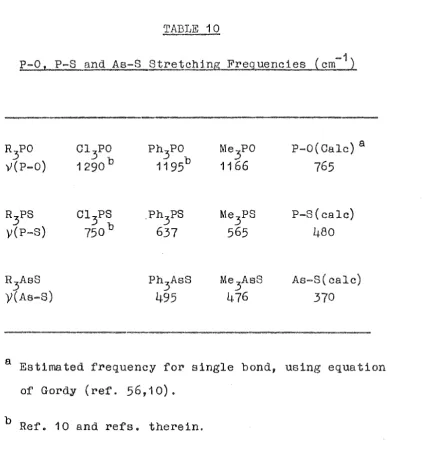
anticipated. From Table 10 it is seen thatY(P-S)
frequencies are increased by the more electron withdraw-ing R groups, and that
Y(As-S)
frequencies are also influenced by substituent groups. However arsine sulphides containing highly electronegative groups(Ol
3AsS for example) have not been synthesised.
Phosphine oxides are included in Table 10 for comparison. While a number of factors influence the position of the
Y(P-0)
absorption in complexes, the lowering of the frequency upon coordination can be related mainly to a reduction of the dn = Pn component in the P-O11nkage69. That a similar decrease in the
Y(P-S)
andy(As-S) frequencies (Table 9) is observed is further evidence for
TI
bonding in theP-S
and As-S bonds.The available evidence indicates that although TI bonding is important in the
P-S
andAs-S
bonds, it isless extensive than in corresponding P-0 bonds68 •
The dissociation energies
or
P-8 bonds (rJ95 kcal./mole) are some 35 - 65 kcal./mole lower than of P-O bonds(125- 155 kcal/mole)
6
5. Moreover, it appenrs thatthe increase in strength on passing from a single
P-0 bond to a P=O bond in an R
3Po compound is greater than that on passing from a single P-8 bond to a P=8
bond in a corresponding phosphine sulphide. The
difference between P-O and P=O (in R
3Po) is about 55 kcal/mole compared with 26 kcal./mole between P-8 and
P31 chemical shifts (8) are always
lower for phosphine sulphides. The 8 values for
Me
3Po (- 36ppm) and Me3PS (- 59ppm) indicate lower
nuclear shielding of the phosphorus atom in the
sulphide due to a lower d~ orbital occupancy71.
Little is known about the relative degree of
bonding in the P-8 and As-S bonds although Me
3AsS
produces greater ~ values than Me
3
Ps
in correspondingcobalt(II) complexes (Table
4),
probably indicatingthe Me
3AsS ligand has stronger bonding properties
and therefore a weaker As-S TI component.
TABLE
2
Shifts in P-0, P-8, As-0 and As-S Stretching Frequencies
a
on coordination
40
Com12ound Shift(cm-1) Compound Shift(cm-1)
[co( Me
3Ps) 4 ]( c1o4) 2 -34 [Co(Me3Po)4](Cl04) 2 b
Co(Me
3Ps) 2cl2 -29 Co(Me3Po)2cl2 -56
Co(Me
3Ps)2Br2 -29 Co(Me3Po)2Br2 -56
Co(Me
3Ps)2
r
2 -34 Co(Me3Po)2r
2 -45[co(Me3Ass)
4](Clo4) 2 -36 [Co(Me3Aso)4J(Cl04)2 -25
Co(Me
3AsS) 2cl2 -34 Co(Me3Aso)2Cl2 -23
Co(Me
3AsS) 2Br2 -36 Co(Me3Aso) 2Br2 -26
a
Thio-complexes this work; oxo-complexes from refs. 19,21 ,37;
for split bands average value of shift has been taken.
b
Y(P-0) obscured by Clo
TABLE 10
I cm-11
P-01 P-S and As-S Stretching Freguencies ~ _
Cl 3Po 1290 b
Me
3Po
1166
P-O(Calc) 8
765
P-8 (calc)
480
As-S (calc) 370
a Estimated frequency for single bond, using equation of Gordy (ref.
56,10).
b Ref.
10
and refs. therein. [image:57.595.81.523.128.579.2]CHAPTER 2
BRIDGED OCTAHEDRAL TRIMETHYLARSINE OXIDE COMPLEXES
OF Fe(II), Co(II) AND Ni(II) AND TETRAHEDRAL
INTRODUCTION
Both trimethylarsine oxide and sulphide react with cobalt(II) to give structurally analagous pairs
of complexes (Chapter 1). A wider study shows that corresponding pairs of oxo- and thio-complexes of
iron(II) and of nickel(II), although stoichiometrically the same, have different structures (Table 11).
Thus the trimethylarsine oxide perchlorate complexes [ML
4
(clo4
)]Clo4
(where M =Fe and N1) arefive-coordinate9 whereas the corresponding thio-complexes contain the tetrahedral [ML
4
J
2+ cation. With the halides, trimethylarsine sulphide continues to givetetrahedral ML2
x
2 complexes but trimethylarsine oxide appears to act as a bridging group9 giving rise tooctahedral polymers. Evidence on the mode of bridging is obtained from the infrared spectra of
the analogous ML2(NCS) 2 thiocyanate complexes.
Cobalt halides also react with trimethylarsine oxide to give bridged octahedral complexes, as well as the tetrahedral isomers described previously (Chapter 1).
This chapter is concerned primarily with the bridged octahedral trirnethylarsine oxide complexes
and the tetrahedral trirnethylarsine sulphide complexes. The five-coordinate trimethylarsine oxide perchlorate
complexes are discussed in Chapter
3.
[
[
[
TABLE 11 Me
3
As0 and Me3
As8 Complexes of the First Row DivalentTransition Metals
Complex Structure8
b
M
ML
4
J(Clo4
)
2 tetr. Me3As0 Co,Zn Me
3As8 Fe,Co,Ni,Zn ML
4
(clo4
)]Cl04
5-coo:rd. Me3As0 Mn,Fe,Ni,Cu ML5J(Clo
4)
2 5-coord. Me3As0 Mn,Co,NiML
2X2 tetr. Me3As0 Co,Zn
(X= Cl,Br) Me
3As8 Fe,Co,Ni,Zn ML2X2
(X = Cl,Br) bri. oct. Me
3As0 Fe,Co,Ni
a tetr. = tetrahedral, bri. oat. = bridged octahedral
[image:60.598.87.522.218.690.2]RESULTS AND DISCUSSION
Trimethylarsine oxide reacts readily with the divalent salts of iron and nickel. Complexes of the
bromides of iron and nickel. The iron(II) compounds, which are rapidly oxidised, were prepared and stored under nitrogen. Depending on the reaction conditions two distinct products can be isolated from the reaction of trimethylarsine oxide with cobalt(II) chloride.
An intense blue tetraheru~al complex Co(Me
3Aso)2cl2 (Chapter 1) is obtained from cold acetone solutions, while reaction in hot ethanol gives a pale blue
compound with the same formula. Similarly two
products are obtained with cobalt(II) bromide although the pale blue isomer is more difficult to isolate, (p. 103) and electronic reflectance spectra indicate that it still contains some of the tetrahedral form. The pale blue bromide complex Co(Me
3Aso) 2Br2 reverts completely to the tetrahedral isomer upon dissolving in nitromethane, heating to 100° or on exposure to atmospheric moisture.
X-ray powder photographs show the compounds
Fe(Me
3
Aso) 2x
2, Co(Me3
Aso) 2x
2 (pale blue forms) and Ni(Me3
Aso) 2x
2 (where X= Cl and Br) to be isomorphous. Electronic SpectraThe insolubility of the isomorphous M(Me
3Aso) 2
x
2 complexes prevents the measurement of their solution spectra. Reflectance spectra (Table 12) however,are typical of high spin octahedral iron(II), cobalt(!!) and nickel(!!) compounds7 2 ,73. The spectrum of
octahedral Co(Me
3
Aso) 2Br2 indicates that it still contains some tetrahedral impurity.The spectra of the Fe(Me
3Aso)2
x
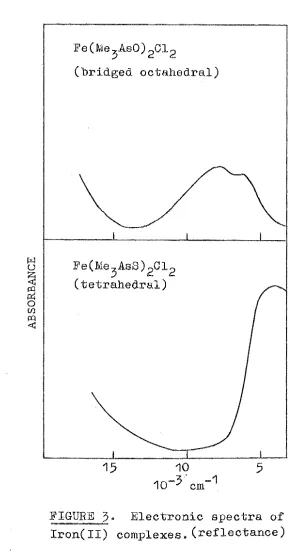
2 compounds show one assymmetric band (Figure 3) consisting of a max-imum at about 8000 cm-1 and a shoulder at about 6 000 em -1 , which can be assigned to the T5 52 g :-1 E g transit1on72 • A splitting of the 5
m
state under theg
influence of the ligand field will cause the observed doublet structure of the absorption74.
The spectra of the cobalt complexes are more difficult to interpret. For octahedral cobalt(!!) three bands corresponding to the spin allowed
transitions 4T1 g(F)
~
4T2g(F) ( Y1) , 4T1 g (F) -7 4A 2g( ).12), and 4 T1 g(F)
-1
4 T1 g(P) (y
3) are expected 72 • The tro.nsi tion 4T1 g(F)--) 4A2g corresponds to a two

![FIGURE 2c. [CoL4]2+ species (ref.37b)](https://thumb-us.123doks.com/thumbv2/123dok_us/9049220.401185/42.616.136.479.58.783/figure-c-col-species-ref-b.webp)