ACTIVE METHODOLOGIES: WORKING POSSIBILITIES WITH CONCEPTUAL MAPS AND TRAINING
BASED ON PROBLEMS DURING PHYSICAL LESSONS
1
Fernanda Teresa Moro and
1
PhD student in PPGEnsino Teaching (UNIVATES / RS), Specialization in Experimental Physics: emphasis in
Didactic Laboratory, Master in Teaching of Exact Sciences
2
PhD student in Teaching and Master in Teaching of Exact Sciences (U
Education (UESB / BA), Specialist in Innovative Methodologies Applied to Education (FACINTER / PR), BA in
Mathematics (UESB / BA) and Bachelor in Law (FAINOR / BA)
ARTICLEINFO ABSTRACT
This work is result of a final work proposal of the discipline Strategies of Teaching I, in PhD in Teaching at University of Vale do
Maps and Problem Base
Conceptual Maps strategy has been developed with a second school in the municipality of
Problem Based Learning was developed with students of Chemical Engineering, 3rd semester, of a private university, also in the municipality of
studied by those students in disciplines of Physics and Gen
Copyright©2019, Fernanda Teresa Moro and Débora Valim Sinay Neves
License, which permits unrestricted use, distribution, and
INTRODUCTION
The pedagogical practice developed by many teachers in the process of teaching of physics is centered on application of formulas and presentation of concepts and laws. When working with experimental activity or computational simulations, for example, it is
make transition from a model of transmissive
based on copies and focused on activity of teacher, for construction of knowledge in which the student is involved in the process.
During lessons it is possible for the teacher to use acti methodologies or innovative methodologies that have potential to arouse curiosity as students enter into theorizing and bring new elements that are not yet considered in classroom or in teacher's own perspective. Based on that assumption we have develop
that involve active methodologies in Physics classes, for students of High School and Higher Education.
Bastos (2006) presents a conceptualization of active methodologies as interactive processes of knowledge,
ISSN: 0975-833X
Article History:
Received 14th March, 2019 Received in revised form 16th April, 2019 Accepted 20th May, 2019 Published online 30th June, 2019
Citation: Fernanda Teresa Moro and Débora Valim Sinay Neves
on problems during physical lessons”, International Journal
Available
Key Words:
Experimental Activities, Conceptual Maps, Problem-based learning, Teaching of Physics.
*Corresponding author: Débora Valim Sinay Neves
RESEARCH ARTICLE
ACTIVE METHODOLOGIES: WORKING POSSIBILITIES WITH CONCEPTUAL MAPS AND TRAINING
BASED ON PROBLEMS DURING PHYSICAL LESSONS
Fernanda Teresa Moro and
2, *Débora Valim Sinay Neves
PhD student in PPGEnsino Teaching (UNIVATES / RS), Specialization in Experimental Physics: emphasis in
Didactic Laboratory, Master in Teaching of Exact Sciences
PhD student in Teaching and Master in Teaching of Exact Sciences (UNIVATES / RS), Specialist in Media in
Education (UESB / BA), Specialist in Innovative Methodologies Applied to Education (FACINTER / PR), BA in
Mathematics (UESB / BA) and Bachelor in Law (FAINOR / BA)
ABSTRACT
This work is result of a final work proposal of the discipline Strategies of Teaching I, in PhD in Teaching at University of Vale do Taquari - Univates. The strategies discussed here are Conceptual Maps and Problem Based Learning (PBL), which will be described throughout the paper. The Conceptual Maps strategy has been developed with a second-year high school class from a private school in the municipality of Erechim, Rio Grande do Sul. On the other hand, the proposal na Problem Based Learning was developed with students of Chemical Engineering, 3rd semester, of a private university, also in the municipality of Erechim. Those two proposals contemplate contents studied by those students in disciplines of Physics and General Physics C, respectively.
Fernanda Teresa Moro and Débora Valim Sinay Neves. This is an open access article distributed under and reproduction in any medium, provided the original work is properly
The pedagogical practice developed by many teachers in the process of teaching of physics is centered on application of formulas and presentation of concepts and laws. When working with experimental activity or computational simulations, for example, it is possible to transmissive teaching, based on copies and focused on activity of teacher, for construction of knowledge in which the student is involved
During lessons it is possible for the teacher to use active methodologies or innovative methodologies that have potential to arouse curiosity as students enter into theorizing and bring new elements that are not yet considered in classroom or in teacher's own perspective. Based on that assumption we have developed two activities that involve active methodologies in Physics classes, for students of High School and Higher Education.
(2006) presents a conceptualization of active methodologies as interactive processes of knowledge,
analysis, studies, research and individual or collective decisions, in order to find solutions to a problem. In this process, the teacher acts as a facilitator or mediator, seeking the student to research and reflect on what is being worked on, presenting solutions to problems that are proposed to him.
This work presents the results of two interventions that have been developed with students of the second year of high school in a private school and the Chemical Engineering course of a private university, both in the municipality of Erechim
discipline Teaching Strategies I, of doctorate in Teaching of the author of this work.
One of proposals has involved the construction of conceptual maps by students, with the purpose of verifying students' knowledge related to potential grav
elastic and kinetic energy, as well as their applications in everyday situations, through a conceptual map. The other, Problem Based Learning (PBL), with the purpose of applying knowledge studied in Electrodynamics, is related to voltage, current and resistance, in solving a problem situation. Those two proposals will be described later.
International Journal of Current Research
Vol. 11, Issue, 06, pp.4298-4306, June, 2019
DOI: https://doi.org/10.24941/ijcr.35521.06.2019
Fernanda Teresa Moro and Débora Valim Sinay Neves. 2019. “Active methodologies: working possibilities with conceptual maps and training based
Journal of Current Research, 11, (06), 4298-4306. Available online at http://www.journalcra.com
z
ACTIVE METHODOLOGIES: WORKING POSSIBILITIES WITH CONCEPTUAL MAPS AND TRAINING
BASED ON PROBLEMS DURING PHYSICAL LESSONS
Débora Valim Sinay Neves
PhD student in PPGEnsino Teaching (UNIVATES / RS), Specialization in Experimental Physics: emphasis in
Didactic Laboratory, Master in Teaching of Exact Sciences
NIVATES / RS), Specialist in Media in
Education (UESB / BA), Specialist in Innovative Methodologies Applied to Education (FACINTER / PR), BA in
Mathematics (UESB / BA) and Bachelor in Law (FAINOR / BA)
This work is result of a final work proposal of the discipline Strategies of Teaching I, in PhD in The strategies discussed here are Conceptual d Learning (PBL), which will be described throughout the paper. The year high school class from a private On the other hand, the proposal named Problem Based Learning was developed with students of Chemical Engineering, 3rd semester, of a Those two proposals contemplate contents
eral Physics C, respectively.
under the Creative Commons Attribution properly cited.
analysis, studies, research and individual or collective decisions, in order to find solutions to a problem. In this process, the teacher acts as a facilitator or mediator, seeking the student to research and reflect on what is being solutions to problems that are
This work presents the results of two interventions that have been developed with students of the second year of high school in a private school and the Chemical Engineering course of a private university, both in the Erechim / RS. This paper is part of discipline Teaching Strategies I, of doctorate in Teaching
One of proposals has involved the construction of conceptual maps by students, with the purpose of verifying students' knowledge related to potential gravitational, , as well as their applications in everyday situations, through a conceptual map. The other, Problem Based Learning (PBL), with the purpose of applying knowledge studied in Electrodynamics, is related ent and resistance, in solving a problem situation. Those two proposals will be described later.
INTERNATIONAL JOURNAL OF CURRENT RESEARCH
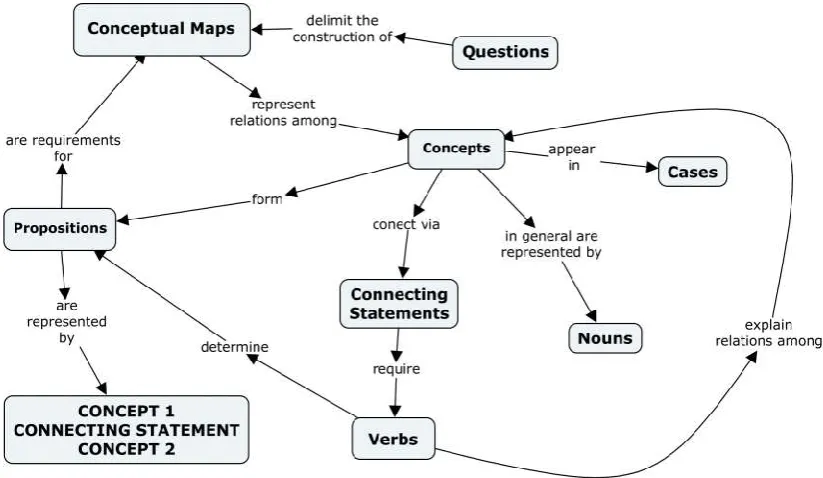
Theoretical approach: In Problem-Based Learning, learning occurs from presentation of real or simulated problems to a group of students. Students, to solve that problem, use previous knowledge, discuss, study, acquire and integrate new knowledge. This integration, together with practical application, facilitates retention of knowledge, which can be more easily rescued, when the student is faced with new problems. Thus, according to Toledo et al (2008), the method of Problem-Based Learning values, in addition to the content to be learned, how learning occurs, reinforcing the active role of student in this process, allowing the student to participate in the process of knowledge construction. In that way, PBL is characterized by providing meaningful learning, articulating prior knowledge of a student with others in the group, the inseparability between theory and practice, respect for student autonomy, work in small groups, development critical thinking and communication skills. Gomes et al. (2009) point out that PBL stimulates an active attitude of student in search of knowledge and not merely information, as can happen in traditional pedagogical practice. The second strategy used in this work was conceptual maps, from the perspective of Active Methodologies. Conceptual maps can be used as a didactic tool and as an evaluation tool in order to obtain information about the type of structure that the student sees for a given set of concepts. According to Moreira (1983, p.1): Conceptual maps are diagrams of meanings, of meaningful relationships; of conceptual hierarchies, if applicable. This also differentiates them from semantic networks that do not necessarily organize by hierarchical levels and do not necessarily include only concepts. Conceptual maps also must not be confused with mental maps that are associationists, do not deal with relationships between concepts, include things that are not concepts and are not organized hierarchically. They should not be equally confused with synoptic tables which are classificatory diagrams. Conceptual maps do not seek to classify concepts, but to relate and hierarchize them. The conceptual maps can provide indications if the methodological proposal applied was potentially significant for students, and should present in its structure the central concepts studied. Figure 1 presents a diagram of main elements that can be part of a conceptual map.
Detail and analysis of strategies used
Conceptual Maps: During classes of Physics in groups of second year of high school, students performed several activities, among them, the experimental activity that had objective to verify the law of conservation of energy, observing eventual differences in the distance reached by the sphere after descending two different ramp profiles. In the activity were explored kinetic energies and gravitational potential. Figure 2 illustrates the experimental activity performed by students. Looking for signs of meaningful learning, students prepared a conceptual map at the end of chapter (after experimental activity and other activities proposed in class) that approached what was studied. In maps, we sought to observe the presence of concepts and hierarchical relationships among them, as a way of externalizing what the student already knows, looking for signs of meaningful. The maps constructed by students have been analyzed, searching for traces of significant learning. Figure 3 highlights students, during class, elaborating conceptual maps. For Moreira (2005), meaningful learning implies attribution of idiosyncratic meanings. For this reason, conceptual maps drawn should reflect such meanings. In evaluation through conceptual maps
the main idea is to evaluate what the student knows in conceptual terms, how he structures, hierarchizes, differentiates, relates, discriminates, integrates, concepts of a particular unit of study. The maps constructed by the students have been analyzed, searching for signs of significant learning. Most of the elaborate maps presented the idea of cobweb. That type of conceptual map, according to Tavares (2007), part of generator theme - energy - and other concepts appear as they moved away from center. In that type of map, there is no concern with hierarchical or transversal relations, according to Moreira and Masini (1982). The maps constructed by students, those will be named by M1, M2 and so on. At map M1 presented in Figure 4, we observe the presence of several connectors that make connection between the most important concepts worked on energy topic.
It is also possible to observe examples of application of energies studied in daily life, which according to Moreira (2005) can represent signs of significant learning. It should be noted that was the map constructed with the greatest number of examples of daily life, referring to each of the energies studied. It is also possible to observe terms like "relaxation" and "compression" when referring to elastic energy. It should be noted that by putting the concepts "reversible" and "irreversible" next to those terms students may be demonstrating an understanding of the concept of energy conservation as well as dissipation. In the conceptual map M2, presented in Figure 5, one can visualize a significant amount of concepts and propositions related to central concept of energy. It also presents, according to Moreira (1983), conceptual hierarchies, showing specific, non-inclusive concepts and examples, especially when referring to phenomena involving energy in everyday life. It is also important to highlight that students have sought to represent in conceptual map the equations of each energy studied, as well as different forms of calculating the work performed by a force (be it constant or variable). One can also observe numerical examples of situations that involve the calculation of different types of energy studied in class. In that map we also observe the presence of units for each of quantities considered in equations.
In working with Physics it is interesting that students watch out for the units, since many errors in solving exercises is centered on the error of units. At the end of conceptual map there are elements of meaningful learning because students relate mechanical energy to the sum of energies involved in process. It is also known that they understood the concept of potential energy (that which is stored in the object) by reporting that it can be gravitational or elastic. Moreira (2012) considers cognitive structure as a structure of interrelated and hierarchically organized subsumption. This structure, according to the author, is dynamic, where two main processes occur, progressive differentiation and integrative reconciliation. According to Moreira (2012, p.6): Progressive differentiation is the process of assigning new meanings to a given subsumption (a concept or a proposition, for example) resulting from successive use of this subsumption to give meaning to new knowledge. When a new concept or a new proposition is learned by a process of interaction and anchoring in a subsumption concept, it also changes. When that process occurs one or more times leads to progressive differentiation of subsumption concept. The ideas established in cognitive structure may be, during the acquisition of new learning, both recognized and related.
Source: DUTRA et al, 2006, p. 26.
Figure 1. Main elements of a conceptual map
[image:3.595.100.490.345.538.2]Source: from research (2018).
Figure 2. Experimental activity involving energy
Source: from research (2018).
[image:3.595.150.444.581.771.2]Source: from research (2018).
Figure 4. M1 conceptual map drawn by students
Source: from research (2018).
Figure 5. M2 conceptual map
Source: from research (2018).
Figure 6. M3 conceptual map
Source: from research (2018).
Figure 7. M4 conceptual map
Source: from research (2018).
Figure 8. M5 conceptual map
[image:6.595.118.493.48.364.2]Source: from research (2018).
Figure 9. Laboratory before class and materials available
Source: from research (2018).
New information is acquired and existing elements in cognitive structure can reorganize and acquire new meanings. Ausubel (2003) calls that stage of recombination of previously existing elements in cognitive structure of integrative reconciliation. Moreira (2012, page 6, emphasis added) highlights: Integrative reconciliation is a process of dynamics of cognitive structure, simultaneous to progressive differentiation, which consists of eliminating apparent differences, solving inconsistencies, integrating meanings, making superordinations.
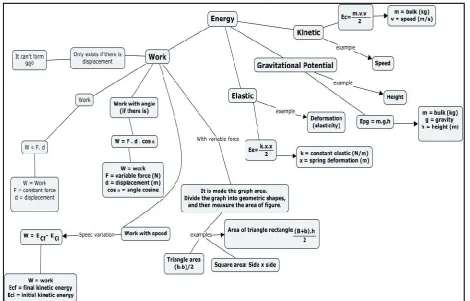
Once in maps M3, M4 and M5 observe the hierarchical structure. This model proposes a structure, from top to bottom, indicating relations of subordination among concepts. Concepts that encompass other concepts appear at the top, and concepts that are encompassed by several others are at the bottom. It should be noted that this model is not unique and, according to Moreira (2006), there are no fixed rules to be observed in construction of a conceptual map. Figure 6 shows one of those maps. In conceptual map of Figure 6 there is a mathematical error in equation for the area of triangle
[image:7.595.63.540.61.223.2]Source: from research (2018).
[image:7.595.53.537.269.340.2]Figure 11. Resistance measurement of associated resistors in series or in parallel
Figure 12. Color table and resistors
Color of Led Voltage in Volt (V) Current in Milliamps (mA)
RED 1,8 V – 2,0 V 20 mA
YELLOW 1,8 V – 2,0 V 20 mA
ORANGE 1,8 V – 2,0 V 20 mA
GREEN 2,0 V – 2,5 V 20 mA
BLUE 2,5 V – 3,0 V 20 mA
WHITE 2,5 V – 3,0 V 20 mA
Source: Available in:<http://www.comofazerascoisas.com.br>.
Source: from research (2018).
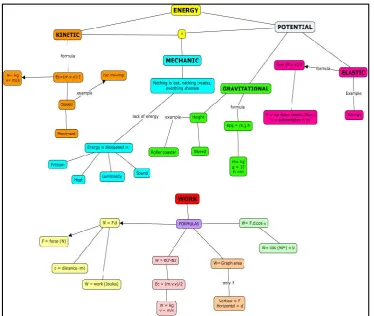
[image:7.595.62.540.373.651.2]rectangle. In fact the equation presented is that of calculating the trapezoid area. However, it is interesting to observe how students were concerned with explaining the calculation of variable-force work by presenting the division of graph into distinct geometric shapes and after calculating the area of each of them. The M4 conceptual map, on the other hand, presents greater clarity of concepts and better organization when compared to the map M5. That map clearly shows the connection between the three energies studied by bringing the concept of mechanical energy, as well as the connection of work with the concept of energy, which demonstrates that students understood work as a form of energy. Figure 7 highlights the conceptual map M4. On the other hand, analyzing the map M5, presented in Figure 8, we can see that it does not have a connection (connectors) between the concepts of energy and work. This fact may indicate the students' lack of understanding of work as a form of energy, and even a learning of concepts mechanically. When searching for signs of meaningful learning, one must take into account the possibility of memorization, which may have occurred in conceptual map previously presented. As Ausubel (2003: 131) suggests:
[...] when searching for evidence of meaningful learning, whether through verbal questioning, sequentially dependent learning or problem-solving tasks, consideration should be given to the possibility of memorization. Extensive expe rience in examinations makes students adept at memorizing not only key propositions and formulas, but also reasons, examples, reasons, explanations, and ways of recognizing and solving problems. The danger of memorized simulation of meaningful understanding can be best avoided by posing questions and problems that have a new and unknown form and require a maximum transformation of existing knowledge. Following the work are presented the results of other strategy worked with undergraduate students in Chemical Engineering.
Problem Based Learning: The proposed activity was carried
out in General Physics C discipline, 3rd semester of Chemical Engineering course, and had as objective to apply concepts discussed in class regarding the association of resistors in practical activities developed, relating concepts of voltage, current and electric power. The work took place in the laboratory of Basic Physics in the university. The students, divided into 6 groups, have developed four activities.
Materials provided for class were at a table available to the groups. Figure 9 shows the organization of space and materials. The following are the activities that were proposed for the group of students.
Activity 1 - Connection of three lamps in series and after in parallel, observing the dissipated power and complete disconnection of the circuit when one of the lamps is disconnected (series connection only). The groups have come to conclusion that the electrical connections of lamps in homes and establishments should be in parallel, because if a lamp burns and the association is in series, all other lamps turn off. In Figure 10, students during the proposed activity. Activity 2 - Measurement of resistance of different resistors, relating to the value tabulated by color code. The groups had the challenge of working with scales of measuring devices - which were close to numbers presented by the color code and could observe that the tolerance factor is important, since few resistors were 100% confirmed in the presented value color-coded.
By using a multimeter, students should figure out how to read with the multimeter's hands in contact with resistor terminals, noting the value and its relationship to color code and the tolerance factor of the manufacturer. Activity 3 - Construct an association of resistors, calculate the equivalent resistor and read the electrical resistance between terminals of the circuit built using the multimeter. The groups constructed with wire, pliers and different resistors, an association (in series, parallel or mixed) to verify the equivalent resistance. It was possible to perceive the difficulties of some students in handling of materials such as pliers. Figure 11 illustrates students during the proposed activity. After completing activity 3, each group received a LED Light Emitting Diode lamp, it should be connected without burning. A white LED bulb and a voltage converter (220V - 12V) were provided. The proposed problem has consisted in putting the lamp in operation with the knowledge of electrodynamics seen in class. The challenge was to find a resistor to make the connection and make sure the white LED did not burn. Finding the solution to that problem students have researched how to do the calculation to find the correct resistor to connect a white LED to a 12 V voltage source (since we use a voltage lowering - 220V at 12V). The groups searched on Internet (on their smartphones) and found on a website a table that shows the voltage for different LED colors and their respective currents. Figure 12 shows the table found by some groups.
Some groups did not pay attention to the current being in milliamps. Since the LED could not be burned and the technical guidelines indicated that it is safer to have a higher than the calculated resistor, one of the groups connected in series three identical resistors (justifying that the equivalent resistor is the sum of the three) and guaranteeing that there would be no burn. That demonstrated the interest of other groups in figuring out the correct way to solve the challenge. The contentment and satisfaction were clear when the lamp had worked correctly. Ausubel (1983) points out three factors are important for occurrence of meaningful learning: material used is potentially significant; presence of subsumptions in cognitive structure of learner and predisposition to learn. Figure 13 presents the solution presented by three of groups, using 1, 2 and 3 resistors respectively. The students presented to other classmates how the problem had been solved by their group. It was also proposed to prepare a report, including a detailed description of activities, materials, photos and conclusions of each group.
Final considerations: This work has aimed to put into practice the knowledge acquired in discipline of Strategies of Teaching I, component of Doctorate in Teaching of Univates. During activities carried out in that intervention, one can see the involvement, the predisposition of students during the proposed activities, which is already one of conditions for the occurrence of significant learning. According to Ausubel (2003), cognitive and interpersonal motivation factors influence the learning process concomitantly. Different teaching strategies, such as Conceptual Maps, Problem-Based Learning, GVGO, brainstorming, World Café, among others, are a possibility to engage students and motivate them, as well as an alternative to get rid of traditional classes, centered in frame and books, being able to break with the formalism existing in curricular structure of schools, where, according to Moreira (2006), some contents are listed in a program that is followed linearly, without back and forth, or as if aspects more important should be left to the end.
Moreira (2006) also points out that most textbooks are made in a linear and chronological way, starting from the simplest and ending with the most complex. The author points out that for meaningful learning to become accessible, the learner must have an initial view of the whole, of what is important to then differentiate and reconcile meanings, criteria, properties, and categories. And that linear organization does not promote progressive differentiation and integrative reconciliation. In activity in which the concept maps have been used, it is important to point out that not all students have evolved, which can be observed in some maps constructed. There were transitions, some in significant sense and others in mechanical sense. Moreira (2001) shows that learning is very often mechanical and not significant. In turn, in problem-based activity, the curiosity and motivation of students was remarkable in being able to turn on the LED without burning it. The students have involved in seeking different ways to solve the challenge proposed. Regardless of methodological proposal used, it was evident how experimental activities awaken the student to learn and actively involve him in the process of knowledge construction. At the end of activities carried out, it could be inferred that the elaboration of methodological proposals that approach different teaching strategies, such as Problem-Based Learning and Conceptual Maps, combined with experimental activities may constitute a potentially significant material for the work of teacher, aiming at meaningful student learning.
REFERENCES
Ausubel David P. 2003. Aquisição e Retenção de Conhecimentos: Uma perspectiva Cognitiva. Lisboa: Paralelo Editora, LDA. 1ª Edição. 220p.
Bastos, C. C. 2006. Metodologias ativas. Disponível em: . Acesso em: 14 fev. 2018.
Dutra, Í. M. et al., 2006. Uma base de dados para compartilhamento de experiências no uso de mapas conceituais no acompanhamento de processos de conceituação. Novas tecnologias na Educação, Porto Alegre, v. 4, n. 2, p. 124 – 138.
Gomes, R., Brino R.F., Aquilante A.G., AVÓ, L.R.S. Aprendizagem baseada em problemas na formação médica e o currículo tradicional de medicina: uma revisão bibliográfica. Revista Brasileira de Educação Médica. 2009; 33:444-51.
Moreira, M. A. 2018. Aprendizagem significativa: da visão clássica à visão crítica. In: Encontro internacional sobre aprendizagem significativa, 5, Madrid. Anais... Madri, 2006. Disponível em: <http://www.if.ufrgs.br /~moreira/visaoclasicavisaocritica.pdf>. Acesso em: 15 mar..
Moreira, M. A., Masini, E. F. S. Aprendizagem significativa: a teoria de aprendizagem de David Ausubel. São Paulo: Moraes, 1982.
Moreira, Marco Antônio. 1983. Uma abordagem Cognitiva ao Ensino de Física: A teoria de aprendizagem de David Ausubel como sistema de referência para a organização do ensino de ciências. Porto Alegre: UFRGS.
Moreira, Marco Antônio. 2001. Aprendizagem significativa: a teoria de David Ausubel. São Paulo, Centauro.
Moreira, Marco Antônio. 2012. Al final, que és aprendizaje significativo? Qurriculum (La Laguna), v. 25, p. 29-56,. Moreira, Marco Antônio. 2015. Mapas conceituais e diagramas
V.Porto Alegre, Ed. Do autor.
Tavares, R. 2007. Construindo mapas conceituais. Ciências & Cognição, Rio de Janeiro, v. 12, p. 72-85, 2007. Disponível em: http://www.cienciasecognicao.org/ pdf/v12/m 347187.pdf>. Acesso em: 12 mar. 2018.
Toledo, J., Ibiapina, C.C., Lopes S.C.F., Rodrigues A.C.P., Soares S.M.S. 2008. Aprendizagem baseada em problemas: uma nova referência para a construção do currículo médico. Revista Médica. Minas Gerais. 18:123-31.
4306 International Journal of Current Research, Vol. 11, Issue, 06, pp.4298-4306, June, 2019