ISSN Online: 2331-4249 ISSN Print: 2331-4222
DOI: 10.4236/wjet.2019.73028 Aug. 6, 2019 379 World Journal of Engineering and Technology
Quantitative Characterization and Dynamic
Law of Interlayer Interference for Multilayer
Commingled Production in Heavy Oil
Reservoirs by Numerical Simulation
Dong Liu
*, Fengyi Zhang, Qin Zhu, Xinran Wang, Jing Fan
Tianjin Branch of CNOOC Ltd., China National Offshore Oil Corporation, Tianjin, China
Abstract
This paper moves one step forward to build a numerical model to research quantitative characterization and dynamic law for interlayer interference factor (IIF) in the multilayer reservoir which was heavy oil reservoirs and produced by directional wells. There are mainly four contributions of this paper to the exist-ing body of literature. Firstly, an equivalent simulation method of the pseudo start pressure gradient (PSPG) is developed to quantitatively predict the value of IIF under different geological reservoir conditions. Secondly, the interlayer interference is extended in time, and the time period of the study extends from a water cut stage to the whole process from the oil well open to produce a high water cut. Thirdly, besides the conventional productivity interlayer interference factor (PIIF), a new parameter, that is, the oil recovery interlayer interference factor (RIIF) is put forward. RIIF can be used to evaluate the technical indexes of stratified development and multilayer co-production effectively. Fourthly, the effects of various geological reservoir parameters such as reservoir permea-bility and crude oil viscosity, etc. on the PIIF and RIIF’s type curves are dis-cussed in detail and the typical plate is plotted. The research results provide a foundation for the effective development of multilayer heavy oil reservoirs.
Keywords
Heavy Oil, Interlayer Interference, Multilayer Commingled Production, Pseudo Start Pressure Gradient, Water Flooding
1. Introduction
As a short-term non-renewable fossil energy, petroleum resources are very im-How to cite this paper: Liu, D., Zhang,
F.Y., Zhu, Q., Wang, X.R. and Fan, J. (2019) Quantitative Characterization and Dynam-ic Law of Interlayer Interference for Multi-layer Commingled Production in Heavy Oil Reservoirs by Numerical Simulation. World Journal of Engineering and Technology, 7, 379-395.
https://doi.org/10.4236/wjet.2019.73028
Received: June 18, 2019 Accepted: August 3, 2019 Published: August 6, 2019
Copyright © 2019 by author(s) and Scientific Research Publishing Inc. This work is licensed under the Creative Commons Attribution International License (CC BY 4.0).
DOI: 10.4236/wjet.2019.73028 380 World Journal of Engineering and Technology portant to today’s economic and social development, affecting all aspects of people’s lives. The global oil resources can be divided into several types, such as low permeability reserves, heavy oil reserves, and medium and high-permeability sandstone rare oil reserves. Low permeability and heavy oil reserves account for a large proportion. Due to low fluidity (formation permeability divided by crude viscosity), it is difficult for the reserves of low permeability and heavy oil to flow in porous media, and many scholars’ studies have proved the widespread exis-tence of pseudo start pressure gradient (PSPG) in low permeability and heavy oil
[1] [2]. The so-called PSPG refers to the flow of crude oil in porous media only when the pressure gradient is exceeded. Therefore, it is an important parameter to characterize the flow threshold of oil.
In the eastern part of China, there are mainly continental sandstone reser-voirs, which are characterized by multiple development strata, thin reservoir and thick oil. Its reserves and output account for about 50% of the country. A large number of geological research results show that the sandstone reservoir in China has the length of oil well section and a large number of small layers [3]. There is a large difference in permeability between multiple and interlayer. This kind of reservoir usually uses the directional well to carry out several reservoir combina-tion development. The main advantage of this method is large well controlled reserves and high degree of reserves utilization. But at the same time, there are also obvious defects, such as serious interlayer interference, and with the pro-duction, interlayer interference is more and more serious. Therefore, the study of the subdivision sequence in the later stage of oilfield development becomes an important content of oilfield adjustment.
The heterogeneous multi-layer oilfield is composed of several or even dozens of oil layers, some of which have high permeability and low permeability. In wa-ter injection, high permeability, medium permeability and low permeability re-servoirs are different in water absorption capacity, water line propulsion speed, formation pressure, oil recovery speed, water flooding and so on, so it may cause the interlayer interference [4] [5]. According to the multi wells stratified produc-tivity test of sandstone reservoir, it is shown that the production fluid index is far less than that of the separate oil production. Interlayer interference coefficient is an important parameter to confirm the limits of layer series combination and productivity evaluation. However, interlayer interference coefficient is difficult to decide because the parameter used for calculating is hard to acquire. Then in-terlayer interference coefficient empirical value is usually used and some uncer-tainty is involved. Many scholars have studied the problem of interlayer interfe-rence. At present, the research mainly focuses on three aspects: theoretical deri-vation, physical experiments and numerical simulation.
DOI: 10.4236/wjet.2019.73028 381 World Journal of Engineering and Technology will be shielded along the high permeability layer, and the residual oil is formed, which seriously affects the efficiency of water flooding and the recovery of oil field [7] [8] [9]. Yu Huili et al. [10] qualitative analysis the main controlling fac-tors of interlayer interference at different water cut stages, with the application of various data of dynamic production, coring inspection chamber, log interpre-tation data and fined reservoir research. Xian Bo et al. [11] obtained the degree of interlayer interference, technical countermeasures of eliminating the interfe-rence and corresponding technical chart for commingled production in thin re-servoirs by using dual model without interlayer channeling, numerical simula-tion and analysis of single and orthogonal factors. However, the effect of different pressure coefficient and formation permeability is only considered. Wang Shibo et al. [12] through the numerical simulation test, the influence degree of various factors on recovery can be obtained, and the oil recovery of various factors can be obtained by regression. When there is no interlayer interference well testing, Liu Hongjie [13] proposed using reservoir engineering method to calculate in-terlayer interference coefficient with DST test data, dynamic performance data, pressure buildup test interpretation results, PVT and core analysis results, and so on. In view of the present few theoretical researches on the quantitative charac-terization of interlayer interference in multi-layer commingled sandstone reser-voirs, Su Yanchun et al. [14] proposed a new concept of interlayer dynamic in-terference, and established a mathematical model for the quantitative characte-rization of the dynamic interference coefficient between layers. The quantitative relationship between the dynamic interference coefficient of the multi-layer com-bined production sandstone reservoir and the water content of the longitudinal layers, the permeability and the pressure difference of the combined production pressure is deduced by the seepage theory. However, the research only analyzed the influence of formation permeability and formation crude viscosity on pro-duction capacity interference factor (PIIF), the oil recovery interference factor (RIIF) is not analyzed.
DOI: 10.4236/wjet.2019.73028 382 World Journal of Engineering and Technology proposed that it can be comprehensively characterized by reservoir reference permeability, permeability contrast and permeability deviation.
At the same time, the reservoirs with multilayer water injection have the problems of injection water quick braking through and low oil recovery in wa-ter-free oil production period, and the middle and high water cut period become the main oil producing period [16]. Therefore, it is very important to determine the influence of interlayer interference on oil well productivity at different water cut stages, especially in middle and high water cut period. Considering the cha-racteristics of short production years and high development cost of offshore oil fields [17], it is of great significance to accurately evaluate the productivity of oil wells, to reasonably divide the development layer, and to take the corresponding technical countermeasures to eliminate or reduce the impact of interlayer inter-ference on the efficient development of offshore oil fields.
All of these previous works laid a solid foundation for later research. However, these works were not focused on pseudo start pressure gradient (PSPG). These previous models are no longer applicable for heavier oil with PSPG. In recent years, pioneer works were conducted on the flow behaviors of heavy oil with PSPG. Wang Shoulei et al. [18] proposed a new method to determine interlayer in-terference coefficient by considering PSPG in reservoir simulation. Based on the consideration of periodicity and dynamic characteristics, Xu Jiafeng et al. [19]
established the dynamic interference mathematic model of multilayer commin-gle producing for water flooding sand stone heavy oil. And the effects of such main factors as permeability, viscosity and threshold pressure gradient on inter-layer interference are revealed.
At present, there are many studies on interlayer interference, but most of the con-clusions are only suitable for single phase flow or only for a certain water cut stage
[20] [21] [22], or describing qualitatively the interference phenomena at various stages based on a rough division of the production stage according to the field situa-tion [8] [10] [13]. This has little guiding significance for actual production. However, the dynamic law and recovery interference factor in multilayer co-production are still not clear.
DOI: 10.4236/wjet.2019.73028 383 World Journal of Engineering and Technology crude oil viscosity, etc. on the PIIF and RIIF’s type curves are discussed in detail and the typical plate are plotted. The research results provide a foundation for the effective development of multilayer heavy oil reservoirs.
2. Methods and Models
2.1. Definition of Interference Coefficients
To better characterize the interference, three interference coefficients can be de-fined as follows:
1 1 1 n n sli mli i i l n sli i SPI SPI PIIF SPI = = = − =
∑
∑
∑
(1)
1 1 1 n n soi moi i i o n soi i SPI SPI PIIF SPI = = = − =
∑
∑
∑
(2)1 1 1 n n soi moi i i n soi i RF RF RIIF RF = = = − =
∑
∑
∑
(3)The physical significance of the interference coefficient is the degree to which the overall fluid productivity and oil production capacity of the multi-layer well are reduced by interlayer interference under the same water-cut condition when mingled injection and production.
2.2. Establishment of Numerical Model Considering
Pseudo-Start-Up Pressure Gradient
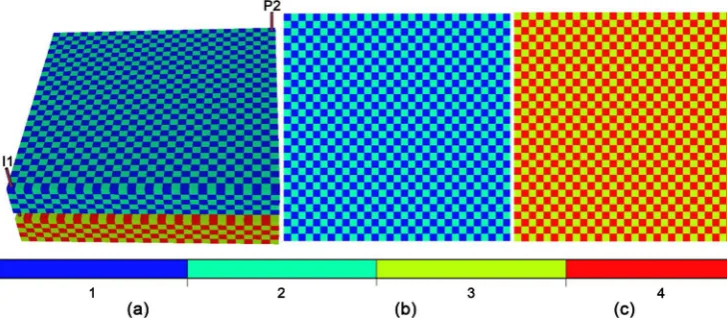
The numerical model is available by the ECLIPSE reservoir simulator, which is shown in Figure 1. In addition, the grid system is 31 × 31 × 12 and the corres-ponding block dimensions in I, J and K directions are 5.0 m, 5.0 m and 4.0 m, respectively. And the border is a closed border. The reservoir has two oil layers, the upper layer and lower layer has the same thickness of 20 m. The 1 - 5th layer
is the upper layer, the 6th layer is the mudstone interlayer, the 7 - 11th layer is the
lower layer, and the 12th layer is the mudstone interlayer. In the model, the water
is injected by directional well I1 located in the center of left, and the production well P2 located in the center of right, which can be seen as a quarter of the re-verse five point pattern.
DOI: 10.4236/wjet.2019.73028 384 World Journal of Engineering and Technology
Figure 1. Equilibrium zones schematic diagram of numerical simulation model for (a) three dimen-sional grid, (b) the upper layer, (c) the lower layer.
partitions is set. The setting of balanced partition takes the following methods: the first grid in line 1 is set as balanced partition 1, and the second grid is set as balanced partition 2, which is repeated until the end of the line. The first grid in line 2 is set as balanced partition 2, and the second grid is set as balanced parti-tion 1. Repeat until the end of the row. The other rows will be repeated in line 1 and line 2 Settings. As shown in Figure 1(a) and Figure 1(b), for any grid, its balanced partition is different from that of the four adjacent grids, and the thre-shold pressure of two balanced partitions must be overcome for fluid flow from the grid to any grid.
Luo Xiaobo et al. [21] used sand filling pipes for physical simulation experi-ments in 3 heavy oil fields in Bohai sea area (crude oil viscosity 49.2 - 135.0 mPa∙s) and the main oil sands (permeability 632 - 3265 mD). According to the reference [21], the relationship between PSPG and fluidity obtained through re-gression was as follows:
0.8688 0.1231
o
PSPG K
µ −
= ×
(4) Taking the first layer as an example, the permeability of this layer is 10,000 mD, and the viscosity of crude oil is 300 mPa∙s. The calculation results by for-mula (4) show that the PSPG is 0.00585 MPa/m. Due to the grid size is 5 m, so the threshold pressure between adjacent zones is 0.029 MPa.
2.3. Validation of Model Prediction Results
DOI: 10.4236/wjet.2019.73028 385 World Journal of Engineering and Technology
Table 1. The interference coefficient comparison between reported in the literature and calculated by above numerical model based on the S heavy oil field.
Well Name Value for Field Test Result Value for above Numerical Model
A04 0.57 /
A11 0.46 /
A25 0.54 /
A14 0.35 /
B6 0.53 /
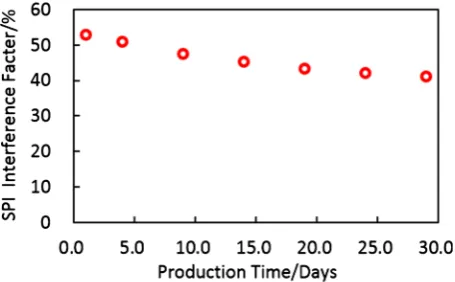
Average Value 0.49 0.457
Annotation: Value for above Numerical Model is the average value for the first produce month.
Figure 2. The oil production index interference coefficient calculated by the above model changes with time.
3. Program Design and Research Results
In this paper, the effects of formation permeability and oil viscosity on interlayer interference are considered.
For the study of formation permeability, the viscosity of formation oil is con-stant at 300 mPa∙s, and the permeability of upper reservoir is concon-stant at 10 µm2,
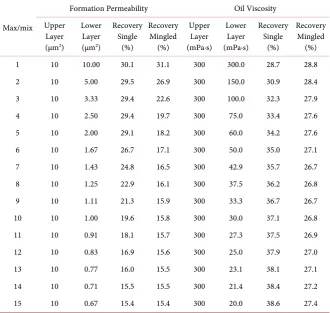
and the permeability of lower reservoir is different under different schemes (15 range Max/Min values are studied) to obtain 15 geological reservoir models. Each model studies the three development scheme: only produce the upper oil layer, only produce the lower oil layer and mingled produce the two-layers respectively.
For the study of oil viscosity, the permeability of formation is constant at 2.5 µm2, and the oil viscosity of upper reservoir is constant at 300 mPa∙s, and the
lower reservoir is different under different schemes (15 range Max/Min values are studied) to obtain 15 geological reservoir models. The PSPG of different com-bination schemes is calculated according to formula 4. The parameters and cal-culation results of the model design are shown in Table 2.
4. Discussion
4.1. Formation Oil Viscosity
[image:7.595.260.488.243.384.2]DOI: 10.4236/wjet.2019.73028 386 World Journal of Engineering and Technology
Table 2. The parameters and values in the scheme design and the results.
Max/mix
Formation Permeability Oil Viscosity
Upper Layer (µm2)
Lower Layer (µm2)
Recovery Single (%) Recovery Mingled (%) Upper Layer (mPa∙s) Lower Layer (mPa∙s) Recovery Single (%) Recovery Mingled (%)
1 10 10.00 30.1 31.1 300 300.0 28.7 28.8
2 10 5.00 29.5 26.9 300 150.0 30.9 28.4
3 10 3.33 29.4 22.6 300 100.0 32.3 27.9
4 10 2.50 29.4 19.7 300 75.0 33.4 27.6
5 10 2.00 29.1 18.2 300 60.0 34.2 27.6
6 10 1.67 26.7 17.1 300 50.0 35.0 27.1
7 10 1.43 24.8 16.5 300 42.9 35.7 26.7
8 10 1.25 22.9 16.1 300 37.5 36.2 26.8
9 10 1.11 21.3 15.9 300 33.3 36.7 26.7
10 10 1.00 19.6 15.8 300 30.0 37.1 26.8
11 10 0.91 18.1 15.7 300 27.3 37.5 26.9
12 10 0.83 16.9 15.6 300 25.0 37.9 27.0
13 10 0.77 16.0 15.5 300 23.1 38.1 27.1
14 10 0.71 15.5 15.5 300 21.4 38.4 27.2
15 10 0.67 15.4 15.4 300 20.0 38.6 27.4
affected by the static parameters of the geological reservoir. Therefore, this paper focuses on the influence of the formation permeability and the oil viscosity un-der formation conditions on the interlayer interference.
4.1.1. Specific Productivity Index
Specific productivity index (SPI) is an important indicator to measure the daily oil production capacity of the reservoir. The physical significance of this index is the daily oil production capacity per unit reservoir thickness per unit pressure difference. The larger the value, the stronger the oil production capacity of the oilfield. In case of Max/Min = 5, the variation law of the SPI with production time is shown in Figure 3.
DOI: 10.4236/wjet.2019.73028 387 World Journal of Engineering and Technology production capacity of reservoirs with relatively thin viscosity is increasing at the later stage, while the fluid production capacity of reservoirs with high crude oil viscosity is basically unchanged.
4.1.2. Specific Productivity Index Interference Factor
Figure 4 is a comparison diagram of the PIIF between the upper reservoir and
[image:9.595.125.538.395.535.2]the lower reservoir under different Max/Min values. As shown in the above fig-ure, the greater the difference of formation crude oil viscosity, the earlier the water injection breakthrough time. Correspondingly, the earlier the water breakthrough in the upper reservoir, the earlier the inflection point of PIIF appears. In this mod-el, for the case of max/min = 5, the maximum PIIF is 55.6% after producing 74 days, and for the case of max/min = 10, the maximum PIIF is 56.2% after pro-ducing 52 days.
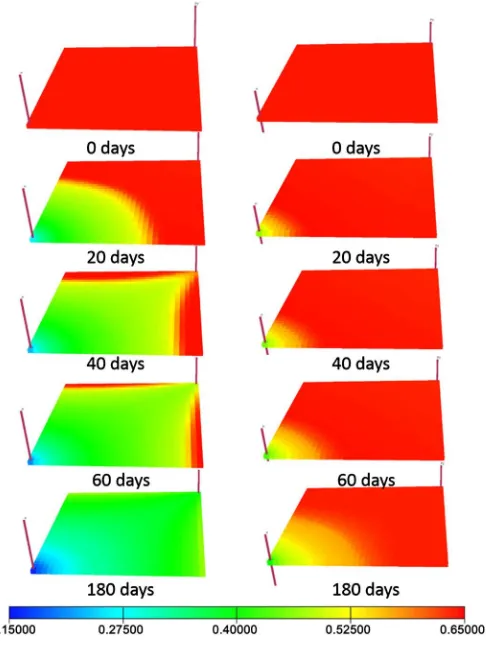
Figure 5 is the isogram of oil saturation at different production times under
[image:9.595.126.539.566.706.2]the condition of formation crude oil viscosity at Max/Min = 10. It can be seen from Figure 5 that the periodic change rule of the interference coefficient of the specific oil recovery index corresponds to the periodic change of oil saturation field. Specifically, the rule of interlayer interference is summarized as follows: at the initial stage of production, because the crude oil in the lower reservoir is low and the seepage resistance is relatively small, the injected water first enters the production well along the lower reservoir, showing that the lower reservoir has a
Figure 3.SPI figure of formation oil viscosity max/min = 5 for (a) oil, (b) oil add water.
DOI: 10.4236/wjet.2019.73028 388 World Journal of Engineering and Technology
Figure 5. Oil saturation field varied with production time of the case formation oil vis-cosity max/min = 10 (the left is the lower layer with 30 mPa∙s, and the right is the upper layer with 300 mPa∙s).
higher SPI, while the upper reservoir has a lower SPI. With the development of production, the PIIF decreases gradually. When the injected water breaks through to the production well along the main line of the lower reservoir, the SPI of the lower reservoir begins to reduce greatly. As the breakthrough became more and more serious, the SPI in the lower oil layer began to decline slowly. Therefore, the curve of PIIF shows two distinct stages. In the first stage, before the injected water breaks through the production well, the PIIF drops slowly. In the second stage, after the injected water broke through the production well, the disturbance coefficient was basically stable around a certain value.
4.1.3. Oil Recovery Degree Interference Factor
The PIIF is mainly used for the judgment of a certain stage, while for the evalua-tion of the entire development stage, another parameter, RIIF is more effective.
Figure 6 is the figure of oil recovery degree varied with max/min formation oil
viscosity of commingled production.
DOI: 10.4236/wjet.2019.73028 389 World Journal of Engineering and Technology
Figure 6. Oil recovery degree varied with max/min formation oil viscosity of commingled production. (a) Upper and lower layer comparison; (b) Different production ways comparison.
greatly with the decrease of the lower layer viscosity difference. When the vis-cosity difference (max/min value) increased from 1 to 15, the recovery degree of the upper reservoir decreased from 29.0% to 4.8%. And with the increase of the viscosity difference, the recovery degree of the upper reservoir showed a law of logarithmic decline. As the viscosity of the lower reservoir gradually decreased from 300 mPa∙s to 20 mPa∙s, the recovery degree of the lower reservoir increased from 28.6% to 49.8%. And the recovery degree of the lower reservoir presented a law of logarithmic function.
(
)
(
2)
8.759ln 26.774 0.9743
Upper viso viso
RF = − Max Min + R = (5)
(
)
(
2)
7.3435ln 30.368 0.9849
Lower viso viso
RF = Max Min + R = (6)
For different development methods (commingled production and separated production), the ultimate recovery degree of the whole reservoir is different. It can be clearly seen from Figure 6(b) that, with the increase of crude oil viscosity extreme difference, the oil recovery of commingled production changes slightly, while that of produce layer by layer significantly increases.
(
)
(
2)
11.195ln 1.2382 0.9783
viso viso viso
RIF = Max Min + R = (7)
Figure 7 shows the relationship between the RIIF and the Max/Min oil viscos-ity. As the Max/Min viscosity increases, the RIIF increases in logarithmic form. When the Max/Min is less than 5, the increase speed is faster. When the Max/Min is between 5 and 10, the increase rate becomes slow. When the Max/Min is greater than 10, the RIIF is stable at about 30%. Therefore, in order to obtain a better development effect, it is recommended to conduct stratified mining when the Max/Min viscosity is greater than 5.
4.2. Formation Permeability
4.2.1. Specific Productivity IndexDOI: 10.4236/wjet.2019.73028 390 World Journal of Engineering and Technology
[image:12.595.129.539.234.375.2]Figure 7. Oil recovery degree interference factor (RIIF) varied with max/min formation oil viscosity.
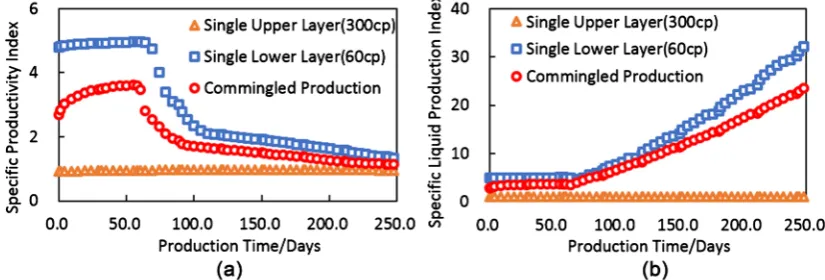
Figure 8.SPI and PIIF of formation permeability max/min = 5 for (a) SPI, (b) PIIF.
production, and the SPI is constant. In the second stage, rapid decline stage, af-ter two months of production, the SPI decreased from 4.0 to 2.8, with a decline amplitude of 30%. The third stage, SPI declines slowly. When producing the lower permeability oil layer separately, the SPI is nearly constant. So, when the two layers are produced combined, SPI presents the same periodic characteris-tics as that of producing upper reservoir separately.
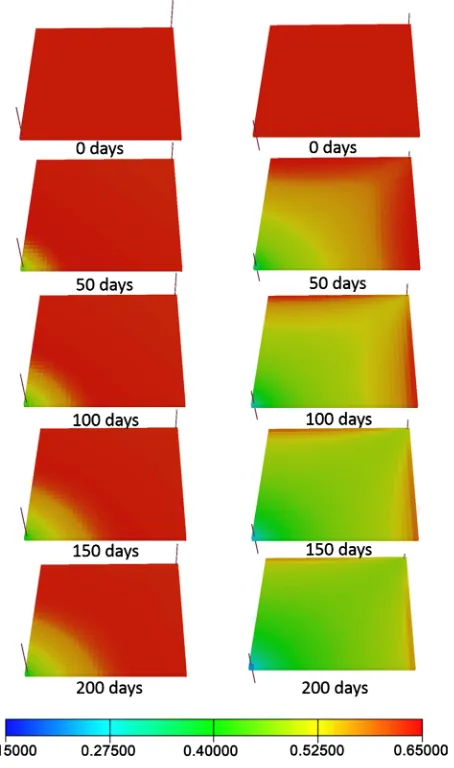
As shown in Figure 8(b), the greater the difference of formation permeability, the earlier the water injection breakthrough time. Correspondingly, the earlier the water breakthrough in the upper reservoir, the earlier the inflection point appears in the PIIF. In this model, for the case of max/min = 5, there are two peak points, one occurs after produce 50 days, with the PIIF of 56.7%, and the other occurs after produce 150 days, with the PIIF of 60.2%. This characteristic is corresponds to the periodic change of oil saturation field, which has been showed in Figure 9.
4.2.2. Oil Recovery Degree Interference Factor
Figure 10 is the figure of oil recovery degree varied with max/min formation
DOI: 10.4236/wjet.2019.73028 391 World Journal of Engineering and Technology
Figure 9. Oil saturation field varied with production time of the case formation permeability max/min = 5 (the left is the lower layer with 2000 mD, and the right is the upper layer with 10,000 mD).
Figure 10. Oil recovery degree varied with max/min formation permeability of commingled production. (a) Upper and lower layer comparison; (b) Different production ways comparison.
[image:13.595.125.539.494.639.2]DOI: 10.4236/wjet.2019.73028 392 World Journal of Engineering and Technology recovery degree of the lower reservoir decreased from 31.0% to 0.8%. And with the increase of the max/min value, the recovery degree of the lower reservoir showed a law of power function decline.
(
)
1.495(
2)
47.104 0.9788
Lower perm perm
RF = Max Min − R = (8)
[image:14.595.261.487.552.695.2]It can be clearly seen from Figure 10(b) that, with the increase of formation permeability extreme difference, the oil recovery of combined mining changes from 30.0% to 15.4%, while that of single mining significantly increases at first, and decreased to the same value after max/min formation permeability larger than 12.
Figure 11 shows the relationship between the RIIF and the Max/Min
permea-bility, and can be regressed as:
(
)
(
)
(
)
3 2
2
0.0957 2.9485
24.531 0.9863
Perm perm perm perm perm
RIF Max Min Max Min
R
= −
− = (9)
As the Max/Min permeability increases, the RIIF presents the characteristics of two stages. When the Max/Min is less than 5, the increase speed is faster. When the Max/Min is higher than 5, the RIF begins to decrease. The main rea-son is that with the decrease of formation permeability, the starting pressure gradient of low permeability layer increases continuously and the seepage resis-tance increases, leading to the injection water breakthrough along the high per-meability layer with relatively small seepage resistance, resulting in low water flooding sweep coefficient of low permeability layer. When the max/min forma-tion permeability is greater than 5, the recovery degree of low permeability layer is only 4.8%. When the max/min formation permeability is greater than 10, the recovery degree of low permeability layer is only 1.4%. Therefore, in order to ob-tain a better produce effect, it is recommended to conduct stratified mining when the Max/Min viscosity is greater than 5.
4.3. Strengths and Limitations
The innovation of this paper is that by establishing the numerical simulation
DOI: 10.4236/wjet.2019.73028 393 World Journal of Engineering and Technology model considering the PSPG of heavy oil, the variation law of the interference coefficient between the two reservoirs with different crude oil viscosity and dif-ferent permeability differences is successfully simulated. At the same time, in order to more accurately judge the influence of combined mining and separate mining on the oilfield development effect, the concept of RIIF is defined, which makes up for the insufficiency of the PIIF which only represents the value of a certain stage, and represents a final effect. Through the study, we get the limit of using the reservoir with high seepage resistance under different conditions. The results of the study provide a selection condition for the selection of multi-layer sandstone reservoir for the development of stratified system, especially for the design of oilfield development scheme.
Although some achievements have been made in this paper, there are still some areas for further study. For example, the study in this paper is based on the homogeneous model without considering the effect of in-layer plane hetero-geneity. It can be speculated that, for planar heterogeneous reservoirs, the law of water injection breakthrough is different from that of homogeneous reservoirs, which may lead to the difference of interlayer interference coefficient. However, this does not affect the general understanding of the interference coefficient and interference law of two-layer heavy oil reservoirs.
5. Conclusions
Through efforts, this paper aims at the problem of dynamic rule and quantitative description of interlayer interference in the co-production of heavy oil reser-voirs, and obtains several important understandings, which are as follows:
1) A novel equivalent simulation method of the pseudo start pressure gradient (PSPG) is developed to quantitatively predict the value of PIIF. The interlayer interference is extended in time, and the time period of the study extends from a water cut stage to the whole process from the oil well open to produce a high water cut.
2) Based on the conventional production capacity interference factor (PIIF), a new parameter, that is, the oil recovery interference factor (RIIF) is put forward. RIIF can be used to evaluate the technical indexes of stratified development and multilayer co-production.
3) The effects of various geological reservoir parameters such as permeability, crude oil viscosity, etc. on the PIIF and RIIF’s type curvesare discussed in detail. The PIIF and RIIF under different range conditions are plotted. In order to ob-tain a better development effect, it is recommended to conduct stratified mining when the Max/Min viscosity is greater than 5 or the Max/Min permeability is greater than 5.
Acknowledgements
DOI: 10.4236/wjet.2019.73028 394 World Journal of Engineering and Technology of thermal recovery in offshore heavy oil fields.
Conflicts of Interest
The authors declare no conflicts of interest regarding the publication of this pa-per.
References
[1] Dou, H., Ma, S., Zou, C., et al. (2014) Threshold Pressure Gradient of Fluid Flow through Multi-Porous Media in Low and Extra-Low Permeability Reservoirs.
Science China (Earth Sciences), 57, 2808-2818. https://doi.org/10.1007/s11430-014-4933-1
[2] Liu, D., Li, X., Liu, J., et al. (2017) Mesoscopic Mechanism of Threshold Pressure Gradient in Low Permeability Porous Media. Journal of Engineering Thermophys-ics, 38, 787-791.
[3] Han, D. and Wan, R. (1999) The Development Models of Multizone Sandstone Re-servoirs. Petroleum Industry Press, Beijing, 132-145.
[4] Wang, Z. and Shi, Z. (1999) Advanced Reservoir Characterization Technology. Pe-troleum Industry Press, Beijing, 251-258.
[5] Xiong, Q., Wang, Z. and Ji, F. (1994) The Modern Reservoir Description Technique and Its Application in China. Acta Petrolei Sinica, 15, 1-9.
[6] Wu, S., Zeng, J., Lin, S., et al. (2003) Interlayer Interference and Differential Injec-tion of Hydrocarbon into a Trap. Petroleum Geology & Experiment, 25, 285-288. [7] Weber, K.J. (1986) How Heterogeneity Affects Oil Recovery. In: Lake, L.W. and
Carroll, H.B., Eds., Reservoir Characterization, Academic Press, Orlando, 487-544. https://doi.org/10.1016/B978-0-12-434065-7.50021-6
[8] Chen, Y. (1993) Countermeasures for Heterogeneity of Continental. Petroleum In-dustry Press, Beijing.
[9] Wu, S. and Xiong, Q. (1998) Oil and Gas Reservoir Geology. Petroleum Industry Press, Beijing.
[10] Yu, H., Wang, W., Rong, N., et al. (2006) Rule of Interlayer Interference in Various Water Cut Periods of Shengtuo Oilfield. Petroleum Geology and Recovery Efficien-cy, 13, 71-73.
[11] Xian, B., Xiong, Y., Shi, G., et al. (2007) Interlayer Interference Analysis of Com-mingled Production in Thin Reservoirs and Its Technical Countermeasures. Special Oil & Gas Reservoirs, 14, 51-54.
[12] Wang, S., Huang, A. and Wei, J. (2012) Numerical Simulation on Interlayer Inter-ference of Thin and Interbed Reservoirs. Journal of Oil and Gas Technology, 34, 247-250.
[13] Liu, H. (2013) New Determination Method of Interlayer Interference Coefficient among Commingling Production Layers in Conventional Reservoirs. Petroleum Geology and Engineering, 27, 50-82.
[14] Su, Y., Jia, X., Li, Y., et al. (2015) New Technology for Quantitative Characterization of Interlayer Dynamic Interference in Multi-Layer Commingled Production Reser-voirs. Special Oil & Gas Reservoirs, 22, 101-103.
DOI: 10.4236/wjet.2019.73028 395 World Journal of Engineering and Technology Exploration and Development, 42, 488-495.
https://doi.org/10.1016/S1876-3804(15)30046-X
[16] Wang, D. (1985) Slicing Production Theory. Petroleum Industry Press, Beijing. [17] Zhou, S. (2009) The Typical Development Practice of Chinese Offshore Oilfield.
Petroleum Industry Press, Beijing, 28-29.
[18] Wang, S., Geng, Z. and An, G. (2017) A New Method of Determining the Interlayer Coefficient in Offshore Heavy Oil Reservoir. China Offshore Oil and Gas, 29, 90-95. [19] Xu, J., Zhang, J., Cheng, L., et al. (2016) The Dynamic Characterization and Appli-cation of Interlayer Interference for Sandstone Heavy Oil Multilayer Commingled Producing. China Offshore Oil and Gas, 28, 48-54.
[20] Zhao, Y. (1983) A Discussion on the Interlayer Interference in Water Injection Wells. Petroleum Exploration and Development, 10, 64-69.
[21] Zhang, S. (1984) A Discussion on the Interlayers Interference in a Water Injection Well. Petroleum Exploration and Development, 11, 56-60.
[22] Wang, G., Li, L., Wang, P., et al. (2012) One New Method of Equivalent Simulation of Start-Up Pressure in Numerical Simulation Software. Science Technology and Engineering, 12, 165-167.
Nomenclature
PIIF, Dimensionless Productivity interlayer interference factor SPI, m3/(Day∙MPa∙m) Specific productivity index
RIIF, Dimensionless Oil recovery interference factor RF, Dimensionless Oil recovery
G, MPa/m Pseudo start pressure gradient K, mD Formation permeability
o
µ , mPa∙s Oil viscosity under formation conditions Greek letters
l water + oil
o oil
sli separated production for fluids mli mingled production for fluids soi separated production for oil moi mingled production for oil upper the upper layer
lower the lower layer