Entity Linking at Web Scale
Thomas Lin, Mausam, Oren Etzioni Computer Science & Engineering
University of Washington Seattle, WA 98195, USA
{tlin, mausam, etzioni}@cs.washington.edu
Abstract
This paper investigates entity linking over mil-lions of high-precision extractions from a cor-pus of 500 million Web documents, toward the goal of creating a useful knowledge base of general facts. This paper is the first to re-port on entity linking over this many extrac-tions, and describes new opportunities (such as corpus-level features) and challenges we found when entity linking at Web scale. We present several techniques that we developed and also lessons that we learned. We envi-sion a future where information extraction and entity linking are paired to automatically gen-erate knowledge bases with billions of asser-tions over millions of linked entities.
1 Introduction
Information Extraction techniques such as Open IE (Banko et al., 2007; Weld et al., 2008) operate at un-precedented scale. The REVERBextractor (Fader et
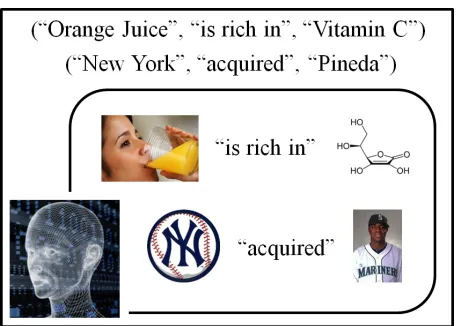
al., 2011) was run on 500 million Web pages, and extracted 6 billion (Subject, Relation, Object) ex-tractions such as (“Orange Juice”, “is rich in”, “Vi-tamin C”), over millions of textual relations. Link-ing each textual argument strLink-ing to its correspondLink-ing Wikipedia entity, known asentity linking(Bunescu and Pas¸ca, 2006; Cucerzan, 2007), would offer ben-efits such as semantic type information, integration with linked data resources (Bizer et al., 2009), and disambiguation (see Figure 1).
[image:1.612.313.541.241.404.2]Existing entity linking research has focused pri-marily on linking all the entities within individual documents into Wikipedia (Milne and Witten, 2008;
Figure 1: Entity Linking elevates textual argument strings to meaningful entities that hold properties, semantic types, and relationships with each other.
Kulkarni et al., 2009; Dredze et al., 2010). To link a million documents they would repeat a million times. However, there are opportunities to do bet-ter when we know ahead of time that the task is large scale linking. For example, information on one document might help link an entity on another document. This relates to cross-document corefer-ence (Singh et al., 2011), but is not the same be-cause cross-document coreference does not offer all the benefits of linking to Wikipedia. Another op-portunity is that after linking a million documents, we can discover systematic linking errors when par-ticular entities are linked to many more times than expected.
In this paper we entity link millions of high-precision extractions from the Web, and present our initial methods for addressing some of the opportu-nities and practical challenges that arise when
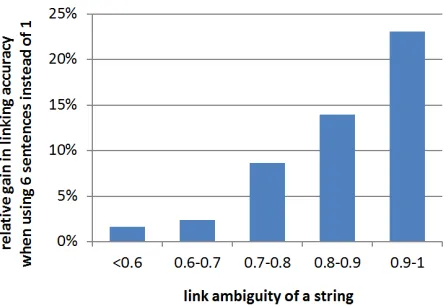
Figure 2: Context matching using more source sentences can increase entity linking accuracy, especially in cases where link ambiguity is high.
ing at this scale.
2 Entity Linking
Given a textual assertion, we aim to find the Wikipedia entity that corresponds to the argument. For example, the assertion (“New York”, “ac-quired”, “Pineda”) should link to the Wikipedia arti-cle forNew York Yankees, rather thanNew York City. Speed is a practical concern when linking this many assertions, so instead of designing a sys-tem with sophisticated features that rely on the full Wikipedia graph structure, we instead start with a faster system leveraging linking features such as string matching, prominence, and context matching. (Ratinov et al., 2011) found that these “local” fea-tures already provide a baseline that is very difficult to beat with the more sophisticated “global” features that take more time to compute. For efficient high-quality entity linking of Web scale corpora, we focus on the faster techniques, and then later incorporate corpus-level featuresto increase precision.
2.1 Our Basic Linker
Given an entity string, we first obtain the most prominent Wikipedia entities that meet string match-ing criteria. As in (Fader et al., 2009), we measure prominence using inlink count, which is the number of Wikipedia pages that link to a Wikipedia entity’s page. In our example, candidate matches for “New York” include entities such as:
• New York (State) at 92,253 inlinks • New York City at 87,974 inlinks
entity assertions wiki inlinks ratio
“Barack Obama” 16,094 16,415 0.98 “Larry Page” 13,871 588 23.6 “Bill Clinton” 5,710 11,176 0.51 “Microsoft” 5,681 12,880 0.44
“Same” 6,975 36 193
Table 1: The ratio between an entity’slinked assertion count and itsinlink prominence can help to detect sys-tematic errors to correct or filter out.
• New York Yankees at 8,647 inlinks • New York University at 7,983 inlinks
After obtaining a list of candidate entities, we em-ploy a context matching (Bunescu and Pas¸ca, 2006) step that uses cosine similarity to measure the se-mantic distance between the assertion and each can-didate’s Wikipedia article. For example, if our as-sertion came from the sentence “New York acquired Pineda on January 23,” then we would calculate the similarity between this sentence and the Wikipedia articles for New York (State), New York City, etc.
As a final step we calculate a link scorefor each candidate as a product of string match level, promi-nence score and context match score. We also cal-culate alink ambiguityas the2nd highest link score divided by the highest link score. The best matches have high link score and low link ambiguity.
2.2 Corpus-Level Features
This section describes two novel features we used that are enabled when linking at the corpus level.
2.2.1 Collective Contexts
[image:2.612.319.541.61.144.2]randomly sampled source sentences per assertion in-stead of 1. At eachlink ambiguitylevel, we took 200 random samples.
2.2.2 Link Count Expectation
Another corpus-level feature we found to be use-ful islink count expectation. When linking millions of general assertions, we do not expect strong rela-tive deviation between thenumber of assertions link-ing to each entityand theknown prominence of the entities. For example, we would expect many more assertions to link to “Lady Gaga” than “Michael Pineda.” We formalize this notion by calculating an inlink ratio for each entity as thenumber of asser-tions linking to itdivided by itsinlink prominence.
When linking 15 million assertions, we found that ratios significantly greater than 1 were often signs of systematic errors. Table 1 shows ratios for several entities that had many assertions linked to them. It turns out that many assertions of the form “(Page, loaded in, 0.23 seconds)” were being incorrectly linked to “Larry Page,” and assertions like “(Same, goes for, women)” were being linked to a city in East Timor named “Same.” We filtered systematic errors detected in this way, but these errors could also serve as valuable negative labels in training a better linker.
2.3 Speed and Accuracy
Some of the existing linking systems we looked at (Hoffart et al., 2011; Ratinov et al., 2011) can take up to several seconds to link documents, which makes them difficult to run at Web scale without massive distributed computing. By focusing on the fastest local features and then improving precision using corpus-level features, our initial implementa-tion was able to link at an average speed of 60 as-sertions per second on a standard machine without using multithreading. This translated to 3 days to link the set of 15 million textual assertions that RE -VERBidentified as having the highest precision over its run of 500 million Web pages. On our Figure 2 data, overall linking accuracy was above 70%.
2.4 Unlinkable Entities
Aside from the speed benefit, another advantage of using the “extract then entity-link” pipeline (rather than entity linking all the source documents and then running extraction only for linked entities) is that it
also allows us to capture assertions concerning the long tail of entities (e.g., “prune juice”) that are not prominent enough to have their own Wikipedia ar-ticle. Wikipedia has dedicated articles for “apple juice” and “orange juice” but not for “prune juice” or “wheatgrass juice.” Searching Wikipedia for “prune juice” instead redirects to the article for “prune,” which works for an encyclopedia, but not for many entity linking end tasks because “prunes” and “prune juice” are not the same and do not have the same semantic types. Out of 15 million assertions, we observed that around 5 million could not be linked. Even if an argument is not in Wikipedia, we would still like to assign semantic types to it and disam-biguate it. We have been exploring handling these unlinkable entities over 3 steps, which can be per-formed in sequence or jointly:
2.4.1 Detect Entities
Noun phrase extraction arguments that cannot be linked tend to be a mix of entities that are too new or not prominent enough (e.g., “prune juice,” “fiscal year 2012”) and non-entities (e.g., “such techniques,” “serious change”). We have had suc-cess training a classifier to separate these categories by using features derived from the Google Books Ngrams corpus, as unlinkable entities tend to have different usage-over-time characteristics than non-entities. For example, many non-entities are seen in books usage going back hundreds of years, with little year-to-year frequency variation.
2.4.2 Predict Types
top assertions
rank by “(teachers, teach at, school)” freq “(friend, teaches at, school)” “(Mike, teaches at, school)” “(biologist, teaches at, Harvard)” “(Jorie Graham, teaches at, Harvard)”
rank by “(Pauline Oliveros, teaches at, RPI)” link “(Azar Nafisi, teaches at, Johns Hopkins)” score “(Steven Plaut, teaches at, Univ of Haifa)”
[image:4.612.313.541.58.220.2]“(Niall Ferguson, teaches at, NYU)” “(Ha Jin, teaches at, Boston University)”
Table 2: Ranking based onlink scoregives higher quality results than ranking based onfrequency.
2.4.3 Disambiguation
In cases where we predict mutually exclusive types (e.g., film and person can be observed to be mutually exclusive in Freebase instances), this sig-nifies that the argument is a name shared by multi-ple entities. We plan to use clustering to recover the most likely types of the multiple entities and then divide assertions among them.
3 Resources Enabled
We observed that entity linking of 15 million textual extractions enables several resources.
3.1 Freebase Selectional Preferences
Each Wikipedia entity that gets linked is eas-ily annoted with its Freebase (Bollacker et al., 2008) semantic types using data from the Freebase Wikipedia Extraction (WEX) project. On the 15 million extractions, the entities that we linked to encompassed over 1,300 Freebase types. Know-ing these entity types then allows us to compute the Freebase selectional preferences of all our tex-tual relations. For example, we can observe from our linked entities that the “originated in” relation most often has types such as food, sport, and an-imal breed in the domain. Selectional preferences have been calculated for WordNet (Agirre and Mar-tinez, 2002), but have not been calculated at scale for Freebase, which is something that we get for free in our scenario. Freebase has a much greater focus on named entities than WordNet, so these selectional preferences could be valuable in future applications.
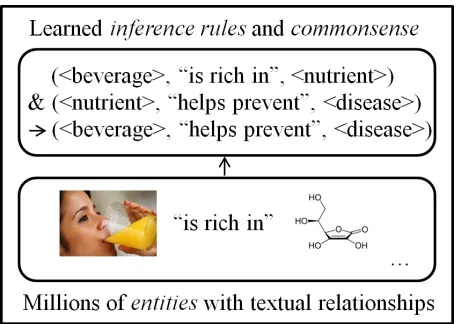
Figure 3: On top of an Entity Linked Open IE corpus we could learninference rulesandcommonsense knowledge.
3.2 Improved Instance Ranking Function
We observedlink scoreto be a better ranking func-tion than assertion frequency for presenting query results. For example, Table 2 shows the top results when searching the extractions for instances of the “teaches at” textual relation. When results are sorted by frequency in the corpus, assertions like “(friend, teaches at, school)” and “(Mike, teaches at, school)” are returned first. When results are sorted bylink score, the top hundred results are all specific in-stances of professors and the schools they teach at, and are noticeably more specific and generally cor-rect than the top frequency-sorted instances.
3.3 Inference
[image:4.612.74.298.62.207.2]4 Conclusions
While numerous entity-linking systems have been developed in recent years, we believe that going forward, researchers will increasingly be consider-ing the opportunities and challenges that arise when scaling up from the single document level toward the Web-scale corpus level. This paper is the first to run and report back on entity linking over millions of textual extractions, and we proposed novel ideas in areas such as corpus-level features and unlinkable entities. There are potentially many other corpus-level features and characteristics to explore, as well as additional challenges (e.g., how to best evaluate recall at this scale), and we look forward to seeing additional research in Entity Linking at Web scale over the coming years.
5 Acknowledgements
This research was supported in part by NSF grant IIS-0803481, ONR grant N00014-08-1-0431, and DARPA contract FA8750-09-C-0179, and carried out at the University of Washington’s Turing Cen-ter.
References
Eneko Agirre and David Martinez. 2002. Integrating selectional preferences in wordnet. InProceedings of the first International WordNet Conference.
Michele Banko, Michael J Cafarella, Stephen Soderland, Matt Broadhead, and Oren Etzioni. 2007. Open in-formation extraction from the Web. InProceedings of IJCAI.
Christian Bizer, Tom Heath, and Tim Berners-Lee. 2009. Linked data - the story so far. InInternational Journal on Semantic Web and Information Systems (IJSWIS). Kurt Bollacker, Colin Evans, Praveen Paritosh, Tim
Sturge, and Jamie Taylor. 2008. Freebase: a collabo-ratively created graph database for structuring human knowledge. In Proceedings of SIGMOD ’08, pages 1247–1250, New York, NY, USA.
Razvan Bunescu and Marius Pas¸ca. 2006. Using ency-clopedic knowledge for named entity disambiguation. InProceedings of the 11th Conference of the European
Chapter of the Association of Computational Linguis-tics (EACL).
Silviu Cucerzan. 2007. Large-scale named entity disam-biguation based on wikipedia data. InProceedings of EMNLP.
Mark Dredze, Paul McNamee, Delip Rao, Adam Ger-ber, and Tim Finin. 2010. Entity disambiguation for knowledge base population. InProceedings of COL-ING.
Anthony Fader, Stephen Soderland, and Oren Etzioni. 2009. Scaling Wikipedia-based named entity disam-biguation to arbitrary Web text. InIJCAI-09 Workshop on User-contributed Knowledge and Artificial Intelli-gence (WikiAI09).
Anthony Fader, Stephen Soderland, and Oren Etzioni. 2011. Identifying relations for open information ex-traction. InProceedings of EMNLP.
Johannes Hoffart, Mohamed Amir Yosef, Ilaria Bordino, Hagen F¨urstenau, Manfred Pinkal, Marc Spaniol, Bilyana Taneva, Stefan Thater, and Gerhard Weikum. 2011. Robust disambiguation of named entities in text. InProceedings of EMNLP.
Sayali Kulkarni, Amit Singh, Ganesh Ramakrishnan, and Soumen Chakrabarti. 2009. Collective annotation of wikipedia entities in text. InProceedings of KDD. Thomas Lin, Mausam, and Oren Etzioni. 2010.
Com-monsense from the web: Relation properties. InAAAI Fall Symposium on Commonsense.
David Milne and Ian H. Witten. 2008. Learning to link with wikipedia. InProceedings of the 17h ACM Inter-national Conference on Information and Knowledge Management (CIKM).
Lev Ratinov, Dan Roth, Doug Downey, and Mike Ander-son. 2011. Local and global algorithms for disam-biguation to wikipedia. InProceedings of the Annual Meeting of the Association of Computational Linguis-tics (ACL).
Stefan Schoenmackers, Oren Etzioni, Daniel S. Weld, and Jesse Davis. 2010. Learning first-order horn clauses from web text. InProceedings of EMNLP. Sameer Singh, Amarnag Subramanya, Fernando Pereira,
and Andrew McCallum. 2011. Large-scale cross-document coreference using distributed inference and hierarchical models. InProceedings of ACL.