A Mood Driven Computational Model for Gross
Emotion Regulation Process Paradigm
Ahmad Soleimani and Ziad Kobti
Abstract—Judgments, preferences, and other cognitive tasks entail an emotional foundation and cannot function in an emotional vacuum. This essential emotional component how-ever, needs to be continuously monitored. Emotion regulation strategies target the potential risk of having inappropriate level of emotions in the process of decision making. This study is a follow-up on a formerly proposed computational model for emotion regulation strategies based on Gross theory and applies several enhancements to it. In particular, we extend the dynamism and realism of the original model by considering a dynamic environment in which we study the effect of emotion eliciting events such as psychiatric therapies or traumas occurring during the simulation period. Furthermore, the new model uses an emotion-dependent regulation process based on the mood of individuals. This approach is consistent with human behavior in the real life. In addition, some key pa-rameters in our proposed computational model, such as emotion persistence factor were made adaptive. Results obtained from the simulation experiments using our proposed model show further consistency with the base theory.
Index terms- emotion regulation, cognitive modeling, adap-tivity
I. INTRODUCTION
Emotions pose an important component in the process of decision making and other cognitive tasks. Recent studies emphasize the important role of emotions as major adjusters in the process of decision making, ready to use behavioral responses, and an effective mean to ease the social inter-personal communications [1]. Conversely, emotion can have adverse impacts if it is applied at the wrong time and/or with inappropriate level of intensity. This nonconstructive attribution can be tracked in many forms of social difficulties and even psychopathology [1].
Emotion regulation strategies target the potential risk of having such inappropriate (over or below) level of emo-tions and thus they are aimed at balancing one’s emotional responses in different situations. Gross in [2] states that, “Emotion regulation includes all of the conscious and non-conscious strategies we use to increase, maintain, or decrease one or more components of an emotional response”.
According to Gross [3], humans use strategies to influence the level of emotional response to a given type of emotion; for instance, to prevent a person from having a too high or low response level. Emotion regulation strategies would consist of “changes in emotion latency, rise time, magnitude, duration and offset of responses in behavioral, experiential or physiological domains” [3].
Bosse et al. in [4] used Gross theory to develop the Cognitive Model for Emotion Regulation based on Gross
Manuscript received July 23, 2012; revised August 15, 2012.
A. Soleimani and Z. Kobti are with the Department of Computer Science, University of Windsor, ON, Canada e-mail: [email protected]; [email protected]
(CoMERG). This model, which consists of a set of difference equations combined with logical rules, can be used to simu-late the dynamics of the various emotion regulation strategies described by Gross. CoMERG was the base for our formal computational model [5], whereas the current work is an augmented version of that model with a special emphasis on the dynamism of the environment as well as adaptation of the system parameters.
Computational models of emotions can have several ap-plications in the fields of Psychology, Biology and Neu-roscience at which such models could be used to test and improve formalization of the background theories [6]. Fur-thermore, many application for such models can be named in the fields of robotics and computer gaming industry. Also, these models can be used to significantly improve the performance of HCI applications in order to enable virtual agents to exhibit a maximal degree of human-like behavior [4].
This article extends a formerly proposed computational model for emotion regulation [5] and applies a set of enhancements in order to increase the adaptivity and hence usability of the model under different circumstances. In next section, we overview the related work done in this area. Section 3 elaborates on Gross informal process model of emotion regulation. Next, we review briefly our previous model and address some of the shortcomings associated with it. In section 5, we explain the new approach to this problem and introduce our augmented model for emotion regulation strategies followed by simulation experiments, discussion and conclusion.
II. RELATED WORK
In most of old psychological theories, emotions were considered as a negative and sometimes neutral element in the process of decision making and hence must be avoided or kept at its minimum level [7]. Conversely, in almost all recent theories of emotion (e.g., Ortony and colleagues [8], Lazarus [9], Scherer [10], and Frijda [11]), the necessity and functionality of emotions and affect in general in cognitional activities and in particular, decision making is emphasized.
Gebhard in his computational model, ALMA[13] which is based on OCC process model of emotion [8], integrates three major affective characteristics: emotions, moods and personality in a three-dimensional space (either of which can impact the behavior of the agent).
FLAME is an OCC-inspired appraisal model which uses fuzzy logic rules to map the appraisals of events impact on goals into emotional intensities [14]. FLAME also includes several inductive algorithms for the purpose of learning about event expectations, rewards, patterns of user actions, etc.
In some recent works, an increasing number of studies have concentrated on building an independent computational model for the process of emotion regulation. These studies consider different strategies and techniques that could be used to modulate and finally regulate emotional responses in order to utilize emotions more effectively in cognitive activities at different levels. (e.g., [3], [2], [15]).
Gratch and Marsella in their detailed model of Emotion and adaptation (EMA) [16], assign a great deal of their work to the process of emotion regulation. EMA adopts the approach of Lazarus [9] in building its detailed computational model of coping (i.e., the regulation of negative emotions). They suggest four groups of such strategies: attention-related coping, belief-attention-related coping, desire-attention-related coping, intention-related coping [17].
III. EMOTION REGULATION STRATEGIES
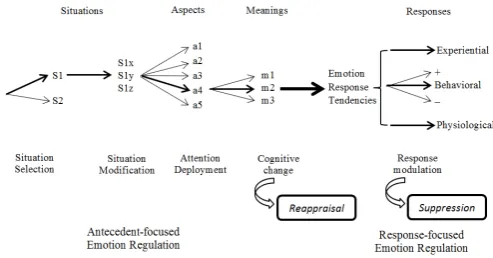
Gross identifies two main streams in the formation of emo-tion regulaemo-tion strategies, antecedent-focused and response-focused. Antecedent-focused strategies contribute in shaping the emotional response tendencies before they are fully acti-vated while response-focused can be applied to the emotional responses which have already taken place.
The first antecedent-focused regulation strategy in Gross theory is situation selection. Here, the target is to choose a situation that would meet with the desired response levels for a certain emotion. A person might stay away from a place which provokes a bad memory about a negative event which has had happened before at that specific place. This example depicts a down-regulating possible grief emotion.
The second antecedent-focused regulation strategy is situ-ation modificsitu-ation. Based on this strategy, a person tries to modify some controllable attributes of a current situation in order to acquire a different level of emotion.
The third antecedent-focused regulation strategy is at-tention deployment. Based on this strategy, emotions can be regulated without changing the world. Each situation has many aspects at which an individual can shift his/her attention to a certain one in order to manipulate his/her emotion response level. A person who is watching a TV show might cover his/her eyes at a horrible scene.
The fourth antecedent-focused regulation strategy is cogni-tive change. This strategy is aimed at changing the cognitive meaning of an event and thus altering its emotional signifi-cance. A specific type of cognitive change, which is aimed at down-regulating a negative emotion is reappraisal. Reap-praisal means that “the individual reappraises or cognitively re-evaluates a potentially emotion-eliciting situation in a way that decrease its emotional impact”[2].
As of the response-focused category,response modulation is an important strategy that can be applied after the
mani-Figure 1. A process model of emotion regulation. According to this model, emotion may be regulated at: (a) selection of the situation, (b) modification of the situation, (c) deployment of attention, (d) cognition change, and (e) modulation of experiential, behavioral, or physiological responses. [18]
festation of the emotion. Figure 1 depicts a comprehensive picture for different regulation strategies along with the points at which each strategy can be applied.
IV. COMPUTATIONAL MODEL BASED ONGROSS
In our formerly presented work [5], we had proposed a computational model for emotion regulation strategies based on Gross informal process model. According to Gross, a hyper emotional state can be regulated using different strategies. Thus, the first step in the modeling process is to declare a set of variables corresponding to the available strategies.
Hence, at each point in time, it is assumed that for each elementka specific choice is in effect and it has an emotional value of vk attached to it. Each emotional component vk
contributes to the emotion response levelERLwith an as-sociated weight ofwk. In order to include a decay component
inERLbetween two consecutive time steps (each time step = 1 time unit), a persistence factorβ indicating the degree of persistence of the emotion response level (i.e., the slowness of adjustment) was considered. Someone who can switch between different emotional states rapidly (e.g., stops being upset right after an apology) will have a lowβ.
Humans often look for a certain favorite level for each emotion. These levels vary among different individuals and also along the time for a single individual. In general, most people aim at a relatively high level of positive emotions (e.g., happiness, joy, etc.) while they target a lower level for negative emotions (e.g., fear, anxiety, etc.). In fact, the regulation process begins with a simple comparison between the current emotion response level ERL and the emotion response level aimed atERLnorm. The difference dbetween these two components is the basis for the amount of adjustments required for each of the elementsk. In other words, in each time step, we try to make ERL converges more toward ERLnorm. Since different emotion regulation
strategies can be applied with different intensities (frequen-cies), a modification factorαn was considered to reflect the
strength of the adjustments using different strategies. In fact,
αn is the flexibility or willingness of an individual to change
his/her emotional value using strategyn.
[image:2.595.309.556.52.181.2]V. OUR APPROACH
The major motivation for our approach that inspired us to have a follow-up on the former model was the fact that the environment was considered static with no events occurring during the simulation period. This assumption makes the computational model oversimplified and limits to a large extent, the useability and possible applications of the model. This limitation is due to the fact that such premise is unrealistic in the real world with many expected/unexpected events occur in the environment. Therefore, in the proposed model, we generate different events with opposite valences (i.e., with positive/negative impact on the regulation process) and also different intensities. We use a scale of [0..1] in order to measure event’s intensities. Furthermore, our proposed computational model suggests using an emotion-dependent regulation mechanism rather than having a generic emotion-independent regulation process adopted in the previ-ous model. The new approach is more realistic in the sense that it comes in-line with individual’s emotional behavior. Humans generally use different strategies to regulate different emotions and they are more sensitive towards regulating negative emotions than those hyper positive emotions.
In brief, we argue that people gives different precedences to regulate different emotions. Thus, more critical and typ-ically negative emotions such as anger, fear and grief often take higher priority and urgency in the regulation process. In our suggested model, this problem was addressed by associating the regulation process to the attributes of each emotion. For this purpose, we adopt the approach taken in ALMA (A Layered Model of Affect) [13] with some changes. We consider three nearly independent attributes including pleasure (P), arousibility (A) and dominance (D) to express each emotion. All these quantities range in the interval of [-1, +1]. +P reflects the degree of pleasure (relief) for a particular emotion, whereas -P indicates the degree of displeasure or discomfort that an emotional response might bring for the individual. Compromisingly, it is possible to state that emotions with +P are positive emotions, whereas those with -P depict negative emotions. Arousibility attribute with positive values +A show the ease of arousal (i.e., elicitation) of a particular emotion, whereas -A represents the degree of difficulty in eliciting a particular emotion. The attribute of dominance indicates the ability to control a particular emotional response by the individual. Hence, +D shows the degree of dominance, whereas -D reflects the degree of submission (i.e., the feeling of being controlled) by a specific emotion. By using this approach, each emotion can be represented in terms of a 3-tuple vector. For instance, Shame emotion can be expressed with the 3-tuple of (-0.3,0.1,-0.6).
A. The detailed model
In our model, an agent entity refers to an individual who tries to modulate his/her emotion response level. Also, base model refers to S-model. Furthermore, a time step in our model equals one time unit (i.e., second, hour, etc.). The emotion response level is represented in a scale of real numbers between 0 and 2. A value of 0 is equivalent to No-emotion state while 2 indicates the state of extremely emotional. As a simple illustration, suppose an agent wants to
Table I
MOOD OCTANTS OF THEPADSPACE[13]
+P+A+D Exuberant -P-A-D Bored +P+A-D Dependent -P-A+D Disdainful
+P-A+D Relaxed -P+A-D Anxious +P-A-D Docile -P+A+D Hostile
influence its state of excitement by going to the wonderland. It will have the choice of riding a scary roller coaster or a Taxi Jam (milder ride). This can be represented by introducing two situations,sit1 andsit2, with for example,
sit1= 1.2andsit2= 0.6 (since roller coaster will increase the state of excitement more). Moreover, we assume that
ERLnorm is for instance = 1.5 (i.e., one aims at being
excited, but not too excited). In this case, if the agent’s currentERLexcited is already high, it would likely take the
Taxi jam ride (i.e., to choosesit2), etc.
1) Updating emotion response level: In order to measure the emotional response level at each time step, we adopt the same approach taken in the base model with the difference that the persistence factorβis not a constant value, but rather is a function of the mood of the agent at each time step. Therefore,
ERLnew= (1−β)∗Pn(wn∗vn) +β∗ERL (1)
β=f(mood) (2)
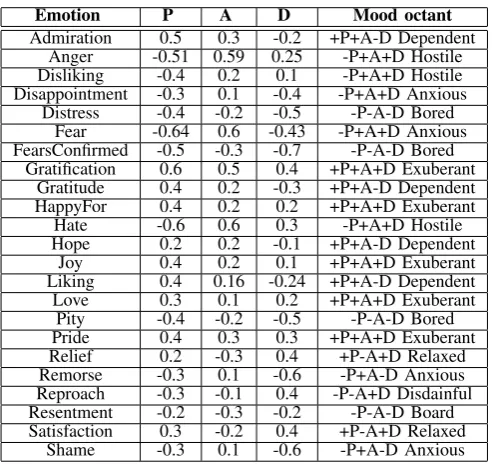
In order to express the persistence factor in terms of the agent’s mood, we use the approach taken by Gebhard in his layered model of affect (ALMA) [13]. ALMA adopts the approach of Mehrabian [19], in which he describes the mood with the three traits of pleasure (P), arousal (A) and dominance (D). In order to implement the PAD mood space, three axes ranging from -1.0 to 1.0 are used. Hence, the mood is described based on the classification of each of the three mood axises: +P and –P to reflect pleasant and unpleasant, +A and –A for aroused and unaroused, and +D and –D for dominant and submissive. These three discrete factors builds the so called PAD space in which each point and based on its coordinates in this three dimensional system, represents a mood state called mood octant (such as relaxed, bored, anxious, etc. see Table I). Although emotions are not the only factor in mood changes, for simplicity, we consider only the role of emotions in shaping the mood of the agent. Using this approach, a mapping between emotions and the PAD space of mood was suggested in ALMA. Table II depicts the full mapping between the OCC emotions set [8] and the PAD space. In our model, we exploit this approach to encode the mood of the agent into a single quantifier through calculating the Euclidean distance of each emotion to the origin of the PAD three dimensional space. This distance can be expressed as the magnitude of the PAD vector for each emotion. In Figure 2, vector−OP−→shows the intensity of emotion pride in the PAD coordinate system.
Here, we expressβas a function of these mood quantifiers. In our approach, the persistence factor has two components. The first component, −−−−−−→P ADbase, is a fixed PAD vector
which indicates the basic (initial) value of β. The second component, −−−−−→P ADvar, is the emotion-dependent part of β
Figure 2. PAD vector for emotion Pride
β =−−−−−−→P ADbase+
−−−−−→
P ADvar (3)
In the above equation,−−−−−−→P ADbaserepresents the PAD vector
of (0.39,0.26,0.33) as the default constant component for the persistence factor. These values were calculated by taking the mean of the corresponding trait (i.e., P, A or D) for all emotions. Based on this PAD vector, the initial value of β
will be:
β =√0.392+ 0.262+ 0.332∼= 0.57
which means that initially, 57% of the previous emotional state will persist in the new emotional response (i.e., after regulation), whereas the remaining 43% will be determined by the regulation process.
On the other hand, after careful calculations, we came up with the following equations for the PAD attributes of
−−−−−→
P ADvar components:
Pvar=
(
+0.25Pemotion P >0 −0.25|Pemotion| P <0
Avar =
(
+0.25Aemotion A >0 −0.25|Aemotion| A <0
Dvar=
(
+0.50Demotion D >0 −0.50|Demotion| D <0
As a simple illustration on above equations, let’s consider a scenario at which an agent is trying to regulate its hyper fear emotion. As per table II, the PAD vector for emotion fear is <-0.64,0.6,-0.43>. These values indicates that such an emotion creates a great deal of displeasure (-0.64) with high arousibility (0.6) and proportionally high degree of submissive feeling (-0.43). By applying above formulas in order to compute the overall persistence factor for such emotion, we obtain β = 0.76 which means that 76% of the current emotional response (level of fear) will persist in the new emotional response and only 24% (1−0.76)of that will be determined by the regulation process. This finding makes sense since a person under a fear emotion will not be able to comply well with the regulation process and it would take a longer time to reach its aimed at emotional response level.
Therefore, in our model the value forβ, unlike the original model which was considered as a pair of fixed values, would be a simple function of the mood traits of the agent.
2) Difference between the two emotion response levels: As discussed before, the difference between emotion re-sponse level ERLand the aimed at emotion response level
ERLnorm at any point in time poses the main motor to
Table II
MAPPING OFOCCEMOTIONS INTOPADSPACE[13]
Emotion P A D Mood octant
Admiration 0.5 0.3 -0.2 +P+A-D Dependent Anger -0.51 0.59 0.25 -P+A+D Hostile Disliking -0.4 0.2 0.1 -P+A+D Hostile Disappointment -0.3 0.1 -0.4 -P+A+D Anxious
Distress -0.4 -0.2 -0.5 -P-A-D Bored Fear -0.64 0.6 -0.43 -P+A+D Anxious FearsConfirmed -0.5 -0.3 -0.7 -P-A-D Bored
Gratification 0.6 0.5 0.4 +P+A+D Exuberant Gratitude 0.4 0.2 -0.3 +P+A-D Dependent HappyFor 0.4 0.2 0.2 +P+A+D Exuberant Hate -0.6 0.6 0.3 -P+A+D Hostile Hope 0.2 0.2 -0.1 +P+A-D Dependent
Joy 0.4 0.2 0.1 +P+A+D Exuberant Liking 0.4 0.16 -0.24 +P+A-D Dependent Love 0.3 0.1 0.2 +P+A+D Exuberant
Pity -0.4 -0.2 -0.5 -P-A-D Bored Pride 0.4 0.3 0.3 +P+A+D Exuberant Relief 0.2 -0.3 0.4 +P-A+D Relaxed Remorse -0.3 0.1 -0.6 -P+A-D Anxious Reproach -0.3 -0.1 0.4 -P-A+D Disdainful Resentment -0.2 -0.3 -0.2 -P-A-D Board Satisfaction 0.3 -0.2 0.4 +P-A+D Relaxed
Shame -0.3 0.1 -0.6 -P+A-D Anxious
direct the process of choosing the more effective strategies in emotion regulation. Thus, we have:
d=ERL−ERLnorm (3)
3) Updating emotional components: In order to specify the emotional contribution level of each regulation strategy
vnin the total emotion response levelERL, we use the same
approach taken in the original study. Therefore, we have:
4vn =−αn∗ dd
max4t (4)
vnnew =vn+4vn (5)
Adopting the same approach of S-model in calculating the emotional components is beneficial in the sense that it provides a more concrete and accurate comparison between the base and proposed models.
4) Adaptivity of the modification factors with events: The modification factors are the most critical elements that provide the required dynamism and adaptivity for the sys-tem. As elaborated before, a modification factorαn reflects
the willingness to change the agent’s behavior in favor of emotion regulation strategy n. In other words, it gives a measure for the speed with which different emotional values are changed over time. In order to study the impact of events (either positive or negative) on the adaptation process of the modification factors, we generate different events during the simulation and monitor the influence of these events on the values and trends of αn’s. The events are expressed in real
numbers in the interval of [-1,1]. An event with positive value such as a psychiatric therapy session, indicates a positive impact in favor of the corresponding strategyn (increase in
αn), whereas an event with a negative value such as a trauma
attack, represents an adverse impact on current regulation strategyndiminishing the value ofαn. An event with a value
Table III
VALUES OF PARAMETERS USED IN THE SIMULATION
Var. value Var. I. value
ERL/ERLnorm 1.85 / 0.7 v1 1.90
w1−w4 0.35, 0.30, 0.20, 0.15 v2 1.85
α1−α4basic 0.10 v3 1.80
θ1−θ4 0.15 v4 1.75
4αn=θn∗Event/(1+(αn−αnbasic)∗Event)4t (6)
αnnew =αn+4αn (7)
In the above equation,θn’s are strategy-dependent
coeffi-cients that represent the speed of the adaptation process. The exact values for this set of variables are left for the simulation experiments. αnbasicindicates the initial (default) value for each modification factor at the beginning of the experiment. These values are all equal for different strategies and remain constant during the simulation.
VI. SIMULATION EXPERIMENTS AND DISCUSSION
In order to assess the behavior of our suggested model under different circumstances and its consistency with Gross theory, as well as to compare its performance against the base model, a number of simulation experiments have been conducted. In each of below explained experiments, we address a specific scenario. Table III gives a summery of the setup and values for the system parameters. According to Gross, those strategies applied at an earlier time in the regulation process will have a bigger influence on the reg-ulation process. Therefore, a weight of 0.35 was associated to situation selection, whereas weights of 0.30, 0.20, and 0.15 were assigned to situation modification, attentional deployment and cognitive change respectively.
A. Experiment 1: Emotion-dependent regulation versus generic regulation
In this experiment, we compare the performance of the regulation process using our suggested emotion-dependent model versus the emotion-independent method adopted by S-model. In this experiment and after trying different values for0≺α≺1, we found out that atα= 0.15, the regulation seemed optimal. Part A of Figure 3 shows the the graph for
ERLduring the regulation of hyper hope (positive) emotion, whereas Part B depicts the graph for ERL for a similar regulation process, but this time for hyper anger (negative) emotion. Based on these graphs, we observe that for the regulation of hope emotion, the ERL obtained from our approach managed to reach its target level (i.e.,ERLnorm)
relatively much faster than that of S-model. In particular, in our model this situation occurs at time step = 30, while in S-model this state was not reached before time step∼= 55. With regards to part B, we observe a somehow opposite behavior at which S-model shows a similar trend for ERL as Part A, while our model exhibit a much slower and sometimes volatile regulation behavior. Particularly, we observe that the
ERLin our model does not meet with its target value before time step ∼= 80. (in fact, it does reach ERLnorm at step ∼
[image:5.595.49.293.74.180.2]= 50, but it does not become stable until step = 80). These two scenarios describe graphically our so called emotion-dependent approach to the regulation process. This behavior
Figure 3. Emotion-dependent versus generic regulation. Part A, shows the ERL during the regulation of emotion hope, whereas part B depicts the ERL graph for the regulation of emotion anger
Table IV
LIST OF EVENTS IN EXPERIMENT2
Event occurrence time Intensity
20 0.8
50 -0.7
80 0.9
of theERL comes consistent with the expectations of our model to have a smooth and rapid regulation for positive emotions and a slow and somehow volatile regulation for negative emotions. These results are clearly in line with one of Gross rules stating that “Emotion approaches norm monotonically”. [4]
B. Experiment 2: events and the regulation process
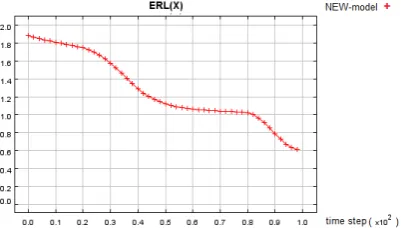
Several experiments have been conducted to analyze the performance of our model in a dynamic environment. The purpose of those experiments was to test the ability of the proposed model to simulate the influence of events on the emotion regulation process. Here, we consider two cases of these experiments and elaborate on the results obtained from the simulation. The first case depicts an under regulation (with very smallα, say 0.01) process for an agent suffering from a hyper distress emotion. at time step= 30, an event with intensity of +0.85 indicating a successful psychiatric therapy session occurs in the system. Figure 4 shows the trend of theERLduring the regulation process. We observe that the trend ofERLstarts to drop dramatically few time steps after the incidence of the event and manages to crossERLnorm
at time step = 60, though it does not become stable before time step = 90. Conversely,ERLin S-model fails to touch
ERLnormand the best value that it reaches is 1.0 at the end
of simulation which is still proportionally far away from the target value (i.e., 0.7).
Figure 4. the trend ofERLin both models in the case of events occurrence
Figure 5. the trend ofERLin our proposed model in the case of multiple events
occur in the system during the simulation. Table IV lists the events that take place during the simulation along with their occurrence times. The graph of theERLfor this experiment is shown in Figure 5. This scenario initially depicts an under regulation process for emotion fear. At time step = 20, a positive event in favor of the regulation process occurs. We observe that few steps later, the ERL drops quickly towards its target value, but before it reaches theERLnorm,
an adverse event such as a trauma occurs in the system which slows down the regulation once again. This situation continues until step = 80 when another in-favor of regulation event occurs which results in a sharp regulation in theERL
which manages to cross the ERLnorm at step∼= 95.
Above experiments emphasize the crucial role of events in the emotion regulation process. Furthermore, these findings are consistent with another Gross rule which states that “high strategy flexibility leads to large adjustments”
VII. CONCLUSION
In this paper, a computational model for emotion reg-ulation strategies based on Gross theory was considered. According to Gross [2], humans use strategies to influence the level of emotional response to a given type of emotion. These strategies can be applied to five points in the emotion generative process: (a) selection of the situation, (b) mod-ification of the situation, (c) deployment of attention, (d) change of cognition, and (e) modulation of experiential, be-havioral, or physiological responses. In Gross process model for emotion regulation, the hypothesizes and inferential rules are described informally.
S-model, a formerly proposed computational model for Gross theory had several shortcomings which inspired us to have a follow-up on that model and enhance it in several directions.
In brief, we suggested an adaptive persistence factor ex-pressed as a simple function of mood. The findings from our experiments were consistent with the tenet that an agent in a bad mood tends to internally impede the changes in its nega-tive emotional state through retaining a bigger portion of the previous emotion response in the new emotion response level and hence to have a slower emotion regulation. Conversely, an agent in a positive mood will exhibit more cooperative behavior and thus have a relatively faster regulation process. Furthermore, the environment in our model is dynamic with different events occurring in the system during the simulation period. We believe that the existence of events is a vital element in such computational models in order to effectively use them in different applications. With these enhancements, our proposed model managed to exhibit more adaptive and realistic behavior and showed more consistency with Gross theory.
REFERENCES
[1] J. Gross and R. A. Thompson, Emotion Regulation: Conceptual foundations, Handbook of emotion regulation. . New York: Guilford Press, 2006.
[2] J. Gross, “Emotion regulation in adulthood: Timing is everything,” Current directions in psychological science, vol. 10, No. 6, pp. 214– 219, 2001.
[3] J. J. Gross, “The emerging field of emotion regulation: An integrative review,”Review of General Psychology, vol. 2, pp. 271–299, 1998. [4] T. Bosse, M. Pontier, and J. Treur, “A computational model based on
gross emotion regulation theory,”Cognitive systems research, vol. 11, pp. 211–230, 2010.
[5] A. Soleimani and Z. Kobti, “An adaptive computational model of emotion regulation strategies based on gross theory,” inProceedings of the fifth C* Conference on Computer Science & Software Engineering, (pp. 9-17), 2012.
[6] T. Wehrle, “Motivations behind modeling emotional agents: Whose emotion does your robot have,” Grounding emotions in adaptive systems, 1998.
[7] A. R. Damasio,Descartes Error: Emotion, Reason, and the Human Brain. Penguin Group, 1994.
[8] G. C. e. a. Ortony, A.,The Cognitive Structure of Emotions. Cam-bridge University Press, 1988.
[9] R. S. Lazarus, “Progress on a cognitive-motivational-relational theory of emotion.”American Psychologist, vol. 46(8), pp. 819–834, 1991. [10] K. R. Scherer, “On the nature and function of emotion: a component
process approach,”In Approaches to emotion, pp. 293–317, 1984. [11] N. H. Frijda,The Emotions. New York: Cambridge University, 1986. [12] R. W. Picard,Affective Computing. The MIT Press, MA, USA, 1997. [13] P. Gebhard, “Alma - a layered model of affect,” inFourth International Joint Conference on Autonomous Agents and Multiagent Systems, 2005.
[14] J. Y. e. a. El Nasr, M. S., “Flame: Fuzzy logic adaptive model of emotions,” Autonomous Agents and Multi-Agent Systems, vol. 3(3), pp. 219–257, 2000.
[15] K. Ochsner and J. Gross, “The cognitive control of emotion,”Trends in Cognitive Sciences,, vol. 9, pp. 242–249, 2005.
[16] S. Marsella and J. Gratch, “Ema: A model of emotional dynamics,” Cognitive Systems Research, vol. 10(1), pp. 70–90, 2009.
[17] G. J. Marsella, S. and P. Petta,Computational Models of Emotion, for Affective Computing. ict.usc.edu, 2010.
[18] J. Gross, “Antecedent and response-focused emotion regulation, di-vergent consequences for experience, expression, and physiology,” Journal of Personality and Social Psychology, vol. 74, pp. 224–237, 1998.
[image:6.595.48.249.213.327.2]