Abstract—This paper proposes a novel spreading code-set construction based on the prime code (PC) families and transpose function, referred to as ‘transposed modified prime codes (T-MPC)’, for the application in synchronous incoherent optical code-division multiple-access (OCDMA) networks. This code family increases the cardinality up to twice of existing PC families’ size. T-MPC unlike conventional MPC, is not predictable and thus securer, yet the code structure is similar to MPC, its deployment will not require hardware modification. Due to the higher code utilization factor of T-MPC, greater number of users is accommodated under certain bit-error rate (BER) resulting in remarkable improvement in the networks’ spectral efficiency (SE) and capacity. The T-MPC compatibility with low-weight energy-efficient MPC construction is also investigated. The BER and SE performances are analyzed and compared with existing code families. The results indicated that the T-MPC employment can improve up to 50% higher SE and network capacity.
Index Terms—multiuser interference, optical CDMA, prime codes, spectral efficiency, spreading code design.
I. INTRODUCTION
YNCHRONOUS OCDMA allows many users to share a common optical channel simultaneously. It has numerous potentials in the optical networking such as all-optical processing, multiple-transmissions on a single-wavelength and simple new user allocation [1]. T. H. Shake [2] showed that the incoherent OCDMA was insecure and it could only provide some degree of data obscurity. However, it is noted that fine physical layer security is feasible in incoherent scheme depending on the spreading en/decoding algorithm or technique selection. A high-performance OCDMA network requires that the receiver correctly recognizes the intended user in the presence of the other interfering ones. Also the receiver should accommodate more subscribers with higher spectral efficiency (SE).
On the other hand, since WDM systems use multiple
Authors are with the College of Optical Sciences at the University of Arizona, affiliated with the Engineering Research Center for Integrated Access Networks, Tucson, 85721 AZ, USA. (E-mail: [email protected]) Franko Kueppers is also with the Department of Electrical Engineering and Information Technology, Technical University of Darmstadt, Darmstadt 64283, Germany
wavelengths, the effect of beat noise is more destructive than the one in multi-wavelength OCDMA system due to the advantage of spread spectrum techniques [3]. Synchronous OCDMA as a close competitor of TDM can use variable address codes with low in-phase cross-correlation value (i.e., ideally zero) to support differentiated services, much easier than TDM complex timing processing. While the synchronization is still though a challenging task, there are a few simpler methods than TDM currently considered for the OCDMA synchronization [4].
It is preferable to employ suitable optical sequence codes with the best orthogonal characteristics. Spreading codes with maximum auto-correlation and minimum cross-correlation values are designed to discriminate the desired signal from noise and interferences. Various optical code families for synchronous OCDMA systems and networks have been studied in particular prime code families, including prime codes (PC), modified prime codes (MPC) [5] and various padded MPC (xPMPC) [6].
The previously introduced PC families are still struggling with the code security and the cardinality. Another common family of spreading codes is the optical orthogonal codes (OOC) [7] which are extensively employed in asynchronous OCDMA schemes due to their correlation properties. Asynchronous OCDMA however supports less number of subscribers and requires random/medium access protocol to control the interference, collisions and code assignments which also bring complexity to the system implementations to compare with synchronous one [8].
Another problem associated with PC families is their code-weight, (the number of ‘ones’ or pulses in the sequences) which is always fixed to the number of subsequences and must be a prime number [5]. To accommodate more users in an OCDMA system a larger is required so the code-weight ; meaning more power consumption. Incoherent OCDMA scheme has attracted a lot of attention due to simple architecture, inexpensive design and robustness to environmental, nonlinear and coherence effects [9]. In incoherent time-spreading OCDMA, en/decoders for PC families utilize a parallel configuration by active multipliers or passive optical tapped-delay lines, the resulting optical power losses and complexity of an en/decoder could also be high when increases. For example, the power loss of an all-parallel en/decoder is as high as 35.4 when 59 [10]
Maximization of Spreading Code Cardinality
Using Transpose Function in Synchronous
Optical CDMA
M. M. Karbassian, Member, IAENG and Franko Kueppers
since the required number of optical delay lines per en/decoder also equals 59. Consequently, the en/decoders will be bulky and their implementation by integrated optics will be challenging and inefficient. Other degrading factors are the auto- ( ) and cross-correlation ( ) constraints and multiuser interference (MUI) which affect the overall performance of an OCDMA networks. To reduce the effect of MUI, the optical address sequences with minimum (i.e. the weakest MUI) are desirable for synchronous incoherent time-spreading OCDMA networks.
Accordingly, security concerns, high code-weight, and correlation constraints limit the code-set cardinality denoting the lower capacity of OCDMA networks for a given power budget and system cost. Compared with OOCs of 1, PCs of 2 can use a simple tunable en/decoder to reduce both coding power loss and transmitter cost due to the property of equal-length ‘subsequences’ in each address code sequence [10].
It is observed that the existing researches on the code enhancement have been mostly on the length [6], code-weight [11] and accordingly correlation values. It is apparent that the correlation properties will enhance when the code-length and the code-weight grow. While, longer code-code-length and higher code-weight can imply lower data-rate (throughput), lower SE, higher power consumptions and
complex (impractical) transceivers. On the other hand, there is always a set of unused codes in the system due to the fact that the number of available codes (i.e., cardinality), is always far greater than the number of active simultaneous users under a prescribed , . Here we then define the code utilization factor, as:
(1) Therefore, increasing the code utilization factor will lead us to higher SE implying optimum resource utilization. This paper proposes a new code-set family, transposed-MPC (T-MPC), to improve network capacity and SE. Its performance and properties are compared to closest existing code families. In this paper, to further reduce the en/decoder cost and power loss, low-weight T-MPC (LW-T-MPC) family is also studied in which ‘pulses’ are assigned systematically in the code sequences.
II. CONSTRUCTION OF TRANSPOSED-MPC
Here we explain the construction of T-MPC. The procedure is in twofold:
Firstly, full-padded MPC is produced by concatenating the MPC sequences with a rotation in each group, meaning that the final sequence-stream of the previous MPC sequence is padded to the following MPC sequence (the bold ones in Table I) where rotating in the same group (the italic ones in Table I) and so on. This padding process is performed 1 times since the round will repeat the last sequence-streams of MPC itself. It is noted that the padded sequences are not restricted to the final sequence-stream of MPC; they can be any sequence-stream of MPC. This is due to the uniqueness of each MPC sequence-stream; however, it is important to maintain the column’s order uniformly throughout the padding process; otherwise this would increase the cross-correlation values. To make the subsequences symmetric, the group sequence-stream is padded to the previously concatenated sequences as the last stream to make full-padded MPC (the italic-underlined ones in Table I). Now, the values of code-weight, code-length and cardinality for this full-padded MPC are 2 , 2 and respectively.
Secondly, the unique lemma is now to treat this generated full-padded MPC sequences, in Table I for example, as a matrix in which every chip (i.e. every ‘0’ and ‘1’) representing the full-padded MPC sequences as the elements of the
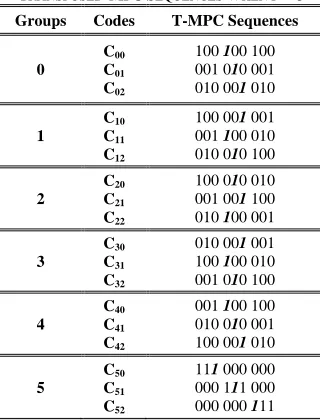
2 matrix. By applying a ‘transpose function’ on this matrix, a new 2 matrix will be generated. After rearranging the chips into -subsequence streams, the transposed-MPC (T-MPC) codes are generated as seen in Table II.
The new values of code-weight, code-length and cardinality for this novel T-MPC are , and 2 respectively. The code-length and code-weight are now practical and efficient equal to the original MPC ones; while, the available codes are doubled resulting in higher throughput and greater network capacity. It is also worthwhile to notice that the number of generated codes exceeds (doubles) the code-length in this new TABLE I
FULL-PADDED MPCSEQUENCES WHEN P =3
Grps. Seq. Codes MPC Seq. Full-Padded Seq.
0 0 0 C00 100 100 100 010 001 100
0 2 2 2 C01 001 001 001 100 010 100
1 1 1 C02 010 010 010 001 100 100
0 1 2 C10 100 010 001 010 100 010
1 1 2 0 C11 010 001 100 001 010 010
2 0 1 C12 001 100 010 100 001 010
0 2 1 C20 100 001 010 001 100 001
2 2 1 0 C21 001 010 100 010 001 001
1 0 2 C22 010 100 001 100 010 001
TABLE II
TRANSPOSED-MPCSEQUENCES WHEN P =3
Groups Codes T-MPC Sequences
0
C00
C01
C02
100 100 100 001 010 001 010 001 010
1
C10
C11
C12
100 001 001 001 100 010 010 010 100
2
C20
C21
C22
100 010 010 001 001 100 010 100 001
3
C30
C31
C32
010 001 001 100 100 010 001 010 100
4
C40
C41
C42
001 100 100 010 010 001 100 001 010
5
C50
C51
C52
[image:2.612.89.249.206.416.2]code family. We will show later that the code utilization factor also improves.
Since the time-shift is no longer a feature in the T-MPC, its predictability much reduces and accordingly the physical layer security enhances remarkably. The in-phase auto- and cross-correlation values for any pair codes of and can be obtained as:
0 ;
2 ; (2)
where , ∈ 1, 2, … , . It is observed in contrast that the shrink in the code-length also improved the correlation values and increased the number of orthogonal groups as compared to full-padded MPC and even other PC families.
III. ANALYSIS AND CONSTRUCTION OF LOW-WEIGHT T-MPC It is reported in [5] that the of incoherent OCDMA systems using PC families is decreased when code-weight, increases. When is large enough (say, 53 without optical hard-limiters), the becomes very low even if all the users simultaneously transmit data in the network at the cost of extra power consumption. Jian-Guo Zhang [10] introduced a scheme to reduce the code-weight of MPC to achieve the same performance as the conventional MPC achieves with higher code-weights. It is expected that we can choose a lower code-weight than that of the conventional MPC to ensure a prescribed (i.e. 10 ) by removing some ‘redundant’ pulses from the original MPC sequences of pulses. The analysis in [10] resulted in the construction of a low-weight family of modified prime (MPR) codes for OCDMA applications. Subsequently here in this paper, the same technique is employed to reduce the code-weight of T-MPC and the results with previously generated MPR (as the closest code-set with similar properties) are compared. However, the different method here is to remove the pulses from mid-subsequence chips rather than from chips in sides of sequences. This implies an increase to the decoding slots distance of T-MPC. This means the code sequences become more distinguishable at the receiver end.
As proposed from MPC of prime number , a quadruple T-MPC , , , code-set of length , constant code-weight , maximum auto-correlation and maximum cross-correlation 2 supporting specific number of active users under the prescribed 10 is constructed. To generate low-weight T-MPC (LW-T-MPC) the arbitrary ‘ones’ representing the optical pulses are removed from the middle subsequence-streams of T-MPC sequences. As shown in Table II, the ‘one’s in mid-subsequences in bold-italic can be removed and replaced with ‘zero’ for example. The remaining ‘ones’ (i.e. ) in the sequences form a MPC code-set. The resulting LW-T-MPC preserves the same cross-correlation constraint as original T-MPC where the proof and discussion on how to reasonably choose the weight and length of code-set sequences to optimize the system performance can be found in
detail in [10].
We define as the maximum pulse separation in the code sequence. equals the slot distance between the first and the last ‘one’ chips in the code sequence of weight . For example, suppose a code-set with three sequences of
100 000 100 , 001 010 000 and
100 000 001 , then we have 5, 1, and 7. Note that also represents for example the maximum delay-time difference among optical tapped-delay lines in the optical en/decoder. The physical significance is that the separation of any two optical pulses from either the same code sequence or two successive code sequences larger than does not match any delay-time difference among optical delay lines in the optical decoder. Therefore, the output of the decoder cannot exceed the maximum cross-correlation value of the specific spreading code family.
Similarly, the maximum decoding slots distance of -user OCDMA code-set is defined by
| 0, 1, 2, … , 1 . For example, the above three-user code-set’s is equal to 7. This means that any pulse separation greater than is a safe slot distance of a given spreading/address code due to the fact that safe slot distances do not make the output of the decoders exceed maximum cross-correlation value of specific given code-set (i.e., LW-T-MPC).
Now by keeping and in the calculation, we can give the bounds on the length of the new code-set of LW-T-MPC , , , 2 and MPR as follows:
, 2 2 (3) when the maximum decoding slots distance of a code-set
, , , 2 satisfies:
2 2 (4) The code-length can be shortened with not violation in the correlation constraints of code-set sequences:
2 2 (5) Thus the reduction of bandwidth expansion from the code-length decrement for the OCDMA will be:
(6) In practice, we can choose 2 2 to minimize the for symmetric OCDMA links, i.e.:
2 2 0 (7) If the last successive pulses from an original code-set of size are removed to obtain a new -user low-weight code-set from PC families, then the maximum decoding slots distance of the resulting code-set will be equal to
2. If satisfies , then the code-length for MPR code-set is chosen as:
Note that to increase the maximum decoding slots distance, for LW-T-MPC, the ‘ones’ should be removed from the middle subsequences instead of the beginning or last successive ‘ones’ like in MPR code-set, resulting in
2 2, thus , the original code-length of T-MPC. The of time-spreading signature codes can be calculated by the ‘hits’ possibility between ‘ones’ in code sequences in an incoherent intensity modulated on-off keying (OOK) system. According to the research by M. Azizoghlu [12] and followed by J.-G. Zhang [10], the calculation is based on (i) the ideally comprised of the possibility of binary stream occurrence, (ii) the threshold decoding range and (iii) ‘hits’ possibility between ‘ones’ within different signature codes, that can be formulated as:
∑ / 1 /2 1 (9)
where is the code-weight of code-set and is the number of interfering simultaneous subscribers. More importantly, here for T-MPC ⁄4 which varies in different code families depending on the maximum decoding slots distance and code-length respectively under the specific correlation constraints [10, 12].
IV. OCDMASPECTRAL EFFICIENCY
The speed (bit per second – b/s) of a transmission system is managed by the available bandwidth (Hz) and by the achievable spectral efficiency (SE) (b/s/Hz). Ultimate limits to the SE are determined by the information-theoretic capacity per unit bandwidth. While approaching the restrictions require dramatically growing complexity and delay, establishing precise estimates of the limits can yield insights useful in practical system design. The SE limitation depends on the choice of multiplexing and modulation techniques (e.g., unconstrained, constant intensity, binary or multilevel), detection techniques (coherent or incoherent), and propagation (linear or nonlinear).
Code selection, en/decoding in optical domain, multiple user interference estimation and removal, system compatibility with current and future technologies are vital aspects of OCDMA network design. Accordingly, the existing extreme bandwidth in the optical medium must be utilized efficiently in order to cope with daily growth of network traffic.
The SE which specifies the overall throughput per unit of optical bandwidth associated with a fixed is defined by:
(10) where is the number of simultaneous users at a bit-rate ( 2.5 ) in a certain requirement (as a reference 10 ) and is the optical bandwidth occupied by the system. Due to the limitations in bandwidth resource, the system with higher SE at a prescribed is the most efficient one. Although, in practice is usually less
than maximum SE of 1 , where
is the signal-to-noise ratio of the system. The SE of OCDMA systems with coherent pulsed sources was evaluated
in [13]. It is demonstrated that the SE of an OCDMA system with coherent sources is at least a factor of five higher than systems with incoherent sources. On the other hand, becomes the most important parameter of the incoherent OCDMA since is usually much less than the cardinality of the spreading code families. Thus, the code design becomes seriously significant in OCDMA while the number of available codes should improve and reach as close as possible to , see (1), at a given to raise the code utilization factor. It is believed that exploiting the unused codes increase the SE of the system by using a multilevel coding [14]. Therefore, the need for novel approaches of code designing in the content of OCDMA seems necessary.
Code parameters like code-weight and code-length in the optical encoding and modulation domain can be interpreted as optical signal power and data-rate, respectively. The correlation properties can become critical in order to accommodate greater .
V. DISCUSSION OF RESULTS
The following data analysis for LW-T-MPC is based on the above calculations. Since the MPR codes are currently the best-performed low-weight MPC family in terms of BER and also prime code families have shown superior performance in terms of SE [15], thus in this study the results are only compared to MPR family and discussed accordingly. The aim of this paper is to analyze the performance of this novel spreading code itself and to compare with the most similar existing code family, thus the major degrading factor in the analysis is the ‘hit’ interferences causing the bit-errors. The parameters for simulations are listed in Table III and in the graphs. For the purpose of optimizing the optical bandwidth, the bandwidth is the product of code-length and single-user data-rate.
Figure 1 presents the performance of different codes against the number of simultaneous users, when the code-weight is 24 and prime number, varies from 61 to 67. One might argue that the high values of prime number in this analysis are impractical and make the en/decoders complex. It should be noted that the analysis is for the extreme conditions of optical coding, and simultaneous ‘hit occurrences’ (i.e., interference). On the other hand, the results discussed here should be comparable with the ones presented in [10, 12], which are under the same given conditions for making fair argument.
TABLE III PARAMETERS FOR SIMULATION
Definition Symbol Value
Code-Weight
Bit-Rate 1.25
Code-Length
It is observable from Figure 1 that the increment in value enhances the system performance dramatically with the cost of complexity of course. The MPR of 24 can support 57 and 63 simultaneous users when 61 and 67 respectively under the prescribed of 10 . Whereas, LW-T-MPC of
[image:5.612.63.278.60.226.2]24 under the same constraint supports 70 and 85 simultaneous users when 61 and 67 respectively indicating network capacity enhancement in average. It is apparent that by increasing the value the decoding slots distance also grows (i.e., to compare with 2 2). It is observable from Figure 1 that the LW-T-MPC raised the utilization factor by accommodating greater number of users under the certain .
Figure 2 compares the performance of different codes against the prime number under the given conditions of fixed weight 18 and 5% of total number of simultaneous users present at every step when changes. It can be observed at a certain value that the decoding slots distances of both codes cross over each other and they perform equally. It should be noted that the crossing point in Figure 2 can be shifted vertically (regarding the ) by changing the number of interfering users or horizontally (regarding or decoding
slots distance) by varying the code-weight . As expected, the crossing point will be around 2 which should be considered in the design process. As seen in higher values (i.e., 2 ), LW-T-MPC outperforms in terms of and increases the network capacity as desired in the network planning. Moreover, the growth slop increases much slower in T-MPC as compared with MPR against the prime number .
[image:5.612.326.540.62.228.2]By increasing the number of simultaneous users under the certain constraint i.e. the quality of service (QoS), it will also be expected that the SE enhances. The SE’s of LW-T-MPC and MPR code-sets are compared in Figure 3 against the code-weight, when 59. Different qualities of service like 10 , 10 and 10 are also taken into account. It is observed that the crossing point also exists here. It is found that the SE of LW-T-MPC is up to 50% higher than that of MPR in various qualities especially in lower code-weights. As the code-weight reaches to the critical point of ⁄2, the spectral efficiencies cross over each other due to the fact that the decoding slot distances change as well as the code-lengths. As also expected, the codes’ utilization factor, increases at higher of 10 leading to the higher Fig. 1. BER performances of T-MPC and MPR against the number of
simultaneous users, K when w = 24 and different prime number, P
[image:5.612.64.278.264.428.2]Fig. 2. BER performances of T-MPC and MPR against the prime number, P when w = 18 and 5% of users are active at every P
Fig. 3. Spectral efficiency of T-MPC and MPR against the code-weight, w when P = 59 under various qualities of service
[image:5.612.324.538.268.430.2]SE and obviously less at of 10 .
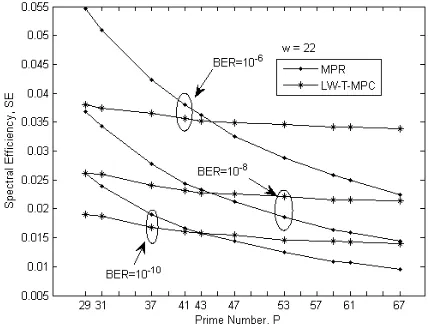
Figure 4 also compares the spectral efficiencies of different codes against the prime number, when 22 under various qualities of service. As seen, the SE of LW-T-MPC outperforms in higher values, similar to the behavior observed in Figure 3 in terms of . The same trends for different qualities of service and the critical crossing points are also present in Figure 4. It is shown that the SE is reduced when grows in general and it is as a result of the code-length increment. On the other hand, the code-weight escalation as seen in Figure 3 enhances the SE, as a consequence of the auto-correlation value increment resulting in higher code utilization factor. No need to say, the forward error correction techniques can further improve the code utilization factor,
and SE. However, here we have only analyzed the pure coding scheme under various circumstances.
VI. CONCLUSION
It is shown that this novel code-set family, hereby referred to as transposed modified prime code (T-MPC), improves the network capacity and spectral efficiency of OCDMA by accommodating greater number of users under the prescribed . The optimized code-length and code-weight of T-MPC are practical, implementable and efficient as they are still equal to original MPC; consequently, employing this novel code is non-destructive to current working systems running MPC. Rewardingly, the available number of code sequences has been doubled to compare with all existing prime code families. Since the time-shift feature is no longer valid in T-MPC, its predictability much reduced and then the security enhanced remarkably. The code generation algorithm is simple and easily implementable for code assignment purposes. The and SE results indicate that the T-MPC is capable of accommodating greater number of subscribers more efficiently to compare with similar-featured code families. This unique matrix-based transpose approach can also be applicable to existing or future spreading code families to maximize the cardinality as long as the correlation constraints are preserved.
ACKNOWLEDGMENT
The authors acknowledge support from the National Science Foundation through ER-CIAN under grant EEC-0812072.
REFERENCES
[1] M. M. Karbassian, and H. Ghafouri-Shiraz, Analysis of scalability and performance in passive optical CDMA network. J. Lightw. Technol., 2009. vol. 27(no. 17): p. 3896-3903.
[2] T. H. Shake, Security performance of optical CDMA against eavesdropping. J. Lightw. Technol., 2005. 23(2): p. 655-670.
[3] X. Wang, and K. Kitayama, Analysis of beat noise in coherent and incoherent time-spreading OCDMA. J. Lightw. Technol., 2004. vol. 22(no. 10): p. 2226-2235.
[4] A. Keshavarzian, and J. A. Salehi, Multiple-shift code acquisition of optical orthogonal codes in optical CDMA systems. IEEE Trans on Comm., 2005. vol. 53(no. 4): p. 687-697.
[5] W. C. Kwong, P. A. Perrier, and P. R. Prucnal, Performance comparison of asynchronous and synchronous code-division mutiple-access techniques for fiber-optic local area networks. IEEE Trans. on Comm., 1991. 39(11): p. 1625-1634.
[6] A. Lalmahomed, M. M. Karbassian, and H. Ghafouri-Shiraz, Performance analysis of enhanced-MPC in incoherent synchronous optical CDMA. J. Lightw. Technol., 2010. 28(1): p. 39-46.
[7] N. Tarhuni, et al., Multiclass optical orthogonal codes for multiservice optical CDMA networks. J. Lightw. Technol., 2005. 24(2): p. 694-704. [8] D. Kamath, J. Touch, and J. A. Bannister. The need for medium access
control in optical CDMA networks. in IEEE InfoCom. 2004.
[9] C. S. Bres, I. Glesk, and P. R. Prucnal, Demonstration of an eight-user 115-Gchip/s incoherent OCDMA system using supercontinuum generation and optical time gating. IEEE Photonics Tech. Letters, 2006. 18(7): p. 889-891.
[10] J. G. Zhang, A. B. Sharma, and W.C. Kwong, Cross-correlation and system performance of modified prime codes for all-optical CDMA applications. J. Opt. A: Pure Appl. Opt. , 2000. 2(5): p. L25-L29. [11] K. Murugesan, Performance analysis of low-weight modified prime
sequence codes for synchronous optical CDMA networks. J. Optical Communications, 2004. 25(2): p. 68-74.
[12] M. Azizoghlu, J. A. Salehi, and Y. Li, Optical CDMA via temporal codes. IEEE Trans on Comm., 1992. 40(8): p. 1162-1170.
[13] M. Rochette, and L. A. Rusch, Spectral efficiency of OCDMA systems with coherent pulsed sources. J. Lightw. Technol., 2005. 23(3): p. 1033-1038.
[14] S. Galli, et al. A novel method for increasing the spectral efficiency of optical CDMA. in GlobeCom. 2005.