Srinivas Bangalore
∗ AT&T Labs – ResearchMichael Johnston
∗∗ AT&T Labs – ResearchMultimodal grammars provide an effective mechanism for quickly creating integration and understanding capabilities for interactive systems supporting simultaneous use of multiple input modalities. However, like other approaches based on hand-crafted grammars, multimodal grammars can be brittle with respect to unexpected, erroneous, or disfluent input. In this article, we show how the finite-state approach to multimodal language processing can be extended to support multimodal applications combining speech with complex freehand pen input, and evaluate the approach in the context of a multimodal conversational system (MATCH). We explore a range of different techniques for improving the robustness of multimodal integration and understanding. These include techniques for building effective language models for speech recognition when little or no multimodal training data is available, and techniques for robust multimodal understanding that draw on classification, machine translation, and sequence edit methods. We also explore the use of edit-based methods to overcome mismatches between the gesture stream and the speech stream.
1. Introduction
The ongoing convergence of the Web with telephony, driven by technologies such as voice over IP, broadband Internet access, high-speed mobile data networks, and hand-held computers and smartphones, enables widespread deployment of multimodal in-terfaces which combine graphical user inin-terfaces with natural modalities such as speech and pen. The critical advantage of multimodal interfaces is that they allow user input and system output to be expressed in the mode or modes to which they are best suited, given the task at hand, user preferences, and the physical and social environment of the interaction (Oviatt 1997; Cassell 2001; Andr´e 2002; Wahlster 2002). There is also an increasing body of empirical evidence (Hauptmann 1989; Nishimoto et al. 1995; Cohen et al. 1998a; Oviatt 1999) showing user preference and task performance advantages of multimodal interfaces.
In order to support effective multimodal interfaces, natural language processing techniques, which have typically operated over linear sequences of speech or text,
∗180 Park Avenue, Florham Park, NJ 07932. E-mail: [email protected]. ∗∗180 Park Avenue, Florham Park, NJ 07932. E-mail: [email protected].
need to be extended in order to support integration and understanding of multimodal language distributed over multiple different input modes (Johnston et al. 1997; Johnston 1998b). Multimodal grammars provide an expressive mechanism for quickly creating language processing capabilities for multimodal interfaces supporting input modes such as speech and gesture (Johnston and Bangalore 2000). They support composite multimodal inputs by aligning speech input (words) and gesture input (represented as sequences of gesture symbols) while expressing the relation between the speech and gesture input and their combined semantic representation. Johnston and Bangalore (2005) show that such grammars can be compiled into finite-state transducers, enabling effective processing of lattice input from speech and gesture recognition and mutual compensation for errors and ambiguities.
In this article, we show how multimodal grammars and their finite-state imple-mentation can be extended to support more complex multimodal applications. These applications combine speech with complex pen input including both freehand gestures and handwritten input. More general mechanisms are introduced for representation of gestures and abstraction over specific content in the gesture stream along with a new technique for aggregation of gestures. We evaluate the approach in the context of the MATCH multimodal conversational system (Johnston et al. 2002b), an interactive city guide. In Section 2, we present the MATCH application, the architecture of the system, and our experimental method for collection and annotation of multimodal data. In Section 3, we evaluate the baseline approach on the collected data.
The performance of this baseline approach is limited by the use of hand-crafted models for speech recognition and multimodal understanding. Like other approaches based on hand-crafted grammars, multimodal grammars can be brittle with respect to extra-grammatical, erroneous, and disfluent input. This is particularly problematic for multimodal interfaces if they are to be used in noisy mobile environments. To overcome this limitation we explore a broad range of different techniques for improving the robustness of both speech recognition and multimodal understanding components.
For automatic speech recognition (ASR), a corpus-driven stochastic language model (SLM) with smoothing can be built in order to overcome the brittleness of a grammar-based language model. However, for multimodal applications there is often very little training data available and collection and annotation of realistic data can be very expensive. In Section 5, we examine and evaluate various different techniques for rapid prototyping of the language model for the speech recognizer, including transforma-tion of out-of-domain data, grammar sampling, adaptatransforma-tion from wide-coverage gram-mars, and speech recognition models built on conversational corpora (Switchboard). Although some of the techniques presented have been reported in the literature, we are not aware of work comparing the effectiveness of these techniques on the same domain and using the same data sets. Furthermore, the techniques are general enough that they can be applied to bootstrap robust gesture recognition models as well. The presentation here focuses on speech recognition models, partly due to the greater impact of speech recognition performance compared to gesture recognition performance on the multimodal application described here. However, in Section 7 we explore the use of robustness techniques on gesture input.
routing (Haffner, Tur, and Wright 2003; Gupta et al. 2004) and semantic role label-ing (Punyakanok, Roth, and Yih 2005), we first pursue a purely data-driven approach where the predicate of a multimodal command and its arguments are determined by classifiers trained on an annotated corpus of multimodal data. However, given the limited amount of data available, this approach does not provide an improvement over the grammar-based approach. We next pursue an approach combining grammar and data where robust understanding is viewed as a statistical machine translation problem where out-of-grammar or misrecognized language must be translated to the closest language the system can understand. This approach provides modest improvement over the grammar-based approach. Finally we explore an edit-distance approach which combines grammar-based understanding with knowledge derived from the underlying application database. Essentially, if a string cannot be parsed, we attempt to identify the in-grammar string that it is most similar to, just as in the translation approach. This is achieved by using a finite-state edit transducer to compose the output of the ASR with the grammar-based multimodal alignment and understanding models. We have presented these techniques as methods for improving the robustness of the multimodal understanding by processing the speech recognition output. Given the higher chance of error in speech recognition compared to gesture recognition, we focus on processing the speech recognition output to achieve robust multimodal understanding. However, these techniques are also equally applicable to gesture recognition output. In Section 7, we explore the use of edit techniques on gesture input. Section 8 concludes and discusses the implications of these results.
2. The MATCH Application
Urban environments present a complex and constantly changing body of informa-tion regarding restaurants, cinema and theater schedules, transportainforma-tion topology, and timetables. This information is most valuable if it can be delivered effectively while mo-bile, since users’ needs change rapidly and the information itself is dynamic (e.g., train times change and shows get cancelled). MATCH (Multimodal Access To City Help) is a working city guide and navigation system that enables mobile users to access restaurant and subway information for urban centers such as New York City and Washington, DC (Johnston et al. 2002a, 2002b). MATCH runs stand-alone on a tablet PC (Figure 1) or in client-server mode across a wireless network. There is also a kiosk version of the system (MATCHkiosk) (Johnston and Bangalore 2004) which incorporates a life-like talking head. In this article, we focus on the mobile version of MATCH, in which the user interacts with a graphical interface displaying restaurant listings and a dynamic map showing locations and street information. The inputs can be speech, drawings on the display with a stylus, or synchronous multimodal combinations of the two modes. The user can ask for reviews, cuisine, phone number, address, or other information about restaurants and for subway directions to restaurants and locations. The system responds with graphical callouts on the display, synchronized with synthetic speech output.
Figure 1
MATCH on tablet.
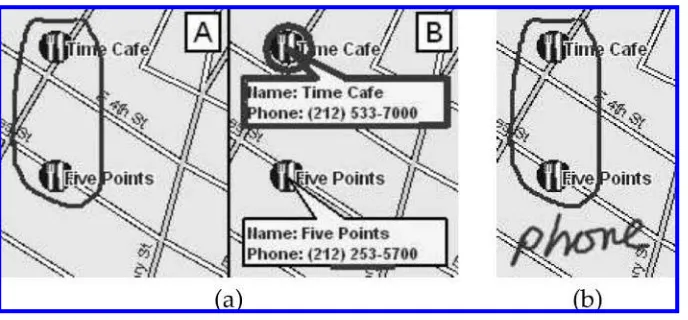
Similarly, if the user says phone numbers for these two restaurants and circles two restaurants as in Figure 3(a) [A], the system will draw a callout with the restaurant name and number and say, for example, Time Cafe can be reached at 212-533-7000, for each restaurant in turn (Figure 3(a) [B]). If the immediate environment is too noisy or public, the same command can be given completely in pen by circling the restaurants and writingphone(Figure 3(b)).
The system also provides subway directions. For example, if the user saysHow do I get to this place?and circles one of the restaurants displayed on the map the system will askWhere do you want to go from?. The user can then respond with speech (for example, 25th Street and 3rd Avenue), with pen by writing (for example, 25th St & 3rd Ave), or multimodally (for example, from here, with a circle gesture indicating the location). The system then calculates the optimal subway route and generates a multimodal presentation coordinating graphical presentation of each stage of the route with spoken instructions indicating the series of actions the user needs to take (Figure 4).
Map-based systems have been a common application area for exploring multimodal interaction techniques. One of the reasons for this is the effectiveness and naturalness of combining graphical input to indicate spatial locations with spoken input to specify commands. See Oviatt (1997) for a detailed experimental investigation illustrating the
Figure 2
Figure 3
(a) Two area gestures. (b) Phone command in pen.
Figure 4
Multimodal subway route.
advantages of multimodal input for map-based tasks. Previous map-based multimodal prototypes can be broken down into two main task domains: map annotation tasks and information search tasks. Systems such as QuickSet (Cohen et al. 1998b) focus on the use of speech and pen input in order to annotate the location of features on a map. Other systems use speech and pen input to enable users to search and browse for information through direct interaction with a map display. In the ADAPT system (Gustafson et al. 2000), users browse for apartments using combinations of speaking and pointing. In the Multimodal Maps system (Cheyer and Julia 1998), users perform travel planning tasks such as searching for hotels and points of interest. MATCH is an information search application providing local search capabilities combined with transportation directions. As such it is most similar to the Multimodal Maps application, though it provides more powerful and robust language processing and multimodal integration capabili-ties, while the language processing in the Multimodal Maps application is limited to simple Verb Object Argument constructions (Cheyer and Julia 1998).
In the next section we explain the underlying architecture and the series of compo-nents which enable the MATCH user interface.
2.1 MATCH Multimodal Architecture
Figure 5
Multimodal architecture.
versions of the system, communication was over socket connections. In later versions of the system communication between components uses HTTP.
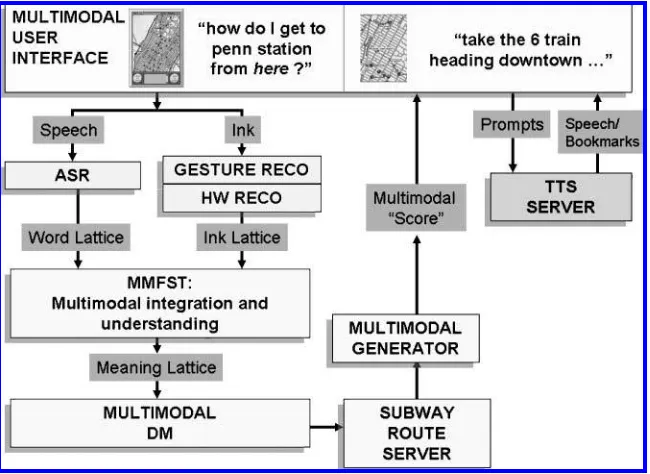
[image:6.486.50.375.396.633.2]Users interact with the system through a Multimodal User Interface client (MUI) which runs in a Web browser. Their speech is processed by the WATSON speech recog-nition server (Goffin et al. 2005) resulting in a weighted lattice of word strings. When the user draws on the map their ink is captured and any objects potentially selected, such as currently displayed restaurants, are identified. The electronic ink is broken into a lattice of strokes and sent to both gesture and handwriting recognition components which
Figure 6
enrich this stroke lattice with possible classifications of strokes and stroke combinations. The gesture recognizer uses a variant of the template matching approach described by Rubine (1991). This recognizes symbolic gestures such as lines, areas, points, arrows, and so on. The stroke lattice is then converted into an ink lattice which represents all of the possible interpretations of the user’s ink as either symbolic gestures or handwritten words. The word lattice and ink lattice are integrated and assigned a combined meaning representation by the multimodal integration and understanding component (Johnston and Bangalore 2000; Johnston et al. 2002b). Because we implement this component using finite-state transducers, we refer to this component as the Multimodal Finite State Transducer (MMFST). The approach used in the MMFST component for integrating and interpreting multimodal inputs (Johnston et al. 2002a, 2002b) is an extension of the finite-state approach previously proposed (Bangalore and Johnston 2000; Johnston and Bangalore 2000, 2005). (See Section 3 for details.) This provides as output a lattice encoding all of the potential meaning representations assigned to the user’s input. The meaning is represented in XML, facilitating parsing and logging by other system components. MMFST can receive inputs and generate outputs using multiple communication protocols, including the W3C EMMA standard for representation of multimodal inputs (Johnston et al. 2007). The meaning lattice is flattened to ann-best list and passed to a multimodal dialog manager (MDM) (Johnston et al. 2002b), which re-ranks the possible meanings in accordance with the current dialogue state. If additional information or confirmation is required, the MDM enters into a short information gathering dialogue with the user. Once a command or query is complete, it is passed to the multimodal generation component (MMGEN), which builds amultimodal score
indicating a coordinated sequence of graphical actions and TTS prompts. This score is passed back to the MUI. The MUI then coordinates presentation of graphical content with synthetic speech output using the AT&T Natural Voices TTS engine (Beutnagel et al. 1999). The subway route constraint solver (SUBWAY) is a backend server built for the prototype which identifies the best route between any two points in the city.
In the given example where the user saysphone for these two restaurantswhile circling two restaurants (Figure 3(a) [A]), assume the speech recognizer returns the lattice in Figure 7 (Speech). The gesture recognition component also returns a lattice (Figure 7, Gesture) indicating that the user’s ink is either a selection of two restaurants or a geo-graphical area. The multimodal integration and understanding component (MMFST) combines these two input lattices into a lattice representing their combined meaning (Figure 7, Meaning). This is passed to the multimodal dialog manager (MDM) and from there to the MUI where it results in the display in Figure 3(a) [B] and coordinated TTS output.
The multimodal integration and understanding component utilizes a declarative multimodal grammar which captures both the structure and the interpretation of mul-timodal and unimodal commands. This formalism and its finite-state implementation for the MATCH system are explained in detail in Section 3.
Figure 7
Multimodal example.
in the underlying application database. The appropriate multimodal grammar rules are then derived automatically as part of the grammar compilation process. Because the new entity type baris assigned the ontology categorylocated entity, the grammar will automatically support deictic reference to bars with expressions such as this place in addition to the more specificthis bar.
In the next section, we explain the data collection procedure we employed in order to evaluate the system and provide a test set for experimenting with different techniques for multimodal integration and understanding.
2.2 Multimodal Data Collection
A corpus of multimodal data was collected in a laboratory setting from a gender-balanced set of 16 first-time novice users. The subjects were AT&T personnel with no prior knowledge of the system and no experience building spoken or multimodal systems. A total of 833 user interactions (218 multimodal/491 speech-only/124 pen-only) resulting from six sample task scenarios involving finding restaurants of various types and getting their names, phones, addresses, or reviews, and getting subway directions between locations were collected and annotated.
Figure 8 shows the experimental set-up. Subjects interacted with the system in a soundproof room separated from the experimenter by one-way glass. Two video feeds were recorded, one from a scan converter connected to the system, the other from a camera located in the subject room, which captured a side-on view of the subject and the display. The system ran on a Fujitsu tablet computer networked to a desktop PC logging server located next to the experimenter. The subject’s audio inputs were captured using both a close-talking headset microphone and a desktop microphone (which captured both user input and system audio).
Figure 8
Experimenter and subject set-up.
The experimenter started out each subject with a brief tutorial on the system, show-ing them the pen and how to click on the display in order to turn on the microphone. The tutorial was intentionally vague and broad in scope so the subjects might overestimate the system’s capabilities and approach problems in new ways. The experimenter then left the subject to complete, unassisted, a series of six sample task scenarios of vary-ing complexity. These involved findvary-ing restaurants of various types and gettvary-ing their names, phones, addresses, or reviews, and getting subway directions between locations. The task scenarios were presented in a GUI on the tablet next to the map display. In our pilot testing, we presented users with whole paragraphs describing scenarios. We found that users would often just rephrase the wording given in the paragraph, thereby limiting the utility of the data collection. Instead, in this data collection we presented what the user had to find as a table (Table 1). This approach elicited a broader range of inputs from users.
After completing the scenarios the user then completed an online questionnaire on the tablet regarding their experience with the system. This consisted of a series of Likert scale questions to measure user satisfaction (Walker, Passonneau, and Boland 2001). After the questionnaire the experimenter came into the experiment room and conducted an informal qualitative post-experiment feedback interview.
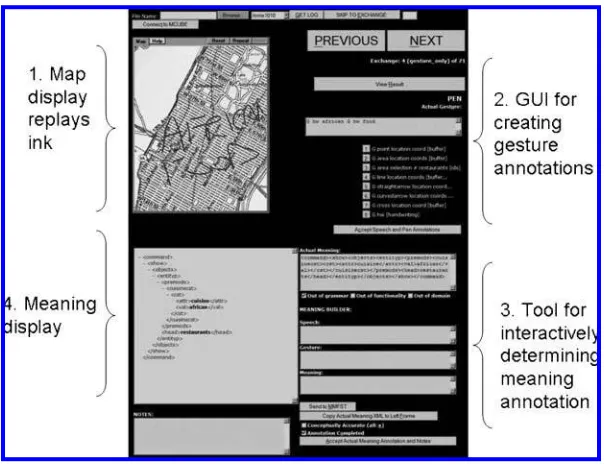
The next phase of the data collection process was to transcribe and annotate the users’ input. Transcription is more complex for multimodal systems than for speech-only systems because the annotator needs not just to hear what the user said but also to see what they did. The browser-based construction of the multimodal user interface enabled us to rapidly build a custom version of the system which serves as an online multimodal annotation tool (Figure 9). This tool extends the approach described in Ehlen, Johnston, and Vasireddy (2002) with a graphical interface for construction of
Table 1
Example scenario.
Use MATCH to find the name, address, and phone number of a restaurant matching the following criteria:
Food Type Location
Figure 9
Multimodal log annotation tool.
gesture annotations and a tool for automatically deriving the meaning annotation for out-of-grammar examples. This tool allows the annotator to dynamically replay the users’ inputs and system responses on the interactive map system itself, turn by turn, and add annotations to a multimodal log file, encoded in XML. The annotation utilizes the map component of the system (Figure 9(1)). It provides coordinated playback of the subject’s audio with their electronic ink, enabling the user to rapidly annotate multimodal data without having to replay video of the interaction. The user interface of the multimodal log viewer provides fields for the annotator to transcribe the speech input, the gesture input, and the meaning. A series of buttons and widgets are provided to enable the annotator to rapidly and accurately transcribe the user’s gesture and the appropriate meaning representation without having to remember the specifics of the gesture and meaning representations (Figure 9(2)).
corpus of 833 user interactions all fully annotated with speech, gesture, and meaning transcriptions.
3. Multimodal Grammars and Finite-State Multimodal Language Processing
One of the most critical technical challenges in the development of effective multimodal systems is that of enabling multimodal language understanding; that is, determining the user’s intent by integrating and understanding inputs distributed over multiple modes. In early work on this problem (Neal and Shapiro 1991; Cohen 1991, 1992; Brison and Vigouroux 1993; Koons, Sparrell, and Thorisson 1993; Wauchope 1994), multimodal un-derstanding was primarily speech-driven,1treating gesture as a secondary dependent mode. In these systems, incorporation of information from the gesture input into the multimodal meaning is triggered by the appearance of expressions in the speech input whose reference needs to be resolved, such as definite and deictic noun phrases (e.g., this one,the red cube). Multimodal integration was essentially a procedural add-on to a speech or text understanding system.
Johnston et al. (1997) developed a more declarative approach where multimodal integration is modeled as unification of typed feature structures (Carpenter 1992) as-signed to speech and gesture inputs. Johnston (1998a, 1998b) utilized techniques from natural language processing (unification-based grammars and chart parsers) to extend the unification-based approach and enable handling of inputs with more than one gesture, visual parsing, and more flexible and declarative encoding of temporal and spatial constraints. In contrast to the unification-based approaches, which separate speech parsing and multimodal integration into separate processing stages, Johnston and Bangalore (2000, 2005) proposed aone-stageapproach to multimodal understanding in which a single grammar specified the integration and understanding of multimodal language. This avoids the complexity of interfacing between separate speech under-standing and multimodal parsing components. This approach is highly efficient and enables tight coupling with speech recognition, because the grammar can be directly compiled into a cascade of finite-state transducers which can compose directly with lattices from speech recognition and gesture recognition components.
In this section, we explain how the finite-state approach to multimodal language understanding can be extended beyond multimodal input with simple pointing ges-tures made on a touchscreen (as in Johnston and Bangalore [2000, 2005]) to applica-tions such as MATCH with complex gesture input combining freeform drawings with handwriting recognition. This involves three significant extensions to the approach: the development of a gesture representation language for complex pen input combining freehand drawing with selections and handwriting (Section 3.1); a new more scalable approach to abstraction over the specific content of gestures within the finite-state mechanism (Section 3.3); and a new gesture aggregation algorithm which enables robust handling of the integration of deictic phrases with a broad range of different selection gestures (Section 3.4). In Section 3.2, we illustrate the use of multimodal grammars for this application with a fragment of the multimodal grammar for MATCH and illustrate how this grammar is compiled into a cascade of finite-state transducers. Section 3.5 addresses the issue of temporal constraints on multimodal integration. In Section 3.6, we describe the multimodal dialog management mechanism used in the system and how
Figure 10
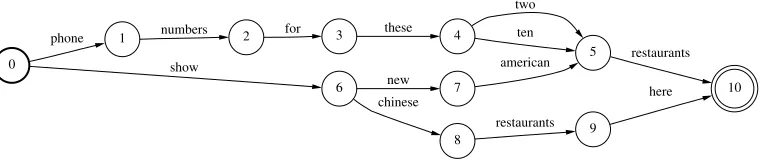
Speech lattice.
contextual resolution of deictic expressions is accounted for. In Section 3.7, we evaluate the performance of this approach to multimodal integration and understanding using the multimodal data collected as described in Section 2.2.
3.1 Lattice Representations for Gesture and Meaning
One of the goals of our approach to multimodal understanding is to allow for am-biguities and errors in the recognition of the individual modalities to be overcome through combination with the other mode (Oviatt 1999; Bangalore and Johnston 2000). To maximize the potential for error compensation, we maintain multiple recognition hypotheses by representing input modes as weighted lattices of possible recognition strings. For speech input, the lattice is a network of word hypotheses with associated weights. Figure 10 presents a simplified speech lattice from the MATCH application.2
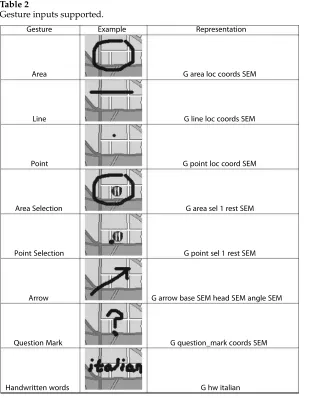
Representation of Gesture.Like speech, gesture input can also be represented as a token stream, but unlike speech there is no pre-established tokenization of gestures (words of a gesture language) other than for handwritten words. We have developed a gesture representation language for pen input which enables representation of symbolic ges-tures such as areas, lines, and arrows, selection gesges-tures, and handwritten words. This language covers a broad range of pen-based input for interactive multimodal applica-tions and can easily be extended to new domains with different gesture symbols. Each gesture is represented as a sequence of symbols indicating different characteristics of the gesture. These symbol sequences can be concatenated in order to represent sequences of gestures and assembled into a lattice representation in order to represent a range of possible segmentations and interpretations of a sequence of ink strokes. In the MATCH system, when the user draws on the map, their ink points are captured along with in-formation about potentially selected items, and these are passed to a gesture processing component. First, the electronic ink is rotated and scaled and broken into a lattice of strokes. This stroke lattice is processed by both gesture and handwriting recognizers to identify possible pen gestures and handwritten words in the ink stream. The results are combined with selection information to derive the gesture lattice representations presented in this section. The gesture recognizer uses a variant of the trained template matching approach described in Rubine (1991). The handwriting recognizer is neural-network based. Table 2 provides the full set of eight gestures supported and the symbol sequences used to represent them in the gesture lattice.
Table 2
Gesture inputs supported.
For symbolic gestures and selections, the gesture symbol complexes have the basic form:G FORM MEANING (NUMBER TYPE) SEM.FORMindicates the physical form of the gesture, and has values such asarea,point,line, andarrow.MEANINGprovides a rough characterization of the specific meaning of that form; for example, anareacan be either a loc(location) or asel(selection), indicating the difference between gestures which delimit a spatial location on the screen and gestures which select specific dis-played icons. NUMBERandTYPEare only found withsel. They indicate the number of entities selected (1, 2, 3, many) and the specific type of entity (e.g.,rest(restaurant) or thtr (theater)). TheTYPEvalue mixis used for selections of entities of different types. Recognition of inputs as handwritten words is also encoded in the gesture lattice. These are indicated by the sequenceG hw WORD. For example, if the user wrotephone number the gesture sequence would beG hw phone G hw number.
the gesture lattice will be as in Figure 11. The first two paths through this gesture lattice represent the ambiguity between the use of the gesture to indicate a spatial location versus a selection of objects on the screen. As defined in the subsequent multimodal grammar, if the speech is show me chinese restaurants in this neighborhoodthen the first path will be chosen. If the speech istell me about these two restaurantsthen the second path will be chosen. The third path represents the recognition hypothesis from handwriting recognition that this is a handwritten O. If instead the user circles a restaurant and a theatre, the lattice would be as in Figure 12. If they saytell me about this theater, the third path will be taken. If they saytell me about these two, the fourth path will be taken. This allows for cases where a user circles several entities and selects a specific one by type.
The underlying ontology of the application domain plays a critical role in the han-dling of multimodal expressions. For example, ifplaceintell me about this placecan refer to either a restaurant or a theatre, then it can be aligned with both gesture symbols in the multimodal grammar. The nounplaceis associated in the lexicon with a general type in the ontology:located entity. When the multimodal grammar is compiled, by virtue of this type assignment, the expressionthis placeis associated with gesture representations for all of the specific subtypes of located entity in the ontology, such asrestaurant and theater. The approach also extends to support deictic references to collections of objects of different types. For example, the nounbuildingis associated in the lexicon with the typebuilding. In the grammarthese buildingsis associated with the gesture typebuilding. If the user selects a collection of objects of different types they are assigned the type buildingin the gesture lattice and so the expressionthese buildingswill pick out that path. In the application domain of our prototype, where restaurants and theaters are the only selectable object types, we use a simpler ontology with a single general object typemix for collections of objects as in Figure 12, and this integrates with spoken phrases such as these places.
[image:14.486.49.433.433.494.2]Representation of Meaning.Understanding multimodal language is about extracting the meaningfrom multimodal utterances. Although there continue to be endless debates in
Figure 11
Gesture latticeG: Selection of two restaurants.
Figure 12
[image:14.486.50.451.539.631.2]Figure 13
Meaning lattice.
Figure 14
XML meaning representation.
linguistics, philosophy, psychology, and neuroscience on what constitutes the meaning of a natural language utterance (Jackendoff 2002), for the purpose of human–computer interactive systems, “meaning” is generally regarded as a representation that can be executed by an interpreter in order to change the state of the system.
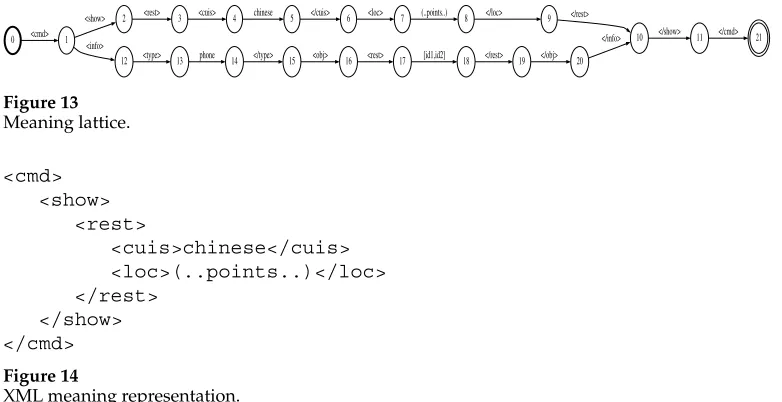
Similar to the input speech and gesture representations, in our approach the output meaning is also represented in a lattice format. This enables compact representation of multiple possible interpretations of the user’s inputs and allows for later stages of processing, such as the multimodal dialog manager, to use contextual information to rescore the meaning lattice. In order to facilitate logging and parsing by other components (dialog manager, backend servers), the meaning representation language is encoded in XML.3 The meaning lattice resulting from combination of speech and gesture is such that for every path through the lattice, the concatenation of symbols from that path will result in a well-formed XML expression which can be evaluated with respect to the underlying application semantics. In the city information application this includes elements such as<show>which contains a specification of a kind of restaurant to show, with elements<cuis>(cuisine),<loc>(location), and so on. Figure 13 shows the meaning lattice that would result when the speech lattice (Figure 10) combines with the gesture lattice (Figure 11).
The first path through the lattice results from the combination of the speech string show chinese restaurants here with an area gesture. Concatenating the symbols on this path, we have the well-formed XML expression in Figure 14.
3.2 Multimodal Grammars and Finite-State Understanding
Context-free grammars have generally been used to encode the sequences of input tokens (words) in a language which are considered grammatical or acceptable for pro-cessing in a single input stream. In some cases grammar rules are augmented with oper-ations used to simultaneously build a semantic representation of an utterance (Ades and
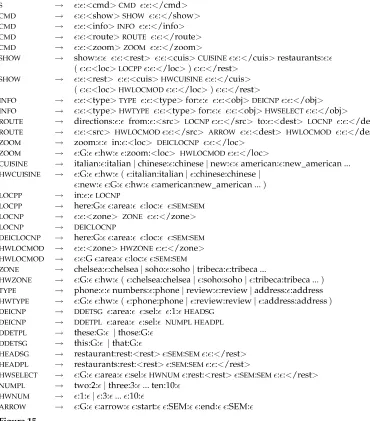
Steedman 1982; Pollard and Sag 1994; van Tichelen 2004). Johnston and Bangalore (2000, 2005) present a multimodal grammar formalism which directly captures the relation-ship between multiple input streams and their combined semantic representation. The non-terminals in the multimodal grammar are atomic symbols. The multimodal aspects of the grammar become apparent in the terminals. Each terminal contains three compo-nentsW:G:Mcorresponding to the two input streams and one output stream, whereW is for the spoken language input stream,Gis for the gesture input stream, andMis for the combined meaning output stream. These correspond to the three representations described in Section 3.1. The epsilon symbol () is used to indicate when one of these is empty within a given terminal. In addition to the gesture symbols (G area loc...),G contains a symbolSEMused as a placeholder for specific content (see Section 3.3).
In Figure 15, we present a fragment of the multimodal grammar used for the city information application described in this article. This grammar is simplified for ease of exposition. The rules capture spoken, multimodal, and pen-only commands for showing restaurants (SHOW), getting information about them (INFO), requesting subway directions (ROUTE), and zooming the map (ZOOM).
As in Johnston and Bangalore (2000, 2005), this multimodal grammar is com-piled into a cascade of finite-state transducers. Finite-state machines have been exten-sively applied to many aspects of language processing, including speech recognition (Riccardi, Pieraccini, and Bocchieri 1996; Pereira and Riley 1997), phonology (Kartunnen 1991; Kaplan and Kay 1994), morphology (Koskenniemi 1984), chunking (Abney 1991; Joshi and Hopely 1997; Bangalore 1997), parsing (Roche 1999), and machine transla-tion (Bangalore and Riccardi 2000). Finite-state models are attractive mechanisms for language processing since they are (a) efficiently learnable from data; (b) generally effective for decoding; and (c) associated with a calculus for composing machines which allows for straightforward integration of constraints from various levels of language processing. Furthermore, software implementing the finite-state calculus is available for research purposes (Noord 1997; Mohri, Pereira, and Riley 1998; Kanthak and Ney 2004; Allauzen et al. 2007).
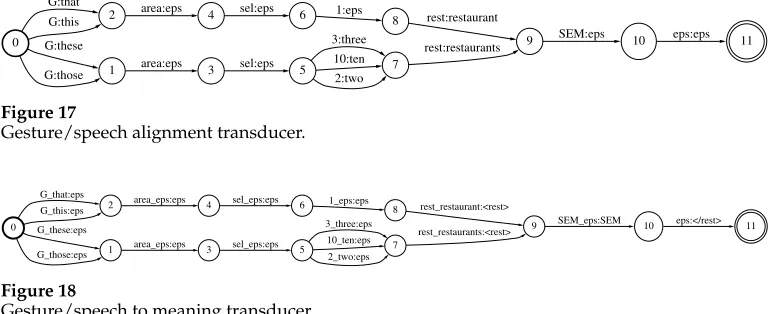
We compile the multimodal grammar into a finite-state device operating over two input streams (speech and gesture) and one output stream (meaning). The transition symbols of the FSA correspond to the terminals of the multimodal grammar. For the sake of illustration here and in the following examples we will only show the portion of the three-tape finite-state device which corresponds to theDEICNPrule in the grammar in Figure 15. The corresponding finite-state device is shown in Figure 16. This three-tape machine is then factored into two transducers:R:G→WandT:(G×W)→M. TheR machine (e.g., Figure 17) aligns the speech and gesture streams through a composition with the speech and gesture input lattices (Go (G:WoW)). The result of this operation is then factored onto a single tape and composed with theT machine (e.g., Figure 18) in order to map these composite gesture–speech symbols into their combined meaning (G W:M). Essentially the three-tape transducer is simulated by increasing the alphabet size by adding composite multimodal symbols that include both gesture and speech information. A lattice of possible meanings is derived by projecting on the output of G W:M.
Figure 15
Multimodal grammar fragment.
Figure 16
Multimodal three-tape FSA.
[image:17.486.58.439.522.561.2]Figure 17
[image:18.486.51.438.70.115.2]Gesture/speech alignment transducer.
Figure 18
Gesture/speech to meaning transducer.
of exposition we have left out weights from the examples given. For the sake of com-pleteness, we provide a brief description of the treatment of weights in the multimodal integration mechanism. The speech and gesture lattices contain weights. These weights are combined through the process of finite-state composition, so the finite-state device resulting from multimodal integration sums the weights from both the input lattices. In order to account for differences in reliability between the speech lattice weights and gesture lattice weights, the weights on the lattices are scaled according to a weighting factorλlearned from held-out training data. The speech lattice is scaled byλ: 0< λ <1 and the gesture lattice by 1−λ. Potentially this scaling factor could be dynamically adapted based on environmental factors and specific users’ performance with the indi-vidual modes, though in the system described here the scaling factor was fixed for the duration of the experiment.
3.3 Abstraction over Specific Gesture Content
The semantic content associated with gesture inputs frequently involves specific infor-mation such as a sequence of map coordinates (e.g., for area gestures) or the identities of selected entities (e.g., restaurants or theaters). As part of the process of multimodal integration and understanding this specific content needs to be copied from the gesture stream into the resulting combined meaning. Within the finite-state mechanism, the only way to copy content is to have matching symbols on the gesture input and meaning output tapes. It is not desirable and in some cases infeasible to enumerate all of the different possible pieces of specific content (such as sequences of coordinates) so that they can be copied from the gesture input tape to the meaning output tape. This will significantly increase the size of the machine. In order to capture multimodal integration using finite-state methods, it is necessary to abstract over certain aspects of the gestural content.
Figure 19
I:Gtransducer: Two restaurants.
Figure 20
Gesture latticeG.
In any location in the multimodal grammar (Figure 15) and corresponding three-tape finite-state device (Figure 16) where content needs to be copied from the gesture input into the meaning, the transition :SEM:SEM is used. In the T:(G×W)→M (Figure 17) transducer these transitions are labeledSEM:SEM.
[image:19.486.57.438.67.128.2]For composition with theG:Wgesture/speech alignment transducer (Figure 18) we take a projection of the output of the I:Gtransducer. For the example I:Gtransducer (Figure 19) the output projectionGis as shown in Figure 20. This projection operation provides the abstraction over the specific content.
After composing theGandWwithG:W, factoring this transducer into an FSAG W and composing it with T:(G×W)→M, we are left with a transducer G W:M. This transducer combines a meaning latticeMwith a specification of the gesture and speech symbols and is used to determine the meaning ofG W.
The next step is to factor out the speech information (W), resulting in a transducer G:Mwhich relates a meaning latticeMto the gestures involved in determining those meaningsG. This machine can be composed with the originalI:Gtransducer (I:G o G:M), yielding a transducerI:M. The final step is to read off meanings from theI:Mtransducer. For each path through the meaning lattice we concatenate symbols from the outputM side, unless theMsymbol isSEMin which case we take the inputIsymbol for that arc. Essentially, theI:Gtransducer provides an index back from the gesture symbol sequence associated with each meaning in the meaning lattice to the specific content associated with each gesture.
For our example case, if the speechthese two restaurantsis aligned with the gesture lattice (Figure 20) using R:G→W (Figure 18) and the result is then factored and composed withT:(G×W)→M(Figure 17), the resultingG W:Mtransducer is as in Figure 21. This is then factored in theG:Mtransducer Figure 22 and composed withI:G (Figure 19), yielding theI:Mtransducer shown in Figure 23.
Figure 21
Figure 22
G:Mtransducer.
Figure 23
I:Mtransducer.
The meaning is generated by reading off and concatenating meaning symbols from the output of theI:Mtransducer, except for cases in which the output symbol isSEM, where instead the input symbol is taken. Alternatively, for all arcs in theI:Mtransducer where the output isSEM, the input and output symbols can be swapped (because the input label represents the value of theSEMvariable), and then all paths inMwill be the full meanings with the specific content. For our example case this results in the following meaning representation:<rest>[r12,r15]</rest>. This example was only for the DEICNP subgrammar. With the full stringphone numbers for these two restaurants the complete resulting meaning is:<cmd> <info> <type>phone</type> <obj> <rest> [r12,r15]</rest> </obj> </info> </cmd>.
A critical advantage of this approach is that, because the gesture lattice itself is used to store the specific contents, the retrieval mechanism scales as the size and complexity of the gesture lattice increases. In the earlier approach more and more variable names are required as lattices increase in size, and in all places in the grammar where content is copied from gesture to meaning, arcs must be present for all of these variables. Instead here we leverage the fact that the gesture lattice itself can be used as a data structure from which the specific contents can be retrieved using the finite-state operation of composingI:Gand G:M. This has the advantage that the algorithms required for ab-stracting over the specific contents and then reinserting the content are not required, and these operations are instead captured within the finite-state mechanism. One of the advantages of this representation of the abstraction is that it encodes not just the type of each gesture but also its position within the gesture lattice.
3.4Gesture Aggregation
Johnston (2000) identifies problems involved in multimodal understanding and integra-tion of deictic numeral expressions such asthese three restaurants. The problem is that for a particular spoken phrase there are a multitude of different lexical choices of gesture and combinations of gestures that can be used to select the specified plurality of entities and all of these need to be integrated with the spoken phrase. For example, as illustrated in Figure 24, the user might circle all three restaurants with a single pen stroke, circle each in turn, or circle a group of two and group of one.
Figure 24
Multiple ways to select.
In the finite-state approach described here this can be achieved using a process we termgesture aggregation, which serves as a pre-processing phase on the gesture input lattice. A gesture aggregation algorithm traverses the gesture input lattice and adds new sequences of arcs which represent combinations of adjacent gestures of identical type. The operation of the gesture aggregation algorithm is described in pseudo-code in Algorithm 1. The functionplurality() retrieves the number of entities in a selection gesture; for example, for a selection of two entitiesg1,plurality(g1)=2. The function type() yields the type of the gesture; for examplerestfor a restaurant selection gesture. The functionspecific content() yields the specific IDs.
Algorithm 1Gesture aggregation.
P⇐the list of all paths through the gesture latticeGL
whileP=∅do
p⇐pop(P)
G⇐the list of gestures in pathp i⇐1
whilei<length(G)do
ifg[i] andg[i+1] are both selection gesturesthen iftype(g[i])==type(g[i+1])then
plurality⇐plurality(g[i])+plurality(g[i+1) start⇐start state(g[i])
end⇐end state(g[i+1]) type⇐type(g[i])
specific⇐append(specific content(g[i]),specific content(g[i+1]) g⇐G area selplurality type specific
AddgtoGLstarting at statestartand ending at stateend
p⇐the pathpbut with the arcs fromstarttoendreplaced withg pushpontoP
i⇐i+1
Essentially what this algorithm does is perform closure on the gesture lattice of a function which combines adjacent gestures of identical type. For each pair of adjacent gestures in the lattice which are of identical type, a new gesture is added to the lattice. This new gesture starts at the start state of the first gesture and ends at the end state of the second gesture. Its plurality is equal to the sum of the pluralities of the combining gestures. The specific content for the new gesture (lists of identifiers of selected objects) results from appending the specific contents of the two combining gestures. This oper-ation feeds itself so that sequences of more than two gestures of identical type can be combined.
For our example case of three selection gestures on three different restaurants as in Figure 24(2), the gesture lattice before aggregation is as in Figure 25(a). After aggregation the gesture lattice is as in Figure 25(b). Three new sequences of arcs have been added. The first, from state 3 to state 8, results from the combination of the first two gestures; the second, from state 14 to state 24, from the combination of the last two gestures; and the third, from state 3 to state 24, from the combination of all three ges-tures. The resulting lattice after the gesture aggregation algorithm has applied is shown in Figure 25(b). Note that minimization has been applied to collapse identical paths.
A spoken expression such as these three restaurants is aligned with the gesture symbol sequence G area sel 3 rest SEMin the multimodal grammar. This will be able to combine not just with a single gesture containing three restaurants but also with our example gesture lattice, since aggregation adds the path:G area sel 3 rest [id1,id2,id3].
We term this kind of aggregationtype specific aggregation. The aggregation process can be extended to supporttype non-specific aggregationfor cases where users refer to sets of objects of mixed types and select them using multiple gestures. For example in the case where the user saystell me about these twoand circles a restaurant and then a theater, non-type specific aggregationapplies to combine the two gestures into an aggregate of mixed type G area sel 2 mix [(id1,id2)] and this is able to combine with these two. For applications with a richer ontology with multiple levels of hierarchy, thetype non-specific aggregation should assign to the aggregate to the lowest common subtype of the set of entities being aggregated. In order to differentiate the original sequence of gestures that the user made from the aggregate, paths added through aggregation are assigned additional cost.
Figure 25(c) shows how these new processes of gesture abstraction and aggregation integrate into the overall finite-state multimodal language processing cascade. Aggre-gation applies to the I:G representation of the gesture. A projection G on the I:Gis composed with the gesture/speech alignment transducerR:G→W, then the result is composed with the speech lattice. The resultingG:Wtransducer is factored into an FSA with a composite alphabet of symbols. This is then composed with theT:(G×W)→M yielding a result transducerG W:M. The speech is factored out of the input yielding G:Mwhich can then be composed withI:G, yielding a transducerI:Mfrom which the final meanings can be read.
3.5 Temporal Constraints on Multimodal Integration
Figure 25
multimodal utterances but sequences of two utterances.4 The multimodal integration mechanism and multimodal grammars described herein enumerate the content of single turns of user input, be they unimodal or multimodal. The multimodal integration component and multimodal grammars are not responsible for combination of content from different modes that occur in separate dialog turns. This is treated as part of dialog management and reference resolution. Temporal constraints do, however, play a role in segmenting parallel multimodal input streams into single user turns. This is one of the functions of the multimodal understanding component. In order to determine which gestures and speech should be considered part of a single user utterance, a dynamic timeout adaptation mechanism was used. In initial versions of the system, fixed timeout intervals were used on receipt of input from one modality to see if the input is in fact unimodal or whether input in the other modality is forthcoming. In pilot studies we determined that the system latency introduced by these timeouts could be significantly reduced by making the timeouts sensitive to activity in the other mode. In addition to messages containing the results of speech recognition and gesture processing, we instrumented the multimodal understanding component (MMFST) to receive events indicating when the pen first touches the screen (pen-down event) and when the click-to-speak button is pressed (click-click-to-speak event). When the MMFST component receives a speech lattice, if a gesture lattice has already been received then the two lattices are processed immediately as a multimodal input. If gesture has not yet been received and there is no pen-down event, the multimodal component waits for a short timeout interval before interpreting the speech as a unimodal input. If gesture has not been received, but there has been a pen-down event, the multimodal component will wait for a longer timeout period for the gesture lattice message to arrive. Similarly, when gesture is received, if the speech lattice has already been received the two are integrated immediately. If speech has not yet arrived, and there was no click-to-speak event, then the system will wait for a short timeout before processing the gesture lattice as unimodal input. If speech has not yet arrived but the click-to-speak event has been received then the component will wait for the speech lattice to arrive for a longer timeout period. Longer timeouts are used instead of waiting indefinitely to account for cases where the speech or gesture processing does not return a result. In pilot testing we determined that with the adaptive mechanism the short timeouts could be kept as low as a second or less, significantly reducing system latency for unimodal inputs. With the non-adaptive mechanism we required timeouts of as much as two to three seconds. For the longer timeouts we found 15 seconds to be an appropriate time period. A further extension of this approach would be to make the timeout mechanism adapt to specific users, since empirical studies have shown that users tend to fall into specific temporal integration patterns (Oviatt, DeAngeli, and Kuhn 1997).
The adaptive timeout mechanism could also be used with other speech activation mechanisms. In an ”open microphone” setting where there is no explicit click-to-speak event, voice activity detection could be used to signal that a speech event is forthcom-ing. For our application we chose a ”click-to-speak” strategy over ”open microphone” because it is more robust to noise and mobile multimodal interfaces are intended for use in environments subject to noise. The other alternative, ”click-and-hold,” where the user has to hold down a button for the duration of their speech, is also problematic because it limits the ability of the user to use pen input while they are speaking.
3.6 Multimodal Dialog Management and Contextual Resolution
The multimodal dialog manager (MDM) is based on previous work on speech-act based models of dialog (Rich and Sidner 1998; Stent et al. 1999). It uses a Java-based toolkit for writing dialog managers that is similar in philosophy to TrindiKit (Larsson et al. 1999). It includes several rule-based processes that operate on a shared state. The state includes system and user intentions and beliefs, a dialog history and focus space, and information about the speaker, the domain, and the available modalities. The processes include interpretation, update, selection, and generation.
The interpretation process takes as input an n-best list of possible multimodal interpretations for a user input from the MMFST. It rescores them according to a set of rules that encode the most likely next speech act given the current dialogue context, and picks the most likely interpretation from the result. The update process updates the dialogue context according to the system’s interpretation of user input. It augments the dialogue history, focus space, models of user and system beliefs, and model of user intentions. It also alters the list of current modalities to reflect those most recently used by the user.
The selection process determines the system’s next move(s). In the case of a com-mand, request, or question, it first checks that the input is fully specified (using the domain ontology, which contains information about required and optional roles for different types of actions); if it is not, then the system’s next move is to take the initiative and start an information-gathering subdialogue. If the input is fully specified, the system’s next move is to perform the command or answer the question; to do this, MDM communicates directly with the UI.
The generation process performs template-based generation for simple responses and updates the system’s model of the user’s intentions after generation. A text plan-ning component (TEXTPLAN) is used for more complex generation, such as the gener-ation of comparisons (Walker et al. 2002, 2004).
In the case of a navigational query, such as the example in Section 2, MDM first receives a route query in which only the destination is specified: How do I get to this place?. In the selection phase it consults the domain ontology and determines that a source is also required for a route. It adds a request to query the user for the source to the system’s next moves. This move is selected and the generation process selects a prompt and sends it to the TTS component. The system asksWhere do you want to go from?. If the user says or writes25th Street and 3rd Avenuethen the MMFST will assign this input two possible interpretations: either this is a request to zoom the display to the specified location or it is an assertion of a location. Because the MDM dialogue state indicates that it is waiting for an answer of the type location, MDM reranks the assertion as the most likely interpretation. A generalized overlay process (Alexandersson and Becker 2001) is used to take the content of the assertion (a location) and add it into the partial route request. The result is determined to be complete. The UI resolves the location to map coordinates and passes on a route request to the SUBWAY component.
We found this traditional speech-act based dialogue manager worked well for our multimodal interface. Critical in this was our use of a common semantic representation across spoken, gestured, and multimodal commands. The majority of the dialogue rules operate in a mode-independent fashion, giving users flexibility in the mode they choose to advance the dialogue.
ambiguous in the multimodal grammar. There will be one path through the grammar where this expression is associated with a sequence of gesture symbols, such as G area selection 1 rest r123, and another where it is not associated with any gesture sym-bols and assigned a semantic representation which indicates that it must be resolved from context: <rest><discourseref></discourseref></rest>. If at the multimodal un-derstanding stage there is a gesture of the appropriate type in the gesture lattice, then the first of these paths will be chosen and the identifier associated with the gesture will be added to the semantics during the multimodal integration and under-standing process: <rest>r123</rest>. If there is no gesture, then this restaurantwill be assigned the semantic representation <rest><discourseref></discourseref></rest> and the dialog manager will attempt to resolve the gesture from the dialog context. The update process in the multimodal dialog manager maintains a record in the fo-cus space of the last mention of entities of each semantic type, and the last men-tioned entity. When the interpretation process receives a semantic representation containing the marker <rest><discourseref></discourseref></rest> it replaces < dis-courseref></discourseref> with the identifier of the last-mentioned entity of the type restaurant.
Cases where the gesture is a low-confidence recognition result, in fact, where the gesture is spurious and not an intentional input, are handled using back-offs in the multimodal grammar as follows: In the multimodal grammar, productions are added which consume a gesture from the gesture lattice, but assign the semantics <rest><discourseref></discourseref></rest>. Generally these are assigned a higher cost than paths through the model where the gesture is meaningful, so that these back-off paths will only be chosen if there is no alternative. In practice for speech and pen systems of the kind described here, we have found that spurious gestures are uncommon, though they are likely to be considerably more of a problem for other kinds of modalities, such as freehand gesture recognized using computer vision.
3.7 Experimental Evaluation
To determine the baseline performance of the finite-state approach to multimodal in-tegration and understanding, and to collect data for the experiments on multimodal robustness described in this article, we collected and annotated a corpus of multimodal data as described in Section 2.2. To enable this initial experiment and data collection, because no corpus data had already been collected, to bootstrap the process we initially used a handcrafted multimodal grammar using grammar templates combined with data from the underlying application database. As shown in Figure 26, the multimodal grammar can be used to create language models for ASR, align the speech and gesture results from the respective recognizers, and transform the multimodal utterance to a meaning representation. All these operations are achieved using finite-state transducer operations.
Figure 26
Multimodal grammar compilation for different processes of MATCH.
The hierarchically-nested XML representation described in Section 3.1 is effective for processing by the backend application, but is not well suited for the automated determination of the performance of the language understanding mechanism. We de-veloped an approach, similar to Ciaramella (1993) and Boros et al. (1996), in which the meaning representation, in our case XML, is transformed into a sorted flat list of attribute–value pairs indicating the core contentful concepts of each command. The attribute–value meaning representation normalizes over multiple different XML rep-resentations which correspond to the same underlying meaning. For example, phone and address and address and phonereceive different XML representations but the same attribute–value representation. For the examplephone number of this restaurant, the XML representation is as in Figure 27, and the corresponding attribute–value representation is as in Figure 28.
Figure 27
XML meaning representation.
cmd:info type:phone object:selection. (1)
Figure 28
Table 3
ASR and concept accuracy for the grammar-based finite-state approach (10-fold).
Speech recognition Word accuracy 41.6%
Sentence accuracy 38.0%
Understanding Concept sentence accuracy 50.7%
Predicate accuracy 67.2%
Argument accuracy 52.8%
This transformation of the meaning representation allows us to calculate the per-formance of the understanding component using string-matching metrics parallel to those used for speech recognition accuracy. Concept Sentence Accuracy measures the number of user inputs for which the system got the meaning completely right.5
Predicate Sentence Accuracymeasures whether the main predicate of the sentence was correct (similar to call type in call classification). Argument Sentence Accuracyis an exact string match between the reference list of arguments and the list of arguments identified for the command. Note that the reference and hypothesized argument se-quences are lexicographically sorted before comparison so the order of the arguments does not matter. We do not utilize the equivalent of word accuracy on the concept token sequence. The concept-level equivalent of word accuracy is problematic because it can easily be manipulated by increasing or decreasing the number of tokens used in the meaning representation.
To provide a baseline for the series of techniques explored in the rest of the article, we performed recognition and understanding experiments on the same 10 partitions of the data as in Section 4. The numbers are all averages over all 10 partitions. Table 3 shows the speech recognition accuracy using the grammar-based language model pro-jected from the multimodal grammar. It also shows the concept accuracy results for the multimodal–grammar-based finite-state approach to multimodal understanding.
The multimodal grammars described here provide an expressive mechanism for quickly creating language processing capabilities for multimodal interfaces support-ing input modes such as speech and pen, but like other approaches based on hand-crafted grammars, multimodal grammars are brittle with respect to extra-grammatical or erroneous input. The language model directly projected from the speech portion of the hand-crafted multimodal grammar is not able to recognize any strings that are not encoded in the grammar. In our data, 62% of user’s utterances were out of the multi-modal grammar, a major problem for recognition (as illustrated in Table 3). The poor ASR performance has a direct impact on concept accuracy. The fact that the score for concept sentence accuracy is higher than that for sentence accuracy is not unexpected since recognition errors do not always result in changes in meaning and also to a certain extent the grammar-based language model will force fit out-of-grammar utterances to similar in-grammar utterances.
4. Robustness in Multimodal Language Processing
A limitation of grammar-based approaches to (multimodal) language processing is that the user’s input is often not covered by the grammar and hence fails to receive an interpretation. This issue is present in grammar-based speech-only dialog systems
as well. The lack of robustness in such systems is due to limitations in (a) language modeling and (b) understanding of the speech recognition output.
The brittleness of using a grammar as a language model is typically alleviated by building SLMs that capture the distribution of the user’s interactions in an application domain. However, such SLMs are trained on large amounts of spoken interactions collected in that domain—a tedious task in itself, in speech-only systems, but an often insurmountable task in multimodal systems. The problem we face is how to make multimodal systems more robust to disfluent or unexpected multimodal language in applications for which little or no training data is available. The reliance on multimodal grammars as a source of data is inevitable in such situations. In Section 5, we explore and evaluate a range of different techniques for building effective SLMs for spoken and multimodal systems under constraints of limited training data. The techniques are presented in the context of SLMs, since spoken language interaction tends to be a dom-inant mode in our application and has higher perplexity than the gesture interactions. However, most of these techniques can also be applied to improve the robustness of the gesture recognition component in applications with higher gesture language perplexity. The second source of brittleness in a grammar-based multimodal/unimodal inter-active system is in the assignment of meaning to the multimodal output. The grammar typically encodes the relation between the multimodal inputs and their meanings. The assignment of meaning to a multimodal output is achieved by parsing the utterance using the grammar. In a grammar-based speech-only system, if the language model of ASR is derived directly from the grammar, then every ASR output can be parsed and assigned a meaning by the grammar. However, using an SLM results in ASR outputs that may not be parsable by the grammar and hence cannot be assigned a meaning by the grammar. Robustness in such cases is achieved by either (a) modifying the parser to accommodate for unparsable substrings in the input (Ward 1991; Dowding et al. 1993; Allen et al. 2001) or (b) modifying the meaning representation to make it learnable as a classification task using robust machine learning techniques as is done in large scale human-machine dialog systems (e.g., Gorin, Riccardi, and Wright 1997).
In our grammar-based multimodal system, the grammar serves as the speech-gesture alignment model and assigns a meaning representation to the multimodal input. Failure to parse a multimodal input implies that the speech and gesture inputs are not fused together and consequently may not be assigned a meaning representation. In order to improve robustness in multimodal understanding, more flexible mechanisms must be employed in the integration and the meaning-assignment phases. In Section 6, we explore and evaluate approaches that transform the multimodal input so as to be parsable by the multimodal grammar, as well as methods that directly map the multimodal input to the meaning representation without the use of the grammar. We again present these approaches in the context of transformation of the ASR output, but they are equally applicable to gesture recognition outputs. Transformation of the multimodal inputs so as to be parsable by the multimodal grammar directly improves robustness of multimodal integration and understanding.
multimodal application. However, here we focus on techniques for improving robust-ness of multimodal understanding that do not rely on such factors.
5. Robustness of Language Models for Speech Recognition
The problem of speech recognition can be succinctly represented as a search for the most likely word sequence (w∗) through the network created by the composition of a language of acoustic observations (O), an acoustic model which is a transduction from acoustic observations to phone sequences (A), a pronunciation model which is a trans-duction from phone sequences to word sequences (L), and a language model acceptor (G) (Pereira and Riley 1997) (Equation 2). The language model acceptor encodes the (weighted) word sequences permitted in an application.
w∗=argmax
w
π2(O◦A◦L◦G)(w) (2)
Typically,Gis built using either a hand-crafted grammar or using a statistical lan-guage model derived from a corpus of sentences from the application domain. Although a grammar could be written so as to be easily portable across applications, it suffers from being too prescriptive and has no metric for the relative likelihood of users’ utterances. In contrast, in the data-driven approach a weighted grammar is automatically induced from a corpus and the weights can be interpreted as a measure of the relative likeli-hoods of users’ utterances. However, the reliance on a domain-specific corpus is one of the significant bottlenecks of data-driven approaches, because collecting a corpus specific to a domain is an expensive and time-consuming task, especially for multimodal applications.
In this section, we investigate a range of techniques for producing a domain-specific corpus using resources such as a domain-specific grammar as well as an out-of-domain corpus. We refer to the corpus resulting from such techniques as adomain-specific de-rived corpusin contrast to adomain-specific collected corpus. We are interested in techniques that would result in corpora such that the performance of language models trained on these corpora would rival the performance of models trained on corpora collected for a specific domain. We investigate these techniques in the context of MATCH. We use the notationCdfor the corpus,λdfor the language model built using the corpusCd, and
Gλdfor the language model acceptor representation of the modelλdwhich can be used
in Equation (2).
5.1 Language Model Using In-Domain Corpus
We used the MATCH domain corpus from the data collection to build a class-based trigram language model (λMATCH) using the 709 multimodal and speech-only utterances as the corpus (CMATCH). We used the names of cuisine types, areas of interest, points of