Do We Really Need All Those Rich Linguistic Features?
A Neural Network-Based Approach to Implicit Sense Labeling
Niko Schenk∗, Christian Chiarcos∗, Kathrin Donandt∗, Samuel R¨onnqvist∗,†,Evgeny A. Stepanov‡andGiuseppe Riccardi‡
∗Applied Computational Linguistics Lab, Goethe University, Frankfurt am Main, Germany †Turku Centre for Computer Science, TUCS, ˚Abo Akademi University, Turku, Finland
‡Signals and Interactive Systems Lab, DISI, University of Trento, Italy {schenk,chiarcos,donandt}@informatik.uni-frankfurt.de,
[email protected],{evgeny.stepanov,giuseppe.riccardi}@unitn.it
Abstract
We describe our contribution to the CoNLL 2016 Shared Task on shallow dis-course parsing.1 Our system extends the
two best parsers from previous year’s com-petition by integration of a novelimplicit
sense labeling component. It is grounded on a highly generic, language-independent feedforward neural network architecture incorporating weighted word embeddings for argument spans which obviates the need for (traditional) hand-crafted fea-tures. Despite its simplicity, our system overall outperforms all results from 2015 on 5 out of 6 evaluation sets for English and achieves an absolute improvement in
F1-score of 3.2% on the PDTB test section
for non-explicit sense classification.
1 Introduction
Text comprehension is an essential part of Nat-ural Language Understanding and requires capa-bilities beyond capturing the lexical semantics of individual words or phrases. In order to under-stand how meaning is established, altered and transferred across words and sentences, a model is needed to account for contextual information as a semantically coherent representation of the logical discourse structure of a text. Different formalisms and frameworks have been proposed to realize this assumption (Mann and Thompson, 1988; Lascarides and Asher, 1993; Webber, 2004). In a more applied NLP context, shallow dis-course parsing (SDP) aims at automatically
de-1http://www.cs.brandeis.edu/˜clp/
conll16st
Our parser code is available at:https://github.com/ acoli-repo/shallow-discourse-parser
tecting relevant discourse units and to label the re-lations that hold between them. Unlikedeep dis-course parsing, a stringent logical formalization or the establishment of a global data structure, for instance, a tree, is not required.
With the release of the Penn Discourse Tree-bank (Prasad et al., 2008, PDTB) and the Chi-nese Discourse Treebank (Zhou and Xue, 2012, CDTB), annotated training data for SDP has be-come available and, as a consequence, the field has considerably attracted researchers from the NLP and IR community. Informally, the PDTB anno-tation scheme describes a discourse unit as a syn-tactically motivated character span in the text, aug-mented with relations pointing from the second ar-gument (Arg2, prototypically, a discourse unit as-sociated with an explicit discourse marker) to its antecedent, i.e., the discourse unitArg1. Relations are labeled with a relation type (itssense) and the associated discourse marker (either as found in the text or as inferred by the annotator). PDTB distin-guishes explicit and implicit relations depending on whether such a connector or cue phrase (e.g.,
because) is present, or not.2 As an illustrative
ex-ample without such a marker, consider the follow-ing two adjacent sentences from the PDTB:
Arg1: The real culprits are computer makers such as IBM that have jumped the gun to unveil 486-based products.
Arg2: The reason this is getting so much visibility is that some started shipping and announced early availability.
In this implicit relation, Arg1 and Arg2 are directly related. The discourse relation type is Expansion.Restatement—one out of roughly twenty finegrained tags marking the sense relation
2The set of relation types is completed by alternative
lex-icalization (AltLex, discourse marker rephrased), entity rela-tion (EntRel, i.e., anaphoric coherence), resp. the absence of any relation (NoRel).
between any given argument pair in the PDTB.
Our Contribution: We participate in the
CoNLL 2016 Shared Task on SDP (Xue et al., 2016; Potthast et al., 2014) and propose a novel, neural network-based approach for implicit sense labeling. Its system architecture is modular, highly generic and mostly language-independent, by leveraging the full power of pre-trained word embeddings for the SDP sense classification task. Our parser performs well on both English and Chinese data and is highly competitive with the state-of-the-art, though does not require manual feature engineering as employed in most prior works on implicit SDP, but rather relies extensively on features learned from data.
2 Related Work
Most of the literature on automated discourse pars-ing has focused on specialized subtasks such as: 1. Argument identification
(Ghosh et al., 2012; Kong et al., 2014) 2. Explicit sense classification
(Pitler and Nenkova, 2009) 3. Implicit sense classification
(Marcu and Echihabi, 2002; Pitler et al., 2009; Lin et al., 2009; Zhou et al., 2010; Park and Cardie, 2012; Biran and McKeown, 2013; Rutherford and Xue, 2014)
A minimal requirement for any full-fledged end-to-end discourse parser is to integrate at least these three processes into a sequential pipeline. How-ever, until recently, only a handful of such parsers have existed (Lin et al., 2014; Biran and McKe-own, 2015; duVerle and Prendinger, 2009; Feng and Hirst, 2012). It has been enormously diffi-cult to evaluate the performance of these systems among themselves, and also to compare the effi-ciency of their individual components with other competing methods, as i.) those systems rely on different theories of discourse, e.g., PDTB or RST; and ii) different (sub)modules involve custom set-tings, feature- and tool-specific parameters, (esp. for the most challenging task ofimplicit sense la-beling). Furthermore, iii) most previous works are not directly comparable in terms of overall accu-racies as their underlying evaluation data suffers from inconsistent label sizes among studies (e.g., full sense inventory vs. simplified 1- or 2-level classes, cf. Huang and Chen (2011)).
Fortunately, with the first edition of the shared task on SDP, Xue et al. (2015) had established a
unified frameworkand had made an independent evaluation possible. The best performing partici-pating systems – most notably those by Wang and Lan (2015) and Stepanov et al. (2015) – have re-implemented the well-established techniques, for example the one by Lin et al. (2014).
2.1 Deep Learning Approaches to SDP
In last year’s shared task, first implementations on
deep learninghave seen a surge of interest: Wang et al. (2015) and Okita et al. (2015) proposed a re-current neural network for argument identification and a paragraph vector model for sense classifi-cation. Distributed representations for both argu-ments were obtained by vector concatenation of embeddings.
An earlier attempt in a similar direction of rep-resentation learning(Bengio et al., 2013) has been made by Ji and Eisenstein (2014). The authors demonstrated successfully how to discriminatively learn a latent, low-dimensional feature represen-tation for RST-style discourse parsing, which has the benefit of capturing the underlying meaning of elementary discourse units without suffering from data sparsity of the originally high dimensional in-put data.
Closely related, Li et al. (2014) introduced a recursive neural network for discourse parsing which jointly models distributed representations for sentences based on words and syntactic in-formation. The approach is motivated by Socher et al. (2013) and models the discourse unit’s root embedding to represent the whole discourse unit which is being obtained from its parts by an itera-tive process. Their system is made up of a binary structure classifier and a multi-class relation clas-sifier and achieves similar performance compared to Ji and Eisenstein (2014).
approach substitutes the traditional sparse and hand-crafted features from the literature to ac-count for a minimalist, but at the same time, gen-eral (latent) representation of the discourse units. In the next sections, we elaborate on our novel neural network-based approach for implicit sense labeling and how it is fit into the overall system architecture of the parser.
3 A Neural Sense Labeler for Implicit and Entity Relations
We construct a neural network-based module for the classification of senses for both implicit and entity (EntRel) relations.3 As a very general
and highly data-driven approach to modeling dis-course relations, our classifier incorporates only
word embeddings and basic syntactic dependency information. Also, in order to keep the setup eas-ily adaptable to new data and other languages, we avoid the use of very specific and costly hand-crafted features (such as sentiment polari-ties, word-pair features, cue phrases, modality, production rules, highly specific semantic infor-mation from external ontologies such as VerbNet, etc.), which has been the main focus in traditional approaches to SDP (Huang and Chen, 2011; Park and Cardie, 2012; Feng and Hirst, 2012). In-stead, we substitute (sparse) tokens in the argu-ment spans, with dense, distributed representa-tions, i.e. word embeddings, as the main source of information for the sense classification compo-nent. Closely related, Zhang et al. (2015) have explored a similar approach of constructing ar-gument vectors by applying a set of aggregation functions on their token vectors, however, without the use of additional (syntactic) information, while embedding their vectors into a single-layer neural network only.
In our experiments, we used the pre-trained
GoogleNews vectors (for English) and the Giga-word-induced vectors (for Chinese) provided by the shared task as a starting point.4 We further
trained the word vectors on the raw Wall Street Journal texts, thus tuning the embeddings toward the data at hand, with the goal of considerably
im-3The reason to combine both relation types has been a
de-sign decision asEntRelsare very similar to implicit relations and are also missing a connective. AltLexrelations seemed too few to have any statistical impact on the performance of our experiments and have been ignored altogether.
4http://www.cs.brandeis.edu/˜clp/
conll16st/dataset.html
proving their predictive power in the sense classi-fication task. Specifically, the pre-trained vectors of size 300 were updated by the skip-gram method (Mikolov et al., 2013)5in multiple passes over the
Newswire texts with decreasing learning rate. This procedure is supposed to improve the quality of the embeddings and also their coverage.
Our new word vector model provides general vector representations for each token in the two argument spans6, which forms the basis for
pro-ducing compositional vectors to represent the two spans. Compositional vectors that introduce a fixed-length representation of a variable-length span of tokens are practical features for feedfor-ward neural networks. Thus, we may combine the token vectors of each span by simply averaging vectors, or – following Mitchell and Lapata (2008) – by calculating an aggregated argument vector~v0:
~v0(j) = 1 k(j)
k(j)
X
i=1
V(j)i+ kY(j)
i=1
V(j)i (1)
for arguments j ∈ {1,2}, where k(j) = |t(j)|
defines their lengths in the number of tokens and
Q
applies the pointwise productover the token vectors inV(j).
Both procedures produce rather simple argu-ment representations that do not account for word order variation or any other sentence structure in-formation, yet they serve as decent features for discourse parsing and other related tasks. By in-troducing pointwise multiplication of the token vectors, the elements that represent assumed in-dependent, latent semantic dimensions are not merely lumped together across vectors, but are allowed to scale according to their mutual rele-vance.7
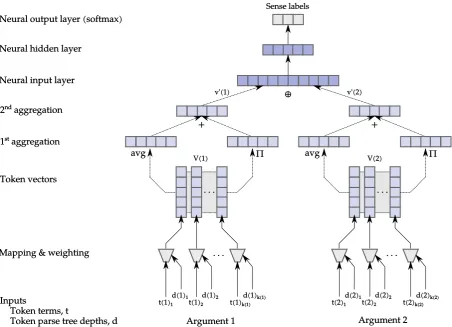
Improving upon the compositional representa-tion produced by Equarepresenta-tion 1, we incorporate addi-tional syntactic dependency information: for each token in an argument span, we calculate the depth
dfrom the corresponding sentence’s root node and weight the token vector by 1
2d before applying the
5We found window size of 8 and min term count= 3to
be optimal. Neural networks were trained using thegensim package:http://radimrehurek.com/gensim/.
6We ignore unknown tokens for which no vectors exist. 7 In our experiments, Equation 1 outperformed simpler
Figure 1: The feature construction process from argument spans (light blue) and neural architecture (dark blue) for implicit sense classification (incl.EntRel) . Dotted lines represent pointwise vector operations.
aggregating operators.8
The bottom of Figure 1 illustrates the first step of the process, i.e. mapping tokens to their corre-sponding vectors based on the updated word vec-tor model, as well as the token depth weighting. Secondly, the aggregation operators are applied, i.e., the sum (+) of the pointwise product (Q/) and average (avg) of the vectors. Finally, the com-positional vectors for each of the arguments are concatenated (⊕) and serve as input to a feedfor-ward neural network.
Given the composed argument vectors, we set up a network with one hidden layer and a softmax output layer to classify among 20 implicit senses for English and 9 for Chinese, plus an additional
EntRellabel. Other relations, such asAltLex, are not modeled. We train the network using Nes-terov’s Accelerated Gradient (Nesterov, 1983) and optimized all hyper-parameters on the develop-ment set. Best results were achieved withrectified linear activation with learnable leak rate and gain
8Tokens that are missing in the parse tree, such as
punctu-ation symbols, are weighted by 0.25, in our optimal setting.
(lgrelu), 40-60 hidden nodes and weight decay and hidden node regularization of 0.0001.9
4 The Competition Tasks & Pipelines
We participate in the closed track of the shared task, specifically in both full and supplementary tasks (sense-only) on English and Chinese texts. Full tasks require a participant’s system to iden-tify argument pairs and to label the sense relation that holds between them. In each supplementary task, gold arguments are provided so that the per-formance of sense labeling does not suffer from error propagation due to incorrectly detected ar-gument spans.
We combine different existent modules to ad-dress the specific settings and classification needs of both full and supplementary tasks for both
lan-9The learning rate was set to 0.0001. Momentum of
guages. The modules and their combination with our implicit neural sense classifier will be outlined in the following sections.
4.1 English Full Task Pipeline (EFTP)
For the full task, we exploit the high-quality argument extraction modules of the two best-performing systems by Wang and Lan (2015, W&L) and Stepanov et al. (2015) from last year’s competition (re-using their original implementa-tions): Specifically, we initially run both systems for allexplicit relations only, and keep those pre-dicted arguments and sense labels – from either of the two systems – which maximize F1-score
on the development set. With this simple heuris-tic, we hope to improve upon the best results from W&L, as, for instance, Stepanov et al. (2015) per-form particularly well on all temporal relations, while W&L’s tool handles the majority of other senses well.
For all implicit and EntRel relations, we keep the exact argument spans obtained from the W&L system and reject all sense labels. In a second step, we re-classify all these implicit relations by our neural net-based architecture described in Section 3 given only the tokens and their dependencies in both argument spans. Finally, we merge all com-bined explicit and re-classified implicit relations into the final set for evaluation.
4.2 English Supplementary Task Pipeline (ESTP)
We make use of the system by Stepanov et al. (2015) to label all explicit relation senses, and classify all other relations with an empty token list for connectors (i.e., implicit and EntRels) by our neural network architecture from Section 3.
4.3 Chinese Full Task Pipeline (CFTP)
Since for the Chinese full task no reusable argu-ment extraction tools were available, we have set up a minimalist (baseline) implementation whose individual steps we sketch briefly:
1. Connective detectionis realized by means of a sequence labeling/CRF model.10Features are
unigram and bigram information from the to-kens, their parts-of-speech, dependency head, dependency chain, whether the token is found as a connector in the training set, and its relative position within the sentence.
10https://taku910.github.io/crfpp/
2. Argument extractionis based on the output of predicted connectives for both inter- and intra-sentence relations. As an additional feature, we found the IOB chain for the syntactic path of a token to be useful.11
3. We heuristicallypost-processthe CRF-labeled argument tokens in order to assign connectors to same-sentence or separate-sentence Arg1
andArg2spans.
4. The so-obtained explicit argument pairs are sense labeled by a (linear-kernel) SVM clas-sifier12 with the connector word as the only
feature, following the minimalist setting in Chiarcos and Schenk (2015).
5. As implicit relations we consider all inter-sentential relationswhich are not already part of an explicit relation. Same-sentence relations are ignored altogether.
4.4 Chinese Supplementary Task Pipeline (CSTP)
For the provided argument pairs, we label ex-plicitrelations (i.e. those containing a non-empty connector) by the SVM classifier which has been trained using only a single feature – the connec-tor token. For all other relations, we again em-ploy our neural network-based strategy described in Section 3. The overall architecture is exactly the same as for the English subtask; only the (hy-per)parameters have been updated in accordance with the Chinese training data.
5 Evaluation
5.1 English Full Task
Table 1 shows the performance of our full-task pipeline (EFTP) which integrates our novel feed-forward neural network architecture for implicit sense labeling. The figures suggest that our min-imalist approach is highly competitive and can even outperform the best results from last year’s competition in terms ofF1-scores on two out of
three evaluation sets (cf. lastimplicitcolumn). Overall, with the integration of the combined systems by W&L and Stepanov et al. (2015), we can improve upon the state-of-the-art by an abso-lute increase inF1-score of 0.5% on the blind test 11This information was generated using the script from
http://ilk.uvt.nl/team/sabine/chunklink/ chunklink_2-2-2000_for_conll.pl
12https://www.csie.ntu.edu.tw/˜cjlin/
set– which is marginal but only due to the fruit-ful re-classification of the already-provided (and therefore fixed) argument spans.
Measured on the development set, we found that the dependency depth weighting contributes to an absolute improvement in accuracy of 1.5% for non-explicit relations.
set system overall explicit implicit
dev W&LEFTP 37.8440.21 48.1650.87 28.7030.99
test W&LEFTP 29.6929.78 39.9640.44 20.7420.60
blind W&LEFTP 24.0024.47 30.3830.74 18.7819.63
Table 1: English full taskF1-scores.
5.2 English Supplementary Task
Without error propagation from argument identi-fication, and with the gold arguments provided in the evaluation sets, the performance of our implicit sense labeling component is even better; cf. Ta-ble 2: on both PDTB evaluation sets F1-scores
increase by 2.7% and 3.16% (absolute) and by 6.32% and up to 9.17% (relative) on the devel-opment and test section, respectively.
Strikingly, however, the prediction quality on the blind test set is worse than expected. We as-sume that this is partly due to the (slightly) het-erogeneous content of the annotatedWikinews, as opposed to the original Penn Discourse Treebank data on which our system performs extraordinarily well.
set system overall explicit implicit
dev W&LESTP 65.1166.90 90.0091.35 42.7245.42
test W&LESTP 61.2762.64 90.7990.13 34.4537.61
blind W&LESTP 54.7652.32 76.4476.40 36.2931.85
Table 2: English sense-only taskF1-scores.
5.3 Chinese Full Task
This year’s edition of the shared task has been the first to address shallow discourse parsing for Chinese Newswire texts. Given no prior (directly
comparable) results on Chinese SDP so far, we simply report the performance of our system on all evaluation sets in Table 3.
set system overall explicit implicit
dev CFTP 22.16 17.45 22.67
test CFTP 24.21 28.73 22.26
blind CFTP 12.90 18.56 10.80
Table 3: Chinese full taskF1-scores.
5.4 Chinese Supplementary Task
A final evaluation has been concerned with the sense-only labeling of gold-provided arguments for Chinese. We want to point out that the neural network architecture for implicit relations (with 70.59%F1-score on the dev set, cf. Table 4) has
beaten all our other experiments: In particular, we have conducted an SVM setup in which we employed the traditional word-pair features sub-stituted by Brown clusters 3200 (65.12%), and special additive Arg1/Arg2 combinations of word embeddings – yielding only 62.8% which equals the majority class baseline indicating no predictive power for any given kernel type.
set system overall explicit implicit
dev CSTP 75.72 96.10 70.59
test CSTP 77.01 96.34 71.87
blind CSTP 63.73 80.39 57.59
Table 4: Chinese sense-only taskF1-scores.
6 Conclusion
In the context of the CoNLL 2016 Shared Task on shallow discourse parsing, we have described our participating system and its architecture. Specif-ically, we introduced a novel feedforward neural network-based component for implicit sense la-beling whose only source of information are pre-trained word embeddings and syntactic dependen-cies. Its highly generic and extremely simple de-sign is the main advantage of this module. It has proven to be language-independent, easy to tune and optimize and does not require the use of hand-crafted – rich – linguistic features.
References
Yoshua Bengio, Aaron Courville, and Pascal Vincent. 2013. Representation Learning: A Review and New Perspectives. IEEE Trans. Pattern Anal. Mach. In-tell., 35(8):1798–1828, August.
Or Biran and Kathleen McKeown. 2013. Aggregated Word Pair Features for Implicit Discourse Relation Disambiguation. InProceedings of the 51st Annual Meeting of the Association for Computational Lin-guistics, ACL 2013, 4-9 August 2013, Sofia, Bul-garia, Volume 2: Short Papers, pages 69–73. Or Biran and Kathleen McKeown. 2015. PDTB
Dis-course Parsing as a Tagging Task: The Two Taggers Approach. InProceedings of the 16th Annual Meet-ing of the Special Interest Group on Discourse and Dialogue, pages 96–104, Prague, Czech Republic, September. Association for Computational Linguis-tics.
Christian Chiarcos and Niko Schenk. 2015. A Mini-malist Approach to Shallow Discourse Parsing and Implicit Relation Recognition. In Proceedings of the 19th Conference on Computational Natural Lan-guage Learning: Shared Task, CoNLL 2015, Bei-jing, China, July 30-31, 2015, pages 42–49. David A. duVerle and Helmut Prendinger. 2009. A
Novel Discourse Parser Based on Support Vector Machine Classification. InProceedings of the Joint Conference of the 47th Annual Meeting of the ACL and the 4th International Joint Conference on Nat-ural Language Processing of the AFNLP: Volume 2 - Volume 2, ACL ’09, pages 665–673, Stroudsburg, PA, USA. Association for Computational Linguis-tics.
Vanessa Wei Feng and Graeme Hirst. 2012. Text-level Discourse Parsing with Rich Linguistic Features. In
Proceedings of the 50th Annual Meeting of the Asso-ciation for Computational Linguistics: Long Papers - Volume 1, ACL ’12, pages 60–68, Stroudsburg, PA, USA. Association for Computational Linguistics.
Sucheta Ghosh, Giuseppe Riccardi, and Richard Jo-hansson. 2012. Global Features for Shallow Dis-course Parsing. In Proceedings of the 13th Annual Meeting of the Special Interest Group on Discourse and Dialogue (SIGDIAL), pages 150–159.
Hen-Hsen Huang and Hsin-Hsi Chen. 2011. Chinese Discourse Relation Recognition. InProceedings of 5th International Joint Conference on Natural Lan-guage Processing, pages 1442–1446, Chiang Mai, Thailand, November. Asian Federation of Natural Language Processing.
Yangfeng Ji and Jacob Eisenstein. 2014. Representa-tion Learning for Text-level Discourse Parsing. In
Proceedings of the 52nd Annual Meeting of the As-sociation for Computational Linguistics (Volume 1: Long Papers), pages 13–24, Baltimore, Maryland, June. Association for Computational Linguistics.
Fang Kong, Tou Hwee Ng, and Guodong Zhou. 2014. A Constituent-Based Approach to Argument La-beling with Joint Inference in Discourse Parsing. In Proceedings of the 2014 Conference on Em-pirical Methods in Natural Language Processing (EMNLP), pages 68–77. Association for Computa-tional Linguistics.
Alex Lascarides and Nicholas Asher. 1993. Tem-poral Interpretation, Discourse Relations and Com-monsense entailment. Linguistics and Philosophy, 16(5):437–493.
Jiwei Li, Rumeng Li, and Eduard Hovy. 2014. Re-cursive Deep Models for Discourse Parsing. In Pro-ceedings of the 2014 Conference on Empirical Meth-ods in Natural Language Processing (EMNLP), pages 2061–2069, Doha, Qatar, October. Associa-tion for ComputaAssocia-tional Linguistics.
Ziheng Lin, Min-Yen Kan, and Hwee Tou Ng. 2009. Recognizing Implicit Discourse Relations in the Penn Discourse Treebank. In Proceedings of the 2009 Conference on Empirical Methods in Nat-ural Language Processing: Volume 1 - Volume 1, EMNLP ’09, pages 343–351, Stroudsburg, PA, USA. Association for Computational Linguistics.
Ziheng Lin, Hwee Tou Ng, and Min-Yen Kan. 2014. A PDTB-styled end-to-end discourse parser. Natural Language Engineering, 20:151–184, 4.
Yang Liu, Sujian Li, Xiaodong Zhang, and Zhifang Sui. 2016. Implicit Discourse Relation Classi-fication via Multi-Task Neural Networks. CoRR, abs/1603.02776.
William C. Mann and Sandra A. Thompson. 1988. Rhetorical structure theory: Toward a functional the-ory of text organization. Text, 8(3):243–281.
Daniel Marcu and Abdessamad Echihabi. 2002. An Unsupervised Approach to Recognizing Discourse Relations. InProceedings of the 40th Annual Meet-ing on Association for Computational LMeet-inguistics, ACL ’02, pages 368–375, Stroudsburg, PA, USA. Association for Computational Linguistics.
Tomas Mikolov, Kai Chen, Greg Corrado, and Jeffrey Dean. 2013. Efficient Estimation of Word Repre-sentations in Vector Space. InProceedings of Work-shop at International Conference on Learning Rep-resentations.
Jeff Mitchell and Mirella Lapata. 2008. Vector-based Models of Semantic Composition. InProceedings of Association for Computational Linguistics, pages 236–244.
Tsuyoshi Okita, Longyue Wang, and Qun Liu. 2015. The DCU Discourse Parser: A Sense Classifica-tion Task. InProceedings of the Nineteenth Confer-ence on Computational Natural Language Learning - Shared Task, pages 71–77, Beijing, China, July. Association for Computational Linguistics.
Joonsuk Park and Claire Cardie. 2012. Improving Implicit Discourse Relation Recognition Through Feature Set Optimization. In Proceedings of the 13th Annual Meeting of the Special Interest Group on Discourse and Dialogue, page 108–112, Seoul, South Korea, July. Association for Computational Linguistics, Association for Computational Linguis-tics.
Emily Pitler and Ani Nenkova. 2009. Using Syntax to Disambiguate Explicit Discourse Connectives in Text. InACL 2009, Proceedings of the 47th Annual Meeting of the Association for Computational Lin-guistics and the 4th International Joint Conference on Natural Language Processing of the AFNLP, 2-7 August 2009, Singapore, Short Papers, pages 13–16.
Emily Pitler, Annie Louis, and Ani Nenkova. 2009. Automatic Sense Prediction for Implicit Discourse Relations in Text. InProceedings of the Joint Con-ference of the 47th Annual Meeting of the ACL and the 4th International Joint Conference on Natural Language Processing of the AFNLP: Volume 2 - Vol-ume 2, ACL ’09, pages 683–691, Stroudsburg, PA, USA. Association for Computational Linguistics.
Martin Potthast, Tim Gollub, Francisco Rangel, Paolo Rosso, Efstathios Stamatatos, and Benno Stein. 2014. Improving the Reproducibility of PAN’s Shared Tasks: Plagiarism Detection, Author Iden-tification, and Author Profiling. In Evangelos Kanoulas, Mihai Lupu, Paul Clough, Mark Sander-son, Mark Hall, Allan Hanbury, and Elaine Toms, editors, Information Access Evaluation meets Mul-tilinguality, Multimodality, and Visualization. 5th International Conference of the CLEF Initiative (CLEF 14), pages 268–299, Berlin Heidelberg New York, September. Springer.
Rashmi Prasad, Nikhil Dinesh, Alan Lee, Eleni Milt-sakaki, Livio Robaldo, Aravind Joshi, and Bonnie Webber. 2008. The Penn Discourse TreeBank 2.0. InIn Proceedings of LREC.
Attapol Rutherford and Nianwen Xue. 2014. Discov-ering Implicit Discourse Relations Through Brown Cluster Pair Representation and Coreference Pat-terns. InProceedings of the 14th Conference of the European Chapter of the Association for Computa-tional Linguistics, pages 645–654. Association for Computational Linguistics.
Richard Socher, Alex Perelygin, Jean Wu, Jason Chuang, Christopher D. Manning, Andrew Y. Ng, and Christopher Potts. 2013. Recursive Deep Mod-els for Semantic Compositionality Over a Sentiment Treebank. In Proceedings of the 2013 Conference
on Empirical Methods in Natural Language Pro-cessing, pages 1631–1642, Stroudsburg, PA, Octo-ber. Association for Computational Linguistics.
Evgeny Stepanov, Giuseppe Riccardi, and Orkan Ali Bayer. 2015. The UniTN Discourse Parser in CoNLL 2015 Shared Task: Token-level Sequence Labeling with Argument-specific Models. In Pro-ceedings of the Nineteenth Conference on Compu-tational Natural Language Learning - Shared Task, pages 25–31. Association for Computational Lin-guistics.
Jianxiang Wang and Man Lan. 2015. A Refined End-to-End Discourse Parser. In Proceedings of the Nineteenth Conference on Computational Natu-ral Language Learning - Shared Task, pages 17–24. Association for Computational Linguistics.
Longyue Wang, Chris Hokamp, Tsuyoshi Okita, Xiao-jun Zhang, and Qun Liu. 2015. The DCU Discourse Parser for Connective, Argument Identification and Explicit Sense Classification. InProceedings of the Nineteenth Conference on Computational Natural Language Learning - Shared Task, pages 89–94. As-sociation for Computational Linguistics.
Bonnie L. Webber. 2004. D-LTAG: extending lex-icalized TAG to discourse. Cognitive Science, 28(5):751–779.
Gregor Weiss. 2015. Learning Representations for Text-level Discourse Parsing. In Proceedings of the ACL-IJCNLP 2015 Student Research Workshop, pages 16–21, Beijing, China, July. Association for Computational Linguistics.
Nianwen Xue, Hwee Tou Ng, Sameer Pradhan, Rashmi Prasad, Christopher Bryant, and Attapol Rutherford. 2015. The CoNLL-2015 Shared Task on Shallow Discourse Parsing. In Proceedings of the Nine-teenth Conference on Computational Natural Lan-guage Learning: Shared Task, Beijing, China.
Nianwen Xue, Hwee Tou Ng, Sameer Pradhan, Bon-nie Webber, Attapol Rutherford, Chuan Wang, and Hongmin Wang. 2016. The CoNLL-2016 Shared Task on Shallow Discourse Parsing. InProceedings of the Twentieth Conference on Computational Nat-ural Language Learning - Shared Task, Berlin, Ger-many, August. Association for Computational Lin-guistics.
Biao Zhang, Jinsong Su, Deyi Xiong, Yaojie Lu, Hong Duan, and Junfeng Yao. 2015. Shallow Convolu-tional Neural Network for Implicit Discourse Re-lation Recognition. In Proceedings of the 2015 Conference on Empirical Methods in Natural Lan-guage Processing, EMNLP 2015, Lisbon, Portugal, September 17-21, 2015, pages 2230–2235.
for Computational Linguistics (Volume 1: Long Pa-pers), pages 69–77, Jeju Island, Korea, July. Associ-ation for ComputAssoci-ational Linguistics.