7
Tracking Discrete and Continuous Entity State for
Process Understanding
Aditya Gupta and Greg Durrett
Department of Computer Science The University of Texas at Austin
{agupta,gdurrett}@cs.utexas.edu
Abstract
Procedural text, which describes entities and their interactions as they undergo some pro-cess, depicts entities in a uniquely nuanced way. First, each entity may have some ob-servable discrete attributes, such as its state or location; modeling these involves impos-ing global structure and enforcimpos-ing consistency. Second, an entity may have properties which are not made explicit but can be effectively in-duced and tracked by neural networks. In this paper, we propose a structured neural archi-tecture that reflects this dual nature of entity evolution. The model tracks each entity recur-rently, updating its hidden continuous repre-sentation at each step to contain relevant state information. The global discrete state struc-ture is explicitly modelled with a neural CRF over the changing hidden representation of the entity. This CRF can explicitly capture con-straints on entity states over time, enforcing that, for example, an entity cannot move to a location after it is destroyed. We evaluate the performance of our proposed model on QA tasks over process paragraphs in the PROPARA dataset (Dalvi et al.,2018) and find that our model achieves state-of-the-art results.
1 Introduction
Many reading comprehension question answering tasks (Richardson et al., 2013; Rajpurkar et al.,
2016;Joshi et al.,2017) require looking at primar-ily one point in the passage to answer each ques-tion, or sometimes two or three (Yang et al.,2018;
Welbl et al.,2018). As a result, modeling
surface-level correspondences can work well (Seo et al.,
2017) and holistic passage comprehension is not
necessary. However, certain QA settings require deeper analysis by focusing specifically on enti-ties, asking questions about their states over time (Weston et al.,2015;Long et al.,2016),
combina-tion in recipes (Bosselut et al.,2018), and partic-ipation in scientific processes (Dalvi et al.,2018). These settings then suggest more highly structured models as a way of dealing with the more highly structured tasks. One crucial aspect of such texts is the way an entity’s state evolves with both discrete (observable state and location changes) and con-tinuous (changes in unobserved hidden attributes) phenomena going on. Additionally, the discrete changes unfold in a way that maintains the state
consistency: an entity can not bedestroyedbefore
it even starts toexist.
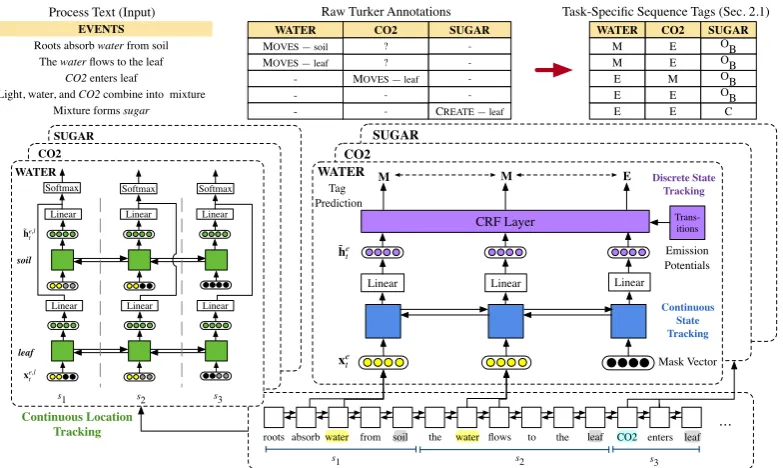
In this work, we present a model which both re-currently tracks the entity in a continuous space while imposing discrete constraints using a condi-tional random field (CRF). We focus on the sci-entific process understanding setting introduced in
Dalvi et al.(2018). For each entity, we instantiate a sentence-level LSTM to distill continuous state information from each of that entity’s mentions. Separate LSTMs integrate entity-location infor-mation into this process. These continuous com-ponents then produce potentials for a sequential CRF tagging layer, which predicts discrete entity states. The CRF’s problem-specific tag scheme, along with transition constraints, ensures that the model’s predictions of these observed entity prop-erties are structurally coherent. For example, in procedural texts, this involves ensuring existence before destruction and unique creation and de-struction points. Because we use global inference, identifying implicit event creation or destruction is made easier, since the model resolves conflicts among competing time steps and chooses the best time step for these events during sequence predic-tion.
syn-roots absorb water from soil the water flows to Linear
leaf
the CO2 enters leaf Mask Vector Linear Linear
Emission Potentials
Trans-itions
Tag Prediction
M M E
WATER CO2
CRF Layer
-
-MOVES — soil
-SUGAR
MOVES — leaf
MOVES — leaf
-CO2 WATER
-CREATE — leaf
-?
-?
-WATER
soil
leaf
s1 s2 s3
Linear Linear
Linear Linear Linear Softmax Softmax
Linear
Softmax Discrete State Tracking
Continuous State Tracking
Continuous Location Tracking
˜
he t
xe t xe,l
t
˜
he,l t
s1 s2 s3
CO2
C E
OB WATER
E E
OB M
SUGAR
OB E E
E
E OB
M M
SUGAR
Raw Turker Annotations Task-Specific Sequence Tags (Sec. 2.1)
…
SUGAR CO2
The water flows to the leaf Roots absorb water from soil
CO2 enters leaf
Light, water, and CO2 combine into mixture Mixture forms sugar
EVENTS
[image:2.595.107.499.62.296.2]Process Text (Input)
Figure 1: Task and our proposed model. Top: raw text descriptions are annotated with entity-state change informa-tion; we modify this in a rule-based way for our model. Bottom: our model. Entity mention and verb information is aggregated in per-entity LSTMs (right). A CRF layer then predicts entity state. A separate sentence-level LSTM (left) tracks each entity-location pair using the combined entity and location mention information.
thetic (Weston et al.,2015), or continuous entity-centric neural language models (Clark et al.,2018;
Ji et al.,2017). For process understanding specifi-cally, past work has effectively captured global in-formation (Dalvi et al., 2018) and temporal char-acteristics (Das et al.,2019). However, these mod-els do not leverage the structure constraints of the
problem, or only handle them heuristically (
Tan-don et al., 2018). We find that our model
out-performs these past approaches on the PROPARA
dataset of Dalvi et al. (2018) with a significant boost in questions concerning entity state, regard-less of the location.
2 Model
We propose a structured neural model for the
pro-cess paragraph comprehension task ofDalvi et al.
(2018). An example from their dataset is shown in Figure1. It consists of annotation over a process paragraphw={wi}Pi=1ofP tokens described by a sequence of T sentences s = {st}Tt=1. A pre-specified set of entitiesE = {ek}m
k=1 is given as well. For each entity, gold annotation is provided consisting of the state (EXISTS, MOVES, etc.) and location (soil,leaf) after each sentence. From this information, a set of questions about the process can be answered deterministically as outlined in
Tandon et al.(2018).
Our model, as depicted in Fig. 1, consists of
two core modules: (i) state tracking, and (ii) lo-cation tracking. We follow past work on neural CRFs (Collobert et al., 2011; Durrett and Klein,
2015;Lample et al.,2016), leveraging continuous LSTMs to distill information and a discrete CRF layer for prediction.
2.1 State Tracking
This part of the model is charged with modeling each entity’s state over time. Our model places a distribution over state sequencesygiven a passage
wand an entitye:P(y|w, e).
Contextual Embeddings Our model first com-putes contextual embeddings for each word in the paragraph using a single layered bidirectional
LSTM. Each token wordwi is encoded as a
vec-tor xi = [emb(wi);vi]which serves as input to
the LSTM. Here, emb(wi) ∈ Rd1 is an
embed-ding for the word produced by either pre-trained GloVe (Pennington et al.,2014) or ELMo (Peters et al.,2018) embeddings andvi is a scalar binary indicator if the current word is a verb. We denote byhi = LSTM([xi])the LSTM’s output for the
ith token inw.
specific bidirectional LSTM on top of the base LSTM which operates at the sentence level. The aim of this BiLSTM is to get a continuous rep-resentation of the entity’s state at each time step, since not all time steps mention that entity. This representation can capture long-range information about the entity’s state which may not be summa-rized in the discrete representation.
For a fixed entityeand each sentencestin the paragraph, the input to the entity tracking LSTM
is the contextual embedding of themention
loca-tion1 of the entityeinst, or a mask vector when the entity isn’t present in st. Let xet denote the representation of entityein sentencet. Then
xet =
[het;hvt], ife∈st
zero vector, otherwise (1)
where het and hvt denote the contextual
embed-dings of the entity and the associated verb, respec-tively, from the base BiLSTM. In case of multiple tokens, a mean pooling over the token represen-tations is used. Here, the information about verb is extracted using POS tags from an off-the-shelf POS tagger. The entity tracking LSTM then pro-duces representationsehet = LSTM([xet]).
Neural CRF We use the output of the entity tracking BiLSTM to generate emission potentials for each tag in our possible tag set at each time stept:
φ(yt, t,w, e) =WyTthe
e
t (2)
whereWis a learnable parameter matrix. For the
specific case of entity tracking, we propose a 6 tag scheme where the tags are as follows:
Tags Description
OB, OA None state before and after existence, resp.
C, D Creation and destruction event for entity, resp.
E Exists in the process without any state change
M Entity moves fromlocatolocb
Table 1: Proposed tag scheme for the neural CRF based model for entity tracking.
Additionally, we train a transition matrix to get transition potentials between tags which we de-note byψ(yi−1, yi)and two extra tags:hSTARTi
andhSTOPi. Finally, for a tag sequencey, we
1We use
mentionlocation to differentiate these from the physical entity locations present in this QA domain.
get the probability as:
P(y|w, e)∝exp
XT
i=0
φi(yi,w, e) +ψ(yi−1, yi)
(3)
2.2 Location Tracking
To complement entity’s state changes with the change in physical location of the entity, we use a separate recurrent module to predict the
loca-tions. Given a set of potential locations L =
(l1, l2, . . . , ln), where eachlj ∈Lis a continuous span inw, the location predictor outputs a distri-bution for a passagewand entitye, at a given time steptasP(l|w, e, t).
Identifying potential locations Instead of con-sidering all the spans of text as candidates for po-tential locations, we systematically reduce the set of locations by utilizing the part of speech (POS) tags of the tokens, whereby extracting all the max-imalnounandnoun + adjectivespans as potential physical location spans. Thus, using an off-the-shelf POS tagger, we get a setL= (l1, l2, . . . , ln) of potential locations for eachw. These heuristics lead to a85%recall classifier for locations which are not null or unk.2
Location Tracking LSTM For a given location
l and an entity e, we take the mean of the
hid-den representations of tokens in the span oflinst (or else a mask vector) analogous to the input for entity state tracking LSTM, concatenating it with the mention location of the entityeinst, as input for time-steptfor the tracking this entity-location pair withhee,lt = LSTM
[xe,lt ]
. Fig. 1 shows
an example where we instantiate location tracking LSTMs for each pair of entityeand potential
loca-tionl. In the example,e∈ {water, CO2, sugar}
andl∈ {soil, leaf}.
Softmax over Location Potentials The output of the location tracking LSTM is then used to
gen-erate potentials by for each entity eand location
l pair for a time stept. Taking softmax over the
potentials gives us a probability distribution over the locationslat that time steptfor that entitye: pe,lt = softmax(wlocT eh
e,l t )
2Major non-matching cases include long phrases like
Model Task-1 Task-2
Cat-1 Cat-2 Cat-3 Macro-Avg Micro-Avg Precision Recall F1
EntNet (Henaff et al.,2017) 51.62 18.83 7.77 26.07 25.96 50.2 33.5 40.2
QRN (Seo et al.,2017) 52.37 15.51 10.92 26.26 26.49 55.5 31.3 40.0
ProGlobal (Dalvi et al.,2018) 62.95 36.39 35.90 45.08 45.37 46.7 52.4 49.4
ProStruct (Tandon et al.,2018) - - - 74.2 42.1 53.75
KG-MRC (Das et al.,2019) 62.86 40.00 38.23 47.03 46.62 64.52 50.68 56.77
This work: NCET 70.55 44.57 41.34 52.15 52.31 64.2 53.9 58.6
[image:4.595.76.524.64.175.2]This work: NCET + ELMo 73.68 47.09 41.03 53.93 53.97 67.1 58.5 62.5
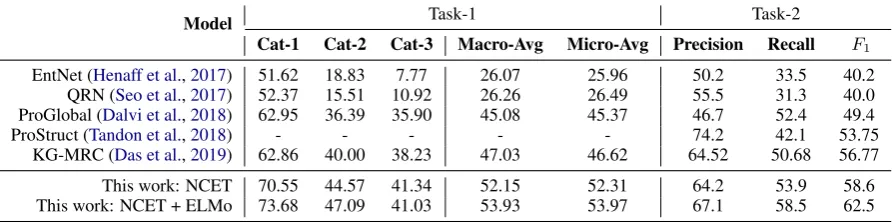
Table 2: Results on the sentence-level (Task-1) and document-level (Task-2) evaluation task of the PROPARA dataset on the test set. Our proposed CRF-based model achieves state of the art results on both the tasks compared to the previous work in (Das et al.,2019). Incorporating ELMo further improves the performance for the state tracking module, as we see from the gains in Cat-1 and Cat-2.
2.3 Learning and Inference
The full model is trained end-to-end by minimiz-ing the negative log likelihood of the gold state tag sequence for each entity and process paragraph pair. The location predictor is only trained to make predictions when the gold location is defined for that entity in the dataset (i.e., the entity exists).
At inference time, we perform a global state change inference coupled with location prediction in a pipelined fashion. First, we use the state track-ing module of the proposed model to predict the state change sequence with the maximum score using Viterbi decoding. Subsequently, we predict
locations where the predicted tag is eithercreate
ormove, which is sufficient to identify the object’s location at all times since these are the only points where it can change.
3 Experiments
We evaluate the performance of the proposed model on the two comprehension tasks of the PROPARAdataset (Dalvi et al.,2018). This dataset consists of 488 crowdsourced real world process paragraphs about 183 distinct topics in the science genre. The names of the participating entities and their existence spans are identified by expert an-notators. Finally, crowd workers label locations of participant entities at each time step (sentence). The final data consists of 3.3k sentence with an av-erage of 6.7 sentences and 4.17 entities per process paragraph. We compare our model, the Neural CRF Entity Tracking (NCET) model, with bench-mark systems from past work.
3.1 Task 1: Sentence Level
This comprehension task concerns answering 10 fine grained sentence level templated questions
grouped into three categories: (Cat-1) Is e
Cre-ated (Moved, Destroyed) in the process (yes/no for
each)? (Cat-2) When waseCreated (Moved,
De-stroyed)? (Cat-3) Where waseCreated, (Moved
from/to, Destroyed)? The ground truth for these questions were extracted by the application of sim-ple rules to the annotated location state data. Note that Cat-1 and Cat-2 can be answered from our state-tracking model alone, and only Cat-3 in-volves location.
As shown in Table 2, our model using GloVe
achieves state of the art performance on the test set. The performance gain is attributed to the gains in Cat-1 and Cat-2 (7.69% and4.57%absolute), owing to the structural constraints imposed by the CRF layer. The gain in Cat-3 is relatively lower as it is the only sub-task involving location tracking. Additionally, using the frozen ELMo embedding the performance further improves with major im-provements in Cat-1 and Cat-2.
3.2 Task 2: Document Level
The document level evaluation tries to capture a
more global context where the templated3
ques-tions set forth concern about the whole paragraph structure: (i) What are the inputs to the process?
(ii) What are the outputs of the process? (iii)
What conversions occur, when and where? (iv)
What movements occur, when and where? Table2
shows the performance of the model on this task.
We achieve state of the art results with a F1 of
58.6.
3
Model C-1 C-2 C-3 Mac. Mic.
NCET 72.27 46.08 40.82 53.06 53.13
Tag Set 1 71.53 41.89 41.42 51.61 51.94
Tag Set 2 71.97 41.85 39.71 51.18 51.43
No trans. 71.68 44.22 40.38 52.09 52.24
No verb 73.16 42.58 41.85 52.53 52.85
Attn. 61.69 22.80 36.44 40.31 41.38
Table 3: Ablation studies for the proposed architecture.
3.3 Model Ablations
We now examine the performance of the model by comparing its variants along two different dimen-sions: (i) modifying the structural constraints for the CRF layer, and (ii) making changes to the con-tinuous entity tracking.
Discrete Structural Constraints We
experi-ment with two new tag schemes: (i)tag1 :OA =
OB, and (ii) tag2 : OA = E = OB. As shown
in Table3, the proposed 6 tag scheme outperforms
the simpler tag schemes indicating that the model is able to gain more from a better structural anno-tation. Additionally, we experiment with remov-ing the transition features from our CRF layer, though we still use structural constraints. Taken together, these results show that carefully captur-ing the domain constraints in how entities change over time is an important factor in our model.
Continuous Entity Tracking To evaluate the importance of different modules in our continu-ous entity tracking model, we experiment with (i) removing the verb information, and (ii) taking attention-based input for the entity tracking LSTM instead of the entity-mention information. This way instead of giving a hard attention by focus-ing exactly on the entity, we let the model learn soft attention across the tokens for each time-step. The model can now learn to look anywhere in a sentence for entity information, but is not given prior knowledge of how to do so. As shown, using attention-based input for entity tracking performs substantially worse, indicating the structural im-portance of passing the mask vector.
4 Conclusion
In this paper, we present a structured architecture for entity tracking which leverages both the dis-crete and continuous characterization of the en-tity evolution. We use a neural CRF approach to
model our discrete constraints while tracking enti-ties and locations recurrently. Our model achieves state of the art results on the PROPARAdataset.
Acknowledgments
This work was partially supported by NSF Grant IIS-1814522, NSF Grant SHF-1762299, a Bloomberg Data Science Grant, and an equipment grant from NVIDIA. The authors acknowledge the Texas Advanced Computing Center (TACC) at The University of Texas at Austin for provid-ing HPC resources used to conduct this research. Thanks to the anonymous reviewers for their help-ful comments.
References
Antoine Bosselut, Corin Ennis, Omer Levy, Ari Holtz-man, Dieter Fox, and Yejin Choi. 2018. Simulating Action Dynamics with Neural Process Networks. In Proceedings of the International Conference on Learning Representations (ICLR).
Elizabeth Clark, Yangfeng Ji, and Noah A. Smith. 2018. Neural Text Generation in Stories Using En-tity Representations as Context. In Proceedings of the 2018 Conference of the North American Chap-ter of the Association for Computational Linguistics (ACL): Human Language Technologies.
Ronan Collobert, Jason Weston, L´eon Bottou, Michael Karlen, Koray Kavukcuoglu, and Pavel Kuksa. 2011. Natural Language Processing (Almost) from Scratch. Journal of Machine Learning Research, 12(Aug):2493–2537.
Bhavana Dalvi, Lifu Huang, Niket Tandon, Wen-tau Yih, and Peter Clark. 2018. Tracking State Changes in Procedural Text: a Challenge Dataset and Models for Process Paragraph Comprehension. In Proceed-ings of the Conference of the North American Chap-ter of the Association for Computational Linguistics (NAACL): Human Language Technologies.
Rajarshi Das, Tsendsuren Munkhdalai, Xingdi Yuan, Adam Trischler, and Andrew McCallum. 2019. Building Dynamic Knowledge Graphs from Text us-ing Machine Readus-ing Comprehension. In Proceed-ings of the International Conference on Learning Representations (ICLR).
Greg Durrett and Dan Klein. 2015. Neural CRF Pars-ing. In Proceedings of the 53rd Annual Meeting of the Association for Computational Linguistics (ACL) and the 7th International Joint Conference on Natural Language Processing.
State with Recurrent Entity Networks. In Proceed-ings of the International Conference on Learning Representations (ICLR).
Yangfeng Ji, Chenhao Tan, Sebastian Martschat, Yejin Choi, and Noah A. Smith. 2017. Dynamic Entity Representations in Neural Language Models. In
Proceedings of the 2017 Conference on Empirical Methods in Natural Language Processing.
Mandar Joshi, Eunsol Choi, Daniel Weld, and Luke Zettlemoyer. 2017. TriviaQA: A Large Scale Dis-tantly Supervised Challenge Dataset for Reading Comprehension. InProceedings of the 55th Annual Meeting of the Association for Computational Lin-guistics (ACL).
Guillaume Lample, Miguel Ballesteros, Sandeep Sub-ramanian, Kazuya Kawakami, and Chris Dyer. 2016. Neural Architectures for Named Entity Recognition. InProceedings of the Conference of the North Amer-ican Chapter of the Association for Computational Linguistics (NAACL): Human Language Technolo-gies.
Reginald Long, Panupong Pasupat, and Percy Liang. 2016. Simpler Context-Dependent Logical Forms via Model Projections. In Proceedings of the 54th Annual Meeting of the Association for Computa-tional Linguistics (ACL).
Jeffrey Pennington, Richard Socher, and Christopher Manning. 2014. GloVe: Global Vectors for Word Representation. In Proceedings of the Conference on Empirical Methods in Natural Language Pro-cessing (EMNLP).
Matthew Peters, Mark Neumann, Mohit Iyyer, Matt Gardner, Christopher Clark, Kenton Lee, and Luke Zettlemoyer. 2018. Deep Contextualized Word Rep-resentations. In Proceedings of the Conference of the North American Chapter of the Association for Computational Linguistics (NAACL): Human Lan-guage Technologies.
Pranav Rajpurkar, Jian Zhang, Konstantin Lopyrev, and Percy Liang. 2016. SQuAD: 100,000+ Questions for Machine Comprehension of Text. In Proceed-ings of the Conference on Empirical Methods in Nat-ural Language Processing (EMNLP).
Matthew Richardson, Christopher J.C. Burges, and Erin Renshaw. 2013. MCTest: A Challenge Dataset for the Open-Domain Machine Comprehension of Text. In Proceedings of the Conference on Em-pirical Methods in Natural Language Processing (EMNLP).
Minjoon Seo, Sewon Min, Ali Farhadi, and Hannaneh Hajishirzi. 2017. Query-Reduction Networks for Question Answering. In Proceedings of the Inter-national Conference on Learning Representations (ICLR).
Niket Tandon, Bhavana Dalvi, Joel Grus, Wen-tau Yih, Antoine Bosselut, and Peter Clark. 2018. Reasoning about Actions and State Changes by Injecting Com-monsense Knowledge. InProceedings of the Con-ference on Empirical Methods in Natural Language Processing (EMNLP).
Johannes Welbl, Pontus Stenetorp, and Sebastian Riedel. 2018. Constructing Datasets for Multi-hop Reading Comprehension Across Documents. In
Proceedings of the Transactions of the Association for Computational Linguistics (TACL).
Jason Weston, Antoine Bordes, Sumit Chopra, Alexan-der M Rush, Bart van Merri¨enboer, Armand Joulin, and Tomas Mikolov. 2015. Towards AI-Complete Question Answering: A Set of Prerequisite Toy Tasks. InarXiv preprint arXiv:1502.05698.