Original Article
Meta-analysis of the association between endometriosis
and polymorphisms in ACE and PAI-1
Luyang Zhao1*, Chenglei Gu1,2*, Yuanguang Meng1
1Department of Gynecology and Obstetrics, PLA Medical School, Chinese People’s Liberation Army General
Hos-pital, Beijing 100853, China; 2Department of Gynecology and Obstetrics, The 309th Hospital of Chinese People’s
Liberation Army, Beijing 100091, China. *Equal contributors.
Received January 13, 2016; Accepted May 6, 2016; Epub June 15, 2016; Published June 30, 2016
Abstract: Purpose: This meta-analysis aims to evaluate the associations between endometriosis risk and the poly-morphisms of 2350A/G, -240A/T, Alu insertion/deletion (I/D) in angiotensin I converting enzyme (ACE) gene and 4G/5G in plasminogen activator inhibitor-1 (PAI-1) gene. Methods: Studies published until November 2015 were searched in PubMed, EMBASE, ISI Web of Knowledge, China National Knowledge Infrastructure, and Chinese Bio-medical Literature Database. The Odds ratio (OR) and 95% confidence interval (CI) were estimated to assess the effect. Heterogeneity testing and sensitivity analysis were also performed. Results: A total of 11 studies with 1486 cases and 1598 controls were identified for final analysis. Three polymorphisms were significantly associated with the risk of endometriosis (ACE 2350A/G: G vs. A: OR = 2.66, 95% CI: 1.29-5.53, P = 0.008; ACE -240A/T: T vs. A: OR = 1.61, 95% CI: 1.04-2.48, P = 0.03; PAI-1 4G/5G: 4G vs. 5G: OR = 2.92, 95% CI: 1.13-7.55, P = 0.027). In the subgroup analysis by ethnicity, none of the three polymorphisms was associated with the risk of endometriosis among Caucasian populations. No association was observed between ACE I/D polymorphism and endometriosis. Conclusions: ACE 2350A/G, ACE -240A/T, and PAI-1 4G/5G polymorphisms may contribute to endometriosis risk. Further large-scale and well-designed studies should be conducted to validate these associations.
Keywords:Endometriosis, meta-analysis, angiotensin i converting enzyme, plasminogen activator inhibitor-1, polymorphism
Introduction
Endometriosis is characterized by the presence of endometrial tissue outside the uterine cavi-ty, mainly on the pelvic peritoneum, ovaries, and rectovaginal septum. Despite the high prevalence of endometriosis, its etiology and pathophysiology remain unclear [1]. Several theories have been proposed to explain the pathogenesis of this disease, among which Sampson’s retrograde menstruation theory is the most widely accepted. This theory suggests that endometrial cells implant into the perito-neum or pelvic organs via reflux through the fal-lopian tubes during menstruation [2]. However, retrograde spill of menstrual blood has been found in 76% of women undergoing laparosco-py during menstruation, whereas only a small percentage of women contract this specific dis-order [3]. This phenomenon indicates that some other factors may play a significant role in
the pathogenesis of endometriosis. Given that the endometrial debris needs to implant and grow in other tissues, the roles of tissue-remod-eling-related processes, such as angiogenesis and fibroblast proliferation, in the adhesion, invasion, and regression of endometriotic lesions have been stressed in recent studies [4, 5].
[8, 9]. The three most studied sites related to endometriosis are 2350 A/G (rs4343), -240 A/T (rs4291), and 287-bp Alu insertion/dele-tion (I/D) (rs1799752). To date, the results of these three variants in the pathogenesis of endometriosis remain controversial and no meta-analysis has been published.
Plasminogen activator inhibtor-1 (PAI-1), as an important element of fibrin formation and deg-radation, can inhibit the fibrinolytic activity of tissue-type plasminogen activator, produce active plasmin, and eventually degrade fibrin [10]. Evidence has also shown that abnormal fibrinolytic activity can make endometrial frag-ments adhere to and invade the surrounding tissue easily [11]. The guanosine (G) I/D poly-morphism located upstream of the start cod- on of PAI-1, which is named -675 4G/5G (rs- 1799768), is an important SNP that can influ-ence PAI-1 biosynthesis [12]. Several studies that focused on the relationship between endo-metriosis and -675 4G/5G polymorphism have been published; however, the outcomes are inconsistent.
The relatively small sample size and the inade-quate statistical power of a single research indicate that the results of association between polymorphisms of ACE 2350A/G, ACE-240A/T, ACE I/D, and PAI-1-675 4G/5G and endometrio-sis susceptibility may not strong and reliable. Considering the potential influences on these four polymorphisms and endometriosis risk, we performed a meta-analysis of 11 detailed arti-cles to further evaluate the association of ACE 2350 A/G, -240 A/T, I/D, and PAI-1 4G/5G with endometriosis susceptibility.
Materials and methods
Literature search
We systematically searched for relevant papers published before November 2015 in PubMed, Embase, ISI Web of Knowledge, CBM (Chinese Biomedical Literature Database), and CNKI (China National Knowledge Infrastructure) da- tabases. No restrictions on language, popula-tion, or sample size were set in this meta-anal-ysis. The search strategies were based on the combinations of the following keywords: (“angiotensin converting enzyme” or “ACE” or “plasminogen activator inhibitor” or “PAI” or “serpin peptidase inhibitor clade E” or “SER-
PINE1”) and (“polymorphism” or “variant” or “mutation”) and “endometriosis”. Additional rel-evant literatures were obtained from the refer-ence lists of the relevant articles.
Inclusion and exclusion criteria
Studies were included in this meta-analysis based on the following criteria: (1) full-text arti-cles; (2) original case-control or cohort study evaluating at least one of the ACE 2350A/G, ACE -240A/T, ACE I/D, and PAI-1 4G/5G linked with the risk of endometriosis; (3) sufficient data to estimate an odds ratio (OR) and 95% confidence interval (CI); (4) Chinese articles were published in Chinese core periodicals; and (5) no overlapping data. For the studies with the same authors, only those with the larg-est sample sizes or the most recent publication dates were selected to avoid overlapping patients and controls. Studies were excluded on the basis of the following criteria: (1) meta-analysis, letter, review, or editorial article; (2) study with no control case; (3) studies based on incomplete or sufficient data, such as deficien-cy of specific genotype distribution in cases and controls.
Data extraction
Two investigators (Luyang Zhao and Chenglei Gu) independently extracted useful data from each study. Discrepancies were resolved thro- ugh discussion. The following information was collected from each of the included studies: name of the first author, year of publication, country of origin, ethnicity of descent, number of subjects, genotype distribution in cases and controls, source of control, genotype method, outcomes, and probability (p) value for the Hardy-Weinberg equilibrium (HWE) test in con-trols. The authorship and sample sources were also checked to identify the existence of multi-ple publications from the same study.
Quality evaluation of the included studies
Statistical analysis
HWE was assessed in the control group by using χ2 test for goodness of fit, with P < 0.05
considered as a deviation. OR and 95% CI were used to assess the strengths of the associa-tions between polymorphisms of ACE and PAI-1 and the risk of endometriosis. Five models, namely allele model, dominant model, reces-sive model, homozygous model, and heterozy-gous model, were evaluated. The statistical sig-nificance (P < 0.05) of the pooled ORs was determined by Z-test. Heterogeneity was as- sessed by Q-test and quantified by I2 test. When
heterogeneity existed (P < 0.05 or I2 > 50%),
the random effects model (DerSimonian Laird method) was used; otherwise, the fixed effec- ts model (Mantel-Haenszel method) was em- ployed. Subgroup analyses stratified with HWE in controls (yes or no), ethnicity (Asian or Caucasian), and NOS quality score (high or low) were also evaluated in ACE 2350A/G, ACE -240A/T, and PAI-1 4G/5G polymorphisms. Sensitivity analysis was performed to assess the quality and stability of the results. All analy-ses were conducted by Stata 12.0 (Stata Corporation, College Station, TX, USA).
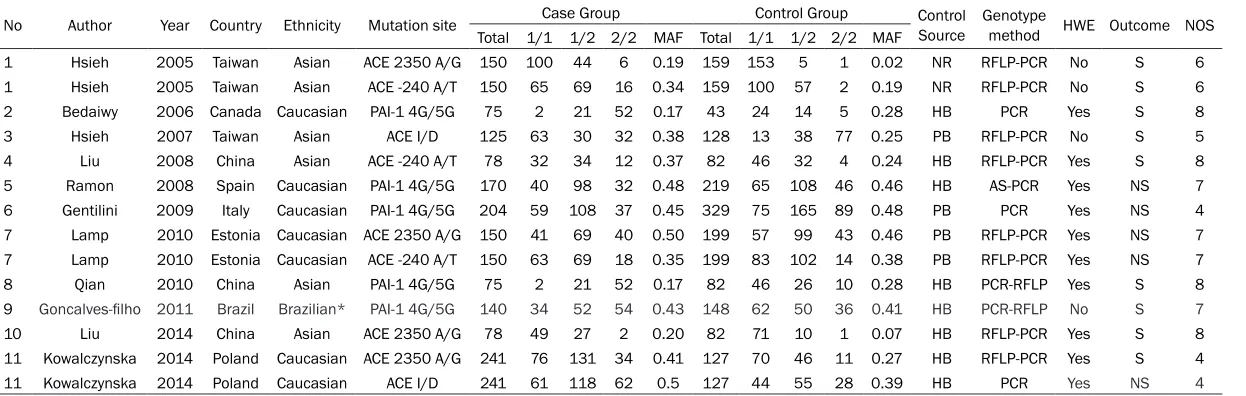
The publication year of the included studies ranged from 2005 to 2014. The surname of the first author, publication year, country, ethnicity, sample size, frequencies of various genotypes in patients and controls, minor allele frequency, control source, genotype method, HWE in con-trols, primary outcome, and NOS quality score for each study are listed in Table 1.
Quantitative data synthesis
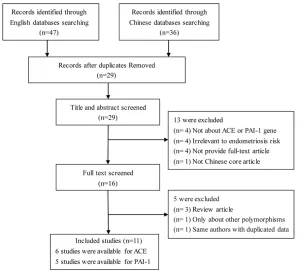
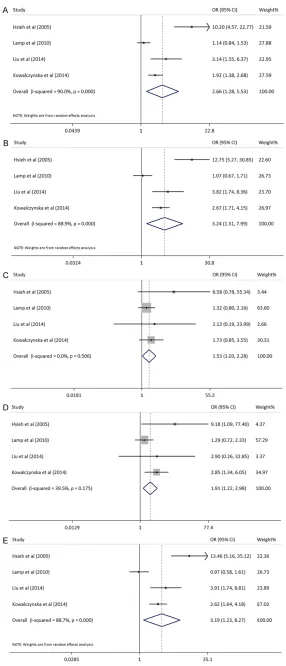
[image:3.612.90.391.71.342.2]Four studies [17, 23, 26, 27] with 619 cases and 567 controls assessed the association between ACE 2350A/G polymorphism and endometriosis susceptibility. The results indi-cated that ACE 2350A/G polymorphism is associated with endometriosis risk under all genetic models (allele model: OR = 2.66, 95% CI: 1.29-5.53, P = 0.008; dominant model: OR = 3.24, 95% CI: 1.31-7.99, P = 0.011; recessi- ve model: OR = 1.53, 95% CI: 1.03-2.28, P = 0.034; homozygous model: OR = 1.91, 95% CI: 1.22-2.98, P = 0.004; and heterozygous model: OR = 3.19, 95% CI: 1.23-8.27, P = 0.017; Figure 2). After excluding the study in which the geno-type distributions in the control groups deviat-ed from HWE, association was still observdeviat-ed Figure 1. Flow diagram of the study search and selection process.
Results
Characteristics of the included studies
Table 1. The main characteristics and quality of all eligible studies
No Author Year Country Ethnicity Mutation site Case Group Control Group Control Source Genotype method HWE Outcome NOS Total 1/1 1/2 2/2 MAF Total 1/1 1/2 2/2 MAF
1 Hsieh 2005 Taiwan Asian ACE 2350 A/G 150 100 44 6 0.19 159 153 5 1 0.02 NR RFLP-PCR No S 6
1 Hsieh 2005 Taiwan Asian ACE -240 A/T 150 65 69 16 0.34 159 100 57 2 0.19 NR RFLP-PCR No S 6
2 Bedaiwy 2006 Canada Caucasian PAI-1 4G/5G 75 2 21 52 0.17 43 24 14 5 0.28 HB PCR Yes S 8
3 Hsieh 2007 Taiwan Asian ACE I/D 125 63 30 32 0.38 128 13 38 77 0.25 PB RFLP-PCR No S 5
4 Liu 2008 China Asian ACE -240 A/T 78 32 34 12 0.37 82 46 32 4 0.24 HB RFLP-PCR Yes S 8
5 Ramon 2008 Spain Caucasian PAI-1 4G/5G 170 40 98 32 0.48 219 65 108 46 0.46 HB AS-PCR Yes NS 7
6 Gentilini 2009 Italy Caucasian PAI-1 4G/5G 204 59 108 37 0.45 329 75 165 89 0.48 PB PCR Yes NS 4
7 Lamp 2010 Estonia Caucasian ACE 2350 A/G 150 41 69 40 0.50 199 57 99 43 0.46 PB RFLP-PCR Yes NS 7 7 Lamp 2010 Estonia Caucasian ACE -240 A/T 150 63 69 18 0.35 199 83 102 14 0.38 PB RFLP-PCR Yes NS 7
8 Qian 2010 China Asian PAI-1 4G/5G 75 2 21 52 0.17 82 46 26 10 0.28 HB PCR-RFLP Yes S 8
9 Goncalves-filho 2011 Brazil Brazilian* PAI-1 4G/5G 140 34 52 54 0.43 148 62 50 36 0.41 HB PCR-RFLP No S 7
10 Liu 2014 China Asian ACE 2350 A/G 78 49 27 2 0.20 82 71 10 1 0.07 HB RFLP-PCR Yes S 8
11 Kowalczynska 2014 Poland Caucasian ACE 2350 A/G 241 76 131 34 0.41 127 70 46 11 0.27 HB RFLP-PCR Yes S 4
11 Kowalczynska 2014 Poland Caucasian ACE I/D 241 61 118 62 0.5 127 44 55 28 0.39 HB PCR Yes NS 4
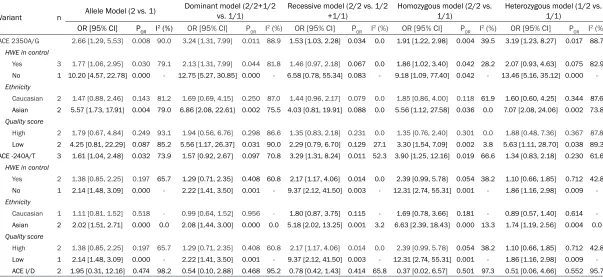
in the allele model (OR = 1.77, 95% CI: 1.06-2.95, P = 0.030), dominant model (OR = 2.13, 95% CI: 1.31-7.99, P = 0.044) and homozygous model (OR = 1.86, 95% CI: 1.02-3.40, P = 0.042). In the subgroup analyses, as- sociation was only observed among Asian group in the allele model (OR = 5.57, 95% CI: 1.73-17.91, P = 0.004), dominant model (OR =6.86, 95% CI: 2.08-22.61, P = 0.002), homozygous model (OR = 5.56, 95% CI: 1.12-27.58, P = 0.036) and heterozygous model (OR = 7.07, 95% CI: 2.08-24.06, P = 0.002). In addition, corre-lation was only found in the low NOS score group under the dominant model (OR = 5.56, 95% CI: 1.17-26.37, P = 0.031), homozygous model (OR = 3.30, 95% CI: 1.54-7.09, P = 0.002), and heterozygous model (OR =5.63, 95% CI: 1.11-28.7, P = 0.038). All these results are listed in Table 2.
[image:5.612.90.376.68.734.2]Table 2. Main results of the pooled data in the meta-analysis of ACE polymorphisms
Variant n Allele Model (2 vs. 1)
Dominant model (2/2+1/2
vs. 1/1) Recessive model (2/2 vs. 1/2 +1/1) Homozygous model (2/2 vs. 1/1) Heterozygous model (1/2 vs. 1/1) OR [95% CI] POR I2 (%) OR [95% CI] P
OR I2 (%) OR [95% CI] POR I2 (%) OR [95% CI] POR I2 (%) OR [95% CI] POR I2 (%) ACE 2350A/G 2.66 [1.29, 5.53] 0.008 90.0 3.24 [1.31, 7.99] 0.011 88.9 1.53 [1.03, 2.28] 0.034 0.0 1.91 [1.22, 2.98] 0.004 39.5 3.19 [1.23, 8.27] 0.017 88.7
HWE in control
Yes 3 1.77 [1.06, 2.95] 0.030 79.1 2.13 [1.31, 7.99] 0.044 81.8 1.46 [0.97, 2.18] 0.067 0.0 1.86 [1.02, 3.40] 0.042 28.2 2.07 [0.93, 4.63] 0.075 82.9 No 1 10.20 [4.57, 22.78] 0.000 - 12.75 [5.27, 30.85] 0.000 - 6.58 [0.78, 55.34] 0.083 - 9.18 [1.09, 77.40] 0.042 - 13.46 [5.16, 35.12] 0.000
Ethnicity
Caucasian 2 1.47 [0.88, 2.46] 0.143 81.2 1.69 [0.69, 4.15] 0.250 87.0 1.44 [0.96, 2.17] 0.079 0.0 1.85 [0.86, 4.00] 0.118 61.9 1.60 [0.60, 4.25] 0.344 87.6 Asian 2 5.57 [1.73, 17.91] 0.004 79.0 6.86 [2.08, 22.61] 0.002 75.5 4.03 [0.81, 19.91] 0.088 0.0 5.56 [1.12, 27.58] 0.036 0.0 7.07 [2.08, 24.06] 0.002 73.8
Quality score
High 2 1.79 [0.67, 4.84] 0.249 93.1 1.94 [0.56, 6.76] 0.298 86.6 1.35 [0.83, 2.18] 0.231 0.0 1.35 [0.76, 2.40] 0.301 0.0 1.88 [0.48, 7.36] 0.367 87.8
Low 2 4.25 [0.81, 22.29] 0.087 85.2 5.56 [1.17, 26.37] 0.031 90.0 2.29 [0.79, 6.70] 0.129 27.1 3.30 [1.54, 7.09] 0.002 3.8 5.63 [1.11, 28.70] 0.038 89.3 ACE -240A/T 3 1.61 [1.04, 2.48] 0.032 73.9 1.57 [0.92, 2.67] 0.097 70.8 3.29 [1.31, 8.24] 0.011 52.3 3.90 [1.25, 12.16] 0.019 66.6 1.34 [0.83, 2.18] 0.230 61.6
HWE in control
Yes 2 1.38 [0.85, 2.25] 0.197 65.7 1.29 [0.71, 2.35] 0.408 60.8 2.17 [1.17, 4.06] 0.014 0.0 2.39 [0.99, 5.78] 0.054 38.2 1.10 [0.66, 1.85] 0.712 42.8 No 1 2.14 [1.48, 3.09] 0.000 - 2.22 [1.41, 3.50] 0.001 - 9.37 [2.12, 41.50] 0.003 - 12.31 [2.74, 55.31] 0.001 - 1.86 [1.16, 2.98] 0.009
Ethnicity
Caucasian 1 1.11 [0.81, 1.52] 0.518 - 0.99 [0.64, 1.52] 0.956 - 1.80 [0.87, 3.75] 0.115 - 1.69 [0.78, 3.66] 0.181 - 0.89 [0.57, 1.40] 0.614 Asian 2 2.02 [1.51, 2.71] 0.000 0.0 2.08 [1.44, 3.00] 0.000 0.0 5.18 [2.02, 13.25] 0.001 3.2 6.63 [2.39, 18.43] 0.000 13.3 1.74 [1.19, 2.56] 0.004 0.0
Quality score
High 2 1.38 [0.85, 2.25] 0.197 65.7 1.29 [0.71, 2.35] 0.408 60.8 2.17 [1.17, 4.06] 0.014 0.0 2.39 [0.99, 5.78] 0.054 38.2 1.10 [0.66, 1.85] 0.712 42.8 Low 1 2.14 [1.48, 3.09] 0.000 - 2.22 [1.41, 3.50] 0.001 - 9.37 [2.12, 41.50] 0.003 - 12.31 [2.74, 55.31] 0.001 - 1.86 [1.16, 2.98] 0.009 ACE I/D 2 1.95 [0.31, 12.16] 0.474 98.2 0.54 [0.10, 2.88] 0.468 95.2 0.78 [0.42, 1.43] 0.414 65.8 0.37 [0.02, 6.57] 0.501 97.3 0.51 [0.06, 4.66] 0.552 95.7
1.25-12.16, P = 0.019, Figure 3C). After exclud-ing one study that deviated from HWE, associa-tion was only observed in the recessive model (OR = 2.17, 95% CI: 1.17-4.06, P = 0.014). In the subgroup analyses, correlation was only observed among Asian populations (all P < 0.01). All these results are shown in Table 2. Two studies [19, 27] that include 366 endome-triosis patients and 255 controls investigated the relationship between ACE I/D polymor-phism and endometriosis susceptibility. No associations were observed among the five genetic models (Table 2).
Five studies [18, 21, 22, 24, 25] with 644 cases and 777 controls reported the potential
Heterogeneity and sensitivity analysis
For ACE 2350 A/G polymorphism, heterogene-ity was observed in the allele model, dominant model and heterozygous model. For ACE -240 A/T, ACE I/D and PAI-1 4G/5G polymorphisms, heterogeneity was observed in all genetic mod-els. To identify the source of heterogeneity, we conducted subgroup analyses according to HWE in controls, ethnicity, and quality score. However, none of them could completely explain the heterogeneity.
[image:7.612.90.385.73.459.2]In the sensitivity analysis, we sequentially removed the eligible studies to assess the influ-ence of each individual study on the pooled ORs. The results showed that the pooled ORs Figure 3. Forest plot of ORs for the association between ACE -240A/T
polymor-phism and susceptibility to endometriosis. A. Allele model. B. Recessive model. C. Homozygous model.
were not qualitatively changed when any single
[image:8.612.90.385.73.637.2]study was omitted under ACE 2350 A/G, ACE- very few reports have focused on the relation-ship between endometriosis and SNPs. After a Figure 4. Forest plot of ORs for the association between PAI-1 4G/5G
polymor-phism and susceptibility to endometriosis. A. Allele model. B. Dominant model. C. Homozygous model. D. Heterozygous model.
240 A/T and PAI-1 4G/5G polymorphisms, indicating that the analysis was reli-able and robust.
Discussion
Table 3. Main results of the pooled data in the meta-analysis PAI-1 4G/5G polymorphism
Variant n Allele Model (4G vs. 5G)
Dominant model (4G/4G+4G/5G
vs. 5G/5G) Recessive model (4G/4G 4G/5G +5G/5G) vs. Homozygous model (4G/4G vs. 5G/5G)
Heterozygous model (4G/5G
vs. 5G/5G)
OR [95% CI] POR I2 (%) OR [95% CI] P
OR I2 (%) OR [95% CI] POR I2 (%) OR [95% CI] POR I2 (%) OR [95% CI] POR I2 (%)
Overall 5 2.92 [1.13, 7.56] 0.027 97.2 4.15 [1.40, 12.26] 0.010 93.2 2.90 [0.91, 9.24] 0.072 94.8 6.08 [1.32, 28.11] 0.021 95.0 2.69 [1.18, 6.14] 0.018 86.0
HWE in control
Yes 4 3.30 [0.93, 11.70] 0.065 97.8 5.48 [1.21, 24.76] 0.027 94.7 3.29 [0.68, 15.97] 0.139 96.0 8.27 [0.95, 72.04] 0.057 96.1 3.35 [1.09, 10.35] 0.036 89.1
No 1 1.90 [1.37, 2.65] 0.000 - 2.25 [1.36, 3.73] 0.002 - 1.95 [1.18, 3.24] 0.010 - 2.74 [1.51, 4.95] 0.001 - 1.90 [1.07, 3.36] 0.028
Ethnicity
Caucasian 3 2.07 [0.66, 6.50] 0.211 97.0 2.65 [0.71, 9.88] 0.148 93.1 1.88 [0.456, 7.77] 0.383 94.1 3.28 [0.49, 22.02] 0.222 94.8 1.97 [0.72, 5.38] 0.187 86.6
Asian 1 12.83 [7.41, 22.19] 0.000 - 46.64 [10.71, 203.03] 0.000 - 16.28 [7.14, 37.10] 0.000 - 119.60 [24.90, 574.39] 0.000 - 18.58 [4.03, 85.62] 0.000
Brazilian* 1 1.90 [1.37, 2.65] 0.000 - 2.25 [1.36, 3.73] 0.002 - 1.95 [1.18, 3.24] 0.010 - 2.74 [1.51, 4.95] 0.001 - 1.90 [1.07, 3.36] 0.028
Quality score
High 4 4.18 [1.33, 13.2] 0.015 96.8 7.26 [1.86, 28.41] 0.004 92.2 4.42 [1.13, 17.31] 0.033 94.1 12.32 [1.88, 80.73] 0.009 94.2 4.12 [1.49, 11.38] 0.01 82.8 Low 1 0.74 [0.58, 0.95] 0.017 - 0.73 [0.49, 1.08] 0.114 - 0.60 [0.39, 0.92] 0.019 - 0.53 [0.32, 0.88] 0.015 - 0.8 3[0.55, 1.27] 0.389
comprehensive search, only six articles with 672 cases and 777 controls are included. The results indicated that ACE 2350 A/G polymor-phism is associated with the pathogenesis of endometriosis up to 3.2-fold risk (dominant model). The ACE -240 A/T polymorphism also showed a significant association with endome-triosis, particularly in TT genotype, which can increase 2.9-fold endometriosis risk compared with AA genotype. The OR values of both poly-morphisms decreased when confined with HWE in controls; however, P-values still showed sig-nificant associations. Women with ACE 2350*G allele presented a 77% increased risk of endo-metriosis compared with those exhibiting ACE 2350*A allele. Compared with the -240*AA genotype, the -240*TT genotype increased risk of endometriosis by 1.1-fold. Subgroup analysis by ethnicity revealed that the ACE 2350 A/G and -240 A/T polymorphisms are associated with the increased risk of endometriosis among Asian populations only and not in Caucasian populations. Since only one published articles focused on Caucasian, a small-study bias may have arisen from the results in this regard. Moreover, ACE I/D polymorphism did not show a positive result. However, this evidence is rela-tively weak because only two articles meet the inclusion criteria.
The PAI-1 gene, which is located on human chromosome 7q21.3-q22, consists of nine exons and eight introns [36]. Genetic polymor-phisms in the PAI-1 gene influence the level of PAI-1 expression [37]. A single G nucleotide I/D in PAI-1 gene, named 4G/5G, is the most-stud-ied polymorphism of the PAI-1 gene. The 4G allele is more transcriptionally active than the 5G allele because the latter contains an addi-tional binding site for a repressor [38]. There- fore, 4G/4G genotype carrier has higher con-centration of PAI-1 than people carrying 5G. Overexpression of PAI-1 may result in the im- pairment of the fibrinolytic system and prone to endometriosis. Five case-control studies with 644 cases and 821 controls, which were lau- nched to determine the association between the PAI-1 4G/5G polymorphism and endome-triosis risk, were retrieved in this meta-analysis. Overall, the results indicate a significant asso-ciation between the PAI-1 4G/5G polymorphism and increased risk of endometriosis under all genetic models. The homozygote 4G/4G con-fers six-fold risk on the susceptibility to
To date, several genome-wide association (GWA) studies that focused on patients with endometriosis have been published. Many sus-ceptible polymorphisms in several related ge- nes, such as NFE2L3, CDKN2BAS, ID4, and WNT4, have been revealed [41-44]. To our best knowledge, we believe that no SNP association between ACE gene and PAI-1 gene and endo-metriosis was revealed. Thus, future elaborate GWA studies should be expected to reveal the association between the polymorphisms in ACE and PAI-1 and endometriosis risk.
In conclusion, this meta-analysis is the first to investigate the association between endome-triosis and polymorphisms of ACE and PAI-1. The results presented evidence for the associa-tion of ACE 2350 A/G and ACE-240 A/T poly-morphisms with endometriosis risk, particularly in Asian population. The findings also indicated that PAI-1 4G/5G polymorphism may play important roles in the pathogenesis of endome-triosis, particularly in Asian and Brazilian popu-lations. Further larger-cohorts studies with respect to disease stages, environmental expo-sure, endometriosis type and other factors that may alter the heterogeneity should be conduct-ed to validate these associations. Such investi-gations may finally lead to a comprehensive understanding of their possible roles in the endometriosis development.
Acknowledgements
This study was funded by the National Natural Science Foundation of China (grant number: 81571411).
Disclosure of conflict of interest
None.
Address correspondence to: Dr. Yuanguang Meng, Department of Gynecology and Obstetrics, PLA Medical School, Chinese People’s Liberation Army General Hospital, 28th Fuxing Road, Beijing 100853,
China. Tel: 86-10-6693-8244; E-mail: meng6512@ vip.sina.com
References
[1] Giudice LC and Kao LC. Endometriosis. Lancet 2004; 364: 1789-1799.
[2] Sampson JA. Metastatic or Embolic Endome-triosis, due to the Menstrual Dissemination of Endometrial Tissue into the Venous Circula-tion. Am J Pathol 1927; 3: 93-110 143.
[3] Liu DT and Hitchcock A. Endometriosis: its as-sociation with retrograde menstruation, dys-menorrhoea and tubal pathology. Br J Obstet Gynaecol 1986; 93: 859-862.
[4] Taylor RN, Yu J, Torres PB, Schickedanz AC, Park JK, Mueller MD and Sidell N. Mechanistic and therapeutic implications of angiogenesis in endometriosis. Reprod Sci 2009; 16: 140-146.
[5] Trovo de Marqui AB. Genetic polymorphisms and endometriosis: contribution of genes that regulate vascular function and tissue remodel-ing. Rev Assoc Med Bras 2012; 58: 620-632. [6] Fornage M, Amos CI, Kardia S, Sing CF, Turner
ST and Boerwinkle E. Variation in the region of the angiotensin-converting enzyme gene influ-ences interindividual differinflu-ences in blood pres-sure levels in young white males. Circulation 1998; 97: 1773-1779.
[7] Ahmed A, Li XF, Shams M, Gregory J, Rollason T, Barnes NM and Newton JR. Localization of the angiotensin II and its receptor subtype ex-pression in human endometrium and identifi-cation of a novel high-affinity angiotensin II binding site. J Clin Invest 1995; 96: 848-857. [8] Okamoto H, Nonen S and Azuma J. [Genetic
polymorphism in heart failure]. Nihon Rinsho 2007; 65 Suppl 4: 278-284.
[9] Koh WP, Yuan JM, Sun CL, van den Berg D, Seow A, Lee HP and Yu MC. Angiotensin I-con-verting enzyme (ACE) gene polymorphism and breast cancer risk among Chinese women in Singapore. Cancer Res 2003; 63: 573-578. [10] Diamanti-Kandarakis E, Spina G, Kouli C and
Migdalis I. Increased endothelin-1 levels in women with polycystic ovary syndrome and the beneficial effect of metformin therapy. J Clin Endocrinol Metab 2001; 86: 4666-4673. [11] Gilabert-Estelles J, Ramon LA, Espana F,
Gila-bert J, Castello R and Estelles A. Expression of the fibrinolytic components in endometriosis. Pathophysiol Haemost Thromb 2006; 35: 136-140.
[12] Dawson S, Hamsten A, Wiman B, Henney A and Humphries S. Genetic variation at the plasminogen activator inhibitor-1 locus is as-sociated with altered levels of plasma plasmin-ogen activator inhibitor-1 activity. Arterioscler Thromb 1991; 11: 183-190.
[13] Wells GA SB, O’Connell D, Peterson J, Welch V, Losos M, Tugwell P. The Newcastle-Ottawa Scale (NOS) for assessing the quality of non-randomised studies in meta-analyses. http:// www.ohri.ca/programs/clinical_epidemiology/ oxford.asp Accessed 6 November 2015. [14] Zorio E, Gilabert-Estelles J, Espana F, Ramon
[15] Liu H, Chen SQ. The association of ACE poly-morphism endometriosis. Prog Obstet Gyneco 2009; 18: 67-70.
[16] Brandes A, Christofolini DM, Cavalheiro CM, Vilarino FL, Andre GM, Bianco B and Barbosa CP. Genetic variants in fibrinolytic system-relat-ed genes in infertile women with and without endometriosis. Genet Test Mol Biomarkers 2012; 16: 54-57.
[17] Hsieh YY, Chang CC, Tsai FJ, Hsu CM, Lin CC and Tsai CH. Angiotensin I-converting enzyme ACE 2350*G and ACE-240*T-related geno-types and alleles are associated with higher susceptibility to endometriosis. Mol Hum Re-prod 2005; 11: 11-14.
[18] Bedaiwy MA, Falcone T, Mascha EJ and Casper RF. Genetic polymorphism in the fibrinolytic system and endometriosis. Obstet Gynecol 2006; 108: 162-168.
[19] Hsieh YY, Lee CC, Chang CC, Wang YK, Yeh LS and Lin CS. Angiotensin I-converting enzyme insertion-related genotypes and allele are as-sociated with higher susceptibility of endome-triosis and leiomyoma. Mol Reprod Dev 2007; 74: 808-814.
[20] Liu H, Chen SQ, Qian ML. Association of the ACE and AGT polymorphism with genetic sus-ceptibility to endometriosis. Prog Obstet Gyne-co 2008; 17: 733-736.
[21] Ramon LA, Gilabert-Estelles J, Cosin R, Gila-bert J, Espana F, Castello R, Chirivella M, Romeu A and Estelles A. Plasminogen activa-tor inhibiactiva-tor-1 (PAI-1) 4G/5G polymorphism and endometriosis. Influence of PAI-1 polymor-phism on PAI-1 antigen and mRNA expression. Thromb Res 2008; 122: 854-860.
[22] Gentilini D, Vigano P, Castaldi D, Mari D, Busacca M, Vercellini P, Somigliana E and di Blasio AM. Plasminogen activator inhibitor-1 4G/5G polymorphism and susceptibility to en-dometriosis in the Italian population. Eur J Ob-stet Gynecol Reprod Biol 2009; 146: 219-221. [23] Lamp M, Saare M, Laisk T, Karro H, Kadastik U,
Metspalu A, Peters M and Salumets A. Genetic variations in vascular endothelial growth factor but not in angiotensin I-converting enzyme genes are associated with endometriosis in Es-tonian women. Eur J Obstet Gynecol Reprod Biol 2010; 153: 85-89.
[24] Qian M, Chen S, Liu H. Association of the PAI-1and TGFB1polymorphisms with genetic sus-ceptibility to endometriosis. Prog Obstet Gyne-col 2010; 19: 189-193.
[25] Goncalves-Filho RP, Brandes A, Christofolini DM, Lerner TG, Bianco B and Barbosa CP. Plas-minogen activator inhibitor-1 4G/5G polymor-phism in infertile women with and without en-dometriosis. Acta Obstet Gynecol Scand 2011; 90: 473-477.
[26] Liu H, Chen S, Liu, L. ACE and AT1R polymor-phism and endometriosis susceptibility. Shan-dong Medicine 2014; 54: 58-60.
[27] Kowalczynska LJ, Ferenc T, Wojciechowski M, Mordalska A, Pogoda K and Malinowski A. En-dometriosis and RAS system gene polymor-phisms: the association of ACE A2350G poly-morphism with endometriosis in Polish indi- viduals. DNA Cell Biol 2014; 33: 328-335. [28] Belbin O, Brown K, Shi H, Medway C, Abraham
R, Passmore P, Mann D, Smith AD, Holmes C, McGuinness B, Craig D, Warden D, Heun R, Kolsch H, Love S, Kalsheker N, Williams J, Owen MJ, Carrasquillo M, Younkin S, Morgan K and Kehoe PG. A multi-center study of ACE and the risk of late-onset Alzheimer’s disease. J Al-zheimers Dis 2011; 24: 587-597.
[29] Li Y. Angiotensconverting enzyme gene in-sertion/deletion polymorphism and essential hypertension in the Chinese population: a me-ta-analysis including 21,058 participants. In-tern Med J 2012; 42: 439-444.
[30] Lee YH, Choi SJ, Ji JD and Song GG. Associa-tions between the angiotensin-converting en-zyme insertion/deletion polymorphism and susceptibility to vasculitis: a meta-analysis. J Renin Angiotensin Aldosterone Syst 2012; 13: 196-201.
[31] Zhu X, Bouzekri N, Southam L, Cooper RS, Ad-eyemo A, McKenzie CA, Luke A, Chen G, Elston RC and Ward R. Linkage and association analy-sis of angiotensin I-converting enzyme (ACE)-gene polymorphisms with ACE concentration and blood pressure. Am J Hum Genet 2001; 68: 1139-1148.
[32] Lee JM, Lo AC, Yang SY, Tsau HS, Chen RJ and Lee YC. Association of angiotensin-converting enzyme insertion/deletion polymorphism with serum level and development of pulmonary complications following esophagectomy. Ann Surg 2005; 241: 659-665.
[33] Kennon B, Ingram MC, Friel EC, Anderson NH, MacKenzie SM, Davies E, Shakerdi L, Wallace AM, Fraser R and Connell JM. Aldosterone syn-thase gene variation and adrenocortical re-sponse to sodium status, angiotensin II and ACTH in normal male subjects. Clin Endocrinol (Oxf) 2004; 61: 174-181.
[34] Tanaka C, Kamide K, Takiuchi S, Miwa Y, Yoshii M, Kawano Y and Miyata T. An alternative fast and convenient genotyping method for the screening of angiotensin converting enzyme gene polymorphisms. Hypertens Res 2003; 26: 301-306.
carcinoma cells. J Cancer Res Clin Oncol 2004; 130: 567-573.
[36] Bosma PJ, van den Berg EA, Kooistra T, Siemie-niak DR and Slightom JL. Human plasminogen activator inhibitor-1 gene. Promoter and struc-tural gene nucleotide sequences. J Biol Chem 1988; 263: 9129-9141.
[37] Barcellona D, Fenu L, Cauli C, Pisu G and Ma-rongiu F. Allele 4G of gene PAI-1 associated with prothrombin mutation G20210A increas-es the risk for venous thrombosis. Thromb Haemost 2003; 90: 1061-1064.
[38] Iacoviello L, Burzotta F, Di Castelnuovo A, Zito F, Marchioli R and Donati MB. The 4G/5G poly-morphism of PAI-1 promoter gene and the risk of myocardial infarction: a meta-analysis. Thro- mb Haemost 1998; 80: 1029-1030.
[39] Vigano P, Somigliana E, Vignali M, Busacca M and Blasio AM. Genetics of endometriosis: cur-rent status and prospects. Front Biosci 2007; 12: 3247-3255.
[40] Nisolle M and Donnez J. Peritoneal endometri-osis, ovarian endometriendometri-osis, and adenomyotic nodules of the rectovaginal septum are three different entities. Fertil Steril 1997; 68: 585-596.
[41] Uno S, Zembutsu H, Hirasawa A, Takahashi A, Kubo M, Akahane T, Aoki D, Kamatani N, Hira-ta K and Nakamura Y. A genome-wide associa-tion study identifies genetic variants in the CD-KN2BAS locus associated with endometriosis in Japanese. Nat Genet 2010; 42: 707-710.
[42] Adachi S, Tajima A, Quan J, Haino K, Yoshihara K, Masuzaki H, Katabuchi H, Ikuma K, Sugina-mi H, Nishida N, Kuwano R, Okazaki Y, Kawamura Y, Sasaki T, Tokunaga K, Inoue I and Tanaka K. Meta-analysis of genome-wide association scans for genetic susceptibility to endometriosis in Japanese population. J Hum Genet 2010; 55: 816-821.
[43] Painter JN, Anderson CA, Nyholt DR, Mac-gregor S, Lin J, Lee SH, Lambert A, Zhao ZZ, Roseman F, Guo Q, Gordon SD, Wallace L, Hen-ders AK, Visscher PM, Kraft P, Martin NG, Mor-ris AP, Treloar SA, Kennedy SH, Missmer SA, Montgomery GW and Zondervan KT. Genome-wide association study identifies a locus at 7p15.2 associated with endometriosis. Nat Genet 2011; 43: 51-54.