268
Revisiting the Binary Linearization Technique for Surface Realization
Yevgeniy Puzikov1, Claire Gardent2, Ido Dagan3, Iryna Gurevych1
1 Ubiquitous Knowledge Processing Lab (UKP-TUDA) and Research Training Group AIPHES,
Department of Computer Science, Technische Universit¨at Darmstadt, Germany
2 CNRS / LORIA Nancy, France
3Department of Computer Science, Bar-Ilan University, Ramat-Gan, Israel
https://www.ukp.tu-darmstadt.de [email protected]
Abstract
End-to-end neural approaches have achieved state-of-the-art performance in many
natu-ral language processing (NLP) tasks. Yet,
they often lack transparency of the underly-ing decision-makunderly-ing process, hinderunderly-ing error analysis and certain model improvements. In this work, we revisit the binary linearization approach to surface realization, which exhibits more interpretable behavior, but was falling short in terms of prediction accuracy. We show how enriching the training data to better cap-ture word order constraints almost doubles the performance of the system. We further demon-strate that encoding both local and global pre-diction contexts yields another considerable performance boost. With the proposed mod-ifications, the system which ranked low in the latest shared task on multilingual surface re-alization now achieves best results in five out of ten languages, while being on par with the state-of-the-art approaches in others.1
1 Introduction
Natural Language Generation (NLG) is the task of generating natural language utterances from var-ious data representations. In this work we con-sider lemmatized dependency trees as input and focus on the process of transforming a dependency tree into a linearly-ordered grammatical string of morphologically inflected words – the setup which is most commonly known as surface realization (SR) (Langkilde-Geary,2002;Belz et al.,2011).
Most surface realization approaches fall into two main groups: feature-based incremental generation pipelines and end-to-end neural ap-proaches. To predict a correct token sequence,
1https://github.com/UKPLab/
inlg2019-revisiting-binlin
the former methods start with an empty hypothe-sis and extend it by ranking possible continuation candidates. These systems use manually-crafted feature sets and lack a principled way of incorpo-rating global context. Neural models, on the other hand, usually encode the whole input to pass the information to the decoder which then generates the output sequence. The two main limitations of these approaches are their reliance on large amounts of training data and less interpretable be-havior compared to feature-based methods.
This work builds upon BINLIN, a binary lin-earization technique proposed by Puzikov and Gurevych (2018). It is a hybrid approach which uses a feature-based neural word ordering module and a sequence-to-sequence morphological inflec-tion component. In terms of predicinflec-tion accuracy, BINLINfalls short compared to end-to-end neural approaches, but has an advantage of being more intuitive and interpretable. It also supports sep-arate analysis of the syntactic ordering and mor-phological inflection steps of the surface lineariza-tion process. From a research perspective, this of-fers greater control over the problem-solving pro-cedure.
Data split Language
ar cs en es fi fr it nl pt ru
Train 6,016 66,485 12,375 14,289 12,030 14,529 12,796 12,318 8,325 48,119 Dev 897 9,016 1,978 1,651 1,336 1,473 562 720 559 6,441 Test 676 9,876 2,061 1,719 1,525 416 480 685 476 6,366
Table 1: Number of sentences in SR’18 datasets (Mille et al.,2018).
2 Task Description
The NLP community organized two Surface Re-alization Shared Tasks (in 2011 and 2018) which aimed at developing a common representation that could be used by a variety of NLG systems as in-put (Belz et al., 2011). They used almost identi-cal task definitions, but different datasets. We fo-cus on the latest task (SR’18 (Mille et al.,2018)), because the former was confined to using En-glish data only, while the latter included Arabic, Czech, Dutch, English, Finnish, French, Italian, Portuguese, Russian and Spanish Universal De-pendencies (UD, version 2.0) treebanks.2
SR’18 offered two different input data represen-tations:
Shallow Track: unordered dependency trees con-sisting of lemmatized nodes with part-of-speech (POS) tags and morphological infor-mation, as found in the UD annotations.
Deep Track: same as above, but having func-tional words and morphological features re-moved and syntactic edge labels mapped into predicate-argument semantic relation labels.
We focus on the Shallow Track, because it cov-ers more languages than the Deep Track (only three), and is therefore more interesting to study the problem of word ordering and morphological inflection as two steps of the surface realization process. The task can be considered as operating under low-resource scenario: Table 1 shows that the treebanks are rather small, which poses a chal-lenge for training complex neural models.
3 Related Work
The two best-performing approaches in the task of generating sentences from dependency trees have been feature-based incremental text genera-tion (Bohnet et al.,2010;Liu et al.,2015; Pudup-pully et al., 2016; King and White, 2018) and
2http://universaldependencies.org/
techniques performing more global input-output mapping (Castro Ferreira et al., 2018;Elder and Hokamp, 2018). The former approaches traverse the input tree, encode nodes using sparse manu-ally defined feature sets as input representations and generate a sentence by extending a candidate hypothesis with an input word that has the high-est score among other input words that have not yet been processed. These approaches rely on the observation that natural language production has a preference for shorter dependencies ( Gib-son,2000;White and Rajkumar,2012;King and White,2018), which facilitates building sentences incrementally.
Marcheg-Property Approaches Neural Feature-based
Data efficiency 7 3
Rich context representation 3 7
Interpretability 7 3
[image:3.595.79.284.64.140.2]Language coverage 3 7
Table 2: High-level comparison of the two most promi-nent approaches to surface realization.
giani and Perez-Beltrachini,2018).
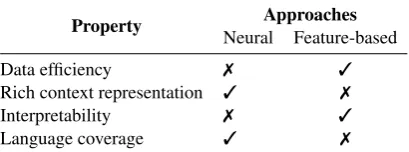
Each of these approaches has their advantages and limitations (Table2). Feature-based systems employ carefully crafted feature templates created using expert knowledge, which makes these ap-proaches more interpretable and data efficient, but difficult to port to other domains or languages. The expressiveness of data representation in these systems is largely determined by the complex-ity of the feature set, which is another limitation of feature-based approaches. These systems are rather slow to train, since feature extraction is de-fined over a dynamically changing context.
Deep learning, on the other hand, offers a uni-fied language-agnostic framework to train accu-rate models when abundant training data is avail-able; they are also fast to train (although hyper-parameter tuning routines can take a significant amount of time). However, neural models are less interpretable than their sparse-feature coun-terparts. Also, low-resource scenario still poses a great challenge to complex neural models. The ADAPT system that achieved the best results in SR’18 task on English data (Elder and Hokamp, 2018) used a data augmentation technique which allowed it to leverage 50 times more data than originally provided by the organizers of the work-shop. The authors identified the lack of sufficient training data as the major obstacle to training high-performing neural models and mentioned that the system trained only on the original dataset failed to deliver sensible outputs. These results are sup-ported by the work done in other NLP fields. For example, in the machine translation community researchers have found that neural models have a much slower learning curve with respect to the amount of training data, which usually manifests itself as worse quality in low-resource settings, but better performance in high-resource cases (Koehn and Knowles,2017). In morphological inflection, when trained on small datasets, seq2seq models with additional external (noisy) alignments
per-form much better than similar systems which learn the alignment information from scratch (Aharoni and Goldberg,2017).
The success of the encoder-decoder paradigm has given birth to a prominent research trend of finding various ways of utilizing the abundant data on the web. While looking for ways to acquire more data for training even larger models is a promising research topic, an orthogonal direction is pursuing the question of how to design and train more data-efficient models. Our work focuses on this latter point and attempts to address it via data analysis and algorithm design. Taking this into consideration, we build upon the work done by Puzikov and Gurevych(2018), and attempt to improve their method based on the results of our error analysis.
4 Approach Description
Before explaining our work, we briefly recap how BINLINworks. It is a pipeline system which gen-erates a sentence from a dependency tree in two stages:
1. Syntactic ordering: convert dependency tree into a binary tree, then traverse the latter to obtain a sequence of lemmas.
2. Morphological inflection: conjugate each lemma into a surface form.
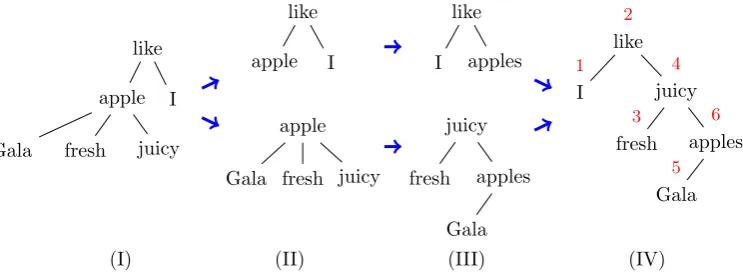
Figure 1 shows a schematic view of the first stage. It relies on the procedure which first runs a breadth-first search (BFS) algorithm on the input dependency tree to obtain (head, children) node groups, corresponding to subtrees of depth one. The head of each subtree is used to initialize a binary tree. Then a binary classifier is used to make decisions of positioning the child nodes to the right/left of the head node. Once all the chil-dren have been inserted, the construction of a bi-nary tree for the subtree under consideration is fin-ished and the algorithm moves on to the next sub-tree.
BINLIN uses a multi-layer perceptron model with a logistic regression function on top to pre-dict the probability of nodenj being positioned to
the right (y = 1) or left (y = 0) of node ni in a
binary tree:
p(y= 1) =g([xi;xj];θ) =
1
like
apple
Gala fresh juicy I
like
apple I
apple
Gala fresh juicy
like
I apples
juicy
fresh apples
Gala
like
2
I
1
juicy
4
fresh
3
apples
6
Gala
5
(III) (II)
[image:4.595.115.487.64.201.2](I) (IV)
Figure 1: High-level overview of the BINLINalgorithm. Decompose the dependency tree (1) into subtrees of depth one (2), then convert subtrees into equivalent binary trees (3), and merge them. In-order traversal of the merged binary tree (4) produces a sequence of lemmas “I like fresh juicy Gala apple”.
Here, xi andxj are feature representations of
niandnj, andθdenotes parameters of the neural
network. The decision-making rule is defined by setting a threshold on the output ofg(·):
decision= (
right, ifp(y =1)≥0.5, left, otherwise.
The algorithm converts local subtrees into bi-nary trees in a bottom-up manner until it reaches the root node. At this point, all dependency nodes have been processed. The constructed local bi-nary trees are merged and the resultant bibi-nary tree can be linearized by in-order traversal. Finally, a morphological inflection component, applying a character-level seq2seq model with a hard atten-tion mechanism (Aharoni and Goldberg,2017), is used to predict a surface form for each lemma in the sequence.
The error analysis of the system outputs pro-vided in (Puzikov and Gurevych,2018) has shown that the majority of BINLIN’s mistakes are caused by the incorrect ordering of lemmas, which is why we focus on the syntactic ordering component and leave the morphological inflection module the same as in the original system.
We argue that there are several directions by which BINLIN could be improved: the way the training data is created and the input encoding schema. In what follows we describe the changes that we made to the original system; the corre-sponding performance improvements are reported in Section5.
4.1 Modification 1: Training Data Preparation
The first modification we made was improving the way training data for the binary classifier is cre-ated. When making training examples, the BIN -LINsystem considers (ni,nj) node pairs extracted
from subtrees of depth one. For example, in the case of the “I like apple” subtree from Figure 1, one of the training examples the system would add is (“like”, “I”,left), since the word “I” in the sen-tence is positioned to the left of its head “like”.
This procedure seems to be based on the as-sumption that the system learns position-invariant word order representations, i.e., if the system learns that node nj should be positioned to the
right of ni, it will also be able to deduce thatni
should be inserted to the left ofnj. However, it
is known that neural networks in general do not have this reasoning ability, and to circumvent this issue, researchers use various data augmentation techniques. For example, in the image processing domain it is common to create additional training images through random rotation, shifts, shear and flips, etc.
In a similar fashion, we propose to enrich the training set with training examples which we call “symmetric”: for each (ni,nj,label) triple
orig-inally considered by BINLIN, we add (nj, ni,
. . .
xi
. . .
xj
. . . . . .
. . .
(1)x= [xi;xj] (2)h1=W1x
(3)h2=lrelu(W2h1)
(5)h3=lrelu([h2;c])
(6)o=sigm(h3)
. . .
+
... ... ... . . . ...
(4)c = lrelu(PMk=1αkxk)
[image:5.595.94.503.60.206.2]local context global context
Figure 2: Schematic view of the neural network architecture used as a classifier for the syntactic ordering compo-nent of our system.
4.2 Modification 2: Encoding Strategy
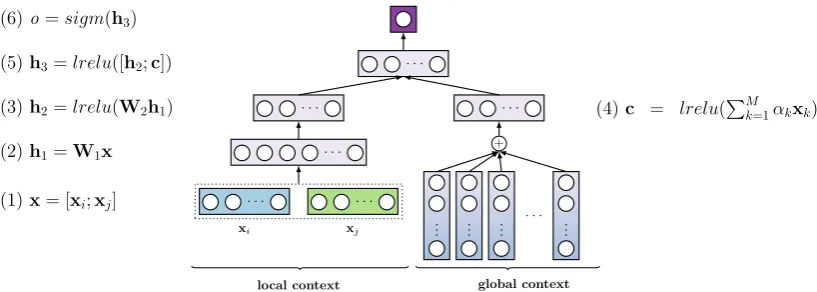
Figure 2 shows the schematic view of the em-ployed binary classifier; the original BINLIN sys-tem would consider the part marked aslocal con-text, while the remainingglobal contextpart is our proposed enhancement.
Given a pair of nodes (ni,nj), we first need to
extract their features. BINLIN uses a local fea-ture representation of each node, which includes the node itself and graph context in the close prox-imity – its head and an immediate child. Formally speaking, each nodenk is represented as a vector
xk ∈ RF d, where F denotes the number of
ex-tracted features and dis the embedding size. In other words, each dense node representationxkis
a concatenation of the embeddings for each fea-ture in the feafea-ture setF. The embedding matrix is denoted asE∈Rd×|V|, whereVis the vocabulary
of unique lemmas, POS tags and dependency edge labels, observed in the training data.
The extracted dense feature representations xi
andxj for the two nodes are (1) concatenated to
form the input to the classifier, (2) projected onto a lower-dimensional space via a linear transforma-tion, (3) squeezed further via another linear trans-formation followed by applying the Leaky ReLu function (Maas et al.,2013). The last layer of the BINLIN classifier consists of one node, followed by the sigmoid function.
As mentioned in the previous subsection, in some cases knowing a wider context is crucial for making the correct decision. We decided to en-rich the feature representation with aglobal con-textwhich encodes all the nodes in the subtree un-der consiun-deration. We compute it as (4) a weighted sum of the feature representations of these nodes,
similar to the attention mechanism of Bahdanau et al.(2015).
We also experimented with the feature set trying to figure out what provides a stronger supervision signal for the binary classifier. The best feature configuration is the same as in the original system with the exception of two additional node features: the number of the node’s children and the length of the path from the node to the root of the depen-dency tree.
5 Experiments
The official SR’18 data preserved one-to-one cor-respondence between sentences and dependency trees, but the alignment between lemmas and sur-face word forms was omitted, which complicated extracting training data pairs.
Following BINLIN’s authors, we used the origi-nal UD data files for training all our models (the files contain the same dependency trees as the shared task data, but the order of the tokens is not scrambled and each surface form is aligned with the respective lemma). For a fair comparison with other approaches, system evaluation was done us-ing the official SR’18 data. We used English UD treebank for system development, the evaluation was done on all ten treebanks.
All neural network components were imple-mented using PyTorch (Paszke et al., 2017). No pretrained embedding vectors or other external re-sources were used for the experiments. The ex-act hyper-parameter values for each system com-ponent are provided in Appendix A.1.
syn-Language
ar cs en es fi fr it nl pt ru
Left/right labels (%) 32/68 57/43 62/38 56/44 57/43 57/43 57/43 61/39 56/44 47/53
Node pair head-dep 96.27 90.26 96.14 92.67 89.21 95.14 94.26 91.51 97.29 92.85 dep-dep 82.81 82.78 87.64 83.85 81.43 85.12 84.98 82.52 85.6 85.56
Table 3: The distribution of left/right labels in the training data and the accuracy of predicting a node’s relative position with the binary classifier. Two cases are considered: predicting the position of a dependent w.r.t. its head
(head-dep), and a sibling (dep-dep).
BLEU EDIST NIST
BINLIN 24.92 35.91 9.55
+data enrichment 48.47 62.04 10.72
+new encoder 50.67 64.05 10.82
+new features 51.15 64.78 10.82
Upper bound 65.31 85.52 11.38
Table 4: Cumulative improvements from the modifica-tions to the syntactic ordering procedure that we pro-pose in this work, computed on the English portion of the SR’18 development set.
tactic component and 200 for the morphological component. Both modules were trained for a fixed number of epochs (ten for the syntactic component and 15 for the morphological one).
Since we left the morphological module intact, in Section5.1we report evaluation results only for the syntactic ordering component.
5.1 Syntactic Ordering
Before evaluating the syntactic ordering module, we conducted a preliminary study in which we tried to validate the dependency locality hypoth-esis and answer the following question: Is it pos-sible to accurately predict the relative position of a dependent with respect to its head?
Table3shows the distribution of left/right target labels in the training data and the accuracy of pre-dicting the node’s relative position with our sys-tem’s binary classifier (all proposed modifications applied), both for head-dependent and dependent-dependent node pairs. The latter pairs are relations between sibling nodes in the respective subtree, since at each prediction step the system operates on dependency subtrees of depth one. Note that modeling such relations is a harder task, since sib-lings in dependency trees do not directly share any grammatical information. However, the surround-ing context seems to be enough to make high-accuracy predictions, which supports the
depen-dency locality hypothesis.
We trained the syntactic ordering component and performed its automatic metric evaluation by computing BLEU (Papineni et al., 2002)3, NIST (Doddington, 2002) and normalized string edit distance (EDIST) scores between the refer-ences and system outputs. Note that system out-puts contain ordered lemmas, not surface forms, while the references are correctly ordered se-quences of inflected surface forms given in the CONLL file.
Table 4 shows the contribution of each of the modifications that we propose in this work; the re-sults are computed on the English SR’18 devel-opment set. We also show the maximum metric scores that an ideal syntactic ordering component would get, i.e. an upper bound on its performance. We computed it by retrieving oracle lemma se-quences and computing metric scores against the corresponding references. This evaluation was done on English data only, since it was used for system development.
5.2 Full Pipeline
We further add the morphological inflection com-ponent and evaluate the full pipeline on the SR’18 test data. Table5shows the metric scores achieved by the best SR’18 systems (OSU (King and White,2018) and TILBURG(Castro Ferreira et al., 2018)), BINLINand the version of BINLINwith the proposed modifications (BINLIN+). We ex-cluded the scores achieved by the ADAPT sys-tem, since the system was only evaluated when trained with additional data and such a compari-son would not be fair. In order to better assess the performance gains that we obtained from the pro-posed modifications, the syntactic ordering com-ponent of BINLIN+ was trained ten times with different random seeds; we report both the mean scores and standard deviation.
Metric System Language
ar cs en es fi fr it nl pt ru
BLEU
OSU 25.65 – 66.33 65.31 37.52 38.24 – 25.52 – –
TILBURG – – 55.29 49.47 – 52.03 44.46 32.28 30.82 –
BINLIN 16.20 25.05 29.60 32.15 23.26 20.53 23.55 22.69 24.59 34.34
BINLIN+ 29.07±0.20 54.49±0.26 64.70±0.76 63.86±0.50 37.38±0.59 43.40±1.33 41.17±0.51 50.28±0.53 49.01±0.60 62.88±0.36
NIST
OSU 7.15 – 12.02 12.74 9.56 8.0 – 7.33 – –
TILBURG – – 10.85 11.11 – 9.85 9.11 8.04 7.55 –
BINLIN 6.94 10.74 9.53 10.19 9.34 7.21 7.6 8.63 7.52 13.05
BINLIN+ 7.53±0.01 13.65±0.03 12.03±0.05 12.59±0.03 9.83±0.06 8.78±0.11 8.63±0.03 10.30±0.02 9.21±0.05 14.43±0.02
EDIST
OSU 34.37 – 68.59 59.75 47.99 44.84 – 34.22 – –
TILBURG – – 60.32 48.47 – 51.16 46.67 37.20 40.75 –
BINLIN 18.03 24.30 36.83 27.55 28.53 23.41 27.66 26.32 32.50 31.77
[image:7.595.76.522.62.182.2]BINLIN+ 38.11±0.60 54.00±0.34 66.77±0.77 59.00±0.46 49.58±0.65 45.17±1.10 48.50±0.86 52.50±0.65 59.70±0.78 62.80±0.54
Table 5: Final results computed on the SR’18 test data. BINLIN+results include mean scores and standard
deviation (scores averaged across ten models trained with different random seed values). Cells with dashes denote cases for which the respective systems have not submitted any output in the shared task.
As can be seen from the table, our modifications bridge the gap between the top-scoring systems and BINLIN. BINLIN+ is the best-performing system for five out of ten languages.
6 Error Analysis
In order to better understand the most common er-rors made by the BINLIN+system, we manually examined its predictions on the development set. We were focusing predominantly on the syntactic ordering component in its best configuration (i.e. with all the proposed modifications). In what fol-lows we describe the most prominent error types.
Punctuation. Generally speaking, the position of punctuation marks is determined not by a spe-cific dependency relation, but rather by discourse-level characteristics of the sentence, since their primary goal is to help the reader interpret text by means of delimiting the contents, dividing it into easy-to-process pieces. Oftentimes there are lex-ical markers (“so”, “because”, “although”) which signal that, for example, a comma should be in-serted before or after a phrase:
• I like chocolate,becauseit is sweet.
• Bryan, you’re in,right?
However, in UD annotation punctuation marks are considered as dependents of the subtree root. The binary classifier fails to encode discourse in-formation, since it mainly looks for local patterns in head-dependent relations. A more global tech-nique of input encoding might alleviate this issue.
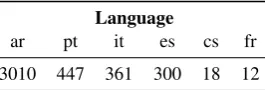
Contractions. Spanish, Czech, French, Por-tuguese, Arabic and Italian treebanks contain an-notation of multi-word expressions (MWE). Ta-ble6shows the number of unique MWE encoun-tered in the training portion of the UD treebanks.
Language
ar pt it es cs fr
3010 447 361 300 18 12
Table 6: Number of multi-word expressions (MWE) in UD treebanks for the languages included in the SR’18 task (only languages with MWE are shown).
The most common case marked as MWE in the UD treebanks is that of contractions which occur when two adjacent words are merged into one. For example, in French the article “les” contracts with the preposition “`a” into a compound article “aux”. English UD annotation does not contain contrac-tions, which is why when developing BINLIN+ we did not encounter this issue.
Our system predicts the relative position of the contraction elements and attempts to conjugate them separately, but does not perform token merg-ing. The following is an example of a contraction in French:
• Un autel `a Jupiter est ´erig´e `a l’emplacement de le Temple.
• Un autel `a Jupiter est ´erig´e `a l’emplacement du Temple.
The first line is what BINLIN+would predict; the second is what the correct output should be. We suspect that this is the main reason for the performance gap that exists between BINLIN+ and the best-performing approaches on Spanish, French and Italian data.
[image:7.595.349.482.249.294.2]Metric System Language
cs fr it
BLEU BinLin+ 54.50 43.90 40.84
- w/ MWE 54.78 49.26 52.11
NIST BinLin+ 13.63 8.85 8.61
- w/ MWE 13.67 9.46 9.78
EDIST BinLin+ 54.00 46.20 47.57
[image:8.595.88.274.63.172.2]- w/ MWE 54.07 49.45 53.25
Table 7: The result of adding a post-processing step of merging MWE tokens for Czech, French and Italian SR’18 test data.
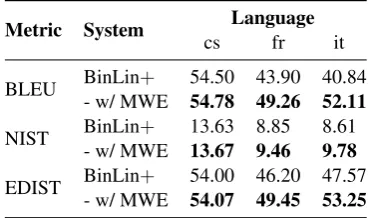
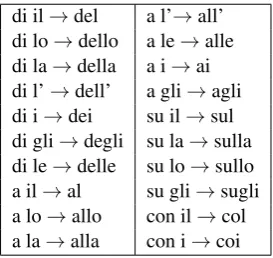
post-processing step to the outputs of our system4, whereby we stitch adjacent contraction items into one token. We focused on Czech, French and Italian treebanks, since these languages have very simple contraction cases which we extracted with-out any knowledge of the respective grammar rules (see Appendix A.2).
Table 7 shows an improvement over all three languages, which suggests that this is indeed a promising direction to investigate in detail, and a more principled treatment of contractions would boost the performance of the system even further.
7 Limitations and Future Work
The proposed modifications increase the perfor-mance of the baseline BINLIN system signifi-cantly, closing the performance gap relative to the state-of-the-art methods to surface realization. Unlike feature-based approaches, the system does not require exhaustive enumeration of the feature templates and is much faster to train. On top of that, it follows a human-designed algorithm, rely-ing on a neural model only to make binary classi-fication decisions which are more transparent than the inner workings of end-to-end neural models. This offers an additional benefit of interpretabil-ity and easier debugging. Unlike seq2seq mod-els that occasionally hallucinate content or gener-ate incomprehensible outputs, our system remains faithful to its inputs, since it builds outputs by re-arranging input elements and conjugating them.
However, the approach has its limitations. We outline them below and plan to address them in the future.
Zero-Markov assumption. The system does not rely on its past predictions when making a
cur-4For the syntactic component that we trained with ten dif-ferent random seeds, we chose one variant randomly.
rent decision. This is a simplifying assumption that sped up system development, but at this point it is a constraint that limits the approach’s poten-tial.
Formalism specificity. Unlike seq2seq mod-els which can process any input, the approach works only on tree inputs. When changing the input structure one would have to come up with a new graph-to-tree conversion technique. One reassuring fact is that as of now the annotation consistency of available meaning representations is rather low (considering inter-annotator agree-ment scores), which means that text-based repre-sentations like dependencies is the best option one could hope to use in real-life applications.
Dependent-dependent classification bottle-neck. As can be seen from Table3, ordering chil-dren nodes in a dependency tree is a much harder task, compared to deciding on the position of a child node w.r.t. its head. Most likely this is due to the fact that dependency annotation is not suffi-cient to make a correct decision, while predicting the order between children nodes might be eas-ier if we change the optimization objective. The masked language modeling approach used in (Liu et al.,2015;King and White,2018) is very promis-ing in this regard and we plan to investigate it in the future.
8 Conclusion
In this work we extended the binary linearization technique for generating sentences from depen-dency trees. The modifications are motivated by the results of the error analysis of the baseline sys-tem and, when applied, significantly improve its accuracy. The resultant system reaches competi-tive performance in a multilingual setting, while preserving more interpretable behavior and higher data efficiency than the competitors.
Acknowledgments
under the promotional reference 01IS17050. We thank Henry Elder and Anastasia Shimorina for the insightful discussions and our colleagues Michael Bugert, Yang Gao, Ji-Ung Lee and Jonas Pfeiffer who provided suggestions that greatly as-sisted our research.
References
Roee Aharoni and Yoav Goldberg. 2017.
Morpholog-ical Inflection Generation with Hard Monotonic At-tention. In Proceedings of the 55th Annual Meet-ing of the Association for Computational LMeet-inguistics
(Volume 1: Long Papers), pages 2004–2015,
Van-couver, Canada.
Dzmitry Bahdanau, Kyunghyun Cho, and Yoshua
Ben-gio. 2015. Neural machine translation by jointly
learning to align and translate. In Proceedings of the 3rd International Conference on Learning
Rep-resentations (ICLR 2015), San Diego, CA, USA.
Anja Belz, Mike White, Dominic Espinosa, Eric Kow,
Deirdre Hogan, and Amanda Stent. 2011. The First
Surface Realisation Shared Task: Overview and Evaluation Results. InProceedings of the Genera-tion Challenges Session at the 13th European
Work-shop on Natural Language Generation, pages 217–
226, Nancy, France.
Bernd Bohnet, Leo Wanner, Simon Mille, and
Ali-cia Burga. 2010. Broad Coverage Multilingual
Deep Sentence Generation with a Stochastic Multi-level Realizer. In Proceedings of the 23rd
Inter-national Conference on Computational Linguistics,
pages 98–106, Beijing, China.
Thiago Castro Ferreira, Iacer Calixto, Sander Wubben, and Emiel Krahmer. 2017. Linguistic realisation as machine translation: Comparing different MT mod-els for AMR-to-text generation. InProceedings of the 10th International Conference on Natural
Lan-guage Generation, pages 1–10, Santiago de
Com-postela, Spain.
Thiago Castro Ferreira, Sander Wubben, and Emiel Krahmer. 2018.Surface realization shared task 2018 (SR18): The Tilburg university approach. In Pro-ceedings of the First Workshop on Multilingual
Sur-face Realisation, pages 35–38, Melbourne,
Aus-tralia.
Kyunghyun Cho, Bart van Merrienboer, Caglar Gul-cehre, Dzmitry Bahdanau, Fethi Bougares,
Hol-ger Schwenk, and Yoshua Bengio. 2014.
Learn-ing Phrase Representations UsLearn-ing RNN Encoder-decoder for Statistical Machine Translation. In Pro-ceedings of the 2014 Conference on Empirical
Meth-ods in Natural Language Processing (EMNLP),
pages 1724–1734, Doha, Qatar.
George Doddington. 2002. Automatic Evaluation of
Machine Translation Quality Using N-gram Co-occurrence Statistics. In Proceedings of the Sec-ond International Conference on Human Language
Technology Research, pages 138–145, San
Fran-cisco, CA, USA.
Henry Elder and Chris Hokamp. 2018. Generating
high-quality surface realizations using data augmen-tation and factored sequence models. In Proceed-ings of the First Workshop on Multilingual Surface
Realisation, pages 49–53, Melbourne, Australia.
Claire Gardent, Anastasia Shimorina, Shashi Narayan,
and Laura Perez-Beltrachini. 2017. The WebNLG
challenge: Generating text from RDF data. In Pro-ceedings of the 10th International Conference on
Natural Language Generation, pages 124–133,
San-tiago de Compostela, Spain.
Edward Gibson. 2000. The dependency locality the-ory: a distance-based theory of linguistic
complex-ity. Image, Language, Brain: Papers from the First
Mind Articulation Project Symposium.
David King and Michael White. 2018. The OSU
real-izer for SRST ‘18: Neural sequence-to-sequence in-flection and incremental locality-based linearization.
In Proceedings of the First Workshop on
Multilin-gual Surface Realisation, pages 39–48, Melbourne,
Australia.
Diederik Kingma and Jimmy Ba. 2015. Adam: a
method for stochastic optimization. InProceedings of the International Conference on Learning
Repre-sentations (ICLR), San Diego, USA.
Philipp Koehn and Rebecca Knowles. 2017. Six
chal-lenges for neural machine translation. In Pro-ceedings of the First Workshop on Neural Machine
Translation, pages 28–39, Vancouver.
Ioannis Konstas, Srinivasan Iyer, Mark Yatskar, Yejin
Choi, and Luke Zettlemoyer. 2017. Neural AMR:
Sequence-to-sequence models for parsing and gen-eration. In Proceedings of the 55th Annual Meet-ing of the Association for Computational LMeet-inguistics
(Volume 1: Long Papers), pages 146–157,
Vancou-ver, Canada.
Irene Langkilde-Geary. 2002. An Empirical
Verifi-cation of Coverage and Correctness for a General-purpose Sentence Generator. In Proceedings of the 2nd International Natural Language
Genera-tion Conference, pages 17–24, Harriman, New York,
USA.
Yijia Liu, Yue Zhang, Wanxiang Che, and Bing Qin. 2015. Transition-based Syntactic Linearization. In
Proceedings of the 2015 Conference of the North American Chapter of the Association for
Computa-tional Linguistics: Human Language Technologies,
Andrew L. Maas, Awni Y. Hannun, and Andrew Y. Ng. 2013. Rectifier Nonlinearities Improve Neural Net-work Acoustic Models. InICML Workshop on Deep Learning for Audio, Speech and Language Process-ing, Atlanta, USA.
Diego Marcheggiani and Laura Perez-Beltrachini. 2018. Deep graph convolutional encoders for struc-tured data to text generation. In Proceedings of the 11th International Conference on Natural
Lan-guage Generation, pages 1–9, Tilburg University,
The Netherlands.
Simon Mille, Anja Belz, Bernd Bohnet, Yvette Gra-ham, Emily Pitler, and Leo Wanner. 2018. The first multilingual surface realisation shared task (SR’18): Overview and evaluation results. InProceedings of the First Workshop on Multilingual Surface Realisa-tion, pages 1–12, Melbourne, Australia.
Kishore Papineni, Salim Roukos, Todd Ward, and
Wei-Jing Zhu. 2002. BLEU: a Method for Automatic
Evaluation of Machine Translation. InProceedings of 40th Annual Meeting of the Association for
Com-putational Linguistics, pages 311–318, Philadelphia,
Pennsylvania, USA.
Adam Paszke, Sam Gross, Soumith Chintala, Gre-gory Chanan, Edward Yang, Zachary DeVito, Zem-ing Lin, Alban Desmaison, Luca Antiga, and Adam Lerer. 2017. Automatic Differentiation in PyTorch.
InNIPS 2017 Workshop Autodiff, Long Beach,
Cal-ifornia, USA.
Ratish Puduppully, Yue Zhang, and Manish Shrivas-tava. 2016. Transition-based Syntactic Lineariza-tion with Lookahead Features. InProceedings of the 2016 Conference of the North American Chapter of the Association for Computational Linguistics:
Hu-man Language Technologies, pages 488–493, San
Diego, California.
Yevgeniy Puzikov and Iryna Gurevych. 2018. BinLin:
A simple method of dependency tree linearization.
In Proceedings of the First Workshop on
Multilin-gual Surface Realisation, pages 13–28, Melbourne,
Australia.
Linfeng Song, Yue Zhang, Zhiguo Wang, and Daniel
Gildea. 2018. A graph-to-sequence model for
AMR-to-text generation. InProceedings of the 56th Annual Meeting of the Association for
Computa-tional Linguistics (Volume 1: Long Papers), pages
1616–1626, Melbourne, Australia.
Ilya Sutskever, Oriol Vinyals, and Quoc V Le. 2014.
Sequence to Sequence Learning with Neural Net-works. In Z. Ghahramani, M. Welling, C. Cortes, N. D. Lawrence, and K. Q. Weinberger, editors, Ad-vances in Neural Information Processing Systems 27, pages 3104–3112. Curran Associates, Inc.
Bayu Distiawan Trisedya, Jianzhong Qi, Rui Zhang,
and Wei Wang. 2018. GTR-LSTM: A triple encoder
for sentence generation from RDF data. In Proceed-ings of the 56th Annual Meeting of the Association
for Computational Linguistics (Volume 1: Long
Pa-pers), pages 1627–1637, Melbourne, Australia.
Michael White and Rajakrishnan Rajkumar. 2012.
Minimal dependency length in realization ranking.
In Proceedings of the 2012 Joint Conference on
Empirical Methods in Natural Language
Process-ing and Computational Natural Language LearnProcess-ing,
pages 244–255, Jeju Island, Korea.
A Appendix
A.1 Hyper-parameter Details
We did not perform any hyper-parameter tuning, all values were chosen based on our intuition and what we have observed in the research literature.
Morphological Component. The morpholog-ical inflection component was implemented us-ing character-level LSTM networks, a two-layer bidirectional encoder and a one-layer unidirec-tional decoder with hidden layer sizes of 200. We used 200-dimensional randomly-initialized em-beddings.
We did not lowercase the data, maintained a fixed size vocabulary of 250 characters, and for training used only sequences of maximum 30 characters long (both source and target sides).
Syntactic Ordering Component. The syntac-tic ordering component was implemented using feed-forward networks; the corresponding hidden layer sizes were fixed at 100 and 64 dimensions (weight matricesW1andW2from Figure 2). We
A.2 Contraction Rules
The following tables contain the contraction rules we used as a post-processing step described in Section 6. The rules were created by extracting lines with contractions in the UD CONLL files and analyzing the contraction patterns.
`a le→au de lequel→duquel `a les→aux de lesquels→desquels `a lequel→auquel de lesquelles→desquelles `a lesquels→auxquels en les→`es
[image:11.595.73.310.159.248.2]`a lesquelles→auxquelles vois ci→voici de le→du vois l`a→voil`a de les→des
Table 8: French contraction rules.
[image:11.595.113.250.297.426.2]di il→del a l’→all’ di lo→dello a le→alle di la→della a i→ai di l’→dell’ a gli→agli di i→dei su il→sul di gli→degli su la→sulla di le→delle su lo→sullo a il→al su gli→sugli a lo→allo con il→col a la→alla con i→coi
Table 9: Italian contraction rules.
aby by→aby kdyˇz by→kdyby
Aby by→Aby Kdyˇz by→Kdyby