Original Article
The application of aptamer functionalized hydrogel
to capture circulating tumor cells
Yanxia Xing, Jiequn Guo, Qingli Chen, Fujuan Li, Yanli Yang
Department of Gynaecology, The Fifth Hospital of Qinghai Province, Xining 810007, Qinghai, P. R. China Received July 19, 2015; Accepted February 29, 2016; Epub July 15, 2016; Published July 30, 2016
Abstract: Aims: The aim of this study is to establish a new method to separate Circulating Tumor Cells (CTCs) using molecular hybridization technology centering on cell and molecular biology. Methods: Epithelial ovarian carcinoma cells SKOV3 were cultured. Aptamers with fluorophore and complementary DNA oligonucleotides were mixed to-gether at a molar ratio of 1:2 and incubated for intermolecular hybridization. Cells were caught and released and then were flow cytometry analysed. Results: Our study showed that molecular hybridization could inactivate or reju-venate aptamers in the interaction cells, and AFH could capture specific cells after coated on the glass surface. AFH could control the interaction between cells to achieve the CTCs capture without damage. Conclusions: Cells capture and release with aptamers and complementary oligonucleotides represent better development prospect.
Keywords: Hydrogel, affinity, interface, cell adhesion
Introduction
Circulating tumor cells (CTCs) has been widely recognized as the major cause of cancer metas-tasis since found in 1869 [1]. In recent years, with the development of tumor biology and progress of detection technology, CTCs has become a very reliable biomarker for detection of micrometastasis in early tumor patients, determination of clinical stages of cancer, mon-itoring tumor recurrence and metastasis of postoperative patients, prognosis evaluation and selection of individual therapeutic sched-ule [2-6]. Detection of CTCs in blood may be an effective method in cancer instead of biopsy. However, it is still very difficult to establish an efficient and accurate method to identify and capture CTCs in blood since CTCs represent very low frequency in blood, about 1-10 CTCs per 5×10⁹ hemocytes [7]. Furthermore, CTCs can become cloaked by platelets or by coagula-tion factors, thereby shielding them from the immune system [1].
Aptamer functionalized hydrogel (AFH), as an emerging biological material, has been attract-ed more and more attention in mattract-edicine, bionic engineering, molecular biology and other are- as recently [8-10]. Hydrogels are crosslinked
hydrophilic polymer networks that possess many attractive physical properties [11, 12]. Hydrogel structures can be formed by introduc-ing chemical or physical crosslinks between hydrophilic natural or synthetic polymers [13]. DNA aptamers can capture target molecules based on reversible combination properties of DNA to form hydrogel systems. Then, the target molecules can be separated from the aptamers when displaced by matched DNA with apta- mers.
Materials and methods
Chemical reagents
and RPMI medium 1640 was obtained from ATCC (Manassas, VA).
Preparation of silanized glass surface
Glass slides (Fisher Scientific, Suwanee, GA) were cut into small squares with a dimension of 4×4 mm2. The glass squares were sonicated in NaOH (1.0 M) for 10 min. After washed thor-oughly with deionized water, the slides were treated for 5 min in a silanization solution that was prepared by diluting TMSPM (0.5 mL) in themixture of ethanol (50 mL) and diluted gla-cial acetic acid (1.5 mL, 10% v/v). The silanized glass squares were washed with ethanol, dried in the air and stored in a vacuum desiccator before use.
Cell culture
Epithelial ovarian carcinoma cells SKOV3 were taken from CO2 incubator. Culture flask wall with cells were blown gently with suckers in clean bench and the cells grown poorly were remove. Several drops of 0.04% EDTA were added till soaked the cells after abandoning the culture solution. After incubated at 37°C 10 min, the cells were retracted to round without falling off the flask wall when observed using an inverted microscope. RPMI medium 1640 sup-plemented with 10% PBS was added after dis-carding the EDTA in clean bench, and the cells were inculated by the ratio of 1:2 or 1:3.
Gel electrophoresis
Aptamers with fluorophore and complementary DNA oligonucleotides were mixed together at a molar ratio of 1:2 and incubated at 37°C for 30 min for intermolecular hybridization. For the
examination of the fluorescence intensity of aptamer bands, oligonucleotides in different concentrations were added into the original hybridization mixture and quantified using poly-acrylamide gel electrophoresis.
Cell catch and release
Glass squares (5 mm) coated with hydrogels were incubated in an aptamer solution at 37°C for 1 h to immobilize nucleic acid aptamers, and then the glass squares were thoroughly washed with the binding buffer DPBS contain-ing glucose (4.5 g/L), MgCl2 (10 mM) and BSA (0.1% w/v). For cell catch, the glass squares were incubated in a 24-well plate containing cell suspension (800 mL, 5×10⁵ cells/well) at 37°C for 30 min. The unbound cells were gently removed from the coatings by shaking the plate at 90 rpm for 1 min. For cell release, the glass squares were incubated in restriction enzyme solution (80 mL, 5 U/mL) at 37°C for 30 min. The released cells were gently rinsed off the surface by shaking the plate at 90 rpm for 10 min. The glass slides were imaged using an inverted microscope and the cells on hydroge- ls were quantified using Image. Three images were randomly selected for each sample. A total of three samples were used in each group [14].
Microscopy and flow cytometry analysis
[image:2.612.90.523.75.208.2]times. The cells were then incubated in 200 ul various concentrations of primary complemen-tary oligonucleotides solution (10, 50, 250 and 1000 nm) for different times (10, 30 and 60 min). Some cell suspension liquid was placed on clean slide and observed using laser scan-ning confocal microscope (Leica SP2) after covered by coverslip. The flow cytometry (BD FACSCalibur) analysis was also used.
Statistical analyses
All statistical analyses in this study were per-formed used SPSS software, version 16.0 (SPSS, Chicago, IL, USA) for windows.
Results
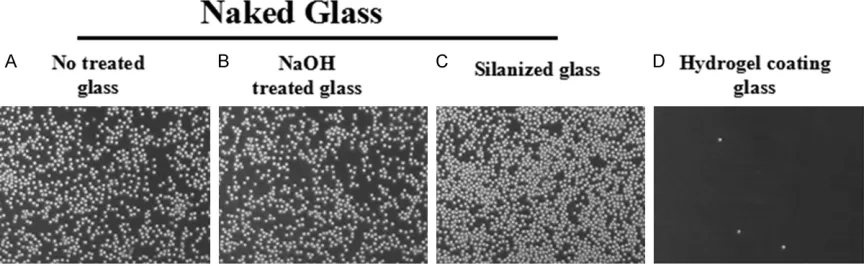
The cell images show that the density of SKOV3 cells on the untreated glass surface, NaOH treated glass surface, and silanized glass sur-face were 1100, 1200 and 1400 cells/mm2, respectively (Figure 1). In contrast, the cell den-sity on the hydrogel coating was ~5 cells/mm2
[image:3.612.91.518.73.215.2](Figure 1). A cell catch experiment was run to examine whether the immobilized B1 could induce cell binding to the hydrogel. The B1 func-tionalized hydrogel could catch cells with the density over w1200 cells/mm2 (Figure 1D). After demoll binding, we studied whether ap- tamers were capable of inducing cell type-spe-cific nstrating the functionality of the polyacr- ylamide hydrogel in resisting nonspecific ce- binding to the polyacrylamide hydrogel. The sequences A1 and B1 can hybridize through 20 base pairs with a melting temperature higher than 60°C. In addition to the examination of intermolecular hybridization in aqueous solu-tions, we also investigated the feasibility of hybridizing these sequences in the hydrogel coatings. A total of three hydrogels were syn-thesized. The first one was a native polyacryl-amide hydrogel. The second one was a poly-acrylamide hydrogel that was prepared with a pregel solution containing sequence A1 witho- ut acrydite. The third one was prepared with the pregel solution containing sequence A with Figure 2. Characterization of the functionality of the aptamer in catching SKOV3 cells.
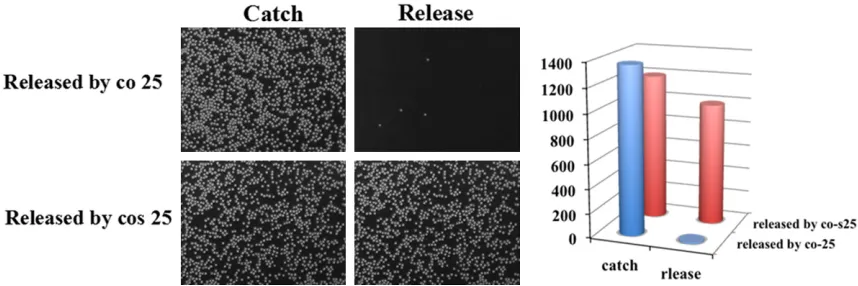
[image:3.612.91.520.261.404.2]acrydite (i.e., A1A). Thus, during the free radical polymerization, acrydite enabled the chemical incorporation of sequence A into the hydrogel network. All three hydrogel coatings were treat-ed with sequence B1T and then subjecttreat-ed to thorough washing. TAMRA was used to label sequence B1T for clear legibility of the hybrid-ization. A cell catch experiment was run to examine whether the immobilized B1 could induce cell binding to the hydrogel. The B1 func-tionalized hydrogel could catch cells with the density over w1200 cells/mm2 (Figure 1D). In contrast, only ~10 cells/mm2 was observed on the other two control surfaces (Figure 2). We studied whether the state of cell binding can be transformed into a state of cell release using the secondary CS. After the treatment with C25, the density of cells decreased to 19±15 cells/cm2 (Figure 3). The release effi-ciency was approximately 99%. In contrast, the C25S could not induce significant cell release. Discussion
CTCs were a very small population in blood and various method and material research mainly focused on the sensibility and accuracy of CTCs detection. In addition, two hybrid nucleotide chains can be replaced by another chain based on base paring and from which a double-cha- in structure and a primary hybrid chain are formed. Aptamers have high affinity and speci-ficity and the affinity can be controlled by add-ing complementary small oligonucleotide mol-ecules in physical condition. In brief, oligo- nucleotide aptamers can be inactivated and rejuvenated by intermolecular hybridization in the process of cell-cell interaction to control this process.
In this study, we examined nonspecific cell binding in a pseudostatic condition, in which cells were allowed to gradually precipitate to the material surface from the cell suspension. Different surfaces were studied and compared, including untreated glass surface, NaOH treat-ed glass surface, silaniztreat-ed glass surface and the hydrogel coating. The cell images show that the density of SKOV3 cells on the untreated glass surface, NaOH treated glass surface, and silanized glass surface were ~1100, 1200 and 1400 cells/mm2, respectively (Figure 1). In con-trast, the cell density on the hydrogel coating was ~5 cells/mm2 (Figure 1). These results
indi-cate that it would be important to prepare a coating to prevent nonspecific cell binding to the surface of a device, and that the hydrogel coating would be suitable for solving this non-specific binding problem [14].
For the hybridization of aptamer with fully bind-ing function, it can bind to the cell almost equal primary full length when hybridized in 3’ region with the unnecessary nucleotides. The binding efficiency of aptamer starts to decrease when essential nucleotides are hybridized and 10 essential nucleotides hybridization can make the aptamer lose its function. For hybridization in 5’ region, the aptamer almost loses the bind-ing function with only 4 essential nucleotides hybridization.
sequence B1T and then subjected to thorough washing. TAMRA was used to label sequence B1T for clear legibility of the hybridization. A cell catch experiment was run to examine whether the immobilized B1 could induce cell binding to the hydrogel. The B1 functionalized hydrogel could catch cells with the density over w1200 cells/mm2. In contrast, only ~10 cells/mm2 was observed on the other two control surfaces. These results demonstrate that the hybridized functional aptamers enabled the successful cell catch to the hydrogel coating.
After cell catch and separation, it is also impor-tant to release cells with minimized cell dam-age for downstream cell character-ization. We studied whether the state of cell binding can be transformed into a state of cell release using the secondary CS. After the treatment with C25, the density of cells decreased to 19±15 cells/cm2. The release efficiency was approxi-mately 99%. In contrast, the C25S could not induce significant cell release. These results show that cell binding was successfully con-verted into cell release via sequence-specific nucleic acid hybridization. We also varied the length of the secondary CS to further under-stand the ability of the secondary CS to induce cell release.
Conclusions
Oligonucleotides with secondary structure can separate primary ologonuleotides and aptam-ers and recover the activity of aptamaptam-ers. Functionalized aptamers can result in cells cap-ture, and oligonucleotides added can mediate the release and regeneration of cells. AFH, an emerging biomaterial, can capture specific cells when coated on the glass surface. In- termolecular hybridization can inactivate and rejuvenate aptamers in the process of lular interaction. And this can control intercel-lular interaction and realize specific catch and nondestructive release of cancer cells. In con-clusion, aptamer-functionalized hydrogels and complentary oligonucleotides hold great poten-tial in specific catch and nondestructive release of rare circulating tumor cells.
Acknowledgements
This work was partly supported by operating research grants from the Qinghai scientific foundation.
Disclosure of conflict of interest None.
Address correspondence to: Dr. Yanxia Xing, De- partment of Gynaecology, The Fifth Hospital of Qinghai Province, 24 Weimin Road, Xining 810007, Qinghai, P. R. China. Tel: +86-971-7191027; Fax: +86-971-7191027; E-mail: xingyanxiaqinhai@163. com
References
[1] Plaks V, Koopman CD, Werb Z. Cancer. Circu-lating tumor cells. Science 2013; 341: 1186-1188.
[2] Rhim AD, Mirek ET, Aiello NM, Maitra A, Bailey JM, McAllister F, Reichert M, Beatty GL, Rustgi AK, Vonderheide RH, Leach SD, Stanger BZ. EMT and dissemination precede pancreatic tu-mor formation. Cell 2012; 148: 349-361. [3] Williams SC. Circulating tumor cells. Proc Natl
Acad Sci U S A 2013; 110: 4861.
[4] Hayes DF, Smerage JB. Circulating tumor cells. Prog Mol Biol Transl Sci 2010; 95: 95-112. [5] de Bono JS, Scher HI, Montgomery RB, Parker
C, Miller MC, Tissing H, Doyle GV, Terstappen LW, Pienta KJ, Raghavan D. Circulating tumor cells predict survival benefit from treatment in metastatic castration-resistant prostate can-cer. Clin Cancer Res 2008; 14: 6302-6309. [6] Baccelli I, Schneeweiss A, Riethdorf S,
Stenz-inger A, Schillert A, Vogel V, Klein C, Saini M, Bäuerle T, Wallwiener M, Holland-Letz T, Höf-ner T, Sprick M, Scharpff M, Marmé F, Sinn HP, Pantel K, Weichert W, Trumpp A. Identification of a population of blood circulating tumor cells from breast cancer patients that initiates me-tastasis in a xenograft assay. Nat Biotechnol 2013; 31: 539-544.
[7] Nagrath S, Sequist LV, Maheswaran S, Bell DW, Irimia D, Ulkus L, Smith MR, Kwak EL, Digum-arthy S, Muzikansky A, Ryan P, Balis UJ, Tomp-kins RG, Haber DA, Toner M. Isolation of rare circulating tumour cells in cancer patients by microchip technology. Nature 2007; 450: 1235-1239.
[8] Plouffe BD, Brown MA, Iyer RK, Radisic M, Mur-thy SK. Controlled capture and release of car-diac fibroblasts using peptide-functionalized alginate gels in microfluidicchannels. Lab Chip 2009; 9: 1507-1510.
[9] Soontornworajit B, Zhou J, Shaw MT, Fan TH, Wang Y. Hydrogel functionalization with DNA aptamers for sustained PDGF-BB relea- se. Chem Commun (Camb) 2010; 46: 1857-1859.
extracel-lular matrix using aptamer-functionalized PEG hydrogels. Biomaterials 2012; 33: 1353-1362.
[11] Tsitsilianis C. Responsive reversible hydrogels from associative “smart” macromolecules. So- ft Matter 2010; 6: 2372-2388.
[12] Banta S, Wheeldon IR, Blenner M. Protein engi-neering in the development of functional hy-drogels. Annu Rev Biomed Eng 2010; 12: 167-186.
[13] Raemdonck K, Demeester J, De Smedt S. Ad-vanced nanogel engineering for drug delivery. Soft Matter 2009; 5: 707-715.