
Original Article
Oral administration of Lactobacillus acidophilus stain
SW1 suppresses tumor necrosis factor (TNF)-alpha and
increases transforming growth factor (TGF)-beta in mice
Xiaofang Zhang*, Yongbo Kang*, Zhenrong Xie, Junhong Su, Xiangyang Kong
Medical Faculty, Kunming University of Science and Technology, Kunming, PR China. *Equal contributors.
Received March 30, 2016; Accepted September 11, 2016; Epub December 15, 2016; Published December 30, 2016
Abstract: In the present study, the effect of the L. acidophilus strain SW1 on the systemic immune response was
evaluated in BALB/c mice. Upon oral administration of SW1, tumor necrosis factor (TNF)-α production was strongly inhibited compared to the control group, whereas transforming growth factor (TGF)-β was significantly increased.
Changes in the relative abundance of serum immunoglobulin isotypes were also observed via oral intake of SW1. Increased frequencies of CD4+CD25+Foxp3+ regulatory T cells in peripheral blood was further obtained in mice
fol-lowing SW1 treatment. These results demonstrated profound immunomodulatory properties of this bacterial strain
in healthy mice upon oral administration. In conclusion, strain SW1-induced suppression of pro-inflammatory cyto
-kine TNF-α might occur in a Treg-dependent manner.
Keywords: Lactobacillus acidophilus, tumor necrosis factor-α, regulatory T cells
Introduction
Probiotic bacteria, such as lactic acid bacteria (LAB), have been shown to regulate intestinal immune responses in humans and mice by in- hibiting or augmenting cytokines. There is grow-ing interest in probiotics for treatgrow-ing inflamma-tory bowel disease, diarrhea, and atopic derma-titis as well as for adjusting the T helper (Th) 1/ Th2 balance that is tightly associated with aller-gic, autoimmune, and chronic inflammatory dis-eases [1-4]. Recently, Lactobacillus reuteri was revealed to inhibit TNF-α production by prevent-ing the activation of c-Jun and the mitogen-acti-vated protein kinase (MAPK)-regulated tran-scription factor activator protein (AP)-1 in mam-mals [5]. An in vitro study demonstrated that co-culture of mucosal explants from Crohn’s disease patients with either Lactobacillus casei or Lactobacillus bulgaricus inhibited TNF-α re- lease by the inflamed mucosa [6]. This finding illustrates that probiotic-influenced immune responses can occur in a strain-dependent manner. In this regard, confirming that results obtained in animal models translating into human models will be critical to the selection of strains and treatment strategies that are
most-likely to meet with success in preventing or treating human diseases such as chronic infl- ammatory disease.
Lactobacillus acidophilus is a species of gram positive bacteria in the genus Lactobacillus, so- me stains have been studied extensively for health effects [7]. In our previous study, we de- monstrated that L. acidophilus strain SW1 cou- ld function as an immune adjuvant for a DNA vaccine against the foot-and-mouth disease virus (FMDV) [8]. In this study, increased viral-specific antibody titers, T cell proliferation res- ponses were observed. These observed chang-es were likely mediated in part by SW1-mediated alterations in systemic cytokine production, al- though this was not formally tested.
strain SW1 exerts its immune regulation in mice by assessing the impact of this probiotic strain on the cytokine profiles in vivo. We dem-onstrated that lactobacillus acidophilus could balance inflammatory response in a favor of Treg cell status in health mice.
Materials and methods
Bacterial strains
L. acidophilus strain SW1 was described previ-ously [8]. Bacteria were grown in overnight cul-ture at 37°C with 5% CO2 in sterile MRS broth (BD Biosciences, San Jose, CA, USA). When the OD value reached approximately 0.6, bacteria were harvested by centrifugation at 6000 rpm for 10 min, washed three times with fresh phos-phate-buffered saline (PBS), and then resus-pended in fresh PBS.
Animals and experimental design
Male BALB/c mice (6-8 weeks old) were pur-chased from Hunan SJA Laboratory Animal Co., Ltd and acclimatized for 1 week before the start of the experiment. They were fed with a standard diet and allowed free access to dis-tilled water throughout the experimental peri-od. Animal care was performed according to the Animal Ethics Procedures and Guidelines of the People’s Republic of China, and the experi-mental protocol was approved by the local com-mittee on animal use and protection. For the animal experiments, a total of 30 mice were divided into two groups. Mice (n=15) in the experimental group daily received approximate-ly 2-5×10⁹ CFU of SW1 in 300 μL of MRS by oral
administration for consecutive 5 days. The con-trol group (n=15) received 300 μL of MRS. Serum samples were collected from the mice from the tail and stored in -80°C until use. Cytokine detection
All serum cytokines were measured using com-mercial ELISA kits (eBioscience, San Diego, CA, USA) strictly according to the manufacturer’s instructions. Cytokine concentrations in each serum sample were calculated from the equa-tions derived from the standard curve.
Quantification of mouse Ig isotypes by flow cytometry
For quantifying the effect of SW1 on the con-centration of Ig isotypes in response to oral administration of SW1, the total concentration
of IgA, IgG1, IgG2a, IgG2b and IgM in the sera samples were measured using a Mouse Immu- noglobulin Isotyping Panel 6 plex FlowCytomix Multiplex Kit (eBioscience) according to the manufacturer’s instructions. Flow Cytomix Pro Analysis software (eBioscience) was used to calculate and analyze the data against astan-dard curve.
Flow cytometry (FCM)
For analyzing the T regulatory cell populations in response to oral administration of SW1, mouse blood were collected from the tail vein into the EDTA-Na2-containing tubes prepared for subsequent processing on days 6. For stain-ing, 110 μL aliquot of peripheral blood (contain-ing EDTA-Na2) was incubated at room tempera-ture (RT) for 10 min in the dark with the follow-ing mAbs: APC-anti-CD4 and PE-anti-CD25 (eBioscience). Red blood cell (RBC) lysis solu-tion (1×, 5 mL) (BD Biosciences) was then added to the sample and incubated for 15 min at RT in the dark. T cells were collected by cen-trifugation (350×g for 10 min) at RT, and the supernatant was discarded. For Foxp3 expres-sion, cells were fixed, permeabilized, and stain- ed with FITC-anti-Foxp3 (eBioscience) accord-ing to the manufacturer instruction. T cells were collected by centrifugation (350×g for 10 min) at RT, and the supernatant was discarded. The pellet was then washed with 4 mL PBS (350×g for 7 min) at RT, and resuspended in 300 μL of PBS after aspirating off the supernatant. To dis-card cell debris, cells were filtered into BD fal-con tubes (BD Biosciences) using a 300-μm nylon mesh filter and fixed with 4% paraformal-dehyde (300 μL). The stained cells were then analyzed by flow cytometry, and cells in the lym-phocyte gate were used for analysis.
Statistical analysis
Each specimen was tested at least twice. All analyses were performed using the IBM SPSS Statistics 19.0 software for Windows, and one-way ANOVA was used to calculate significance. Differences were considered statistically sig-nificant if P<0.05. Graphs were created using GraphPad software 5.0.
Results
Oral administration of SW1 suppresses TNF-α production
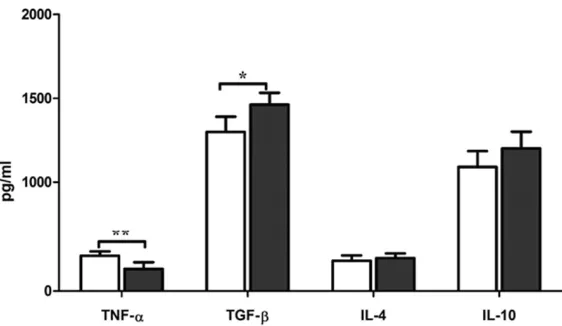
respons-es for a vaccine against FMDV. However, the underlying reason for this increase remained unknown, and we speculated that the orally administered SW1 induced cytokine changes within the mice. To address this question, BALB/c mice were orally administrated with SW1 and mouse serum cytokine levels were evaluated over time. As shown in Figure 1, serum levels of TNF-α significantly decreased on day 6 post-administration, while levels of TGF-β were increased in sera from mice treated
serum was decreased after SW1 treatment. These results demonstrated that consuming probiotic SW1 induces profound changes in humoral immune responses.
SW1 treatment increases the frequency of sys-temic regulatory T cells
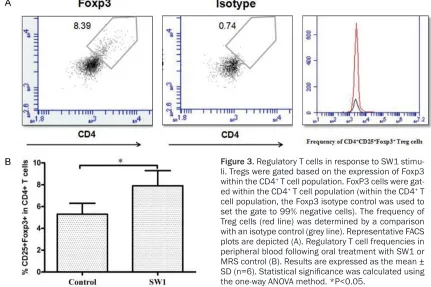
[image:3.612.93.374.70.233.2]We further questioned whether the blood Treg cell population was changed in mice after orally administrated with SW1. CD4+ Tregs were de-
Figure 1. Serum cytokine pattern of BALB/c mice receiving oral
adminis-tration of SW1. TNF-α, TGF-β, IL-4 and IL-10 levels in sera were measured
by ELISA on day 6 after receiving oral administration of SW1. Data are ex-pressed as the mean ± standard deviation (SD). The assay was repeated
twice. Statistical significance was calculated using the one-way ANOVA meth -od. *P<0.05, **P<0.01.
Figure 2. Quantitative detection of mouse serum immunoglobulin isotypes
following probiotic treatment by flow cytometry. Sera were collected 6 days
after mice received a daily dose (2~5×10⁹ CFU) of SW1 for consecutive 5 days. A Mouse Immunoglobulin Isotyping Panel 6plex FlowCytomix Multiplex Kit was used to measure immunoglobulin isotypes IgA, IgG1, IgG2a, IgG2b
and IgM. Data are expressed as the mean ± SD (n=6). Statistical significance
was calculated using the one-way ANOVA method. *P<0.05, **P<0.01.
with SW1 compared to those in the control mice. The con-centrations of IL-4 and IL-10 were not affected.
SW1 modifies the systemic concentration of immuno-globulin isotypes
Next, we evaluated whether SW1 activated adaptive imm- une responses and influenced the systemic concentration of different Ig isotypes. For this, we collected the sera from the various groups of mice follow-ing oral administration with SW1, and the production of Ig isotypes was quantified by fl- ow cytometry.
[image:3.612.92.375.328.501.2]fined on the basis of Foxp3 (Figure 3) and CD25+ expression compared to the total CD4+ T
cell population. As shown in Figure 3B, the fre-quency of CD4+CD25+Foxp3+ Tregs increased
after treatment with SW1 compared to treat-ment with MRS alone.
Discussion
Immunomodulation by probiotics have been widely investigated during the last several de- cades. In particular, probiotics, including some LABs, were able to alleviate inflammatory symp-toms and modulate immune response [9, 10]. In this study, the ability of a strain SW1 to regu-late murine immune responses was evaluated by analyzing systemic cytokine profiles and peripheral blood T lymphocytes, and the chang-es in systemic concentration of immunoglobu-lin isotypes. We demonstrated that consump-tion of this probiotic bacterial strain induced profound changes in both the humoral and cel-lular adaptive immune responses in vivo. High TNF-α levels are correlated with severe diarrhea in children [11] and disease progres-sion of many inflammatory conditions [12, 13]. In some cases, inflammation can cause
inflam-matory disease in the intestine. Therefore, the inhibition of inflammation or inflammatory cyto-kines such as TNF-α is critical for maintaining intestinal homeostasis. One well-known meth-od to inhibit TNF-α activity in TNF-α-mediated diseases is administration of TNF-α antagonist, such as etanercept and golimumab, some of which are currently in clinical practice, as previ-ously reviewed [14]. Our data demonstrated that oral administration of SW1 strongly inhibits systemic TNF-α production (Figure 1). As shown in our study, administration of L. acidophilus might present an alternative method to inhibit TNF-α production, which is consistent with pre-vious studies. For instance, oral administration of Lactobacillus delbrueckii subsp. Bulgaricus OLL1073R-1 to DBA mice inhibits TNF-α and IL-6 secretion [15]. Our data suggested that SW1 may be a promising probiotic to prevent allergy and/or chronic inflammation in healthy individuals.
CD4+CD25+Foxp3+ regulatory T cell is a
[image:4.612.90.521.76.363.2]subpop-ulation of T cells which modulate the immune system and maintain tolerance to self-antigen. Recent studies revealed that oral intake of Lactobacillus rhamnosus suppresses Th1 and Th2 cytokines in asthma mouse model by Figure 3. Regulatory T cells in response to SW1 stimu-li. Tregs were gated based on the expression of Foxp3 within the CD4+ T cell population. FoxP3 cells were
gat-ed within the CD4+ T cell population (within the CD4+ T
cell population, the Foxp3 isotype control was used to set the gate to 99% negative cells). The frequency of Treg cells (red line) was determined by a comparison with an isotype control (grey line). Representative FACS plots are depicted (A). Regulatory T cell frequencies in peripheral blood following oral treatment with SW1 or MRS control (B). Results are expressed as the mean ±
SD (n=6). Statistical significance was calculated using
CD4+CD25+Foxp3+ Tregs cell-mediated
mecha-nism [16]. In our study, the increased popula-tion of CD4+CD25+Foxp3+ Tregs was also ob-
served in probiotic-treated mice, and high TGF-β levels were also obtained. TGF-β is a powerful pleiotropic cytokine and produced by Tregs, with immune-suppressing and anti-inflammatory properties [13, 17]. Collectively, the suppression of TNF-α production in this study might be a consequence of the anti-inflammatory properties of Tregs [18], as dem-onstrated by the simultaneous increase of Tregs and TGF-β and decrease of TNF-α in our experiments (Figures 1 and 3).
Probiotics have been reported to modulate sys-temic Ig isotypes in the host [19]. Ingesting yogurt containing L. acidophilus and Bifido- bacterium have been shown to potentiate the IgA response [20]. In this study, we further showed that systemic IgA and IgG1 levels were enhanced in mice treated with SW1 (Figure 2). Therefore, oral intake of lactobacillus acidophi-lus can modulate systemic Ig responses in mice, which might also occur in a Treg-depen- dent manner.
In conclusion, we demonstrated in the current study that systemic immunomodulation occurs following oral administration of SW1 in healthy mice. This study also showed that oral adminis-tration of SW1 strain predominately inhibits TNF-α and induces Tregs in mice, suggesting that the suppression of inflammatory respon- se might be resulted from the increases in CD4+CD25+Foxp3+ regulatory T cell population. Acknowledgements
This study was supported in part by Talent Train- ing Project for Kunming University of Science and Technology (KKSY201560004).
Disclosure of conflict of interest
None.
Address correspondence to: Drs. Junhong Su and Xiangyang Kong, Medical Faculty, Kunming Univer- sity of Science and Technology, No. 727 South Jing- ming Road, Chenggong District, Kunming 650500, China. Tel: +86-871-65919293; Fax: +86-871-6591- 9293; E-mail: [email protected] (JHS); [email protected] (XYK)
References
[1] Borruel N. [Probiotics and prebiotics in inflam -matory bowel disease]. Gastroenterol Hepatol 2007; 30: 419-425.
[2] Hempel S, Newberry SJ, Maher AR, Wang Z, Miles JN, Shanman R, Johnsen B and Shekelle PG. Probiotics for the prevention and treat-ment of antibiotic-associated diarrhea: a sys-tematic review and meta-analysis. JAMA 2012; 307: 1959-1969.
[3] Fujiwara D, Inoue S, Wakabayashi H and Fujii T. The anti-allergic effects of lactic acid bacteria are strain dependent and mediated by effects on both Th1/Th2 cytokine expression and bal-ance. Int Arch Allergy Immunol 2004; 135: 205-215.
[4] Zhao HM, Huang XY, Zuo ZQ, Pan QH, Ao MY, Zhou F, Liu HN, Liu ZY and Liu DY. Probiotics increase T regulatory cells and reduce severity of experimental colitis in mice. World J Gas- troenterol 2013; 19: 742-749.
[5] Lin YP, Thibodeaux CH, Pena JA, Ferry GD and Versalovic J. Probiotic Lactobacillus reuteri
suppress proinflammatory cytokines via c-Jun. Inflamm Bowel Dis 2008; 14: 1068-1083.
[6] Borruel N, Carol M, Casellas F, Antolin M, de Lara F, Espin E, Naval J, Guarner F and Mala- gelada JR. Increased mucosal tumour necrosis factor alpha production in Crohn's disease can be downregulated ex vivo by probiotic bacteria. Gut 2002; 51: 659-664.
[7] Sanders ME and Klaenhammer TR. Invited
re-view: the scientific basis of Lactobacillus aci -dophilus NCFM functionality as a probiotic. J Dairy Sci 2001; 84: 319-331.
[8] Su J, Li J, Zheng H, You Y, Luo X, Li Y, Li X, Ma X, Li J, Dou Y and Cai X. Adjuvant effects of L. aci-dophilus LW1 on immune responses to the foot-and-mouth disease virus DNA vaccine in mice. PLoS One 2014; 9: e104446.
[9] Segawa S, Nakakita Y, Takata Y, Wakita Y, Kan- eko T, Kaneda H, Watari J and Yasui H. Effect of oral administration of heat-killed Lactobacillus brevis SBC8803 on total and
ovalbumin-spe-cific immunoglobulin E production through the
improvement of Th1/Th2 balance. Int J Food Microbiol 2008; 121: 1-10.
[10] Tobita K, Yanaka H and Otani H. Anti-allergic effects of Lactobacillus crispatus KT-11 strain on ovalbumin-sensitized BALB/c mice. Anim Sci J 2010; 81: 699-705.
[11] Jiang B, Snipes-Magaldi L, Dennehy P, Keyser- ling H, Holman RC, Bresee J, Gentsch J and Glass RI. Cytokines as mediators for or effec-tors against rotavirus disease in children. Clin Diagn Lab Immunol 2003; 10: 995-1001. [12] Bradley JR. TNF-mediated inflammatory dis
[13] Landskron G, De la Fuente M, Thuwajit P,
Thuwajit C and Hermoso MA. Chronic inflam -mation and cytokines in the tumor microenvi-ronment. J Immunol Res 2014; 2014: 149185. [14] Tracey D, Klareskog L, Sasso EH, Salfeld JG
and Tak PP. Tumor necrosis factor antagonist mechanisms of action: a comprehensive re-view. Pharmacol Ther 2008; 117: 244-279. [15] Kano H, Mogami O and Uchida M. Oral
admin-istration of milk fermented with Lactobacillus delbrueckii ssp. bulgaricus OLL1073R-1 to
DBA/1 mice inhibits secretion of proinflamma -tory cytokines. Cytotechnology 2002; 40: 67-73.
[16] Jang SO, Kim HJ, Kim YJ, Kang MJ, Kwon JW, Seo JH, Kim HY, Kim BJ, Yu J and Hong SJ. Asthma Prevention by Lactobacillus Rham- nosus in a Mouse Model is Associated With CD4(+)CD25(+)Foxp3(+) T Cells. Allergy Asth- ma Immunol Res 2012; 4: 150-156.
[17] Hong T, Xing J, Li L and Tyson JJ. A mathemati-cal model for the recipromathemati-cal differentiation of T helper 17 cells and induced regulatory T cells. PLoS Comput Biol 2011; 7: e1002122.
[18] Afzali B, Lombardi G, Lechler RI and Lord GM. The role of T helper 17 (Th17) and regulatory T cells (Treg) in human organ transplantation and autoimmune disease. Clin Exp Immunol 2007; 148: 32-46.
[19] Al-Dohail MA, Hashim R and Aliyu-Paiko M. Effects of the probiotic, Lactobacillus acidophi-lus, on the growth performance, haematology parameters and immunoglobulin
concentra-tion in African Catfish (Clarias gariepinus, Bur-chell 1822) fingerling. Aquaculture Research
2009; 40: 1642-1652.
[20] Tejada-Simon MV, Lee JH, Ustunol Z and Pestka JJ. Ingestion of yogurt containing Lacto-
![2 [(E) Benzyliminomethyl] 4 methylphenol](data:image/gif;base64,R0lGODlhAQABAIAAAP///wAAACH5BAEAAAAALAAAAAABAAEAAAICRAEAOw==)