CUNI Experiments for WMT17 Metrics Task
David Mareˇcek Ondˇrej Bojar
Ondˇrej H¨ubsch Rudolf Rosa Duˇsan Variˇs
Charles University, Faculty of Mathematics and Physics Institute of Formal and Applied Linguistics
Malostransk´e n´amˇest´ı 25, 118 00 Prague, Czech Republic
[email protected], [email protected]
Abstract
In this paper, we propose three different methods for automatic evaluation of the machine translation (MT) quality. Two of the metrics are trainable on direct-assessment scores and two of them use de-pendency structures. The trainable metric AutoDA, which uses deep-syntactic fea-tures, achieved better correlation with hu-mans compared e.g. to the chrF3 metric. 1 Introduction
With the ongoing research of the machine transla-tion (MT) systems in the past the need for accu-rate automatic evaluation of the translation quality became unquestionable. Even though the human judgment of the MT system outputs still holds as the most reliable form of evaluation, the high cost of human evaluation together with the amount of time required for such evaluation makes human judgment unsuitable for large scale experiments where we need to evaluate many different system configurations in a relatively short timespan. An additional important limitation of human evalua-tion is that it cannot be exactly repeated. This led to development of various methods for automatic MT evaluation in the past with the aim to elimi-nate the need for the expensive human assessment of the developed MT systems.
In this paper we suggest three novel methods for automatic MT evaluation together with their direct comparison:
1. AutoDA: A linear regression model using semantic features trained on WMT Direct Assessment scores (Bojar et al., 2016) or HUMEseg scores (Birch et al.,2016).
2. TreeAggreg: N-gram based metric computed over aligned syntactic structures instead of
the linear representation of the translated sen-tences.
3. NMTScorer: A neural sequence classifier which assigns correct/incorrect flags to the evaluated sentence segments.
Table 1 shows the main properties of the pro-posed methods. Some of them were mainly devel-oped for Czech as the target language and were later modified to be applied to other languages. The differences in the data preprocessing and their impact on the resulting evaluator are also de-scribed in this paper.
2 AutoDA: Automatic Direct Assessment AutoDA is a sentence-level metric trainable on any direct assessment scores. The metric is based on a simple linear regression combining several features extracted from the automatically aligned translation-reference pair. There may be also other established metrics within the features.
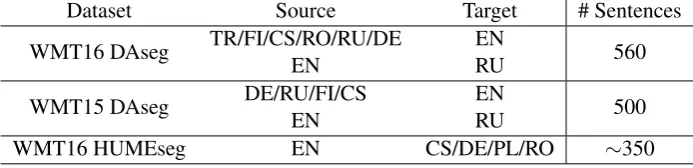
The training data with golden direct-assessment scores available are shown in Table2.
We describe two variants. The first one works only on Czech and uses many semantic features based of rich Czech tectogrammatical annotation (B¨ohmov´a et al., 2003). The second one uses much fewer features, however, it is language uni-versal and needs only a dependency parsing model available.
2.1 AutoDA Using Czech Tectogrammatics This metric automatically parses the Czech trans-lation candidate and the reference transtrans-lation and uses various semantic features to compute the final score.
2.1.1 Word Alignment
AutoDA relies on automatic alignment between the translation candidate and the reference
Method Resource Type Trainable Metric Type
AutoDA Monolingual/Bilingual* Yes Segment-level Linear Regression
TreeAggreg Monolingual No Tree Segment-level ChrF**
[image:2.595.105.495.62.118.2]NMTScorer Bilingual Yes Segment-level Classification
Table 1: Overview of the examined methods. Currently, AutoDA uses only monolingual resources even though extracting additional features from the bilingual data (*) is possible. TreeAggreg can use any string-level metric for score computation instead of ChrF (**).
Dataset Source Target # Sentences
WMT16 DAseg TR/FI/CS/RO/RU/DEEN RUEN 560
WMT15 DAseg DE/RU/FI/CSEN RUEN 500
WMT16 HUMEseg EN CS/DE/PL/RO ∼350
Table 2: Overview of the available data for training AutoDA.
lation. The easiest way of obtaining word align-ments is to run GIZA++ (Och and Ney,2000) on the set of sentence pairs. GIZA++ was designed to align documents in two languages and it can obvi-ously also align documents in a single language, although it does not benefit in any way from the fact that many words are identical in the aligned sentences. GIZA++ works well if the input corpus is sufficiently large, to allow for extraction of reli-able word co-occurrence statistics. While the test sets alone are too small, we have a corpus of para-phrases for Czech (Bojar et al., 2013). We thus run GIZA++ on all possible paraphrase combina-tions together with the reference-translation pairs we need to align and then extract alignments only for the sentences of interest.
2.1.2 Tectogrammatical Parsing
We use Treex1framework (Popel and ˇZabokrtsk´y,
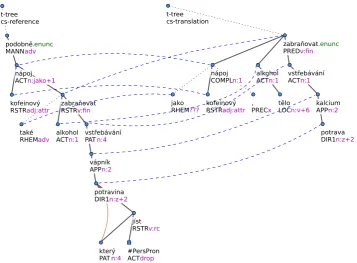
2010) to do the tagging, parsing and tectogram-matical annotation. Tectogramtectogram-matical annotation of sentence is a dependency tree, in which only content words are represented by nodes. The main label of the node is a tectogrammatical lemma – mostly the same as the morphological lemma, sometimes combined with a function word in case it changes its meaning. Other function words and grammatical features of the words are expressed by other attributes of the tectogrammatical node. An example of a pair of tectogrammatical trees is provided in Figure1. The main attributes are:
• tectogrammatical lemma (t-lemma): the lexical value of the node,
1http://ufal.mff.cuni.cz/treex
• functor: the semantic value of the syntac-tic dependency relation. Functors express the functions of individual modifications in the sentence, e.g. ACT (Actor), PAT (Pa-tient), ADDR (Addressee), LOC (Location), MANN (Manner),
• sempos: semantic part of speech: n (noun), adj (adjective), v (verb), or adv (adverbial),
• formeme: morphosyntactic form of the node. The formeme includes for example preposi-tions and cases of the nouns, e.g. n:jako+1
for nominative case with prepositionjako.
• grammatemes: tectogrammatical counter-parts of morphological categories, such as number, gender, person, negation, modality, aspect, etc.
[image:2.595.125.472.178.262.2]t-tree cs-reference
podobně.enunc MANNadv
kofeinový RSTRadj:attr
nápoj ACTn:jako+1
také
RHEMadv alkoholACTn:1 zabraňovat RSTRv:fin
vstřebávání PATn:4
vápník APPn:2
potravina DIR1n:z+2
který
PATn:4 #PersPronACTdrop jíst RSTRv:rc
t-tree cs-translation
jako
RHEM??? kofeinovýRSTRadj:attr nápoj COMPLn:1
, PRECx
alkohol ACTn:1
tělo LOCn:v+6
zabraňovat.enunc PREDv:fin
vstřebávání ACTn:1
kalcium APPn:2
[image:3.595.120.478.59.322.2]potrava DIR1n:z+2
Figure 1: Example of aligned tectogrammatical trees of the reference “Podobnˇe jako kofeinov´y n´apoj tak´e alkohol zabraˇnuje vstˇreb´av´an´ı v´apn´ıku z potravin, kter´e j´ıme.” and the candidate translation“Jako kofeinov´y n´apoj, alkohol v tˇele zabraˇnuje vstˇreb´av´an´ı kalcia z potravy.”
2.1.4 Linear Regression Training
We collect 83 various features based on match-ing tectogrammatical attributes computed on all nodes or a subsets defined by particular seman-tic part-of-speech tags. To this set of features, we add two BLEU scores (Papineni et al.,2002) computed on forms and on lemmas and two chrF3 scores (Popovic,2015) computed on trigrams and sixgrams, so we have 87 features in total.
We train a linear regression model to obtain a weighted mix of features that fits best the WMT16 HUMEseg scores. Since the amount of annotated data available is low, we use the jackknife strategy:
• We split the annotated data into ten parts.
• For each tenth, we train the regression on all the rest data and apply it to this tenth.
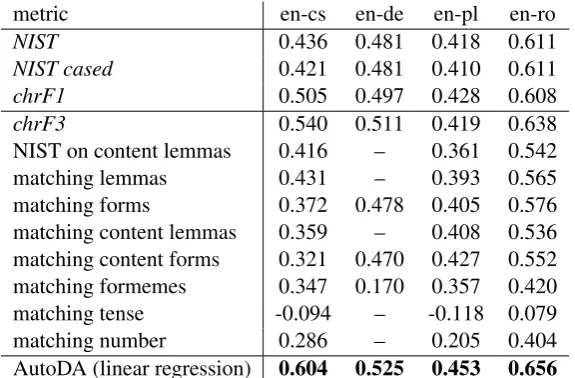
By this procedure, we obtain automatically as-signed scores for all sentences in the data. The cor-relation coefficients are shown in Table 3, along with the individual features.
In addition to the regression using all 87 fea-tures, we also did a feature selection, in which we manually chose only 23 features with a posi-tive impact on the overall correlation score. For instance, we found that the BLEU scores can be
metric en-cs
aligned-tnode-tlemma-exact-match 0.449 aligned-tnode-formeme-match 0.429 aligned-tnode-functor-match 0.391 aligned-tnode-sempos-match 0.416 lexrf-form-exact-match 0.372 lexrf-lemma-exact-match 0.436
BLEU on forms 0.361
BLEU on lemmas 0.395
chrF3 0.540
AutoDA (87 features) 0.625
AutoDA (selected 23 features) 0.659
Table 3: Selected Czech deep-syntactic features and their correlation against WMT16 HUMEseg dataset. Comparison with BLEU, chrF3, and our trainable AutoDA (using chrF3 as well).
easily omitted without worsening the correlation. Conversely, the chrF scores are very valuable and omiting them would lower the correlation signifi-cantly.
[image:3.595.316.519.398.562.2]2.2 Language Universal AutoDA
We have seen that deep-syntactic features help to train an automatic metric with higher correlation for Czech. Even though we have no similar tools for other languages so far, we try to extract simi-lar features for them as well. The source code is available online.2
2.2.1 Universal Parsing
We use Universal Dependencies (UD) by Nivre et al.(2016b), a collection of treebanks in a com-mon annotation style, where all our testing guages are present – version 1.3 covers 40 lan-guages (Nivre et al., 2016a). For syntactic anal-ysis, we use UDPipe byStraka et al.(2016), a to-kenizer, tagger, and parser in one tool, which is trained on UD. The UD tagset consists of 17 POS tags; the big advantage is that the tagset is the same for all the languages and therefore we can easily extract e.g. content words, prepositional phrases, etc.
2.2.2 Monolingual Alignment
Unlike from Czech, we did not known about the existing corpus of paraphrases available across other languages,3 so we used a simple
monolin-gual aligner based on word similarities and rel-ative positions in the sentence. Our implemen-tation is inspired by the heuristic Monolingual Greedy Aligner written by Martin Popel (Rosa et al.,2012), which is available in the Treex frame-work.4
First, we compute scores for all possible align-ment connections between tokens of the reference and translated sentence:
score(i, j) =w1JaroWinkler(Wit, Wjr) +w2I(Tit=Tjr)
+w3(1− |(i/len(t)−j/len(r)|),
(1)
where JaroWinkler(Wt
i, Wjr)defines similarity
between the given words (Winkler,1990),I(Tit=
Tjr) is a binary indicator testing the identity of
POS tags, and(1−|(i/len(t)−j/len(r)|)tells us how close are the two words according to their rel-ative positions in the sentences. The weights were
2https://github.com/ufal/auto-hume 3Multilingual corpus of paraphrases has been released by Chris Callison-Burch’s group and is available here: http: //paraphrase.org/#/download
4https://github.com/ufal/treex/
set manually to w1 = 8, w2 = 3, andw3 = 3;
they were not tuned for this specific task. When we have the scores, we can simply produce uni-directional alignments (i.e. find the best token in the translation for each token in the reference and vice versa) and then symmetrize them to create in-tersection (one-to-one) or union (many-to-many) alignments. We finally use union symmetrization, since it achieved slightly better correlation with humans.
2.2.3 Extracting Features
We distinguish content words from function ones by the POS tag. The tags for nouns (NOUN, PROPN), verbs (VERB), adjectives (ADJ), and adverbs (ADV) correspond more or less to content words. Then there are pronouns (PRON), symbols (SYM), and other (X), which may be sometimes content words as well, but we do not count them. The rest of POS tags represent function words.
Now, using the alignment links and the content words, we can compute numbers of matching con-tent word forms and matching concon-tent word lem-mas. The universal annotations contains also mor-phological features of words: case, number, tense, etc. Therefore, we also create equivalents of tec-togrammatical formemes or grammatemes. Our features can thus check for instance the percent-age of aligned words with matching morphologi-cal number or tense.
2.2.4 Regression and Results
We compute all the scores proposed in the pre-vious section on the four languages and test the correlation on WMT16 HUMEseg dataset (Birch et al.,2016). German UD annotation does not con-tain lemmas and morphological features, so some scores for German could not be computed.
Similarly as in Section2.1.4, we trained a lin-ear regression on all the features together with
chrF3 score. The results computed by 10-fold cross-validation on WMT16 HUMEseg dataset and comparison with chrF and NIST5 scores is
shown in Table4.
3 Tree Aggregated Evaluation
metric en-cs en-de en-pl en-ro
NIST 0.436 0.481 0.418 0.611
NIST cased 0.421 0.481 0.410 0.611
chrF1 0.505 0.497 0.428 0.608
chrF3 0.540 0.511 0.419 0.638
NIST on content lemmas 0.416 – 0.361 0.542
matching lemmas 0.431 – 0.393 0.565
matching forms 0.372 0.478 0.405 0.576
matching content lemmas 0.359 – 0.408 0.536 matching content forms 0.321 0.470 0.427 0.552 matching formemes 0.347 0.170 0.357 0.420
matching tense -0.094 – -0.118 0.079
matching number 0.286 – 0.205 0.404
[image:5.595.156.444.62.251.2]AutoDA (linear regression) 0.604 0.525 0.453 0.656
Table 4: Pearson correlations of different sentence-level metrics on WMT16 HUMEseg dataset. Standard NIST and chrF metrics are compared with our individual features matching. AutoDA combines all the features together with the chrF3 score and the NIST score computed on content lemmas only. Other NIST scores are not included in AutoDA, since they do not bring any improvement.
a metric template, for in principle, any string-based MT metric can be plugged into it; we used chrF3 (Popovic,2015) in our work.
In TreeAggreg, we are trying to improve an existing string-based metric by applying it in a syntax-tree-based context. This is motivated by our belief that dependency trees are a good means of capturing sentence structure, which may be rel-evant for MT evaluation metrics, as the MT out-put should presumably transfer the information present in the source sentence into a similar syn-tactic structure as the reference translation uses. However, in string-based MT metrics, the syntac-tic structure of a sentence is typically ignored.
In our rather light-weight attempt to employ syntactic analysis in MT evaluation, we segment the sentences into phrases based on their depen-dency parse trees, and evaluate these phrases inde-pendently with the string-based MT metric. The resulting scores are then aggregated into a final sentence-level score using a simple weighted av-erage.
Our source codes are available online.6
3.1 Method
To be able to apply TreeAggreg to measuring the correspondence of a translationtto the reference r, we first need to apply a set of NLP tools in a
pre-processing pipeline:
6https://github.com/ufal/auto-hume/
tree/rudolf
1. align reference and translation
2. parse reference
3. parse translation
We use the monolingual aligner presented in Sec-tion2.2.2, using the unidirectional alignment from reference to translation; i.e. for each reference word we get exactly one translation word aligned to it (not necessarily unique). We use the UDPipe tool to provide the dependency parse trees (see Section2.2.1).
Next, both the reference and the translation are split into the following types of segments:
1. the whole sentence (sr,st)
2. the sentence root (rr,rt)
3. for each immediate dependent (dir,dit) of the
root, the continuous span defined by its sub-tree (pi
r,pit)
Whole sentence This is simply the base string-based MT metric applied in the standard way. Sentence root The sentence root is selected ac-cording to the parse trees; usually this is the main verb in the sentence.
spans, and the word alignment to identify the cor-responding spans in the translation:
• pircontains all words fromsrthat are
transi-tively dependent ondi
r, theith dependent of
rr;pirincludesdirbut excludesrr
• pit contains the first and last word from st
which are aligned to any of the words inpi r,
and all of the words between them
The string-level metricm(r, t)is then computed
on each corresponding pair of the reference and translation segments. A weighted average of the segment-level scores is computed, where longer segments are given higher weight: the weight is the sum of the numbers of words in the reference segment and in the translation segment. Addition-ally, for the (sr,st) segment pair, which is still the
most important component of the metric, we use a double weight. Thus, the final scoremis
com-puted as follows:
ms =m(sr, st)·(|sr|+|st|)·2
mr =m(rr, rt)·2
mip =m(pir, pit)·(|pir|+|pit|)
m = ms+mr+ P
i∈Dep(rr)m i p 2|sr|+ 2|st|+ 2 +Pi∈Dep(rr)|p
i
r|+|pit|
Dep(rr)are all immediate dependents ofrr.
3.2 Development
When developing the TreeAggreg metric, we tried multiple configurations, evaluating each of them on the WMT16 HUMEseg dataset for correlation with human judgments, and then selected the one that performed best, which we have just described. For example, we also experimented with more fine-grained segmentations, such as taking each node together only with its immediate dependents as a span. However, such setups performed poorer, probably because they depend more heavily on the high structural similarity of the translation to the reference. Still, it seems reasonable to assume that at least the arguments of the root node should usu-ally correspond well between the reference and the candidate translation.
We also tried to put more weight to certain words that we expected to be more important, such asdir(immediate dependents of the rootrr)
How-ever, this always led to a deterioration in the corre-lation of the metric to human judgments. Thus, an
Lang. chrF3 TreeAggreg Difference
en-cs 0.5403 0.5473 +0.0070
en-de 0.5111 0.5078 −0.0033
en-pl 0.4186 0.4266 +0.0080
en-ro 0.6314 0.6226 −0.0088
[image:6.595.311.524.62.152.2]Average 0.5254 0.5261 +0.0007
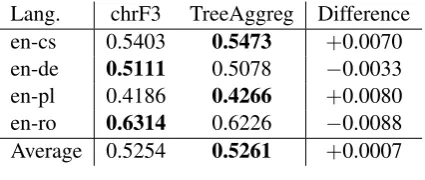
Table 5: Evaluation of TreeAggreg (our metric) and chrF3 (baseline) with Pearson’s correlation to human judgments.
important property of our metric seems to be that each reference word is taken into account exactly twice.7
3.3 Evaluation
To evaluate our metric, we measured Pearson’s correlation of chrF3-based TreeAggreg scores with sentence-level human judgments on the WMT16 HUMEseg dataset. For comparison, we also measure the correlation of a baseline metric, which is the vanilla sentence-level chrF3.
As shown in Table5, our metric performs com-parably to the chrF3 baseline, leading to a slight improvement for two language pairs, and a slight deterioration for the other two.
Thus, our approach of employing sentence syn-tactic structure into a string-based MT metric seems to affect the metric only minimally. More-over, the TreeAggreg metric was developed and evaluated on the same data and therefore the com-parison in Table 5 is not quite fair, however, the number of configurations tested was very little.
4 Neural MT Scorer
Neural MT Scorer is a model that predicts a proba-bility for a given source/target translation pair us-ing a simplified architecture that is based on ex-isting NMT models with attention. The predicted number should reflect how much the meaning of source and target matches. We used that model for a different task (scoring phrase table entries in PBMT) where it performed well. Note that as of now, Neural MT Scorer indeed does not make any use of the reference translation, so it is effectively a quality estimation method.
The training data for the model are bilingual corpus (set of sentences that should be classified
7The same holds for words in the translation only if the pi
tspans do not overlap, are contiguous, include both the first
as entirely correct) as well as a set of sentences that should be classified as incorrect (we obtain these by performing some random operations on the bilingual corpus). We do not train it on data specific for the metrics task (i.e. the model is only trained to recognize correct and incorrect transla-tions, but small differences among different trans-lations of the same sentence might not be recog-nized), therefore there is a room for potential im-provement.
We do not use any smoother labeling than 0/1 (correct/incorrect), since even a single word omis-sion may cause completely different meaning of the sentence. At inference time, the output is a float number between 0 and 1.
4.1 Architecture
We use two LSTM encoders, one for source and one for target side. The vector representations of the source words are fed into the source LSTM encoder to obtain one representationpsof the
en-tire sentence. Also, the intermediate outputs of the source LSTM encoder are used in an attentional layer when processing the target sentence in the target LSTM encoder. The final cell statespsand
ptare used to measure the bilingual similarity by
σ(pTspt). The entire architecture is very similar to
(Bahdanau et al.,2014), except that we use the at-tention mechanism while encoding the target side. Note that there is also no softmax layer over the word dictionary – we know the entire source and target sentences and so we do not need to predict the next word; we just need one score between 0 and 1. This should allow for faster training of the model; however, we need to provide labeled train-ing data. We currently generate wrong sentences using these basic operations:
• change a few words to completely random ones from the source/target dictionary
• take a translation of a completely different sentence
• utilize WordNet to change the polarity of a sentence
• remove/add some random words at a random place
4.2 Evaluation
We evaluated the model on the WMT16 HUME-seg dataset, but currently it performs poorly. It
Languages NMT Scorer
en-cs 0.4099
en-de 0.3462
en-pl 0.3261
en-ro 0.4792
[image:7.595.354.484.60.144.2]Average 0.3903
Table 6: Evaluation of NMT Scorer with Pearson correlation to human judgments.
should be possible to improve it significantly by optimizing the training process for the metrics task (for example by adding another layer that uses the final representations ps and pt to predict human
scores and finetune the entire model on some man-ually evaluated datasets). The Pearson correlation coefficients to human judgements are shown in Ta-ble6.
5 Conclusion
We presented three metrics. AutoDA is a trainable metric combining syntactic features matching and chrF and naturally significantly outperforms chrF on all four tested languages.
In TreeAggreg, we tried to enrich a string-based MT metric with light-weight information about the syntactic structure of the sentences, but the re-sults seem rather disappointing.
NMTScorer in which we used two LSTM en-coders for source sentence and candidate transla-tion and predicted sentence similarity also did not prove to work well.
Acknowledgments
This work has been in part supported by the Eu-ropean Union’s Horizon 2020 research and in-novation programme under grant agreements No 644402 (HimL) and 645452 (QT21), by the LIN-DAT/CLARIN project of the Ministry of Ed-ucation, Youth and Sports of the Czech Re-public (projects LM2015071 and OP VVV VI CZ.02.1.01/0.0/0.0/16 013/0001781), by the grant No. DG16P02B048 of the Ministry of Culture of the Czech Republic and by the SVV 260 453 grant.
References
Alexandra Birch, Omri Abend, Ondrej Bojar, and Barry Haddow. 2016. HUME: Human UCCA-based evaluation of machine translation. arXiv preprint arXiv:1607.00030.
Alena B¨ohmov´a, Jan Hajiˇc, Eva Hajiˇcov´a, and Barbora Hladk´a. 2003. The Prague dependency treebank. In Treebanks, Springer, pages 103–127.
Ondˇrej Bojar, Matouˇs Mach´aˇcek, Aleˇs Tamchyna, and Daniel Zeman. 2013. Scratching the Surface of Possible Translations. In Proc. of TSD 2013. Z´apadoˇcesk´a univerzita v Plzni, Springer Verlag, Berlin / Heidelberg, Lecture Notes in Artificial In-telligence.
Ondˇrej Bojar, Rajen Chatterjee, Christian Feder-mann, Yvette Graham, Barry Haddow, Matthias Huck, Antonio Jimeno Yepes, Philipp Koehn, Varvara Logacheva, Christof Monz, Matteo Negri, Aurelie Neveol, Mariana Neves, Martin Popel, Matt Post, Raphael Rubino, Carolina Scarton, Lucia Specia, Marco Turchi, Karin Verspoor, and Marcos Zampieri. 2016. Findings of the 2016 conference on machine translation. In Proceedings of the First Conference on Ma-chine Translation. Association for Computational Linguistics, Berlin, Germany, pages 131–198. http://www.aclweb.org/anthology/W/W16/W16-2301.
Joakim Nivre, ˇZ. Agi´c, L. Ahrenberg, M. J. Aranzabe, M. Asahara, A. Atutxa, M. Ballesteros, J. Bauer, K. Bengoetxea, Y. Berzak, R. A. Bhat, C. Bosco, G. Bouma, S. Bowman, G. Cebirolu Eryiit, Giuseppe G. A. Celano, C¸. C¸¨oltekin, M. Con-nor, Marie-Catherine de Marneffe, A. Diaz de Ilarraza, K. Dobrovoljc, T. Dozat, K. Droganova, T. Erjavec, R. Farkas, J. Foster, D. Galbraith, S. Garza, F.and Goenaga I. Ginter, K. Gojenola, M. Gokirmak, Y. Goldberg, X. G´omez Guinovart, B. Gonz´ales Saavedra, N. Gr¯uz¯itis, B. Guillaume, J. Hajiˇc, D. Haug, B. Hladk´a, R. Ion, E. Irimia, A. Johannsen, H. Kas¸kara, H. Kanayama, J. Kan-erva, B. Katz, J. Kenney, S. Krek, V. Laippala, L. Lam, A. Lenci, N. Ljubeˇsi´c, O. Lyashevskaya, T. Lynn, A. Makazhanov, C. Manning, C. M˘ar˘anduc, D. Mareˇcek, H. Mart´ınez Alonso, J. Maˇsek, Y. Mat-sumoto, R. McDonald, A. Missil¨a, V. Mititelu, Y. Miyao, S. Montemagni, K. S. Mori, S. Mori, K. Muischnek, N. Mustafina, K. M¨u¨urisep, V. Niko-laev, H. Nurmi, P. Osenova, L. Øvrelid, E. Pascual, M. Passarotti, C. Perez, S. Petrov, J. Piitulainen, B. Plank, M. Popel, L. Pretkalnia, P. Prokopidis, T. Puolakainen, S. Pyysalo, L. Ramasamy, L. Ri-tuma, R. Rosa, S. Saleh, B. Saul¯ite, S. Schuster, W. Seeker, M. Seraji, L. Shakurova, M. Shen, N. Sil-veira, M. Simi, R. Simionescu, K. Simk´o, K. Simov, A. Smith, C. Spadine, A. Suhr, U. Sulubacak, Z. Sz´ant´o, T. Tanaka, R. Tsarfaty, F. Tyers, S. Ue-matsu, L. Uria, G. van Noord, V. Varga, V. Vincze, Jing Xian Wang, J. N. Washington, Z. ˇZabokrtsk´y, Daniel Zeman, and Hanzhi Zhu. 2016a. Universal dependencies 1.3. LINDAT/CLARIN digital library
at the Institute of Formal and Applied Linguistics, Charles University. http://hdl.handle.net/11234/1-1699.
Joakim Nivre, Marie-Catherine de Marneffe, Filip Gin-ter, Yoav Goldberg, Jan Hajiˇc, Christopher Man-ning, Ryan McDonald, Slav Petrov, Sampo Pyysalo, Natalia Silveira, Reut Tsarfaty, and Daniel Zeman. 2016b. Universal Dependencies v1: A Multilingual Treebank Collection. InProceedings of the 10th In-ternational Conference on Language Resources and Evaluation (LREC 2016). European Language Re-sources Association, Portoroˇz, Slovenia.
Franz Josef Och and Hermann Ney. 2000. A Compar-ison of Alignment Models for Statistical Machine Translation. InProceedings of the 17th conference on Computational linguistics. Association for Com-putational Linguistics, pages 1086–1090.
Kishore Papineni, Salim Roukos, Todd Ward, and Wei-Jing Zhu. 2002. Bleu: A method for au-tomatic evaluation of machine translation. In Proceedings of the 40th Annual Meeting on As-sociation for Computational Linguistics. Asso-ciation for Computational Linguistics, Strouds-burg, PA, USA, ACL ’02, pages 311–318. https://doi.org/10.3115/1073083.1073135.
Martin Popel and Zdenˇek ˇZabokrtsk´y. 2010. Tec-toMT: Modular NLP framework. In Hrafn Lofts-son, Eirikur R¨ognvaldsLofts-son, and Sigrun Helgadot-tir, editors, Lecture Notes in Artificial Intelligence, Proceedings of the 7th International Conference on Advances in Natural Language Processing (Ic-eTAL 2010). Iceland Centre for Language Technol-ogy (ICLT), Springer, Berlin / Heidelberg, volume 6233 ofLecture Notes in Computer Science, pages 293–304.
Maja Popovic. 2015. chrF: character n-gram F-score for automatic MT evaluation. InProceedings of the 10th Workshop on Statistical Machine Translation (WMT-15). pages 392–395.
Rudolf Rosa, Ondˇrej Duˇsek, David Mareˇcek, and Mar-tin Popel. 2012. Using parallel features in pars-ing of machine-translated sentences for correction of grammatical errors. InProceedings of Sixth Work-shop on Syntax, Semantics and Structure in Statis-tical Translation (SSST-6), ACL. ACL, Jeju, Korea, pages 39–48.
Milan Straka, Jan Hajiˇc, and Strakov´a. 2016. UDPipe: trainable pipeline for processing CoNLL-U files per-forming tokenization, morphological analysis, pos tagging and parsing. In Proceedings of the Tenth International Conference on Language Resources and Evaluation (LREC’16). European Language Re-sources Association (ELRA), Paris, France.