Learning Household Task Knowledge from WikiHow Descriptions
Yilun Zhou MIT CSAIL yilun@ mit.edu
Julie A. Shah MIT CSAIL julie a shah@ csail.mit.edu
Steven Schockaert Cardiff University SchockaertS1@ cardiff.ac.uk
Abstract
Commonsense procedural knowledge is im-portant for AI agents and robots that operate in a human environment. While previous at-tempts at constructing procedural knowledge are mostly rule- and template-based, recent ad-vances in deep learning provide the possibil-ity of acquiring such knowledge directly from natural language sources. As a first step in this direction, we propose a model to learn em-beddings for tasks, as well as the individual steps that need to be taken to solve them, based on WikiHow1articles. We learn these embed-dings such that they are predictive of both step relevance and step ordering. We also experi-ment with the use of integer programming for inferring consistent global step orderings from noisy pairwise predictions.
1 Introduction
For AI agents to serve as competent (digital or physical) assistants in everyday environments, they need an understanding of the common tasks that people perform. In contrast to factual edge, which is encoded to some extent in knowl-edge graphs such as Freebase (Bollacker et al.,
2008), there are currently no resources that cap-ture such knowledge in a comprehensive way.
As a natural solution, in this paper, we con-sider the problem of learning procedural knowl-edge from text descriptions, focusing on house-hold tasks as a case study. There are two reasons for this particular focus. First, household tasks re-quire a rich amount of commonsense knowledge, which makes them challenging to deal with for AI agents. Second, learning such knowledge has im-portant applications in the context of household robots and smart home technologies, among oth-ers.
1https://www.wikihow.com
The biggest challenge associated with house-hold tasks is the lack of explicit structured infor-mation. While specialized datasets for some as-pects of household tasks are available (e.g. cook-ing recipes (Yagcioglu et al.,2018), in-home nav-igation commands (Matuszek et al., 2013), hu-man action trajectories for chores (Koppula and
Saxena,2013)), general information only exists in
natural language format as descriptions intended for human consumption. With recent advances in deep learning and text mining, it is natural to won-der whether, and to what extent, we can acquire knowledge about household tasks from existing textual sources. To start answering this question, in this paper we tap into WikiHow, one of the largest online databases of procedural knowledge. Our aim is to jointly learn two types of knowl-edge: (i) whether a certain step pertains to a cer-tain task and (ii) how to order two (potentially non-sequential) steps for a given task. We evaluate our learned model both in terms of the performance achieved on these two tasks and by analyzing the resulting embeddings.
2 Related Work
Knowledge Representation A large number of
knowledge graphs have already been constructed, capturing a wide variety of human knowledge. These graphs, such as Freebase (Bollacker et al.,
2008) and ConceptNet (Liu and Singh,2004), all share the common structure of using nodes to rep-resent concepts and using edges to reprep-resent rela-tions. Among many applications, Williams et al.
(2017) showed that ConceptNet can enable better story understanding by capturing some aspects of commonsense knowledge.
knowl-edge. In classical planning languages, such as PDDL (McDermott et al.,1998), the environment is described with a set of predicates and actions are defined in terms of pre-conditions and post-conditions. This turns planning into a search prob-lem. While efficient and provably optimal in small domains, it is hard to model the full spectrum of real world environments with such exact defini-tions. By contrast, in our work we take a comple-mentary approach, acquiring implicit knowledge from large amounts of data.
Embedding learning Vector space embeddings
are commonly used to represent the semantics of linguistic constructs such as words and sen-tences as vectors in a high-dimensional space. At word level, embedding models such as word2vec
(Mikolov et al., 2013) and GloVe (Pennington
et al., 2014) are trained based on linguistic
con-text, i.e. the representation of a word depends on the words surrounding mentions of that word in some text corpus. At sentence level, embeddings can be trained from context or learned for one or several downstream applications (Radford et al.,
2018;Devlin et al.,2018).
Embeddings for various other kinds of data have also been studied. For example,Chung and
Glass(2018) learn vector representations from
au-dio data. Moreover, a large number of methods for embedding graph and network structures have been proposed (Goyal and Ferrara,2018).
Script knowledge In our work, we learn
em-beddings for natural language instructions targeted to facilitate commonsense knowledge acquisition. One of the ways in which such embeddings can be used is to rank step instructions for a spe-cific task. Specifically, given the name of the task and two steps, all expressed in natural lan-guage, we want our model to predict which step should be done first, using only the embeddings of the task name and steps as input. This problem falls into the general category of learning script knowledge, for which several models have already been proposed. For example, Chambers and
Ju-rafsky(2009) proposed one of the first models to
learn script knowledge based on estimated mu-tual information between events. Modi and Titov
(2014) learned embeddings for events such that a linear ranking function operating on embedding space can be used to infer event orders. Pichotta
and Mooney (2016a) learned orders from parsed
event representation with a LSTM model.Pichotta
and Mooney(2016b) used a sentence-level LSTM
model that does not require explicit event parsing and extraction.
Knowledge Acquisition from WikiHow There
have been many works on collecting knowledge from the web. With specific focus on WikiHow,
Chu et al. (2017) used information retrieval and
embedding-based clustering to distill a knowledge base of task execution. By using the OpenIE sys-tem (Angeli et al., 2015), they inferred relations between tasks and steps so that the distilled knowl-edge base recognizes that the task in a WikiHow articleAis equivalent to a stepBin another Wik-iHow articleC, and the user, when reading article C can look up detailed instructions for stepB by reading the automatically linked articleA. In this way, a hierarchical structure among articles can be extracted.
Park and Motahari Nezhad(2018) used a
neu-ral network model to learn specific relations be-tween the steps of each task. Specifically, three re-lations is method of, is subtask of, and
is alternative of are learned using a hier-archical attention neural network that achieved su-perior performance than standard approaches us-ing an information extraction pipeline.
3 Method
3.1 Dataset Description
We collected a corpus consisting of all WikiHow articles under the category of “Home and Gar-den2”, which we believe is most relevant for our purpose of understanding household procedural knowledge. Each WikiHow article describes a par-ticular task, which is composed of a number of steps. Some example tasks are shown in Table
1. Each step is represented by a gist and an
ex-planation. The gist is a brief and concise
sum-mary of the step, such as “purchase packing sup-plies”. The corresponding explanation gives ad-ditional contexts and details to the gist. For the previous example, the explanation is as follows:
“Furniture should generally not be placed in a truck without wrapping it in some sort of protective material. After you’ve completed your inventory,
con-2https://www.wikihow.com/Category:
Remove Staples with Your Bare Hands Buy a Shipping Container
Pick Up Broken Glass Splinters Clean Fireplace Glass
[image:3.595.334.502.74.156.2]Clean an Espresso Machine
Table 1: A random sample of task titles
Shake your clothes Move the bowl
Dig a hole about 2 ft deep Take out the trash
Steam clean older carpets
Table 2: A random sample of task steps
sider what you’ll need to move each piece of furniture...”
Some additional examples of step gists as shown in Table2.
An additional particularity with WikiHow is that there are two types of article structures. About 30% of all articles have flat structures, which means that an article has a list of individual steps. The remaining ones have 2-level hierarchi-cal structures, which means that an article has sev-eral titled subsections, and each subsection has a list of individual steps. For example, an article on “clean kitchen” may include subsections on “or-ganize kitchen shelves”, “clean countertop”, and “remove oil stain on floor”. We found that subsec-tion titles are semantically and syntactically very similar to article titles, so we simply consider each subsection as a separate task. With this prepro-cessing, the dataset contains 12,431 articles with a total of 162,771 individual steps.3
3.2 Model Architecture
A task titletis a list ofl natural language words (w1, ..., wl). For each word, we use the pre-trained GloVe embedding (Pennington et al., 2014) to look up its vector representation. This embedding is fixed during training. Words which are not in the GloVe vocabulary are represented using a special <unk>token, the embedding for which is learned. We use~vito denote the embedding corresponding to the word wi. Hence the task title t is
repre-3The dataset and the model implementation can be
downloaded at https://github.com/YilunZhou/ wikihow-embedding/
Fill The Bucket With Clean Water . Word Embedding Layer
LSTM Network
Text Embedding
(a) Embedding of task title, step gist, and step explanation
Task Title Step Gist Step Explanation
Hidden Layer
Relevance Prediction
(b) Step relevance prediction
Step 1 Gist Step 1 Explanation Step 2 Gist Step 2 Explanation Task Title
Hidden Layer
Order Prediction
[image:3.595.311.523.94.388.2](c) Step order prediction
Figure 1: Model architecture
sented ast= (~v1, ..., ~vl). The representations for step gists and step explanations are analogous.
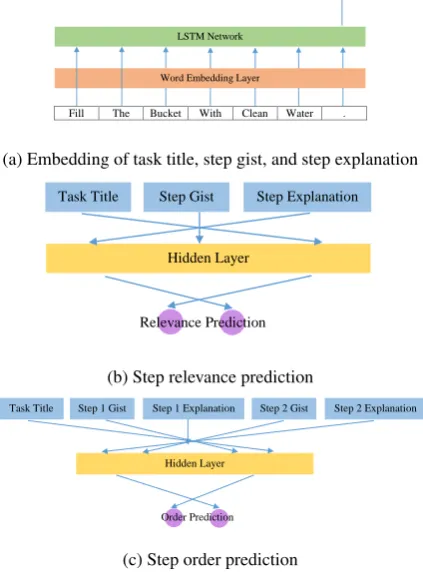
Figure 1 shows the general workflow of our model. First, three LSTM networks are used to encode the task titles, step gists and step expla-nations. The input to each of these LSTMs is a list of word vectors, as explained above, and the outputs are the corresponding embeddings, which are taken as the last hidden state of the LSTM en-coder. The initial hidden units and memory units of the LSTMs are initialized to 0 (and not updated during training).
3.3 Step Relevance Prediction
3.4 Step Ranking Prediction
Given the task name and two steps from the Wik-iHow description of that task, we use a similar fully connected network to predict whether a step should happen before another step from the con-catenation of embeddings of the task and the two steps, also with NLL loss.
3.5 Joint Prediction of Step Ordering
Given an unordered set of steps, for a given task, the aforementioned neural network can be applied to make a prediction for pairwise step orderings. However, since these predictions are made inde-pendently, they may be conflicting with each other (e.g. A is predicted before B, B is predicted before C, and C is predicted before A). Furthermore, we recognize that sometimes two steps can be done in parallel, and a penalty should not be incurred for incorrectly predicting the ordering in which these two steps happen to be ordered in WikiHow. Thus, to be fully flexible with the possibility of “ambigu-ous” ordering, we employ an integer programming (IP) formulation.
For each pair of steps (i, j), with i 6= j, we introduce two binary variables xij and xji. The meaning of xij = 1 is that step i has to occur (strictly) before stepj, whilexij = 0means that either stepihas to occur (strictly) after stepj (if xji = 1), or that the ordering does not matter (if xji = 0). Then we set up the following IP prob-lem:
maximize X i,j
wijxij,
subject toxij ∈ {0,1} ∀i, j, xij+xji ≤1 ∀i, j,
xij+xjk−xik ≤1 ∀i, j, k,
X
i,j
xij ≥D.
In the objective function, we choose wij = log Pr(ibeforej), where this log probability is pre-dicted by the neural network. The first constraint enforces the binary nature ofxij. The second con-straint requires thatxij andxji cannot be both 1, as that would mean that stepiis both strictly be-fore and after step j, which is not possible. The third constraint enforces transitivity: if step i is strictly before stepj, and stepjis also strictly be-fore stepk, then we must have that stepiis strictly before step k. At this stage, it is easy to see that
since wij ≤ 0 due to wij being a log probabil-ity, the optimal solution is achieved by choosing xij = 0for eachiandj. Indeed, no penalty is in-curred if all pairwise relations are predicted to be ambiguous. For this reason, we have the final con-straint which imposes that at leastDpairs should be ordered. Note that for a task with T steps,D can be at most T(T −1)/2 (i.e. half of all total pairs). Otherwise the second constraint would be unsatisfiable.
3.6 Learning and Inference
We used PyTorch (Paszke et al.,2017) to imple-ment the feed-forward and back-propagation of training, with Adam (Kingma and Ba, 2014) as the optimizer. To solve the integer programming problem, we used CVXPY (Diamond and Boyd,
2016).
4 Experiments
4.1 Data Preparation
We used a 80%/10%/10% split of training, valida-tion, and test data. All reported statistics are from the test set, which is held out during training. Ta-ble3summarizes the results.
For step relevance prediction tasks, we collected each positive example by sampling a task title and a random step associated with the task. For nega-tive examples, we sampled task titles and steps in-dependently and made sure that the step does not belong to the task. The number of positive and negative examples are balanced.
For step ordering, for each example we sample a task and two steps. Then we randomly denote one of them as step 1 and the other as step 2, and set up the label accordingly.
4.2 Training Details
We used 500-dimensional embeddings through-out, but we found that the learning performance is not sensitive to the embedding dimension, as long as it is over 100. We zero-initialized the hidden and memory cells of the LSTM encoders. The learning rate for the Adam optimizer was set to 0.001.
4.3 Learning Performance
Step relevance Step ranking
LSTM step
explanation 0.911 0.752
bag step
explanation 0.902 0.664
no step
[image:5.595.323.510.62.203.2]explanation 0.844 0.657
Table 3: Model performance on two prediction prob-lems
Figure 2: Training/validation loss and accuracy for two tasks
encoder for step gist (second row). Specifically, the embedding of the step explanation is calcu-lated as the average of all embedding vectors for words in the explanation. We also tried not using step explanation information at all, whose perfor-mance is shown in the third row.
We see that for both relevance and ranking predictions, the full model with step explanation encoded by an LSTM model performs the best. However, using a bag of words vector representa-tion of step explanarepresenta-tions still performs better than not using the step explanation at all, although the improvement is small in the case of step ranking prediction.
[image:5.595.77.284.63.180.2]The learning curve in Figure2shows that while the model is able to get very high accuracy on the training set, the validation accuracy stabilizes af-ter a few thousand iaf-terations, indicating that the model is overfitting to the training set afterwards. The test performance in Table3was calculated on the test set using the model iteration that achieves the highest validation accuracy.
Figure 3: Rank order inference using integer program-ming
4.4 Integer Programming Inference
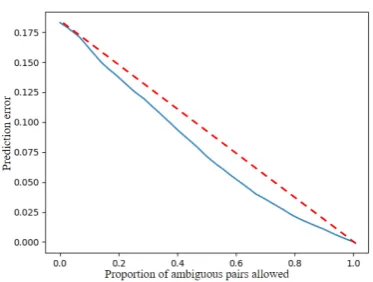
In this section, we study if using integer program-ming inference can provide better ordering perfor-mance if we allow the ordering among some pairs to be undecided (i.e. if we set D to be strictly less than half the total number of pairs). Figure
3presents the result.
The horizontal axis shows the proportion of am-biguous pairs allowed, and the vertical axis shows the proportion of ordering errors. For comparison, we would achieve the red dashed line if we ran-domly mark pairs as ambiguous, and thus not pe-nalized. We can see that the integer programming inference method is indeed better at identifying ambiguous pairs that, when marked as such, would lead to better performance. However, the improve-ment is not very substantial, maybe because at training time, the neural network tries to satisfy ambiguous pairs in a way that is more or less arbitrarily defined by the training data, bringing the overall performance down. Thus, one specific idea for future work would be to allow the neural network to intentionally make ambiguous predic-tions, for which it would not be penalized. Clearly, however, some form of regularization would need to be in place to prevent the network from making the ambiguous prediction too frequently.
4.5 Embedding Visualization
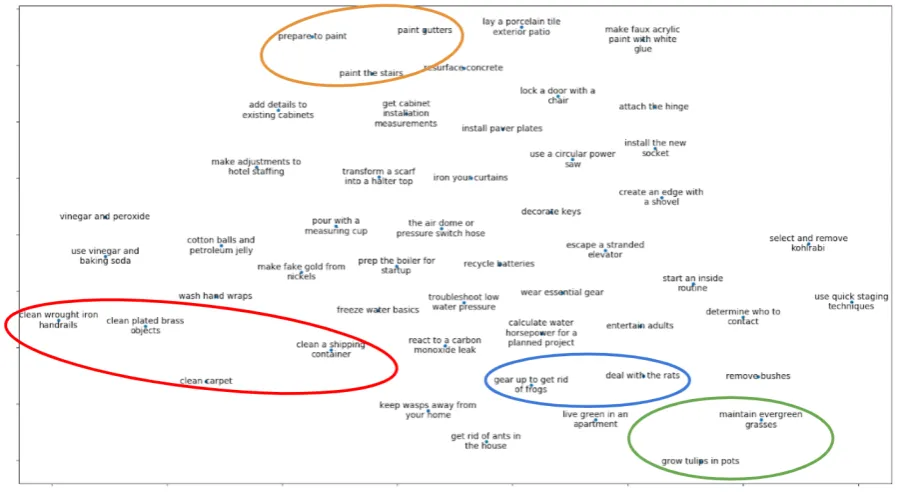
Figure4visualizes the embedding of 50 randomly selected tasks, using t-SNE (Maaten and Hinton,
[image:5.595.85.280.242.385.2]Figure 4: Embedding visualization.
5 Conclusion and Future Work
In this paper, we collected a dataset of natural lan-guage instructions for a diverse set of household tasks. We learned a joint embedding of task ti-tle and step text for two problems, predicting if a step belongs to a task title and ordering two steps given the task title. We showed that the step rele-vance can be predicted with a high accuracy if we include the step explanation as part of our model. However, step ordering turned out to be a more challenging problem. We believe that this is at least partly due to noise in the dataset, especially the fact that the ordering of some steps tends to be exchangeable. We also noticed some issues that are specific to WikiHow. For example, the steps which are mentioned for some tasks are more like tips and suggestions.
In terms of future work, one direction is to ground the learned knowledge into some physi-cal systems, such as an in-home robotic platform. Another direction is to try to recognize steps that do not have well-defined orders (Section4.4), al-though this is likely to require some additional su-pervision signal.
6 Acknowledgments
Steven Schockaert has been supported by ERC Starting Grant 637277.
References
Gabor Angeli, Melvin Jose Johnson Premkumar, and Christopher D Manning. 2015. Leveraging linguis-tic structure for open domain information extraction.
In Proceedings of the 53rd Annual Meeting of the
Association for Computational Linguistics and the 7th International Joint Conference on Natural
Lan-guage Processing (Volume 1: Long Papers),
vol-ume 1, pages 344–354.
Kurt Bollacker, Colin Evans, Praveen Paritosh, Tim Sturge, and Jamie Taylor. 2008. Freebase: a collab-oratively created graph database for structuring hu-man knowledge. In Proceedings of the 2008 ACM SIGMOD international conference on Management
of data, pages 1247–1250. AcM.
Nathanael Chambers and Dan Jurafsky. 2009. Un-supervised learning of narrative schemas and their participants. In Proceedings of the Joint Confer-ence of the 47th Annual Meeting of the ACL and the 4th International Joint Conference on Natural Lan-guage Processing of the AFNLP: Volume 2-Volume 2, pages 602–610. Association for Computational Linguistics.
Cuong Xuan Chu, Niket Tandon, and Gerhard Weikum. 2017. Distilling task knowledge from how-to com-munities. InProceedings of the 26th International
Conference on World Wide Web, pages 805–814.
In-ternational World Wide Web Conferences Steering Committee.
Yu-An Chung and James Glass. 2018. Speech2vec: A sequence-to-sequence framework for learning word embeddings from speech. arXiv preprint
Jacob Devlin, Ming-Wei Chang, Kenton Lee, and Kristina Toutanova. 2018. Bert: Pre-training of deep bidirectional transformers for language
understand-ing. arXiv preprint arXiv:1810.04805.
Steven Diamond and Stephen Boyd. 2016. Cvxpy: A python-embedded modeling language for convex optimization. The Journal of Machine Learning
Re-search, 17(1):2909–2913.
Palash Goyal and Emilio Ferrara. 2018. Graph embed-ding techniques, applications, and performance: A survey. Knowledge-Based Systems, 151:78–94.
Diederik P Kingma and Jimmy Ba. 2014. Adam: A method for stochastic optimization. arXiv preprint
arXiv:1412.6980.
Hema Koppula and Ashutosh Saxena. 2013. Learning spatio-temporal structure from rgb-d videos for hu-man activity detection and anticipation. In
Interna-tional conference on machine learning, pages 792–
800.
Hugo Liu and Push Singh. 2004. Conceptneta practi-cal commonsense reasoning tool-kit. BT technology
journal, 22(4):211–226.
Laurens van der Maaten and Geoffrey Hinton. 2008. Visualizing data using t-sne. Journal of machine
learning research, 9(Nov):2579–2605.
Cynthia Matuszek, Evan Herbst, Luke Zettlemoyer, and Dieter Fox. 2013. Learning to parse natural lan-guage commands to a robot control system. In
Ex-perimental Robotics, pages 403–415. Springer.
Drew McDermott, Malik Ghallab, Adele Howe, Craig Knoblock, Ashwin Ram, Manuela Veloso, Daniel Weld, and David Wilkins. 1998. Pddl-the planning domain definition language.
Tomas Mikolov, Ilya Sutskever, Kai Chen, Greg S Cor-rado, and Jeff Dean. 2013. Distributed representa-tions of words and phrases and their compositional-ity. InAdvances in Neural Information Processing
Systems (NIPS), pages 3111–3119.
Ashutosh Modi and Ivan Titov. 2014. Inducing neu-ral models of script knowledge. In Proceedings of the Eighteenth Conference on Computational
Natu-ral Language Learning, pages 49–57.
Hogun Park and Hamid Reza Motahari Nezhad. 2018. Learning procedures from text: Codifying how-to procedures in deep neural networks. InCompanion of the The Web Conference 2018 on The Web
Con-ference 2018, pages 351–358. International World
Wide Web Conferences Steering Committee.
Adam Paszke, Sam Gross, Soumith Chintala, Gre-gory Chanan, Edward Yang, Zachary DeVito, Zem-ing Lin, Alban Desmaison, Luca Antiga, and Adam Lerer. 2017. Automatic differentiation in pytorch.
Jeffrey Pennington, Richard Socher, and Christopher Manning. 2014. GloVe: Global vectors for word representation. InProceedings of the Conference on Empirical Methods in Natural Language Processing
(EMNLP), pages 1532–1543.
Karl Pichotta and Raymond J Mooney. 2016a. Learn-ing statistical scripts with lstm recurrent neural net-works. In Thirtieth AAAI Conference on Artificial
Intelligence.
Karl Pichotta and Raymond J Mooney. 2016b. Using sentence-level lstm language models for script infer-ence. arXiv preprint arXiv:1604.02993.
Alec Radford, Karthik Narasimhan, Tim Salimans, and Ilya Sutskever. 2018. Improving language under-standing by generative pre-training.
Bryan Williams, Henry Lieberman, and Patrick H Win-ston. 2017. Understanding stories with large-scale common sense. InCOMMONSENSE.