JOURNAL OF FOREST SCIENCE, 61, 2015 (3): 106–111
doi: 10.17221/106/2014-JFS
Analysis of standing timber sales based on overall
coniferous/broadleaved tree species ratio
S. Slanina, P. Natov, J. Dvořák, B. Gabrielová
Faculty of Forestry and Wood Sciences, Czech University of Life Sciences Prague, Prague, Czech Republic
ABSTRACT: The first competitive open tender called “Standing timber sale” was executed in 2010. The aim of the paper was to conduct complete collection of data from online tender catalogues and to analyze the data with respect to the coniferous/broadleaved ratio. A total of 254 units were analyzed, 195 of them harvested and 59 withdrawn from the auction at a limit price. Out of the harvested units, 125 units with a maximum 10% coniferous or broadleaved tree rep-resentation were selected, while the remaining 70 units showed a varying coniferous/broadleaved ratio ranging from 11%
to 89%. Upon 0–10% coniferous ratio the average winning price ranged between 330 and 2,045 CZK·m–3. Upon 91–100%
coniferous ratio the winning prices ranged between 766 and 1,743 CZK·m–3. The results obtained indicated a statistically
significant difference between the average winning prices in stands with more than 90% conifers and in stands with more than 90% broadleaved species.
Keywords: open tender; invited competition; SQL; database; data mining
A homogeneous product is one of the general prerequisites of a functioning market. The homo-geneity or heterohomo-geneity of timber is determined by the contractual terms and conditions (Bluďovský 2002). Standing timber sales are conducted in the en bloc form, when the total price for all trees is set and every tree is thus sold at the same price, without the need to agree on its quality. In this sale form timber therefore represents a homogeneous product.
The forms of invitation to tenders are highly di-verse. They are conditioned by the environment, given commodity, market size, technical possibili-ties, etc. Apart from the envelope system, the most common form of sale with contacting competition is an auction (Tjostheim, Eide 1998).
Standing timber sale via open tenders with in-vited competition is a sales method which has not had a long tradition in the Czech Republic. In the modern history of the Czech forestry, the first suc-cessful standing timber sales took place at the be-ginning of 2010, focusing on both municipal and private estates and covering several thousand cubic
meters. Early in 2011, Ministry of Agriculture of the Czech Republic published a document called “The Wood Book” (MZE 2012), which obliges For-ests of the Czech Republic, State Enterprise, as the major manager of state-owned forests, to imple-ment standing timber sales as one of the timber sale methods in the form of auctions covering 10–20% of annual timber production.
This method may prove interesting for other owners and forest managers as well. Its key asset is sale transparency, teamed with the fact that small forest owners do not require qualified knowledge in forestry and timber trade to reach proper market prices (SDZP 2013).
Standing timber sale with invited competition is a service under which the service provider, upon the forest owner’s request, measures and describes the standing timber intended for sale and publish-es the offer on a public internet portal. In the fol-lowing open tender, which takes place in a meet-ing room with all prospective buyers present, the buyer offering the highest price is selected. Despite the demanding terms and conditions and inherent
buyer’s risks, the final prices for timber sold are well above average (Evropský zemědělský fond pro rozvoj venkova 2013).
For the purposes of implementing the offer, all required parameters of the offered stands must be examined well in advance. The extent and accuracy of collected data are conditioned by the sales meth-od used. Offers of stands intended for harvesting should be published via suitable media, preferably the internet, or in the form of circulated printed outputs (catalogues). Those should be published well in advance of the auction; so that the prospec-tive buyers were given sufficient times to evalu-ate the existing offers and calculevalu-ate their financial and technical limits. The stand description should include local identification and stand structures. Based on the sales method used, the extent of le-gally binding published data should be determined. The examination is not restricted to such data only but should cover also data of the so-called informa-tive nature, which usually complement the descrip-tion of qualitative elements (green crown points, boreholes, defect occurrence etc.). Analytically, the relation between the data guarantee provided by the seller and the expected price (offered by the buyer) is valid. It may be asserted that by increasing the degree of assume-guarantee and data exami-nation, the seller will achieve a higher price. The survey data will also be used by the seller to cal-culate and set the price limit. Under the stand sale preparation, the specific offers of harvesting stands need to be presented. Their form is conditioned by the sales method applied. In the case of a sale with invited competition, a public notice about the of-fer needs to be published. Another precondition of such a sale is publication of a catalogue of the of-fered stands. This catalogue should contain all the specified descriptive parameters and stand charac-teristics. The internet is an ideal environment for presenting catalogues. Based on thus published information the prospective buyers may make cal-culations of possible price offers well in advance and consequently take part in the bidding. Owing to the not binding character of some data they may also verify the correctness of the offer directly in the field. They are also given the chance to collect information and create databases for future analy-ses and decisions (Evropský zemědělský fond pro rozvoj venkova 2013).
The presented catalogues contain descriptive pa-rameters and stand characteristics of the offered units in the form of a so-called “Catalogue Sheet “. It is divided into the following sections: Informa-tion on the sale unit (number, type of contract,
etc.); Territorial affiliation (region, district, mu-nicipality, GPS coordinates of roadside landing); Information for bidders (place, date and time of viewing, notes); Logging elements (parts of stands are also elements, type of logging, age, number of trees, expected harvesting volume in m3, average stem volume in m3, number of not classified trees, area of the logging element in ha, mid-diameter in cm, mean height in m, skidding distance in m, de-scription of terrain and timber landing); Tree data (tree species, average tree volume in m3, number of trees, expected harvesting volume in m3, repre-sentation in %, mid-diameter in cm, mean height in m); Binding provisions and logging conditions (date of logging, payment terms, contact person, etc.); Tree numbers and volume in m3 under bark based on the given tree species and diameter class.
The aim of the present paper was to conduct a complete collection of data obtained from on-line catalogues related to the concluded open tenders for standing timber sale with invited competition. Thus obtained data were stored in a newly designed relational database which became the principal da-tabase for storing new data related to sales con-cluded in the future.
This database also serves as a data source for special analyses according to randomly selected requests. The partial objective of the paper is to demonstrate the application of this database in analysing the data obtained with respect to the representation of coniferous and broadleaved tree species.
The partial objective of the paper, which focuses on analysing the data obtained with respect to the representation of coniferous and broadleaved tree species groups, requires a brief overview of the current situation in the Czech Republic.
of the youngest stands is evident, which in the long run increases the ratio of broadleaved tree species in Czech forests. These trends will continue in the future and a further rise in the broadleaved tree spe-cies ratio can be expected. Within several decades it will translate into a decrease in the thin coniferous timber supply reflecting the decreasing production of such timber in lower age classes, i.e. in thinning.
In the following decades the opposite will be reg-istered in pine and spruce, as our major commercial species. The area of mature stands will decrease for several decades, which will be strongly reflected in the market supply of wood raw material.
MATERIAL AND METHODS
Data collection from the open tender “Standing Timber Sale” with invited competition, which was organized and administered by the legal entity (Ev-ropský zemědělský fond pro rozvoj venkova 2013), applied the methodology for raw data preparation. The raw data was taken from catalogue overviews of concluded auctions which are continuously pub-lished on a public internet portal www.forestrade. cz in the form of the so-called catalogue sheets. The data was collected gradually over the period between the launch of the project, which may be identified as the concluded sale of the first unit on 04.03.2010, and 07.02.2013 which was set to be the initial day after completing the first round of data collection. A total of 254 units were collected over the period. Thus obtained raw data guided the design of the relational database structure which applies the method of non-trivial extraction of im-plicit and potentially useful information known as data mining (Thuraisingham 1999). This method applied suitable statements of SQL queries over the filled relational database (Han, Kamber 2006).
The proposed relational database contains the following data obtained from the catalogue sheets (unit number, tree number, expected harvesting volume in m3, area in ha, GPS coordinates of road-side landing, type of logging, average volume in m3, representation in %, age), and results of individual open tenders (winning price in CZK/m3, tender venue, date of tender, buyer).
The statistical significance of the difference be-tween the auctioned prices of individual units in which the coniferous/broadleaved group ratio was a maximum 10% of the tree group representation in the second group within the same stand, was veri-fied for the data stored in the relational database. The 10% limit was chosen with respect to the
clas-sification of tree species mixes which in the Czech Republic is utilized e.g. by the Institute of Forestry Management (Vašíček 2010).
Suitable SQL queries against the relational data-base of 254 auctioned units were used to select units with a maximum 10% ratio of the second group of coniferous or broadleaved tree species which were successfully auctioned and harvested at the same time. A total of 49.2% units, i.e. 125 successfully auctioned and harvested stands, met these condi-tions. As a follow-up, a mathematical and statisti-cal analysis of the difference in their selling prices was conducted between these stands.
The comparison of independent samples drew on the fact that the first selection dataset consisting of 110 units encompasses dominant representation of coniferous tree species with a maximum 10% of broadleaves, while the second selection dataset consisting of 15 units encompasses dominant rep-resentation of broadleaved tree species group with a maximum 10% of the coniferous tree species group.
Specific descriptive statistics were determined for these two independent samples, followed by the test of agreement of two independent sample mean values (the two-sample t-test), which evaluates the statistical significance of the difference between the means of two independent samples. Calculation of the two-sample t-test was preceded by an evalua-tion of the conclusiveness of differences between the variances using the F-test (Brabenec et al. 2004).
RESULTS
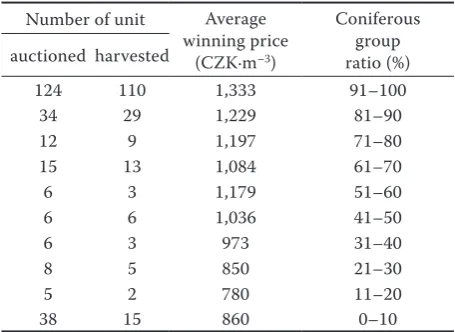
In the period from 04.03.2010 to 07.02.2013, a total of 254 units were auctioned during an open tender “Standing Timber Sale” with invited compe-tition. Out of this number, 195 units were success-Table 1. Overview of all the auctioned and harvested units in the studied period
Number of unit Average
winning price
(CZK·m–3)
Coniferous group ratio (%) auctioned harvested
124 110 1,333 91–100
34 29 1,229 81–90
12 9 1,197 71–80
15 13 1,084 61–70
6 3 1,179 51–60
6 6 1,036 41–50
6 3 973 31–40
8 5 850 21–30
5 2 780 11–20
[image:3.595.304.532.588.754.2]fully auctioned and harvested. 59 units were with-drawn from the auction at a limit price and were not harvested.
Out of the 195 harvested units, 110 units en-compassed a dominant coniferous group, with a maximum 10% ratio of the broadleaved group. 15 units consisted of dominant broadleaved group with a maximum 10% ratio of the coniferous group. The remaining 70 units showed a varying ratio of coniferous and broadleaved trees ranging from 11 to 89%. Table 1 gives an overview of all the auctioned and harvested units, including the coniferous group ratio and the average winning prize.
Selected descriptive statistics for the studied sam-ples are presented in Table 2
The test of agreement of two independent sample mean values (the two-sample t-test), which evaluates the statistical significance of the difference between the means of two independent samples: (i) mean –x
1 = 1,333 CZK/m3; frequency of sample m = 110 units; (ii) mean –x2 = 860 CZK/m3; frequency of sample
n = 15 units
The t-test calculation was preceded by an assess-ment of conclusive variance between (s2
1, s22) using the F-test, where F = 6.71. The obtained P-value = 0.00028, i.e. there is a statistically significant dif-ference between variances (non-homogeneity of variances).
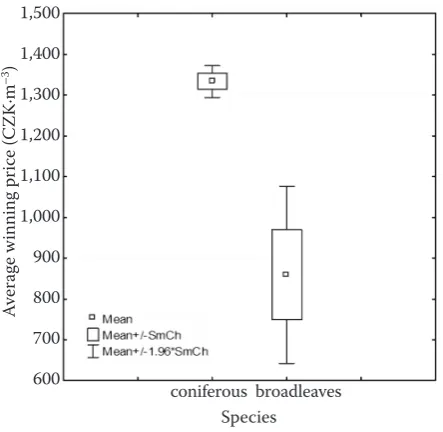
The performed t-test (Table 3) has the corre-sponding p-value very close to zero, therefore the difference between means –x1 and –x2 can be consid-ered statistically significant at the significance level
of α = 0.01. A graphical comparison of the two data sets is shown in Fig. 1.
DISCUSSION
The conducted collection of data from on-line catalogues related to the concluded open tenders for standing timber sale with invited competition has revealed the scope of opportunities inherent in a transparent publication of standing timber sale results on the Internet.
With respect to the public sector activities, trans-parency is generally understood as the transpar-ency of decision-making processes, meaning that the persons or companies concerned are allowed access to relevant information in real time. The concept of transparency encompasses the principle of equal and unlimited access to all relevant infor-mation on public decision-making (Transparency International Czech Republic 2008).
Transparency also greatly disrupts the social system of corruption, as it decreases the exclu-siveness of information required for carrying out a corrupt exchange. Access to privileged infor-mation and sharing of such inforinfor-mation create a comparative advantage against the players uncon-cerned, fosters corruption relations and increases the likelihood of corruption yield (Della Porta, Vanucci 1999).
[image:4.595.308.530.54.270.2]With respect to the results obtained we can note that in the case of open tenders for standing timber sale the transparency concept is observed and the relevant data can be effectively obtained and stored in suitable relational databases which may then be Table 2. Selected descriptive statistics for the studied samples
Coniferous group ratio (%)
Number of indd
Price (CZK·m–3)
average
winning x
˜
xˆ
min max91–100 110 1,333 1,327 1,343 766 1,743
0–10 15 860 704 – 330 2,045
˜
[image:4.595.63.290.72.144.2]x – median,
ˆ
x – modusTable 3. The two-sample t-test evaluating the mean auc-tioned prices of the coniferous and broadleaved groups
Tree species groups
CZK
t df P
SD1 SD2
Coniferous vs.
broadleaved 1111.6 429.0 1.99 123 0
SD1 – standard deviation of the coniferous tree price limit;
SD2 – standard deviation of the broadleaved tree price limit;
df – degrees of freedom
Fig. 1. Graphical comparison of the two studied data sets coniferous broadleaves
Species 1,500
1,400
1,300
1,200
1,100
1,000
900
800
700
600
Average w
inning pr
ic
e (CZ
K·m
[image:4.595.64.289.204.264.2]continuously filled and processed. This way of re-sult publication thus significantly contributes to eliminating the role of corruption.
With regard to the partial objective which fo-cused on analysing the average winning price with respect to the representation of coniferous and broadleaved tree species we may note that the re-sults obtained indicate a statistically significant difference between the average winning prices in stands where the coniferous ratio exceeded 90% and in stands with 90% broadleaved ratio.
In this context we can note an interesting ra-tio between offered coniferous and broadleaved groups, where the number of offered coniferous tree units significantly exceeds the broadleaved unit number. This fact deserves a more detailed analysis aided by continued collection of data related to this phenomenon. A more detailed analysis of this phenomenon would also require detailed data on harvested units with dominant broadleaved tree ratio. It would be particularly de-sirable to determine the expected composition of harvested assortments, localize the end custom-ers (processors) capable of processing raw hard-wood and localize units with respect to the aver-age skidding distance.
More interesting data could be yielded from comparison of winning prices with respect to the average price of raw timber in the Czech Republic. This would require determination of raw timber production prices for different production sites. The Czech Statistical Office publishes prices of raw timber in roadside landing parity, yet the studied open tenders sell standing timber, i.e. on site stump (stand). Added to this, information on the pro-duced raw timber assortments in the sold units is required for the comparison mentioned earlier but at present it is still missing.
CONCLUSIONS
Targeted gathering, storage and analysis of data obtained from open tenders for standing timber sale with invited competition can be done with-out major limitations and restrictions. This type of sale and publication of sale results enable effi-cient gathering of data and its storage in relational databases within which further detailed analyses can be conducted. This particular paper focused on analyses of average winning prices with regard to the coniferous/broadleaved group ratio. The results obtained have indicated a statistically sig-nificant difference between the average winning
prices in stands where the coniferous ratio ex-ceeded 90% and in stands with a 90% broadleaved ratio.
In terms of the future evolution of the broad-leaved ratio within the species composition in the Czech Republic it is advisable to continue the gradual complementation of the created relational database, followed by monitoring and analyses of further trends related to standing timber sales and to the species composition in Czech forests.
Other possible analyses which could be conduct-ed over the collectconduct-ed data storconduct-ed in the form of the relational database encompass e.g. an analysis re-lated to the average winning price in broadleaved species, as has been suggested in the Discussion. It would also be possible and desirable to extend the database to contain available data from Regional Plans of Forest Development related to the domi-nant forest type set or management set of stands and analyze the average winning price with respect to stand conditions.
References
Bluďovský Z. (2002): Obchod s dřevem. Praha, Česká zemědělská univerzita v Praze: 125.
Brabenec V. et al. (2004): Statistika a biometrika: přednášky a cvičení pro AF a ITS1. Praha, Česká zemědělská univerzita v Praze: 271.
Della Porta D., Vanucci A. (1999): Corrupt Exchanges: Actors, Resources, and Mechanisms of Political Corruption. New York, Aldine de Gruyter: 314.
Evropský zemědělský fond pro rozvoj venkova (2013): Metody a způsoby umisťování dříví na trh v podmínkách privátního a komunálního vlastnictví lesů. Available at http://sorti-mentace.cz/Sbornik.pdf (accessed Dec 12, 2013) Han J., Kamber M. (2006): Data Mining: Concepts and
Tech-niques. San Francisco, Elsevier: 10–41.
Kupčák V. (2006): Ekonomika lesního hospodářství. Brno, Mendelova zemědělská a lesnická univerzita: 257. MZE (2012): Koncepce MZe k hospodářské politice státního
podniku Lesy České republiky od roku 2012. Available at http://eagri.cz/public/web/mze/lesy/lesnictvi/koncepce-a-strategie/koncepce-mze-k-hospodarske-politice.html (accessed Feb 2, 2011)
MZE (2013): Zpráva o stavu lesa a lesního hospodářství České republiky v roce 2012. Praha, Ministerstvo zemědělství České republiky: 53–55.
Corresponding author:
Ing. Pavel Natov, Ph.D., Czech University of Life Sciences Prague, Faculty of Forestry and Wood Sciences, Kamýcká 1176, 165 21 Prague 6-Suchdol, Czech Republic; e-mail: [email protected]
SDZP (2013): Model rozvoje hodnot státniho lesnictví a zpracování dříví. Available at http://www.silvarium.cz/ sklad/Koncepce.pdf (accessed Nov 10, 2013).
Thuraisingham B. (1999): Data Mining: Technologies, Tech-niques, Tools, and Trends. Boca Raton, CRC Press LLC: 93–102.
Tjostheim I., Eide J.O. (1998): A case study of an on-line auc-tion for the World Wide Web. In: Informaauc-tion and Com-munication Technologies in Tourism. Vienna, Springer: 149–161.
Transparency international Česká republika (2008): Korupce a protikorupční politika ve veřejné správě. Praha, Transpar-ency international Česká Republika: 212.
Vašíček J. (2010): Podíl listnatých dřevin v lesích – Výsledky státní lesnické politiky ČR po roce 1989. Lesnická práce, 89: 10.