Bis(1,3-dimethyl-1
H
-imidazolium)
hexa-fluorosilicate: the second monoclinic
polymorph
Chong Tian,‡ Wanli Nie‡ and Maxim V. Borzov*‡
College of Chemistry, Leshan Normal University, Binhe Rd 778, Leshan 614000, Sichuan Province, People’s Republic of China
Correspondence e-mail: [email protected]
Received 7 June 2013; accepted 1 July 2013
Key indicators: single-crystal X-ray study;T= 296 K; mean(C–C) = 0.002 A˚;
Rfactor = 0.028;wRfactor = 0.081; data-to-parameter ratio = 10.2.
The title compound, 2C5H9N2 +
SiF6 2
, (I), crystallized as a new polymorph, different from the previously reported one (Ia) [Light et al. (2007) private communication (refcode: NIQFAV). CCDC, Cambridge, England]. The symmetry [space groups P21/n for (I) and C2/c for(Ia)] and crystal packing patterns are markedly different for this pair of polymorphs. In (I), all imidazolium cations in the lattice are nearly parallel to each other, whereas a herringbone arrangement can be found in (Ia). In (I), each SiF6
2–
dianion forms four short C—H F contacts with adjacent C5H9N2
+
cations, resulting in the formation of layers parallel to theac plane. In (Ia), the C—H F contacts are generally longer and result in the formation of layers along thebcplane.
Related literature
For the structure of the previously reported polymorph of (I) and its solvatomorph 6C5H9N2
+ 3SiF6
2
CH3OH, see: Lightet
al.(2007) and Tianet al.(2013), respectively. For an overview of polymorphism, see: Bernstein (2002); Linden (2011). For the practical importance of sterically non-hindered 1,3-dialkyl-1H-imidazolium salts with perfluoro anions of the main-group elements in the preparation of Arduengo carbene adducts, see: Tian et al. (2012). For graph-set notation, see: Etteret al.(1990); Bernsteinet al.(1995); Grellet al.(1999).
Experimental
Crystal data
2C5H9N2+SiF62
Mr= 336.38 Monoclinic,P21=n a= 8.2240 (8) A˚
b= 9.7901 (9) A˚
c= 8.7753 (9) A˚
= 90.106 (1)
V= 706.53 (12) A˚3
Z= 2
MoKradiation
= 0.23 mm1
T= 296 K
0.400.390.05 mm
Data collection
Bruker SMART APEXII diffractometer
Absorption correction: multi-scan (SADABS; Sheldrick, 1996)
Tmin= 0.913,Tmax= 0.988
3670 measured reflections 1373 independent reflections 1228 reflections withI> 2(I)
Rint= 0.020
Refinement
R[F2> 2(F2)] = 0.028
wR(F2) = 0.081
S= 1.09 1373 reflections
134 parameters
All H-atom parameters refined
max= 0.18 e A˚
3
min=0.22 e A˚
3
Table 1
Hydrogen-bond geometry (A˚ ,).
D—H A D—H H A D A D—H A
C1—H1 F3 0.884 (18) 2.164 (19) 2.9622 (17) 149.8 (14) C2i
—H2i
F2 0.934 (19) 2.26 (2) 3.1935 (18) 174.0 (5)
Symmetry code: (i)xþ1 2;yþ
1 2;zþ
3 2.
Data collection:APEX2(Bruker, 2007); cell refinement:SAINT
(Bruker, 2007); data reduction:SAINT; program(s) used to solve structure:SHELXS97(Sheldrick, 2008); program(s) used to refine structure: SHELXL97 (Sheldrick, 2008); molecular graphics:
SHELXTL(Sheldrick, 2008) andOLEX2(Dolomanovet al., 2009); software used to prepare material for publication:SHELXTL and
OLEX2.
Financial support from the National Natural Science Foundation of China (project Nos. 20702041 and 21072157) and the Shaanxi Province Administration of Foreign Experts Bureau Foundation (grant No. 20106100079) is gratefully acknowledged. The authors are thankful to Mr Su Pengfei (Xi’an Modern Chemistry Research Institute) for his help in carrying out the X-ray diffraction measurements.
Supplementary data and figures for this paper are available from the IUCr electronic archives (Reference: LD2107).
organic compounds
o1218
Tianet al. doi:10.1107/S1600536813018242 Acta Cryst.(2013). E69, o1218–o1219Acta Crystallographica Section E Structure Reports
Online
ISSN 1600-5368
Bernstein, J. (2002).Polymorphism in Molecular Crystals, Oxford: Clarendon Press.
Bernstein, J., Davis, R. E., Shimoni, L. & Chang, N.-L. (1995).Angew. Chem. Int. Ed. Engl.34, 1555–1573.
Bruker (2007).APEX2andSAINT. Bruker AXS Inc., Madison, Wisconsin, USA.
Dolomanov, O. V., Bourhis, L. J., Gildea, R. J., Howard, J. A. K. & Puschmann, H. (2009).J. Appl. Cryst.42, 339–341.
Etter, M. C., MacDonald, J. C. & Bernstein, J. (1990).Acta Cryst.B46, 256–262.
Hydrogen Bond Patterns. Some Mathematical Concepts, edited by H. Wa¨hling. Mu¨nchen: Fakulta¨t fu¨r Mathematik und Informatik, Technische Universita¨t Mu¨nchen.
Light, M. E., Bates, G. W. & Gale, P. A. (2007). Private communication (refcode NIQFAV). CCDC, Cambridge, England.
Linden, A. (2011).Acta Cryst.C67, e15.
Sheldrick, G. M. (1996).SADABS. University of Go¨ttingen, Germany. Sheldrick, G. M. (2008).Acta Cryst.A64, 112–122.
Tian, C., Nie, W. & Borzov, M. V. (2013).Acta Cryst. E69, o1216–o1217. Tian, C., Nie, W., Borzov, M. V. & Su, P. (2012).Organometallics,31, 1751–
supporting information
sup-1
Acta Cryst. (2013). E69, o1218–o1219supporting information
Acta Cryst. (2013). E69, o1218–o1219 [doi:10.1107/S1600536813018242]
Bis(1,3-dimethyl-1
H
-imidazolium) hexafluorosilicate: the second monoclinic
polymorph
Chong Tian, Wanli Nie and Maxim V. Borzov
S1. Comment
Polymorphism of molecular crystals (including pseudopolymorphism and solvatomorphism) is an important object of structural studies [see a monograph (Bernstein, 2002) and an editorial paper (Linden, 2011)]. However, discovery of new polymorphic forms still remains a matter of serendipity.
Recently, being interested in preparation of a variety of sterically non-hindered 1,3-dialkyl-1H-imidazolium salts with main-group element perfluorato anions as potential precursors of Arduengo carbene adducts with the Group 13–15 element fluorides (Tian et al., 2012), we analyzed materials obtained by re-crystallization of crude bis(1,3-dimethyl-1H -imidazolium) hexafluorosilicate, [C5H9N2+]2[SiF62–], from either ethanol or methanol solutions. While crystallization from
ethanol afforded only the solvent-free [C5H9N2+]2[SiF62–], (I), the material obtained from methanol presented both (I)
(crystals grow on the walls of a vessel above the solution surface during its gradual evaporation into air) and its adduct with methanol, {[C5H9N2+]2[SiF62–]}3(CH3OH), (II), crystals of which grow at the bottom of a vessel under the layer of the
mother liquor. In the latter case, single crystals of (I) and (II) could be easily separated manually. Identity of the single crystals of (I) prepared from EtOH and MeOH was proved by the unit cell measurements. Due to a better quality of the sample of (I) grown from ethanol, only these data are provided and will be referred to further in the discussion.
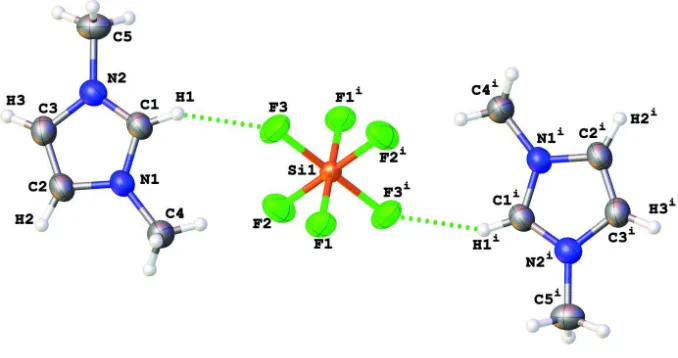
The β-angle very close to 90° presented a difficulty in determination of the actual crystal system and space group (P21/n) for (I). The Si-atoms are positioned on inversion centres. Each [SiF62–] moiety forms two pairs of noticeable F···H
contacts: F3···H1 and F2···H2ii [symmetry code: (ii) –x + 1/2, y + 1/2, –z + 3/2] and their centrosymmetric equivalents
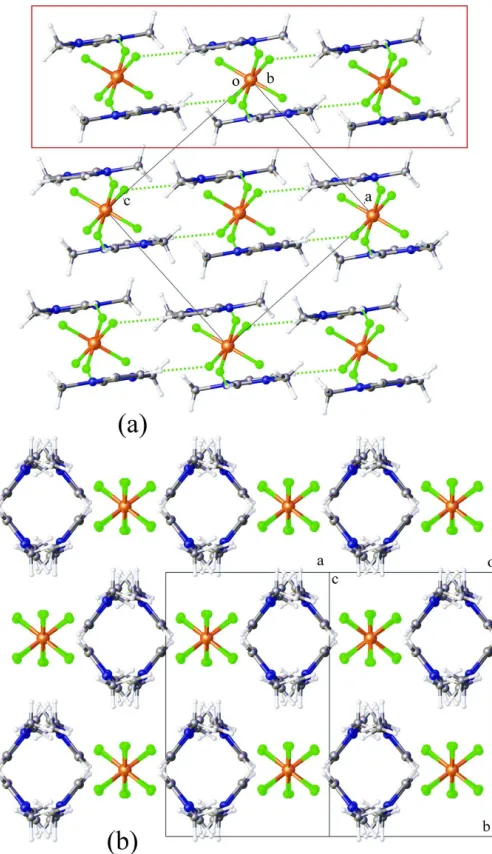
(see Table 1 and Fig. 1). In (I), the plane of the imidazolium ring is nearly perpendicular to the crystallographic [010] plane [interplanar angle 87.25 (4)°] that results in a nearly parallel arrangement of all imidazolium moieties in the lattice (see Fig. 2a). The F···H contacts connect the imidazolium cations and the [SiF62–] dianions into layers parallel to the [101]
plane (highlightened on Fig. 2a) consisting of the first- and second-order networks N1=D22(4)D22(4) and N2=C22(8)]. Any
interlayer C-H···F contacts shorter than 2.5 Å are absent in (I).
The previously reported polymorph (Ia) (Light et al., 2007) has space group C2/c. The principal geometrical parameters of ions in (I) and (Ia) are similar. However, the packing patterns in (I) and (Ia) are distinctly different (compare Figs. 2a and 2 b). Overall, the packing in (Ia) is less dense than that found in (I) [the respective calculated densities Dx are 1.507
Mg m-3 for (Ia) at 120 K and 1.581 Mg m-3 for (I) at 296 K. In (Ia), the H···F contacts are longer than in (I) and form the
first- and second-order networks N1=D22(4)D22(4) and N2=C22(8) seemingly similar to those in (I) (primary and secondary
contact lenghts are equal to 2.334 and 2.359 Å, respectively). This network similarity, however, is only apparent because the secondary H···F contacts in (Ia) are formed not by H4, but by a H1′-atom of the Me-group (superscripts here denote the
The longer contacts in (Ia) also form non-interconnected layers in its crystal lattice. The neighbour pairs of layers in (Ia) are connected by the C-centering translation, C2 rotation, n-glide reflection, and inversion operations. Moreover, these
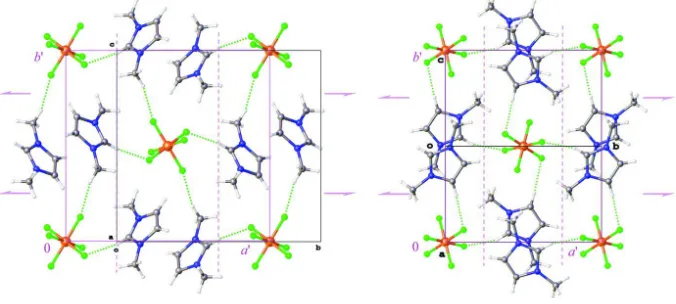
layers belong to the same layer group as it is observed in (I; p21/b11), with its a′ and b′ parameters being comparable
[9.7901 (9) and 12.0377 (9) Å for (I) and 11.988 and 11.258 Å for (Ia); see Fig. 3; priming is used to distinguish between unit cell axes a and b and layer-related axes a′ and b′]. Distances between adjacent inversion-related pairs of imidazolium rings are also close (the interplane distances are 3.418 (2) and 3.449 Å in (I) and (Ia), respectively]. Fig. 3 also illustrates that the layers within (I) and (Ia) can be converted one into another by a diffusionless transformation which can be best described as continuous rotations of the inversion-related pairs of imidazolium cations and SiF62– groups around the
corresponding centers accompanied with dilations/contractions of the layers along the a′ and b′ directions.
Transformation of the entire lattice of (Ia) into that of (I) also requires a mutual (0, 1/2, 0) shear of adjacent layers in the
b-direction what results in vanishing of centering translations and conversion of C2 rotations into 21 screw ones. Being a
continuous transformation, such a layer shift, however, can not be classified as a "diffusionless" one. Thus, any direct first-order phase transition between (I) and (Ia) is hardly believable. Unfortunately, the lack of the information about the sample crystal of (Ia) [in the corresponding Private communication to the CCDC (Light et al., 2007), no data on the crystallization conditions are provided] does not allow us to outline the actual reasons of the (I)/(Ia) polymorphism.
The structure of solvated crystals {[C5H9N2+]2[SiF62–]}3(CH3OH), (II) is reported separately (Tian et al., 2013).
S2. Experimental
Crude 1,3-dimethyl-1H-imidazolium hexafluorosilicate was prepared by a reaction of 1,3-dimethyl-1H-imidazolium iodide and disilver hexafluorosilicate (molar ratio 2:1) in distilled water. Concentration of the filtrate till dryness followed by re-crystallization from ethanol gave (I) in an almost quantitative yield. If methanol is used as a solvent, crystals of both (I) and (II) are formed. Single crystals of (I) suitable for X-ray diffraction analysis were picked up directly from the material (when methanol was used as a solvent, the crystals located on the vessel walls above the solution surface were selected). Identity of the single crystals of (I) grown from EtOH and MeOH was proved by unit cell measurements. Melting point measurements were performed with a Microscopic Melting Point X4 apparatus (Beijing MAISIQI High-Tech Co., Ltd.)
S3. Refinement
supporting information
[image:5.610.136.475.73.252.2]sup-3
Acta Cryst. (2013). E69, o1218–o1219Figure 1
Figure 2
supporting information
[image:7.610.137.475.76.228.2]sup-5
Acta Cryst. (2013). E69, o1218–o1219Figure 3
Ball-and-stick drawings of F···H binded layers (layer group p21/b11) in (Ia; left; a view along a-axis; N1=[D22(4)]H1′D22(4), N2=[C22(8)]H2,H1′) and in (I) [right; a view along (1, 0, 1) direction; N1=[D22(4)]H4D22(4), N2=[C22(8)]H2,H4]. The F···H
contacts are depicted as dotted lines. Symmetry diagrams for layer group p21/b11 are also provided in pink colour [a′ =
11.988, b′ = 11.258 Å for (Ia) and a′ = 9.7901 (9), 12.0377 (9) Å for (I); the inversion centres are omitted for clarity]. For description of the graph set notation, see: Etter et al. (1990), Bernstein et al. (1995), Grell et al. (1999).
Bis(1,3-dimethyl-1H-imidazolium) hexafluorosilicate
Crystal data
2C5H9N2+·SiF62− Mr = 336.38
Monoclinic, P21/n
Hall symbol: -P 2yn
a = 8.2240 (8) Å
b = 9.7901 (9) Å
c = 8.7753 (9) Å
β = 90.106 (1)°
V = 706.53 (12) Å3 Z = 2
F(000) = 348
Dx = 1.581 Mg m−3
Melting point: 550 K
Mo Kα radiation, λ = 0.71073 Å Cell parameters from 3479 reflections
θ = 2.3–28.3°
µ = 0.23 mm−1 T = 296 K Plate, colourless 0.40 × 0.39 × 0.05 mm
Data collection
Bruker SMART APEXII diffractometer
Radiation source: fine-focus sealed tube Graphite monochromator
Detector resolution: 8.333 pixels mm-1
phi and ω scans
Absorption correction: multi-scan (SADABS; Sheldrick, 1996)
Tmin = 0.913, Tmax = 0.988
3670 measured reflections 1373 independent reflections 1228 reflections with I > 2σ(I)
Rint = 0.020
θmax = 26.0°, θmin = 3.2° h = −10→10
k = −12→9
l = −10→8
Refinement
Refinement on F2
Least-squares matrix: full
R[F2 > 2σ(F2)] = 0.028 wR(F2) = 0.081 S = 1.09 1373 reflections
134 parameters 0 restraints
Primary atom site location: structure-invariant direct methods
All H-atom parameters refined
w = 1/[σ2(F
o2) + (0.0471P)2 + 0.1056P]
where P = (Fo2 + 2Fc2)/3
(Δ/σ)max < 0.001
Δρmin = −0.22 e Å−3
Extinction correction: SHELXL, Fc*=kFc[1+0.001xFc2λ3/sin(2θ)]-1/4
Extinction coefficient: 0.065 (7)
Special details
Experimental. A very tight closeness of the β-angle to 90° presented a certain difficulty in determination of the actual crystal system and the space group for (I).
Geometry. All e.s.d.'s (except the e.s.d. in the dihedral angle between two l.s. planes) are estimated using the full covariance matrix. The cell e.s.d.'s are taken into account individually in the estimation of e.s.d.'s in distances, angles and torsion angles; correlations between e.s.d.'s in cell parameters are only used when they are defined by crystal symmetry. An approximate (isotropic) treatment of cell e.s.d.'s is used for estimating e.s.d.'s involving l.s. planes.
Refinement. Refinement of F2 against ALL reflections. The weighted R-factor wR and goodness of fit S are based on F2,
conventional R-factors R are based on F, with F set to zero for negative F2. The threshold expression of F2 > σ(F2) is used
only for calculating R-factors(gt) etc. and is not relevant to the choice of reflections for refinement. R-factors based on F2
are statistically about twice as large as those based on F, and R- factors based on ALL data will be even larger.
Fractional atomic coordinates and isotropic or equivalent isotropic displacement parameters (Å2)
x y z Uiso*/Ueq
Si1 0.5000 0.5000 0.5000 0.02918 (18) F1 0.31022 (9) 0.53884 (9) 0.55758 (10) 0.0445 (3) F2 0.51424 (12) 0.38309 (9) 0.63991 (10) 0.0563 (3) F3 0.42533 (10) 0.38065 (9) 0.38175 (11) 0.0532 (3) N1 0.22279 (13) 0.08942 (11) 0.52963 (12) 0.0362 (3) N2 0.34964 (14) −0.03111 (12) 0.36255 (13) 0.0373 (3) C1 0.31135 (17) 0.09435 (15) 0.40423 (16) 0.0387 (3) C2 0.20313 (19) −0.04525 (15) 0.56970 (17) 0.0419 (3) C3 0.28241 (18) −0.12049 (16) 0.46592 (16) 0.0423 (3) C4 0.1593 (2) 0.20729 (16) 0.61283 (19) 0.0462 (4) C5 0.4404 (2) −0.06783 (19) 0.22545 (18) 0.0482 (4) H1 0.341 (2) 0.1721 (19) 0.3610 (19) 0.048 (4)* H2 0.146 (2) −0.0695 (18) 0.658 (2) 0.054 (5)* H3 0.297 (2) −0.2124 (19) 0.4561 (19) 0.050 (5)* H4A 0.218 (3) 0.282 (2) 0.590 (2) 0.074 (6)* H4B 0.048 (3) 0.227 (2) 0.580 (3) 0.080 (6)* H4C 0.162 (3) 0.188 (2) 0.718 (3) 0.093 (7)* H5A 0.538 (3) −0.015 (2) 0.227 (3) 0.071 (6)* H5B 0.377 (3) −0.058 (2) 0.141 (3) 0.074 (6)* H5C 0.479 (3) −0.164 (3) 0.229 (3) 0.094 (7)*
Atomic displacement parameters (Å2)
U11 U22 U33 U12 U13 U23
supporting information
sup-7
Acta Cryst. (2013). E69, o1218–o1219N2 0.0358 (6) 0.0419 (6) 0.0343 (6) −0.0026 (5) −0.0012 (5) 0.0007 (4) C1 0.0409 (7) 0.0381 (7) 0.0371 (7) −0.0041 (6) 0.0022 (6) 0.0054 (6) C2 0.0483 (8) 0.0387 (7) 0.0386 (7) −0.0075 (6) 0.0025 (6) 0.0060 (6) C3 0.0488 (8) 0.0361 (7) 0.0419 (8) −0.0048 (6) −0.0018 (6) 0.0034 (6) C4 0.0532 (9) 0.0391 (8) 0.0463 (9) −0.0031 (7) 0.0107 (7) −0.0017 (6) C5 0.0454 (8) 0.0607 (10) 0.0384 (8) 0.0026 (7) 0.0036 (6) −0.0050 (7)
Geometric parameters (Å, º)
Si1—F3i 1.6783 (8) N2—C5 1.4619 (19)
Si1—F3 1.6783 (8) C1—H1 0.884 (19) Si1—F2 1.6824 (8) C2—C3 1.341 (2) Si1—F2i 1.6824 (8) C2—H2 0.934 (19)
Si1—F1 1.6849 (8) C3—H3 0.912 (18) Si1—F1i 1.6849 (8) C4—H4A 0.90 (2)
N1—C1 1.3216 (18) C4—H4B 0.98 (2) N1—C2 1.3742 (18) C4—H4C 0.94 (3) N1—C4 1.4625 (19) C5—H5A 0.96 (3) N2—C1 1.3199 (18) C5—H5B 0.91 (2) N2—C3 1.3770 (19) C5—H5C 0.99 (3)
F3i—Si1—F3 180.0 N2—C1—N1 109.20 (12)
F3i—Si1—F2 89.86 (5) N2—C1—H1 128.1 (11)
F3—Si1—F2 90.14 (5) N1—C1—H1 122.7 (11) F3i—Si1—F2i 90.14 (5) C3—C2—N1 107.19 (13)
F3—Si1—F2i 89.86 (5) C3—C2—H2 131.8 (11)
F2—Si1—F2i 180.0 N1—C2—H2 121.0 (11)
F3i—Si1—F1 89.75 (4) C2—C3—N2 107.14 (13)
F3—Si1—F1 90.25 (4) C2—C3—H3 132.2 (11) F2—Si1—F1 89.88 (4) N2—C3—H3 120.6 (11) F2i—Si1—F1 90.12 (4) N1—C4—H4A 109.4 (14)
F3i—Si1—F1i 90.25 (4) N1—C4—H4B 110.0 (13)
F3—Si1—F1i 89.75 (4) H4A—C4—H4B 106.4 (18)
F2—Si1—F1i 90.12 (4) N1—C4—H4C 108.6 (15)
F2i—Si1—F1i 89.88 (4) H4A—C4—H4C 112 (2)
F1—Si1—F1i 180.00 (6) H4B—C4—H4C 110 (2)
C1—N1—C2 108.26 (12) N2—C5—H5A 106.3 (14) C1—N1—C4 125.78 (12) N2—C5—H5B 110.8 (14) C2—N1—C4 125.94 (12) H5A—C5—H5B 115.6 (19) C1—N2—C3 108.21 (12) N2—C5—H5C 111.8 (14) C1—N2—C5 125.41 (13) H5A—C5—H5C 104.5 (19) C3—N2—C5 126.31 (13) H5B—C5—H5C 107.7 (19)
C1—N1—C2—C3 0.26 (16)
Symmetry code: (i) −x+1, −y+1, −z+1.
Hydrogen-bond geometry (Å, º)
D—H···A D—H H···A D···A D—H···A
C1—H1···F3 0.884 (18) 2.164 (19) 2.9622 (17) 149.8 (14) C2ii—H2ii···F2 0.934 (19) 2.26 (2) 3.1935 (18) 174.0 (5)