A Generic Postprocessing Technique for Image Compression
S. Chen, Z. He, and B. L. Luk
Abstract—A postprocessing technique is developed for image quality enhancement. In this method, a distortion-recovery model extracts multiresolution edge features from the decompressed image and uses these visual features as input to estimate the difference image between the original uncompressed image and the decompressed image. Coding distortions are compensated by adding the model output to the decompressed image. Unlike many existing postprocessing methods, which smooth blocking artifacts and are designed specifically for transform coding or vector quantization, the proposed technique is generic and can be applied to all of the main coding methods. Experimental results involving postprocessing four coding systems show that the proposed technique achieves significant improvements on the quality of reconstructed images, both in terms of the objective distortion measure and subjective visual assessment.
Index Terms—Image compression, image recovery, neural net-works, postprocessing, visual features.
I. INTRODUCTION
I
MAGE CODING is a principal technique for reducing the requirements on bandwidth and storage capacity. The majority of current image-coding methods cause distortions in reconstructed images. In practice, it is always a tradeoff between the coding bit rate and the coded image quality. Generally speaking, increasing coding bit rate can improve the quality of the reconstructed image, but this is limited by channel bandwidth or storage capacity. Alternatively, post-processing—which improves the quality of the reconstructed image after coding and decoding have been completed—can be an effective approach to achieve a good-quality reconstructed image without requesting extra bit rate. Existing postprocessing methods can roughly be divided into two categories: those em-ploying filtering to smooth blocking artifacts in reconstructed images [1]–[5] and those formulating postprocessing as an image-recovery problem [6]–[11].The filtering approach is mainly designed to achieve better viewing quality because smoothing basically provides some artificial “make-up” on reconstructed images. This is accept-able and adequate for applications where obtaining pleasant viewing quality for entertainment is the main purpose. Since
Manuscript received December 8, 1998; revised October 19, 2000. This work was supported in part by the U.K. EPSRC under Grant GR/M16894. This paper was recommended by Associate Editor H.-M. Hang.
S. Chen is with the Department of Electronics and Computer Science, Uni-versity of Southampton, Southampton SO17 1BJ, U.K.
Z. He is with the LTX Corporation, Westwood, MA 02090 USA.
B. L. Luk is with the Center for Intelligent Design, Automation and Manu-facturing, City University of Hong Kong, Kowloon, Hong Kong, China.
Publisher Item Identifier S 1051-8215(01)03009-9.
filtering also causes unwanted over-smoothing on image edges, this class of methods is not appropriate for applications which require genuinely good image quality with minimum distor-tions. The second class of methods rely heavily on the accuracy of a priori image models used and the optimization algorithms adopted. These methods often involve adaptive filtering to limit excessive smoothing. In addition, existing postprocessing methods are specifically designed for block-based coding methods with fixed coding block sizes, such as transform coding (TC) and vector quantization (VQ), where blocking artifacts are serious sources of distortions. They cannot be applied to nonblock-based predictive coding (PC), where blocking artifacts do not exist and blurred edges are main coding distortions. These methods are also impractical to use for quadtree (QT) coding [12], which has variant block sizes.
The motivation of this research is the need for a postpro-cessing technique which is able to correct the actual coding distortions and applicable to all the major coding systems. The key here is the ability to recover the distortion image, defined as the difference between the original and decoded images. It can be shown that main coding losses are due to edge distortions, including blurred edges and blocking artifacts (the latter can be regarded as spurious edges). This suggests that the basic task of postprocessing is to correct these edge distortions. Our distortion-recovery model consists of a visual feature extractor to extract edge information from the decoded image, and a mapping to map the visual features of the decoded image onto the distortion image. Specifically, visually important edge features are computed as multi-scale first-order derivatives. Interestingly, this gradient extractor imitates certain charac-teristics of visual cortex [13]–[15]. As the exact relationship between the gradient features of the decoded image and the distortion image is unknown, a neural network—referred to as the neural network visual model (NNVM)—is trained to learn this relationship.
We demonstrate the advantages of the proposed postpro-cesing technique on four coding systems, namely TC, VQ, and QT coding and PC. Our experimental results confirm that the NNVM achieves significant improvements on the quality of reconstructed images, in both the objective distortion measure and subjective viewing assessment. We also implement two typical existing postprocessing methods [1], [8] to compare them with the proposed approach in identical coding environ-ments. The simulation results show that the proposed technique generally has better postprocessing gains over the two existing methods.
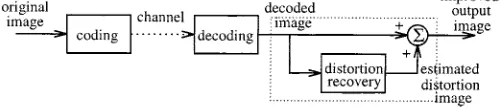
In our approach, a distortion-recovery model estimates the dis-tortion image from the decompressed image and adds this es-timate to the decoded image to compensate coding distortions. Obviously, the relationship between the decoded image and the distortion image is highly complicated and may be impossible or unadvisable to correct all the coding distortions. We start with a brief discussion on main sources of coding distortions for the three major coding methods, PC, TC, and VQ. This will point to the way for building up an efficient distortion-recovery model.
A. Main Coding Distortions
The coding error of the most popular PC system, the differen-tial pulse code modulation (DPCM) consists of the slope over-load and granular noise [16]. The slope overover-load causes visual blurring at the edges in the reproduced image, and these edge distortions are visually more annoying than granular noise [17]. In a TC system, such as the DCT coding, high spatial frequency components are either coded with very few bits or deleted com-pletely [18]. This helps to achieve significant data compression but also causes distortions mainly at the edges in the reproduced image. The process of VQ is to find a representative codeword in the codebook for each input vector [19]. Since a codeword is the centroid (average) of all the vectors in a class, the process of averaging leads to smoothed edges in the reproduced image. Coding methods based on nonoverlapping blocks, such as TC and VQ, also give rise to the blocking artifacts, namely visible discontinuities between adjacent blocks [20]. Blocking artifacts may be viewed as exotic or spurious edges.
Perceptually, edges and contours of objects in an image be-long to the most important features which characterize the pic-ture. Errors at edges have more influence on the picture quality than errors in other image regions [21]. Therefore, the quality of the reproduced image relies very much on the fidelity of the reconstructed edges. The main coding distortions are edge dis-tortions, including blurred edges and blocking artifacts. These edge distortions are the main visual disturbances for human ob-servers viewing images. Reducing these distortions can signifi-cantly improve visual quality of reproduced images. The distor-tion-recovery model in Fig. 1 is a realization or approximation of the underlying functional relationship between the decoded image and the distortion image. It is clear that the main task of this model is to correct edge distortions. To achieve this aim, we adopt the following strategy. A decoded image of size
is divided into blocks of size , and pixels of each block are fed into a visual feature extractor, which extracts edge fea-tures of the block. These edge feafea-tures are then mapped onto the corresponding block in the distortion image. We will refer to as the postprocessing block size. Fig. 2 illustrates this
Fig. 2. Schematic of the proposed distortion-recovery model. The postprocessing block size isn 2 n and the total number of gradient features isM.
distortion-recovery model. The basic idea is that after learning, the output of the model will be a good estimate of the distortion image, which can then be added to the decoded image to com-pensate actual coding distortions.
B. Edge-Feature Extractor
Edge features of an image block are extracted as multiscale first-order directional derivatives, since gradients are known to represent edges well. Psychovisual experiments have demon-strated that stimuli in vertical and horizontal directions have more visual sensitivity than stimuli in other directions [17]. The horizontal and vertical derivatives are, therefore, chosen to rep-resent edges along vertical and horizontal directions, respec-tively. Furthermore, the combination of these two directional derivatives can represent edges in any other directions. To cal-culate derivatives for an block in different scales, the block is recursively divided into four equal-size sub-blocks until the sub-block size is reduced to . For a generic sub-block of size , a pair of horizontal and vertical derivatives
are calculated as
(1)
(2)
where is the pixel value at position in . The
outputs of the visual feature extractor, the multi-scale deriva-tives, can be arranged in a vector form
(3)
The total number of derivatives, , for an block is deter-mined by the formula
(4)
[image:2.612.315.540.62.179.2] [image:2.612.40.290.68.122.2](a)
[image:3.612.136.457.82.552.2](b)
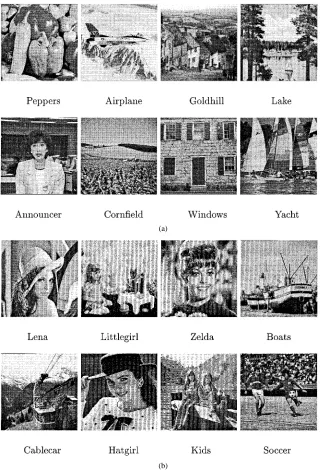
Fig. 3. Images used for: (a) training and (b) testing.
simple cell responds maximumly to edges with particular orien-tation in its receptive field. A complex cell also responds max-imumly to edges, but has a larger receptive field. A hypercom-plex cell responds mostly to edge patterns and can generalize its response over several complex cells. In the proposed edge-fea-ture extractor, an image block of certain size is divided into smaller sub-blocks. Derivatives of small sub-blocks can model visual features detected by simple cells, and derivatives of larger sub-blocks can represent features detected by complex cells. The collection of multi-scale derivatives can mimic the response of a hypercomplex cell, which is able to generalize all the de-tails over the given area in the visual field.
Obviously, the choice of the postprocessing block size has important influence on the complexity and performance of
(a) (b)
(c) (d)
(e) (f)
[image:4.612.129.466.59.647.2](g) (h)
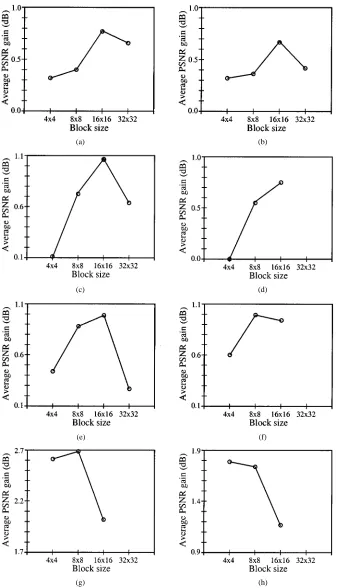
Fig. 4. Postprocessing gain averaged over eight test images as a function of postprocessing block size. The NNVM has 40 hidden neurons. (a) JPEG with Quality
= 7. (b) JPEG with quality = 14. (c) VQ with bit rate = 0.25 bpp. (d) VQ with bit rate = 0.5 bpp. (e) QT with bit rate = 0.25 bpp. (f) QT with bit rate = 0.5 bpp.
(g) PC: coding bit= 1, quantizing step = 4. (h) PC: coding bit = 2, quantizing step = 4.
C. Neural Network Visual Model
We use a one-hidden-layer neural network to learn the rela-tionship between the edge features and distortion patterns, and call the resulting distortion-recovery model the NNVM. Specifi-cally, the inputs to the NNVM, the edge features, are normalized
to the range ; the hidden-layer outputs of the NNVM are given by
(a) (b)
[image:5.612.114.480.62.340.2](c) (d)
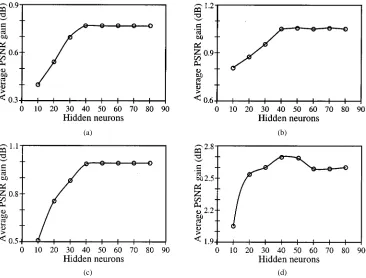
Fig. 5. Postprocessing gain averaged over eight test images as a function of the number of hidden neurons in the NNVM. The postprocessing block size is16216 for JPEG, VQ, and QT, and8 2 8 for PC. (a) JPEG with Quality = 7. (b) VQ with bit rate = 0.25 bpp. (c) QT with bit rate = 0.25 bpp. (d) PC: coding bit = 1, quantizing step= 4.
where is the number of hidden neurons, and the outputs of the NNVM are given by
(6) where and are fixed scaling and shifting constants for map-ping the model outputs onto the range of pixel values. The acti-vation function is the bipolar sigmoid function
(7)
The number of the hidden-layer neurons, , is determined during training using the following procedure. Given an ap-propriate block size , we start with a small hidden layer and gradually increase the size of the hidden layer until the performance stops improving. The network weights and are learned using the stochastic gradient algorithm [22], [23]. The total number of adjustable parameters
for the NNVM is
(8)
With and , for example,
. To collect training data from a coding system, a training image of size is compressed and then decompressed. The corresponding distortion image is obtained by subtracting the decoded image from the original image. The decoded and distortion images are divided into blocks. A pair of blocks gives rise to a pair of input and desired output. As an image can
only provide pairs of training data, many
images should be used in order to collect sufficient training data samples.
III. EXPERIMENTALRESULTS ANDCOMPARISON
The proposed postprocessing technique was applied to four coding methods, TC, VQ, and QT coding and PC. The coding algorithms employed were the JPEG [24] for TC, the algorithm based on the Kohonen self-organizing feature map [25] for VQ design, the improved QT algorithm [12] for QT coding, and the algorithm using a neural network predictor [26] for PC. Sixteen images of size with 8 bits per pixel (bpp), as shown in Fig. 3, were involved in the experiment. The first eight ages were used to provide training data, and the other eight im-ages were used as test imim-ages. We also implemented two typical existing postprocessing methods, Reeve’s filtering method [1], and Paek’s modified projection onto convex set (PCS) method [8] to compare them with our approach in the identical TC and VQ coding environments. It should be pointed out that these two existing algorithms are impractical for postprocessing of QT and PC systems.
(a)
(b) (c)
[image:6.612.46.286.61.483.2](d) (e)
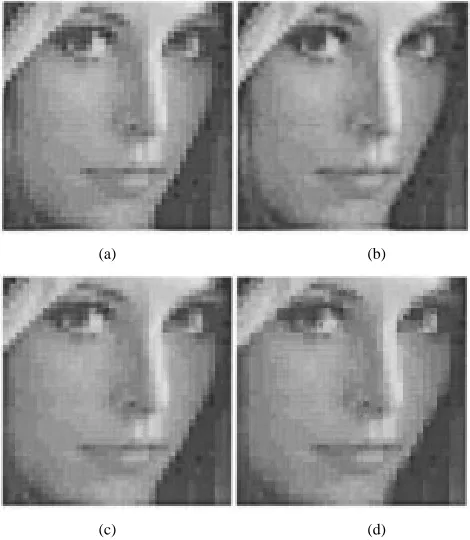
Fig. 6. Face portions of original, JPEG coded (Quality = 7) and post-improved images of “Lena.” (a) Original image. (b) JPEG coded (PSNR
= 28.85. (c) NNVM (PSNR gain = 0.81 dB). (d) Reeve’s (PSNR gain = 0.69
dB). (e) Paek’s (PSNR gain= 0.36 dB).
and for PC. The results in Fig. 4 suggest that a block size of is adequate for postprocessing of JPEG, VQ, and QT coding. The JPEG algorithm used had a standard coding block size and the VQ employed in the study had a coding block size of . The QT had variable block sizes, depending on image activities, and majority of the blocks were and . A postprocessing block size larger than coding block sizes en-sures that the distortions at coding block boundaries can be cor-rected. The PC is nonblock based and a smaller postprocessing block size of appears sufficient. The results of Fig. 5 sug-gest that is sufficient for the NNVM to achieve ade-quate performance.
Tables I–IV compare the postprocessing gains obtained using the NNVM and two existing algorithms for the JPEG and VQ. Tables V–VIII list the postprocessing gains obtained using the NNVM for the QT coding and PC. Fig. 6 depicts the original and JPEG-coded images of “Lena” together with the three post-im-proved images. Fig. 7 shows the VQ coded image and the three
(a) (b)
[image:6.612.311.546.63.333.2](c) (d)
Fig. 7. Face portions of VQ coded (bit rate= 0:25 bpp) and post-improved images of “Lena.” (a) VQ coded (PSNR= 26.53 dB). (b) NNVM (PSNR gain
= 1.13 dB). (c) Reeve’s (PSNR gain = 0.64 dB). (d) Paek’s (PSNR gain = 0.02
dB).
[image:6.612.310.548.387.518.2](a) (b)
Fig. 8. Face portions of QT coded (bit rate= 0:25 bpp) and post-improved images of “Lena.” (a) QT coded (PSNR= 29.66 dB). (b) NNVM (PSNR gain
= 0.91 dB).
(a) (b)
Fig. 9. Face portions of PC coded (coding bit= 1, quantizing step = 4) and post-improved images of “Lena.” (a) PC coded (PSNR= 24.17 dB). (b) NNVM (PSNR gain= 2.87 dB).
[image:6.612.311.548.566.698.2]TABLE II
PSNR VALUES(dB)OFJPEG CODING(QUALITY= 14)ANDPOSTPROCESSING
GAINS(dB). THEPOSTPROCESSINGBLOCKSIZE FOR THENNVM IS16 2 16 AND THENNVM HAS40 HIDDENNEURONS
9 compare the QT and PC coded images of “Lena” with the post-improved images obtained using the NNVM, respectively. These pictures give face portions of their corresponding im-ages for a clearer visual evaluation. The results given in Ta-bles I–IV, and Figs. 6 and 7 demonstrate that the NNVM has superior performance over Reeve’s and Paek’s algorithms for postprocessing of TC and VQ systems, in terms of both the ob-jective PSNR measure and subob-jective visual evaluation. For the VQ case, the performance of Paek’s algorithm was particularly poor, as it is designed for the TC with an coding block size. The results shown in Tables V–VIII, and Figs. 8 and 9, confirm that the NNVM is particularly effective for post-improving QT coding and PC systems.
Reeve’s and Paek’s methods were used in the comparative study, as they represents two typical approaches of the existing postprocessing methods and can readily be implemented. For many other existing postprocessing methods, we can make some comparisons using the results reported in the literature. For the sophisticated space-variant filtering method [2], the improvement given by the authors was 0.40 dB for a VQ coded “Lena” image at an original coding PSNR of 29.90 dB. The NNVM achieved a postprocessing gain of 0.80 dB for a VQ coded “Lena” image at an original coding PSNR of 30.20 dB. For Tien and Hang’s postprocessing methods [3], their experimental results gave a postprocessing gain of 0.36 dB at most for TC-coded images, while the NNVM achieved average improvements up to 0.77 dB for TC-coded images. For the adaptive -filtering method [5], the varying postfiltering
TABLE IV
PSNR VALUES(dB)OFVQ CODING(BITRATE = 0:5 bpp)AND
POSTPROCESSINGGAINS(dB). THEPOSTPROCESSINGBLOCKSIZE FOR THE
NNVM IS16 2 16AND THENNVM HAS40 HIDDENNEURONS
TABLE V
PSNR VALUES(dB)OFQT CODING(BITRATE = 0:25 bpp)AND
POSTPROCESSINGGAINS(dB). THEPOSTPROCESSINGBLOCKSIZE FOR THE
NNVM IS16 2 16AND THENNVM HAS40 HIDDENNEURONS
method [4], and another modified PCS method [9], the authors did not provide any numerical distortion measurements.
IV. CONCLUSION
[image:7.612.42.283.88.234.2]TABLE VII
PSNR VALUES(dB)OFPC (CODINGBIT= 1, QUANTIZINGSTEP= 4)AND
POSTPROCESSINGGAINS(dB). THEPOSTPROCESSINGBLOCKSIZE FOR THE
NNVM IS8 2 8AND THENNVM HAS40 HIDDENNEURONS
TABLE VIII
PSNR VALUES(dB)OFPC (CODINGBIT= 2, QUANTIZINGSTEP= 4)AND
POSTPROCESSINGGAINS(dB). THEPOSTPROCESSINGBLOCKSIZE FOR THE
NNVM IS8 2 8AND THENNVM HAS40 HIDDENNEURONS
approach is that the same simple design can be employed for postprocessing of different coding systems. This is in contrast to existing postprocessing methods, which are limited to TC or VQ. Experimental results of applying the proposed technique to four coding systems confirm that the proposed technique has better postprocessing gains and wider applications over existing methods.
REFERENCES
[1] H. C. Reeve and J. S. Lim, “Reduction of blocking effect in image coding,” in Proc. ICASSP, Boston, MA, 1983, pp. 1212–1215.
2, pp. 91–95, 1992.
[7] Y. Yang, N. P. Galatsanos, and A. K. Katsaggelos, “Regularized recon-struction to reduce blocking artifacts of block discrete cosine transform compressed images,” IEEE Trans. Circuits Syst. Video Technol., vol. 3, pp. 421–432, 1993.
[8] H. Paek, J. W. Park, and S. U. Lee, “Non-iterative post-processing tech-nique for transform coded image sequence,” in Proc. ICIP, 1995, pp. 208–211.
[9] Y. K. Lai, J. Li, and C. C. J. Kuo, “Image enhancement for low bit-rate JPEG and MPEG coding via postprocessing,” in Proc. SPIE, vol. 2727, 1996, pp. 1484–1494.
[10] J. Luo, C. W. Chen, K. J. Parker, and T. S. Huang, “Artifact reduction in low bit rate DCT-based image compression,” IEEE Trans. Image
Pro-cessing, vol. 5, pp. 1363–1368, Sept. 1996.
[11] S. Comes, B. Macq, and M. Mattavelli, “Postprocesing of image by fil-tering the unmasked coding noise,” IEEE Trans. Image Processing, vol. 8, pp. 1050–1062, Aug. 1999.
[12] E. Shusterman and M. Feder, “Image compression via improved quadtree decomposition algorithms,” IEEE Trans. Image Processing, vol. 3, pp. 207–215, 1994.
[13] D. H. Hubel and T. N. Wiesel, “Receptive fields, binocular interaction and functional architecture in the cat’s visual cortex,” J. Physiol., vol. 160, pp. 106–154, 1962.
[14] , “Receptive fields and functional architecture of monkey striate cortex,” J. Physiol., vol. 195, pp. 215–243, 1968.
[15] E. R. Kandel, J. H. Schwartz, and T. M. Jessell, Principles of Neural
Science, 3rd ed. Englewood Cliffs, NJ: Prentice-Hall, 1991. [16] N. S. Jayant and P. Noll, Digital Coding of Waveforms: Principles and
Applications to Speech and Video. Englewood Cliffs, NJ: Prentice-Hall, 1984.
[17] S. Comes and B. Macq, “Human visual quality criterion,” in Proc.
SPIE Visual Communications and Image Processing, vol. 1360, 1990,
pp. 2–13.
[18] R. J. Clarke, Transform Coding of Images, London, U.K.: Academic, 1985.
[19] R. M. Gray, “Vector quantization,” IEEE ASSP Mag., pp. 4–29, Apr. 1984.
[20] S. A. Karunasekera and N. G. Kingsbury, “A distortion measure for blocking artifacts of images based on human visual sensitivity,” IEEE
Trans. Image Processing, vol. 4, pp. 713–724, 1995.
[21] H. Sakata, “Effect of contour components on picture quality,” Soc.
Mo-tion Picture TV Eng. J., vol. 90, pp. 1075–1084, 1981.
[22] S. Chen, C. F. N. Cowan, S. A. Billings, and P. M. Grant, “Parallel re-cursive prediction error algorithm for training layered neural networks,”
Int. J. Control, vol. 51, pp. 1215–1228, 1990.
[23] S. Haykin, Neural Networks: A Comprehensive Foundation. New York: Macmillan, 1994.
[24] W. B. Pennebaker and J. L. Mitchell, JPEG Still Image Data
Compres-sion Standard. New York: Van Nostrand, 1993.
[25] N. M. Nasrabadi and Y. Feng, “Vector quantization of images based upon the Kohonen self-organizing feature maps,” Proc. IEEE Int. Conf.
Neural Networks, pp. 101–105, 1988.