Genetic Programming Bias
with
Software Performance Analysis
Brendan Cody-Kenny
A Dissertation submitted to the University of Dublin, Trinity College
in fulllment of the requirements for the degree of
Doctor of Philosophy (Computer Science)
Declaration
I declare that this thesis has not been submitted as an exercise for a degree at this or
any other university and it is entirely my own work.
I agree to deposit this thesis in the University's open access institutional repository or
allow the library to do so on my behalf, subject to Irish Copyright Legislation and Trinity
College Library conditions of use and acknowledgement.
Brendan Cody-Kenny
Permission to Lend and/or Copy
I, the undersigned, agree that Trinity College Library may lend or copy this
Disserta-tion upon request.
Brendan Cody-Kenny
Acknowledgements
This thesis would not have been possible without the support and guidance of many people.
I would like to thank my supervisor, Stephen, for his help. His support and encour-agement has helped me get this work to where it is. My research outlook has been also shaped by everyone who has been through the lab over the years. Stefan, Edgar, Michael, Ciaran, Dave, Ricardo, Serena, Colm, Paul, Steve, Sandra, Andriana and Paul D. have all been a great help both technically and personally during this work. A whole host of others have shaped the experience over the years within TCD, too many to name here. I would like to thank the SBSE community who have shaped this thesis greatly through conferences and papers. Needless to say, I am in support of their cause and thank them all for their eorts.
To Lorna whose determination has spurred my own. To my family, especially my brother and sister, thanks for always being there. Finally, to my parents a special thank you, for this thesis and so much more would not have been possible.
Brendan Cody-Kenny
Abstract
The complexities of modern software systems make their engineering costly and time consuming. This thesis explores and develops techniques to improve software by au-tomating re-design. Source code can be randomly modied and subsequently tested for correctness to search for improvements in existing software. By iteratively selecting use-ful programs for modication a randomised search of program variants can be guided toward improved programs. Genetic Programming (GP) is a search algorithm which crucially relies on selection to guide the evolution of programs. Applying GP to software improvement represents a scalability challenge given the number of possible modication locations in even the smallest of programs.
The problem addressed in this thesis is locating performance improvements within programs. By randomly modifying a location within a program and measuring the change in performance and functionality we determine the probability of nding a performance improvement at that location under further modication.
Contents
Acknowledgements iv
Abstract v
List of Tables viii
List of Figures ix
Chapter 1 Introduction 1
1.1 Challenge . . . 2
1.2 Approach . . . 2
1.3 Problem . . . 3
1.4 Hypothesis . . . 4
1.5 Self-Focusing Genetic Programming. . . 5
1.6 Research Question . . . 7
1.7 Evaluation . . . 7
1.8 Findings . . . 8
1.9 Contributions . . . 10
1.10 Reader's Guide . . . 10
Chapter 2 Related Work 12 2.1 Overview . . . 12
2.2.1 Conguration . . . 15
2.2.2 Compilers & Interpreters. . . 16
2.2.3 Trading Functionality for Performance . . . 17
2.3 Genetic Improvement. . . 19
2.3.1 Representation . . . 20
2.3.2 Modication . . . 21
2.3.3 Fitness Functions . . . 22
2.3.4 Code Reuse . . . 25
2.3.5 Operators . . . 27
2.3.6 Search Space . . . 27
2.4 Guiding GP . . . 28
2.4.1 Self-Adaption . . . 29
2.4.2 Location Learning . . . 33
2.5 Dynamic Individual-level Node Selection Bias in GP . . . 35
2.5.1 Individual Level Adaption . . . 36
2.5.2 Gaussian Bias. . . 36
2.5.3 Node Selection Bias . . . 37
2.5.4 Fitness Guided Node Selection . . . 38
2.5.5 Summary . . . 38
2.6 Analysing Software . . . 38
2.6.1 Prolers . . . 39
2.6.2 Performance Root-Cause Diagnosis . . . 42
2.6.3 Sensitivity Analysis. . . 44
2.6.4 Program Spectra . . . 44
2.6.5 Mutation Analysis . . . 45
2.7 Summary . . . 47
3.2 Genetic Programming Conguration . . . 53
3.2.1 Representation . . . 54
3.2.2 Node Selection . . . 55
3.2.3 Operators . . . 55
3.2.4 Fitness Function . . . 56
3.2.5 Selection. . . 60
3.2.6 Elitism. . . 60
3.3 Self-focusing Genetic Programming . . . 61
3.3.1 Design Methodology . . . 62
3.3.2 Bias Values . . . 62
3.3.3 Value Initialisation . . . 62
3.3.4 Modication . . . 62
3.3.5 Updating Node Bias During GP . . . 64
3.4 Gaussian Bias . . . 65
3.5 Summary . . . 65
Chapter 4 Evaluation 66 4.1 Overview . . . 66
4.2 Improving Programs with GP . . . 68
4.2.1 Problem Set. . . 74
4.3 Statistical Comparison . . . 76
4.4 Static Bias. . . 77
4.4.1 Hand-Made Bias . . . 77
4.4.2 Proler-Derived Bias . . . 80
4.4.3 Mutation-Derived Bias . . . 84
4.5 Dynamic Bias . . . 88
4.5.1 Static VS Dynamic . . . 90
4.5.2 Deceptive Problem . . . 92
4.5.4 Trend Analysis . . . 95
4.5.5 Gaussian Bias. . . 102
4.6 Mutation Spectrum Analysis . . . 105
4.6.1 Exhaustive Modication . . . 105
4.6.2 Fitness Analysis . . . 106
4.6.3 Results . . . 107
4.7 Threats to validity . . . 110
4.8 Summary . . . 111
Chapter 5 Conclusion 112 5.1 Review of the Research Question . . . 113
5.2 Overview of the Evidence . . . 114
5.3 Review of Contributions . . . 116
5.4 Future Work . . . 116
5.4.1 Analysis . . . 117
5.4.2 Bias Update Rules . . . 117
5.4.3 Problem Set. . . 118
5.4.4 Broader Work. . . 119
5.4.5 Open Questions. . . 119
5.5 Closing Remarks . . . 120
Bibliography 121 Appendix A Implementation: locoGP 139 Appendix B Code Listings 142 B.1 Bubble Sort . . . 142
B.2 Shell Sort . . . 143
B.3 Selection Sort . . . 144
B.4 Selection Sort 2 . . . 145
B.6 Quick Sort . . . 146
B.7 Merge Sort . . . 148
B.8 Deceptive Bubble Sort . . . 150
B.9 Insertion Sort . . . 151
B.10 Heap Sort . . . 151
B.11 Cocktail Sort . . . 154
B.12 Human Codebook Generator . . . 155
Appendix C Bias Rules 160 C.0.1 Bias Allocation Rules . . . 160
Appendix D Absolute Values for Dynamic Bias 165 D.1 Insertion Sort . . . 166
D.2 Heap Sort . . . 167
D.3 Merge Sort . . . 168
D.4 Radix Sort. . . 169
D.5 Selection Sort . . . 170
D.6 Selection Sort 2 . . . 171
D.7 Shell Sort . . . 172
D.8 Quick Sort . . . 173
D.9 Cocktail Sort . . . 174
List of Tables
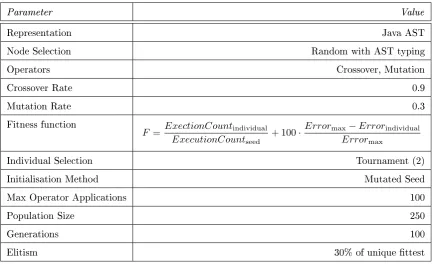
3.1 Baseline GP Conguration Summary . . . 54
4.1 Problem improvement overview . . . 75
4.2 Proler-Derived Bias Values for Bubble Sort . . . 81
4.3 Mutation-derived Node Rankings for Bubble Sort . . . 86
4.4 Size of Program and Minimum Change Required for Improvement. . . 96
4.5 Average Ranking for Improvement Nodes when Modied . . . 108
List of Figures
3.1 Fitness Function . . . 57
3.2 Functionality Score . . . 59
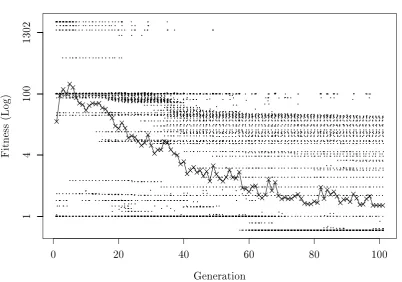
4.1 Fitness Scatter and Average for GP on Bubble Sort . . . 71
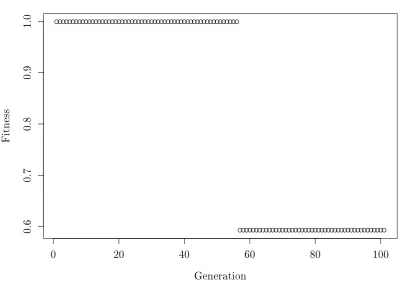
4.2 Best individual programs for GP on Bubble Sort . . . 72
4.3 GP with Hand-Made Outer-Loop Bias on Bubble Sort . . . 78
4.4 GP with Hand-made Inner-Loop Bias on Bubble Sort. . . 79
4.5 GP with Proler-Derived Bias on Bubble Sort . . . 81
4.6 Proler-Derived Bias Dierence on Bubble Sort . . . 82
4.7 GP with Proler-Derived Bias Dierence on Deceptive Bubble Sort . . . . 83
4.8 GP with Mutation-Derived Bias on Deceptive Bubble Sort . . . 87
4.9 Proler and Mutation-Derived Bias Dierence on Deceptive Bubble Sort . 88 4.10 GP with Dynamic Bias Allocation on Bubble Sort . . . 90
4.11 Dynamic and Static Derived Bias Dierence on Bubble Sort . . . 91
4.12 GP with Dynamic Bias Allocation on Deceptive Bubble Sort. . . 92
4.13 Dynamic Mutation-Derived Bias Across All Generations . . . 94
4.14 Dynamic Mutation-Derived Bias Ordered by Problem Size . . . 98
4.15 Dynamic Mutation-Derived Bias Ordered by Improvement Size . . . 99
4.16 Dynamic Mutation-Derived Bias Ordered by Improvement Size over Prob-lem Size . . . 100
4.18 Canonical GP against Gaussian Bias . . . 103
4.19 Gaussian Bias against Dynamic Mutation-Based Bias . . . 104
D.1 GP with Dynamic mutation-derived bias on Insertion Sort . . . 166
D.2 GP with Dynamic mutation-derived bias on Heap Sort . . . 167
D.3 GP with Dynamic mutation-derived bias on Merge Sort . . . 168
D.4 GP with Dynamic mutation-derived bias on Radix Sort . . . 169
D.5 GP with Dynamic mutation-derived bias on Selection Sort . . . 170
D.6 GP with Dynamic mutation-derived bias on Selection Sort 2 . . . 171
D.7 GP with Dynamic mutation-derived bias on Shell Sort . . . 172
D.8 GP with Dynamic mutation-derived bias on Quick Sort. . . 173
D.9 GP with Dynamic mutation-derived bias on Cocktail Sort . . . 174
Chapter 1
Introduction
People, as software's chief maintainers currently, have a dicult task in ensuring software meets changing requirements. The complexity of contemporary software systems has lim-ited the eectiveness of traditional engineering processes when applied to large software projects motivating the emergence of more exible development models. To support the development process, many automated tools exist. As developer time and expertise are costly, further automation in this area would benet the software engineering discipline and industry.
Randomised search algorithms have been proposed for their potential to provide so-lutions in the area of Software Engineering. Randomised algorithms are particularly interesting for program improvement as they are not restricted by the type of program modications performed. While random modication can generate programs which do not compile, evaluating a wide range of program variants increases the chances that an improved program will be found.
bug-xing [140] and performance improvement [73,146].
GP is an algorithm which relies on random modication to search through many variants of a program. Repeated random modication produces program variants ranging in performance and functionality. Even though programs are created by random, and sometimes destructive modications, the algorithm is not considered random search. Program evaluation and selection is crucial to the progress of the algorithm toward more improved programs. Provided programs can be evaluated and measured for tness for purpose, the best program variants can be selected to produce further program variants. How programs are evaluated determines the direction of the overall search process during GP. Over many generations of randomly modied programs, selection provides guidance as to which programs are considered more improved relative to others. Over time, the algorithm is expected to increase the chances of nding a more improved program variant. Performance improvement of programs is the main concern of this work, and so the number of operations executed [42] is used as performance measure.
1.1 Challenge
Scaling GP to larger programs poses a challenge. Larger programs provide an increased number of possible places which can be modied. As more modication points are possible in larger programs the search process is closer to random search due to the increased number of possible variant programs [85]
1.2 Approach
Although program evaluation and selection provide guidance as to what programs are modied in canonical GP, there is no guidance for where within a program should be modied.
In canonical GP all nodes in a program are equally likely to be selected for modica-tion. To provide a more directed search, modication can be focused on certain locations in a program which are deemed interesting. Modication can be focused by controlling the probability of each location being selected. By attaching values to each node in the program we can vary the probability of each location being selected [6].
Bias values can be changed dynamically during GP, or statically set before GP is run. During GP, bias can be changed entirely at random [6], in response to program evaluation [49] or derived from program measures such as size [53].
Program analysis techniques [29,57] have been used to set bias statically before the application of GP. Fault localisation techniques have been used to highlight the location of bug xes in software [140] and proling techniques have been used to guide performance improvement [73].
One example of the use of proling is to vary the size of program input to observe how the execution frequency of lines of code varies accordingly [73]. However, if a 100 line program starts by setting a variable which is subsequently read during a loop at line 90 to determine how many iterations are performed, the cause of execution cost of the loop is not at the same location as the loop itself. Although this example is simplistic, it illustrates that applying change at the loop may not alleviate the problem. The cause of an execution bottleneck in code may be due to complex code with many interdependencies. Finding what code is most likely relevant (or contributes the most) to execution cost is therefore not trivial.
1.3 Problem
execution cost.
Our problem can be posed as: How can the cause of execution be attributed to locations in code. The cause of execution cost is dicult to attribute to an exact location (or multiple locations) in a program as all code executed contributes to the execution cost of a program. Source code elements can embody interdependencies within a program making it dicult to denitively attribute execution cost directly to a code element.
1.4 Hypothesis
The central hypothesis in this work is that repeated modication can indicate how likely a performance improvement is to be found at each location in a program.
As GP makes many random modications to generate variant programs, there is a learning opportunity in how modication eects a programs behaviour. By making a modication, we can associate the measurable change in program functionality and performance with the location of that modication, ignoring what the code modication was. We propose that these measurable changes can be used to highlight the location of performance improvements.
Our hypothesis is based on the assumption that random modication to a program at a specic location will produce a variety of programs with characteristics which are specic to that location in the program. If this is true, then modication points in a program should be uniquely distinguishable under modication.
If the assumptions and hypothesis are correct, then repeated modication to a pro-gram should highlight the locations of performance improvements. We can perform repeated modication to allocate bias values to dierent locations in a program. Once bias values are found, they can be used statically to observe how they inuence the GP process. We should see improved program variants appearing earlier in the GP process if the bias values highlight improvements.
benecial impact on solution nding during the GP algorithm itself.
1.5 Self-Focusing Genetic Programming
Given an existing program, code elements within the program can be modied at the language level allowing variables, operators, expressions and statements to be modied. A modication can be a deletion, clone or replacement from the set of elements in the program. Compilable programs that result from this type of modication can be tested or evaluated for correctness and execution cost. Our proposed solution builds on the iterative modication and evaluation as performed during canonical GP.
The result of program modication is used to infer information about the modication location in our solution. Based on how functionality and performance change, we can increase or decrease the bias value at the location of code modication which produced the variant program.
Repeating this process eventually changes bias values for all nodes in a program. This culminates in a learning process that gathers information from measuring the eect of repeated random modication of a program. The information gathered highlights to which parts of a program more random modication should be applied. Although there is a random element to the selection of nodes for modication, the random selection is biased per the node values.
Initially, bias values are set to the maximum allowed value of one for each modiable node in a program. To produce a variant child program, a clone of the parent program is modied. When the parent is cloned, all bias values are cloned to the child. When the child program is modied bias values propagated depending on the type of modication performed. If code is replaced, then values for the replacement code are initialised to one. If code is deleted, then the bias values are lost.
modication for each location in a program.
After the cloned child program is modied, the program is evaluated to ascertain performance and correctness measures. Bias values for the location of modication are updated depending on how the performance and correctness dier for the child program in comparison to the parent program. Bias values are updated in both the parent and child program as both have a chance of being modied again in the evolutionary process. We update bias values in a number of ways in response to the dierent results at-tainable when a program is evaluated. Bias is increased and decreased so that after the initial modication, it is always between zero and one. The bias value is increased by no more than half the dierence between the existing value and one. V = V + (1-V)/2 For a decrease, the change is similarly, V = V - (V/2).
If a program variant does not compile, the value at the location of modication is reduced. If the program compiles, and the child program evaluates with a lower functionality measure than the parent, the bias value at the location of modication in the parent is increased, and decreased in the child. The rational behind this update strategy is that if we modify the program and it compiles then it is worth modifying there again in the parent. If the functionality increases, then the chances of modifying that location are reduced in the parent, and increased in the child.
The bias update rules are designed to focus change on exploring the functionality variants of the program which have reduced functionality. Destructive modications are favoured, with a focus on exploration of variants. Modication tends to focus where code has broken before.
1.6 Research Question
Our research question is posed as follows:
• Can dierences in functionality and performance measures caused by arbitrary
program modications indicate the likelihood that further modication will create a program with reduced execution cost?
1.7 Evaluation
In this thesis we are interested in answering the research question to understand how GP can be guided. The GP process is conducted with and without bias to observe the eect bias has on the chances of nding improved programs. We also seek to inspect what change in tness measures are particularly good indicators for improvements. Bias allocation is also inspected in a static and dynamic context.
Static bias refers to bias values which are attached to a program before GP is started. The values do not change during GP. Proling techniques have been used to nd this bias. In this thesis we nd a static bias by repeated mutation on a program which is to be improved. Once this bias is found, it can be attached the seed and GP can be applied. If the bias accurately highlights locations where an improvement exists, then GP should nd an improved version of the program more quickly. If mutation-derived bias can nd improvements in a program, then we should see GP runs nding these improvements more quickly. Where improvements are known to exist in a program we can observe the bias values (and thus likelihood of a node being modied) that is produced under various bias schemes such as proling and random bias updates.
bias is updated is more varied than when dealing with a single program. Although bias is inherited, the number of modications to any one program is less than when applied to a single program. For this reason, we expect dynamic bias during GP to be less specic to any one program and be somewhat general as it is updated in a number of program variants, each providing a dierent context for changing the bias. Although this environment is noisy, we want to see if bias can be benecial to GP when allocated as a by-product of mutation and crossover during GP. Although modications are performed on many dierent programs during GP, we wish to see if there is still enough information summarised in bias values to increase the chances of nding improved program variants.
1.8 Findings
We apply GP to a number of sort algorithms and a Human codebook algorithm. The test programs are relatively small, with the largest containing 115 lines of code, and have a very specic denition of functionality. We can characterise them as having a high level of interdependencies between source code elements. Although these programs are small they require a reasonable eort to evolve and improve given that any single change is likely to degrade the program. Regardless of this search space GP can nd improvements in all of these programs
We repeatedly mutate a Bubble Sort algorithm to derive bias, and then apply GP using this bias for modication location selection. The static bias guides GP to an improved version of this program more quickly than canonical GP which selects locations for modication with equal probability across all locations in a program.
We use a proler to derive bias on the same problem and compare to the use of static bias. Proler derived bias increases the chances of nding improved variants over the use of mutation-derived bias on Bubble Sort.
improvement from code which is executed most frequently when the program is run. The outer loop is only executed twice, while the swap function is executed many times during execution. On this problem a proler reduces the chances that GP will nd both possible improvements. Mutation-derived bias is not deceived in this case and improves on canonical GP as well as the use of a proling technique.
Dynamic bias is compared against canonical GP across a range of sort problems and a Human codebook generator problem to inspect generalisability of our approach. We nd that, while dynamic bias does not increase GP's chances on Bubble Sort, dynamic bias increases the chances of nding program improvements over canonical GP on 7 out of 12 problems through a large number of generations, but is eventually overtaken by canonical GP on 2 of these problems. This shows that there is a distinction between static and dynamic derivation of bias, and also that the bias rule we have presented does not generalise across all problems.
We compare dynamic mutation-derived bias with randomly modied bias and nd that dynamic bias outperforms random bias on half of the problems. This provides evidence that explicit credit assignment can be benecial during GP [6].
1.9 Contributions
In summary, the contributions of this thesis are:
a Propose repeated program modication and evaluation as a program analysis tech-nique for the location of performance improvements.
b Demonstrate that mutation derived bias can improve the chances that GP will nd performance improvements.
c Demonstrate that improvements can be found during GP.
d Demonstrate that proler-derived bias can be deceived as to the location of perfor-mance improvements on a hand-crafted deceptive problem.
e Demonstrate that mutation-derived bias (or explicit credit assignment) can improve GP more quickly than randomly changing bias.
In terms of Software Engineering, our contribution could be stated as execution cause localisation through the analysis of program output over many program variants. When applied to GP, our contribution culminates in a learning mechanism during GP for per-formance improvement of programs.
1.10 Reader's Guide
The next chapter begins with background in software improvement and moves towards stochastic modication of programs, in particular the use of GP. Attention turns to how GP has been guided and subsequently to software analysis for locating performance improvement. The theme throughout revolves around nding where performance can be improved. The chapter concludes with a brief summary and problem overview.
Chapter 4, Results, describes the methodology by which we answer our research questions and provides experimental results in support of these answers.
Chapter 2
Related Work
This related work chapter begins with background on general performance improvement techniques. We then introduce GP for improvement. We cover methods for guiding GP, which have been proposed to scale the algorithm to larger programs. From general methods of guiding GP, we look at program analysis techniques specically for locating performance improvements in code. Software analysis techniques for attributing exe-cution cost to locations in a program have been used to guide GP for improvements including performance and are particularly relevant.
2.1 Overview
subtle performance nuances in a program.
Much GP work addresses the creation (or growing) of programs in their entirety.Programs are initially randomly generated from primitives which can be described as domain spe-cic. For example, to evolve a sorting algorithm, a swap function may be specied as a primitive [61]. In these cases evolution may not operate over a Turing complete language. Work in GP tends to address the generation of program functionality, as opposed to any measure of execution performance. Functionality is problem specic and generally measured as the correctness of the result returned after program execution. A specic metric is usually designed to measure functionality on a graduated scale. For example, the functionality of a sort algorithm could be measured by the number of items that have been moved to their correct ordering.
GP is a randomised algorithm with little restriction on the code modications that can be made. Generating a wide variety of program variants means a wide range of program improvements are possible. There is an opportunity to improve performance where code is large and dicult to understand.
Program improvement using GP is somewhat distinct in the GP literature as the algorithm begins with an existing program. Much GP work starts from randomly gen-erated programs of very low utility. Improving existing programs means GP is seeded with a signicant portion of the solution [75]. Program improvement can be thought of as improving a single aspect of an already mostly acceptable program. Attention is focused on program improvement as a large amount of software is in existence and growing large programs appears beyond the current ability of GP.
The terms guided GP and software analysis have emerged from dierent research origins, the eld of GP (or more generally Evolutionary Computation), and the eld of SE. Though these areas have dierent origins and thrusts, they have conceptual similar-ities and dierences which are mutually applicable. Both utilise the concept of program inspection, potentially at runtime, for the purpose of generating information about par-ticular locations in source code.
from scratch [65]. Many approaches to guiding GP use general program characteristics, such as code size, to guide the algorithm. In much of the literature the emphasis is on the GP algorithm itself as opposed to being specic to any particular class of problems or improvement types [130]. Guidance information can be generated as an integral part of the GP algorithm, with modication bias for programs emerging during the evolutionary process [71] or dynamically.
Software analysis techniques from the Software Engineering literature have been used to guide GP for specic instances of program improvement, namely bug xing [142] and performance improvement [73]. Where software analysis techniques have been used to guide GP, they generally have been used prior to the application of GP [73,141] or statically. There is nothing preventing these analysis techniques being used continually during a GP run, but it appears that this has been as yet unexplored.
This related work chapter tends toward a central theme of determining where to make a modication in a program to improve the chances of generating a program with a re-duced number of execution operations. Specifying where to make a change tends toward looser, more probabilistic methods as the discussion progresses. For example, pattern matching is a deterministic method for nding where to replace code in a program. Con-versely, locations for modication can be selected entirely at random even disregarding typing information.
The next section introduces background to performance improvement and the appli-cation of GP to this task.
2.2 Improving Performance
are allowed.
Performance improvement is traditionally done with a restricted set of code trans-forms which are deemed safe or behaviour preserving in some sense. As performance improvement requires modication in some aspect of program behaviour, it is dicult to formally ensure a program transform will always produce an equivalent program capable of returning the same values [16]. To preserve the correctness of programs in compiler optimisation for example, great attention has been paid to the development of transforms which are considered correct or safe to some degree [138].
If transforms are dened less rigorously, a wider range of program behaviour can be generated [38]. Relaxing the restrictions on transformation type allowed means that we increase the chances of producing defective programs on average. The bent of unrestricted transformation is that it enables the generation of program variants which are unlikely to be considered otherwise and have some small chance of being greatly improved. Though searching through many program variants is expensive, especially where unrestricted transformations are performed, there is less developer eort needed to rigorously dene program transforms.
By way of introducing GP, we review how human-designed improvements are auto-matically reused. We then move discussion toward methods where program modication or transformations are less rigorously dened. When using less restricted program trans-forms, the eect of a transform is largely unknown until the transform has been applied and the variant program has been tested for correctness.
2.2.1 Conguration
be specically designed to allow such post-design and pre-execution conguration of a program [136]. The location of program change is therefore manually dened.
The assumption is that conguration options are in some sense safe for use in that they have been previously designed to allow tuning of the program. Automated approaches have used search to nd the best conguration options to use for performance [99]. The approach assumes that conguration options can be modularised and exposed succinctly external to a program.
Program conguration can be automated through the application of previously useful conguration changes to other observed programs. Replaying conguration changes [125] can improve the performance of a program. The source code of a program remains the same in these cases, where improvement is achieved through modifying the input data to a program in the form of conguration changes. This does not constitute a re-design of a program's code.
A change which xed one machine is recorded and applied for similar problems on dierent machines [125]. The location of change which xed a bug previously, can be used to match against similar contexts and the x can be replayed. This is also a good example of automated code reuse and illustrates how the location of change can be found using pattern matching.
The approach is interesting as it shows the requirement for semantics-preserving transforms is relaxed. It is possible to produce programs with dierent code through conguration but depends on these code variants being provided manually. Conguration also manually determines what program code is executed.
2.2.2 Compilers & Interpreters
in both cases, we may say that optimisations are achieved by code transforms which are required to only aect a narrow aspect of performance, and strive to have little or no eect on program functionality. The application of optimisations is less specically dened within compilers and interpreters as they are applied through the use of various heuristics [123]. While the type of code transform performed is rigorously dened, the location is less so.
Due to the requirement that compiler optimisations maintain the behaviour of a program, optimisation in this context fall short of program redesign [147]. Compiler optimisations, whether guided or not, can be described as program tuning as opposed to algorithm tuning [19]. While the dierence between compiler optimisation and al-gorithm redesign is not rigorously dened, we are interested in broadening the type of program improvements which can be automated.
2.2.3 Trading Functionality for Performance
For some program use cases we can trade functionality or allow the degradation of a program for the sake of performance.
One way to improve program performance is to reduce the number of iterations in a loop. While this approach is nearly guaranteed to improve performance, it is equally likely to degrade functionality. Loop Perforation trades program functionality for execution speed [118]. This is a direct approach to performance improvement where loops are targeted in a program and modied in such a way as to reduce the number of loop iterations. Transforms are specically targeted at loop constructs within code.
slightly in terms of performance can be selected at runtime depending on system load and execution context requirements.
Determining where best to make a a modication in a program can be determined by applying many changes at a location in the program, then selecting which one is the best [101]. No prediction is made as to what modication at what location is best before the program is evaluated. This approach evaluates many programs to nd what modication is best similar to the use of a hill-climber algorithm [90] or brood-selection in GP [126]. The location of modication is found by matching the location of loops. The changes made to loops are predened from a relatively small set of regex-like replacement patterns which target loop modications. The location and content of the change is pre-written manually. The approach is manually guided but is not semantics-preserving in its mutation of a program.
Relaxing restrictions on the transformation type further, shader simplication can be achieved by mutating a program using the existing lines of code within the program [120]. This automates the specication of code which is used to modify a program essentially leaving the specication of transforms up to the original developer of the program. The code which is used to improve the program was designed as part of the original program and was not specically created for the purposes of optimising the program. It appears that performance improvements can be found by reordering and recombination of existing code within a program. The location of reordering is random and the code modication type is specied by the lines of code created when the program was written. This work relaxes the specication of what a code modication consists of by reusing code from within the existing program under modication. The transform type is determined only in passing by the code which was design to fulll functional requirements.
2.3 Genetic Improvement
Search algorithms have been applied to improve program performance by searching through program compositions [79] and compiler conguration options [124]. As these works deal with searching through relatively safe program transforms which are expected to be at least functionally correct, we turn attention toward search methods which pro-duce a wider range of program variants. During the search process many program variants do not compile.
The advantage of using randomised search algorithms to search through program vari-ants is that a wide range of program transforms can be considered. Using unrestricted transforms means that programs may vary more in behaviour. Although randomly mod-ifying and evaluating programs is computationally expensive, there is no restriction on the improvement type which can be found. The likelihood of a degraded program being created is high, but the possibility of nding an improved program is also enabled.
This section gives an overview of a particular search algorithm, Genetic Programming (GP) [66,106], which is used to improve programs by directly modifying a program [105]. A number of important topics in GP are discussed here to give an intuition of how GP works and what makes software dicult to improve using this technique. As such, it provides an introduction to terminology and context needed to frame our approach and problem.
algorithm uses this measurement scale to favour programs to modify on the assumption that they are likely to produce even better programs. The measurement scale is referred to as the tness function in GP literature.
GP has been used to improve execution performance of existing program code [8, 72,105,146]. A general issue with the application of GP, is its ability to nd improved programs in large search spaces. In the remainder of this section we cover how the various choices in applying GP to software improvement aect the range of program variants produced and the chances of nding performance improved program variants.
2.3.1 Representation
GP has been used on existing code at a range of representations from ne grained low level representations to high level representations. Bytecode [98] and assembler [114] level modications have been explored as well as higher level modularisations of code such as line of code [140] and statement [73]. Even higher level changes have been made using design patterns [25,95,119]. The most relevant representation to our discussion is modications which can be made at the language level, in particular for Java source code [8,146].
Work which seeks to uncover better understanding of the GP algorithm itself typically evolves programs in functional languages leaving the evolution of imperative languages less explored [18]. It is less likely that valid imperative programs will be produced during GP than valid functional programs due to syntactic constraints [122]. It is interesting in itself to understand how dierent language paradigms make problems harder or easier for the GP process [122,150]. The evolution of programs in imperative languages is also of practical importance due to the widespread use of imperative languages throughout industrial settings.
the unit of modication is during GP.
An alternative to directly modifying a program is to evolve a program modication. Program patches, as opposed to programs, are the subject of evolution. Each evolved patch is applied to the original program and the resulting patched program is then evaluated. This approach appears to have been initially developed as a solution to memory issues related to modifying very large programs [72,77]. When modifying existing programs, a modication can be expected to be relatively small. The small size of a patch can make it easily compared and guaranteed unique [72]. Evolving patches allow two working patches to be merged in a single operation, whereas merging the same code changes in tree-based GP would require a growing number of edits as the patch size grows. If the resulting program from the merged patch does not compile, then the contents of the two working patches may be dissected and recombined to see if there is a combination of the two which will compile. As this is a relatively new approach, little is known about how evolving patches inuences GP search or compares with traditional tree-based evolution.
2.3.2 Modication
Modication of programs during GP is performed under two schemes referred to as mutation and crossover [149]. A node within a program is chosen for modication which yields an ospring or child program. When nodes are modied, it can be assumed all nodes in the subtree are included in the modication.
Under subtree mutation, a node (and its subtree) can be replaced by a node (or sub-tree) of a similar type, deleted or cloned. The initial generation is created by repeatedly applying mutation to the seed program.
2.3.2.1 Reachability
If the representation chosen is a Turing complete language, then the sequence of language elements which can be accepted as valid is governed by the syntax and semantics of that language. If a non-Turing-complete representation is used, such as lines of code, then the programs generated will be made of only some combination of allowed code lines. Provided the lines allowed have the right structure, presumably requiring large numbers of diverse lines, it is conceivable that evolving lines of code could be considered Turing complete. We mention this because if the GP conguration does not allow the generation of programs in a Turing complete way then we are restricted in the programs that can be generated. This intuitively means our GP system is searching through a restricted subset of possible valid programs. We are unsure whether an improved program exists in this set and if our GP conguration is too limited then we may have entirely removed any chance of nding an improved program where an improved program is not reachable given a particular GP conguration.
The structure of software makes modication dicult where increasing interdepen-dencies makes modication less likely to result in valid programs [15,31]. As some programs are invalid, and thus can not be evaluated, they receive low tness values. If invalid programs must be modied to reach a more improved program then it is unlikely that those improved programs are practically reachable.
A single modication to a program may produce an uncompilable program which may be discarded during GP. If this discarded program is required to produce programs which do compile then these programs may not be reachable. Where only single modications are applied before evaluation (and discarding of programs) the programs subsequent to a non-compiling program may not be reachable. Such a problem has been labeled a coding trap in a more general context [41].
2.3.3 Fitness Functions
There are a wide range of program metrics from the SE literature [43], even for more subjective measures such as elegance [119]. Software characteristics can be measured in terms of functional or non-functional metrics. Metrics can be combined and used as a tness function. Similarly in the GP literature there are a wide range of measures which are used as tness functions.
In GP, it is important for the program measures to capture the characteristics of a desired solution to ensure evolutionary pressure is towards the desired goals. Designing a tness function which gives a scale for how good a program is can be non-trivial particularly when the scale relates to functionality [61]. The issue is how to ensure that aspects of a programs operation that are important to a solution put that program at the right place on the scale in comparison to other programs. In a sorting example, a program which contains the code for swapping two values in a list to produce a less sorted list would still be considered better than a program which doesn't change the list at all. Additionally if an empty program is compared with a large program but a swap is never performed then both programs may be given the same tness even though one contains code which makes it a better candidate for selection and mutation. The point can be made that if a desired trait cannot be measured, or receives a value lower than it should, then GP will not promote its use in the population.
2.3.3.1 Performance Measurement
average across multiple samples can reduce the eect of such variance but increase the evaluation cost of a program.
Each measure is particularly relevant for a dierent purpose. By measuring perfor-mance as part of a tness function a parsimony pressure is put on the search which means smaller, or less costly programs to execute will be favoured mitigating the issue of bloat somewhat [121].
A typical measure of performance is wall-clock time. Wall clock time gives an overall measure of the time the program took to run as well as how quickly the environment can execute the program. Time may be useful when specialising an implementation to a particular environment. Accurate execution time is dicult to measure due to high variability in execution environment conditions and complexity [70]. Measuring wall clock time is subject to large amounts of variability. Although GP can tolerate a certain amount of noise in the tness function in terms of how deterministic it ranks dierent programs GP, noise may slow the evolutionary process. To get a more deterministic measure of performance, the number of clock cycles, lines of code or instructions executed can be counted.
Low level measures of program performance, such as time or hardware counters show how the program interacts with it's execution environment. Estimates of execution cost can also be used to evolve programs with respect to power consumption [148]. Perfor-mance measures which count higher level operators executed ignore how code actually performs in a particular environment.
These two measurement approaches provide a choice for what type of software im-provement is sought. Meausurements which include environment time or energy are par-ticularly suited to specialisation of a program to the environment, where any resulting improved programs may perform well in the specic case, but are less likely to perform as well in dierent system congurations [24]. Where only high-level measurements are taken ignoring environment specic interations only more general improvements will be detected.
wish to choose what aspect of the code is to be improved. If we want to improve the code at some general level, where it can reasonably be expected to perform better no matter what environment it is run in then we can ignore measurements which are environment specic in our tness function. This would focus the evolutionary pressure on improving the general design of the code without specialising the code to an environment.
2.3.3.2 Test Cases
When modifying code using random modication a concern is maintaining functional cor-rectness. When improving performance of a program through random change, the func-tionality will frequently deteriorate. To maintain correctness, test cases can be used [8] as part of the tness function. In SE, test cases are widely used to check the functionality of a program. Test cases are usually made of test input data and a known correct response to this input data. A collection of these test cases forms a test suite which can be used to check the functionality of many parts of a program. When improving the functionality of programs using GP, the tness of programs can determined by how many test cases they pass [77]. The number of tests passed is summed and used as a tness function. As each test case returns a boolean value, a coarse tness gradient may result especially where a small number of test cases are used.
The choice of input data used in test cases inuences evolutionary pressure. Where a general algorithmic improvement is needed, a general representative set of input data is desirable. This is similar to the generation of adequate test cases for general software development. If we were to use input of a particular distribution, we should expect solutions to be more specialised for that distribution [9].
2.3.4 Code Reuse
A prominent characteristic of program improvement is the extensive reuse of existing code. The extent of code reuse is a main distinguishing point in GP for source improve-ment. Reusing code which already exists in the program prior to the application of GP may seem a somewhat arbitrary choice of code, though it has been shown that reordering and recombining code allows the knowledge and functionality embodied in existing code to be made more widely applicable through small edits [76,120].
For GP to be successfully grow solutions outright, primitives which can be consid-ered domain specic are commonly used. For example, the primitives used to evolve sort algorithms could include a swap function [61]. It is questionable whether the resulting set of primitives are Turing complete or are more in line with a Domain Specic Language for the problem at hand. As more of the solution is provided to GP it becomes more likely GP will nd improved programs.
Part of the solution other than useful primitives can be manually provided, such as program architecture [1]. Manual can also be used to rene the tness function [119]. When existing code is reused the primitives and architecture are manually dened when the original code is written. Though existing code is not written specically with the intent of aiding GP there exists useful material for improvement nonetheless.
When considering larger sized programs it appears dicult to grow programs outright and so the emphasis is placed on improving code [44]. If evolving existing working code then we can expect it be already at least functionally correct to a high degree. Provided the code is relevant, reusing existing code relieves the GP practitioner of hand-crafting domain specic primitives for the problem. The larger the program, the higher the chance that the required code already exists in some other part of the program. This has been demonstrated very successfully for bug-xing [76] as well as performance improvement [104].
program. We distinguish the with what from the where for code modications within a program.
2.3.5 Operators
The way in which code is modied can aect the solutions which are searched through. For example, an operator may remove a FOR loop from a program, but leave the body of the loop intact. An operator would have to be designed to do this in one edit to a program. If using only basic tree edits such as delete, replace and clone, then it would take two of these operations to replace a FOR loop with the body of the loop. In these cases, domain specic operators may be of use [11]. In SE, code transforms such as those classed as refactoring [25,119] can be used for improvement.
2.3.6 Search Space
The previous sections cover GP conguration options which determine the search space of programs created and evaluated during search. The chances of nding an improvement is inuenced by the abstractions used as primitives in GP.
The size of the programs evolved aects the chances of nding a solution.
can be oset by using a coarse granularity of change but runs the risk of making some solutions unlikely to be generated and evaluated as discussed insubsubsection 2.3.2.1.
A large program with few dependencies between code elements, may be dicult for GP to improve simply because of the large number of combinations of elements. Conversely, a small program which has high dependence between code elements, means any single change is highly likely to produce an uncompilable program. This problem is dicult in that many programs can not be evaluated and do not register on the tness gradient scale. We are essentially performing random search where all program variants do not compile as there is no measurement gradient for guidance.
The issue of a large search space has been recognised [9,85].To tackle the problem, we can try to scale down the problem by recommending what programs are worth evaluating by making a more top-down choice as to what programs are likely to be relevant [137].
2.4 Guiding GP
Previous sections have shown how performance improvement can be automated. This section turns attention toward how code modication can be guided in GP to increase changes of nding an improved program. Although program selection provides guidance during canonical GP, once a parent program is selected the choice of how a subsequent ospring program is generated is entirely random by design.
variant are increased if a solution lies within the chosen subset of the code under search. Many dierent approaches to updating bias values during GP have been proposed. Furthermore, bias can be applied globally where bias applies the same to all programs, or can be applied individually
When bias values are allowed to change during GP, we can divide mechanisms into two approaches, which we term global [155] and individual based bias mechanisms [4,80]. The labels global and individual refer to how bias is summarised. Global mechanisms summarise information which is used to guide program modication across many grams, and assumes information found is generalisable to some degree across these grams. Individual bias refers to bias information which is more specic to a single pro-gram. Individual bias learned with respect to each individual program is only transferred between descendants or individuals which have some genetic interaction. As each unique program is likely to be derived through a dierent lineage [6], so too does individual bias. We focus on individual bias in this thesis, but discuss global oriented bias for comparison mechanisms of inferring bias.
In the next section we discuss general adaption techniques in GP. Many self-adaption techniques attempt to nd how or with what a change is made. In the sub-sequent section we discuss how locations in programs can be highlighted, and for what purpose they are used during the GP algorithm. Biasing locations can be thought of as nding where to make a change.
2.4.1 Self-Adaption
Self-adaptive GP refers to modifying or tuning parameters, or other parts of the GP algorithm itself as the algorithm runs. In this section we note self adaption techniques in GP and their purposepaying particular attention to how the adaption is driven.
2.4.1.1 Operator Adaption
operators allow entire subtrees or a node to be replaced. An evolved operator can be expected to make more complicated operations as a single modication to a program, equivalent to repeated applications of simpler operators. The approach is intended to discover any problem specic transforms, with the intention that these operators will be able to more eectively navigate the search space. Evolved operators may be able to make decisions about the structure of the code they are modifying [34,60,128,151].
This approach is considered global, as en evolved operator can be applied to any program in the population. The selection of what operator to apply can also be adapted [117] which may make operator application more local to the context which has been selected for modication. The selection of where to make a change is still random but the decision for how to modify is biased.
2.4.1.2 Reusing Code
Many approaches to self-adaption have attempted to encapsulate and reuse code which was evolved and found useful during GP [46,64,83,110]. The motivation for this approach stems from the building block hypothesis that has been the subject of much discussion in GP literature [7].
By assigning tness to subtrees evolutionary search can be focused on subtrees which have a low tness measure [56]. Tracing the lineage of programs can be used to nd useful genetic material [112] and tness reward propagation back through previous program lineages [113] can achieve similar measures of code relevance.
Although not considered genetic, neural programming deserves a mention [129]. The contribution that each node makes to the overall output is used to determine what nodes are contributing the most and the least. Proposed in this work is internal reinforcement with a credit-blame map for programs represented as graphs. In this way the nodes are separated into good and bad nodes. Detailed tracking of internal state information is attributed to each node in a neural program. The goal is to grow programs outright with an appropriate goal to maximise the most important nodes and maintain benecial code as building blocks.
Measuring the frequency of terminals in successful programs can be used to bias the distribution of these terminals in subsequent programs [39]. This approach is concerned with removing terminals superuous to the problem at hand. It is unclear how this would help in scenarios where the initial population is seeded with programs which presumably contain mostly relevant terminals. Gene dominance is a similar approach which counts the frequency which subtrees exist in programs [154].
2.4.1.3 Evolving Representation
2.4.1.4 Learning Structure
A wide range of mechanisms which are extensions to GP or dier so much as to be named dierently exist which reuse global information almost exclusively, instead of using anything that could be termed genetic. One such approach evolves a single tree is by repeatedly sampling from the tree. At each node in the tree there are a number of options as to what code can be chosen. Through successive sampling and evaluation the options and associated probabilities are updated. The probability value for each code section are modied inuencing the chances of particular code being picked during subsequent samplings. Essentially a probabilsitic model of a solution program is expected to emerge. Estimation of Distribution (EDA) algorithms are of this type [22,82,107,152,152] as is Probability Based Incremental Learning (PBIL) [96,116] and Linkage Learning [20]. Linkage learning builds a probabilistic model of a solution [21] to discover building blocks that are associated with each other through a grouping or clustering mechanisms [20].
Individual and global models are considered in this work [20] but no evidence as to whether a distributed or centralised model seems to be better. The survey hypothesises that a distributed model might have better scalability, in terms of at least processing across many machines. This work makes no direct reference as to how global and dis-tributed models dier in terms of search space traversed by algorithms. The use of tness only measures to nd linkages is non-optimal.
or negatively in response to good or bad movements in the maze. Hitting a wall at-tributes a negative value whereas reaching a goal segment of the maze receives a large positive value. The most successful node behaviour is then favoured during subsequent evaluations. The rule used is to update the bias when the tness increases. This assumes the population starts from a low tness, and any improvement in tness is a good thing.
2.4.1.5 Cultural Algorithms
Cultural algorithms are relevant as they perform a type of reinforcement learning in the form of a belief system. This belief system captures where, when and how a change should be performed [109,155]. As such, Cultural Algorithms appear useful as a framework for capturing general knowledge produced during a GP run for reuse.
The way beliefs are generated in cultural algorithms is based only on what is involved in generating the best programs and can be used to determine a crossover point [155].
Particularly relevant here is information at the micro-evolutionary level of cultural algorithms [27]. Information gathered consists of behaviour traits which pass between generations using socially motivated operators. The micro-level links in with the global macro-evolutionary layer or belief space which is accessible to all individuals. Cultural additions aect the tournament selection of individuals only.
Cultural algorithms make use of information above what is used in GP in a number of dierent classes [102]. Normative knowledge covers the range of values which have been found to be benecial. This assumes that the improvement of these values is single peaked and contains a smooth gradient to the global optima.
2.4.2 Location Learning
This section discusses self-adaption techniques which highlight locations in a program where modication should be applied.
In canonical GP, all nodes in a program are equally likely to be selected for modi-cation. Code is selected at random for modication but it has been noted that some places in code should not be modied due to destructive eects [87]. As discussed in the previous section, mechanisms have been used to maintain blocks of code which appear useful as a unit. These works reuse code as exact blocks of code but a specic block of code may not always be valid when placed in certain contexts [97]. By reusing functions the generality for reuse is improved [111] as any variable of the same type can be used (as opposed to a specic variable as referenced in a specic piece of code).
2.4.2.1 Local Search
One straightforward way to nd where to modify a program is to make a range of possible changes and discard all but the ttest generated program [87,120,126]. Another similar approach is to prune sub-trees from a program and evaluate the resulting eect on tness [49].
Local search falls short of being a learning technique as information gathered during the process is not retained or summarised for subsequent use. There is no attempt to predict where to change before modication. This approach is performed per individual program as opposed to on a global basis. An additional re-evaluation of the program is needed to nd the impact of each sub-tree pruned and provides an aggressive selection mechanism which will only accept the best mutation. Adding local search to GP can increase the computational cost of the algorithm due to the large number of re-evaluations performed.
2.4.2.2 Program Size
programs produced [54]. The size of genetic material or tree depth can be taken into account when considering where code is to be exchanged between programs [87] with the emphasis on reducing destructive code modications. This can be considered a global approach as the depth at which modication is performed is tuned for all programs.
Although size is used to select location, the location of code is randomly selected in one program and the size or depth of this subtree is then used to select a location in the second program. This approach still relies on random node selection in the rst case and then selects what to exchange this node with based on size [87].
Locations for crossover can be chosen at the same places in both parent programs [37]. The initial selection of a node is random but the choice of node is at the same location in both programs under homologous crossover.
2.4.2.3 Semantics
2.5 Dynamic Individual-level Node Selection Bias in GP
We have discussed self-adaptive GP techniques insubsection 2.4.1 and more specically techniques which can nd program modication locations in subsection 2.4.2. This fol-lowing section discusses mechanisms which bias the location of modication during GP specic to individual programs.
2.5.1 Individual Level Adaption
The tness of a program as quotient of the average tness of the entire generation can be used to tune crossover and mutation rates for individual programs [35]. The purpose is to balance exploration (with mutation) and exploitation (with crossover) at dierent stages of the evolutionary process. Mutation is applied more frequently on more t individuals, with the more coarse modication performed by crossover being applied to programs which are less t with respect to the total population. The approach appears to rene t programs and provide large changes to unt programs. Nodes are selected at random from each program in this approach.
2.5.2 Gaussian Bias
One of the earliest descriptions of node selection bias proposed the use of values for each modication point in a program tree [6].
In this work, node values are updated every time an ospring program is created. The values are updated by randomly applying Gaussian noise. Updating bias is achieved by the addition of random noise to the parameters at each node. Attaching parameters to every node in a program yields bias which can be unique to each program [6]. The parameter tree is individual to each program in the population. When the parameter tree is created, all values are the same.
meaning a good set of values is maintained in the population if the values can maintain good tness in individuals. A bias which produces a t program is more likely to remain in the population. Bias emerges based on it being less destructive and more likely to produce viable and tter programs. As node probabilities are selected by the overall individual selection process the bias is not explicitly shaped by any explicit rule and instead is shaped by a more implicit evolutionary pressure. Useful bias is thus allowed to emerge through standard evolutionary pressure.
As the GP algorithm progresses through generations the dierence in values in the parameter tree should grow more pronounced. When random noise is used to change the values the only cumulative bias in how these values emerge is driven by the individual selection mechanism. Selection favours tter individuals and therefore their parameter trees will also survive. Parameter trees that survive will likely continue to survive if they continually provide good locations to apply operators. The mechanism they arrive at providing good bias for node selection is through random modication. The value modication mechanism, random noise, is disconnected with how well the existing value has been in previously recommending good locations to apply operators. We regard the use of random noise in this manner as a gentle or light pressure on the emergence of large dierences in parameter values, and hence a gentle guiding pressure on the overall GP search algorithm. As the noise applied is essentially random it may take a reasonable amount of time for useful bias to emerge.
As the values are arbitrarily changed it may happen that the values are changed in the wrong direction or in the wrong place for an individual. This could mean that a promising individual is subsequently changed in a less-than-optimal location in a non-optimal direction due to arbitrary allocation of noise within the parameter tree. Where noise is added which is not optimal the GP algorithm could briey perform worse than a GP system without any node selection bias. As GP can tolerate a certain amount of sampling noise this may have negligible eect on an evolutionary run.
credit assignment for each node, and that evolutionary pressure is enough to allow a useful bias emerge.
2.5.3 Node Selection Bias
A guided technique for choosing where to modify a program is to pick the largest subtree from those in a tournament [48,52]. The purpose of this approach is to control program size generated and reduce bloat. If larger trees are chosen for modication the aver-age eect on program size is neutral neither increasing or decreasing the averaver-age size. This work does not require that subtree size be equivalent as is the case in Homologous crossover [37].
2.5.4 Fitness Guided Node Selection
Node selection bias has been used to control program size during GP [131] by picking the ttest node with roulette wheel selection. Node tness is measured by the amount of tness each node contributes to the overall tness. This technique is applicable where the results of parts of a program can be evaluated directly as per the tness function.
When roulette wheel selection is used node selection is biased towards nodes with higher values but lower value nodes still have a chance of being picked.
This work is distinct, as it does not perform local search to specify what nodes to select in a program and uses tness information to propose what node is selected.
2.5.5 Summary
The approaches listed here have all addressed issues specic to GP and have not at-tempted to utilise aspect specic to the domain of improvement.
2.6 Analysing Software
As discussed in the previous section, many techniques for determining what programs to generate have been proposed to guide or navigate GP through the search space. When modifying a program, we can consider where to modify a program and with what to modify a program with. Modularisation and coding styles can make source code more easily navigated by people. Analysis techniques such as proling can guide developers but can also be used to automatically expose where in code to modify.
In this section methods for analysing program execution are discussed. We can mea-sure programs by their output or by analysing the operations performed in producing the output. To observe variance in these measures we can modify program input or the program code itself. Analysing program output after source code modication is most relevant for this thesis. The program analysis techniques covered here are specic to performance improvement as more general software metrics do not appear to be suitable for guiding GP [17].
One approach is to measure dierences in ne grained proling information such as execution path [57] or count of specic execution operations [45] along with dierences in program output to make inferences about locations in a program. Similarly, dierences in program behaviour can be observed amongst two slightly dierent versions of a program [45].
2.6.1 Prolers
This section discusses how program proling techniques can be used to guide automati-cally improving program execution cost.
exe-cution [12]. This may be in terms of memory, I/O, system calls or time spent executing. Proling information can show what parts of a program are using the most resources. We are most interested in proling for execution cost but other proling techniques are of interest for their measurement technique.
Prolers which focus on CPU or energy proling are of particular relevance as they are related to cost of execution [94]. Prolers are widely used to aid program understanding when performance bottlenecks are observed [3].
The main execution proling approaches can be broken into sampling, timing and execution count. Sampling methods take note of what part of the program is executing sporadically during execution [127]. This is a low cost way of nd where in the program the most time is being spent. A relatively small number of samples are needed to nd the most time-consuming segment of code. As such, it highlights the most problematic code quickly, as opposed to attempting a measure of exactly how much time is spent in dierent sections of code.
Timing measures introduce relatively low-overhead also by measuring the time elapsed or wall-clock time for various portions of a program. Measures are taken at certain points of interest in the program, such as measuring duration of a functional call. Tim-ing measures can also be useful to understand complex interactions with an execution environment [69,92]. Timing may be particularly relevant for program specialising or tuning. Accurate timing of code can be dicult to perform especially as computing environments grow more complex, for example where there is some runtime interpreta-tion and improvement performed [67]. Interpreted or semi-interpreted languages allow a larger variance in time as frequently interpreted code can be improved in many ways such as compiling to machine code [13]. The operating system and its conguration play a part in how a runtime environment behaves. Due to this, timing measurements must be repeated to gain a dependable average measure but the variance can be expected to be high.
program [14,78]. Instrumenting refers to adding information gathering code to a program. An example would be the a