Munich Personal RePEc Archive
Are Islamic Banks Truly Shariah
Compliant? An Application of Time
Series Multivariate Forecasting
Techniques to Islamic Bank Financing
Rafi, Umar and Masih, Mansur
INCEIF,Malaysia, INCEIF, Malaysia
27 July 2014
Online at
https://mpra.ub.uni-muenchen.de/57711/
1Umar Rafi is pursuing a PhD in Islamic Finance at INCEIF, Lorong Universiti A, 59100 Kuala Lumpur, Malaysia. Email: [email protected]
2
Corresponding author, Professor of Finance and Econometrics, INCEIF, Lorong Universiti A, 59100 Kuala Lumpur, Malaysia. Phone: +60173841464 Email: [email protected]
Are Islamic Banks Truly Shariah Compliant? An Application of Time Series Multivariate Forecasting Techniques to Islamic Bank Financing
Umar Rafi1 and Mansur Masih2
ABSTRACT
This paper analyzes the Shariah compliant nature of Islamic banks (IB) by using Time Series Multivariate Forecasting techniques to test the correlation and direction of causality between interest rates and IB financing . Islamic finance defines a 0% Interest rate, both on the asset and on the liability side. Thus, in a utopian Islamic financial system, any movement in interest rates should have no direct impact on any aspect of any Islamic bank. However, the supposition of IBs being genuinely Shariah compliant from a Credit Risk perspective has been challenged by many Shariah scholars. Using Malaysia as a test case, this paper measures changes in KLIBOR (Kuala Lampur Interbank Offer Rate) and tests them for correlations and directional causality with the IB Lending rate (used as a proxy measure for financing by Malaysian IBs). If a correlation and causality can be established between KLIBOR and
financing by IBs, then it is an indication that IB’s may not be genuinely Shariah compliant.
2 | P a g e 1. INTRODUCTION: The Issue Motivating this Paper
Despite solid theoretical foundations defined for IBs (via Shariah principles), there
exists a disagreement in how Islamic financing practically functions in today’s environment; which is dominated by Conventional banks (CB). Islamic banking products on the asset side are, theoretically, to be based primarily on two contracts of partnership – mudaraba and
musharaka; similar to the Conventional concepts of Venture capital and Joint ventures, respectively. However, over 95% of the asset-side financial products being utilized by Islamic banks, worldwide, are based on trading and leasing contracts – murabaha and ijara
(and their derivative financial products) -, respectively (Durrani and Babcock, 2006). The reason is that this is the easiest mechanism for IBs to map their Credit risks to those of CBs in a competitive and risk-averse manner. This has resulted in a situation where it has become impossible for IBs to indulge in genuine Profit Loss Sharing (PLS) financing on the asset side.
The above has been a target of a significant amount of critique by various Shariah scholars. It has been highlighted that Islamic financial products only differ with Conventional products in the area of Operational risk; not in Credit risk, i.e. only the procedures and paperwork for the processing of the products are Shariah compliant, however there is no genuine Risk sharing being carried out beyond that being carried out under Conventional contracts. The details of this are explained below:
Murabaha is a cost plus profit sales contract. When it is used as a mode of Credit financing (as is done by IBs all over the world), it becomes a cost plus profit Credit sale. The rate charged on the profit by IBs is directly in line with the interest rates charged by CBs for financing; which itself is a mark up on Interbank offer rate. Similarly, an ijara contract is based on a rental or hire-to-purchase contract. Once again, the rental payments, charged by IBs, during the rental/hire phase are exactly in line with those charged by CBs, which are further linked to the Interbank offer rate.
If IBs do not benchmark their Profit rates with CB interest rates, they can face Systemic risks, via deposit arbitrage, with the IB depositors withdrawing their funds if CBs offer a higher Deposit rate1. This can also have an impact on the asset side where customers may stop approaching IBs for financing if the IB Profit rates are higher than those offered by CBs. On the other hand if the IB Profit rates fall below the CB interest rates on the asset side, IBs may be flooded with financing applications at a time when they are offering lower rates, without having the ability to raise the Profit rates at a later stage.
By linking their Profit rates to the CB Interest rates, IBs are indirectly attaching their Profit rates to the Interbank offer rate. This has been allowed by various Shariah scholars. Justice (retd.) Taqi Usmani has given a positive ruling on this by using the example of two
1
3 | P a g e
brothers – one selling alcohol and one selling soft drinks (Usmani, 1998). To remain competitive, the brother selling soft drinks links his price to the price at which his brother is selling alcohol. This linkage does not declare the soft drink to be non-Shariah compliant.
However, is should be understood that Islamic finance is based on the concept of interest-free transactions. Under Islamic finance, the purpose of money is only to act as a form of exchange. It should not be possible to make money from money through Shariah compliant transactions, i.e. ten Ringgit today should be worth ten Ringgit tomorrow and ten years from tomorrow. Under Islamic finance, there is a Time Value of Price (TVP); however there is no Time Value of Money (TVM). Under Conventional banking, TVM is defined by its interest-related Opportunity cost, which is the rate of interest (r) that can be achieved by investing the money in Treasury bills. However, under Islamic finance, the Opportunity cost is supposed to be variable, with no linkage to interest rates.
Based on the above, the aims of this research are four-fold:
To establish whether a correlation exists between interest rates and IB financing
To establish the nature of the causality of this relationship
To analyze the policy impacts of the result
To review the Shariah compliant nature of the Islamic financing in light of the results of this research
The significance for this research stretches across the Financial and Shariah fields; making it unique in this regard. If it is estimated there does not exist any correlation between interest rates and IB financing, then it can be considered that IBs are independent of Interest rate risk and are, thus, genuinely Shariah complaint in their financing. Not only does this have an impact on the Shariah-compliant credentials of the Islamic banks, it also has a direct policy impact in that, without Interest rate risk, Islamic banks can act as a stabilizing factor in the economy. However, if it is established that IB financing has a correlation with interest rate, then this opens the door to challenging the Shariah-complaint nature of IB financing. This nature of the correlation will need to be further analyzed via the establishment of a causal relationship between the interest rates and IB financing. This can be accomplished via various tests from Time Series Multivariate Forecasting techniques.
Once the above has been accomplished, we will have a clear understanding of a model, which specifies the relationship between interest rates and IB financing. This will benefit the Shariah scholars in interpreting the Shariah compliant nature of present-day Islamic finance in future Shariah rulings. It will also provide policymakers information on how to plan their economic decisions; specifically in jurisdictions, where financial systems are based, jointly, on Conventional and Islamic financing, e.g. Malaysia, Pakistan, GCC etc.
Furthermore, if it is estimated that IB financing is impacted by interest rates in a manner similar/identical to CBs, then it may indicate that IB financial products are merely a replica of Conventional financial products and do not offer anything new from an economic perspective. This also may raise question marks on their Shariah-compliant nature, as well increase the demand for pursuing mudaraba and musharaka equity-based financing.
4 | P a g e
Regulators. Under Stress conditions, this could result in Systemic risk across both the Islamic and Conventional Banking sector. Hence, the economic impact for policymakers of this research can be quite large. It is important for policymakers to correctly understand the exact relationship between interest rates and the financing portfolio of IBs for the following reasons:
It will allow policymakers to define correct monetary policies in a dual-banking system
It will allow policymakers to maintain financial stability in the economy
It will allow policymakers to proactively manage the Interest rate risk in the Banking sector
Due to limited data available from IBs in various jurisdictions, as well due to the broad scope of this topic, as a case study, the paper will concentrate on the IBs in Malaysia as a case study; using KLIBOR as the interest rate benchmark.
To summarize, the basic research question becomes simple: Is IB financing directly linked with changes in Interest rates? If so, then how does that impact the Shariah compliant nature of Islamic Banks? And if they do show Shariah compliant tendencies, then how Shariah compliant are they? A somewhat more complex research question is also considered: it should be understood that interest rates can indirectly impact financing also. Interest rates can impact factors on the liability side, which can have an impact on the asset side financing2. In addition, a change in interest rates will impact CBs, which may force IBs to change their Profit rates to remain competitive. Hence, even if IB financing may not directly be linked to interest rates, the financing by IBs can become indirectly linked to KLIBOR due to competitive pressures on the asset and liability side form CBs. This will also be tested via VECM, VDC and LRSM.
This rest of this paper is divided into five sections. Following the introduction, the second section covers a Literature review of the available research on the subject of the relationship between changes in interest rates to changes in IB Asset side financing. The third section of the paper defines the Objectives of this research. The fourth section describes the Theoretical underpinnings, based on which the variables for this research are defined. The fifth section defines the Methodology used to select the variables under study. The sixth section explains how the data was collected; as well as the empirical results, which include the 8 Steps used for Multivariate Forecasting. The seventh section discusses the economic impact of the results of the discussion for policymakers. In the final section, any conclusions that have been reached are explained.
2. LITERATURE REVIEW
The high growth rate of IBs has led to a significant amount of research being carried out in the area of Islamic finance. This research has been in many different directions –
5 | P a g e
comparing the growth of IBs to CBs, analysis of the asset and liability side portfolios of IBs, analysing the impact of balance sheet size of IBs, etc.
There has been a significant amount of research that links the changes in CB interest rates to the changes in IB Profit rates. In addition, there has been a great deal of research already carried out that compares the performance of IBs to CBs across multiple jurisdictions. However, there is a limited amount of detailed research available on the performance of IB’s within one specific jurisdiction (e.g. Turkey, Malaysia etc.). Similarly there is a limited amount of research available on relating the financing (as opposed to just the Profit rates) by IB’s, specifically, to interest rates.
In addition to the large amount of data analysis-based research on the performance of IBs, there is also a great deal of qualitative and fiqhi discussion that has been carried out regarding the Shariah compliant (or lack thereof) nature of Islamic banks. However, there are two areas, which remain relatively undiscovered: the first is a direct data analysis of discovering a correlation between Interest rates and IB financing; the second is an attempt to relate the quantitative results of the data analysis to the qualitative and fiqhi discussions regarding Shariah compatibility of Islamic banks. To the best of our knowledge, such a discussion of relating results of data analysis around interest rates/IB financing to qualitative discussions around fiqh has yet to be carried out.
The Literature review covers six different papers, covering different analytical approaches to the problem. Haron and Ahmed (2000) utilize Univariate Time Series analysis. Yussof, Rahman et al (2001), Kader and Leong (2009), Chong and Liu (2009) and Hakan and Gulumser (2011) use various Time Series Multivariate Forecasting techniques for their analyses, while Abu-Bakr and Tahir (2009) utilize Multiple Linear Regression (MLE) and Neural Networks for their analysis.
None of these papers utilize all eight steps of Multivariate Forecasting. This is an additional area in which this paper adds to the research by utilizing all eight steps of the Time Series Multivariate Forecasting.
Haron and Ahmed (2000) study the impact of interest rate on the rate of deposits of IBs in Malaysia, over a time period from January 1984 through December 1998, using the data made available by Bank Negara Malaysia (BNM). They use the Adaptive Expectation Model (expected level of Yt in the future (not observable) based on current expectations or on
what happened in the past) to determine the effects of interest rates of deposit account facilities of CBs and past dividend rates on funds deposited by customers on the Islamic deposit facilities of Malaysian banks. They also study whether the rates of interest available at CBs has an influence on the level of deposits in IBs.
6 | P a g e
Yussof, Rahman et al (2001) carried out the first quantitative empirical analysis of IBs and their linkage to interest rate, thereby laying the foundation of such research. Since their research was based on IBs in Malaysia and they used KLIBOR as the benchmark, it brings it close to the research for this topic. They cover all the IBs and CBs in Malaysia (as of 2001) using the monthly data for loan supply and the interest rates as published by BNM between the timeframe of May 1999 to August 2001.
While this study is dated, however, its importance lies in the techniques used by the researchers and in an evaluation of those techniques to see if they can still be used today, by only changing the timeframe of the data to a more present date. The study is also interesting in that the researchers use Time Series Analysis. The research attempts to study both correlation and causality. They use Akaike Information Test (AIC) for model selection. The researchers use Granger Causality test to identify the dependent and independent variable for the Regression analysis. They divide IBs into Commercial Banks, Finance companies and Merchant banks, thereby, taking the research at a more detailed level of analysis – vis-a-vis types of IBs – than our research
The main findings of their research estimate the following two results: i) a rise in KLIBOR causes changes in the growth of Islamic and Conventional Merchant banks ii) the growth of the asset side portfolio of Islamic and Conventional Merchant banks is positively related to the movement in KLIBOR. They also estimate that Islamic Merchant banks are actually impacted more than Conventional Merchant banks by changes in KLIBOR.
Kader and Leong (2009) study the impact of interest rate change on Islamic financing utilizing the monthly data from 1999 to 2007 for the 29 Islamic banking institutions in Malaysia – 12 full-fledged banks, 8 CBs offering Islamic windows, 4 Islamic investments banks and 5 Development Financial Institutions (DFIs). This is the most comprehensive analysis of IBs in the Malaysian market in regard to the impact of interest rates.
The main variables used by Kader and Leong (2009) are Total Residential Property Financing of CBs, Total Residential Property Financing of IBs and Base Lending Rate (this is linked to KLIBOR). Kader and Leong (2009) use a more complete subset of Time Series techniques – Unit Root Test, Augmented Dickey-Fuller (ADF), Phillip Perron (PP) and Johansen and Juselius (JJ) Tests for Cointegration, moving to Vector Autoregressive (VAR) model or VECM (depending on result of JJ test) and Impulse Response Function (IRF) to examine the responses of the variable due to one-time shock in any of the other variables.
Kader and Leong (2009) discover a highly positive correlation between Conventional financing and Islamic financing; specifically in the area of Residential financing. They establish a bi-directional causality relationship between Residential property financing of IBs and CBs. Their final conclusion is that Residential financing of IBs responds positively to shocks in Residential financing of CBs and Base Lending Rates, with the response to the later being more immediate. Once again indicating that Muslim investors prefer profit maximization over Shariah compliance, and thus IBs are motivated/forced to link their financing directly to interest rate changes. This is specifically true for fixed rate financing (BBA in case of Malaysia).
7 | P a g e
deposits. The purpose of their study is to propose whether, based on the results for the above, IBs should be subject to regulations similar to those of Conventional counterparts. They collect a monthly series of Islamic investment rates and Conventional deposit rate data supplied by BNM, based on average rates for financial institutions in Malaysia from April 1995 to April 2004.
After presenting a very detailed analysis of the aggregated balance sheets of the IBs in Malaysia, they also rely on Time Series techniques for data analysis. They carry out a Bivariate Granger causality test to determine the dependent and independent variables. Their Null hypothesis is two-fold: i) changes in Islamic Profit rates are not caused by changes in Conventional deposit rates ii) changes in Conventional deposit rates are not caused by changes in Islamic Profit rates.
They utilize Unit root and Cointegration tests in a similar fashion to Kader and Leong (2009), using ADF, PP and JJ tests and reach a conclusion that only a negligible portion of financing from IBs is based on PLS. Their results indicate a long-term positive relation between Islamic investment rates and a maturity-matched Conventional deposit rates, to a point where 79% to 93% of the variation in Islamic investment rates can be explained by changes in Conventional deposit rates
They end up not rejecting the Null hypothesis that changes in Islamic investment rates do not cause adjustments in Conventional deposit rates, while rejecting the Null hypothesis that changes in Conventional deposit rates do not cause adjustments in Islamic Investment rates.
Hakan and Gulumser (2011) study the impact of interest rate shocks on the deposits and loans held by IBs and CBs in Turkey during the time period between December 2005 and July 2009. This study is similar to Kader and Leong (2009); albeit with more recent data and it relates to Turkey and not to Malaysia. They collect data from the Electronic Data Delivery System (EDDS) of the Central Bank of the Republic of Turkey (CBRT). Hakan and Gulumser (2011) also utilize the full scope of Time Series Multivariate Forecasting techniques:
The data is analyzed through four Vector Autoregression (VAR) models to calculate the interest rate shock on deposits and on financing. They use Impulse-Response Function (IRF) and Variance Decomposition (VDC) analysis within VAR to test the relationships between the variables used in the study. They use Vector Error Correction (VEC) to test for non stationary variables and cointegrated relationship. Augmented Dicky-Fuller (ADF) and Phillips-Peron (PP) procedure is used to test the order of integration of the variables. Cointegration is tested by using Johansen cointegration test to gauge the existence of any long-term relationship between the variables.
8 | P a g e
In summary, there is general agreement in the literature available till now on the following items:
i) IB depositors following the concept of Profit maximization and not Shariah compulsions
ii) IB and CB deposits have a negative correlation, vis-a-vis interest rate changes
iii) the asset side financing of IBs and CBs is impacted by the interest rate changes (research limited to study of IBs in Malaysia and Turkey)
Points i and ii, above, occur due to deposit arbitrage. Since IBs, in Malaysia, indulge almost exclusively in Fixed Rate Asste (FRA) on the financing side (BBA and AITAB) and have Variable Rate Liabilities (VRL) on the deposit side (wadiah, IAH), they suffer from a
Positive Negative Insignificant
IB Deposits Haron and Ahmed (2000)
Hakan and Gulumser (2011)
CB Deposits Haron and Ahmed (2000)
IB Asset-side Financing Yussof and Rahman (2001)
IB Total Residential Financing Kader and Leong (2009)
IB Loans Hakan and Gulumser (2011)
negative Income gap (VRL > VRA). When interest rates move up, IBs are unable to raise the Profit rates on their assets (since they are at fixed-rates) and thus do not have enough funds available to provide higher returns to depositors to match their CB counterparts.
There is ample room to expand upon point iii, by filling in certain gaps in the following areas: the available research concentrates on the movement of Profit rates offered by IBs and how they are linked to CBs and to KLIBOR. It does not carry out an analysis of the financing by IBs, independent of CBs, and its direct relationship to changes in KLIBOR.
One of the main reasons for this is the lack of availability of Time Series data on IB financing, since Islamic Banking is a new phenomenon and data is still being collected on the performances of IBs. Moreover, the existing research does not differentiate clearly between the impacts of changes in interest rates on the two specific asset-side products used by IBs – murabaha (BBA) and ijara (AITAB).
9 | P a g e
Secondly, the research that is currently available is somewhat outdated, and does not accommodate the latest rules and regulations for Islamic Finance (specifically for Malaysia), which are evolving rapidly due to new standards being defined by BNM (e.g. IFSA 2013). Thirdly, while causal relationships have been established between IBs and interest rates, a clear relationship of the exact impact of interest rates on financing by IBs needs to be estimated in more detail.
3. OBJECTIVE OF THE STUDY
The Literature review presented above indicates a clear gap that can be filled: establishing a relationship between interest rates and asset-side financing by IBs. This paper is an attempt to fill that gap, taking into the account the impact of the latest regulations by BNM on IB financing. Furthermore, the relationship between interest rate changes and IB financing, as mentioned earlier, can become the foundation for assessing the Shariah complaint nature of IBs.
The research in this paper can serve as a basis for further areas of studies in this area, i.e. it will be beneficial to study the impact of interest rate changes on specific IB products3; primarily murabaha, ijara and their respective derivates. It is essential to estimate a relationship of interest rate for each IB product,4 in further research.
Moreover, due to differences in Financial laws and Regulatory requirements across jurisdictions, financial products may be structured differently by IBs in Malaysia in comparison to IBs in other jurisdictions. This may result in changes in interest rates having different impacts on IBs in separate jurisdictions. Hence, the most comprehensive study would be to use the research presented in this paper as the basis for studying the impact of interest rate changes in more detail by drilling down into each IB asset-side financial product in each jurisdiction, wherever IBs currently exist.
Given the importance of the Shariah compliant nature of Islamic financing, this research quantifies, via data analysis, the Shariah compliant nature of Islamic banks. Using the Time Series Multivariate Forecasting techniques. This study will depart from earlier studies and will grow the field due to the following reasons:
i) to the best of the author’s knowledge, there has not been any Time Series analysis of Interest rate and IB financing. All previous analyses, as highlighted in the Literature review section, have analyzed the effect of Interest rates on combination of variables; but not directly on IB financing.
3 This research concentrates on IB financing, as a whole; without dividing the financing along specific products
4 Historical data provided by BNM aggregates all loans, i.e. it is not broken down per type of contract. Such data can, however, be collected
10 | P a g e
ii) if the findings of this research successfully establish, not only correlation, but also causality amongst the variables, then this could have a large impact on the Shariah compliant nature of the financial contracts. Interest rates movements directly causing changes in IB financing, in a manner similar to changes in Conventional financing, can indicate to the various Shariah boards that they need to review the Islamic banking contracts.
4. THEORETICAL UNDERPINNINGS
The primary focus of this paper is on establishing a causal relationship between two variables – KLIBOR and IB Financing, using the financial jurisdiction of Malaysia, as a case study. However, it is important to understand there are various control variables through which these two variables interact. There is a significant amount of theoretical research that has been mentioned in the Literature Review of this paper, which maps well-understood economic variables to these control variables. The challenge is to define a model in such a manner that a correct model can be specified.
We have relied on the research carried out by Abu Bakr and Tahir (2009) for assistance. Abu Bakr and Tahir (2009) predict Bank performance using Multiple Linear Regression and Neural Networks, with the aim of comparing the accuracy of these two techniques. Their research provides a good theoretical platform for defining the model for our research.
Abu Bakr and Tahir (2009) do not specifically concentrate on IBs. However, their research is limited to banks in Malaysia and they explain in detail, how to construct a Linear Regression model for such research. Hence, it provides us with a solid theoretical foundation for building our model. They use ROA (Return on Assets) to measure Bank performance. They utilize seven different independent variables for their comparison – Liquidity, Credit Risk, Cost to Income Ratio, Size, Concentration Ratio, Inflation and GDP – for their Regression Model.
Abu Bakr and Tahir (2009) randomly selected sample data from 13 banks, from the period of 2001 – 2006, from a list of Malaysian Banks obtained from BNM. All data, other than GDP and CPI, is collected from Bankscope database. GDP and CPI data is collected from BNM website.
Their conclusion is that Linear Regression can be used to estimate Bank performance. They also show that Credit risk and Cost to Income ratio are significant in determining Bank performance.
11 | P a g e
This is a simplistic analysis, as it does not take into consideration any independent variables beyond the interest rate. Moreover, the assumption regarding using Total Residential Property as a measurement of IB financing can also be challenged, as BBA financing does not cover the complete asset side portfolio of IBs.
Hakan and Gulumser (2011) carry out a more detailed analysis for their model selection. While their research is limited to Turkey, however their selection criteria for model fit is more robust. They utilize seven variables – Interbank Overnight Interest Rate, CPI, Industrial Production Index (IPI), CBs total loans, CBs total deposits, IBs total loans, IBs total deposits and Real Exchange Rate (RER). This is a much more comprehensive list of variables than those used by Kader and Leong (2009).
The information presented in the Literature review, along with the personal experience of the author in the IB field, lead us to rely on the following focal and control variables for our research:
FinIB = Aggregated loans by IBs in Malaysia
LendR = Annual Lending Rate as published by BNM5 CPI = Consumer Price Index (for Malaysia)
GDP = Gross Domestic Product (for Malaysia)
We will use the Quarterly Aggregated loans by Malaysian IBs as a proxy focal variable for IB Lending. This is more comprehensive than the Total Residential Property used by Kader and Leong (2009). It will include, within it, other categories of financing, along with BBA: ijara, AITAB, etc. This is in line with Hakan and Gulumser (2011). We will not use ROA, as used by Abu Bakr and Tahir (2009), since our aim is to concentrate on the rise and fall of Financing by IBs (and not on Total Performance of IBs).
We will use the Lending rate, published by IFS, as a focal variable. This is in line with BLR (a derivative of KLIBOR), as used by Kader and Leong (2009) and in line with Interbank Turkish Overnight Interest Rate, as used by Hakan and Gulumser (2011).
Abu Bakr and Tahir (2009) estimate that of all the variables tested in their research, only Credit Risk and Cost to Income ratio is significant for measuring IB Performance. They disregard Liquidity, Size, Concentration Ratio, Inflation and GDP as insignificant. This contradicts Hakan and Gulumser (2011) who use CPI as a Core variable. However, it should be kept in mind that Abu Bakr and Tahir (2009) are regressing ROA, while our aim is to analyze the Financing.
5. METHODOLOGY USED
The primary mechanism for analysis of IB profitability, as highlighted will be based on Time Series Multivariate Forecasting; in particular cointegration, error correction modelling and variance decomposition, with the aim of finding empirical evidence of the
12 | P a g e
nature of relationship between IB financing and Interest rates. The author had initially carried out an OLS Regression-based analysis for this problem. However, OLS Regression analysis suffers from various (well-understood) deficiencies that make the model specification unreliable.
While the theoretical underpinnings of the variables selected, separately, have a strong foundation (as explained in the Literature Review section), the techniques used so far for the data analysis leave a lot to be desired and do not estimate accurate results. In addition, theories do not provide answers; hence an attempt was made toward empirical data. However, the issue is irresolvable empirically, due to which data analysis is undertaken. Based on this, we have utilized all eight steps of Time Series techniques to analyze the data and the relationships, while maintaining the same group of variables.
6. DATA, EMPRICAL RESULTS AND DISCUSSIONS
Quarterly data, form 1999 – 2012, for CPI and GDP for Malaysia is collected from DataStream. Quarterly data for Lending Rate for Malaysia is collected from IFS. Quarterly aggregated data for asset-side financing of all IBs in Malaysia - two full-fledged Malaysian IBs plus sixteen Islamic windows and foreign-owned Islamic banks - is collected from the BNM website. The first IB in Malaysia – Bank Islam Malaysia Berhad – was established in 1983; hence it is obviously not possible to get data for Malaysian IB industry, prior to that date.
The above data may seem limited in terms of duration (number of years). The duration is limited, since these are early days for IBs, and we can only rely on the data that has been collected by industry data sources; which is limited to a start date of 1998. However, since we are using quarterly data (and not annual data), we end up with a significant number of data points.
The following eight steps of Time Series Multivariate Forecasting are covered in this research: i) Unit Root test (ADF and PP) ii) VAR iii) Cointegration test (Engle-Granger and JJ) iv) LRSM (Exact identification and Over identification) v) VECM vi) VDC (Generalized and Orthogonal) vii) IRF and viii) PP. In addition, we have carried out tests for Structural Stability (CUSUM and CUSUM Squared) tests.
6.1 Step I: Unit Root Test
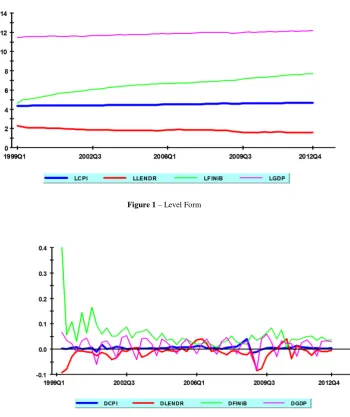
The graph of the first differenced form for the four variables is presented in Figure 2. The first difference of the ln form of each variable is taken (each resulting variable is denoted with a prefix of D), e.g.
DLFinIB = LFinIBt - LFinIBt-1
13 | P a g e
However, we cannot conclude this simply by observing the graphs. We will carry out ADF and PP tests for the confirmation. We will use the Akaike Information Criteria (AIC) and the Schwarz Bayesian Criteria (SBC) to analyze the results of the ADF and PP tests, to see if we can move ahead to Step ii. We will select the ADF Regression order based on the highest computed value of AIC and SBC.
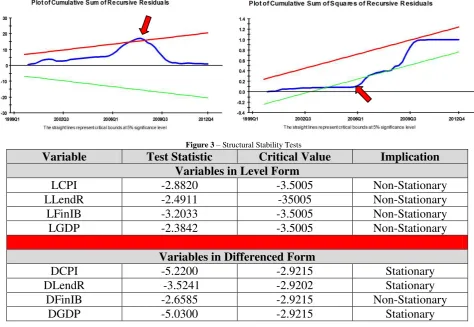
CUSUM and CUSUM Squared test indicates a Structural break is indicated when the sum of recursive residuals goes outside the critical bound of 5%. The test results in Figure 3 indicate a possible Structural break in 2006 and in 2007. This may require us to break the series into two or three part and conduct the tests separately. Since the break is minor, this will be done in future research.
[image:14.595.125.476.79.497.2]Augmented Dickey-Fuller (ADF) test are carried out on each variable. Table 2 summarizes the outcome of ADF tests, for each of the four variables, in both level and differenced form. AIC and SBC criteria indicate that three out of the four of the variables
Figure 1– Level Form
14 | P a g e
being used for this analysis are I(1); with FinIB being non-Stationary in its first difference form.
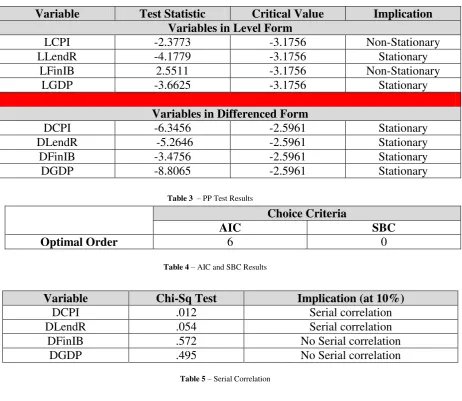
Table 3 summarizes PP results for both the level and differenced form for each of the four variables. The PP tests indicate all four variables to be Stationary in the differenced
Variable Test Statistic Critical Value Implication Variables in Level Form
LCPI -2.8820 -3.5005 Non-Stationary LLendR -2.4911 -35005 Non-Stationary LFinIB -3.2033 -3.5005 Non-Stationary LGDP -2.3842 -3.5005 Non-Stationary
Variables in Differenced Form
DCPI -5.2200 -2.9215 Stationary DLendR -3.5241 -2.9202 Stationary
DFinIB -2.6585 -2.9215 Non-Stationary DGDP -5.0300 -2.9215 Stationary
form. However, PP test indicate two of the four variables to be Stationary in the level form, also. It should be noted that ADF test indicated these two variables to be non-Stationary in the level form.
ADF and PP results show enough consistency for us to consider all four variables to be I(1), i.e. non-Stationary in their level form and Stationary in their first difference form, indicating that the results of the forecasting will not be spurious, and will simultaneously maintain the trend component. This allows us to move ahead towards Step ii.
6.2 Step II: VAR
The results in Table 4 show that AIC recommends order of 6 whereas SBC favors an order of 0 lag.6. The decision on the order of VAR is, thus, a trade-off: the lower order VAR
[image:15.595.60.535.160.487.2]
6 The lag values were computed by using the highest values for AIC and SBC, utilizing an arbitrary high VAR order of 6 Figure 3– Structural Stability Tests
15 | P a g e
will help avoid over-parameterization, when we have a short time series and no Serial correlation, while a higher order VAR will address Serial correlation, when we have a longer
Variable Test Statistic Critical Value Implication Variables in Level Form
LCPI -2.3773 -3.1756 Non-Stationary LLendR -4.1779 -3.1756 Stationary
LFinIB 2.5511 -3.1756 Non-Stationary LGDP -3.6625 -3.1756 Stationary
Variables in Differenced Form
DCPI -6.3456 -2.5961 Stationary DLendR -5.2646 -2.5961 Stationary DFinIB -3.4756 -2.5961 Stationary DGDP -8.8065 -2.5961 Stationary
Choice Criteria
AIC SBC
Optimal Order 6 0
Variable Chi-Sq Test Implication (at 10%)
DCPI .012 Serial correlation DLendR .054 Serial correlation
DFinIB .572 No Serial correlation DGDP .495 No Serial correlation
Based on OLS Regression of FinIB on: CONS LCPI LGDP LFinIB
Test Statistic: -6.0637 (Highest AIC and SBC Value) Critical Value: -4.3190
time series. The trade-off results in a problem if we have a short time series and Serial correlation. Due to the mismatch between the AIC and SBC recommendations, and to address the trade-off mentioned above, we proceeded to check for Serial correlation for each of the variables7. Based on this, the higher VAR order of 6 is selected.
6.3 Step III: Cointegration Test
Having established the variables to be I(1) with the optimal VAR order of 6, we have completed the pre-requisites to move to Step iii. Engle- Granger test and JJ test are used in this step. Table 6 provides a summary of the results from the Engle-Granger test.8
[image:16.595.67.530.107.508.2]
7 The p-value for Chi-sq is tested. The Null is that there is no Serial correlation. If the p-value is less than .1, Null is rejected Table 4– AIC and SBC Results
Table 5– Serial Correlation
Table 3 – PP Test Results
16 | P a g e
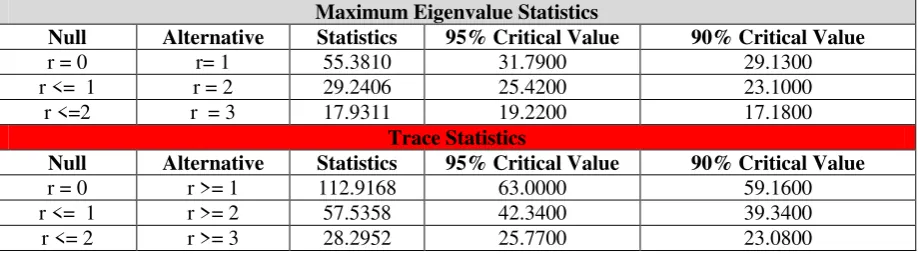
As per the results in Table 7, the Eigen value test statistics of r=0 is higher than the 95% bound. Based on this, we reject the null for r =0. In addition, the Eigen value test
Maximum Eigenvalue Statistics
Null Alternative Statistics 95% Critical Value 90% Critical Value
r = 0 r= 1 55.3810 31.7900 29.1300
r <= 1 r = 2 29.2406 25.4200 23.1000
r <=2 r = 3 17.9311 19.2200 17.1800
Trace Statistics
Null Alternative Statistics 95% Critical Value 90% Critical Value
r = 0 r >= 1 112.9168 63.0000 59.1600
r <= 1 r >= 2 57.5358 42.3400 39.3400
r <= 2 r >= 3 28.2952 25.7700 23.0800
Criteria Number of Cointegrating Vectors
Maximum Eigenvalue 2
Trace 3
AIC 4
SBC 4
HQC 4
[image:17.595.68.527.120.390.2]statistics of r<=1 is also higher than 95%. Based on this, we reject the null for r = 1 also. Finally, the Eigen value test statistics of r<=2 is lower than 95% but higher than the 90% bound. Using the 95% bound, we can conclude that, as per the JJ test, the number of cointegration vectors are less than or equal to 2.
Table 8 summarizes all the results. The maximal Eigenvalue indicates 2 cointegrating vectors, while the Trace statistics indicate 3 cointegrating vectors. While AIC, SBC and HQC indicate that there are 4 cointegrating vectors.
It should be noted that, as per Pesaran (2009), “…the complete agreement between the
three procedures of testing/selecting the number of cointegrating relations is very rare…and the decision concerning the choice of r…must be made in view of other information, perhaps
from economic theory.” Based on the results, economic theory, as well as the information available in the Literature review, we can conclude for the purpose of this research, there is one cointegrating vector; i.e. r = 1.
The economic meaning of this result is that the four variables we have selected move together in the long term, i.e. their relation to each other is not by chance. The number of
8
[image:17.595.69.529.128.255.2]If the abs |Test Statistic| corresponding to the highest value of AIC and SBC is higher than the Critical value, the Null hypothesis can be rejected and we can consider the variables to be cointegrated.
Table 7 – JJ Test
[image:17.595.72.526.296.384.2]17 | P a g e
restrictions = r2; where r is the number of cointegrating relationships. In this case r=1. This allows us to compare the statistical results with theoretical expectations.
6.4 Step IV: LRSM Test
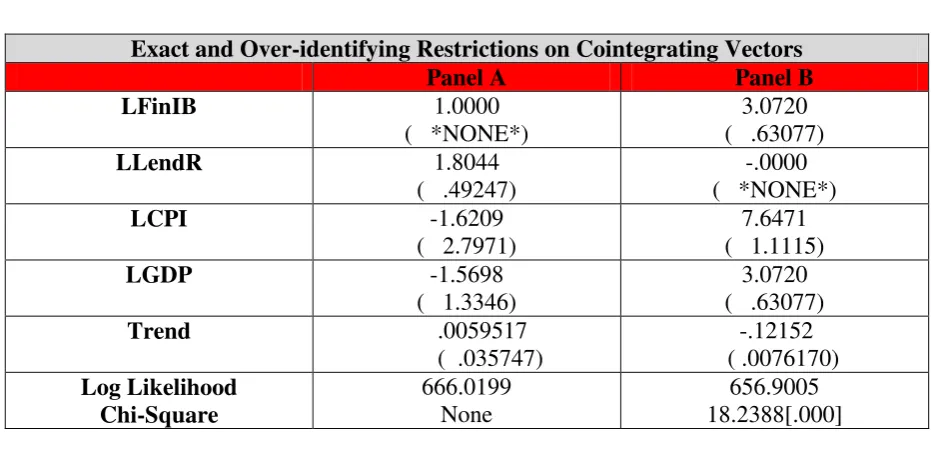
Since our variable of interest is FinIB, we normalized it by placing an exact identifying restriction of unity on the coefficient of FinIB. For the exact-identification test calculating the t-ratios manually (T-ratio = coefficient/ σ , we found all three remaining variables – CPI, LendR and GDP - to be insignificant (as their t-ratios are insignificant as shown in Table 10).
The above result is surprising and contradicts established theory; specifically in the case of CPI and GDP. Theory dictates these two variables to be significant in any discussion on financing. Based on this, we decided to test only the significance of Interest rate via an over-identifying restriction of zero on the coefficient of LendR. The results indicate that Null restriction of zero on LLendr (Lending Rate) is rejected (with a Chi-Sq value of 0.000). The overall results for exact and over-identifying restrictions are presented in Table 9.
FinIB + 1.8044LendR – 1.6209CPI – 1.5698GDP ~ I(0) (.49247) (2.7971) (1.3346)
Exact and Over-identifying Restrictions on Cointegrating Vectors
Panel A Panel B
LFinIB 1.0000
( *NONE*)
3.0720 ( .63077)
LLendR 1.8044
( .49247)
-.0000
( *NONE*) LCPI -1.6209 ( 2.7971) 7.6471 ( 1.1115) LGDP -1.5698 ( 1.3346) 3.0720 ( .63077) Trend .0059517
( .035747)
-.12152
( .0076170)
Log Likelihood Chi-Square
666.0199 None
656.9005 18.2388[.000]
Variable Coefficient Standard Error t-ratio Implication
LCPI -1.6209 2.7971 .5795 variable is insignificant LLendR 1.8044 .49247 -1.64 variable is insignificant
LFinIB - - -
-LGDP -1.5698 1.3346 1.176 variable is insignificant
6.5 Step 5: VECM Test
[image:18.595.64.530.355.581.2]Table 9 – LRSM Results
18 | P a g e
So far, we have been able to establish a theoretical long run relationship between the variables. However the tests, till now, have not established the exogenous and endogenous variables, i.e. we have established that all four variables – CPI, LendR, FinIB and GDP – are cointegrated; however, the cointegrating equation does not provide any information on the causality. This will be decided by VECM test. This is another key point where Time Series Multivariate Forecasting differs from Regression techniques.
We have established that all four variables – CPI, LendR, FinIB and GDP – are cointegrated; however, the cointegrating equation does not provide any information on the causality. Having completed the first four steps (which test the Theory of the model), we move to the final four steps (which test the Causality). VECM is the first step in the test for Causality. The aim is to determine the extent to which the change in one variable is caused by another variable in a previous period. The results of the VECM are displayed in Table 11.
The test is carried out be examining the error correction term et-1, for each variable and
checking its significance9. Based on this, we found FinIB and LendR to be endogenous, while CPI and GDP are exogenous. This seems counter-intuitive to the theory. Based on the existing research, as highlighted in the Literature Review, the variable LLendr was expected to be exogenous. CPI and GDP have shown up as exogenous, however intuition tells us that they are not market-driven hence they cannot be considered to be exogenous. As per Perasam
(2009), “…some variables are intuitively exogenous, no need to test if data shows it…” At
the same time, Lending rate is linked to KLIBOR, which is set by BNM as an interest rate; which as per theory is always exogenous. Hence, based on economic theory, we will assume CPI and GDP to be endogenous and Lending Rate to be exogenous.
The coefficient of the error term et-1 informs us the time it will take to return to
long-term equilibrium if a particular variable is shocked. The coefficient represents proportion of imbalance corrected in each period, e.g. for FinIB, the coefficient 4.8939 indicates that a shock applied to this variable, it will take 4.9 quarters for it to return to equilibrium.
The diagnostics are chi-squared statistics for: Serial correlation (SC), Functional form (FF), Normality (N) and Heteroscedasticity (HET). These indicate that the equations are well- specified10, with a minor issue for GDP, which shows possible issues of Serial correlation and
Functional form.
6.6 Step VI: VDC Test
So far, we are not able to comment on the relative exogeneity and endogenity of the variables. This is can be accomplished through the VDC test. We have carried out the VDC tests under the Generalized and Orthogonalized approaches. The results for Orthogonal tests are presented in Tables 12 while the results for Generalized tests are presented in Tables 13.
T-Ratio[Prob]
Variable FinIB LendR CPI GDP
dLFiniB1 -1.1346[.266] .060429[.952] -1.4154[.168] .68905[.496]
19 | P a g e dLLendR1 .63822[.529] 1.5253[.138] 1.3612[.184] 1.8428[.076]
dLCPI1 -.99627[.328] -.66284[.513] .046086[.964] -.95576[.347]
dGDP1 .58584[.563] .75178[.458] .44948[.657] .12555[.901]
ecml(-1) 4.9822[.000] 1.8428[.076] -.038571[.970] -1.3230[.197]
Implication Endogenous Endogenous Exogenous Exogenous
Diagnostics Tests
Statistic T-ratio[p-val] T-ratio[p-val] T-ratio[p-val] T-ratio[p-val] Chi-Sq SC-1 6.8142[.146] 2.0649[.724] 9.4422[.051] 19.7095[.001]
Chi-Sq FF-1 4.2157[.040] .65697[.418] .0055144[.941] 17.9628[.000]
Chi-Sq N-1 2.4173[.299] .40777[.816] 125.7321[.000] 2.4056[.300]
Chi-Sq HET-1 .021856[.882] .092094[.762] 2.7443[.098] .012910[.910]
LFinIB LLendR LCPI LGDP
LFinIB .80% 95.91% .48% 2.79%
LLendR .54% 97.64% 1.25% .55%
LCPI .78% 28.60% 68.62% 1.98%
LGDP 12.64% 40.83% 16.84% 29.68%
Forecasting – 48 (quarters)
LFinIB LLendR LCPI LGDP
LFinanIB .45% 96.31% 2.23% 3.01%
LLendR .63% 98.68% .38% .29%
LCPI .46% 38.28% 59.31% 1.93%
LGDP 12.81% 44.19% 14.22% 28.75%
Forecasting - 24 (quarters)
LFinIB LLendR LCPI LGDP
LFinIB 20.77% 78.75% 0.40% 0.08%
LLendR 13.89% 81.52% 1.06% 3.53%
LCPI 26.99% 24.83% 43.54% 4.64%
LGDP 3.23% 39.29% 19.28% 38.20%
Forecasting - 48 (quarters)
LFinIB LLendR LCPI LGDP
LFinIB 20.26% 79.52% 0.18% 0.03%
LLendR 14.44% 82.17% 0.53% 2.86%
LCPI 27.83% 31.41% 36.73% 4.04%
[image:20.595.67.530.70.245.2]LGDP 2.45% 43.21% 16.46% 37.87%
[image:20.595.79.520.323.501.2]Table 13– VDC Test Results - Generalized
[image:20.595.76.518.537.733.2]Table 12– VDC Test Results - Orthogonal
20 | P a g e
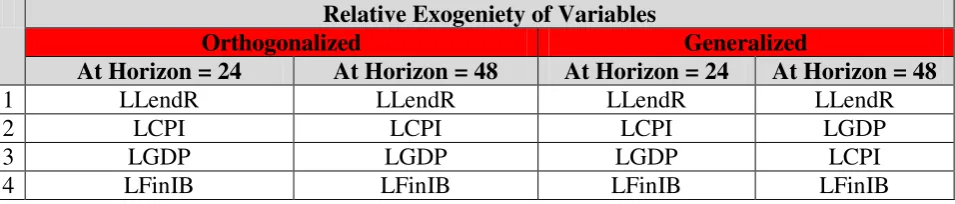
Tables 12 -13 divide each variable into proportions attributable to shocks from all the variables. The % in each column indicates the changes in the variable due the shock (and thus the dependence) from other variables. The diagonal line represents the exogeniety of each variable, since it shows the dependency of each variable on its past variations. This implies the higher the % in the diagonal, the more exogenous is the related variable. This issue is handled by the Generalized test, which is not dependent on the ordering of the variables.
Relative Exogeniety of Variables
Orthogonalized Generalized
At Horizon = 24 At Horizon = 48 At Horizon = 24 At Horizon = 48
1 LLendR LLendR LLendR LLendR
2 LCPI LCPI LCPI LGDP
3 LGDP LGDP LGDP LCPI
4 LFinIB LFinIB LFinIB LFinIB
A summary of the relative exogoniety of the variables, for the Orthogonal and Generalized tests, is presented in Table 14. LLendR (Lending rate) appears as the most exogenous variable in all four sets of forecasting (two each for Orthogonal and Generalized), since the highest % of its variation is explained by itself. This is as per our research objectives and as per the information presented in the Literature review. FinIB (Financing by Islamic Banks) appears as the least exogenous (most endogenous) variables. This is in-line with the VECM test, which showed FinIB to be endogenous. In addition, it is in-line with our research objectives.
6.7 Step VII: IRF Test
The information contained in VDC can be represented, with the same equality, by IRFs. Figures 5 highlight the results of shocking of the most exogenous variable – LLendr. – for the Orthogonal and Generalized approaches. The results are in-line with the VDC results. When LLendr – the most exogenous variable – is shocked, FinIB – the most endogenous variable – deviates the most from the equilibrium.
6.8 Step VIII: PP Test
[image:21.595.61.539.183.285.2]Table 14 - VDC – Relative Exogeniety
[image:21.595.71.531.204.461.2]21 | P a g e
In the final step, the complete equation is shocked (i.e. all the variable simultaneously) over the long run by external factors. Figure 6 shows that it will take the model approximately 14 quarters to return to equilibrium. This implies that, when an external shock occurs, the variables will move away from the equilibrium, resulting in a temporary situation where they are not cointegrated. However, after 14 quarters, they will return to the cointegrated state of equilibrium.
7. POLICY IMPLICATIONS
This is the most important section of the research, as it is of most interest to the policymakers. In this section, we will attempt to highlight the policy implications in light of the economic meanings of the statistical results that we have so far elaborated upon in the previous sections. The first four steps of the forecasting covered the area of theory, which is mostly of academic interest; indicating that our model is statistically sound, as per the requirements of Time Series Multivariate Forecasting techniques. The interpretation of the economic meaning of the results and the subsequent possible impacts on policies will, thus, begin from Step 5.
Other than the VECM results, our research results have fallen, more or less, in line with theoretical expectation. The VECM test showed that the financing by Islamic banks has a dependency on the other three variables, with the financing variable being endogenous. Of the other three variables, GDP and CPI are well understood and, by theory, are taken to be endogenous (contrary to the results of the VECM test).
Before moving further, it is important to highlight a factor in this research, under which the policy implications must be analyzed. Normally, in Multivariate Time Series forecasting, the aim of establishing the ranking of exogoniety of variables is to provide policymakers with a criteria on which variable they can target first to have the maximum impact, i.e. the most exogenous variable. However, the aim of this study is to provide the policymakers with a platform to study the impact of Lending rate on IB financing, with the ultimate aim of dissociating IB financing, as much as possible, from any direct impact of changes in interest rates; thereby linking it to the Real sector, which can be measured via GDP.
[image:22.595.207.439.185.339.2]GDP is a good indicator of the movement of the economy, since it is a representation of the total value of the goods and services produced by a country. Higher GDP is a reflection of economic growth, which implies that consumers are more willing to indulge in financing. CPI measures changes in the price level of a market basket of consumer goods
22 | P a g e
and services purchased by households. The higher the CPI, the more reluctant consumers will be to pursue financing. The theory behind both these concepts is well-established and was not the primary aim of this research.
The focal variable under consideration was the Lending rate, as set by BNM (as a mark-up on KLIBOR). The impact of Lending rate on Conventional finance is a very well-understood phenomenon. When BNM changes the interest rate at which Conventional banks can borrow money, it has a ripple affect across the economy. The lower the interest rate, the more motivated people will be to borrow money from Conventional banks. Since they are paying a lower interest, they will spend more in the economy, as well. This results in an increase in output and productivity. On the other hand, higher interest rates result in reduced disposable income and a reduction in spending.
Since higher interest rates result in higher borrowing costs, with the demand for goods and services falling, they cause inflation to fall, as well; thereby lowering the CPI. Interest rates also affect the Stock and Bond markets. Investors will chose the investments that will provide the highest rate of return. Higher interest rates result in a decline in stock prices, because of fall in earnings of business (due to lesser spending). Similarly, higher interest rates result in a fall in Bond prices.
How many of the above changes in the economy, due to changes in interest rates, impact the financing by Islamic banks; and in what manner? This is the area on which the policymakers are encouraged to concentrate, using the results in this research as a foundation.
The VDC results have estimated a lead-lag relationship between Lending rates and financing by Islamic banks, in a manner where the Lending rate variable was the most leading variable and the Islamic bank financing was the most lagging variable. This supports the view that interest rates have a direct causal relationship with Islamic bank financing. Based on this, the impacts of this for the policymakers will be discussed under the following categories:
Risk Management
Managing financial stability in a Dual-banking system
Impact on individual financial products offered by Islamic Banks
Impact across jurisdictions
Shariah Implications
7.1 Risk Management
Regulators have a direct responsibility for Risk management of the financial sector. This requires an understanding of the driving factors behind financing; one of the most important of which is impact of changes in interest rates. If interest rates are impacting financing by Islamic banks in a manner similar to financing by Conventional banks, then this is an indication that Islamic banks also suffer from Interest rate risk.
23 | P a g e
i.e. the relationship between Profit rate risk of IBs may be closer to Interest rate risk faced by CBs, than previously envisioned.
7.2 Managing Financial Stability
If Islamic bank financing is as causally related to changes in interest rates, as shown by this paper, then this is an indicator that IBs cannot act as an alternate stabilizing factor for the economy, i.e. they cannot be used as a mechanism to offset the risks faced by Conventional Banks. Hence, policymakers will need to take this into account when carrying out changes in KLIBOR.
7.3 Impact on Individual Financial Products
As mentioned in the Literature review, current IB financing is almost totally based on two products (and their derivatives) - murabaha and ijara financing. This study has not looked at the impact of interest rate changes on the financing of each of these individual financial products. It has only looked at the combined financing, which includes both these products. This study can, however, assist policymakers in analyzing the impact of interest rate changes on each financial product separately. This can be of future interest to the policymakers.
7.4 Impact across Jurisdictions
Due to differences in Finance laws and Regulatory requirements across jurisdictions, financial products may be structured differently by IBs in Malaysia in comparison to IBs in other jurisdictions. This may result in changes in interest rates having different impacts on IBs in separate jurisdictions. Policymakers need to keep this in mind, when adjusting interest rates. Hence, the most comprehensive study would be to use the research presented in this paper as the basis for studying the impact of interest rate changes in more detail by drilling down into each IB asset-side financial product in each jurisdiction, wherever IBs currently exist.
7.5 Shariah Implications
This is the main area of research for this paper, and an extremely important aspect to be addressed by policymakers, as ignoring this aspect of the research could lead to Systemic risk across the financial sector.
24 | P a g e
It is, thus, essential for Regulators to analyze the relationship between interest changes rate changes and IB financing in more detail, using this research as a starting point.
8. CONCLUSION
This research is an initial attempt to address the following questions, in an aim to decide the Shariah-compliant nature of Islamic banks and subsequent possible implications on the economy: is IB financing directly linked with changes in Interest rates? If so, then how does that impact the Shariah compliant nature of Islamic Banks? The findings of the research estimate a correlation and lead-lag causality relationship between interest rate changes and financing by Islamic banks. Within the geographical boundaries of our sample study, the results indicate that Lending rates set by BNM, Granger-cause financing by IBs in Malaysia.
Can we make the second conclusion, as well, i.e. based on the results of this research, are IBs Shariah non-compliant. This is a bold question with many fiqhi and Shariah implications. Grange-causality, as shown in this research, in the opinion of the author, does indicate that Islamic banks are not based; and only remain operationally Shariah-compliant. This has been estimated by various different researchers earlier; however this is an original attempt to establish this via Time Series Multivariate Forecasting methods.
However, we do not want to make a sweeping statement about the Shariah-compliant nature of IBs just on the basis of this singular study. We would like to encourage further studies, using this study as a foundation. At the same time, since interest rates, as set by BNM, are estimated to be impacting financing by Malaysia IBs, it should provide further encouragement to IBs to move towards Shariah-based products (mudaraba, musharaka etc.), thereby replacing Shariah-compliant products (murabaha, ijara etc.) for financing. Not only will this make IBs more robust from a Shariah non-compliance risk (SCR) point of view, it will allow IB to genuinely establish themselves as an alternate form of financing to CBs.
25 | P a g e
Literature Table
Summary of impact of Interest Rate on Islamic Bank Financing Literature
Author Countries Methodology Main Variables Other Variables Conclusions
Haron and Ahmed Malaysia Adaptive Expectation Model
CB deposits inversely proportional to Interest rates
IB deposits directly proportional to Interest rates
Increase in the savings deposit of CBs inversely proportional to the amount of deposits of IBs.
Yussof, Rahman and Alias
Malaysia Granger Causality Test, ADF AIC Regression Analysis R2 KLIBOR, Overnight Loans t-statistic KLIBOR impacts Islamic and Conventional Merchant banks KILBOR positively impacts the growth of the asset side portfolio of Islamic and Conventional Merchant banks
Islamic Merchant banks are impacted more than Conventional Merchant banks
Kader and Leong Malaysia Unit Root test, Cointegration, VAR, Granger Causality IRF, ADF, PP VAR VEC JJ
Highly positive correlation between Conventional financing and Islamic financing; Negative correlation with BLR. Bi-directional causality relationship between Residential property financing of Islamic and CBs as well as BLR.
Residential financing of IBs responds positively to shot in Residential financing of CBs and Base Lending Rates
Chong and Liu Malaysia Granger Causality
test,
Unit Root Test, Cointegration Tests, ADF
Changes in Islamic
26 | P a g e
PP JJ
Hukum and Gulumser
Turkey VAR, IRF, VDC VAR, VEC, ADF, PP
Increase in Interest rates increases the deposits of CBs
Increase in Interest rates negatively impacts the deposits of IBs.
CB loans are negatively impacted by Interest rates
IBs loans show a positive response to Interest rates
Abu-Bakr and Malaysia Multiple Linear Liquidity Linear
Tahir Regression Credit Risk Regression can
Neural Networks Cost/Income be used to Size estimate Bank Concentration Ratio Performance CPI
27 | P a g e
References
Abu Bakr, N., Tahir, I. (2009). Applying Multiple Linear Regression and Neural Network to Predict Bank Performance. International Business Research, Vol. 2 No.4.
Chong, B. S. and Liu, M. H. (2009). Islamic Banking: Interest Free or Interest Based. Pacific Basin Finance Journal, Vol 17. 125 – 144.
Durrani, M., Boocock, G., (2006). Venture Capital, Islamic Finance and SMEs. Palgrave McMillon. New York, NY.
Enders, Walter. (2010). Applied Econometric Time Series. John Wiley & Sons. Alabama
Engle, R., Granger, W. (1987). Cointegration and Error Correction: Representation, Estimation and Testing. Econometrica, Vol. 55, No. 2. (Mar., 1987), pp. 251-276.
Hakan, E. E., Gulumser, A.B., (2011). Impact of Interest Rates on Islamic and Conventional Banks: The Case of Turkey. Munich Personal RePEc Archive.
Haron, Sudan, Ahmad, Norafifah (2000). The Effects of Conventional Interest Rates and Rate of Profit on Funds Deposited with Islamic Banking System in Malaysia. International Journal of Islamic Financial Services, Vol. 1 No.4
Kader, R.A., Leong, K.Y., (2009). The Impact of Interest Rate Changes on Islamic Bank Financing. International Review of Business Research Papers, Vol. 5 No. 3, 189-201.
Masih, M., Al-Elg, A. and Madani, H. (2009). Causality Between Financial Development and Economic Growth: an application of vector error correction and variance decomposition methods to Saudi Arabia, Applied Economics, 41, 1691–1699
Masih, M. and Algahtani, I.(2008). Estimation of Long-Run Demand for Money: An Application of Long-Run Structural Modelling to Saudi Arabia. Economia internazionale, 81–99
Masih, M., Al-Sahlawi, M. A. and De Mello, L. (2010). What drives carbon-dioxide emissions: Income of electricity generation? Evidence from Saudi Arabia, The Journal of Energy and Development, Vol. 33, No. 2, 201–213
Pesaran, B. and Pesaran, M. H. (2009). Time Series Econometrics using Microfit 5.0. Oxford University Press. UK.
Usmani, M.T. (1998), An Introduction to Islamic Finance. Karachi, Pakistan.