Analysis of Fragmentation Processes in High-Mountain
Forests of the Centre of Mexico
Angel Rolando Endara-Agramont1*, Rafael Calderón-Contreras2, Gabino Nava-Bernal1, Sergio Franco-Maass1
1Instituto de Ciencias Agropecuarias y Rurales, Toluca, México; 2Universidad Autónoma Metropolitana, D. F. México, México.
Email: *[email protected], [email protected], [email protected], [email protected], [email protected]
Received January 8th, 2013; revised February 8th, 2013; accepted February 16th, 2013
ABSTRACT
High-mountain forests (>3500 masl) are the main supplier of environmental services to Mexico City and its metropoli-tan area. Taking as a study case the Nevado de Toluca National Park, this article focuses on the considerable reduction on the density of its forest cover, characterised by disturbances in the structure and dynamics of Pinus hartwegii. This
specie is located towards the upper limits of the altitudinal gradient (3500 - 4100 masl) constituting the only pine spe-cies in the world capable to be established in those extreme environmental conditions. The information was collected through the implementation of 30 Sampling Plots (SP) of 20 × 50 mts (1000 m2) in three forest density categories:
dense, semi-dense and fragmented. For each forest category, all trees ≥2.5 cm DBH were measured in 10 SPs. The measurement variables were DBH, total and commercial height, forest health and forest extraction. The results show the abundance of dense, semi-dense and fragmented forest (336, 202 and 150 trees/Ha−1), with extraction percentages of
11%, 20% and 33% respectively. The horizontal structure distribution shows the shape of an inverted J for the three conditions. However, the phytosanitary conditions of the semi-dense forests (83% infested trees) and fragmented (63% infested trees), do not guaranties the survival of the adult trees, implying an intensification of the fragmentation process for the next decade; given the reduction of the regeneration patterns due to the lack of healthy tree breeding.
Keywords: High-Mountain Forests; Fragmentation; Forest Structure; Forest Health
1. Introduction
Worldwide, high-mountain forests represent one of the main sources of local and regional environmental ser- vices. Besides, they are important habitats of an exten- sive rank of endemic species associated; nevertheless, are also environments threatened by over-exploitation and practices of land management. Paradoxically, the dete- rioration of the high-mountain forests is characterized by its scarcity of data and lack of empirical analyses.
In the case of Mexico, high-mountain forests are inti-mately related to the provision of environmental services that fulfil the needs of the largest urban conglomeration in Latin America. Mexico City and its metropolitan area depend directly of the environmental services provided the only zone of high-mountain forests in the country, the transversal volcanic system. The transversal volcanic system includes three of the highest volcanic buildings of the country: Popocatépetl, Iztaccihuatl and the Nevado de Toluca.
The forest coverage also has been reduced progres-
sively, originating social, economic, and ecological pro- blems. Among the most pressing degradation factors it is possible to mention the lack of forest planning, distur- bances in the wildfire regime, overgrazing and atmos- pheric pollution [1].
Deforestation is usually the most utilized indicator to measure forest depletion [2]. Nevertheless, other evi- dence of deterioration is the trees decrease of a deter- mined population and the reduction of species, which can be caused by natural processes such as wildfires and for- est plagues, or by anthropogenic causes; mainly forest extraction [3]. These forest disturbances can modify the forest structure and its diversity [4,5]. The main cones- quence is the forest fragmentation, which reduces the incorporation of new individuals to the forest [6].
Forest fragmentation is often defined as the disruption of a continuous area of forest into smaller fragments with different degrees of isolation [7]. Both deforestation and fragmentation of the native forest are urgent environ- mental problems due their impact on the biodiversity. According to [8], to characterize forest fragmentation, it is necessary to identify the vertical and horizontal forest
structure.
This paper utilizes information of a case of study of the Nevado the Toluca National Park (NTNP) which is located in in the Mexican central highlands, in order to analyze the loss of the forest density as the main indica-tor of high-mountain forests fragmentation processes. This forest is represented by a species of pine (Pinus hartwegii), established over the altitudinal limits of the
trees’ communities > 4000 masl.
The selected measurement variables were forest struc- ture, forest health and extractive activities. The analysis of forest fragmentation presented here constitutes a con- tribution for improving the understanding of the pro- cesses around the high-mountain forests degradation. Furthermore, it provides important conclusions that frame the future implications on the forest management, its resources and the provision of strategic environmental services such as drinking water supply to large metropo- lises.
2. Materials and Methods
2.1. Description of the Case Study
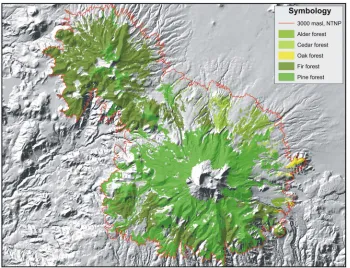
The NTNP is located in the State of Mexico and covers approximately 51,000 has (Figure 1) around the Xi-nantécatl volcano (GEM, 1999), which belongs to the
transversal volcanic system. Its forests are dominated by species of conifers (Pinus spp and Abies religious) and,
in smaller proportion by broad-leaf species (Quercus spp
and Alnus jorullensis) (Figure 2). However, the reduc-
tion of the arboreal density, illegal logging and the prob- lems of forest health affect mainly the forests of Pinus hartwegii, Abies religiosa and Quercus laurel [9].
2.2. Pine Forest
Given their diversity, this study focuses on pine forests. In the case study there are three dominant pine species: at an altitude of <3000 msnm the species found are Pinus pseudostrobus; between 3000 and 3200 small fragments
of Pinus montezumae can be identified. Finally, popula-
tions of Pinus hartwegii dominate the upper limits of the
trees’ communities (3500 to 4100 masl). This altitudinal range concentrate dense forests (Figure 3), therefore, the
population of Pinus hartwegii is constituted as one of the
species located at greater altitude ranges worldwide [9].
2.3. Sampling
The sampling was carried out in the forest of Pinus hartwegii, being the only arboreal species adapted to
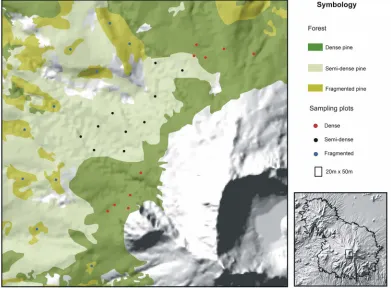
conditions of high altitude, establishing up to the 4390 masl in the study area. The sampling method was first based on secondary data, where the utilization of geo- graphical information systems (GIS) permitted the local- ization of the Sampling Plots (SP). The pine forest den- sity loss for the period 1972-2000 (Franco et al., 2006)
was considered as the main disturbance variable. Hence, three Pinus hartwegii populations were identified (dense,
semi-dense and fragmented) around the Xinantécatl vol-
[image:2.595.128.473.456.718.2]cano (Figure 4).
Figure 2. Nevado de toluca national park forests.
Figure 3. Pinus hartwegii forest (4100 masl), NTNP.
[image:3.595.126.473.524.717.2]The comparison of the two periods shown in Figure 4
represents the evidence of dense pine forest reduction in more than 40% of its surface [10]. As a result of this in- formation 10 SPs of 20 m × 50 m were defined for each forest condition (dense, semi-dense and fragmented). The SPs were established by a stratified random sampling (Figure 5). In each SPs, individuals older or equal to 2.5
cm of Diameter at Breast Height (DBH) were measured, following the criteria proposed by [9,11].
2.4. Measurement Variables
The variables DBH, total and commercial height, and forest health were measured. These variables gave the characterization of the vertical and horizontal structure, as well as the phytosanitary condition of dense, semi- dense and fragmented forests. In addition, the basal di- ameter of the extracted trees was measured in each SP in order to characterize the effect of forest extraction.
The distribution of the number of individuals by dia- metric category was compared among the dense, semi- dense and fragmented forests through a one-way variance analysis with a significance level of p < 0.05. The rela- tion height-diameter was determined through a polyno- mial regression model. This analysis helped to compare the adjustment curves for each condition with a level of significance of p < 0.05.
The presence of forest plagues was used as an indica-
tor regarding forest health. The presence of bark beetle (Dendroctonus adjunctus) was characterized by using the
method proposed by [12], while the incidence of dwarf mistletoe (Arceuthobium globosum and A. Vaginatum)
was characterized by utilizing the method proposed by [13].
3. Results
Description of the High-Mountain Forest
This study defines high-mountain forests in Mexico as the forest ecosystem developed above the 3500 masl. This characterization follows the establishment of Pinus hartwegii populations such as the only species capable to
adapt to cold and extreme altitude conditions.
The structural characteristics of the high-mountain forests are particularly associated with a specific range of human activities. Aspects of the extractive activities of high-mountain forests in the case study selected include fuelwood collection and the extraction of timber [9]. Even though the forests are located above the superior limits of communities and crop fields, they are in severe pressure due to anthropic activities, leading to a local fragmentation of the pine forest. Forest fragmentation is associated to overgrazing, wildfire, and extraction of infested trees.
[image:4.595.104.495.429.717.2]For the comparison of the horizontal structure among
Figure 5. Sampling method.
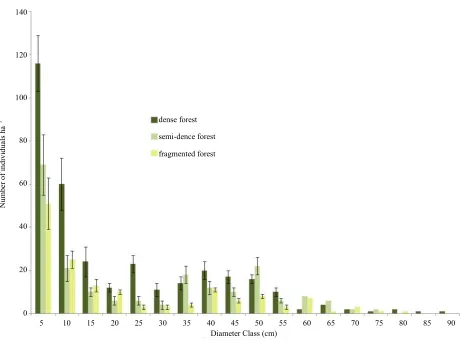
the three forest conditions, the individuals were classified by diametric category. The results show significant dif- ferences (p < 0.05) in the six first classes, where the dense forest presents greater quantity of individuals with regard to the other two conditions (Figure 6). This sug-
gests that the extraction of trees with smaller diameters is favoring the fragmentation of pine forest. The extraction of these trees in the study area is related to the comer- cialization of firewood [9].
The decline curves of the relation diameter-height among the three forest conditions are adjusted to a sec-ond-degree polynomial decline of the dense and semi- dense forest, while the fragmented forest presents a third- degree decline (Figure 7). Such curves do not show sig-
nificant differences (p > 0.05); this suggests that the rela- tion height-diameter is not seen affected by the forest fragmentation. Nevertheless, the upper stratum of the fragmented forests reaches a height of 35 meters, five more than the dense and semi-dense pine forests. This trend in the fragmented forest is related to an increase in the light, space and nutrients availability.
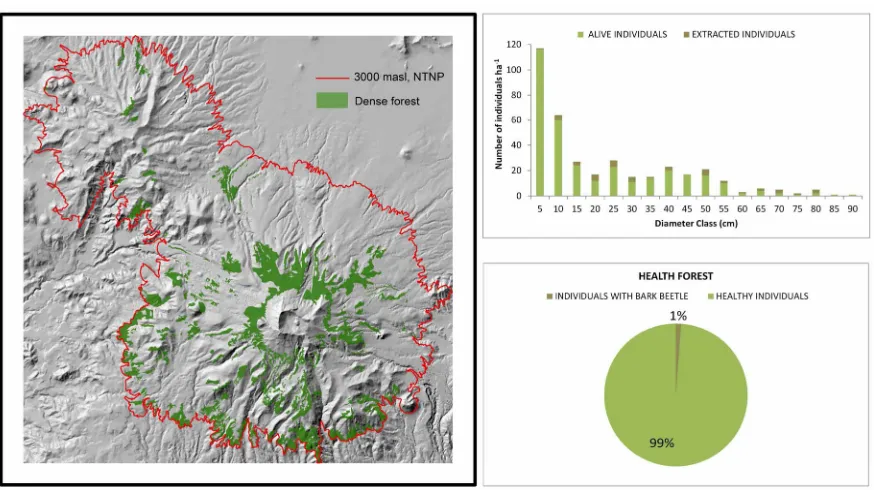
Dense forest presents an abundance of 336 trees/ha. The forest phytosanitary condition and its extraction pat- terns are closely related. For the case of the dense forest
and, despite existing an extraction of 11% (43 trees) dis- tributed in all the diametric categories, this does not mean an increase in the attack of forest plagues (Figure 8). It is important to mention that the accessibility to
dense forest is more difficult, given the abrupt slopes in which it is developed. Therefore, the roads network this zone is very precarious. For this reason, dense forest does not present problems of forest health, since only the 1% has some degree of attack by bark beetle (Dendroctonus adjunctus), the main plague of the high-altitude pine
for-ests in Mexico.
However, the semi-dense forest presents an abundance of 202 trees/ha and an extraction of 20% (51 trees), mainly distributed between the 20 and 55 cm of diamet-ric class (Figure 9). As opposed to dense forests, the
extraction of semi-dense pine forest is concentrated on large diameters, what implies a greater damage on resid-ual woodland. Furthermore, this indicates that the popu-lation of semi-dense forest is vulnerable to the attack of plagues and parasitic plants, being Dendroctonus ad-junctus the plague with greater presence. This situation
allows for a continuous pine forest fragmentation, and denotes the need for health logging actions for forest plagues control.
dense forest
semi-dence forest
fragmented forest
5 10 15 20 25 30 35 40 45 50 55 60 65 70 75 80 85 90 Diameter Class (cm)
[image:5.595.69.530.378.722.2]140 120 100 80 60 40 20 0 N um ber of in di vi du als h a − 1
Dense forest
Semi-dence forest
Fragmented forest
0 50 100 150 200 250 300
He
ight
(m)
40
35
30
25
20
15
10
5
0
Number of individuals ha−1 y = 9E-06x3 + 2E-05x3 + 0.0244x + 0.1765
R2 = 0.8968
y = 0.0005x3 + 0.0485x + 0.1302 R2 = 0.9096
[image:6.595.66.528.96.442.2]y = 0.0003x3− 0.0082x + 1.6238 R2 = 0.8809
Figure 7. Height-diameter relation between dense, semi-dense and fragmented forest.
[image:6.595.86.523.472.717.2]Figure 9. Extraction and forest health in semi-dense forest.
Figure 10. Extraction and forest health in fragmented forest.
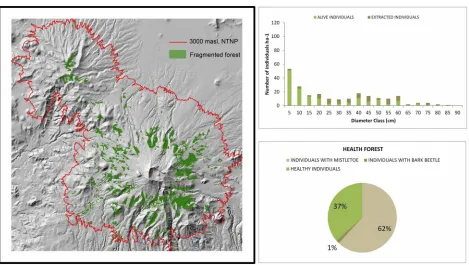
The fragmented forest presents an abundance of 150 trees/ha and an extraction of 33% (73 trees), distributed in all the diametric classes, however, accentuated be- tween the 20 and 60 cm of diametric class. This implies a greater damage on the residual woodland that is trans- lated into an increase of the incidence of parasitic plants
(Arceuthobium globosum and A. vaginatum). 37% of
healthy woodland does not guarantee the survival of frag- mented forest, condition by which it is expected a land use change from woodland to grassland (Figure 10).
[image:7.595.65.535.96.597.2] [image:7.595.65.534.367.632.2]mental services required for central Mexico.
4. Conclusions
The pine forest fragmentation in the NTTP is similar to other Natural Protected Areas in the centre of Mexico. The empirical information provided by this paper illus- trates that high-mountain forests have a notorious trend to fragmentation. This process is closely related to ex- tractive activities, forest plagues, and wildfires.
The forest structure explained through the distribution of trees abundance by diametric category shows an in- verted J. This evidence suggests that the analysed forest is in an apparently good conservation stage. However, the main problem is the phytosanitary condition of the trees, since bark beetle and dwarf mistletoes attack the 83% of individuals in the semi-dense forest and the 63% of individuals in fragmented forest.
These problems describes the high perturbation levels of the high-mountain forests, and furthermore, their scarce possibilities of natural regeneration. Problems accentuated by the lack of healthy tree breeding and im- moderate processes of forest extraction. This trend im- plies to the short term, high-mountain forests will suffer a land use change, from dense forests to fragmented for- ests, and from fragmented forests into grasslands. As a consequence, a reduction in the provision of environ- mental services is expected; particularly water supply for metropolitan areas.
One of the factors that favour the fragmentation proc- ess in high-mountain forests is the restriction to forest management. In the case study it is not possible to carry out actions to favor forest growth and regeneration. For this reason, it is necessary to delegate forest management to local communities [14]. Furthermore, modifying the current forest management policies in natural protected areas is required, especially regarding the areas with im- portant human settlements, such as central Mexico. For this case, forest management prohibition is not a conser- vation option anymore, becoming a cause for the con- tinuous fragmentation of high-mountain forest.
REFERENCES
[1] J. A. Encina, F. J. Encina, E. Matarocha and J. I. Valdez, “Aspectos Estructurales, Composición Florística y Caracterización Ecológica del Bosque de Oyamel de la Sierra de Zapalinamé, Coahuila, México,” Boletín del a Sociedad Botánica de México, Vol. 83, 2008, pp. 13-24. [2] Y. Vázquez, and S. A. Orozco, “La Destrucción de la
Naturaleza,” Fondo de Cultura Económica, México, 1989. [3] L. Villers-Ruiz, L. García del Valle and J. López-Blanco, “Evaluación de los Bosques Templados en México: Una Aplicación en el Parque Nacional Nevado de Toluca,” Investigaciones Geográficas, Vol. 36, 1998, pp. 7-21. [4] J. Hitimana, J. L. Kiyiapi and J. T. Njunge, “Forest
Structure Characteristics in Disturbed and Undisturbed Sites of Mt. Elgon Moist Lower Montane Forest, Western Kenya,” Forest Ecology and Management, Vol. 194, No. 1-3, 2004, pp. 269-291. doi:10.1016/j.foreco.2004.02.025 [5] C. Cannon, D. R. Peart and M. Leighton, “Tree Species
Diversity on Commercially Logged Bornean Rainforest,” Science, Vol. 281, No. 5381, 1998, pp. 1366-1368.
doi:10.1126/science.281.5381.1366
[6] W. Laurance, H. Nascimento, S. G. Laurance, A. C. Andrade, P. M. Fearnside, J. E. L. Ribeiro and R. L. Capretz, “Rain Forest Fragmentation and the Proliferation of Successional Trees,” Ecology, Vol. 87, No. 2, 2006, pp. 469-482. doi:10.1890/05-0064
[7] R. Bustamante, J. A. Simoneti, A. A. Grez and J. San Martín, “Fragmentación y Dinámica de Regeneración del Bosque Maulino: Diagnostico Actual y Perspectivas Futuras,” 2005, pp. 529-539.
[8] M. Wulder, J. C. White, M. E. Andrew, N. E. Seitz and N. C. Coops, “Forest Fragmentation, Structure, and Age Characteristics a Legacy of Forest Management,” Forest Ecology and Management, Vol. 258, No. 9, 2009, pp. 1938-1949. doi:10.1016/j.foreco.2009.07.041
[9] A. Endara, S. Franco, G. Nava, J. I. Valdez and T. Fredericksen, “Effect of Human Disturbance on the Structure and Regeneration of Forests in the Nevado de Toluca National Park, Mexico,” Journal of Forestry Re-search, Vol. 1, No. 23, 2012, pp. 39-44.
[10] S. Franco, H. H. Regil and J. A. B. Ordoñez, “Dinámica de Perturbación-Recuperación de las Zonas Forestales en el Parque Nacional Nevado de Toluca,” Madera y Bos- ques, Vol. 1, No. 12, 2006, pp. 17-28.
[11] E. Villavicencio and J. I. Valdez, “Análisis de la Estructura Arbórea del Sistema Agroforestal Rusticano de Café en San Miguel, Veracruz, México,” Agrociencia, Vol. 4, No. 37, 2003, pp. 413-423.
[12] S. Clarke and R. F. Billings, “Analysis of the Southern Pine Beetle Suppression Program on the National Forests in Texas in the 1990s,” Journal of Forestry, Vol. 2, No. 27, 1990, pp. 122-129.
[13] F. Hawksworth, “Taxonomía y Distribución de Arceutho- bium en México y Centroamérica,” Instituto Nacional de Investigaciones Forestales y Agropecuarias, No. 60, 1991, pp. 559-591.