http://dx.doi.org/10.4236/ojfd.2012.24A033 Published Online December 2012 (http://www.SciRP.org/journal/ojfd)
Transient Response Characteristics of Separated Flow and
Heat Transfer in Enlarged Rectangular Channel
Hiroyuki Yoshikawa1*, Shota Shirakura2, Mizue Munekata1 1
Department of Mechanical System Engineering, Kumamoto University, Kumamoto, Japan 2
Graduate School of Science and Technology, Kumamoto University, Kumamoto, Japan Email: *[email protected]
Received September 18, 2012; revised October 30, 2012; accepted November 9, 2012
ABSTRACT
Numerical results of three-dimensional separated flow and heat transfer in an enlarged rectangular channel are pre-sented in this paper. The expansion ratio and aspect ratio of the channel are 2.0 and 8.0, respectively. Reynolds number of the flow is 200 and it is over the critical Reynolds number. Over the value, the flow in the symmetric channel be-comes to deflect to one side of the walls. Transient response characteristics of the flow and heat transfer in the channel with the fully developed flow imposed one cycle of a pulsating fluctuation at the inlet are investigated. Vortex structure generated in the channel is visualized with a helicity isosurface. In the case of the fluctuation of Strouhal number 0.05, small streamwise vortices appear near the side walls and slightly upstream of the reattachment region of the short sepa-ration bubble. The vortices elongate and shed some vortices. These vortices attract some pairs of the streamwise vor-tices near the reattachment region quickly and they drift downstream along the side walls. They are inclined from the walls and are decaying gradually. It is clarified that high Nusselt number area appears and shifts downstream in accor-dance with the root of the vortices.
Keywords: Transient Response; Pulsating Fluctuation; Symmetric Enlarged Channel; Asymmetric Separated Flow; Heat Transfer
1. Introduction
Recently, prediction of separated flow and heat transfer in an enlarged channel is very important in relation to many types of fluid machinery and heat exchangers, and there have been so many experimental and numerical investigations [1-14]. It has been clarified in these studies that the flow in a two-dimensional symmetrically enlarged channel becomes asymmetric over the critical Reynolds number. The cause of becoming a steady asymmetric flow can be explained by the Coanda effect. The pressure decreases owing to an increase of the velocity near the lower or upper wall in the channel. The flow is biased to the lower pressure side when the pressure difference is once generated across the channel, and the asymmetry of flow is stably maintained. It seems that the instability of the separated shear layer disturbs the velocity resulting in the asymmetric flow. However, the details of these phe-nomena have not been clarified yet.
In engineering applications, the flow channel almost usually provides the side walls, which affect greatly the flow structure resulting in the three-dimensional flow [3, 13]. Accordingly, such the flow and heat transfer may be
quite different from that obtained with the two-dimen- sional simulation. However, there has been little infor-mation about the three-dimensional structure of separated flow and heat transfer in an enlarged channel. Cherdron et al. [3] and Schreck and Schäfer [13] have shown the stabilizing effect of the side walls experimentally and numerically.
upon the separated flow and heat transfer in the enlarged rectangular channel. It is clarified that the pulsating fluc-tuation of St = 0.05 and 0.10 strongly affects on the flow in the channel and heat transfer on wall surfaces en-hanced, especially on the wall covered with the long separation bubble.
However, transient flow and heat transfer with the inlet flow imposed fluctuation are not clarified in detail. The main objective of the present research is to clarify the transient response characteristics of the separated flow and heat transfer with only one cycle of a pulsating fluctuation in the enlarged rectangular channel.
2. Fundamental Equations and Numerical
Procedures
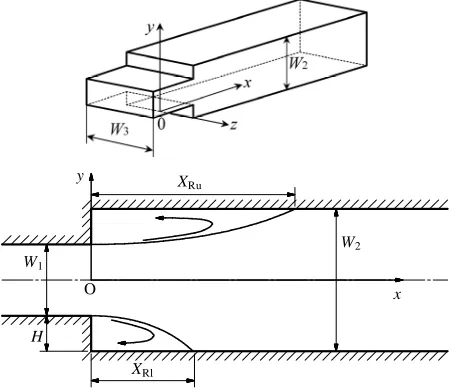
In the present study, three-dimensional (3D) flow of an incompressible viscous fluid with constant properties is treated. Figure 1 illustrates a 3D enlarged channel along with the coordinates and several important geometrical parameters. The fully developed laminar flow enters into the inlet, but only one cycle of a pulsating fluctuation [20] is imposed initially. The flow separates at the step corner and reattaches to the downstream walls. The wall sur-faces in the downstream of the step are heated. The pre-sent study simulates the forced convection and does not consider the influence of buoyancy. Fundamental equa-tions are the continuity, momentum and energy ones.
0
u (1)
1 2Re
t p
u u u u (2)
1 2RePr
t
u (3)
In these equations, physical quantities are nondimen-
[image:2.595.59.285.524.720.2]H W1 W2 x y XRl XRu O
Figure 1. Flow configuration and coordinate system.
sionalized by xx H , u uU, p p U2,
– i
w– i
and t tU H , respectively. The superscript * indicates nondimensional quantities, and it is omitted in the above equations. The finite dif-ference forms of these equations are obtained by the sec-ond-order Adams-Bashforth method for the time differ-entials. The fifth-order upwind difference is employed for the convection terms in order to make clear the de-tails of flow structure, and the fourth-order central dif-ference for the diffusion terms, and the second-order central difference for other terms. Resulting finite equa-tions are solved using the SMAC method [21].
The numerical calculations are performed on the cases of the expansion ratio, ER = 2, the aspect ratio, AR = 8, the Reynolds number based on the mean flow velocity at the inlet and the step height, Re = 200, and the Prandtl number, Pr = 0.71, respectively. The computational re-gion extends from 10 H upstream of the step to 100 H downstream of the step. The boundary conditions are as follows. As for the velocity, the no-slip condition is as-sumed on the walls and the zero gradient is used at the outlet. At the inlet, the fully developed duct flow velocity profile is presumed, though only one cycle of a pulsating fluctuation [20] is imposed initially. As for the tempera-ture, it is assumed to be uniform at the inlet, and the lower and upper wall surfaces downstream of the step are heated under the condition of uniform temperature, and other walls are adiabatic. The second derivative is as-sumed to be zero at the outlet. Initial flow and tempera-ture fields are steady state in the channel and the flow deflects downward, and after that the proper symmetric velocity profile with only one cycle of a pulsating fluc-tuation is imposed at the inlet.
The computational grids are generated using the Car-tesian coordinates with non-uniform spacings and the grids of 251 × 155 × 61 are used.
3. Results and Discussion
confirm the grid dependency in the case of Re = 203.3 using a finer grid in order to clarify these small discrep-ancies. However, these comparisons show the good reli-ability of the present numerical scheme.
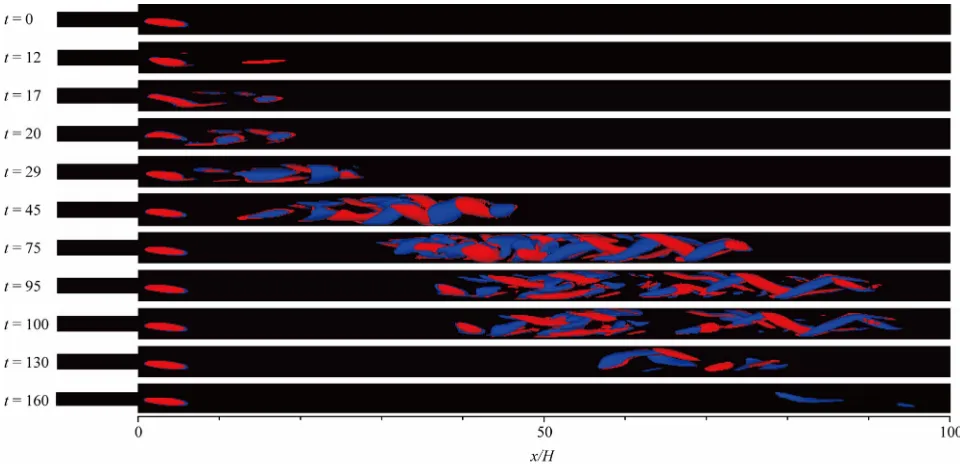
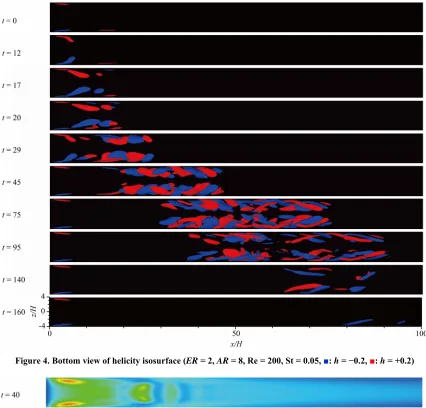
Figures 3 and 4 illustrate side and bottom views of in-stantaneous helicity isosurface. Two inclined vortices exist behind the step near the side walls symmetrically at t = 0. These vortices originated by a jet like flow in steady state [18] and almost keep the shape and location. These vortices are elongated toward spanwise center of the channel on the lower wall from t = 5. Corotating vor-tices appear downstream of the vorvor-tices at t = 17. At t = 20, the initial vortices shed two vortices. Counter rotating vortices are induced in front of the downstream vortices near the side walls. The initial shed vortices slightly in-cline to the upper wall and upper share layer sheds two vortices at t = 25. Downstream vortices successively in-duce counter rotating vortices from t = 25 to t = 80. The
vortices gradually inclined from the walls from t = 47. The cloud of the vortices gradually decreases its intensity from t = 90 and are divided at x H 60 and t = 95. These vortices monotonically decay and split and nearly disappear at t = 160.
Figures 5 and 6 present instantaneous local Nusselt number distribution on lower and upper walls. The dis-tribution within the separation bubbles is little changed. On the lower wall, heat transfer is slightly enhanced in the spanwise center region from t = 25. Two, four and six areas of high Nusselt number exist near the side walls at t = 39, 45 and 55, respectively. Inclined vortices come close to the lower wall and a pair of counter rotating vor-tices entrains cold fluid to the wall. These regions are identical to area of high Nusselt number. At t = 62, high Nusselt number area appears in the spanwise center re-gion and gradually increases the value. At t = 82, Nusselt number takes a peak in the spanwise channel center and
[image:3.595.56.536.483.717.2](a) (b)
Figure 2. Comparison of streamwise velocity profile. (a) ER = 3, AR = 24, Re = 186.7; (b) ER = 2, AR = 16, Re= 203.3.
Figure 4. Bottom view of helicity isosurface (ER = 2, AR = 8, Re= 200, St = 0.05, ■: h = −0.2, ■: h = +0.2)
Figure 5. Local Nusselt number distribution on lower wall (ER = 2, AR = 8, Re= 200, St = 0.05).
gradually decreases in accordance with the decay of the cloud vortices. On the other hand, effect of pulsation on the upper wall is observed from t = 40 and slower than the lower wall. Nusselt number on the upper wall takes a peak near the side walls similar to that on the lower wall.
However the locations on the upper wall are slightly up-stream or downstream from them on the lower wall.
Figure 6. Local Nusselt number distribution on upper wall (ER = 2, AR = 8, Re = 200, St = 0.05).
0.6 0.7
Upper wall
Nu
me
a
n
0 20 40 60 80 100 120 140 160 180 200
0.6 0.7 0.8
Lower wall
St = 0.2, 0.1, 0.05, 0.025, 0.0125
t
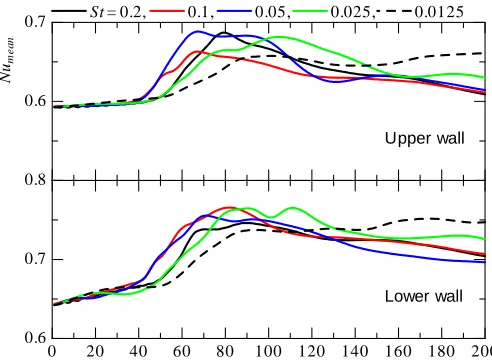
Figure 7. Time series of space averaged Nusselt number (ER = 2, AR = 8, Re = 200, St = 0.05).
trouhal number.
dimensional separated
rcomputer , Tohoku University.
estiga-S Nusselt number of St = 0.05, 0.10 in- ally decay.
creases early and Numean of St = 0.025, 0.20 follows them. It seems that enhancement of heat transfer is almost in-dependent on Strouhal number and the direction of wall.
4. Concluding Remarks
Numerical simulations of
three-flow and heat transfer in the symmetric enlarged rectan-gular channel was conducted. Transient response of the flow and heat transfer in the channel with the fully de-veloped inlet flow imposed one cycle of a pulsating fluctuation was investigated. Main results obtained are summarized as follows.
The vortices shed from behind of the step drift down-stream along the side walls and sequentially induce some pairs of the streamwise vortices near the reattachment region. These cloud vortices incline the walls and
gradu-Nusselt number on the walls takes a peak near the side walls on the upper and lower walls similarly. However the locations on the upper wall are slightly upstream or downstream from them on the lower wall.
In the case of St = 0.05, 0.10, space averaged Nusselt number increases early. However, enhancement of heat transfer is almost independent on Strouhal number of the pulsating fluctuation and the direction of wall.
5. Acknowledgements
These results were partly obtained with a supe SX-9 of Cyberscience Center
REFERENCES
[image:5.595.174.420.308.490.2]tions of Subsonic Turbulent Flow over Single and Double Backward Facing Steps,” Journal of Basic Engineering, Vol. 84, No. 3, 1962, pp. 317-325.
[2] T. Ito, Y. Suematsu, Y. Simokawa and K. Tanaka, “A Study on the Bistable Fluid Amplifier Load Oscillator (1st Report, on the Flow Characteristics of the Fluid Am-plifier),” Transactions of JSME, Vol. 39, No. 321, 1973, pp. 1599-1608. doi:10.1007/s11630-011-0437-x
[3] W. Cherdron, F. Durst and J. H. Whitelaw, “Asymmetric Flows and Instabilities in Symmetric Ducts with Sudden Expansions,” Journal of Fluid Mechanics, Vol. 84, No. 1, 1978, pp. 13-31. doi:10.1017/S0022112078000026
[4] I. J. Sobey, “Observation of Waves during Oscillatory Channel Flow,” Journal of Fluid Mechanics, Vol. 151, 1985, pp. 395-426. doi:10.1017/S0022112085001021
[5] A. Nishihara, K. Suzuki and Y. Inoue, “Numerical Analysis of Flow and Heat Transfer in an Enlarged Channel,” Proceedings of 26th National Heat Transfer Symposium of Japan, Vol. 1, Sendai, 31 May-2 June 1989, pp. 37-39.
[6] M. Shapira, D. Degani and D. Weihs, “Stability and Ex-istence of Multiple Solutions for Viscous Flow in Sud-denly Enlarged Channels,” Computers & Fluids, Vol. 18, No. 3, 1990, pp. 239-258.
doi:10.1016/0045-7930(90)90009-M
[7] R. M. Fearn, T. Mullin and K. A. Cliffe, “Nonlinear Flow Phenomena in a Symmetric Sudden Expansion,” Journal of Fluid Mechanics, Vol. 211, 1990, pp. 595-608. doi:10.1017/S0022112090001707
[8] T. Ota and Y. Toda, “Prediction of Laminar Heat Transfer and Flow in Plane Enlarged Channels (Heat Transfer 1990),” Hemisphere Publishing Corporation, New York, 1990, pp. 305-309.
[9] F. Durst, J. C. F. Pereira and C. Tropea, “The Plane Symmetric Sudden Expansion Flow at Low Reynolds Numbers,” Journal of Fluid Mechanics, Vol. 248, 1993, pp. 567-581. doi:10.1017/S0022112093000916
[10] T. Ota, H. Yanaoka and T. Hata, “Numerical Analysis of Laminar Flow and Heat Transfer in a Two-Dimensional Symmetrically Enlarged Channel,” Transactions of JSME, Vol. 60B, No. 579, 1994, pp. 3930-3936.
doi:10.1299/kikaib.60.3930
[11] S. Nakanishi, M. Sakurai and H. Osaka, “Numerical Study on Two-Dimensional Symmetric Sudden
sion Channel Flow (Dynamic C
Expan-haracteristics),” Transac-tions of JSME, Vol. 61B, No. 589, 1995, pp. 3182-3189.
doi:10.1299/kikaib.61.3182
[12] D. Drikakis, “Bifurcation Phenomena in Incompressible Sudden Expansion Flows,” Physics of Fluids, Vol. 9, No. 1, 1997, pp. 76-87. doi:10.1063/1.869174
[13] E. Schreck and M. Schäfer, “Numerical Study of Bifurca-tion in Three-Dimensional Sudden Channel Expansions,”
Computers & Fluids, Vol. 29, No. 5, 2000, pp. 583-593. doi:10.1016/S0045-7930(99)00014-6
[14] M. Thiruvengadam, J. H. Nie and B. F. Armaly, “Bifur-cated Three-Dimensional Forced Convection in Plane Symmetric Sudden Expansion,” International Journal of Heat and Mass Transfer, Vol. 48, No. 15, 2005, pp. 3128- 3139. doi:10.1016/j.ijheatmasstransfer.2005.02.019
[15] H. Yanaoka and T. Ota, “Three-Dimensional Numerical Simulation of Laminar Flow and Heat Transfer over Blunt Flat Plate in a Channel,” Transactions of JSME, Vol. 62B, No. 596, 1996, pp. 1496-1501.
doi:10.1299/kikaib.62.1496
[16] H. Yanaoka and T. Ota, “Three-Dimensional Numerical Simulation of Unsteady Flow and Heat Transfer over Blunt Flat Plate in Channel,” Transactions of JSME, Vol. 62B, No. 599, 1996, pp. 2745-2750.
doi:10.1299/kikaib.62.2745
[17] T. Ota, H. Yanaoka, K. Shibuya, M. Nakajima and H.
and Heat Yoshikawa, “Numerical Simulation of Separated Flow and Heat Transfer in a Rectangular Channel with Sudden Expansion,” Proceedings of ASME FEDSM, Boston, 11-15 June 2000, Paper No. FEDSM00-11004.
[18] H. Iwai, K. Nakabe and K. Suzuki, “Flow
Transfer Characteristics of Backward-Facing Step Lami-nar Flow in a Rectangular Duct,” International Journal of Heat and Mass Transfer, Vol. 43, No. 3, 2000, pp. 457- 471. doi:10.1016/S0017-9310(99)00140-4
[19] H. Yoshikawa, T. Kai, M. Munekata and H. Ohba, “Ef-fects of Pulsation on Separated Flow and Heat Transfer in Enlarged Channel,” Journal of Thermal Science, Vol. 20, No. 1, 2011, pp. 70-75. doi:10.1007/s11630-011-0437-x
[20] C. Fan and B. Chao, “Unsteady, Laminar, Incompressible Flow through Rectangular Ducts,” Zeitschrift für ange-wandte Mathematik und Physik (ZAMP), Vol. 16, No. 3, 1965, pp. 351-360. doi:10.1007/BF01591915
[21] A. A. Amsden and F. H. Harlow, “A Simplified MAC Technique for Incompressible Fluid Flow Calculations,”
Nomenclature
AR Aspect ratio (= W3/H)
ER Expansion ratio (= W2/W1)
h Helicity
H Step height
Nu Nusselt number (= H/) Numean Space averaged Nusselt number
p Pressure
Pr Prandtl number (= /)
qw Heat flux
Re Reynolds number (= UH/) St Strouhal number (= f H/U)
t Time
u Velocity vector (u, v, w)
U Mean velocity at inlet
Umax Maximum velocity at inlet x Coordinates (x, y, z)
Greek Letters
Heat transfer coefficient Temperature