1575
Higher-order Relation Schema Induction using Tensor Factorization with
Back-off and Aggregation
Madhav Nimishakavi
Indian Institute of Science Bangalore
Manish Gupta
Microsoft Hyderabad
Partha Talukdar
Indian Institute of Science Bangalore
Abstract
Relation Schema Induction (RSI) is the problem of identifying type signatures of arguments of relations from unlabeled text. Most of the previous work in this area have focused only on binary RSI, i.e., inducing only the subject and object type signatures per relation. However, in practice, many relations are high-order, i.e., they have more than two arguments and inducing type signatures of all ar-guments is necessary. For example, in the sports domain, inducing a schema
win(WinningPlayer, OpponentPlayer,
Tournament, Location) is more
informa-tive than inducing justwin(WinningPlayer,
OpponentPlayer). We refer to this
prob-lem as Higher-order Relation Schema Induction (HRSI). In this paper, we propose Tensor Factorization with Back-off and Aggregation (TFBA), a novel framework for the HRSI problem. To the best of our knowledge, this is the first attempt at inducing higher-order relation schemata from unlabeled text. Using the experimental analysis on three real world datasets, we show how TFBA helps in dealing with sparsity and induce higher order schemata.
1 Introduction
Building Knowledge Graphs (KGs) out of un-structured data is an area of active research. Re-search in this has resulted in the construction of several large scale KGs, such as NELL (Mitchell et al., 2015), Google Knowledge Vault (Dong et al., 2014) and YAGO (Suchanek et al., 2007). These KGs consist of millions of entities and be-liefs involving those entities. Such KG
construc-tion methods are schema-guided as they require the list of input relations and their schemata (e.g.,
playerPlaysSport(Player, Sport)). In other words, knowledge of schemata is an important first step towards building such KGs.
While beliefs in such KGs are usually binary (i.e., involving two entities), many beliefs of in-terest go beyond two entities. For example, in the sports domain, one may be interested in beliefs of the form win(Roger Federer, Nadal, Wimbledon,
London), which is an instance of the high-order
(or n-ary) relation win whose schema is given
by win(WinningPlayer, OpponentPlayer,
Tourna-ment, Location). We refer to the problem of induc-ing such relation schemata involvinduc-ing multiple ar-guments as Higher-order Relation Schema Induc-tion (HRSI). In spite of its importance, HRSI is mostly unexplored.
Recently, tensor factorization-based methods have been proposed forbinaryrelation schema in-duction (Nimishakavi et al., 2016), with gains in both speed and accuracy over previously proposed generative models. To the best of our knowledge, tensor factorization methods have not been used for HRSI. We address this gap in this paper.
Due to data sparsity, straightforward adaptation of tensor factorization from (Nimishakavi et al.,
2016) to HRSI is not feasible, as we shall see in Section 3.1. We overcome this challenge in this paper, and make the following contributions.
• We propose Tensor Factorization with Back-off and Aggregation (TFBA), a novel tensor factorization-based method for Higher-order RSI (HRSI). In order to overcome data spar-sity, TFBA backs-off and jointly factorizes multiple lower-order tensors derived from an extremely sparse higher-order tensor.
the higher-order schemata from multiple bi-nary schemata.
• Through experiments on multiple real-world datasets, we show the effectiveness of TFBA for HRSI.
Source code of TFBA is available at https: //github.com/madhavcsa/TFBA.
The remainder of the paper is organized as fol-lows. We discuss related work in Section 2. In Section3.1, we first motivate why a back-off strat-egy is needed for HRSI, rather than factorizing the higher-order tensor. Further, we discuss the pro-posed TFBA framework in Section 3.2. In Sec-tion4, we demonstrate the effectiveness of the pro-posed approach using multiple real world datasets. We conclude with a brief summary in Section5.
2 Related Work
In this section, we discuss related works in two broad areas: schema induction, and tensor and ma-trix factorizations.
Schema Induction: Most work on inducing schemata for relations has been in the binary set-ting (Mohamed et al., 2011; Movshovitz-Attias and Cohen,2015;Nimishakavi et al.,2016). Mc-Donald et al.(2005) andPeng et al.(2017) extract n-ary relations from Biomedical documents, but do not induce the schema, i.e., type signature of the n-ary relations. There has been significant amount of work on Semantic Role Labeling (Lang and Lapata,2011;Titov and Khoddam,2015;Roth and Lapata,2016), which can be considered asn -ary relation extraction. However, we are inter-ested in inducing the schemata, i.e., the type signa-ture of these relations. Event Schema Induction is the problem of inducing schemata for events in the corpus (Balasubramanian et al.,2013;Chambers,
2013;Nguyen et al.,2015). Recently, a model for event representations is proposed in (Weber et al.,
2018).
Cheung et al. (2013) propose a probabilistic model for inducing frames from text. Their no-tion of frame is closer to that of scripts (Schank and Abelson, 1977). Script learning is the pro-cess of automatically inferring sequence of events from text (Mooney and DeJong,1985). There is a fair amount of recent work in statistical script learning (Pichotta and Mooney, 2016), (Pichotta and Mooney, 2014). While script learning deals with the sequence of events, we try to find the
schemata of relations at a corpus level.Ferraro and Durme (2016) propose a unified Bayesian model for scripts, frames and events. Their model tries to capture all levels of Minsky Frame structure ( Min-sky,1974), however we work with the surface se-mantic frames.
Tensor and Matrix Factorizations: Matrix factorization and joint tensor-matrix factorizations have been used for the problem of predicting links in the Universal Schema setting (Riedel et al.,
2013;Singh et al.,2015). Chen et al.(2015) use matrix factorizations for the problem of finding semantic slots for unsupervised spoken language understanding. Tensor factorization methods are also used in factorizing knowledge graphs (Chang et al.,2014;Nickel et al.,2012). Joint matrix and tensor factorization frameworks, where the ma-trix provides additional information, is proposed in (Acar et al., 2013) and (Wang et al., 2015). These models are based on PARAFAC ( Harsh-man, 1970), a tensor factorization model which approximates the given tensor as a sum of rank-1 tensors. A boolean Tucker decomposition for discovering facts is proposed in (Erdos and Miet-tinen,2013). In this paper, we use a modified ver-sion (Tucker2) of Tucker decomposition (Tucker,
1963).
RESCAL (Nickel et al., 2011) is a simplified Tucker model suitable for relational learning. Re-cently, SICTF (Nimishakavi et al., 2016), a vari-ant of RESCAL with side information, is used for the problem of schema induction for binary rela-tions. SICTF cannot be directly used to induce higher order schemata, as the higher-order tensors involved in inducing such schemata tend to be ex-tremely sparse. TFBA overcomes these challenges to induce higher-order relation schemata by per-forming Non-Negative Tucker-style factorization of sparse tensor while utilizing a back-off strategy, as explained in the next section.
3 Higher Order Relation Schema
Induction using Back-off Factorization
Notation Definition
R+ Set of non-negative reals.
X ∈Rn+1×n2×...×nN N th
-order non-negative tensor.
X(i) mode-imatricization of tensorX . Please see (Kolda and Bader,2009) for details.
A∈Rn+×r Non-negative matrix of ordern×r.
[image:3.595.100.501.61.130.2]∗ Hadamard product:(A∗B)i,j=Ai,j×Bi,j.
Table 1: Notations used in the paper.
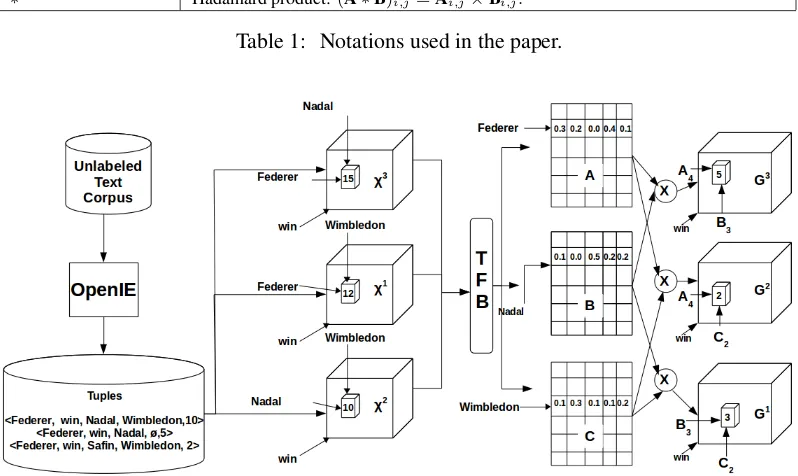
Figure 1: Overview of Step 1 of TFBA. Rather than factorizing the higher-order tensor X, TFBA performs joint Tucker decomposition of multiple 3-mode tensors,X1,X2, andX3, derived out ofX. This joint factorization is performed using shared latent factors A, B, and C. This results in binary schemata, each of which is stored as a cell in one of the core tensorsG1,G2, andG3. Please see Section
3.2.1for details.
3.1 Factorizing a Higher-order Tensor Given a text corpus, we use OpenIEv5 (Mausam,
2016) to extract tuples. Consider the following sentence “Federer won against Nadal at Wimble-don.”. Given this sentence, OpenIE extracts the 4-tuple (Federer, won, against Nadal, at Wimble-don). We lemmatize the relations in the tuples and only consider the noun phrases as arguments. Let Trepresent the set of these 4-tuples. We can con-struct a 4-order tensor X ∈ Rn1+×n2×n3×m from T. Here,n1is the number ofsubjectnoun phrases (NPs), n2 is the number ofobject NPs, n3 is the number ofotherNPs, andmis the number of re-lations inT. Values in the tensor correspond to the frequency of the tuples. In case of 5-tuples of the form (subject, relation, object, other-1, other-2), we split the 5-tuples into two 4-tuples of the form
(subject, relation, object, other-1)and(subject, re-lation, object, other-2)and frequency of these 4-tuples is considered to be same as the original 5-tuple. Factorizing the tensorX results in discov-ering latent categories of NPs, which help in
in-ducing the schemata. We propose the following approach to factorizeX.
min
G,A,B,C
kX −G×1A×2B×3C×4Ik2F
+λakAk2F +λbkBk2F +λckCk2F,
where,
A∈Rn1+×r1,B∈R+n2×r2,C∈Rn3+×r3,
G∈Rr1+×r2×r3×m, λa≥0, λb ≥0andλc≥0.
Here,Iis the identity matrix. Non-negative up-dates for the variables can be obtained following (Lee and Seung, 2000). Similar to (Nimishakavi et al.,2016), schemata induced will be of the form
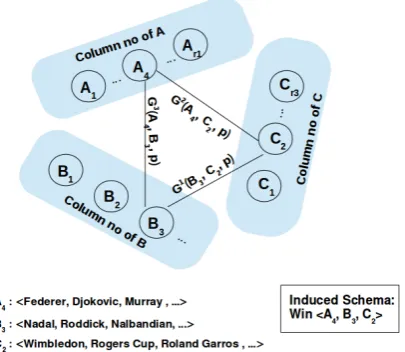
[image:3.595.99.498.124.362.2]Figure 2:Overview of Step 2 of TFBA. Induction of higher-order schemata from the tri-partite graph formed from the columns of matrices A, B, and
C. Triangles in this graph (solid) represent a 3-ary schema, n-ary schemata for n>3can be induced from the 3-ary schemata. Please refer to Section
3.2.2for details.
Care the embedding matrices of object NPs and other NPs respectively. r2 andr3 are the number of latent categories of object NPs and other NPs respectively. G is the core tensor. λa, λb andλc are the regularization weights.
However, the 4-order tensors are heavily sparse for all the datasets we consider in this work. The sparsity ratio of this 4-order tensor for all the datasets is of the order 1e-7. As a result of the extreme sparsity, this approach fails to learn any schemata. Therefore, we propose a more success-ful back-off strategy for higher-order RSI in the next section.
3.2 TFBA: Proposed Framework
To alleviate the problem of sparsity, we construct three tensorsX3,X2, andX1from
Tas follows:
• X3 ∈
Rn1+×n2×m is constructed out of the tuples in T by dropping the other argu-ment and aggregating resulting tuples, i.e., X3
i,j,p =
Pn3
k=1Xi,j,k,p. For example, 4-tuples h(Federer, Win, Nadal, Wimbledon), 10i and h(Federer, Win, Nadal, Australian Open), 5iwill be aggregated to form a triple
h(Federer, Win, Nadal), 15i.
• X2 ∈
Rn1+×n3×m is constructed out of the tuples inTby dropping the objectargument
and aggregating resulting tuples i.e.,X2 i,j,p =
Pn2
k=1Xi,k,j,p.
• X1 ∈
Rn2+×n3×m constructed out of the tu-ples inT by dropping the subject argument and aggregating resulting tuples i.e.,X1
i,j,p =
Pn1
k=1Xk,i,j,p.
The proposed framework TFBA for inducing higher order schemata involves the following two steps.
• Step 1: In this step, TFBA factorizes multi-ple lower-order overlapping tensors,X1,X2, and X3, derived from X to induce binary schemata. This step is illustrated in Figure
1and we discuss details in Section3.2.1.
• Step 2: In this step, TFBA connects multiple binary schemata identified above to induce higher-order schemata. The method accom-plishes this by solving a constrained clique problem. This step is illustrated in Figure2
and we discuss the details in Section3.2.2.
3.2.1 Step 1: Back-off Tensor Factorization A schematic overview of this step is shown in Fig-ure1. TFBA first preprocesses the corpus and ex-tracts OpenIE tuple setT out of it. The 4-mode tensorX is constructed out ofT. Instead of per-forming factorization of the higher-order tensorX as in Section3.1, TFBA creates three tensors out ofX:X1
n2×n3×m,Xn12 ×n3×mandXn13×n2×m. TFBA performs a coupled non-negative Tucker factorization of the input tensorsX1,X2andX3 by solving the following optimization problem.
min
A,B,C
G1,G2,G3
f(X3,G3,A,B) +f(X2,G2,A,C)
+f(X1,G1,B,C) +λakAk2F +λbkBk2F +λckCk 2 F , (1)
where,
f(Xi,Gi,P,Q) =Xi−Gi×1P×2Q×3I
2 F A∈Rn1+×r1,B∈R+n2×r2,C∈Rn3+×r3 G1 ∈Rr2+×r3×m,G2 ∈R
r1×r3×m
+ ,G3∈R
r1×r2×m
+ .
Each slice of the core tensorG3corresponds to one of the m relations. Each cell in a slice cor-responds to an induced schema in terms of the latent factors from matrices A and B. In other words,G3
i,j,k is an induced binary schema for re-lationk involving induced categories represented by columnsAiandBj. Cells inG1andG2may be interpreted accordingly.
We derive non-negative multiplicative updates forA,BandCfollowing the NMF updating rules given in (Lee and Seung,2000). For the update of A, we consider the mode-1 matricization of first and the second term in Equation1along with the regularizer.
A ← A ∗ X
3 (1)G
>
BA+X
2 (1)G
>
CA
A[GBAG>
BA+GCAG >
CA] +λaA
,
where,
GBA = (G
3×
2B)(1), GCA = (G
2× 2C)(1). In order to estimateB, we consider mode-2 ma-tricization of first term and mode-1 mama-tricization of third term in Equation1, along with the regu-larization term. We get the following update rule forB
B ← B ∗ X
3 (2)G
>
AB +X
1 (1)G
>
CB
B[GABG >
AB +GCBG >
CB] +λbB
,
where,
GAB = (G3×
1A)(2), GCB = (G
1×
2C)(1). For updatingC, we consider mode-2 matriciza-tion of second and third terms in Equamatriciza-tion1along with the regularization term, and we get
C ← C ∗ X
3 (2)G
>
BC +X
2 (2)G
>
AC
C[GACG>
AC +GBCG >
BC] +λcC
,
where,
GAC = (G3×1B)(2), GBC = (G
2×
1A)(2). Finally, we update the three core tensors in Equation1following (Kim and Choi,2007) as fol-lows,
G1 ←G1∗ X 1×
1B>×2C> G1×
1B>B×2C>C
,
G2 ←G2∗ X 2×
1A>×2C> G2×
1A>A×2C>C
,
G3 ←G3∗ X 3×
1A>×2B> G3×
1A>A×2B>B
.
In all the above updates, QP represents element-wise division andIis the identity matrix.
Initialization: For initializing the component matrices A,B, and C, we first perform a non-negative Tucker2 Decomposition of the individ-ual input tensors X1,X2, and X3. Then com-pute the average of component matrices obtained from each individual decomposition for initializa-tion. We initialize the core tensorsG1,G2,andG3 with the core tensors obtained from the individual decompositions.
3.2.2 Step 2: Binary to Higher-Order Schema Induction
In this section, we describe how a higher-order schema is constructed from the factorization de-scribed in the previous sub-section. Each relation
khas three representations given by the slicesG1 k, G2
kandGk3from each core tensor. We need a prin-cipled way to produce a joint schema from these representations. For a relation, we select top-n in-dices(i, j) with highest values from each matrix. The indicesiandjfromG3
kcorrespond to column numbers ofAandBrespectively, indices fromG2 k correspond to columns fromAandCand columns fromG1
clique over the tri-partite graph. Here the con-straint is that in the maximal clique, there can only be one edge between sets corresponding to columns ofAand columns ofB.
The procedure above is inspired by (McDonald et al., 2005). However, we note that (McDonald et al.,2005) solved a different problem, viz., n-ary relation instance extraction, while our focus is on inducing schemata. Though we discuss the case of back-off from 4-order to 3-order, ideas presented above can be extended for even higher orders de-pending on the sparsity of the tensors.
4 Experiments
In this section, we evaluate the performance of TFBA for the task of HRSI. We also propose a baseline model for HRSI called HardClust. HardClust: We propose a baseline model called the Hard Clustering Baseline (HardClust) for the task of higher order relation schema induction. This model induces schemata by grouping per-relation NP arguments from OpenIE extractions. In other words, for each relation, all the Noun Phrases (NPs) in first argument form a cluster that represents the subject of the relation, all the NPs in the second argument form a cluster that repre-sents object and so on. Then from each cluster, the top most frequent NPs are chosen as the repre-sentative NPs for the argument type. We note that this method is only able to induce one schema per relation.
Datasets: We run our experiments on three datasets. The first dataset (Shootings) is a collec-tion of 1,335 documents constructed from a pub-licly available database of mass shootings in the United States. The second is New York Times Sports (NYT Sports) dataset which is a collection of 20,940 sports documents from the period 2005 and 2007. And the third dataset (MUC) is a set of 1300 Latin American newswire documents about terrorism events. After performing the processing steps described in Section3, we obtained 357,914 unique OpenIE extractions from the NYT Sports dataset, 10,847 from Shootings dataset, and 8,318 from the MUC dataset. However, in order to prop-erly analyze and evaluate the model, we consider only the 50 most frequent relations in the datasets and their corresponding OpenIE extractions. This is done to avoid noisy OpenIE extractions to yield better data quality and to aid subsequent manual evaluation of the data. We construct input tensors
following the procedure described in Section3.2. Details on the dimensions of tensors obtained are given in Table2.
Model Selection: In order to select appropriate TFBA parameters, we perform a grid search over the space of hyper-parameters, and select the set of hyper-parameters that give best Average FIT score (AvgFIT).
AvgFIT(G1,G2,G3,A,B,C,X1,X2,X3) = 1
3{FIT(X
1,G1,B,C) + FIT(X2,G2,A,C)
+ FIT(X3,G3,A,B)},
where,
FIT(X,G,P,Q) = 1−kX −G×1P×2QkF kXkF .
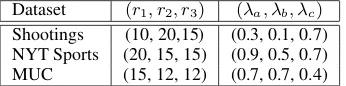
We perform a grid search for the rank param-eters between 5 and 20, for the regularization weights we perform a grid search over 0 and 1. Table 3 provides the details of hyper-parameters set for different datasets.
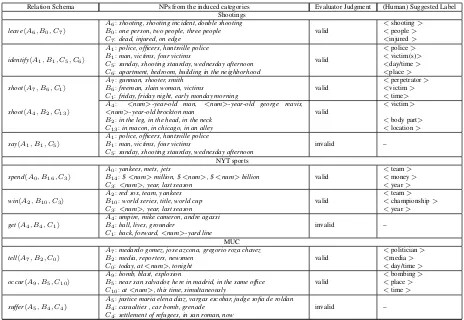
Evaluation Protocol: For TFBA, we follow the protocol mentioned in Section 3.2.2for con-structing higher order schemata. For every rela-tion, we consider top 5 binary schemata from the factorization of each tensor. We construct a tri-partite graph, as explained in Section 3.2.2, and mine constrained maximal cliques from the tripar-tite graphs for schemata. Table4 provides some qualitative examples of higher-order schemata duced by TFBA. Accuracy of the schemata in-duced by the model is evaluated by human evalua-tors. In our experiments, we use human judgments from three evaluators. For every relation, the first and second columns given in Table4are presented to the evaluators and they are asked to validate the schema. We present top 50 schemata based on the score of the constrained maximal clique induced by TFBA to the evaluators. This evaluation proto-col was also used in (Movshovitz-Attias and Co-hen,2015) for evaluating ontology induction. All evaluations were blind, i.e., the evaluators were not aware of the model they were evaluating.
Dataset X1
shape X2
shape X3
shape
Shootings 3365×1295×50 2569×1295×50 2569×3365×50
NYT Sports 57,820×20,356×50 49,659×20,356×50 49,659×57,820×50
[image:7.595.108.489.62.108.2]MUC 2825×962×50 2555×962×50 2555×2825×50
Table 2: Details of dimensions of tensors constructed for each dataset used in the experiments.
Dataset (r1, r2, r3) (λa, λb, λc)
Shootings (10, 20,15) (0.3, 0.1, 0.7) NYT Sports (20, 15, 15) (0.9, 0.5, 0.7) MUC (15, 12, 12) (0.7, 0.7, 0.4)
Table 3: Details of hyper-parameters set for dif-ferent datasets.
Experimental results comparing performance of various models for the task of HRSI are given in Table5. We present evaluation results from three evaluators represented as E1, E2 and E3. As can be observed from Table5, TFBA achieves better results than HardClust for the Shootings and NYT Sports datasets, however HardClust achieves bet-ter results for the MUC dataset. Percentage agree-ment of the evaluators for TFBA is 72%, 70% and 60% for Shootings, NYT Sports and MUC datasets respectively.
HardClust Limitations: Even though Hard-Clust gives better induction for MUC corpus, this approach has some serious drawbacks. HardClust can only induce one schema per relation. This is a restrictive constraint as multiple senses can exist for a relation. For example, consider the schemata induced for the relation shoot as shown in Table
4. TFBA induces two senses for the relation, but HardClust can induce only one schema. For a set of 4-tuples, HardClust can only induce ternary schemata; the dimensionality of the schemata can-not be varied. Since the latent factors induced by HardClust are entirely based on frequency, the latent categories induced by HardClust are dom-inated by only a fixed set of noun phrases. For example, in NYT Sports dataset, subject category induced by HardClust for all the relations ishteam, yankees, metsi. In addition to inducing only one schema per relation, most of the times HardClust only induces a fixed set of categories. Whereas for TFBA, the number of categories depends on the rank of factorization, which is a user provided pa-rameter, thus providing more flexibility to choose the latent categories.
4.1 Using Event Schema Induction for HRSI
Event schema induction is defined as the task of learning high-level representations of events, like a tournament, and their entity roles, like winning-player etc, from unlabeled text. Even though the main focus of event schema induction is to induce the important roles of the events, as a side result most of the algorithms also provide schemata for the relations. In this section, we investigate the effectiveness of these schemata compared to the ones induced by TFBA.
Event schemata are represented as a set of (Ac-tor, Rel, Actor)triples in (Balasubramanian et al.,
2013). Actors represent groups of noun phrases
and Rels represent relations. From this style of representation, however, the n-ary schemata for re-lations cannot be induced. Event schemata gen-erated in (Weber et al., 2018) are similar to that in (Balasubramanian et al.,2013). Event schema induction algorithm proposed in (Nguyen et al.,
2015) doesn’t induce schemata for relations, but rather induces the roles for the events. For this investigation we experiment with the following al-gorithm.
Chambers-13 (Chambers, 2013): This model learns event templates from text documents. Each event template provides a distribution over slots, where slots are clusters of NPs. Each event tem-plate also provides a cluster of relations, which is most likely to appear in the context of the afore-mentioned slots. We evaluate the schemata of these relation clusters.
[image:7.595.95.268.152.195.2]Relation Schema NPs from the induced categories Evaluator Judgment (Human) Suggested Label Shootings
leavehA6, B0, C7i
A6:shooting, shooting incident, double shooting
valid
<shooting> B0:one person, two people, three people <people>
C7:dead, injured, on edge <injured>
identifyhA1, B1, C5, C6i
A1:police, officers, huntsville police
valid
<police> B1:man, victims, four victims <victim(s)>
C5:sunday, shooting staurday, wednesday afternoon <day/time>
C6:apartment, bedroom, building in the neighborhood <place>
shoothA7, B6, C1i
A7:gunman, shooter, smith
valid
<perpetrator> B6:freeman, slain woman, victims <victim>
C1:friday, friday night, early monday morning <time>
shoothA4, B2, C13i
A4: <num>-year-old man, <num>-year-old george reavis,
<num>-year-old brockton man valid
<victim>
B2:in the leg, in the head, in the neck <body part>
C13:in macon, in chicago, in an alley <location>
sayhA1, B1, C5i
A1:police, officers, huntsville police
invalid –
B1:man, victims, four victims
C5:sunday, shooting staurday, wednesday afternoon
NYT sports
spendhA0, B16, C3i
A0:yankees, mets, jets
valid
<team> B14:$<num>million,$<num>,$<num>billion <money>
C3:<num>, year, last season <year>
winhA2, B10, C3i
A2:red sox, team, yankees
valid
<team> B10:world series, title, world cup <championship>
C3:<num>, year, last season <year>
gethA4, B4, C1i
A4:umpire, mike cameron, andre agassi
invalid –
B4:ball, lives, grounder
C1:back, forward,<num>-yard line
MUC
tellhA7, B2, C0i
A7:medardo gomez, jose azcona, gregorio roza chavez
valid
<politician> B2:media, reporters, newsmen <media>
C0:today, at<num>, tonight <day/time>
occurhA9, B5, C10i
A9:bomb, blast, explosion
valid
<bombing> B5:near san salvador, here in madrid, in the same office <place>
C10:at<num>, this time, simultaneously <time>
sufferhA5, B4, C4)
A5:justice maria elena diaz, vargas escobar, judge sofia de roldan
invalid –
B4:casualties , car bomb, grenade
[image:8.595.70.534.60.380.2]C4:settlement of refugees, in san roman, now
Table 4: Examples of schemata induced by TFBA. Please note that some of them are 3-ary while others are 4-ary. For details about schema induction, please refer to Section3.2.
Shootings NYT Sports MUC
E1 E2 E3 Avg E1 E2 E3 Avg E1 E2 E3 Avg
HardClust 0.64 0.70 0.64 0.66 0.42 0.28 0.52 0.46 0.64 0.58 0.52 0.58
Chambers-13 0.32 0.42 0.28 0.34 0.08 0.02 0.04 0.07 0.28 0.34 0.30 0.30 TFBA 0.82 0.78 0.68 0.76 0.86 0.6 0.64 0.70 0.58 0.38 0.48 0.48
Table 5: Higher-order RSI accuracies of various methods on the three datasets. Induced schemata for each dataset and method are evaluated by three human evaluators, E1, E2, and E3. TFBA performs better than HardClust for Shootings and NYT Sports datasets. Even though HardClust achieves better accuracy on MUC dataset, it has several limitations, see Section4for more details. Chambers-13 solves a slightly different problem called event schema induction, for more details about the comparison with Chambers-13 see Section4.1.
schemata induced by TFBA and (Chambers-13) are provided as part of the supplementary mate-rial.
5 Conclusion
Higher order Relation Schema Induction (HRSI) is an important first step towards building domain-specific Knowledge Graphs (KGs). In this pa-per, we proposed TFBA, a tensor factorization-based method for higher-order RSI. To the best of our knowledge, this is the first attempt at in-ducing higher-order (n-ary) schemata for relations from unlabeled text. Rather than factorizing a
[image:8.595.99.495.423.481.2]Acknowledgment
We thank the anonymous reviewers for their in-sightful comments and suggestions. This research has been supported in part by the Ministry of Hu-man Resource Development (Government of In-dia), Accenture, and Google.
References
Evrim Acar, Morten Arendt Rasmussen, Francesco Sa-vorani, Tormod Ns, and Rasmus Bro. 2013. Under-standing data fusion within the framework of cou-pled matrix and tensor factorizations. Chemometrics and Intelligent Laboratory Systems129:53–63.
Niranjan Balasubramanian, Stephen Soderland, Mausam, and Oren Etzioni. 2013. Generating coherent event schemas at scale. InEMNLP.
Nathanael Chambers. 2013. Event schema induction with a probabilistic entity-driven model. InEMNLP.
Kai-Wei Chang, Wen tau Yih, Bishan Yang, and Christopher Meek. 2014. Typed tensor decompo-sition of knowledge bases for relation extraction. In
EMNLP.
Yun-Nung Chen, William Yang Wang, Anatole Gersh-man, and Alexander I. Rudnicky. 2015. Matrix fac-torization with knowledge graph propagation for un-supervised spoken language understanding. InACL.
Jackie Chi Kit Cheung, Hoifung Poon, and Lucy Van-derwende. 2013. Probabilistic frame induction. In
NAACL-HLT.
Xin Dong, Evgeniy Gabrilovich, Geremy Heitz, Wilko Horn, Ni Lao, Kevin Murphy, Thomas Strohmann, Shaohua Sun, and Wei Zhang. 2014. Knowledge vault: A web-scale approach to probabilistic knowl-edge fusion. InKDD.
Dora Erdos and Pauli Miettinen. 2013. Discovering facts with boolean tensor tucker decomposition. In
CIKM.
Francis Ferraro and Benjamin Van Durme. 2016. A unified bayesian model of scripts, frames and lan-guage. InAAAI.
R. A. Harshman. 1970. Foundations of the PARAFAC procedure: Models and conditions for an” explana-tory” multi-modal factor analysis. UCLA Working Papers in Phonetics16(1):84.
Yong-Deok Kim and Seungjin Choi. 2007. Nonnega-tive tucker decomposition. InCVPR.
Tamara G Kolda and Brett W Bader. 2009. Ten-sor decompositions and applications. SIAM review
51(3):455–500.
Joel Lang and Mirella Lapata. 2011. Unsupervised se-mantic role induction via split-merge clustering. In
NAACL-HLT.
Daniel D. Lee and H. Sebastian Seung. 2000. Al-gorithms for non-negative matrix factorization. In
NIPS.
Mausam. 2016. Open information extraction systems and downstream applications. InIJCAI.
Ryan McDonald, Fernando Pereira, Seth Kulick, Scott Winters, Yang Jin, and Pete White. 2005. Simple algorithms for complex relation extraction with ap-plications to biomedical ie. InACL.
Marvin Minsky. 1974. A framework for representing knowledge. Technical report.
T. Mitchell, W. Cohen, E. Hruschka, P. Talukdar, J. Bet-teridge, A. Carlson, B. Dalvi, M. Gardner, B. Kisiel, J. Krishnamurthy, N. Lao, K. Mazaitis, T. Mohamed, N. Nakashole, E. Platanios, A. Ritter, M. Samadi, B. Settles, R. Wang, D. Wijaya, A. Gupta, X. Chen, A. Saparov, M. Greaves, and J. Welling. 2015. Never-ending learning. InAAAI.
Thahir P. Mohamed, Jr. Estevam R. Hruschka, and Tom M. Mitchell. 2011. Discovering relations be-tween noun categories. InEMNLP.
Raymond Mooney and Gerald DeJong. 1985. Learning schemata for natural language processing. InIJCAI.
Dana Movshovitz-Attias and William W. Cohen. 2015. Kb-lda: Jointly learning a knowledge base of hierar-chy, relations, and facts. InACL.
Brian Murphy, Partha Talukdar, and Tom Mitchell. 2012. Learning effective and interpretable seman-tic models using non-negative sparse embedding. In
COLING.
Kiem-Hieu Nguyen, Xavier Tannier, Olivier Ferret, and Romaric Besanc¸on. 2015. Generative event schema induction with entity disambiguation. In
ACL.
Maximilian Nickel, Volker Tresp, and Hans-Peter Kriegel. 2011. A three-way model for collective learning on multi-relational data. InICML.
Maximilian Nickel, Volker Tresp, and Hans-Peter Kriegel. 2012. Factorizing yago: Scalable machine learning for linked data. InWWW.
Madhav Nimishakavi, Uday Singh Saini, and Partha Talukdar. 2016. Relation schema induction us-ing tensor factorization with side information. In
EMNLP.
Nanyun Peng, Hoifung Poon, Chris Quirk, Kristina Toutanova, and Wen-tau Yih. 2017. Cross-sentence n-ary relation extraction with graph lstms. TACL
Karl Pichotta and Raymond J. Mooney. 2014. Statis-tical script learning with multi-argument events. In
EACL.
Karl Pichotta and Raymond J. Mooney. 2016. Learn-ing statistical scripts with lstm recurrent neural net-works. InAAAI.
Sebastian Riedel, Limin Yao, Andrew McCallum, and Benjamin M. Marlin. 2013. Relation extraction with matrix factorization and universal schemas. In
NAACL-HLT.
Michael Roth and Mirella Lapata. 2016. Neural se-mantic role labeling with dependency path embed-dings. InACL.
R. Schank and R. Abelson. 1977. Scripts, plans, goals and understanding: An inquiry into human knowl-edge structures. Lawrence Erlbaum Associates, Hillsdale, NJ.
Sameer Singh, Tim Rockt¨aschel, and Sebastian Riedel. 2015. Towards Combined Matrix and Tensor Fac-torization for Universal Schema Relation Extraction. InNAACL Workshop on Vector Space Modeling for NLP (VSM).
Fabian M Suchanek, Gjergji Kasneci, and Gerhard Weikum. 2007. Yago: a core of semantic knowl-edge. InWWW.
Ivan Titov and Ehsan Khoddam. 2015. Unsupervised induction of semantic roles within a reconstruction-error minimization framework. InNAACL-HLT.
L. R. Tucker. 1963. Implications of factor analysis of three-way matrices for measurement of change. In
Problems in measuring change., University of Wis-consin Press, Madison WI, pages 122–137.
Yichen Wang, Robert Chen, Joydeep Ghosh, Joshua C. Denny, Abel N. Kho, You Chen, Bradley A. Malin, and Jimeng Sun. 2015. Rubik: Knowledge guided tensor factorization and completion for health data analytics. InKDD.