Proceedings of the Fourth Conference on Machine Translation (WMT), Volume 3: Shared Task Papers (Day 2) pages 132–138 132
APE through neural and statistical MT with augmented data:
ADAPT/DCU submission to the WMT 2019 APE Shared task
Dimitar Shterionov Joachim Wagner
ADAPT Centre, School of Computing, Dublin City University, Dublin, Ireland
{firstname}.{lastname}@adaptcentre.ie
F´elix do Carmo
Abstract
Automatic post-editing (APE) can be reduced to a machine translation (MT) task, where the source is the output of a specific MT system and the target is its post-edited variant. How-ever, this approach does not consider context information that can be found in the original source of the MT system. Thus a better ap-proach is to employ multi-source MT, where two input sequences are considered – the orig-inal source and the MT output.
Extra context information can be introduced in the form of extra tokens that identify cer-tain global properties of a group of segments, added as a prefix or a suffix to each segment. Successfully applied in domain adaptation of MT as well as on APE, this technique de-serves further attention. In this work we inves-tigate multi-source neural APE (or NPE) sys-tems with training data which has been aug-mented with two types of extra context tokens. We experiment with authentic and synthetic data provided by WMT 2019 and submit our results to the APE shared task. We also experi-ment with using statistical machine translation (SMT) methods for APE. While our systems score bellow the baseline, we consider this work a step towards understanding the added value of extra context in the case of APE.
1 Introduction
Automatic post-editing (APE) aims at improving text that was previously translated by Machine Translation (MT). An APE system is typically trained on triplets composed of: a segment in the source language, a translation hypothesis of that segment by an MT system, and the edited version of that hypothesis, created by a human translator.
Currently, neural machine translation (NMT) systems are the state-of-the-art in MT, achieving quality beyond that of phrase-based statistical MT (SMT) (Bentivogli et al.,2016;Shterionov et al.,
2018). NMT output is more fluent but may con-tain issues related to accuracy. However, auto-matic post-editing of NMT output has proved to be a challenging task (Chatterjee et al.,2018).
In terms of post-editing technology, neural methods as well represent the current state-of-the-art (do Carmo et al., 2019). And while neu-ral post-editing (NPE) has shown substantial im-provements when applied on PBSMT output, it has not been as effective in improving output from NMT systems. One of the reasons is that NMT and NPE typically use similar approaches, which can make the latter redundant, as it can be assimilated by the former, e.g., in some cases, by increasing the number of layers of the network. One alterna-tive is to explore features of the data not available while training MT systems. In this paper, we ex-plore the effect of adding tokens that identify par-titions in the training data which may be relevant to guide the behaviour of the NPE system. Ex-amples of such tokens are related to basic source and/or target sentence length or to more sophisti-cated analyses of the text. In this work, we explore two features:sentence lengthandtopic.
2 Related Work
tar-get sentences in the training set, which places a token at the end of each sentence to control the politeness level of the output of an NMT model.
Yamagishi et al. (2016) also use target side an-notations during training to control active versus passive voice in the output. Vanmassenhove et al.
(2018) used prefixed tokens identifying the gen-der of the author to aid the MT system in correctly presenting gender features in discourse.
Special input tokens have also been used to aid training of single models on multilingual transla-tion tasks:Johnson et al.(2017) prefix each source sentence in an NMT system with a token to in-dicate the target language, training a multilingual model on a scenario with multiple source and tar-get languages. This approach is at the background of the research on zero-shot translation. In the context of low-resource languages,Mattoni et al.
(2017) add two tokens, one to specify the source language and another to specify the target lan-guage. In their case, the source-language token is used for language specific tokenisation. Sim-ilarly, Zhou et al. (2018) found that adding to-kens that encode the source and target language family, e. g. source-family:Germanicand
target-family:Slavic for English-Czech translation, may improve the accuracy of the NMT outputs for low-resource languages.
Added tokens in APE were used in a scenario where SMT and NMT outputs were trained jointly in a single model (Pylypenko and Rubino,2018). An artificial token was added to the data to indi-cate the system the segments had been produced from. However, this strategy was not very suc-cessful, especially when editing NMT output.
Our current work further explores the strat-egy of adding such tokens about data partitions in NPE. Partitions are derived according to topic models or sentence lengths. Topic models are trained separately on the provided data and aim to identify the topic of each segment of the data.
3 Data and Labels
While the shared task is open to using addi-tional data sources, we only use the data sets linked on the shared task website, aiming at bet-ter result reproducibility: i. e. (a) the authentic English-German WMT 2018 APE shared task data (Turchi et al., 2018), (b) the synthetic English-German data of the WMT 2016 AmuNMT sys-tem (Junczys-Dowmunt and Grundkiewicz,2016),
(c) the NMT part of the synthetic English-German data of the eSCAPE corpus (Negri et al., 2018), (d) the authentic English-Russian data new in the WMT 2019 APE shared task provided by Mi-crosoft1and (e) the synthetic English-Russian data of the eSCAPE corpus.
3.1 Training Data
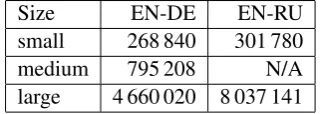
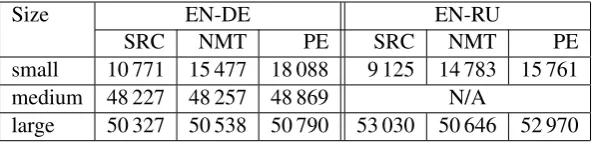
For the EN-DE experiments, we used the 500k and 4M triplets defined in (Junczys-Dowmunt and Grundkiewicz, 2016). For EN-RU, we used the 8M triplets from the eSCAPE project. Table1and Table2show statistics about the data used to train our systems.
Size EN-DE EN-RU small 268 840 301 780 medium 795 208 N/A large 4 660 020 8 037 141
Table 1: Number of SRC-NMT-PE triplets distributed over three data sets used in our experiments.
3.2 Induction of Topic Clusters
We induce ten topic clusters for each language pair using Scikit-Learn’s implementation of Latent Dirichlet Allocation (LDA) (Blei et al.,2003). We use the English side of the data. The data is the concatenation of the authentic and a sample of the synthetic data. For English-German, we sample 50k segments each of AmuNMT (500k) and eS-CAPE data (7M). For English-Russian, we sam-ple 100k of eSCAPE data. The data was cleaned of stop words and words that occur less than five times or in more than 90% of segments.
3.3 Topic Classification
We split the data for training the LDA models, into ten files according to the induced topics and then label each sentence ofall data according to the most similar topic file. We measure similar-ity with cosine similarsimilar-ity on charactern-gram tf-idf vector representations (n = 5,6,7). Before
n-gram extraction, segments are lowercased and e-mail addresses, URL numbers and characters re-peated more than three times are normalised. For tf-idf values, we use plus one smoothing and we avoid zero and negative idf values by adding two to the number of documents. To represent topic clusters, we use the average of its segment vectors.
1http://www.statmt.org/wmt19/ape-task.
[image:2.595.336.497.261.318.2]Size EN-DE EN-RU
SRC NMT PE SRC NMT PE
small 10 771 15 477 18 088 9 125 14 783 15 761 medium 48 227 48 257 48 869 N/A
[image:3.595.151.448.62.133.2]large 50 327 50 538 50 790 53 030 50 646 52 970
Table 2: Vocabulary sizes (after applying BPE on the train data set).
3.4 Length Partitions
Another way of partitioning the data is by sen-tence length. We use the length of the source side of each segment, i. e. the English side to create a partitioning of the data according to the number of tokens. We choose the partition boundaries as thresholds on the number of tokens keeping each partition similar in size within the sample data. Size is measured asP
isei wheresi is the number
of tokens in theith segment ande= 0.5. This is a compromise between counting segments (e= 0) and counting tokens (e= 1).
3.5 Pre-processing for APE Training
We use the available authentic and synthetic data as is. The authentic data, the synthetic AmuNMT data and the synthetic EN-RU eSCAPE data used for training are already tokenised, thus no further tokenisation is conducted. We do not apply lownor true-casing, aiming to learn how to correct er-rors related to the casing. We learn a byte-pair en-coding (Sennrich et al., 2016b) of 50 000 opera-tions from our training data which we then apply to split each data set into subword units. After that, the corresponding partition tokens are attached to each segment. In particular, the partition labels are attached to both source and MT segments, i.e., the two sources in our multi-source NPE systems.
4 Experiments
4.1 Objectives
Our experiments aim at two objectives: (i) to in-vestigate the effect of extra information in the form of prefix tokens for NPE; and (ii) to assess whether monolingual SMT2, can be effective for post-editing of NMT output. The latter is driven by the idea of added benefits from interleaving dif-ferent MT technologies.
2In this work, we use the term
monolingualto define an MT system where the source and the target are in the same language, e.g. the source is a translated sentence in German and the target is its post-edited variant.
We conduct three types of NPE experiments – (a) baseline experiments, using no extra tokens to build a set of baseline systems; (b) length tokens – prefixed with tokens stating the data partition based on the length and (c) topic tokens – data is prefixed with tokens stating the data partition based on the LDA clustering. For the SMT exper-iments no additional tokens were attached to the text. We assumed that such augmentation of the source side would increase the difference with re-spect to word alignment and thus it would have a negative impact on the quality of the system.
4.2 Models
NPE We trained 15 NPE systems: small,
mediumandlargefor EN-DE andsmallandlarge
for EN-RU, on the data discussed in Section3.1, for the three different prefix token settings – no token, topic token, length token. For all of them, we employed Marian-NMT3to train multi-source sequence-to-sequence models (multi-s2s) with LSTM units.4 The two sources are the actual source-side data (EN) from the training corpus and its translation (DE or RU). We used cross-entropy as validation metric and the max-length was 150 tokens. The training stops after 5 epochs with no improvement, i.e., early stopping.
SMT We trained 5 SMT models (small,medium
andlargefor EN-DE andsmallandlargefor EN-RU) using Moses (Koehn et al.,2007) release 4.0, Giza++ (Och and Ney,2003) for word alignment and a 5-gram KenLM language model (Heafield,
2011). Models are tuned with Mert (Och,2003). We ought to stress that these models are monolin-gual, i.e., trained only on the original MT output as source and its post-edited variant as target.
3https://marian-nmt.github.io/
4.3 Evaluation and selection for WMT submission
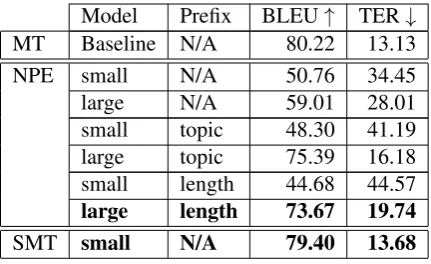
We evaluated our models using BLEU (Papineni et al., 2002) and TER (Snover et al., 2006). For the former, we used themulti-bleuimplementation provided alongside Moses; and for the latter we used the script provided by the WMT organisation. We computed BLEU and TER using the human PE side of the data as reference, and the NPE out-put as hypothesis, e.g. TER(npe,pe). We also computed BLEU and TER scores for the original data, i.e. in this case the reference again is the human PE but the hypothesis is the NMT part of the training data: TER(nmt,pe). We present our results on the development set in Tables 3 and4
for EN-DE and EN-RU, respectively. We denote the scores for the original (baseline) MT output withMT. Scores are scaled between 0 and 100.
Model Prefix BLEU↑ TER↓
MT Baseline N/A 76.94 15.08 NPE small N/A 63.28 24.09 medium N/A 70.57 18.81 large N/A 70.29 19.89 small topic 60.41 28.59 medium topic 73.08 17.81
large topic 75.82 15.89
small length 62.56 26.91 medium length 73.74 17.26
large length 75.85 15.91
SMT small N/A 76.82 15.33
medium N/A 77.04 15.17
[image:4.595.309.525.61.193.2]large N/A 76.82 15.26
Table 3: BLEU and TER scores for the EN-DE NPE and SMT models (dev set). Rows inboldindicate sub-mitted system results.
For submission to the shared task, we selected the best models, according to TER, available at the submission deadline. For EN-DE, these are: the NPE-large-topic (primary), the NPE-large-length and the SMT-medium; for EN-RU these are the NPE-large-length (primary) and the SMT-small. In the result tables these are marked inbold.
5 Results and Analysis
5.1 Development Observations
Table 3 and Table 4 show the evaluation scores (BLEU and TER) on the development set results. In our experiments, the ranking of the systems’
Model Prefix BLEU↑ TER↓
MT Baseline N/A 80.22 13.13 NPE small N/A 50.76 34.45 large N/A 59.01 28.01 small topic 48.30 41.19 large topic 75.39 16.18 small length 44.68 44.57
large length 73.67 19.74
SMT small N/A 79.40 13.68
Table 4: BLEU and TER scores for the EN-RU NPE and SMT models (dev set). Rows inboldindicate sub-mitted system results.
performance scores is always the same, no matter if we use TER or BLEU.
We can see that all NPE systems in our experi-ments, whether or not they are augmented with in-formative tokens, are unable to perform as well as the original NMT translations. So, our NPE sys-tems are not fulfilling their main function. Still, it is worth analysing the evolution of scores from system to system.
As expected, in general, the larger the systems, the better the results. This is most visible in the EN-DE experiments, for which we trained systems in a three-size scale. Systems with small amounts of training data deteriorate the scores very much, which makes them not viable. For augmented sys-tems, in both languages, the addition of more data has a very visible effect, with the largest systems having the best results. The same is not true for the systems with no tokens, in which medium-sized systems achieve better scores than large ones. For the SMT systems, size of the training data was the only factor we tested, but the scores are very close for all systems, with medium-sized systems achieving slightly better results.
[image:4.595.73.289.321.518.2]Surprisingly, the APE systems using SMT are the best performing ones, beating all neural ones. In fact, their scores are very close to the original ones, and very consistent, seeming not to be sensi-tive to the increase in the volumes of training data.
5.2 Final Systems
As noted in Section 4.3 we submitted three systems for EN-DE: the NPE-large-topic (as primary), the NPE-large-length and the SMT-medium. Only the SMT system scores above the original MT system, and only in terms of BLEU. For EN-RU, we submitted two systems: NPE-large-length (as primary) and the SMT-small. None of the system improved on the original MT data, but the SMT system was close. The baseline scores compared to our systems’ scores are pre-sented in Table5and Table6.
System Model Prefix BLEU↑TER↓
MT Baseline N/A N/A 74.73 16.84 NPE Primary large topic 74.29 17.29
Contrastive I large length 74.01 17.41 SMTContrastive IImedium N/A 74.30 17.07
Table 5: BLEU and TER scores for submitted and base-line systems for the EN-DE language pair.
System Model Prefix BLEU↑TER↓
MT Baseline N/A N/A 76.20 16.16 NPE Primary large length 72.90 18.31 SMTContrastivesmall N/A 75.27 16.59
Table 6: BLEU and TER scores for submitted and base-line systems for the EN-RU language pair.
We believe one of the main factors for these re-sults is the initially high quality of the baseline MT systems. The inherent nature of APE systems dictates that they generate a whole new sentence when the inputs are passed through the model. However, in cases when no or barely any changes are required, it will be desirable not generate a new sentence, i.e. the post-edit, but to retain the original one, as any transformation process would be likely to impede the quality. In future work, we will look into combining NPE models with Quality Estimation (QE), to filter NMT output by expected quality and thus control over-correction: the NPE system will then only present alternatives for sentences that require improvements.
6 Conclusions
Although our NPE systems do not fulfill their main aim (improving the output of an NMT sys-tem), this paper highlights the potential of two strategies for APE which explore the thin improve-ment margins allowed by NMT output.
The augmentation strategy is a simple process that requires no system development, but presents its own challenges. The tokens that are used must be informative, so as to guide the NPE system to features in the datasets with a very close relation to the editing patterns the system is supposed to learn. Future work should check the topic model and if necessary switch to a more suitable model. Other types of tokens should also be tested. Fur-thermore, data augmentation in APE implies pre-analysis of the datasets, since the same tokens are not applicable to different datasets nor use-cases.
The strategy of applying a different MT paradigm, SMT for APE of NMT output, yielded interesting results, albeit still not being able to im-prove the original NMT output. The margin of de-velopment of SMT systems may be limited, but this is also worth experimenting, in view of the challenges APE currently faces with NMT output. Furthermore, we outlined a hypothesis about the reasons why the post-edited texts score below the baseline system. In particular, we believe this re-sult has to do with the high quality of the base-line MT systems: this implies that some segments should not be post-edited, but our APE system at-tempted to edit every sentence. We plan to incor-porate QE and data selection to mitigate this over-correction issue, offering an APE suggestion only when editing is necessary.
7 Acknowledgements
References
Luisa Bentivogli, Arianna Bisazza, Mauro Cettolo, and Marcello Federico. 2016. Neural versus Phrase-Based Machine Translation Quality: a Case Study. In Proceedings of the 2016 Conference on Empiri-cal Methods in Natural Language Processing, pages 257–267, Austin, Texas. Association for Computa-tional Linguistics.
David M. Blei, Andrew Y. Ng, and Michael I. Jordan. 2003. Latent Dirichlet allocation. Journal of Ma-chine Learning Research, 3:993–1022.
F´elix do Carmo, Dimitar Shterionov, Joachim Wagner, Murhaf Hossari, Eric Paquin, and Joss Moorkens. 2019. A review of the state-of-the-art in automatic post-editing. Under review for publication: Ma-chine Translation.
Rajen Chatterjee, Matteo Negri, Raphael Rubino, and Marco Turchi. 2018. Findings of the WMT 2018 shared task on automatic post-editing. In Proceed-ings of the Third Conference on Machine Trans-lation: Shared Task Papers, pages 710–725, Bel-gium, Brussels. Association for Computational Lin-guistics.
Kenneth Heafield. 2011. KenLM: faster and smaller language model queries. In Proceedings of the EMNLP 2011 Sixth Workshop on Statistical Ma-chine Translation, pages 187–197, Edinburgh, Scot-land, United Kingdom.
Melvin Johnson, Mike Schuster, Quoc V. Le, Maxim Krikun, Yonghui Wu, Zhifeng Chen, Nikhil Thorat, Fernanda Vi´egas, Martin Wattenberg, Greg Corrado, Macduff Hughes, and Jeffrey Dean. 2017. Google’s multilingual neural machine translation system: En-abling zero-shot translation.Transactions of the As-sociation for Computational Linguistics, 5:339–351.
Marcin Junczys-Dowmunt and Roman Grundkiewicz. 2016. Log-linear combinations of monolingual and bilingual neural machine translation models for au-tomatic post-editing. In Proceedings of the First Conference on Machine Translation, pages 751– 758, Berlin, Germany. Association for Computa-tional Linguistics.
Philipp Koehn, Hieu Hoang, Alexandra Birch, Chris Callison-Burch, Marcello Federico, Nicola Bertoldi, Brooke Cowan, Wade Shen, Christine Moran, Richard Zens, Chris Dyer, Ondrej Bojar, Alexandra Constantin, and Evan Herbst. 2007. Moses: Open source toolkit for statistical machine translation. In
Proceedings of the 45th Annual Meeting of the As-sociation for Computational Linguistics Companion Volume Proceedings of the Demo and Poster Ses-sions, pages 177–180, Prague, Czech Republic. As-sociation for Computational Linguistics.
Giulia Mattoni, Pat Nagle, Carlos Collantes, and Dim-itar Shterionov. 2017. Zero-shot translation for low-resource indian languages. In Proceedings of MT Summit XVI – Vol.2 Commercial MT Users
and Translators Track, pages 1–10, Nagoya, Aichi, Japan. Asia-Pacific Association for Machine Trans-lation.
Tomas Mikolov and Geoffrey Zweig. 2012. Context dependent recurrent neural network language model. InSpoken Language Technologies. IEEE.
Matteo Negri, Marco Turchi, Rajen Chatterjee, and Nicola Bertoldi. 2018. ESCAPE: a large-scale syn-thetic corpus for automatic post-editing. In Proceed-ings of the 11th Language Resources and Evaluation Conference, Miyazaki, Japan. European Language Resource Association.
Franz Josef Och. 2003. Minimum error rate train-ing in statistical machine translation. In Proceed-ings of the 41st Annual Meeting of the Association for Computational Linguistics, pages 160–167, Sap-poro, Japan. Association for Computational Linguis-tics.
Franz Josef Och and Hermann Ney. 2003. A systematic comparison of various statistical alignment models.
Computational Linguistics, 29(1):19–51.
Kishore Papineni, Salim Roukos, Todd Ward, and Wei-Jing Zhu. 2002. BLEU: A Method for Automatic Evaluation of Machine Translation. InProceedings of the 40th Annual Meeting on Association for Com-putational Linguistics, pages 311–318, Philadelphia, Pennsylvania, USA.
Daria Pylypenko and Raphael Rubino. 2018. DFKI-MLT system description for the WMT18 automatic post-editing task. InProceedings of the Third Con-ference on Machine Translation: Shared Task Pa-pers, pages 836–839, Belgium, Brussels. Associa-tion for ComputaAssocia-tional Linguistics.
Rico Sennrich, Barry Haddow, and Alexandra Birch. 2016a. Controlling politeness in neural machine translation via side constraints. In Proceedings of the 2016 Conference of the North American Chap-ter of the Association for Computational Linguistics: Human Language Technologies, pages 35–40, San Diego, California. Association for Computational Linguistics.
Rico Sennrich, Barry Haddow, and Alexandra Birch. 2016b. Neural machine translation of rare words with subword units. InProceedings of the 54th An-nual Meeting of the Association for Computational Linguistics (Volume 1: Long Papers), pages 1715– 1725, Berlin, Germany. Association for Computa-tional Linguistics.
Dimitar Shterionov, Riccardo Superbo, Pat Nagle, Laura Casanellas, Tony O’Dowd, and Andy Way. 2018. Human versus automatic quality evalua-tion of NMT and PBSMT. Machine Translation, 32(3):217–235.
In AMTA 2006. Proceedings of the 7th Conference of the. Association for Machine Translation of the Americas. Visions for the Future of Machine Trans-lation, pages 223–231, Cambridge, Massachusetts, USA.
Marco Turchi, Matteo Negri, and Rajen Chatterjee. 2018. WMT18 APE shared task: En-DE NMT train and dev data. LINDAT/CLARIN digital li-brary at the Institute of Formal and Applied Linguis-tics ( ´UFAL), Faculty of Mathematics and Physics, Charles University.
Eva Vanmassenhove, Christian Hardmeier, and Andy Way. 2018. Getting gender right in neural machine translation. InProceedings of the 2018 Conference on Empirical Methods in Natural Language Pro-cessing, pages 3003–3008, Brussels, Belgium. As-sociation for Computational Linguistics.
Hayahide Yamagishi, Shin Kanouchi, Takayuki Sato, and Mamoru Komachi. 2016. Controlling the voice of a sentence in Japanese-to-English neural machine translation. InProceedings of the 3rd Workshop on Asian Translation (WAT2016), pages 203–210, Os-aka, Japan. The COLING 2016 Organizing Commit-tee.