Proceedings of the 56th Annual Meeting of the Association for Computational Linguistics (Long Papers), pages 208–218 208
Efficient Online Scalar Annotation with Bounded Support
Keisuke Sakaguchi and Benjamin Van Durme
Johns Hopkins University
{keisuke,vandurme}@cs.jhu.edu
Abstract
We describe a novel method for efficiently eliciting scalar annotations for dataset construction and system quality estima-tion by human judgments. We contrast di-rect assessment (annotators assign scores to items directly), online pairwise rank-ing aggregation (scores derive from anno-tator comparison of items), and a hybrid
approach (EASL:EfficientAnnotation of
Scalar Labels) proposed here. Our
pro-posal leads to increased correlation with ground truth, at far greater annotator ef-ficiency, suggesting this strategy as an im-proved mechanism for dataset creation and manual system evaluation.
1 Introduction
We are concerned here with the construction of datasets and evaluation of systems within natural language processing (NLP). Specifically, humans providing responses that are used to derive graded values on natural language contexts, or in the or-dering of systems corresponding to their perceived performance on some task.
Many NLP datasets involve eliciting from an-notators some graded response. The most
pop-ular annotation scheme is the n-ary ordinal
ap-proach as illustrated in Figure1(a). For example,
text may be labeled forsentimentaspositive,
neu-tral or negative (Wiebe et al., 1999; Pang et al.,
2002; Turney, 2002, inter alia); or under
politi-cal spectrum analysisasliberal, neutral, or
con-servative (O’Connor et al., 2010; Bamman and
Smith, 2015). A response may correspond to a likelihood judgment, e.g., how likely a predicate
is factive (Lee et al.,2015), or that some natural
language inference may hold (Zhang et al.,2017).
Responses may correspond to a notion of semantic
Direct Assessment
(a) Ordinal
0 0.5 1.0
(b) Scalar
(c) Unbounded (Gaussian)
(d) Bounded (Beta)
Online Pairwise Comparison very
rare
very frequent “dog”<latexit sha1_base64="Nx3bknXj7znj2B7V4nfpFXhDlAs=">AAACcXicdVHbSgMxEM2ut1pvq+KLggaLKFjKrnjrW9EXHytYFdqlZtO0Dc1eSGbFsuwH+Hu++RW++AGmlxVtdSBw5syZk8nEiwRXYNvvhjkzOze/kFvMLy2vrK5Z6xv3KowlZTUailA+ekQxwQNWAw6CPUaSEd8T7MHrXQ/qD89MKh4Gd9CPmOuTTsDbnBLQVNN6bQB7gSRpDK3qsuO5iV2yh1GcAunTU/qf9Mx2yudO0cmkrbDzr3bS9vAwTZtWIctx5oYzt29QQOOoNq23Riuksc8CoIIoVXfsCNyESOBUsDTfiBWLCO2RDqtrGBCfKTcZDpTiA820cDuU+gSAh+zPjoT4SvV9Tyt9Al01WRuQf9XqMbQv3YQHUQwsoKOL2rHAEOLB/nGLS0ZB9DUgVHI9K6ZdIgkF/Ut5vYSpJ0+D2kmpXLJvTwuVq/E2cmgH7aMj5KALVEE3qIpqiKIPY8vYNfaMT3PbxOb+SGoa455N9CvM4y80t7H+</latexit><latexit sha1_base64="Nx3bknXj7znj2B7V4nfpFXhDlAs=">AAACcXicdVHbSgMxEM2ut1pvq+KLggaLKFjKrnjrW9EXHytYFdqlZtO0Dc1eSGbFsuwH+Hu++RW++AGmlxVtdSBw5syZk8nEiwRXYNvvhjkzOze/kFvMLy2vrK5Z6xv3KowlZTUailA+ekQxwQNWAw6CPUaSEd8T7MHrXQ/qD89MKh4Gd9CPmOuTTsDbnBLQVNN6bQB7gSRpDK3qsuO5iV2yh1GcAunTU/qf9Mx2yudO0cmkrbDzr3bS9vAwTZtWIctx5oYzt29QQOOoNq23Riuksc8CoIIoVXfsCNyESOBUsDTfiBWLCO2RDqtrGBCfKTcZDpTiA820cDuU+gSAh+zPjoT4SvV9Tyt9Al01WRuQf9XqMbQv3YQHUQwsoKOL2rHAEOLB/nGLS0ZB9DUgVHI9K6ZdIgkF/Ut5vYSpJ0+D2kmpXLJvTwuVq/E2cmgH7aMj5KALVEE3qIpqiKIPY8vYNfaMT3PbxOb+SGoa455N9CvM4y80t7H+</latexit><latexit sha1_base64="Nx3bknXj7znj2B7V4nfpFXhDlAs=">AAACcXicdVHbSgMxEM2ut1pvq+KLggaLKFjKrnjrW9EXHytYFdqlZtO0Dc1eSGbFsuwH+Hu++RW++AGmlxVtdSBw5syZk8nEiwRXYNvvhjkzOze/kFvMLy2vrK5Z6xv3KowlZTUailA+ekQxwQNWAw6CPUaSEd8T7MHrXQ/qD89MKh4Gd9CPmOuTTsDbnBLQVNN6bQB7gSRpDK3qsuO5iV2yh1GcAunTU/qf9Mx2yudO0cmkrbDzr3bS9vAwTZtWIctx5oYzt29QQOOoNq23Riuksc8CoIIoVXfsCNyESOBUsDTfiBWLCO2RDqtrGBCfKTcZDpTiA820cDuU+gSAh+zPjoT4SvV9Tyt9Al01WRuQf9XqMbQv3YQHUQwsoKOL2rHAEOLB/nGLS0ZB9DUgVHI9K6ZdIgkF/Ut5vYSpJ0+D2kmpXLJvTwuVq/E2cmgH7aMj5KALVEE3qIpqiKIPY8vYNfaMT3PbxOb+SGoa455N9CvM4y80t7H+</latexit><latexit sha1_base64="C39OhB+IczRcjLNINXH29e9lt8M=">AAAB2HicbZDNSgMxFIXv1L86Vq1rN8EiuCpTN+pOcOOygmML7VAymTttaCYzJHeEMvQFXLhRfDB3vo3pz0KtBwIf5yTk3hMXSloKgi+vtrW9s7tX3/cPGv7h0XGz8WTz0ggMRa5y04+5RSU1hiRJYb8wyLNYYS+e3i3y3jMaK3P9SLMCo4yPtUyl4OSs7qjZCtrBUmwTOmtowVqj5ucwyUWZoSahuLWDTlBQVHFDUiic+8PSYsHFlI9x4FDzDG1ULcecs3PnJCzNjTua2NL9+aLimbWzLHY3M04T+zdbmP9lg5LS66iSuigJtVh9lJaKUc4WO7NEGhSkZg64MNLNysSEGy7INeO7Djp/N96E8LJ90w4eAqjDKZzBBXTgCm7hHroQgoAEXuDNm3iv3vuqqpq37uwEfsn7+Aap5IoM</latexit><latexit sha1_base64="69vOBm8DWjWWG8/c53xOXJRCWfg=">AAACZnicdVHLSgMxFM2Mr1qrVsGNgoYWqQspM4KP7gQ3Lis4tjAd2kyatqGZB8kdsQzzAf6eO7/CjR9g+gJt7YXAybknJzcnfiy4Asv6NMy19Y3Nrdx2fqewu7dfPCi8qCiRlDk0EpFs+kQxwUPmAAfBmrFkJPAFa/jDh3G/8cqk4lH4DKOYeQHph7zHKQFNtYvvLWBvkKatiZUr+76XWlVrUpdLIOt0slXSa8uu3diX9lzajfortYu2lUqWtYvl+R4vg7ltGc2q3i5+tLoRTQIWAhVEKde2YvBSIoFTwbJ8K1EsJnRI+szVMCQBU146GSjD55rp4l4k9QoBT9jfJ1ISKDUKfK0MCAzUYm9M/tdzE+jdeSkP4wRYSKcX9RKBIcLj/HGXS0ZBjDQgVHI9K6YDIgkF/Ut5HYK9+ORl4FxVa1XryUI5dIJK6ALZ6Bbdo0dURw6i6Ms4Mk6NM+PbPDbxNC3TmMV2iP6UWfoBX6SxCg==</latexit><latexit sha1_base64="RX5eSgWIzgnSv7H1r5GjfsuxnLc=">AAACZnicdVHLSgMxFM2Mr1qrjoIbBQ0tUhelzAg+uhPcuKxgbaEd2kyatqGZB8kdsQzzAf6eO7/CjR9g+hJt7YXAybknJzcnXiS4Atv+MMy19Y3Nrcx2die3u7dvHeSeVRhLymo0FKFseEQxwQNWAw6CNSLJiO8JVveG9+N+/YVJxcPgCUYRc33SD3iPUwKaaltvLWCvkCStiVVT9j03scv2pEpLIO100lXSK9upXDslZy7thv2V2kXbYjFN21ZhvsdzNzx3+wEFNKtq23pvdUMa+ywAKohSTceOwE2IBE4FS7OtWLGI0CHps6aGAfGZcpPJQCk+10wX90KpVwB4wv4+kRBfqZHvaaVPYKAWe2Pyv14zht6tm/AgioEFdHpRLxYYQjzOH3e5ZBTESANCJdezYjogklDQv5TVISw9eRnULsuVsv1ooww6QXl0gRx0g+7QA6qiGqLo0zgyTo0z48s8NvE0LdOYxXaI/pSZ/wZ/0rEh</latexit><latexit sha1_base64="S/Z6MZq2Ggn5hi3PzLBOBAJe+Q8=">AAACcXicdVHbSgMxEM2ut1pvVfFFQUOLKFjKruClb0VffKxgbaFd2myatqHZC8msWJb9AH/PN7/CFz/A9Cba2oHAmTNnTiYTNxRcgWV9GObS8srqWmo9vbG5tb2T2d17VkEkKavQQASy5hLFBPdZBTgIVgslI54rWNXt3w/r1RcmFQ/8JxiEzPFI1+cdTgloqpl5awB7hThujKzqsus6sVWwRpGfA0mrlSySXll28drO21NpO+gu1M7anp0lSTOTm+Z46oanbj8ghyZRbmbeG+2ARh7zgQqiVN22QnBiIoFTwZJ0I1IsJLRPuqyuoU88ppx4NFCCTzXTxp1A6uMDHrG/O2LiKTXwXK30CPTUbG1I/lerR9C5dWLuhxEwn44v6kQCQ4CH+8dtLhkFMdCAUMn1rJj2iCQU9C+l9RLmnjwPKpeFYsF6tHKlu8k2UugIZdE5stENKqEHVEYVRNGncWAcGyfGl3loYjM7lprGpGcf/Qnz4hszd7H6</latexit><latexit sha1_base64="Nx3bknXj7znj2B7V4nfpFXhDlAs=">AAACcXicdVHbSgMxEM2ut1pvq+KLggaLKFjKrnjrW9EXHytYFdqlZtO0Dc1eSGbFsuwH+Hu++RW++AGmlxVtdSBw5syZk8nEiwRXYNvvhjkzOze/kFvMLy2vrK5Z6xv3KowlZTUailA+ekQxwQNWAw6CPUaSEd8T7MHrXQ/qD89MKh4Gd9CPmOuTTsDbnBLQVNN6bQB7gSRpDK3qsuO5iV2yh1GcAunTU/qf9Mx2yudO0cmkrbDzr3bS9vAwTZtWIctx5oYzt29QQOOoNq23Riuksc8CoIIoVXfsCNyESOBUsDTfiBWLCO2RDqtrGBCfKTcZDpTiA820cDuU+gSAh+zPjoT4SvV9Tyt9Al01WRuQf9XqMbQv3YQHUQwsoKOL2rHAEOLB/nGLS0ZB9DUgVHI9K6ZdIgkF/Ut5vYSpJ0+D2kmpXLJvTwuVq/E2cmgH7aMj5KALVEE3qIpqiKIPY8vYNfaMT3PbxOb+SGoa455N9CvM4y80t7H+</latexit><latexit sha1_base64="Nx3bknXj7znj2B7V4nfpFXhDlAs=">AAACcXicdVHbSgMxEM2ut1pvq+KLggaLKFjKrnjrW9EXHytYFdqlZtO0Dc1eSGbFsuwH+Hu++RW++AGmlxVtdSBw5syZk8nEiwRXYNvvhjkzOze/kFvMLy2vrK5Z6xv3KowlZTUailA+ekQxwQNWAw6CPUaSEd8T7MHrXQ/qD89MKh4Gd9CPmOuTTsDbnBLQVNN6bQB7gSRpDK3qsuO5iV2yh1GcAunTU/qf9Mx2yudO0cmkrbDzr3bS9vAwTZtWIctx5oYzt29QQOOoNq23Riuksc8CoIIoVXfsCNyESOBUsDTfiBWLCO2RDqtrGBCfKTcZDpTiA820cDuU+gSAh+zPjoT4SvV9Tyt9Al01WRuQf9XqMbQv3YQHUQwsoKOL2rHAEOLB/nGLS0ZB9DUgVHI9K6ZdIgkF/Ut5vYSpJ0+D2kmpXLJvTwuVq/E2cmgH7aMj5KALVEE3qIpqiKIPY8vYNfaMT3PbxOb+SGoa455N9CvM4y80t7H+</latexit><latexit sha1_base64="Nx3bknXj7znj2B7V4nfpFXhDlAs=">AAACcXicdVHbSgMxEM2ut1pvq+KLggaLKFjKrnjrW9EXHytYFdqlZtO0Dc1eSGbFsuwH+Hu++RW++AGmlxVtdSBw5syZk8nEiwRXYNvvhjkzOze/kFvMLy2vrK5Z6xv3KowlZTUailA+ekQxwQNWAw6CPUaSEd8T7MHrXQ/qD89MKh4Gd9CPmOuTTsDbnBLQVNN6bQB7gSRpDK3qsuO5iV2yh1GcAunTU/qf9Mx2yudO0cmkrbDzr3bS9vAwTZtWIctx5oYzt29QQOOoNq23Riuksc8CoIIoVXfsCNyESOBUsDTfiBWLCO2RDqtrGBCfKTcZDpTiA820cDuU+gSAh+zPjoT4SvV9Tyt9Al01WRuQf9XqMbQv3YQHUQwsoKOL2rHAEOLB/nGLS0ZB9DUgVHI9K6ZdIgkF/Ut5vYSpJ0+D2kmpXLJvTwuVq/E2cmgH7aMj5KALVEE3qIpqiKIPY8vYNfaMT3PbxOb+SGoa455N9CvM4y80t7H+</latexit><latexit sha1_base64="Nx3bknXj7znj2B7V4nfpFXhDlAs=">AAACcXicdVHbSgMxEM2ut1pvq+KLggaLKFjKrnjrW9EXHytYFdqlZtO0Dc1eSGbFsuwH+Hu++RW++AGmlxVtdSBw5syZk8nEiwRXYNvvhjkzOze/kFvMLy2vrK5Z6xv3KowlZTUailA+ekQxwQNWAw6CPUaSEd8T7MHrXQ/qD89MKh4Gd9CPmOuTTsDbnBLQVNN6bQB7gSRpDK3qsuO5iV2yh1GcAunTU/qf9Mx2yudO0cmkrbDzr3bS9vAwTZtWIctx5oYzt29QQOOoNq23Riuksc8CoIIoVXfsCNyESOBUsDTfiBWLCO2RDqtrGBCfKTcZDpTiA820cDuU+gSAh+zPjoT4SvV9Tyt9Al01WRuQf9XqMbQv3YQHUQwsoKOL2rHAEOLB/nGLS0ZB9DUgVHI9K6ZdIgkF/Ut5vYSpJ0+D2kmpXLJvTwuVq/E2cmgH7aMj5KALVEE3qIpqiKIPY8vYNfaMT3PbxOb+SGoa455N9CvM4y80t7H+</latexit><latexit sha1_base64="Nx3bknXj7znj2B7V4nfpFXhDlAs=">AAACcXicdVHbSgMxEM2ut1pvq+KLggaLKFjKrnjrW9EXHytYFdqlZtO0Dc1eSGbFsuwH+Hu++RW++AGmlxVtdSBw5syZk8nEiwRXYNvvhjkzOze/kFvMLy2vrK5Z6xv3KowlZTUailA+ekQxwQNWAw6CPUaSEd8T7MHrXQ/qD89MKh4Gd9CPmOuTTsDbnBLQVNN6bQB7gSRpDK3qsuO5iV2yh1GcAunTU/qf9Mx2yudO0cmkrbDzr3bS9vAwTZtWIctx5oYzt29QQOOoNq23Riuksc8CoIIoVXfsCNyESOBUsDTfiBWLCO2RDqtrGBCfKTcZDpTiA820cDuU+gSAh+zPjoT4SvV9Tyt9Al01WRuQf9XqMbQv3YQHUQwsoKOL2rHAEOLB/nGLS0ZB9DUgVHI9K6ZdIgkF/Ut5vYSpJ0+D2kmpXLJvTwuVq/E2cmgH7aMj5KALVEE3qIpqiKIPY8vYNfaMT3PbxOb+SGoa455N9CvM4y80t7H+</latexit>
1
[image:1.595.309.525.220.453.2]<latexit sha1_base64="W3FOctKGhzom8KqPhzefcKqeing=">AAAB7XicbVBNS8NAEJ3Ur1q/qh69LBbBiyURQb0VvXisYGyhDWWz3bRLN5uwOxFK6I/w4kHFq//Hm//GbZuDtj4YeLw3w8y8MJXCoOt+O6WV1bX1jfJmZWt7Z3evun/waJJMM+6zRCa6HVLDpVDcR4GSt1PNaRxK3gpHt1O/9cS1EYl6wHHKg5gOlIgEo2il1llXqAjHvWrNrbszkGXiFaQGBZq96le3n7As5gqZpMZ0PDfFIKcaBZN8UulmhqeUjeiAdyxVNOYmyGfnTsiJVfokSrQthWSm/p7IaWzMOA5tZ0xxaBa9qfif18kwugpyodIMuWLzRVEmCSZk+jvpC80ZyrEllGlhbyVsSDVlaBOq2BC8xZeXiX9ev6679xe1xk2RRhmO4BhOwYNLaMAdNMEHBiN4hld4c1LnxXl3PuatJaeYOYQ/cD5/AJgyj0Y=</latexit><latexit sha1_base64="W3FOctKGhzom8KqPhzefcKqeing=">AAAB7XicbVBNS8NAEJ3Ur1q/qh69LBbBiyURQb0VvXisYGyhDWWz3bRLN5uwOxFK6I/w4kHFq//Hm//GbZuDtj4YeLw3w8y8MJXCoOt+O6WV1bX1jfJmZWt7Z3evun/waJJMM+6zRCa6HVLDpVDcR4GSt1PNaRxK3gpHt1O/9cS1EYl6wHHKg5gOlIgEo2il1llXqAjHvWrNrbszkGXiFaQGBZq96le3n7As5gqZpMZ0PDfFIKcaBZN8UulmhqeUjeiAdyxVNOYmyGfnTsiJVfokSrQthWSm/p7IaWzMOA5tZ0xxaBa9qfif18kwugpyodIMuWLzRVEmCSZk+jvpC80ZyrEllGlhbyVsSDVlaBOq2BC8xZeXiX9ev6679xe1xk2RRhmO4BhOwYNLaMAdNMEHBiN4hld4c1LnxXl3PuatJaeYOYQ/cD5/AJgyj0Y=</latexit><latexit sha1_base64="W3FOctKGhzom8KqPhzefcKqeing=">AAAB7XicbVBNS8NAEJ3Ur1q/qh69LBbBiyURQb0VvXisYGyhDWWz3bRLN5uwOxFK6I/w4kHFq//Hm//GbZuDtj4YeLw3w8y8MJXCoOt+O6WV1bX1jfJmZWt7Z3evun/waJJMM+6zRCa6HVLDpVDcR4GSt1PNaRxK3gpHt1O/9cS1EYl6wHHKg5gOlIgEo2il1llXqAjHvWrNrbszkGXiFaQGBZq96le3n7As5gqZpMZ0PDfFIKcaBZN8UulmhqeUjeiAdyxVNOYmyGfnTsiJVfokSrQthWSm/p7IaWzMOA5tZ0xxaBa9qfif18kwugpyodIMuWLzRVEmCSZk+jvpC80ZyrEllGlhbyVsSDVlaBOq2BC8xZeXiX9ev6679xe1xk2RRhmO4BhOwYNLaMAdNMEHBiN4hld4c1LnxXl3PuatJaeYOYQ/cD5/AJgyj0Y=</latexit> 1<latexit sha1_base64="LzzEZ9jowvLSL2VWrVwNnoLZ648=">AAAB7HicbVBNS8NAEJ34WetX1aOXYBE8lUQE9Vb04rGCaQttKJvtpl272Q27E6GE/gcvHlS8+oO8+W/ctjlo64OBx3szzMyLUsENet63s7K6tr6xWdoqb+/s7u1XDg6bRmWasoAqoXQ7IoYJLlmAHAVrp5qRJBKsFY1up37riWnDlXzAccrChAwkjzklaKVml8sYx71K1at5M7jLxC9IFQo0epWvbl/RLGESqSDGdHwvxTAnGjkVbFLuZoalhI7IgHUslSRhJsxn107cU6v03VhpWxLdmfp7IieJMeMksp0JwaFZ9Kbif14nw/gqzLlMM2SSzhfFmXBRudPX3T7XjKIYW0Ko5vZWlw6JJhRtQGUbgr/48jIJzmvXNe/+olq/KdIowTGcwBn4cAl1uIMGBEDhEZ7hFd4c5bw4787HvHXFKWaO4A+czx8uMI8P</latexit><latexit sha1_base64="LzzEZ9jowvLSL2VWrVwNnoLZ648=">AAAB7HicbVBNS8NAEJ34WetX1aOXYBE8lUQE9Vb04rGCaQttKJvtpl272Q27E6GE/gcvHlS8+oO8+W/ctjlo64OBx3szzMyLUsENet63s7K6tr6xWdoqb+/s7u1XDg6bRmWasoAqoXQ7IoYJLlmAHAVrp5qRJBKsFY1up37riWnDlXzAccrChAwkjzklaKVml8sYx71K1at5M7jLxC9IFQo0epWvbl/RLGESqSDGdHwvxTAnGjkVbFLuZoalhI7IgHUslSRhJsxn107cU6v03VhpWxLdmfp7IieJMeMksp0JwaFZ9Kbif14nw/gqzLlMM2SSzhfFmXBRudPX3T7XjKIYW0Ko5vZWlw6JJhRtQGUbgr/48jIJzmvXNe/+olq/KdIowTGcwBn4cAl1uIMGBEDhEZ7hFd4c5bw4787HvHXFKWaO4A+czx8uMI8P</latexit><latexit sha1_base64="LzzEZ9jowvLSL2VWrVwNnoLZ648=">AAAB7HicbVBNS8NAEJ34WetX1aOXYBE8lUQE9Vb04rGCaQttKJvtpl272Q27E6GE/gcvHlS8+oO8+W/ctjlo64OBx3szzMyLUsENet63s7K6tr6xWdoqb+/s7u1XDg6bRmWasoAqoXQ7IoYJLlmAHAVrp5qRJBKsFY1up37riWnDlXzAccrChAwkjzklaKVml8sYx71K1at5M7jLxC9IFQo0epWvbl/RLGESqSDGdHwvxTAnGjkVbFLuZoalhI7IgHUslSRhJsxn107cU6v03VhpWxLdmfp7IieJMeMksp0JwaFZ9Kbif14nw/gqzLlMM2SSzhfFmXBRudPX3T7XjKIYW0Ko5vZWlw6JJhRtQGUbgr/48jIJzmvXNe/+olq/KdIowTGcwBn4cAl1uIMGBEDhEZ7hFd4c5bw4787HvHXFKWaO4A+czx8uMI8P</latexit> “burrito”<latexit sha1_base64="iw3k6BTFNkiPgEA5tkYxe6F9ki8=">AAADB3icpVLLSgMxFM2M7/qquhQkWEQXUmbEV3dFNy4VrAqdoWbStIZmJkNyRyzDLN34K25cqLj1F9z5N6a1BbUKihcCJ+eee3NykyAWXIPjvFr20PDI6Nj4RG5yanpmNj83f6JloiirUCmkOguIZoJHrAIcBDuLFSNhINhp0Nrv5E8vmdJcRsfQjpkfkmbEG5wSMFRtzlrygF1BmnrdXlXVDPzUKTrdWB8A2fl59knq/izFQaIUB5n9tvfqapZhz9in+H+mPii2HLe07a73bWZ12fyTn1q+0N/jQdBvW0C9OKzlX7y6pEnIIqCCaF11nRj8lCjgVLAs5yWaxYS2SJNVDYxIyLSfdg1leMUwddyQyqwIcJf9WJGSUOt2GBhlSOBCf811yO9y1QQau37KozgBFtH3gxqJwCBx51fgOjdTB9E2gFDzaJxiekEUoWD+Ts4Mwf165UFQ2SiWis7RZqG815vGOFpEy2gNuWgHldEBOkQVRK1r69a6tx7sG/vOfrSf3qW21atZQJ/Cfn4DCiXf6w==</latexit><latexit sha1_base64="iw3k6BTFNkiPgEA5tkYxe6F9ki8=">AAADB3icpVLLSgMxFM2M7/qquhQkWEQXUmbEV3dFNy4VrAqdoWbStIZmJkNyRyzDLN34K25cqLj1F9z5N6a1BbUKihcCJ+eee3NykyAWXIPjvFr20PDI6Nj4RG5yanpmNj83f6JloiirUCmkOguIZoJHrAIcBDuLFSNhINhp0Nrv5E8vmdJcRsfQjpkfkmbEG5wSMFRtzlrygF1BmnrdXlXVDPzUKTrdWB8A2fl59knq/izFQaIUB5n9tvfqapZhz9in+H+mPii2HLe07a73bWZ12fyTn1q+0N/jQdBvW0C9OKzlX7y6pEnIIqCCaF11nRj8lCjgVLAs5yWaxYS2SJNVDYxIyLSfdg1leMUwddyQyqwIcJf9WJGSUOt2GBhlSOBCf811yO9y1QQau37KozgBFtH3gxqJwCBx51fgOjdTB9E2gFDzaJxiekEUoWD+Ts4Mwf165UFQ2SiWis7RZqG815vGOFpEy2gNuWgHldEBOkQVRK1r69a6tx7sG/vOfrSf3qW21atZQJ/Cfn4DCiXf6w==</latexit><latexit sha1_base64="iw3k6BTFNkiPgEA5tkYxe6F9ki8=">AAADB3icpVLLSgMxFM2M7/qquhQkWEQXUmbEV3dFNy4VrAqdoWbStIZmJkNyRyzDLN34K25cqLj1F9z5N6a1BbUKihcCJ+eee3NykyAWXIPjvFr20PDI6Nj4RG5yanpmNj83f6JloiirUCmkOguIZoJHrAIcBDuLFSNhINhp0Nrv5E8vmdJcRsfQjpkfkmbEG5wSMFRtzlrygF1BmnrdXlXVDPzUKTrdWB8A2fl59knq/izFQaIUB5n9tvfqapZhz9in+H+mPii2HLe07a73bWZ12fyTn1q+0N/jQdBvW0C9OKzlX7y6pEnIIqCCaF11nRj8lCjgVLAs5yWaxYS2SJNVDYxIyLSfdg1leMUwddyQyqwIcJf9WJGSUOt2GBhlSOBCf811yO9y1QQau37KozgBFtH3gxqJwCBx51fgOjdTB9E2gFDzaJxiekEUoWD+Ts4Mwf165UFQ2SiWis7RZqG815vGOFpEy2gNuWgHldEBOkQVRK1r69a6tx7sG/vOfrSf3qW21atZQJ/Cfn4DCiXf6w==</latexit> “dog”
Figure 1: Elicitation strategies for graded response include direct assessment via ordinal or scalar judgments, and pair-wise comparisons aggregated via an assumption of latent dis-tributions such as Gaussians, or novel here: Beta distribu-tions, providing bounded support. The example concerns
subjective assessments of the lexical frequency ofdog. In
pairwise comparison, we assess it by comparison such as “burrito” is less frequent (≺) than “dog”.
similarity, e.g., whether one word can be
substi-tuted for another in context (Pavlick et al.,2015),
or whether an entire sentence is more or less
simi-lar than another (Marelli et al.,2014), and so on.
Less common in NLP are system comparisons based on direct human ratings, but an exception includes the annual shared task evaluations of the Conference on Machine Translation (WMT). There, MT practitioners submit system outputs based on a shared set of source sentences, which are then judged relative to other system out-puts. Various aggregation strategies have been em-ployed over the years to take these relative com-parisons and derive competitive rankings between
Bojar et al.,2013,2014,2015,2016,2017). Inspired by prior work in MT system evalua-tion, we propose a procedure for eliciting graded responses that we demonstrate to be more efficient than prior work. While remaining applicable to system evaluation, our experimental results sug-gest our approach as a more general framework for a variety of future data creation tasks, allowing for higher quality data in less time and cost.
We consider three different approaches for scalar annotation: direct assessment (DA), online pairwise ranking aggregation (RA), and a hybrid
method which we call EASL (EfficientAnnotation
ofScalarLabels).1 DA scalar annotation, shown
in Figure 1(b), directly annotates absolute
judg-ments on some scale (e.g., 0 to 100),
indepen-dently per item (§2). As an RA approach (§3), we
start with conventional unbounded models, where each instance is parameterized as a Gaussian
dis-tribution, as shown in Figure1(c). Since
bounded-ness is essential for the scalar annotation we aim to model, we propose a bounded variant which pa-rameterizes each instance by a beta distribution
as illustrated in Figure1(d). Finally, we propose
EASL (§4) that combines benefits of DA and RA.
We illustrate the improvements enabled by our
proposal on three example tasks (§5): lexical
fre-quency inference, political spectrum inference and
machine translation system ranking.2 For
exam-ple, we find that in the commonly employed condi-tion of 3-way redundant annotacondi-tion, our approach on multiple tasks gives similar quality with just 2-way redundancy: this translates to a potential 50% increase in dataset size for the same cost.
2 Direct Assessment
Direct assessment or direct annotation (DA) is a straightforward method for collecting graded re-sponse from annotators. The most popular scheme
is n-ary ordinal labeling, as illustrated in
Fig-ure1(a), where annotators are shown one instance
(i.e., sample point) and asked to label one of the n-ary ordered classes.
According to the level of measurement in
psy-chometrics (Stevens,1946, inter alia), which
clas-sifies the numerals based on certain properties (e.g., identity, order, quantity), ordinal data do not allow for degree of difference. Namely, there is no guarantee that the distance between each label
1
Pronounced as “easel”.
2We release the code athttp://decomp.net/.
is equal, and instances in the same class are not discriminated. For example, in a typical five-level
Likert scale (Likert,1932) of likelihood – very
un-likely, unun-likely, unsure, un-likely, very likely – we
cannot conclude thatvery likelyinstances are
ex-actly twice as likely those markedlikely, nor can
we assume two instances with the same label have exactly the same likelihood.
The issue of distance between ordinals is
per-haps obviated by using scalar annotations (i.e.,
ratio scale in Stevens’s terminology), which
di-rectly correspond to continuous quantities
(Fig-ure1(b)). In scalar DA,3 each instance in the
col-lection (Si ∈ SN
1 ) is annotated with values (e.g.,
on the range 0 to 100) often by several annota-tors. The notion of quantitative difference is
en-abled by the property ofabsolute zero: the scale
isbounded. For example, distance, length, mass,
size etc. are represented by this scale. In the an-nual shared task evaluation of the WMT, DA has been used for scoring adequacy and fluency of ma-chine learning system outputs with human
evalua-tion (Graham et al.,2013,2014;Bojar et al.,2016,
2017), and has separately been used in creating
datasets such as for factuality (Lee et al.,2015).
Why perhaps obviated? Because of two
con-cerns: (1) annotators may not have a pre-existing, well-calibrated scale for performing DA on a
par-ticular collection according to a parpar-ticular task;4
and (2) it is known that people may be biased
in their scalar estimates (Tversky and Kahneman,
1974). Regarding (1), this motivates us to consider
RA on the intuition that annotators may give more calibrated responses when performed in the con-text of other elements. Regarding (2), our goal is not to correct for human bias, but simply to more efficiently converge to the same consensus judg-ments already being pursued by the community in
their annotation protocols, biased or otherwise.5
3 Online Pairwise Ranking Aggregation
3.1 Unbounded Model
Pairwise ranking aggregation (Thurstone,1927) is
a method to obtain a total ranking on instances,
3
In the rest of the paper, we take DA to meanscalar
an-notation rather than ordinals.
4E.g., try to imagine your level of calibration to a
hypo-thetical task described as ”On a scale of 1 to 100, label this tweet according to a conservative / liberal political spectrum.”
5There has been a line of work on relative weighting of
annotators, based on their agreement with others (Whitehill
assuming that scalar value for each sample point
follows a Gaussian distribution, N(µi, σ2). The
parameters{µi}are interpreted as mean scalar
an-notation.6
Given the parameters, the probability thatSiis
preferred () overSj is defined as
p(SiSj) = Φ
µi−µj
√
2σ
, (1)
whereΦ(·)is the cumulative distribution function
of the standard normal distribution. The objective of pairwise ranking aggregation (including all the following models) is formulated as a maximum log-likelihood estimation:
max
{SN
1 }
X
Si,Sj∈{S1N}
logp(Si Sj). (2)
TrueSkillTM(Herbrich et al.,2006) extends the
Thurstone model by applying a Bayesian online and active learning framework, allowing for ties. TrueSkill has been used in the Xbox Live online
gaming community,7and has been applied for
var-ious NLP tasks, such as question difficulty
esti-mation (Liu et al., 2013), ranking speech
qual-ity (Baumann,2017), and ranking machine
trans-lation and grammatical error correction systems
with human evaluation (Bojar et al., 2014,2015;
Sakaguchi et al.,2014,2016)
In the same way as the Thurstone model, TrueSkill assumes that scalar values for each
in-stance Si (i.e., skill level for each player in the
context of TrueSkill) follow a Gaussian
distribu-tionN(µi, σ2
i), whereσi is also parameterized as
the uncertainty of the scalar value for each
in-stance. Importantly, TrueSkill uses a Bayesian
on-line learning scheme, and the parameters are
iter-ativelyupdated after each observation of pairwise
comparison (i.e., game result: win (), tie (≡), or
loss (≺)) in proportion to how surprising the
out-come is. Let tij = µi −µj, the difference in
scalar responses (skill levels) when we observe i
wins j, and > 0be a parameter to specify the
tie rate. The update functions are formulated as follows:
µi =µi+ σ
2
i
c ·v
t c, c (3)
µj =µj−
σ2
j
c ·v
t c, c , (4)
6Thurstone and another popular ranking method byElo
(1978) use a fixedσfor all instances.
7www.xbox.com/live/
−4 −2 0 2 4 tij=µi−µj 0 1 2 3 4 vi j ( t, )
(a)vij
−4 −2 0 2 4 ti≡j=µi−µj −2
−1 0 1 2
vi≡
j
(
t,
)
(b)vi≡j
−4 −2 0 2 4
tij=µi−µj 0.00 0.25 0.50 0.75 1.00 wi j ( t, )
(c) wij
−4 −2 0 2 4
ti≡j=µi−µj 0.00
0.25 0.50 0.75 1.00
wi≡
j
(
t,
)
[image:3.595.308.526.65.326.2](d)wi≡j
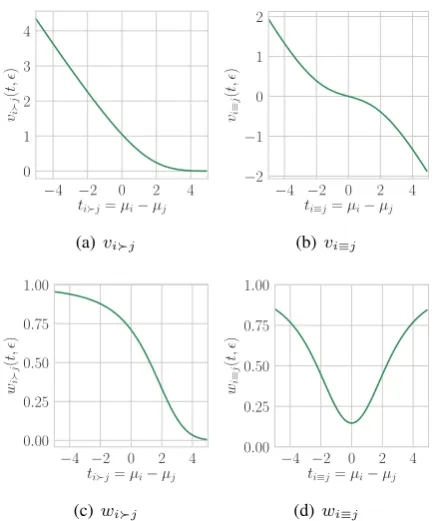
Figure 2: Surprisal of the outcome forµandσ2(= 0.5).
wherec2 = 2γ2+σ2
i+σ2j, andvare multiplicative
factors that affect the amount of change (surprisal
of the outcome) inµ. In the accumulation of the
variances (c2), another free parameter called “skill
chain”, γ, indicates the width (or difference) of
skill levels that two given players have 0.8 (80%) probability of win/lose. The multiplicative factor depends on the observation (wins or ties):
vij(t, ) =
ϕ(−+t)
Φ(−+t), (5)
vi≡j(t, ) =
ϕ(−−t)−ϕ(−t)
Φ(−t)−Φ(−−t), (6)
where ϕ(·) is the probability density function of
the standard normal distribution. As shown in
Fig-ure2(a) and (b), vij increases exponentially as
t becomes smaller (i.e., the observation is
unex-pected), whereasvi≡j becomes close to zero when
|t|is close to zero. In short, vbecomes larger as
the outcome is more surprising.
In order to update variance (σ2), another set of
update functions is used:
σ2i =σ2i ·
1−σ
2
i
c2 ·w
t c, c (7)
σ2j =σ2j ·
" 1−σ
2
j
c2 ·w
wherewserve as multiplicative factors that affect
the amount of change inσ2.
wij(t, ) =vij·(vij+t−) (9)
wi≡j(t, ) =vi2≡j+
(−t)·ϕ(−t) + (+t)·ϕ(+t) Φ(−t)−Φ(−−t) .
(10)
As shown in Figure2(c) and (d), the value ofwis
between 0 and 1. The underlying idea for the vari-ance updates is that these updates always decrease
the size of the variancesσ2, which means
uncer-tainty of the instances (Si, Sj) always decreases as
we observe more pairwise comparisons. In other words, TrueSkill becomes more confident in the
current estimate ofµi andµj. Further details are
provided byHerbrich et al.(2006).8
Another important property of TrueSkill is
“match quality (chance to draw)”. The match
quality helps selecting competitive players to make games more interesting. More broadly, the match quality enables us to choose similar in-stances to be compared to maximize the informa-tion gain from pairwise comparisons, as in the
ac-tive learning literature (Settles et al.,2008). The
match quality between two instances (players) is computed as follows:
q(γ, Si, Sj) :=
r
2γ2
c2 exp
−(µi−µj) 2
2c2
(11)
Intuitively, the match quality is based on the
differ-enceµi−µj. As the difference becomes smaller,
the match quality goes higher, and vice versa. As mentioned, TrueSkill has been used for NLP tasks to infer continuous values for instances. However, it is important to note that the support of a Gaussian distribution is unbounded, namely
R= (−∞,∞). This does not satisfy the property
of absolute zero of scalar annotation in the level of
measurement (§2). It becomes problematic when
it comes to annotating a scalar (continuous) value for extremes such as extremely positive or nega-tive sentiments. We address this issue by propos-ing a novel variant of TrueSkill in the next section.
3.2 Bounded Variant
TrueSkill can induce a continuous spectrum of in-stances (such as skill level of game players) by
8The following material is also useful to understand
the math behind TrueSkill (http://www.moserware. com/assets/computing-your-skill/The% 20Math%20Behind%20TrueSkill.pdf).
assuming that each instance is represented as a Gaussian distribution. However, the Gaussian
dis-tribution has unbounded support, namely R =
(−∞,∞), which does not satisfy the property of
absolutebounds for appropriate scalar annotation
(i.e., ratio scale in the level of measurement). Thus, we propose a variant of TrueSkill by changing the latent distribution from a Gaussian to a beta, using a heuristic algorithm based on TrueSkill for inference. The Beta distribution has
natural[0,1]upper and lower bounds and a simple
parameterization:Si ∼ Bi(αi, βi). We choose the
scalar response as the modeM[Si]of the
distribu-tion and the variance as uncertainty:9
Mi =
αi−1
αi+βi−2
(12)
Vari =σ2i = αiβi
(αi+βi)2(αi+βi+ 1)
(13)
As in TrueSkill, we iteratively update
param-eters of instances B(α, β) according to each
ob-servation and how it is surprising. Similarly to
Eqns. (3) and (4), we choose the update functions
as follows;10first, in case that an annotator judged
thatSiis preferred toSj(SiSj),
αi =αi+
σ2
i
c ·(1−pij) (14)
βj =βj+
σ2
j
c ·(1−pj≺i) (15)
in case of ties with|D|> andMi>Mj,
αj =αj+
σ2
j
c ·(1−pi≡j) (16)
βi=βi+
σ2
i
c ·(1−pi≡j) (17)
and in case of ties with|D|6, for bothSi, Sj,
αi,j =αi,j+ σ
2
i,j
c ·(1−pi≡j) (18)
βi,j =βi,j+σ
2
i,j
c ·(1−pi≡j). (19)
9
We may have instead used the mean (E[Si] = ααi
i+βi)
of the distribution, where in a beta (α, β > 1) the mean is
always closer to 0.5 than the mode, whereas mean and mode are always the same in a Gaussian distribution. The mode was selected owing to better performance in development.
10
There may be other potential update (and surprisal)
func-tions such as−logp, instead of1−p. As in our use of the
mode rather than mean as scalar response, we empirically de-veloped our update functions with respect to annotation
−1 0 1 tij=Mi−Mj 0.00
0.25 0.50 0.75 1.00
1
−
p
(
Si
Sj
)
(a)1−pij
−1 0 1
ti≡j=Mi−Mj 0.7
0.8 0.9 1.0
1
−
p
(
Si
≡
Sj
)
[image:5.595.341.487.63.175.2](b) 1−pi≡j
Figure 3: Surprisal of the outcome for the bounded variant
(= 0.5).
Regarding the probability of pairwise comparison
between instances, we follow Bradley and Terry
(1952) andRao and Kupper(1967) to describe the
chance of win, tie, or loss, as follows:
p(SiSj) =p(D > ) =
πi
πi+θπj
(20)
p(Si≺Sj) =p(D <−) =
πj
θπi+πj
(21)
p(Si≡Sj) =p(|D|6) =
(θ2−1)πiπj
(πi+θπj)(θπi+πj)
(22)
where D = Mi −Mj, > 0 is a parameter to
specify the tie rate,θ= exp (), andπis an
expo-nential score function ofS;πi= exp(Mi).
It is important to note that α and β never
de-crease (because 1−p ≥ 0 as shown Figure 3),
which satisfies the property that variance (uncer-tainty) always decreases as we observe more
judg-ments, as seen in TrueSkill (§3.1). In addition,
we do not need individual update functions for µ
andσ2, since the mode and variance in beta
dis-tribution depend on two shared parameters α, β
(Eqns.12and13).
Regarding match quality, we use the same
for-mulation as the TrueSkill (Eqn.11), except that the
bounded model usesMinstead ofµ:
q(γ, Si, Sj) =
r
2γ2
c2 exp
−(Mi−Mj) 2
2c2
(23)
4 Efficient Annotation of Scalar Labels
In the previous section, we propose a bounded
online ranking aggregation model for scalar an-notation. However, the amount of update by a pairwise judgment depends only on the distance between instances, not on the distance from the
bounds (i.e., 0 and 1). To integrate this
prop-erty into the online ranking aggregation model,
Select Update
0 0.5 1.0
S<latexit sha1_base64="t+Iz4LaxbyDvBoP2/ZeJbTGgKmE=">AAAB6nicbVBNS8NAEJ3Ur1q/qh69LBbBU0lEqMeiF4+V2g9oQ9lsJ+3SzSbsboQS+hO8eFDEq7/Im//GbZuDtj4YeLw3w8y8IBFcG9f9dgobm1vbO8Xd0t7+weFR+fikreNUMWyxWMSqG1CNgktsGW4EdhOFNAoEdoLJ3dzvPKHSPJaPZpqgH9GR5CFn1Fip2RzwQbniVt0FyDrxclKBHI1B+as/jFkaoTRMUK17npsYP6PKcCZwVuqnGhPKJnSEPUsljVD72eLUGbmwypCEsbIlDVmovycyGmk9jQLbGVEz1qveXPzP66UmvPEzLpPUoGTLRWEqiInJ/G8y5AqZEVNLKFPc3krYmCrKjE2nZEPwVl9eJ+2rqudWvYfrSv02j6MIZ3AOl+BBDepwDw1oAYMRPMMrvDnCeXHenY9la8HJZ07hD5zPHygyjbM=</latexit><latexit sha1_base64="t+Iz4LaxbyDvBoP2/ZeJbTGgKmE=">AAAB6nicbVBNS8NAEJ3Ur1q/qh69LBbBU0lEqMeiF4+V2g9oQ9lsJ+3SzSbsboQS+hO8eFDEq7/Im//GbZuDtj4YeLw3w8y8IBFcG9f9dgobm1vbO8Xd0t7+weFR+fikreNUMWyxWMSqG1CNgktsGW4EdhOFNAoEdoLJ3dzvPKHSPJaPZpqgH9GR5CFn1Fip2RzwQbniVt0FyDrxclKBHI1B+as/jFkaoTRMUK17npsYP6PKcCZwVuqnGhPKJnSEPUsljVD72eLUGbmwypCEsbIlDVmovycyGmk9jQLbGVEz1qveXPzP66UmvPEzLpPUoGTLRWEqiInJ/G8y5AqZEVNLKFPc3krYmCrKjE2nZEPwVl9eJ+2rqudWvYfrSv02j6MIZ3AOl+BBDepwDw1oAYMRPMMrvDnCeXHenY9la8HJZ07hD5zPHygyjbM=</latexit><latexit sha1_base64="t+Iz4LaxbyDvBoP2/ZeJbTGgKmE=">AAAB6nicbVBNS8NAEJ3Ur1q/qh69LBbBU0lEqMeiF4+V2g9oQ9lsJ+3SzSbsboQS+hO8eFDEq7/Im//GbZuDtj4YeLw3w8y8IBFcG9f9dgobm1vbO8Xd0t7+weFR+fikreNUMWyxWMSqG1CNgktsGW4EdhOFNAoEdoLJ3dzvPKHSPJaPZpqgH9GR5CFn1Fip2RzwQbniVt0FyDrxclKBHI1B+as/jFkaoTRMUK17npsYP6PKcCZwVuqnGhPKJnSEPUsljVD72eLUGbmwypCEsbIlDVmovycyGmk9jQLbGVEz1qveXPzP66UmvPEzLpPUoGTLRWEqiInJ/G8y5AqZEVNLKFPc3krYmCrKjE2nZEPwVl9eJ+2rqudWvYfrSv02j6MIZ3AOl+BBDepwDw1oAYMRPMMrvDnCeXHenY9la8HJZ07hD5zPHygyjbM=</latexit><latexit sha1_base64="t+Iz4LaxbyDvBoP2/ZeJbTGgKmE=">AAAB6nicbVBNS8NAEJ3Ur1q/qh69LBbBU0lEqMeiF4+V2g9oQ9lsJ+3SzSbsboQS+hO8eFDEq7/Im//GbZuDtj4YeLw3w8y8IBFcG9f9dgobm1vbO8Xd0t7+weFR+fikreNUMWyxWMSqG1CNgktsGW4EdhOFNAoEdoLJ3dzvPKHSPJaPZpqgH9GR5CFn1Fip2RzwQbniVt0FyDrxclKBHI1B+as/jFkaoTRMUK17npsYP6PKcCZwVuqnGhPKJnSEPUsljVD72eLUGbmwypCEsbIlDVmovycyGmk9jQLbGVEz1qveXPzP66UmvPEzLpPUoGTLRWEqiInJ/G8y5AqZEVNLKFPc3krYmCrKjE2nZEPwVl9eJ+2rqudWvYfrSv02j6MIZ3AOl+BBDepwDw1oAYMRPMMrvDnCeXHenY9la8HJZ07hD5zPHygyjbM=</latexit> i
Sj
<latexit sha1_base64="uy8/oo2XH/5NK+sYedP26NUTqT4=">AAAB6nicbVBNS8NAEJ3Ur1q/qh69LBbBU0lE0GPRi8dK7Qe0oWy2k3btZhN2N0IJ/QlePCji1V/kzX/jts1BWx8MPN6bYWZekAiujet+O4W19Y3NreJ2aWd3b/+gfHjU0nGqGDZZLGLVCahGwSU2DTcCO4lCGgUC28H4dua3n1BpHssHM0nQj+hQ8pAzaqzUaPQf++WKW3XnIKvEy0kFctT75a/eIGZphNIwQbXuem5i/Iwqw5nAaamXakwoG9Mhdi2VNELtZ/NTp+TMKgMSxsqWNGSu/p7IaKT1JApsZ0TNSC97M/E/r5ua8NrPuExSg5ItFoWpICYms7/JgCtkRkwsoUxxeythI6ooMzadkg3BW355lbQuqp5b9e4vK7WbPI4inMApnIMHV1CDO6hDExgM4Rle4c0Rzovz7nwsWgtOPnMMf+B8/gApto20</latexit>
<latexit sha1_base64="uy8/oo2XH/5NK+sYedP26NUTqT4=">AAAB6nicbVBNS8NAEJ3Ur1q/qh69LBbBU0lE0GPRi8dK7Qe0oWy2k3btZhN2N0IJ/QlePCji1V/kzX/jts1BWx8MPN6bYWZekAiujet+O4W19Y3NreJ2aWd3b/+gfHjU0nGqGDZZLGLVCahGwSU2DTcCO4lCGgUC28H4dua3n1BpHssHM0nQj+hQ8pAzaqzUaPQf++WKW3XnIKvEy0kFctT75a/eIGZphNIwQbXuem5i/Iwqw5nAaamXakwoG9Mhdi2VNELtZ/NTp+TMKgMSxsqWNGSu/p7IaKT1JApsZ0TNSC97M/E/r5ua8NrPuExSg5ItFoWpICYms7/JgCtkRkwsoUxxeythI6ooMzadkg3BW355lbQuqp5b9e4vK7WbPI4inMApnIMHV1CDO6hDExgM4Rle4c0Rzovz7nwsWgtOPnMMf+B8/gApto20</latexit>
<latexit sha1_base64="uy8/oo2XH/5NK+sYedP26NUTqT4=">AAAB6nicbVBNS8NAEJ3Ur1q/qh69LBbBU0lE0GPRi8dK7Qe0oWy2k3btZhN2N0IJ/QlePCji1V/kzX/jts1BWx8MPN6bYWZekAiujet+O4W19Y3NreJ2aWd3b/+gfHjU0nGqGDZZLGLVCahGwSU2DTcCO4lCGgUC28H4dua3n1BpHssHM0nQj+hQ8pAzaqzUaPQf++WKW3XnIKvEy0kFctT75a/eIGZphNIwQbXuem5i/Iwqw5nAaamXakwoG9Mhdi2VNELtZ/NTp+TMKgMSxsqWNGSu/p7IaKT1JApsZ0TNSC97M/E/r5ua8NrPuExSg5ItFoWpICYms7/JgCtkRkwsoUxxeythI6ooMzadkg3BW355lbQuqp5b9e4vK7WbPI4inMApnIMHV1CDO6hDExgM4Rle4c0Rzovz7nwsWgtOPnMMf+B8/gApto20</latexit>
<latexit sha1_base64="uy8/oo2XH/5NK+sYedP26NUTqT4=">AAAB6nicbVBNS8NAEJ3Ur1q/qh69LBbBU0lE0GPRi8dK7Qe0oWy2k3btZhN2N0IJ/QlePCji1V/kzX/jts1BWx8MPN6bYWZekAiujet+O4W19Y3NreJ2aWd3b/+gfHjU0nGqGDZZLGLVCahGwSU2DTcCO4lCGgUC28H4dua3n1BpHssHM0nQj+hQ8pAzaqzUaPQf++WKW3XnIKvEy0kFctT75a/eIGZphNIwQbXuem5i/Iwqw5nAaamXakwoG9Mhdi2VNELtZ/NTp+TMKgMSxsqWNGSu/p7IaKT1JApsZ0TNSC97M/E/r5ua8NrPuExSg5ItFoWpICYms7/JgCtkRkwsoUxxeythI6ooMzadkg3BW355lbQuqp5b9e4vK7WbPI4inMApnIMHV1CDO6hDExgM4Rle4c0Rzovz7nwsWgtOPnMMf+B8/gApto20</latexit>
s
<latexit sha1_base64="SvlfVCVJhDjhE9FQnoYm58bFYww=">AAAB6nicbVBNS8NAEJ3Ur1q/oh69LBbBU0lE0GPRi8eK9gPaUDbbTbt0swm7E6GE/gQvHhTx6i/y5r9x2+agrQ8GHu/NMDMvTKUw6HnfTmltfWNzq7xd2dnd2z9wD49aJsk0402WyER3Qmq4FIo3UaDknVRzGoeSt8Px7cxvP3FtRKIecZLyIKZDJSLBKFrpwfRF3616NW8Oskr8glShQKPvfvUGCctirpBJakzX91IMcqpRMMmnlV5meErZmA5511JFY26CfH7qlJxZZUCiRNtSSObq74mcxsZM4tB2xhRHZtmbif953Qyj6yAXKs2QK7ZYFGWSYEJmf5OB0JyhnFhCmRb2VsJGVFOGNp2KDcFffnmVtC5qvlfz7y+r9ZsijjKcwCmcgw9XUIc7aEATGAzhGV7hzZHOi/PufCxaS04xcwx/4Hz+AFjyjdM=</latexit><latexit sha1_base64="SvlfVCVJhDjhE9FQnoYm58bFYww=">AAAB6nicbVBNS8NAEJ3Ur1q/oh69LBbBU0lE0GPRi8eK9gPaUDbbTbt0swm7E6GE/gQvHhTx6i/y5r9x2+agrQ8GHu/NMDMvTKUw6HnfTmltfWNzq7xd2dnd2z9wD49aJsk0402WyER3Qmq4FIo3UaDknVRzGoeSt8Px7cxvP3FtRKIecZLyIKZDJSLBKFrpwfRF3616NW8Oskr8glShQKPvfvUGCctirpBJakzX91IMcqpRMMmnlV5meErZmA5511JFY26CfH7qlJxZZUCiRNtSSObq74mcxsZM4tB2xhRHZtmbif953Qyj6yAXKs2QK7ZYFGWSYEJmf5OB0JyhnFhCmRb2VsJGVFOGNp2KDcFffnmVtC5qvlfz7y+r9ZsijjKcwCmcgw9XUIc7aEATGAzhGV7hzZHOi/PufCxaS04xcwx/4Hz+AFjyjdM=</latexit><latexit sha1_base64="SvlfVCVJhDjhE9FQnoYm58bFYww=">AAAB6nicbVBNS8NAEJ3Ur1q/oh69LBbBU0lE0GPRi8eK9gPaUDbbTbt0swm7E6GE/gQvHhTx6i/y5r9x2+agrQ8GHu/NMDMvTKUw6HnfTmltfWNzq7xd2dnd2z9wD49aJsk0402WyER3Qmq4FIo3UaDknVRzGoeSt8Px7cxvP3FtRKIecZLyIKZDJSLBKFrpwfRF3616NW8Oskr8glShQKPvfvUGCctirpBJakzX91IMcqpRMMmnlV5meErZmA5511JFY26CfH7qlJxZZUCiRNtSSObq74mcxsZM4tB2xhRHZtmbif953Qyj6yAXKs2QK7ZYFGWSYEJmf5OB0JyhnFhCmRb2VsJGVFOGNp2KDcFffnmVtC5qvlfz7y+r9ZsijjKcwCmcgw9XUIc7aEATGAzhGV7hzZHOi/PufCxaS04xcwx/4Hz+AFjyjdM=</latexit><latexit sha1_base64="SvlfVCVJhDjhE9FQnoYm58bFYww=">AAAB6nicbVBNS8NAEJ3Ur1q/oh69LBbBU0lE0GPRi8eK9gPaUDbbTbt0swm7E6GE/gQvHhTx6i/y5r9x2+agrQ8GHu/NMDMvTKUw6HnfTmltfWNzq7xd2dnd2z9wD49aJsk0402WyER3Qmq4FIo3UaDknVRzGoeSt8Px7cxvP3FtRKIecZLyIKZDJSLBKFrpwfRF3616NW8Oskr8glShQKPvfvUGCctirpBJakzX91IMcqpRMMmnlV5meErZmA5511JFY26CfH7qlJxZZUCiRNtSSObq74mcxsZM4tB2xhRHZtmbif953Qyj6yAXKs2QK7ZYFGWSYEJmf5OB0JyhnFhCmRb2VsJGVFOGNp2KDcFffnmVtC5qvlfz7y+r9ZsijjKcwCmcgw9XUIc7aEATGAzhGV7hzZHOi/PufCxaS04xcwx/4Hz+AFjyjdM=</latexit> is
j<latexit sha1_base64="Jptagc36AA9ZYk3FYwVaai8xTh4=">AAAB6nicbVBNS8NAEJ3Ur1q/qh69LBbBU0lEqMeiF48V7Qe0oWy2k3btZhN2N0IJ/QlePCji1V/kzX/jts1BWx8MPN6bYWZekAiujet+O4W19Y3NreJ2aWd3b/+gfHjU0nGqGDZZLGLVCahGwSU2DTcCO4lCGgUC28H4Zua3n1BpHssHM0nQj+hQ8pAzaqx0r/uP/XLFrbpzkFXi5aQCORr98ldvELM0QmmYoFp3PTcxfkaV4UzgtNRLNSaUjekQu5ZKGqH2s/mpU3JmlQEJY2VLGjJXf09kNNJ6EgW2M6JmpJe9mfif101NeOVnXCapQckWi8JUEBOT2d9kwBUyIyaWUKa4vZWwEVWUGZtOyYbgLb+8SloXVc+teneXlfp1HkcRTuAUzsGDGtThFhrQBAZDeIZXeHOE8+K8Ox+L1oKTzxzDHzifP1p2jdQ=</latexit>
<latexit sha1_base64="Jptagc36AA9ZYk3FYwVaai8xTh4=">AAAB6nicbVBNS8NAEJ3Ur1q/qh69LBbBU0lEqMeiF48V7Qe0oWy2k3btZhN2N0IJ/QlePCji1V/kzX/jts1BWx8MPN6bYWZekAiujet+O4W19Y3NreJ2aWd3b/+gfHjU0nGqGDZZLGLVCahGwSU2DTcCO4lCGgUC28H4Zua3n1BpHssHM0nQj+hQ8pAzaqx0r/uP/XLFrbpzkFXi5aQCORr98ldvELM0QmmYoFp3PTcxfkaV4UzgtNRLNSaUjekQu5ZKGqH2s/mpU3JmlQEJY2VLGjJXf09kNNJ6EgW2M6JmpJe9mfif101NeOVnXCapQckWi8JUEBOT2d9kwBUyIyaWUKa4vZWwEVWUGZtOyYbgLb+8SloXVc+teneXlfp1HkcRTuAUzsGDGtThFhrQBAZDeIZXeHOE8+K8Ox+L1oKTzxzDHzifP1p2jdQ=</latexit>
<latexit sha1_base64="Jptagc36AA9ZYk3FYwVaai8xTh4=">AAAB6nicbVBNS8NAEJ3Ur1q/qh69LBbBU0lEqMeiF48V7Qe0oWy2k3btZhN2N0IJ/QlePCji1V/kzX/jts1BWx8MPN6bYWZekAiujet+O4W19Y3NreJ2aWd3b/+gfHjU0nGqGDZZLGLVCahGwSU2DTcCO4lCGgUC28H4Zua3n1BpHssHM0nQj+hQ8pAzaqx0r/uP/XLFrbpzkFXi5aQCORr98ldvELM0QmmYoFp3PTcxfkaV4UzgtNRLNSaUjekQu5ZKGqH2s/mpU3JmlQEJY2VLGjJXf09kNNJ6EgW2M6JmpJe9mfif101NeOVnXCapQckWi8JUEBOT2d9kwBUyIyaWUKa4vZWwEVWUGZtOyYbgLb+8SloXVc+teneXlfp1HkcRTuAUzsGDGtThFhrQBAZDeIZXeHOE8+K8Ox+L1oKTzxzDHzifP1p2jdQ=</latexit>
<latexit sha1_base64="Jptagc36AA9ZYk3FYwVaai8xTh4=">AAAB6nicbVBNS8NAEJ3Ur1q/qh69LBbBU0lEqMeiF48V7Qe0oWy2k3btZhN2N0IJ/QlePCji1V/kzX/jts1BWx8MPN6bYWZekAiujet+O4W19Y3NreJ2aWd3b/+gfHjU0nGqGDZZLGLVCahGwSU2DTcCO4lCGgUC28H4Zua3n1BpHssHM0nQj+hQ8pAzaqx0r/uP/XLFrbpzkFXi5aQCORr98ldvELM0QmmYoFp3PTcxfkaV4UzgtNRLNSaUjekQu5ZKGqH2s/mpU3JmlQEJY2VLGjJXf09kNNJ6EgW2M6JmpJe9mfif101NeOVnXCapQckWi8JUEBOT2d9kwBUyIyaWUKa4vZWwEVWUGZtOyYbgLb+8SloXVc+teneXlfp1HkcRTuAUzsGDGtThFhrQBAZDeIZXeHOE8+K8Ox+L1oKTzxzDHzifP1p2jdQ=</latexit> : 0
<latexit sha1_base64="D0FGQE6FBQJNuSufyG9qkORfjp0=">AAAB6XicbVBNS8NAEJ3Ur1q/qh69LBbBU0lEqHgqevFYxX5AG8pmu2mXbjZhdyKU0H/gxYMiXv1H3vw3btsctPXBwOO9GWbmBYkUBl332ymsrW9sbhW3Szu7e/sH5cOjlolTzXiTxTLWnYAaLoXiTRQoeSfRnEaB5O1gfDvz209cGxGrR5wk3I/oUIlQMIpWerh2++WKW3XnIKvEy0kFcjT65a/eIGZpxBUySY3pem6CfkY1Cib5tNRLDU8oG9Mh71qqaMSNn80vnZIzqwxIGGtbCslc/T2R0ciYSRTYzojiyCx7M/E/r5tieOVnQiUpcsUWi8JUEozJ7G0yEJozlBNLKNPC3krYiGrK0IZTsiF4yy+vktZF1XOr3v1lpX6Tx1GEEziFc/CgBnW4gwY0gUEIz/AKb87YeXHenY9Fa8HJZ47hD5zPH/YfjPg=</latexit>
<latexit sha1_base64="D0FGQE6FBQJNuSufyG9qkORfjp0=">AAAB6XicbVBNS8NAEJ3Ur1q/qh69LBbBU0lEqHgqevFYxX5AG8pmu2mXbjZhdyKU0H/gxYMiXv1H3vw3btsctPXBwOO9GWbmBYkUBl332ymsrW9sbhW3Szu7e/sH5cOjlolTzXiTxTLWnYAaLoXiTRQoeSfRnEaB5O1gfDvz209cGxGrR5wk3I/oUIlQMIpWerh2++WKW3XnIKvEy0kFcjT65a/eIGZpxBUySY3pem6CfkY1Cib5tNRLDU8oG9Mh71qqaMSNn80vnZIzqwxIGGtbCslc/T2R0ciYSRTYzojiyCx7M/E/r5tieOVnQiUpcsUWi8JUEozJ7G0yEJozlBNLKNPC3krYiGrK0IZTsiF4yy+vktZF1XOr3v1lpX6Tx1GEEziFc/CgBnW4gwY0gUEIz/AKb87YeXHenY9Fa8HJZ47hD5zPH/YfjPg=</latexit>
<latexit sha1_base64="D0FGQE6FBQJNuSufyG9qkORfjp0=">AAAB6XicbVBNS8NAEJ3Ur1q/qh69LBbBU0lEqHgqevFYxX5AG8pmu2mXbjZhdyKU0H/gxYMiXv1H3vw3btsctPXBwOO9GWbmBYkUBl332ymsrW9sbhW3Szu7e/sH5cOjlolTzXiTxTLWnYAaLoXiTRQoeSfRnEaB5O1gfDvz209cGxGrR5wk3I/oUIlQMIpWerh2++WKW3XnIKvEy0kFcjT65a/eIGZpxBUySY3pem6CfkY1Cib5tNRLDU8oG9Mh71qqaMSNn80vnZIzqwxIGGtbCslc/T2R0ciYSRTYzojiyCx7M/E/r5tieOVnQiUpcsUWi8JUEozJ7G0yEJozlBNLKNPC3krYiGrK0IZTsiF4yy+vktZF1XOr3v1lpX6Tx1GEEziFc/CgBnW4gwY0gUEIz/AKb87YeXHenY9Fa8HJZ47hD5zPH/YfjPg=</latexit>
<latexit sha1_base64="D0FGQE6FBQJNuSufyG9qkORfjp0=">AAAB6XicbVBNS8NAEJ3Ur1q/qh69LBbBU0lEqHgqevFYxX5AG8pmu2mXbjZhdyKU0H/gxYMiXv1H3vw3btsctPXBwOO9GWbmBYkUBl332ymsrW9sbhW3Szu7e/sH5cOjlolTzXiTxTLWnYAaLoXiTRQoeSfRnEaB5O1gfDvz209cGxGrR5wk3I/oUIlQMIpWerh2++WKW3XnIKvEy0kFcjT65a/eIGZpxBUySY3pem6CfkY1Cib5tNRLDU8oG9Mh71qqaMSNn80vnZIzqwxIGGtbCslc/T2R0ciYSRTYzojiyCx7M/E/r5tieOVnQiUpcsUWi8JUEozJ7G0yEJozlBNLKNPC3krYiGrK0IZTsiF4yy+vktZF1XOr3v1lpX6Tx1GEEziFc/CgBnW4gwY0gUEIz/AKb87YeXHenY9Fa8HJZ47hD5zPH/YfjPg=</latexit>
: 0<latexit sha1_base64="D0FGQE6FBQJNuSufyG9qkORfjp0=">AAAB6XicbVBNS8NAEJ3Ur1q/qh69LBbBU0lEqHgqevFYxX5AG8pmu2mXbjZhdyKU0H/gxYMiXv1H3vw3btsctPXBwOO9GWbmBYkUBl332ymsrW9sbhW3Szu7e/sH5cOjlolTzXiTxTLWnYAaLoXiTRQoeSfRnEaB5O1gfDvz209cGxGrR5wk3I/oUIlQMIpWerh2++WKW3XnIKvEy0kFcjT65a/eIGZpxBUySY3pem6CfkY1Cib5tNRLDU8oG9Mh71qqaMSNn80vnZIzqwxIGGtbCslc/T2R0ciYSRTYzojiyCx7M/E/r5tieOVnQiUpcsUWi8JUEozJ7G0yEJozlBNLKNPC3krYiGrK0IZTsiF4yy+vktZF1XOr3v1lpX6Tx1GEEziFc/CgBnW4gwY0gUEIz/AKb87YeXHenY9Fa8HJZ47hD5zPH/YfjPg=</latexit><latexit sha1_base64="D0FGQE6FBQJNuSufyG9qkORfjp0=">AAAB6XicbVBNS8NAEJ3Ur1q/qh69LBbBU0lEqHgqevFYxX5AG8pmu2mXbjZhdyKU0H/gxYMiXv1H3vw3btsctPXBwOO9GWbmBYkUBl332ymsrW9sbhW3Szu7e/sH5cOjlolTzXiTxTLWnYAaLoXiTRQoeSfRnEaB5O1gfDvz209cGxGrR5wk3I/oUIlQMIpWerh2++WKW3XnIKvEy0kFcjT65a/eIGZpxBUySY3pem6CfkY1Cib5tNRLDU8oG9Mh71qqaMSNn80vnZIzqwxIGGtbCslc/T2R0ciYSRTYzojiyCx7M/E/r5tieOVnQiUpcsUWi8JUEozJ7G0yEJozlBNLKNPC3krYiGrK0IZTsiF4yy+vktZF1XOr3v1lpX6Tx1GEEziFc/CgBnW4gwY0gUEIz/AKb87YeXHenY9Fa8HJZ47hD5zPH/YfjPg=</latexit><latexit sha1_base64="D0FGQE6FBQJNuSufyG9qkORfjp0=">AAAB6XicbVBNS8NAEJ3Ur1q/qh69LBbBU0lEqHgqevFYxX5AG8pmu2mXbjZhdyKU0H/gxYMiXv1H3vw3btsctPXBwOO9GWbmBYkUBl332ymsrW9sbhW3Szu7e/sH5cOjlolTzXiTxTLWnYAaLoXiTRQoeSfRnEaB5O1gfDvz209cGxGrR5wk3I/oUIlQMIpWerh2++WKW3XnIKvEy0kFcjT65a/eIGZpxBUySY3pem6CfkY1Cib5tNRLDU8oG9Mh71qqaMSNn80vnZIzqwxIGGtbCslc/T2R0ciYSRTYzojiyCx7M/E/r5tieOVnQiUpcsUWi8JUEozJ7G0yEJozlBNLKNPC3krYiGrK0IZTsiF4yy+vktZF1XOr3v1lpX6Tx1GEEziFc/CgBnW4gwY0gUEIz/AKb87YeXHenY9Fa8HJZ47hD5zPH/YfjPg=</latexit><latexit sha1_base64="D0FGQE6FBQJNuSufyG9qkORfjp0=">AAAB6XicbVBNS8NAEJ3Ur1q/qh69LBbBU0lEqHgqevFYxX5AG8pmu2mXbjZhdyKU0H/gxYMiXv1H3vw3btsctPXBwOO9GWbmBYkUBl332ymsrW9sbhW3Szu7e/sH5cOjlolTzXiTxTLWnYAaLoXiTRQoeSfRnEaB5O1gfDvz209cGxGrR5wk3I/oUIlQMIpWerh2++WKW3XnIKvEy0kFcjT65a/eIGZpxBUySY3pem6CfkY1Cib5tNRLDU8oG9Mh71qqaMSNn80vnZIzqwxIGGtbCslc/T2R0ciYSRTYzojiyCx7M/E/r5tieOVnQiUpcsUWi8JUEozJ7G0yEJozlBNLKNPC3krYiGrK0IZTsiF4yy+vktZF1XOr3v1lpX6Tx1GEEziFc/CgBnW4gwY0gUEIz/AKb87YeXHenY9Fa8HJZ47hD5zPH/YfjPg=</latexit>
[image:5.595.75.291.70.192.2]1<latexit sha1_base64="l9eImvYcFOKpzEDji/n9jPDeWb8=">AAAB6HicbVBNS8NAEJ3Ur1q/qh69LBbBU0lEqMeiF48t2A9oQ9lsJ+3azSbsboQS+gu8eFDEqz/Jm//GbZuDtj4YeLw3w8y8IBFcG9f9dgobm1vbO8Xd0t7+weFR+fikreNUMWyxWMSqG1CNgktsGW4EdhOFNAoEdoLJ3dzvPKHSPJYPZpqgH9GR5CFn1Fip6Q3KFbfqLkDWiZeTCuRoDMpf/WHM0gilYYJq3fPcxPgZVYYzgbNSP9WYUDahI+xZKmmE2s8Wh87IhVWGJIyVLWnIQv09kdFI62kU2M6ImrFe9ebif14vNeGNn3GZpAYlWy4KU0FMTOZfkyFXyIyYWkKZ4vZWwsZUUWZsNiUbgrf68jppX1U9t+o1ryv12zyOIpzBOVyCBzWowz00oAUMEJ7hFd6cR+fFeXc+lq0FJ585hT9wPn8Aep2MtQ==</latexit><latexit sha1_base64="l9eImvYcFOKpzEDji/n9jPDeWb8=">AAAB6HicbVBNS8NAEJ3Ur1q/qh69LBbBU0lEqMeiF48t2A9oQ9lsJ+3azSbsboQS+gu8eFDEqz/Jm//GbZuDtj4YeLw3w8y8IBFcG9f9dgobm1vbO8Xd0t7+weFR+fikreNUMWyxWMSqG1CNgktsGW4EdhOFNAoEdoLJ3dzvPKHSPJYPZpqgH9GR5CFn1Fip6Q3KFbfqLkDWiZeTCuRoDMpf/WHM0gilYYJq3fPcxPgZVYYzgbNSP9WYUDahI+xZKmmE2s8Wh87IhVWGJIyVLWnIQv09kdFI62kU2M6ImrFe9ebif14vNeGNn3GZpAYlWy4KU0FMTOZfkyFXyIyYWkKZ4vZWwsZUUWZsNiUbgrf68jppX1U9t+o1ryv12zyOIpzBOVyCBzWowz00oAUMEJ7hFd6cR+fFeXc+lq0FJ585hT9wPn8Aep2MtQ==</latexit><latexit sha1_base64="l9eImvYcFOKpzEDji/n9jPDeWb8=">AAAB6HicbVBNS8NAEJ3Ur1q/qh69LBbBU0lEqMeiF48t2A9oQ9lsJ+3azSbsboQS+gu8eFDEqz/Jm//GbZuDtj4YeLw3w8y8IBFcG9f9dgobm1vbO8Xd0t7+weFR+fikreNUMWyxWMSqG1CNgktsGW4EdhOFNAoEdoLJ3dzvPKHSPJYPZpqgH9GR5CFn1Fip6Q3KFbfqLkDWiZeTCuRoDMpf/WHM0gilYYJq3fPcxPgZVYYzgbNSP9WYUDahI+xZKmmE2s8Wh87IhVWGJIyVLWnIQv09kdFI62kU2M6ImrFe9ebif14vNeGNn3GZpAYlWy4KU0FMTOZfkyFXyIyYWkKZ4vZWwsZUUWZsNiUbgrf68jppX1U9t+o1ryv12zyOIpzBOVyCBzWowz00oAUMEJ7hFd6cR+fFeXc+lq0FJ585hT9wPn8Aep2MtQ==</latexit><latexit sha1_base64="l9eImvYcFOKpzEDji/n9jPDeWb8=">AAAB6HicbVBNS8NAEJ3Ur1q/qh69LBbBU0lEqMeiF48t2A9oQ9lsJ+3azSbsboQS+gu8eFDEqz/Jm//GbZuDtj4YeLw3w8y8IBFcG9f9dgobm1vbO8Xd0t7+weFR+fikreNUMWyxWMSqG1CNgktsGW4EdhOFNAoEdoLJ3dzvPKHSPJYPZpqgH9GR5CFn1Fip6Q3KFbfqLkDWiZeTCuRoDMpf/WHM0gilYYJq3fPcxPgZVYYzgbNSP9WYUDahI+xZKmmE2s8Wh87IhVWGJIyVLWnIQv09kdFI62kU2M6ImrFe9ebif14vNeGNn3GZpAYlWy4KU0FMTOZfkyFXyIyYWkKZ4vZWwsZUUWZsNiUbgrf68jppX1U9t+o1ryv12zyOIpzBOVyCBzWowz00oAUMEJ7hFd6cR+fFeXc+lq0FJ585hT9wPn8Aep2MtQ==</latexit> 1<latexit sha1_base64="l9eImvYcFOKpzEDji/n9jPDeWb8=">AAAB6HicbVBNS8NAEJ3Ur1q/qh69LBbBU0lEqMeiF48t2A9oQ9lsJ+3azSbsboQS+gu8eFDEqz/Jm//GbZuDtj4YeLw3w8y8IBFcG9f9dgobm1vbO8Xd0t7+weFR+fikreNUMWyxWMSqG1CNgktsGW4EdhOFNAoEdoLJ3dzvPKHSPJYPZpqgH9GR5CFn1Fip6Q3KFbfqLkDWiZeTCuRoDMpf/WHM0gilYYJq3fPcxPgZVYYzgbNSP9WYUDahI+xZKmmE2s8Wh87IhVWGJIyVLWnIQv09kdFI62kU2M6ImrFe9ebif14vNeGNn3GZpAYlWy4KU0FMTOZfkyFXyIyYWkKZ4vZWwsZUUWZsNiUbgrf68jppX1U9t+o1ryv12zyOIpzBOVyCBzWowz00oAUMEJ7hFd6cR+fFeXc+lq0FJ585hT9wPn8Aep2MtQ==</latexit><latexit sha1_base64="l9eImvYcFOKpzEDji/n9jPDeWb8=">AAAB6HicbVBNS8NAEJ3Ur1q/qh69LBbBU0lEqMeiF48t2A9oQ9lsJ+3azSbsboQS+gu8eFDEqz/Jm//GbZuDtj4YeLw3w8y8IBFcG9f9dgobm1vbO8Xd0t7+weFR+fikreNUMWyxWMSqG1CNgktsGW4EdhOFNAoEdoLJ3dzvPKHSPJYPZpqgH9GR5CFn1Fip6Q3KFbfqLkDWiZeTCuRoDMpf/WHM0gilYYJq3fPcxPgZVYYzgbNSP9WYUDahI+xZKmmE2s8Wh87IhVWGJIyVLWnIQv09kdFI62kU2M6ImrFe9ebif14vNeGNn3GZpAYlWy4KU0FMTOZfkyFXyIyYWkKZ4vZWwsZUUWZsNiUbgrf68jppX1U9t+o1ryv12zyOIpzBOVyCBzWowz00oAUMEJ7hFd6cR+fFeXc+lq0FJ585hT9wPn8Aep2MtQ==</latexit><latexit sha1_base64="l9eImvYcFOKpzEDji/n9jPDeWb8=">AAAB6HicbVBNS8NAEJ3Ur1q/qh69LBbBU0lEqMeiF48t2A9oQ9lsJ+3azSbsboQS+gu8eFDEqz/Jm//GbZuDtj4YeLw3w8y8IBFcG9f9dgobm1vbO8Xd0t7+weFR+fikreNUMWyxWMSqG1CNgktsGW4EdhOFNAoEdoLJ3dzvPKHSPJYPZpqgH9GR5CFn1Fip6Q3KFbfqLkDWiZeTCuRoDMpf/WHM0gilYYJq3fPcxPgZVYYzgbNSP9WYUDahI+xZKmmE2s8Wh87IhVWGJIyVLWnIQv09kdFI62kU2M6ImrFe9ebif14vNeGNn3GZpAYlWy4KU0FMTOZfkyFXyIyYWkKZ4vZWwsZUUWZsNiUbgrf68jppX1U9t+o1ryv12zyOIpzBOVyCBzWowz00oAUMEJ7hFd6cR+fFeXc+lq0FJ585hT9wPn8Aep2MtQ==</latexit><latexit sha1_base64="l9eImvYcFOKpzEDji/n9jPDeWb8=">AAAB6HicbVBNS8NAEJ3Ur1q/qh69LBbBU0lEqMeiF48t2A9oQ9lsJ+3azSbsboQS+gu8eFDEqz/Jm//GbZuDtj4YeLw3w8y8IBFcG9f9dgobm1vbO8Xd0t7+weFR+fikreNUMWyxWMSqG1CNgktsGW4EdhOFNAoEdoLJ3dzvPKHSPJYPZpqgH9GR5CFn1Fip6Q3KFbfqLkDWiZeTCuRoDMpf/WHM0gilYYJq3fPcxPgZVYYzgbNSP9WYUDahI+xZKmmE2s8Wh87IhVWGJIyVLWnIQv09kdFI62kU2M6ImrFe9ebif14vNeGNn3GZpAYlWy4KU0FMTOZfkyFXyIyYWkKZ4vZWwsZUUWZsNiUbgrf68jppX1U9t+o1ryv12zyOIpzBOVyCBzWowz00oAUMEJ7hFd6cR+fFeXc+lq0FJ585hT9wPn8Aep2MtQ==</latexit>
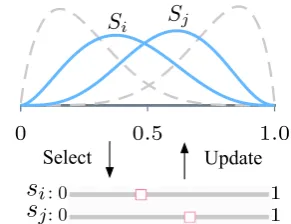
Figure 4: Illustrative example of the EASL protocol. Each instance is represented as a beta distribution. Instances are chosen to annotate according to the variance and match qual-ity, and the parameters are updated iteratively.
we propose EASL (EfficientAnnotation ofScalar
Labels) that combines benefits from both direct as-sessment (DA) and bounded online ranking
aggre-gation model (RA).11
Similarly to RA, EASL parameterizes each
in-stance by a beta distribution (Eqns. 12 and 13),
and the parameters are inferred using a compu-tationally efficient and easy-to-implement heuris-tic. The difference from RA is the type of annota-tion. While we ask for discrete pairwise judgment
(,≺,≡) between Si and Sj in RA, here we
di-rectly ask for scalar values for them (denoted assi
andsj) as in DA. Thus, given an annotated score
si which is normalized between [0,1], we change
the update functions as follows:
αi =αi+si (24)
βi =βi+ (1−si) (25)
This procedure may look similar to DA, where
siis simply accumulated and averaged at the end.
However, there are two differences. First, as
illus-trated in Figure 4, EASL parameterizes each
in-stance as a probability distribution while DA does not. Second, DA elicits annotations independently per element, whereas EASL elicits annotations on elements in the context of other elements selected jointly according to match quality.
Further, DA generally uses a batch style annota-tion scheme, where the number of annotaannota-tions per instance is independent from the latent scalar val-ues. On the other hand, EASL uses online learn-ing, which impacts the calculation of match qual-ity. This allows us to choose instances to annotate
11
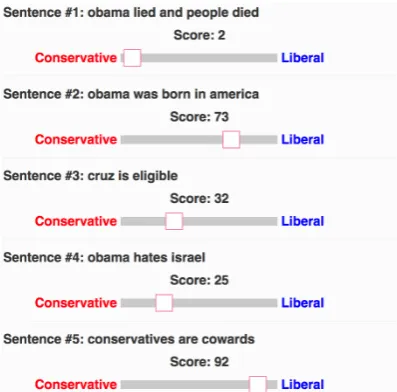
Figure 5: Example of partial ranking with scalars (HITS)
by order of uncertainty for each instance, and as
in RA, the match quality (Eqn.23) enables us to
consider similar instances in the same context.
5 Experiments
To compare different annotation methods, we con-duct three experiments: (1) lexical frequency in-ference, (2) political spectrum inin-ference, and (3) human evaluation for machine translation systems. In all experiments, data collection is conducted through Amazon Mechanical Turk (AMT). We ask annotators who meet the following minimum
re-quirements:12 living in the US, overall approval
rate>98%, and number of tasks approved>500.
The experimental setting for DA is straightfor-ward. We ask annotators to annotate a scalar value for each instance, one item at a time. We collect ten annotations for each instance to see the relation between the number of annotations and accuracy (i.e., correlation).
To set up the online update in RA and EASL,
we use apartial rankingframework with scalars,
where annotators are asked to rank and score n
instances at one time as illustrated in Figure5. In
all three experiments, we fix n = 5. The partial
ranking yields n2 pairwise comparisons for RA
andnscalar values for EASL.13 It is important to
note that we can simultaneously retrieve pairwise
12In all experiments, we set the reward of single instance
to be $0.01 (i.e., $0.05 in RA and EASL). This is $8/hour, as-suming that annotating one instance takes five seconds. Prior to annotation, we run a pilot to make sure that the participants understand the task correctly and the instructions are clear.
13The partial ranking can be regarded as mini-batching.
Algorithm 1:Online pairwise ranking
aggre-gation with bounded support.
Input:Instances{S1N} Output:Updated instances{SN
1 }
/* Initialize params */
1 (αi, βi)∈S= (αiniti , βiinit)
/* Update S over iterations */
2 foreachiterationdo
3 HITS = SampleByMatchQuality(S, N, n)
4 A= Annotate(HITS)
5 forobs∈Ado // Update S
6 i, j, d= parseObservation(obs)
7 αi,j, βi,j= update(i, j, d)
8 returnS
9 FunctionSampleByMatchQuality(S, N, n)
10 k=N/n
11 descendingSort(S, key=Var[S])
12 S0=top-k instances ofS
13 HITS = []
14 foreachSi∈S0do
15 m = []
16 foreachSj∈S/S0do
17 m.append([matchQuality(Si, Sj),j])
18 p= normalize(m)
19 S˜= sampling n-1 items byp
20 HITS.append([Si,S˜])
21 returnHITS
judgments (,≺,≡) as well as scalar values from
this format.
In each iteration, n instances are selected by
variance and match quality. We first select top
k (= N/n) instances according to the variance,
and for each selected instance we choose the other
n−1 instances to be compared based on match
quality. This approach has been used in the NLP community in tasks such as for assessing machine
translation quality (Bojar et al.,2014;Sakaguchi
et al., 2014; Bojar et al., 2015, 2016) to collect pairwise judgments efficiently. The detailed pro-cedure of iterative parameter updates in the RA
and EASL is described in Algorithm1. As
men-tioned in Section4, the main difference between
RA and EASL is the update functions (line 7). Model hyper-parameters in RA and EASL are set as follows; each instance is initialized as
αinit
i = 1.0, βiinit = 1.0. The skill chain
param-eterγand tie-rate parameterare set to be 0.1.14
5.1 Lexical Frequency Inference
In the first experiment, we compare the three scalar annotation approaches on lexical frequency inference, in which we ask annotators to judge fre-quency (from very rare to very frequent) of verbs
1 2 3 4 5 6 7 8 9 10 Number of annotations per item
0.5 0.6 0.7
Sp
earman’s
ρ
DA RA EASL
1 2 3 4 5 6 7 8 9 10
Number of annotations per item 0.5
0.6 0.7
P
earson’s
ρ
[image:7.595.74.288.61.275.2]DA RA EASL
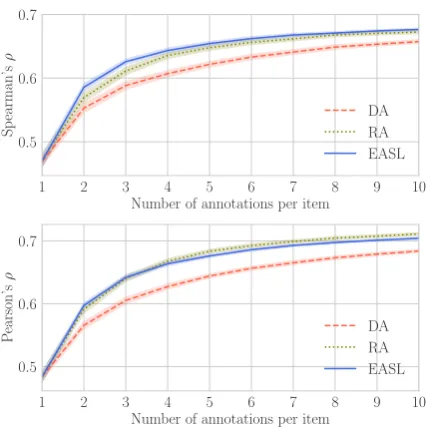
Figure 6: Spearman’s (top) and Pearson’s (bottom) correla-tions with three difference methods on lexical frequency in-ference annotation: direct assessment (DA), online ranking aggregation (RA), and EASL. The shade for each line indi-cates 95% confidence intervals by bootstrap resampling (run-ning 100 times).
that are randomly selected from the corpus of
Con-temporary American English (COCA)15. We
in-clude this task for evaluation owing to its non-subjective ground truth (relative corpus frequency) which can be used as an oracle response we would
like to maximally correlate with.16
We randomly select 150 verbs from COCA; the
log frequency (log10) is regarded as the oracle.
In DA, each instance is annotated by 10
differ-ent annotators.17 In the RA and EASL,
annota-tors are asked to rank/score five verbs for each HIT
(n = 5). Each iteration contains 20 HITS and we
run 10 iterations, which means that total number of
annotations is the same in DA, RA, and EASL.18
Figure 6 presents Spearman’s and Pearson’s
correlations, indicating how accurately each an-notation method obtains scalar values for each in-stance. Overall, in all three methods, the correla-tions are increased as more annotacorrela-tions are made. The result also shows that RA and EASL
ap-15
https://www.wordfrequency.info/ 16
Lexical frequency inference is an established experiment in (computational) psycholinguistics. E.g., human behavioral measures have been compared with predictability and bias in
various corpora (Balota et al.,1999;Fine et al.,2014).
17The agreement rate in DA (10 annotators) is 0.37 in
Spearman’s ρ. Considering the difficulty of ranking 150
verbs, this rate is fair.
18Technically, the number of annotations per instance vary
in RA and EASL, because they choose instances by match quality at each iteration.
0 20 40 60
80 Oracle
0 20 40
EASL
0 10 20 30 40 50 60 70 80 90 100 0
20 40
DA
0 10 20 30 40 50 60 70 80 90 100 0
20 40 60
[image:7.595.307.524.64.221.2]80 RA
Figure 7: Histograms of scalar values on lexical frequency obtained by each annotation scheme (direct assessment (DA), online ranking aggregation (RA), and EASL), and the ora-cle. The scalar annotations are put into five bins to see the overall distribution. The scalar in the oracle is normalized as
log10(frequency(Si)) /maxlog10(frequency(S)).
(a) Iter 0 (b) Iter 3 (c) Iter 6 (d) Iter 9
Figure 8: Heatmaps of match quality distribution across the cross-product of instances ordered by the oracle (i.e.,
log10(frequency)).
proaches achieve high correlation more efficiently than DA. The gain of efficiency from DA to EASL is about 50%; two iterations in EASL achieves a
close Spearman’sρto three annotators in DA.
Figure7 presents the results of the final scalar
values that each method annotated. The distri-bution of the histograms shows that overall three methods successfully capture the latent distribu-tion of scalar values in the data.
Figure 8 shows a dynamic change of match
quality. In the beginning (iteration 0), all the in-stances are equally competitive because we have no information about them and initialize them with
the same parameters. As iterations go on, the
[image:7.595.311.522.321.388.2]1 2 3 4 5 6 7 8 9 10 Number of annotations per item
0.80 0.85 0.90
Sp
earman’s
ρ
DA RA EASL
1 2 3 4 5 6 7 8 9 10
Number of annotations per item 0.80
0.85 0.90 0.95
P
earson’s
ρ
[image:8.595.74.288.60.275.2]DA RA EASL
Figure 9: Spearman’s (top) and Pearson’s (bottom) correla-tions with three difference methods on political spectrum an-notation: direct assessment (DA), online ranking aggregation (RA), and EASL
5.2 Political Spectrum Inference
In the second experiment, we compare the three scalar annotation methods for political spectrum
inference. We use the Fine-Grained Political
Statements dataset (Bamman and Smith, 2015),
which consists of 766 propositions collected from political blog comments, paired with judgments about the political belief of the statement (or the person who would say it) based on the five
ordi-nals: very conservative(-2),slightly conservative
(-1),neutral(0),slightly liberal(1), andvery
lib-eral(2). We normalize the ordinal scores between
0 and 1. The dataset contains the mean scores by
aggregating 7 annotations for each proposition.19
We randomly choose 150 political propositions
from the dataset (see the histogram in Figure 10
oracle).20 The experimental setting (i.e., the
num-ber of annotations per instance, the numnum-ber of iter-ations, and the number of HITS in each iteration) is the same as the lexical frequency inference
ex-periment (§5.1).
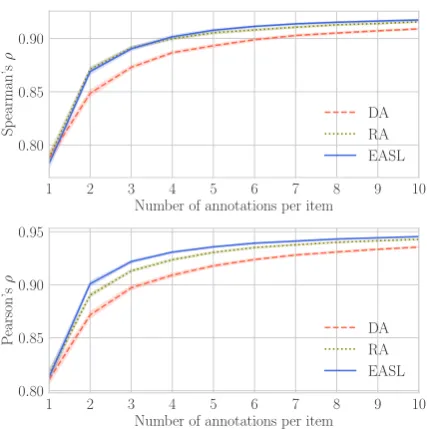
Figure9 shows Spearman’s and Pearson’s
cor-relations to the oracle by each method. Overall, all the three methods achieve strong correlation above
19We stress that the oracle here derives from subjective
an-notations: it does not necessarily reflect the true latent scalar values for each instance. However, in this experiment, we use them as a tentative oracle to compare three scalar annotation methods objectively.
20The agreement rate in DA (among 10 annotators) is 0.67
in Spearman’sρ. This is significantly high, considering the
difficulty of ranking 150 instances in order.
0 20 40
60 Oracle
0 20 40
EASL
0 10 20 30 40 50 60 70 80 90 100 0
20 40
DA
0 10 20 30 40 50 60 70 80 90 100 0
20 40 60
[image:8.595.307.524.63.221.2]RA
Figure 10: Histograms of scalar values on political spectrum obtained by each annotation scheme (DA, RA, EASL) and the oracle. Scalars are put into five bins to see the overall distribution.
Propositions Gold DA RA EASL
the republicans are useless 100 91.7 75.8 91.9
obama is right 92.9 90.1 74.6 90.0
hillary will win 78.6 86.3 72.9 86.4
aca is a success 75.0 78.2 68.3 77.3
harry reid is a democrat 53.6 55.5 55.8 55.9
ebola is a virus 50.0 53.0 53.8 53.5
cruz is eligible 32.2 31.0 44.0 31.4
global warming is a religion 28.6 22.4 37.3 23.0
bush kept us safe 10.7 9.6 31.5 9.6
[image:8.595.308.532.292.409.2]democrats are corrupt 0.0 7.1 29.9 7.4
Table 1: Example propositions and the scalar political spec-trum ranged between 0 (very conservative) and 100 (very lib-eral) by each approach: direct assessment, online ranking ag-gregation, and EASL. The dashed lines indicate a split by 5-ary ordinal scale.
0.9. We also find that RA and EASL reach high correlation more efficiently than DA as in the
lex-ical frequency inference experiment (§5.1). The
gain of efficiency from DA to EASL is about 50%; 4-way redundant annotation in EASL achieves a
close Spearman’sρto 6-way redundancy in DA.
Figure10 presents the results of the annotated
scalar values by each method. The distribution of the histograms shows that DA and EASL success-fully fit to the distribution in the oracle, whereas RA converges to a rather narrow range. This is because of the “lack of distance from bounds” in
RA that is explained in §4. We note that
renor-malizing the distribution in RA will not address the issue. For instance, when the dataset has only liberal propositions, RA still fails to capture the latent distribution because it looks only at rela-tive distances between instances but not the
dis-tance from bounds. Table1 shows the examples
see that RA approach has a narrower range than the oracle, DA, and EASL.
5.3 Ranking Machine Translation Systems
In the third experiment, we apply the scalar anno-tation methods for evaluating machine translation systems. This is different from two previous ex-periments, because the main purpose is to rank the
MT systems (SN
1 ) rather than the adequacy (q) of
each MT output for a given source sentence (m).
Namely, we want to rankSiby observingqi,m.
We use WMT16 German-English translation
dataset (Bojar et al., 2016), which consists of
2,999 test set sentences and the translations from 10 different systems with DA annotation. Each sentence has its adequacy score annotation be-tween 0 and 100, and the average adequacy scores are computed for each system for ranking. In this setting, annotators are asked to judge adequacy of system output(s) with the reference being given. The official scores (made by DA) and ranking in WMT16 are used as the oracle in this experiment. In this experiment, we replicate DA and run EASL to compare the efficiency. We omit RA in this experiment, because it does not necessarily capture the distance from bounds as shown in the
previous experiment (§5.2). In DA, 33,760
trans-lation outputs (3,376 sentences per system in av-erage) are randomly sampled without replacement to make sure that it reaches up to the same result as oracle when the entire data are used.
In EASL, we assume that adequacy (q) of an
MT output by system (Si) for a given source
sen-tence (m) is drawn from beta distribution:qi,m ∼
B(αi, βi).21 Annotators are asked to judge
ade-quacy of system outputs by scoring 0 and 100.
Similarly to the previous experiments (§ 5.1 and
§ 5.2), we use the partial ranking strategy, where
we show n = 5 system outputs (for the same
source sentencel) to annotate at a time. The
proce-dure of parameter updates is the same as previous
experiments (Algorithm1).
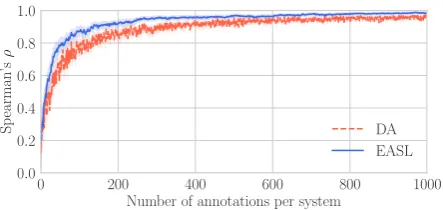
We compare the correlations (Spearman’sρ) of
system ranking with respect to the number of an-notations per system, and the result is shown in
Figure 11. As seen in the previous two
exper-iments, EASL achieves higher Spearmans corre-lation on ranking MT systems with smaller num-ber of annotations than the baseline method (DA),
21This is the same setting as WMT14, WMT15, and
WMT16 (Bojar et al., 2014, 2015), although they used
TrueSkill (Gaussian) instead of EASL to rank systems.
0 200 400 600 800 1000
Number of annotations per system 0.0
0.2 0.4 0.6 0.8 1.0
Sp
earman’s
ρ
[image:9.595.310.532.63.168.2]DA EASL
Figure 11: Spearman’s correlation on ranking machine trans-lation systems on WMT16 German-English data: direct as-sessment (DA), and EASL. The shade for each line indicates 95% confidence intervals by bootstrap resampling (running 100 times).
which means EASL is able to collect annotation more efficiently. The result shows that EASL can be applied for efficient system evaluation in addi-tion to data curaaddi-tion.
6 Conclusions
We have presented an efficient, online model to elicit scalar annotations for computational linguis-tic datasets and system evaluations. The model combines two approaches for scalar annotation: direct assessment and online pairwise ranking ag-gregation. We conducted three illustrative exper-iments on lexical frequency inference, political spectrum inference, and ranking machine transla-tion systems. We have shown that our approach,
EASL (Efficient Annotation of Scalar Labels),
outperforms direct assessment in terms of annota-tion efficiency and outperforms online ranking ag-gregation in terms of accurately capturing the la-tent distributions of scalar values. The significant gains demonstrated suggests EASL as a promis-ing approach for future dataset curation and sys-tem evaluation in the community.
Acknowledgments
References
David A. Balota, Cortese Michael J., and Maura Pilotti. 1999. Item-level analyses of lexical decision
perfor-mance: Results from a mega-study. InAbstracts of
the 40th Annual Meeting of the Psychonomics
Soci-ety, page 44, Los Angeles, California. Psychonomic
Society.
David Bamman and Noah A. Smith. 2015. Open
ex-traction of fine-grained political statements. In
Pro-ceedings of the 2015 Conference on Empirical Meth-ods in Natural Language Processing, pages 76– 85, Lisbon, Portugal. Association for Computational Linguistics.
Timo Baumann. 2017. Large-scale speaker ranking
from crowdsourced pairwise listener ratings.
Ondrej Bojar, Christian Buck, Christian Federmann, Barry Haddow, Philipp Koehn, Johannes Leveling, Christof Monz, Pavel Pecina, Matt Post, Herve Saint-Amand, Radu Soricut, Lucia Specia, and Aleˇs Tamchyna. 2014. Findings of the 2014 workshop on statistical machine translation.
Ondˇrej Bojar, Christian Buck, Chris Callison-Burch,
Christian Federmann, Barry Haddow, Philipp
Koehn, Christof Monz, Matt Post, Radu Soricut, and Lucia Specia. 2013. Findings of the 2013
Work-shop on Statistical Machine Translation. In
Pro-ceedings of the Eighth Workshop on Statistical Ma-chine Translation, pages 1–44, Sofia, Bulgaria. As-sociation for Computational Linguistics.
Ondˇrej Bojar, Rajen Chatterjee, Christian Federmann, Yvette Graham, Barry Haddow, Shujian Huang, Matthias Huck, Philipp Koehn, Qun Liu, Varvara Logacheva, Christof Monz, Matteo Negri, Matt Post, Raphael Rubino, Lucia Specia, and Marco Turchi. 2017. Findings of the 2017 conference on
machine translation (wmt17). InProceedings of the
Second Conference on Machine Translation, pages 169–214, Copenhagen, Denmark. Association for Computational Linguistics.
Ondˇrej Bojar, Rajen Chatterjee, Christian Federmann, Yvette Graham, Barry Haddow, Matthias Huck, Antonio Jimeno Yepes, Philipp Koehn, Varvara Logacheva, Christof Monz, Matteo Negri, Aure-lie Neveol, Mariana Neves, Martin Popel, Matt Post, Raphael Rubino, Carolina Scarton, Lucia Spe-cia, Marco Turchi, Karin Verspoor, and Marcos Zampieri. 2016. Findings of the 2016 conference
on machine translation. InProceedings of the First
Conference on Machine Translation, pages 131– 198, Berlin, Germany. Association for Computa-tional Linguistics.
Ondˇrej Bojar, Rajen Chatterjee, Christian Federmann, Barry Haddow, Matthias Huck, Chris Hokamp, Philipp Koehn, Varvara Logacheva, Christof Monz, Matteo Negri, Matt Post, Carolina Scarton, Lucia Specia, and Marco Turchi. 2015. Findings of the 2015 workshop on statistical machine translation.
InProceedings of the Tenth Workshop on Statistical Machine Translation, pages 1–46, Lisbon, Portugal. Association for Computational Linguistics.
Ralph Allan Bradley and Milton E. Terry. 1952. Rank analysis of incomplete block designs: I. the method
of paired comparisons. Biometrika, 39(3/4):324–
345.
Chris Callison-Burch, Philipp Koehn, Christof Monz, Matt Post, Radu Soricut, and Lucia Specia. 2012. Findings of the 2012 workshop on statistical
ma-chine translation. In Proceedings of the Seventh
Workshop on Statistical Machine Translation, pages 10–51, Montr´eal, Canada. Association for Compu-tational Linguistics.
Arpad E. Elo. 1978. The rating of chessplayers, past
and present. Arco Pub.
Alex B. Fine, Austin F. Frank, T. Florian Jaeger, and Benjamin Van Durme. 2014. Biases in predicting
the human language model. InProceedings of the
52nd Annual Meeting of the Association for Compu-tational Linguistics (Volume 2: Short Papers), pages 7–12, Baltimore, Maryland. Association for Compu-tational Linguistics.
Yvette Graham, Timothy Baldwin, Alistair Moffat, and Justin Zobel. 2013. Continuous measurement scales
in human evaluation of machine translation. In
Pro-ceedings of the 7th Linguistic Annotation Workshop and Interoperability with Discourse, pages 33–41, Sofia, Bulgaria. Association for Computational Lin-guistics.
Yvette Graham, Timothy Baldwin, Alistair Moffat, and Justin Zobel. 2014. Is machine translation getting
better over time? InProceedings of the 14th
Confer-ence of the European Chapter of the Association for Computational Linguistics, pages 443–451, Gothen-burg, Sweden. Association for Computational Lin-guistics.
Ralf Herbrich, Tom Minka, and Thore Graepel. 2006.
TrueSkillTM: A Bayesian Skill Rating System. In
Proceedings of the Twentieth Annual Conference on Neural Information Processing Systems, pages 569– 576, Vancouver, British Columbia, Canada.
Dirk Hovy, Taylor Berg-Kirkpatrick, Ashish Vaswani, and Eduard Hovy. 2013. Learning whom to trust
with mace. InProceedings of the 2013 Conference
of the North American Chapter of the Association for Computational Linguistics: Human Language Technologies, pages 1120–1130, Atlanta, Georgia. Association for Computational Linguistics.
Kenton Lee, Yoav Artzi, Yejin Choi, and Luke
Zettle-moyer. 2015. Event detection and factuality
as-sessment with non-expert supervision. In
Rensis Likert. 1932. A technique for the measurement
of attitudes.Archives of psychology.
Jing Liu, Quan Wang, Chin-Yew Lin, and Hsiao-Wuen Hon. 2013. Question difficulty estimation in
com-munity question answering services. InProceedings
of the 2013 Conference on Empirical Methods in Natural Language Processing, pages 85–90, Seattle, Washington, USA. Association for Computational Linguistics.
Marco Marelli, Stefano Menini, Marco Baroni, Luisa Bentivogli, Raffaella bernardi, and Roberto Zampar-elli. 2014. A sick cure for the evaluation of
compo-sitional distributional semantic models. In
Proceed-ings of the Ninth International Conference on Lan-guage Resources and Evaluation (LREC-2014). Eu-ropean Language Resources Association (ELRA).
J. Novikova, O. Duˇsek, and V. Rieser. 2018. RankME: Reliable Human Ratings for Natural Language
Gen-eration. ArXiv e-prints.
Brendan O’Connor, Ramnath Balasubramanyan,
Bryan R Routledge, and Noah A Smith. 2010. From tweets to polls: Linking text sentiment to public
opinion time series. ICWSM, 11(122-129):1–2.
Bo Pang, Lillian Lee, and Shivakumar Vaithyanathan. 2002. Thumbs up?: sentiment classification using
machine learning techniques. InProceedings of the
ACL-02 conference on Empirical methods in natural language processing-Volume 10, pages 79–86. As-sociation for Computational Linguistics.
Ellie Pavlick, Travis Wolfe, Pushpendre Rastogi, Chris Callison-Burch, Mark Dredze, and Benjamin
Van Durme. 2015. Framenet+: Fast paraphrastic
tripling of framenet. InProceedings of the 53rd
An-nual Meeting of the Association for Computational Linguistics and the 7th International Joint Confer-ence on Natural Language Processing (Volume 2: Short Papers), pages 408–413, Beijing, China. As-sociation for Computational Linguistics.
P. V. Rao and L. L. Kupper. 1967. Ties in
paired-comparison experiments: A generalization of the
bradley-terry model. Journal of the American
Sta-tistical Association, 62(317):194–204.
Keisuke Sakaguchi, Courtney Napoles, Matt Post, and Joel Tetreault. 2016. Reassessing the goals of matical error correction: Fluency instead of
gram-maticality.Transactions of the Association for
Com-putational Linguistics, 4.
Keisuke Sakaguchi, Matt Post, and Benjamin
Van Durme. 2014. Efficient elicitation of annota-tions for human evaluation of machine translation. InProceedings of the Ninth Workshop on Statistical Machine Translation, pages 1–11, Baltimore, Maryland, USA. Association for Computational Linguistics.
Burr Settles, Mark Craven, and Lewis Friedland. 2008.
Active learning with real annotation costs. In
Pro-ceedings of the NIPS workshop on cost-sensitive learning, pages 1–10.
S. S. Stevens. 1946. On the theory of scales of
mea-surement.Science, 103(2684):677–680.
Louis L Thurstone. 1927. The method of paired
com-parisons for social values.The Journal of Abnormal
and Social Psychology, 21(4):384.
Peter D Turney. 2002. Thumbs up or thumbs down?: semantic orientation applied to unsupervised
classi-fication of reviews. InProceedings of the 40th
an-nual meeting on association for computational lin-guistics, pages 417–424. Association for Computa-tional Linguistics.
Amos Tversky and Daniel Kahneman. 1974. Judgment
under uncertainty: Heuristics and biases. Science,
185(4157):1124–1131.
Peter Welinder, Steve Branson, Pietro Perona, and Serge J Belongie. 2010. The multidimensional
wis-dom of crowds. InAdvances in neural information
processing systems, pages 2424–2432.
Jacob Whitehill, Ting-fan Wu, Jacob Bergsma, Javier R Movellan, and Paul L Ruvolo. 2009. Whose vote should count more: Optimal integration of labels
from labelers of unknown expertise. InAdvances in
neural information processing systems, pages 2035– 2043.
Janyce M Wiebe, Rebecca F Bruce, and Thomas P
O’Hara. 1999. Development and use of a
gold-standard data set for subjectivity classifications. In
Proceedings of the 37th annual meeting of the As-sociation for Computational Linguistics on Compu-tational Linguistics, pages 246–253. Association for Computational Linguistics.
Sheng Zhang, Rachel Rudinger, Kevin Duh, and Ben-jamin Van Durme. 2017. Ordinal common-sense
in-ference. Transactions of the Association for