Proceedings of the 57th Annual Meeting of the Association for Computational Linguistics, pages 5880–5894 5880
Variational Pretraining for Semi-supervised Text Classification
Suchin Gururangan1 Tam Dang2 Dallas Card3 Noah A. Smith1,2
1Allen Institute for Artificial Intelligence, Seattle, WA, USA
2Paul G. Allen School of Computer Science & Engineering, University of Washington, Seattle, WA, USA 3Machine Learning Department, Carnegie Mellon University, Pittsburgh, PA, USA
[email protected] {dangt7,nasmith}@cs.washington.edu [email protected]
Abstract
We introduce VAMPIRE,1 a lightweight pre-training framework for effective text classi-fication when data and computing resources are limited. We pretrain a unigram docu-ment model as a variational autoencoder on in-domain, unlabeled data and use its inter-nal states as features in a downstream classi-fier. Empirically, we show the relative strength of VAMPIRE against computationally expen-sive contextual embeddings and other popular semi-supervised baselines under low resource settings. We also find that fine-tuning to in-domaindata is crucial to achieving decent per-formance from contextual embeddings when working with limited supervision. We accom-pany this paper with code to pretrain and use
VAMPIREembeddings in downstream tasks.
1 Introduction
An effective approach to semi-supervised learning has long been a goal for the NLP community, as unlabeled data tends to be plentiful compared to labeled data. Early work emphasized using unla-beled data drawn from the same distribution as the labeled data (Nigam et al., 2000), but larger and more reliable gains have been obtained by using contextual embeddings trained with a language modeling (LM) objective on massive amounts of text from domains such as Wikipedia or news (Pe-ters et al., 2018a; Devlin et al., 2019; Radford et al.,2018;Howard and Ruder,2018). The latter approaches play to the strengths of high-resource settings (e.g., access to web-scale corpora and powerful machines), but their computational and data requirements can make them less useful in resource-limited environments. In this paper, we instead focus on the low-resource setting (§2.1),
1VAriational Methods for Pretraining In Resource-limited
Environments
and develop a lightweight approach to pretraining for semi-supervised text classification.
Our model, which we call VAMPIRE,
com-bines a variational autoencoder (VAE) approach to document modeling (Kingma and Welling,2013; Miao et al., 2016; Srivastava and Sutton, 2017) with insights from LM pretraining (Peters et al., 2018a). By operating on a bag-of-words represen-tation, we avoid the time complexity and difficulty of training a sequence-to-sequence VAE (Bowman et al., 2016; Xu et al., 2017; Yang et al., 2017) while retaining the freedom to use a multi-layer encoder that can learn useful representations for downstream tasks. BecauseVAMPIREignores se-quential information, it leads to models that are much cheaper to train, and offers strong perfor-mance when the amount of labeled data is small. Finally, becauseVAMPIREis a descendant of topic models, we are able to explore model selection by topiccoherence, rather than validation-set per-plexity, which results in better downstream classi-fication performance (§6.1).
In order to evaluate the effectiveness of our method, we experiment with four text classifica-tion datasets. We compare our approach to a tra-ditional semi-supervised baseline (self-training), alternative representation learning techniques that have access to the in-domain data, and the full-scale alternative of using large language models trained on out-of-domain data, optionally fine-tuned to the task domain.
model offers equivalent or superior performance to the alternatives with minimal computational re-quirements, especially when working with limited amounts of labeled data.
The major contributions of this paper are:
• We adapt variational document models to modern pretraining methods for semi-supervised text classification (§3), and high-light the importance of appropriate criteria for model selection (§3.2).
• We demonstrate experimentally that our method is an efficient and effective approach to semi-supervised text classification when data and computation are limited (§5).
• We confirm that fine-tuning is essential when using contextual embeddings for document classification, and provide a summary of practical advice for researchers wishing to use unlabeled data in semi-supervised text classification (§8).
• We release code to pretrain variational mod-els on unlabeled data and use learned repre-sentations in downstream tasks.2
2 Background
2.1 Resource-limited Environments
In this paper, we are interested in the low-resource setting, which entails limited access to compu-tation, labels, and out-of-domain data. Labeled data can be obtained cheaply for some tasks, but for others, labels may require expensive and time-consuming human annotations, possibly from do-main experts, which will limit their availability.
While there is a huge amount of unlabeled text available for some languages, such as English, this scale of data is not available for all languages. In-domaindata availability, of course, varies by do-main. For many researchers, especially outside of STEM fields,computationmay also be a scarce re-source, such that training contextual embeddings from scratch, or even incorporating them into a model could be prohibitively expensive.
Moreover, even when such pretrained models are available, they inevitably come with poten-tially undesirable biases baked in, based on the data on which they were trained (Recasens et al., 2013;Bolukbasi et al., 2016;Zhao et al., 2019).
2http://github.com/allenai/vampire
Particularly for social science applications, it may be preferable to exclude such confounders by only working with in-domain or curated data.
Given these constraints and limitations, we seek an approach to semi-supervised learning that can leverage in-domain unlabeled data, achieve high accuracy with only a handful of labeled instances, and can run efficiently on a CPU.
2.2 Semi-supervised Learning
Many approaches to semi-supervised learning have been developed for NLP, including vari-ants of bootstrapping (Charniak,1997;Blum and Mitchell, 1998; Zhou and Li, 2005; McClosky et al., 2006), and representation learning using generative models or word vectors (Mikolov et al., 2013; Pennington et al., 2014). Contextualized embeddings have recently emerged as a power-ful way to use out-of-domain data (Peters et al., 2018a; Radford, 2018), but training these large models requires a massive amount of appropriate data (typically on the order of hundreds of mil-lions of words), and industry-scale computational resources (hundreds of hours on multiple GPUs).3 There have also been attempts to leverage VAEs for semi-supervised learning in NLP, mostly in the form of sequence-to-sequence models (Xu et al., 2017; Yang et al., 2017), which use sequence-based encoders and decoders (see§3). These pa-pers report strong performance, but there are many open questions which necessitate further investi-gation. First, given the reported difficulty of train-ing sequence-to-sequence VAEs (Bowman et al., 2016), it is questionable whether such an approach is useful in practice. Moreover, it is unclear if such complex models (which are expensive to train) are actually required for good performance on tasks such as text classification.
Here, we instead base our framework on neu-ral document models (Miao et al.,2016;Srivastava and Sutton,2017;Card et al., 2018), which offer both faster training and an explicit interpretation in the form of topics, and explore their utility in the semi-supervised setting.
3 Model
In this work, we assume that we have L docu-ments, DL = {(xi, yi)}Li=1, with observed
cat-3For example, ULM
egorical labels y ∈ Y. We also assume access to a larger set of U documents drawn from the same distribution, but for which the labels are un-observed, i.e,DU ={xi}U+Li=L+1. Our primary goal is to learn a probabilistic classifier,p(y|x).
Our approach heavily borrows from past work on VAEs (Kingma and Welling,2013;Miao et al., 2016; Srivastava and Sutton, 2017), which we adapt to semi-supervised text classification (see Figure1). We do so by pretraining the document model on unlabeled data (§3.1), and then using learned representations in a downstream classifier (§3.3). The downstream classifier makes use of multiple internal states of the pretrained document model, as inPeters et al.(2018b). We also explore how to best do model selection in a way that ben-efits the downstream task (§3.2).
3.1 Unsupervised Pretraining
In order to learn useful representations, we ini-tially ignore labels, and assume each document is generated from a latent variable,z. The functions learned in estimating this model then provide rep-resentations which are used as features in super-vised learning.
Using a variational autoencoder for approxi-mate Bayesian inference, we simultaneously learn anencoder, which maps from the observed text to an approximate posteriorq(z |x), and adecoder, which reconstructs the text from the latent repre-sentation. In practice, we instantiate both the en-coder and deen-coder as neural networks and assume that the encoder maps to a normally distributed posterior, i.e., for documenti,
q(zi|xi) =N(zi|fµ(xi),diag(fσ(xi))) (1)
xi∼p(xi |fd(zi)). (2)
Using standard principles of variational in-ference, we derive a variational bound on the marginal log-likelihood of the observed data,
logp(xi)≥ B(xi) =Eq(zi|xi)[logp(xi|zi)]
−KL[q(zi |xi)kp(z)]. (3) Intuitively, the first term in the bound can be thought of as areconstruction loss, ensuring that generated words are similar to the original docu-ment. The second term, the KL divergence, en-courages the variational approximation to be close to the assumed prior,p(z), which we take to be a spherical normal distribution.
Word Vectors
Encoder
MLP
labeled text
Pretrained VAE
VAMPIRE embedding unlabeled text
Word Frequencies σ μ
VAE Word Frequencies
MLP
MLP
Label
Figure 1: VAMPIREinvolves pretraining a deep vari-ational autoencoder (VAE; displayed on left) on unla-beled text. The VAE, which consists entirely of feed-forward networks, learns to reconstruct a word fre-quency representation of the unlabeled text with a lo-gistic normal prior, parameterized byµandσ. Down-stream, the pretrained VAE’s internal states are frozen and concatenated to task-specific word vectors to im-prove classification in the low-resource setting.
Using the reparameterization trick (Kingma and Welling, 2013;Rezende et al., 2014), we re-place the expectation with a single-sample approx-imation,4i.e.,
B(xi)≈logp(xi |zi(s))−KL[q(zi |xi)kp(z)] (4)
zi(s)=fµ(xi) +fσ(xi)·ε(s), (5)
whereε(s)∼ N(0,I)is sampled from an indepen-dent normal. All parameters can then be optimized simultaneously by performing stochastic gradient ascent on the variational bound.
A powerful way of encoding and decoding text is to use sequence models. That is, fµ(x) and
fσ(x) would map from a sequence of tokens to a pair of vectors,µandσ, andfd(z)would simi-larly decode fromzto a sequence of tokens, using recurrent, convolutional, or attention-based net-works. Some authors have adopted this approach (Bowman et al.,2016;Xu et al.,2017;Yang et al., 2017), but as discussed above (§2.2), it has a num-ber of disadvantages.
In this paper, we adopt a more lightweight and directly interpretable approach, and work with word frequencies instead of word sequences. Us-ing the same basic structure asMiao et al.(2016)
4We leave experimentation with multi-sample
[image:3.595.306.519.61.235.2]but employing a softmax in the decoder, we en-codefµ(x) andfσ(x) with multi-layer feed for-ward neural networks operating on an input vector of word counts,ci:
ci=counts(xi) (6)
hi=MLP(ci) (7)
µi=fµ(xi) =Wµhi+bµ (8)
σi=fσ(xi) = exp(Wσhi+bσ) (9)
zi(s)=µi+σi·ε(s). (10)
For a decoder, we use the following form, which reconstructs the input in terms of topics (coherent distributions over the vocabulary):
θi=softmax(zi(s)) (11)
ηi=softmax(b+Bθi) (12)
logp(xi|zi(s)) = V
X
j=1
cij ·logηij, (13)
wherejranges over the vocabulary.
By placing a softmax onz, we can interpretθas a distribution over latent topics, as in a topic model (Blei et al.,2003), andB as representing positive and negative topical deviations from a background
b. This form (essentially a unigram LM) allows for much more efficient inference onz, compared to sequence-based encoders and decoders.
3.2 Model Selection via Topic Coherence
Because our pretraining ignores document labels, it is not obvious that optimizing it to convergence will produce the best representations for down-stream classification. When pretraining using a LM objective, models are typically trained until model fit stops improving (i.e., perplexity on vali-dation data). In our case, however,θihas a natural interpretation as the distribution (for documenti) over the latent “topics” learned by the model (B). As such, an alternative is to use the quality of the topics as a criterion for early stopping.
It has repeatedly been observed that different types of topic models offer a trade-off between perplexity and topic quality (Chang et al., 2009; Srivastava and Sutton, 2017). Several methods for automatically evaluating topiccoherencehave been proposed (Newman et al., 2010; Mimno et al., 2011), such as normalized pointwise mu-tual information (NPMI), whichLau et al.(2014) found to be among the most strongly correlated
with human judgement. As such, we consider us-ing either log likelihood or NPMI as a stoppus-ing criteria forVAMPIRE pretraining (§6.1), and eval-uate them in terms of which leads to the better downstream classifier.
NPMI measures the probability that two words collocate in an external corpus (in our case, the validation data). For each topic t inB, we col-lect the top ten most probable words and compute NPMI between all pairs:
NPMI(t) = X
i,j≤10;j6=i
log P(ti,tj)
P(ti)P(tj)
−logP(ti, tj)
(14)
We then arrive at a global NPMI for B by aver-aging the NPMIs across all topics. We evaluate NPMI at the end of each epoch during pretraining, and stop training when NPMI has stopped increas-ing for a pre-defined number of epochs.
3.3 Using a Pretrained VAE for Text Classification
Kingma et al. (2014) proposed using the latent variable of an unsupervised VAE as features in a downstream model for classifying images. How-ever, work on pretraining for NLP, such asPeters et al.(2018a), found that LMs encode different in-formation in different layers, each of which may be more or less useful for certain tasks. Here, for an n-layer MLP encoder on word counts ci, we build on that idea, and use as representations a weighted sum overθi and the internal states of the MLP,h(k)i , with weights to be learned by the downstream classifier.5
That is, for any sequence-to-vector encoder, fs2v(x), we propose to augment the vector
rep-resentations for each document by concatenating them with a weighted combination of the inter-nal states of our variatiointer-nal encoder (Peters et al., 2018a). We can then train a supervised classifier on the weighted combination,
ri =λ0θi+ n
X
k=1
λkh (k)
i (15)
p(yi |xi) =fc([ri;fs2v(xi)]), (16)
where fc is a neural classifier and {λ0, . . . , λn} are softmax-normalized trainable parameters.
5We also experimented with the joint training and
3.4 Optimization
In all cases, we optimize models using Adam (Kingma and Ba,2014). In order to prevent diver-gence during pretraining, we make use of a batch-norm layer on the reconstruction of x(Ioffe and Szegedy,2015). We also use KL-annealing (Bow-man et al., 2016), placing a scalar weight on the KL divergence term in Eq. (3), which we gradu-ally increase from zero to one. Because our model consists entirely of feedforward neural networks, it is easily parallelized, and can run efficiently on either CPUs or GPUs.
4 Experimental Setup
We evaluate the performance of our approach on four text classification tasks, as we vary the amount of labeled data, from 200 to 10,000 in-stances. In all cases, we assume the existence of about 75,000 to 125,000 unlabeled in-domain ex-amples, which come from the union of the unused training data and any additional unlabeled data provided by the corpus. Because we are working with a small amount of labeled data, we run each experiment with five random seeds, each with a different sample of labeled training instances, and report the mean performance on test data.
4.1 Datasets and Preprocessing
We experiment with text classification datasets that span a variety of label types. The datasets we use are the familiar AG News (Zhang et al.,2015),
IMDB (Maas et al., 2011), and YAHOO! Answers datasets (Chang et al.,2008), as well as a dataset of tweets labeled in terms of four HATESPEECH cat-egories (Founta et al., 2018). Summary statistics are presented in Table 1. In all cases, we either use the official test set, or take a random stratified sample of 25,000 documents as a test set. We also sample 5,000 instances as a validation set.
We tokenize documents with spaCy, and use up to 400 tokens for sequence encoding (fs2v(x)). For VAMPIRE pretraining, we restrict the vocab-ulary to the 30,000 most common words in the dataset, after excluding tokens shorter than three characters, those with digits or punctuation, and stopwords.6 We leave the vocabulary for down-stream classification unrestricted.
6http://snowball.tartarus.org/
algorithms/english/stop.txt
Dataset Label Type Classes Documents
AG topic 4 127600
HATESPEECH hatespeech 4 99996
IMDB sentiment 2 100000 YAHOO! topic 15 150015
Table 1: Datasets used in our experiments.
4.2 VAMPIREArchitecture
In order to find reasonable hyperparameters for
VAMPIRE, we utilize a random search strategy for pretraining. For each dataset, we take the model with the best NPMI for use in the downstream classifiers. We detail sampling bounds and final assignments for each hyperparameter in Table5in AppendixA.1.
4.3 Downstream Classifiers
For all experiments we make use of the Deep Av-eraging Network (DAN) architecture (Iyyer et al., 2015) as our baseline sequence-to-vector encoder, fs2v(x). That is, embeddings corresponding to each token are summed and passed through a multi-layer perceptron.
p(yi |xi) =MLP
1 |xi|
P|xi|
j=1E(xi)j
, (17)
whereE(x)converts a sequence of tokens to a se-quence of vectors, using randomly initialized vec-tors, off-the-shelf GLOVEembeddings (Penning-ton et al.,2014), or contextual embeddings.
To incorporate the document representations learned by VAMPIRE in a downstream classifier, we concatenate them with the average of randomly initialized trainable embeddings, i.e.,
p(yi |xi) =MLP
ri;
1 |xi|
P|xi|
j=1E(xi)j
.
(18)
Preliminary experiments found that DANs with one-layer MLPs and moderate dropout provide more reliable performance on validation data than more expressive models, such as CNNs or LSTMs, with less hyperparameter tuning, especially when working with few labeled instances (details in Ap-pendixA.2).
4.4 Resources and Baselines
70 80
AG News
VAMPIRE Self-training GloVe (OD)
70 75
Hatespeech
200 500 2500 10000
70 75 80 85
IMDB
200 500 2500 10000
55 60 65 70
75 Yahoo!
Number of labeled instances
[image:6.595.75.290.64.253.2]Accuracy
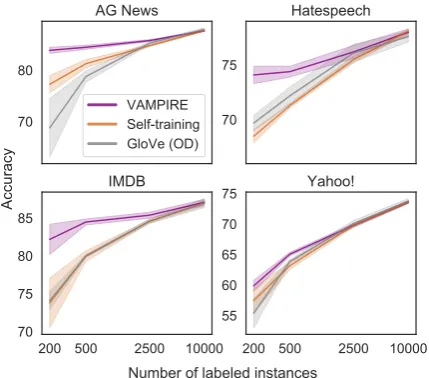
Figure 2: Learning curves for all datasets in the low-resource setting, showing the mean (line) and one standard deviation (bands) over five runs for VAM
-PIRE, self-training, and 840B-token GLOVE embed-dings. Full results are in Table2.
greater computational resources and a either mas-sive amount of unlabeled data or a pretrained model, such as ELMOor BERT.7
Low resource In the low-resource setting we as-sume that computational resources are at a pre-mium, so we are limited to lightweight approaches such as VAMPIRE, which can run efficiently on a CPU. As baselines, we consider a) a purely supervised model, with randomly initialized 50-dimensional embeddings and no access to unla-beled data;b)the same model initialized with 300-dimensional GLOVE vectors, pretrained on 840 billion words;8 c)300-dimensional GLOVE vec-tors trained on only in-domain data; andd) self-training, which has access to the in-domain unla-beled data. For self-training, we iterate over traing a model, predicttraing labels on all unlabeled in-stances, and adding to the training set all unlabeled instances whose label is predicted with high confi-dence, repeating this up to five times and using the model with highest validation accuracy. On each iteration, the threshold for a given label is equal to the 90th percentile of predicted probabilities for validation instances with the corresponding label.
7As discussed above, we consider these models to be
rep-resentative of the high-resource setting, both because they were computationally intensive to train, and because they were made possible by the huge amount of English text that is available online.
8http://nlp.stanford.edu/projects/
glove/
High resource In the high-resource setting, we assume access to plentiful computational re-sources and massive amounts of out-of-domain data, which may be indirectly accessed through pretrained models. Specifically, we evaluate the performance of a Transformer-based ELMO (Pe-ters et al., 2018b) and BERT, both (a) off-the-shelf with frozen embeddings and (b) after semi-supervised fine-tuning to both unlabeled and la-beled in-domain data. To perform semi-supervised fine-tuning, we first use ELMOand BERT’s orig-inal objectives to fine-tune to the unlabeled data. To fine-tune ELMO to the labeled data, we
aver-age over the LM states and add a softmax clas-sification layer. We obtain the best results ap-plying slanted triangular learning rates and grad-ual unfreezing (Howard and Ruder,2018) to this fine-tuning step. To fine-tune BERT to labeled data, we feed the hidden state corresponding to the
[CLS]token of each instance to a softmax clas-sification layer. We use AllenNLP9 to fine-tune ELMO, and Pytorch-pretrained-BERT10 to
fine-tune BERT.
We also experiment with ELMO trained only on in-domain data as an example of high-resource LM pretraining methods, such as Dai and Le (2015), when there is no out-of-domain data avail-able. Specifically, we generate contextual word representations with a Transformer-based ELMO. During downstream classification, the resulting vectors are frozen and concatenated to randomly initialized word vectors prior to the summation in Eq. (17).
5 Results
In the low-resource setting, we find that VAM
-PIRE achieves the highest accuracy of all low-resource methods we consider, especially when the amount of labeled data is small. Table2shows the performance of all low-resource models on all datasets as we vary the amount of labeled data, and a subset of these are also shown in Figure 2 for easy comparison.
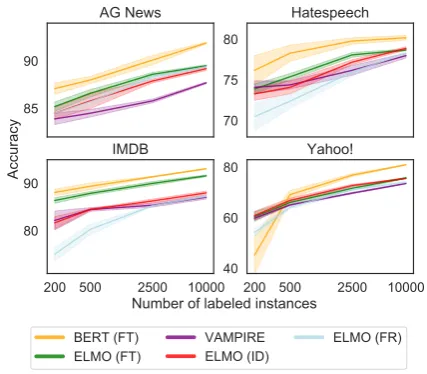
In the high-resource setting, we find, not surprisingly, that fine-tuning the pretrained BERT model to in-domain data provides the best performance. For both BERT and ELMO, we find that using frozen off-the-shelf vectors results
9
https://allennlp.org/elmo
10https://github.com/huggingface/
Dataset Model 200 500 2500 10000
IMDB Baseline 68.5 (7.8) 79.0 (0.4) 84.4 (0.1) 87.1 (0.3) Self-training 73.8 (3.3) 80.0 (0.7) 84.6 (0.2) 87.0 (0.4) GLOVE(ID) 74.5 (0.8) 79.5 (0.4) 84.7 (0.2) 87.1 (0.4) GLOVE(OD) 74.1 (1.2) 80.0 (0.2) 84.6 (0.3) 87.0 (0.6)
VAMPIRE 82.2(2.0) 84.5(0.4) 85.4(0.4) 87.1(0.4) AG Baseline 68.8 (2.0) 77.3 (1.0) 84.4 (0.1) 87.5 (0.2) Self-training 77.3 (1.7) 81.3 (0.8) 84.8 (0.2) 87.7 (0.1) GLOVE(ID) 70.4 (1.2) 78.0 (1.0) 84.1 (0.3) 87.1 (0.2) GLOVE(OD) 68.8 (5.7) 78.8 (1.1) 85.3 (0.3) 88.0(0.3)
VAMPIRE 83.9(0.6) 84.5(0.4) 85.8(0.2) 87.7 (0.1) YAHOO! Baseline 54.5 (2.8) 63.0 (0.5) 69.5 (0.3) 73.6 (0.2) Self-training 57.5 (2.0) 63.2 (0.6) 69.8 (0.3) 73.6 (0.2) GLOVE(ID) 55.2 (2.3) 63.5 (0.3) 69.7 (0.3) 73.5 (0.3) GLOVE(OD) 55.4 (2.4) 63.9 (0.3) 70.1(0.5) 73.8(0.4)
VAMPIRE 59.9(0.9) 65.1(0.3) 69.8 (0.3) 73.6 (0.2) HATESPEECH Baseline 67.7 (1.8) 71.3 (0.2) 75.6 (0.4) 77.8 (0.2) Self-training 68.5 (0.6) 71.3 (0.2) 75.5 (0.3) 78.1 (0.2) GLOVE(ID) 69.7 (1.2) 71.9 (0.5) 76.0 (0.3) 78.3(0.2) GLOVE(OD) 69.7 (0.7) 72.2 (0.8) 76.1 (0.8) 77.6 (0.5)
[image:7.595.141.456.63.309.2]VAMPIRE 74.1(0.8) 74.4(0.5) 76.2(0.6) 78.0 (0.3)
Table 2: Test accuracies in the low-resource setting on four text classification datasets under varying levels of labeled training data (200, 500, 2500, and 10000 documents). Each score is reported as an average over five seeds, with standard deviation in parentheses, and the highest mean result in each setting shown in bold.
85 90
AG News
70 75 80
Hatespeech
200 500 2500 10000 80
90
IMDB
BERT (FT) ELMO (FT)
VAMPIRE ELMO (ID)
ELMO (FR) 200 500 2500 10000 40
60
80 Yahoo!
Number of labeled instances
Accuracy
Figure 3: High-resource methods (plusVAMPIRE) on four datasets; ELMO performance benefits greatly from training on (ID), or fine-tuning (FT) to, the in-domain data (as does BERT; full results in Appendix B). Key: FT (fine-tuned), FR (frozen), ID (in-domain).
in surprisingly poor performance, compared to fine-tuning to the task domain, especially for HATESPEECH and IMDB.11 For these two datasets, an ELMO model trained only on in-domain data offers far superior performance to frozen off-the-shelf ELMO (see Figure 3). This difference is smaller, however, for YAHOO! and
11See alsoHoward and Ruder(2018).
AG. (Please see AppendixBfor full results). These results taken together demonstrate that although pretraining on massive amounts of web text offers large improvements over purely su-pervised models, access to unlabeled in-domain data is critical, either for fine-tuning a pretrained language model in the high-resource setting, or for trainingVAMPIREin the low-resource setting.
Similar findings have been reported byYogatama et al.(2019) for tasks such as natural language in-ference and question answering.
6 Analysis
6.1 NPMI versus NLL as Stopping Criteria
To analyze the effectiveness of different stopping criterion in VAMPIRE, we pretrain 200 VAMPIRE
[image:7.595.73.287.374.561.2]Fig-0.06 0.14
NPMI
840 860 880
NLL
A
0.06 0.14
NPMI
0.7 0.8
Accuracy
B
840 860 880
NLL
0.6 0.8
Accuracy
C
NPMI NLL
Criterion
0.6 0.8
Accuracy
[image:8.595.65.291.60.228.2]D
Figure 4: Comparing NPMI and NLL as early stop-ping criteria for VAMPIRE model selection. NPMI and NLL are correlated measures of model fit, but NPMI-selected VAMPIREmodels have lower variance on downtream classification performance with 200 la-beled documents ofIMDB. Accuracy is reported on the validation data. See§6.1for more details.
ure4C, we observe that better pretrainedVAMPIRE
models (according to either criterion) tend to pro-duce better downstream performance. (ρ = 0.55 andρ= –0.53, for NPMI and NLL respectively).
However, we also observe higher variance in ac-curacy among the VAMPIRE models obtained us-ing NLL as a stoppus-ing criterion (Figure4D). Such models selected via NLL have poor topic coher-ence and downstream performance. As such, do-ing model selection usdo-ing NPMI is the preferred alternative, and allVAMPIREresults in Table2are based on pretrained models selected using this cri-terion.
The experiments in Ding et al.(2018) provide some insight into this behaviour. They find that when training neural topic models, model fit and NPMI initially tend to improve on each epoch. At some point, however, perplexity continues to im-prove, while NPMI starts to drop, sometimes dra-matically. We also observe this phenomenon when trainingVAMPIRE(see AppendixC). Using NPMI
as a stopping criterion, as we propose to do, helps to avoid degenerate models that result from train-ing too long.
In some preliminary experiments, we also ob-serve cases where NPMI is artificially high be-cause of redundancy in topics. Applying batch-norm to the reconstruction markedly improves di-versity of collocating words across topics, which has also been noted by Srivastava and Sutton
IMDB YAHOO!
Horror Classics Food Obstetrics
giallo dunne cuisine obstetrics horror cary peruvian vitro
gore abbott bengali endometriosis lugosi musicals cajun fertility zombie astaire potato contraceptive dracula broadway carne pregnancy
bela irene idli birth cannibal costello pancake ovarian vampire sinatra tofu menstrual
lucio stooges gumbo prenatal
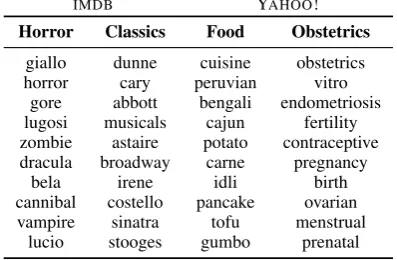
Table 3: Example topics learned by VAMPIRE in
IMDBand YAHOO! datasets. See AppendixDfor more examples.
(2017). Future work may explore assigning a word diversity regularizer to the NPMI metric, so as to encourage models that have both stronger coher-ence and word diversity across topics.
6.2 Learned Latent Topics
In addition to being lightweight, one advantage of
VAMPIREis that it produces document representa-tions that can be explicitly interpreted in terms of topics. Although the input we feed into the down-stream classifier combines this representation with internal states of the encoder, the topical interpre-tation helps to summarize what the pretraining has learned. Examples of topics learned byVAMPIRE
are provided in Table3and AppendixD.
6.3 Learned Scalar Layer Weights
Since the scalar weight parameters inri are train-able, we are able to investigate which layers of the pretrained VAE the classifier tends to prefer. We consistently find that the model tends to upweight the first layer of the VAE encoder,h(1), andθ, and downweight the other layers of the encoder. To improve learning, especially under low resource settings, we initialize the scalar weights applied to the first encoder layer andθwith high values and downweighted the intermediate layers, which in-creases validation performance. However, we also have observed that using a multi-layer encoder in
VAMPIREleads to larger gains downstream.
6.4 Computational Requirements
[image:8.595.317.516.65.195.2]Model Parameters Time
VAMPIRE(GPU) 3.8M 7 min
VAMPIRE(CPU) 3.8M 22 min
[image:9.595.85.274.64.113.2]ELMO(GPU) 159.2M 12 hr 35 min
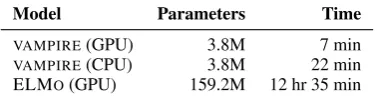
Table 4: VAMPIRE is substantially more compact than Transformer-based ELMO but is still competi-tive under low-resource settings. Here, we display the computational requirements for pretraining VAM
-PIRE and ELMO on in-domain unlabeled text from the IMDB dataset. We report results on training
VAMPIRE (with hyperparameters listed in Appendix A.1) and ELMO (with its default configuration) on a GeForce GTX 1080 Ti GPU, and VAMPIRE on a 2.60GHz Intel Xeon CPU. VAMPIRE uses about 750MB of memory on a GPU, while ELMOrequires about 8.5GB.
a GPU. It is possible to train VAMPIREorders of magnitude faster than ELMO, even without ex-pensive hardware, making it especially suitable for obtaining fast results when resources are limited.
7 Related Work
In addition to references given throughout, many others have explored ways of enhancing perfor-mance when working with limited amounts of la-beled data. Early work on speech recognition demonstrated the importance of pretraining and fine-tuning deep models in the semi-supervised setting (Yu et al.,2010). Chang et al.(2008) con-sidered “dataless” classification, where the names of the categories provide the only supervision. Miyato et al.(2016) showed that adversarial pre-training can offer large gains, effectively augment-ing the amount of data available. A long line of work inactive learningsimilarly tries to maximize performance when obtaining labels is costly (Set-tles,2012). Xie et al.(2019) describe novel data augmentation techniques leveraging back transla-tion and tf-idf word replacement. All of these ap-proaches could be productively combined with the methods proposed in this paper.
8 Recommendations
Based on our findings in this paper, we offer the following practical advice to those who wish to do effective semi-supervised text classification.
• When resources are unlimited, the best re-sults can currently be obtained by using a pre-trained model such as BERT, but fine-tuning
to in-domain data is critically important (see alsoHoward and Ruder,2018).
• When computational resources and annota-tions are limited, but there is plentiful unla-beled data, VAMPIREoffers large gains over
other low-resource approaches.
• Training a language model such as ELMOon only in-domain data offers comparable or somewhat better performance to VAMPIRE, but may be prohibitively expensive, unless working with GPUs.
• Alternatively, resources can be invested in getting more annotations; with sufficient la-beled data (tens of thousands of instances), the advantages offered by additional unla-beled data become negligible. Of course, other NLP tasks may involve different trade-offs between data, speed, and accuracy.
9 Conclusions
The emergence of models like ELMO and BERT has revived semi-supervised NLP, demon-strating that pretraining large models on massive amounts of data can provide representations that are beneficial for a wide range of NLP tasks. In this paper, we confirm that these models are useful for text classification when the number of labeled instances is small, but demonstrate that fine-tuning to in-domain data is also of critical importance. In settings where BERT cannot easily be used, either due to computational limitations, or because an appropriate pretrained model in the relevant lan-guage does not exist, VAMPIRE offers a compet-itive lightweight alternative for pretraining from unlabeled data in the low-resource setting. When working with limited amounts of labeled data, we achieve superior performance to baselines such as self-training, or using word vectors pretrained on out-of-domain data, and approach the perfor-mance of ELMO trained only on in-domain data at a fraction of the computational cost.
Acknowledgments
We thank the members of the AllenNLP and ARK teams for useful comments and discus-sions. We also thank the anonymous reviewers for their insightful feedback. Computations on
References
David M. Blei, Andrew Y. Ng, and Michael I. Jordan. 2003. Latent Dirichlet allocation. JMLR, 3:993– 1022.
Avrim Blum and Tom Mitchell. 1998. Combining la-beled and unlala-beled data with co-training. In Pro-ceedings of COLT.
Tolga Bolukbasi, Kai-Wei Chang, James Y Zou, Venkatesh Saligrama, and Adam T Kalai. 2016. Man is to computer programmer as woman is to homemaker? debiasing word embeddings. In Ad-vances in Neural Information Processing Systems.
Samuel R. Bowman, Luke Vilnis, Oriol Vinyals, An-drew M. Dai, Rafal J´ozefowicz, and Samy Ben-gio. 2016. Generating sentences from a continuous space. InCoNLL.
Dallas Card, Chenhao Tan, and Noah A. Smith. 2018. Neural models for documents with metadata. In Proceedings of ACL.
Jonathan Chang, Jordan Boyd-Graber, Sean Gerrish, Chong Wang, and David M. Blei. 2009. Reading tea leaves: How humans interpret topic models. In Ad-vances in Neural Information Processing Systems.
Ming-Wei Chang, Lev-Arie Ratinov, Dan Roth, and Vivek Srikumar. 2008. Importance of semantic rep-resentation: Dataless classification. InProceedings of AAAI.
Eugene Charniak. 1997. Statistical parsing with a context-free grammar and word statistics. In Pro-ceedings AAAI.
Andrew M. Dai and Quoc V. Le. 2015. Semi-supervised sequence learning. InAdvances in Neu-ral Information Processing Systems.
Jacob Devlin, Ming-Wei Chang, Kenton Lee, and Kristina Toutanova. 2019. BERT: Pre-training of deep bidirectional transformers for language under-standing. InProceedings of NAACL.
Ran Ding, Ramesh Nallapati, and Bing Xiang. 2018. Coherence-aware neural topic modeling. In Pro-ceedings of EMNLP.
Antigoni Maria Founta, Constantinos Djouvas, De-spoina Chatzakou, Ilias Leontiadis, Jeremy Black-burn, Gianluca Stringhini, Athena Vakali, Michael Sirivianos, and Nicolas Kourtellis. 2018. Large scale crowdsourcing and characterization of Twitter abusive behavior. InProceedings of AAAI.
Jeremy Howard and Sebastian Ruder. 2018. Universal language model fine-tuning for text classification. In Proceedings of ACL.
Sergey Ioffe and Christian Szegedy. 2015. Batch nor-malization: Accelerating deep network training by reducing internal covariate shift. In Proceedings ICML.
Mohit Iyyer, Varun Manjunatha, Jordan Boyd-Graber, and Hal Daum´e III. 2015. Deep unordered compo-sition rivals syntactic methods for text classification. InProceedings of ACL.
Diederik P. Kingma and Jimmy Ba. 2014. Adam: A method for stochastic optimization. CoRR, abs/1412.6980.
Diederik P Kingma, Shakir Mohamed, Danilo Jimenez Rezende, and Max Welling. 2014. Semi-supervised learning with deep generative models. InAdvances in Neural Information Processing Sys-tems.
Diederik P. Kingma and Max Welling. 2013. Auto-encoding variational Bayes. CoRR, abs/1312.6114.
Jey Han Lau, David Newman, and Timothy Baldwin. 2014. Machine reading tea leaves: Automatically evaluating topic coherence and topic model quality. InProceedings of EACL.
Andrew L. Maas, Raymond E. Daly, Peter T. Pham, Dan Huang, Andrew Y. Ng, and Christopher Potts. 2011. Learning word vectors for sentiment analysis. InProceedings of ACL.
David McClosky, Eugene Charniak, and Mark John-son. 2006. Effective self-training for parsing. In Proceedings NAACL.
Yishu Miao, Lei Yu, and Phil Blunsom. 2016. Neu-ral variational inference for text processing. In Pro-ceedings of ICML.
Tomas Mikolov, Ilya Sutskever, Kai Chen, Greg S. Cor-rado, and Jeff Dean. 2013. Distributed representa-tions of words and phrases and their compositional-ity. InAdvances in Neural Information Processing Systems.
David Mimno, Hanna M. Wallach, Edmund Talley, Miriam Leenders, and Andrew McCallum. 2011. Optimizing semantic coherence in topic models. In Proceedings of EMNLP.
Takeru Miyato, Andrew M. Dai, and Ian J. Goodfellow. 2016. Virtual adversarial training for semi-supervised text classification. CoRR, abs/1605.07725.
David Newman, Jey Han Lau, Karl Grieser, and Tim-othy Baldwin. 2010. Automatic evaluation of topic coherence. InProceedings of NAACL.
Kamal Nigam, Andrew Kachites McCallum, Sebastian Thrun, and Tom Mitchell. 2000. Text classification from labeled and unlabeled documents using em. Machine Learning, 39(2-3).
Matthew E. Peters, Mark Neumann, Mohit Iyyer, Matt Gardner, Christopher Clark, Kenton Lee, and Luke S. Zettlemoyer. 2018a. Deep contextualized word representations. InProceedings of NAACL.
Matthew E. Peters, Mark Neumann, Luke S. Zettle-moyer, and Wen tau Yih. 2018b. Dissecting contex-tual word embeddings: Architecture and representa-tion. InProceedings of EMNLP.
Jason Phang, Thibault F´evry, and Samuel R. Bow-man. 2018. Sentence encoders on STILTs: Supple-mentary training on intermediate labeled-data tasks. CoRR, abs/1811.01088.
Alec Radford. 2018. Improving language understand-ing by generative pre-trainunderstand-ing.
Alec Radford, Rafal J´ozefowicz, and Ilya Sutskever. 2018. Learning to generate reviews and discovering sentiment. CoRR, abs/1704.01444.
Marta Recasens, Cristian Danescu-Niculescu-Mizil, and Dan Jurafsky. 2013. Linguistic models for an-alyzing and detecting biased language. In Proceed-ings of ACL.
Danilo Jimenez Rezende, Shakir Mohamed, and Daan Wierstra. 2014. Stochastic backpropagation and ap-proximate inference in deep generative models. In Proceedings of ICML.
Burr Settles. 2012. Active Learning. Morgan & Clay-pool.
Akash Srivastava and Charles A. Sutton. 2017. Au-toencoding variational inference for topic models. InProceedings of ICLR.
Qizhe Xie, Zihang Dai, Eduard H. Hovy, Minh-Thang Luong, and Quoc V. Le. 2019. Unsupervised data augmentation. CoRR, abs/1904.12848.
Weidi Xu, Haoze Sun, Chao Deng, and Ying Tan. 2017. Variational autoencoder for semi-supervised text classification. InAAAI.
Zichao Yang, Zhiting Hu, Ruslan Salakhutdinov, and Taylor Berg-Kirkpatrick. 2017. Improved varia-tional autoencoders for text modeling using dilated convolutions. InProceedings of ICML.
Dani Yogatama, Cyprien de Masson d’Autume, Jerome Connor, Tom´as Kocisk´y, Mike Chrzanowski, Ling-peng Kong, Angeliki Lazaridou, Wang Ling, Lei Yu, Chris Dyer, and Phil Blunsom. 2019. Learning and evaluating general linguistic intelligence. CoRR, abs/1901.11373.
Dong Yu, Li Deng, and George E. Dahl. 2010. Roles of pre-training and fine-tuning in context-dependent DBN-HMMs for real-world speech recognition. In NeurIPS Workshop on Deep Learning and Unsuper-vised Feature Learning.
Xiang Zhang, Junbo Zhao, and Yann LeCun. 2015. Character-level convolutional networks for text clas-sification. InAdvances in Neural Information Pro-cessing Systems.
Jieyu Zhao, Tianlu Wang, Mark Yatskar, Ryan Cot-terell, Vicente Ordonez, and Kai-Wei Chang. 2019. Gender bias in contextualized word embeddings. In Proceedings of NAACL.
A Hyperparameter Search
In this section, we describe the hyperparameter search we used to choose model configurations, and include plots illustrating the range of valida-tion performance observed in each setting.
A.1 VAMPIRE Search
For the results presented in the paper, we varied the hyperparameters ofVAMPIREacross a number of different dimensions, outlined in Table5.
A.2 Classifier Search
To choose a baseline classifier for which we experiment with all pretrained models, we per-formed a mix of manual tuning and random search over four basic classifiers: CNN, LSTM, Bag-of-Embeddings (i.e., Deep Averaging Networks), and Logistic Regression.
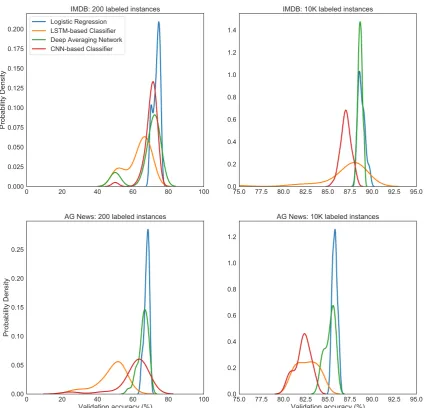
Figure 6 shows the distribution of validation accuracies using 200 and 10,000 labeled in-stances, respectively, for different classifiers on the IMDB and AG datasets. Under the low-resource setting, we observe that logistic regres-sion and DAN based classifiers tend to lead to more reliable validation accuracies. With enough compute, CNN-based classifiers tend to produce marginally higher validation accuracies, but the probability is mostly centered below those of the logistic regression and DAN classifiers. LSTM-based classifiers tend to have extremely high vari-ance under the low-resource setting. For this work, we choose to experiment with the DAN classi-fier, which comes with the richness of vector-based representations, along with the reliability that comes with having very few hyperparameters to tune.
B Results in the High Resource Setting
Table 6 shows the results of all high-resource methods (along with VAMPIRE) on all datasets, as we vary the amount of labeled data. As can be seen, training ELMO only on in-domain data
results in similar or better performance to using an off-the-shelf ELMO or BERT model,without fine-tuning it to in-domain data.
Except for one case in which it fails badly (YAHOO! with 200 labeled instances), fine-tuning BERT to the target domain achieves the best performance in every setting. Though we per-formed a substantial hyperparameter search under this regime, we attribute the failure of fine-tuning
0 50
Step 850
900 950
NLL
0 50
Epoch 0.00
0.05 0.10
[image:12.595.298.525.64.172.2]NPMI
Figure 5: An example learning curve when training
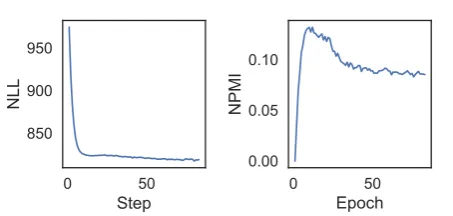
VAMPIREon theIMDBdataset. If trained for too long, we observe many cases in which NPMI (higher is bet-ter) degrades while NLL (lower is betbet-ter) continues to decrease. To avoid selecting a model that has poor topic coherence, we recommend performing model selection with NPMI rather than NLL.
BERT under this setting to potential hyperparam-eter decisions which could be improved with fur-ther tuning. Ofur-ther work has suggest that random initializations have a significant effect on the fail-ure cases of BERT, pointing to the brittleness of fine-tuning (Phang et al.,2018).
The performance gap between fine-tuned ELMO and frozen ELMO in AG News corpus is much smaller than that of the other datasets, per-haps because the ELMOmodel we used was pre-trained on the Billion Words Corpus, which is a news crawl. This dataset is also an example where frozen ELMO tends to out-perform using VAM
-PIRE. We attribute the strength of frozen, pre-trained ELMO under this setting as further
evi-dence of the importance of in-domain data for ef-fective semi-supervised text classification.
C Further Details on NPMI vs. NLL as Stopping Criteria
In the main paper, we note that we have observed cases in which trainingVAMPIREfor too long
re-sults in NPMI degradation, while NLL continues to improve. In Figure5, we display example learn-ing curves that point to this phenomenon.
D Additional Learned Topics
Computing Infrastructure GeForce GTX 1080 GPU
Number of search trials 60 trials per dataset
Search strategy uniform sampling
Model implementation http://github.com/allenai/vampire
Hyperparameter Search space IMDB AG YAHOO! HATESPEECH
number of epochs 50 50 50 50 50
patience 5 5 5 5 5
batch size 64 64 64 64 64
KL divergence annealing choice[sigmoid, linear, constant] linear linear linear constant
KL annealing sigmoid weight 1 0.25 N/A N/A N/A N/A
KL annealing sigmoid weight 2 15 N/A N/A N/A N/A
KL annealing linear scaling 1000 1000 1000 1000 N/A
VAMPIRE hidden dimension uniform-integer[32, 128] 80 81 118 125
Number of encoder layers choice[1, 2, 3] 2 2 3 3
Encoder activation choice[relu, tanh, softplus] tanh relu tanh softplus
Mean projection layers 1 1 1 1 1
Mean projection activation linear linear linear linear linear
Log variance projection layers 1 1 1 1 1
Log variance projection activation linear linear linear linear linear
Number of decoder layers 1 1 1 1 1
Decoder activation linear linear linear linear linear
z-dropout random-uniform[0, 0.5] 0.47 0.49 0.41 0.45
learning rate optimizer Adam Adam Adam Adam Adam
learning rate loguniform-float[1e-4, 1e-2] 0.00081 0.00021 0.00024 0.0040
update background frequency choice[True, False] False False False False
vocabulary size 30000 30000 30000 30000 30000
Dataset VAMPIRENPMI
IMDB 0.131 AG 0.224
[image:13.595.73.526.154.651.2]YAHOO! 0.475 HATESPEECH 0.139
Dataset Model 200 500 2500 10000
IMDB ELMO(FR) 75.1 (1.4) 80.3 (1.1) 85.3 (0.1) 87.3 (0.3) BERT (FR) 81.5 (1.0) 83.9 (0.4) 86.8 (0.3) 88.2 (0.3) ELMO(ID) 81.7 (1.3) 84.5 (0.2) 86.3 (0.4) 88.0 (0.4)
VAMPIRE 82.2 (2.0) 84.5 (0.4) 85.4 (0.4) 87.1 (0.4) ELMO(FT) 86.4 (0.6) 87.9 (0.4) 90.0 (0.4) 91.6 (0.2) BERT (FT) 88.1(0.7) 89.4(0.7) 91.4(0.1) 93.1(0.1)
AG ELMO(FR) 84.5 (0.5) 85.7 (0.5) 88.3 (0.2) 89.4 (0.3) BERT (FR) 84.6 (1.1) 85.7 (0.7) 88.0 (0.4) 89.0 (0.3) ELMO(ID) 84.5 (0.6) 85.8 (0.8) 87.9 (0.2) 89.2 (0.2)
VAMPIRE 83.9 (0.6) 84.5 (0.4) 85.8 (0.2) 87.7 (0.1) ELMO(FT) 85.2 (0.5) 86.6 (0.4) 88.6 (0.2) 89.5 (0.1) BERT (FT) 87.1(0.6) 88.0(0.4) 90.1(0.5) 91.9(0.1)
YAHOO! ELMO(FR) 54.3 (1.6) 64.2 (0.6) 71.2 (1.3) 74.1 (0.3) BERT (FR) 57.0 (1.3) 64.2 (0.5) 70.0 (0.3) 73.8 (0.2) ELMO(ID) 60.9(1.7) 66.9 (0.9) 72.8 (0.5) 75.6 (0.1)
VAMPIRE 59.9 (0.9) 65.1 (0.3) 69.8 (0.3) 73.6 (0.2) ELMO(FT) 60.5 (1.9) 66.1 (0.7) 71.7 (0.7) 75.8 (0.3) BERT (FT) 45.3 (7.5) 69.2(1.6) 76.9(0.6) 81.0(0.1)
HATESPEECH ELMO(FR) 70.5 (1.7) 72.4 (0.9) 76.0 (0.5) 78.3 (0.2) BERT (FR) 75.1 (0.6) 76.3 (0.3) 77.8 (0.4) 79.0 (0.2) ELMO(ID) 73.3 (0.8) 74.1 (0.8) 77.2 (0.3) 78.9 (0.2)
[image:14.595.145.455.66.353.2]VAMPIRE 74.1 (0.8) 74.4 (0.5) 76.2 (0.6) 78.0 (0.3) ELMO(FT) 73.9 (0.6) 75.4 (0.4) 78.1 (0.3) 78.7 (0.1) BERT (FT) 76.2(1.8) 78.3(1.0) 79.8(0.4) 80.2(0.3)
Table 6: Results in the high-resources setting.
YAHOO!
Canine Care Networking Multiplayer Gaming Harry Potter
training wireless multiplayer dumbledore obedience homepna massively longbottom
schutzhund network rifle hogwarts
housebreaking verizon cheating malfoy
iliotibial phone quake weasley
crate blackberry warcraft rubeus
ligament lan runescape philosopher
orthopedic telephone socom albus
fracture bluetooth fortress hufflepuffs
gait broadband duel trelawney
Nutrition Baseball Sexuality Religion
nutritional baseball homophobia islam obesity sox heterosexuality jesus weight yankees orientation isaiah bodybuilding rodriguez transsexuality semitism
anorexia gehrig cultures christian diet cardinals transgender baptist malnutrition astros polyamory jewish
nervosa babe gay prophet
gastric hitter feminism commandments
watchers sosa societal god
[image:14.595.139.460.398.737.2]0 20 40 60 80 100 0.000
0.025 0.050 0.075 0.100 0.125 0.150 0.175 0.200
Probability Density
IMDB: 200 labeled instances Logistic Regression
LSTM-based Classifier Deep Averaging Network CNN-based Classifier
75.0 77.5 80.0 82.5 85.0 87.5 90.0 92.5 95.0 0.0
0.2 0.4 0.6 0.8 1.0 1.2 1.4
IMDB: 10K labeled instances
0 20 40 60 80 100
Validation accuracy (%) 0.00
0.05 0.10 0.15 0.20 0.25
Probability Density
AG News: 200 labeled instances
75.0 77.5 80.0 82.5 85.0 87.5 90.0 92.5 95.0 Validation accuracy (%)
0.0 0.2 0.4 0.6 0.8 1.0 1.2
[image:15.595.82.524.167.575.2]AG News: 10K labeled instances