warwick.ac.uk/lib-publications
Original citation:Hardy, Sophie, Messenger, Katherine and Maylor, Elizabeth A.. (2017) Aging and syntactic representations : evidence of preserved syntactic priming and lexical boost. Psychology and Aging, 32 (6). pp. 588-596.
Permanent WRAP URL:
http://wrap.warwick.ac.uk/88173
Copyright and reuse:
The Warwick Research Archive Portal (WRAP) makes this work by researchers of the University of Warwick available open access under the following conditions. Copyright © and all moral rights to the version of the paper presented here belong to the individual author(s) and/or other copyright owners. To the extent reasonable and practicable the material made available in WRAP has been checked for eligibility before being made available.
Copies of full items can be used for personal research or study, educational, or not-for-profit purposes without prior permission or charge. Provided that the authors, title and full
bibliographic details are credited, a hyperlink and/or URL is given for the original metadata page and the content is not changed in any way.
Publisher’s statement:
© American Psychological Association. 2017, This paper is not the copy of record and may not exactly replicate the final, authoritative version of the article. Please do not copy or cite without authors permission. The final article will be available, upon publication, via its DOI: 10.1037/pag0000180
A note on versions:
The version presented here may differ from the published version or, version of record, if you wish to cite this item you are advised to consult the publisher’s version. Please see the ‘permanent WRAP URL’ above for details on accessing the published version and note that access may require a subscription.
Brief Report
Aging and Syntactic Representations:
Evidence of Preserved Syntactic Priming and Lexical Boost
Sophie M. Hardy
Katherine Messenger
Elizabeth A. Maylor
University of Warwick, UK
Author Note
Sophie M. Hardy, Katherine Messenger and Elizabeth A. Maylor, Department of
Psychology, University of Warwick, Coventry, CV4 7AL, UK.
Sophie M. Hardy is now at the Department of Psychology, University of Birmingham,
UK.
We thank Holly Branigan for providing us with the picture stimuli. The study will be
presented at the 4th International Aging & Cognition Conference, Zurich, April 2017.
Correspondence concerning this article should be addressed to Elizabeth A. Maylor,
Department of Psychology, University of Warwick, Coventry, CV4 7AL. Email:
Abstract
Young adults can be primed to re-use a syntactic structure across otherwise unrelated
utterances but it is not known whether this phenomenon exists in older adults. In a dialogue
task, young and older adults described transitive verb target pictures after hearing active or
passive sentences. Both groups were more likely to produce a passive sentence following a
passive prime than following an active prime (indicating syntactic priming), and this effect
increased when the prime and target involved the same verb (indicating lexical boost). These
effects were statistically equivalent in young and older adults, suggesting that the syntactic
representations underlying sentence production are unaffected by normal aging.
Keywords: aging, communication, syntactic representations, priming, lexicon
Aging and Syntactic Representations:
Evidence of Preserved Syntactic Priming and Lexical Boost
Language and communication are essential to human well-being (Hawkley &
Cacioppo, 2010), and arguably become more important with age because social isolation can
increase cognitive decline (Gow & Mortensen, 2016). One core aspect of language is syntax
production and comprehension: the processing of grammatical structures that indicate the
relationships between words in a sentence. This is important because alternative syntactic
structures can convey the same semantic meaning; for example, a transitive verb event can
either be expressed in an active sentence (“the girl chased the boy”) or a longer, more
syntactically complex passive sentence (“the boy was chased by the girl”).
Current research indicates that the syntactic complexity of spoken and written
language, such as the use of embedded and subordinate clauses, declines across the adult
lifespan in both spontaneous productions (Kemper, Greiner, Marquis, Prenovost, & Mitzner,
2001; Kemper & Sumner, 2001; Rabaglia & Salthouse, 2011, Studies 1 and 2) and controlled
experimental settings (Kemper, Herman, & Lian, 2003; Rabaglia & Salthouse, 2011, Study
3). Similarly, older adults display deficits in comprehension, such as when processing
syntactically ambiguous garden path sentences (Christianson, Williams, Zacks, & Ferreira,
2006; Kemtes & Kemper, 1997). Age-related declines in syntactic complexity occur
regardless of education attainment (Kemper et al., 2001); however, the magnitude of the
decline has been linked to measures of working memory (WM; Kemper & Sumner, 2001;
Kemtes & Kemper, 1997). In a bid to reduce cognitive burden, older adults may prefer to
produce and comprehend syntactically simpler sentences because they have insufficient WM
capacity to process more syntactically complex sentences (Abrams & Farrell, 2011).
Although it seems that WM decline disrupts older adults’ ability to process complex
representations change with age. Use of the syntactic priming paradigm, however, can
provide insight into syntactic representations (Branigan, 2007). Syntactic priming refers to
the tendency to repeat syntactic structures across otherwise unrelated sentences; for example,
Bock (1986) found that if participants repeated a passive prime sentence (e.g., “the referee
was punched by one of the fans”), they were then more likely to describe an unrelated target
picture with a passive sentence (e.g., “the church is being struck by lightning”) than if they
had repeated the alternative active prime (“one of the fans punched the referee”). Syntactic
priming is highly pervasive across a variety of syntactic forms in young adults’ production
(see Mahowald, James, Futrell, & Gibson, 2016, for a meta-analytical review) and
comprehension (see Tooley & Traxler, 2010, for a review), and studies have ruled out
explanations for priming based on repetition of lexical content (Bock, 1989) or repetition of
other levels of structure, such as prosody (Bock & Loebell, 1990). Furthermore, priming
occurs across different language modalities, such as from comprehension to production, and
vice versa (Bock, Dell, Chang, & Onishi, 2007; Branigan, Pickering, & Cleland, 2000;
Tooley & Bock, 2014). This suggests that syntactic priming recruits modality-independent
and lexically-independent (i.e., abstract) representations of syntactic structures; thus, the
presence of priming effects is informative of a speaker’s syntactic representations. We
therefore investigated syntactic priming in older adults in order to gain insight into any
age-related changes that may occur to the representations of different syntactic structures.
There are currently two dominant theories about the mechanisms underlying syntactic
priming (see Pickering & Ferreira, 2008, for a review). The residual activation model
(Pickering & Branigan, 1998) proposed that syntactic structures are represented by
combinatorial nodes in the mental lexicon. When an utterance is processed, the relevant
nodes are activated and remain at an above-baseline level for a short while afterwards. This
then asked to describe a syntactically related target, thus leading to syntactic priming. It is
generally assumed that the residual activation model applies to individuals of all ages because
once established in the lexicon syntactic representations do not change substantially with age
(Rowland, Chang, Ambridge, Pine, & Lieven, 2012). This model therefore predicts that
similar syntactic priming effects should be observed in young and older adults.
Alternatively, Chang, Dell, and Bock (2006) offered an account of syntactic priming
that emphasizes the role of implicit learning (see Elman, 2004, for a similar model of word
learning). They argued that there is a continuation between syntax acquisition in childhood
and adult syntactic processing, such that adults continue to learn mappings between
message-level representations and abstract syntactic structures. When processing a message, this
mapping can be used to anticipate the next word in the utterance; however, if a different word
is heard from that which is expected, this results in prediction error. This leads to error-based
implicit learning, which is a slight change in the mapping between message-level
representations and abstract syntactic structures. A strong baseline preference exists toward
the use of the active syntactic alternative (Roland, Dick, & Elman, 2007); thus, hearing an
unexpected passive sentence causes a slight increase in the strength of the mapping between
the passive syntax and the patient noun in the subject position that causes an individual to be
biased to express a syntactically similar message (i.e., the target) with the primed passive
syntax. Implicit learning is largely maintained in old age, with earlier priming unconsciously
facilitating later performance (Fleischman, Wilson, Gabrieli, Bienias, & Bennett, 2004; Light
& Singh, 1987; Spaan & Raaijmakers, 2011). Therefore, Chang et al.’s (2006) model also
predicts the maintenance of syntactic priming in old age.
Both models suggest that priming occurs due to activation, of some kind, of a
speaker’s syntactic representations. However, the two models differ in their explanations of
and target increases the magnitude of the syntactic priming effect (Mahowald et al., 2016;
Segaert, Wheeldon, & Hagoort, 2016). This leads to contrasting predictions about the effect
of age on lexical boost. The residual activation model (Pickering & Branigan, 1998) proposes
that when an utterance is processed, the lemma nodes that represent individual lexical items,
such as verbs, are activated in conjunction with the combinatorial nodes representing
syntactic structure. The residual activation of the combinatorial and verb nodes and the link
between them is greater than the single activation of the combinatorial node when there is no
lexical overlap; hence, lexical repetition between the prime and target increases the priming
effect. The lexical boost involves the same mechanisms as those that underlie abstract
syntactic priming; therefore, the model predicts that lexical boost should equally be
maintained with age.
By contrast, the implicit learning model requires the mechanisms for lexical boost and
syntactic priming to be dissociated because in a connectionist system, the large effects of
lexical boost would overwrite the implicit learning effects of abstract priming (Chang et al.,
2006; Chang, Janciauskas, & Fitz, 2012). Chang et al. (2006) proposed that the lexical boost
is instead facilitated by explicit memory. When individuals are planning the production of the
target sentence, the repeated lexical item serves as a cue to their explicit memory of the prime
and this biases them to repeat the primed syntax. These explicit memory traces are the result
of sparse conjunctions formed in the hippocampus, whereas abstract syntactic priming relies
on strengthened bidirectional connections formed between various cortical areas (Chang et
al., 2012). Thus, lexical boost decays rapidly over time, whereas abstract syntactic priming
does not (Branigan & McLean, 2016; Hartsuiker, Bernolet, Schoonbaert, Speybroeck, &
Vanderelst, 2008). This is further supported by the presence of abstract priming effects, but
the absence of lexical boost effects in young children, whose hippocampus has not
Stenneken, 2015; Rowland et al., 2012; but cf. Branigan & McLean, 2016), and that children
with better WM skills display greater priming effects (Foltz et al., 2015). Explicit memory
declines with old age on tests of cued and free recall and recognition (Fleischman et al., 2004;
Isingrini, Vazou, & Leroy, 1995; Light & Singh, 1987), attributable in part to age-related
degradation of the hippocampus (Driscoll et al., 2003; Lister & Barnes, 2009). Therefore, this
model predicts that there should be an age-related decline in lexical boost.
In view of these contrasting predictions, we used the syntactic priming paradigm to
investigate changes in syntactic representations with age. To our knowledge, no previous
research has directly compared syntactic priming and lexical boost in young and older
adults.1 We conducted a scripted dialogue priming task in which the experimenter and the
participant took turns to describe picture cards to each other (Branigan et al., 2000). The
experimenter’s description acted as the prime to the participant’s following target description.
We varied prime syntactic structure (active or passive) and lexical overlap between the prime
and target (no overlap or verb overlap) within participants and examined the effect of these
conditions on participants’ choice of syntactic structure.
Method
Participants
We recruited 24 young adults aged 18-23 years, and 24 community-dwelling older
adults aged 69-80 years. Sample sizes were based on previous studies showing reliable
priming effects in a scripted dialogue task with 24 participants (Branigan et al., 2000;
Hartsuiker, Pickering, & Veltkamp, 2004). All participants received monetary compensation
and were native English speakers who did not report any language disorders. There was no
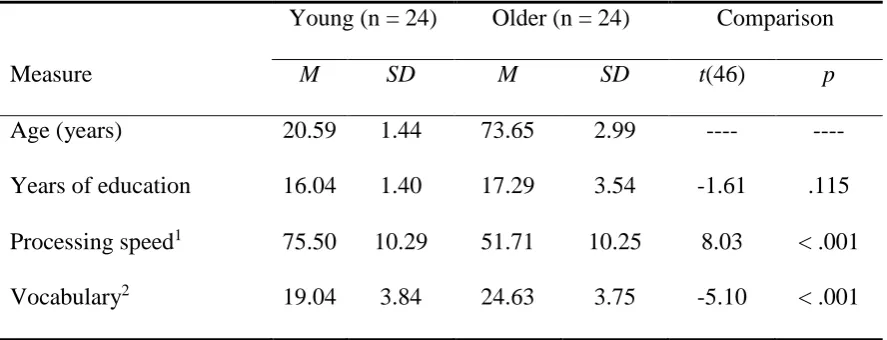
significant difference in education between the groups (see Table 1). Young adults
outperformed older adults in terms of processing speed, but older adults outperformed young
approved by the Psychology Department’s Research Ethics Committee at the University of
Warwick. Informed consent was obtained prior to the test session.
Design and Materials
We used a 2 × 2 × 2 mixed design with one between-participant variable of age
(young vs. older) and two within-participant variables of prime syntax (active vs. passive)
and lexical overlap between the prime and target (no overlap vs. verb overlap), which created
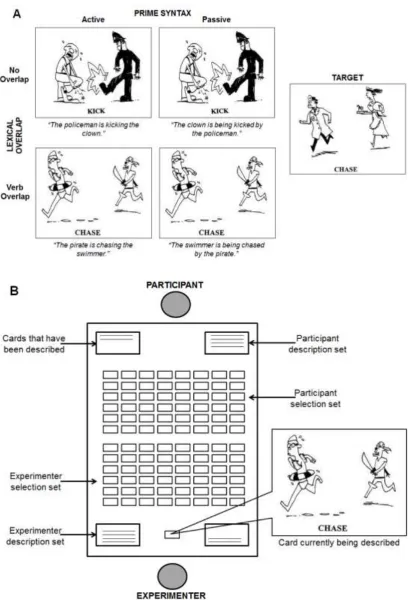
four prime conditions (see Figure 1A).
Based on Branigan et al.’s (2000) stimuli, we prepared 24 experimental items,
consisting of a target card paired with a verb overlap and no overlap version of a prime card
(see Appendix). The cards depicted transitive verb events that could be described using an
active or a passive sentence (“the X is verbing the Y”/“the Y is being verbed by the X”). We
used six transitive verbs eight times each with different pairs of human nouns to create 24
target cards and 24 verb overlap prime cards. We created 24 no overlap prime cards using six
different transitive verbs four times each. The appropriate verb was printed under each
picture. To control for any potential left-right bias in the experimental items, the agent of the
event was depicted an equal number of times on the left and right of the card. We also created
48 filler cards depicting intransitive verb events involving two human nouns performing the
same action (“the Zs are verbing”).
We constructed four lists containing the 24 experimental items. Across the four lists,
each target card appeared in each of the four prime conditions, and within each list, an even
number of targets (six) occurred in each prime condition. Each participant was randomly
assigned to one of the four lists and received a randomized order of the cards.
Procedure
The experimenter and the participant played a dialogue game in which they alternated
the other’s description. Participants were told that the purpose of the study was to investigate
age-related changes in visual search in a picture description task. The experimenter and the
participant stood at opposite ends of a large table. They each had two sets of cards on the
table: a visible selection set arranged in a matrix in alphabetical order by verb, and a
description set that was placed face down in a box (see Figure 1B). The description sets
constituted the prime cards for the experimenter to describe and the target cards for the
participant to describe, as well as 24 filler cards each. The selection sets served as the cards
for the search task and contained the same pictures as the other player’s description set. There
was an empty box next to each player, into which description cards were placed after being
described.
The experimenter began by taking the top card from her description set and describing
it to the participant according to a discreet code indicating syntactic structure; this constituted
the prime. The participant searched for the matching card from his/her selection set and
turned the card over. The roles were then switched and the participant described the top card
from his/her description set; this constituted the target response. The experimenter searched
for the matching card in her selection set and turned it over. The task was audio-recorded and
continued until all the cards had been described and located.
Coding
Of the 1152 target responses, 23 (2.0%) were eliminated because the wrong card or
prime description was used. We coded the first response that a participant produced for each
target card. A complete active response was coded when the participant produced a full
description that contained the agent as the subject, the appropriate transitive verb and the
patient as the object (e.g., “the waitress is chasing the doctor”). A complete passive response
was coded when the participant produced a full description that contained the patient as the
(e.g., “the doctor is being chased by the waitress”). Only 33 (3.2%) responses could not be
coded in this way and were instead coded as ‘other’.
Results
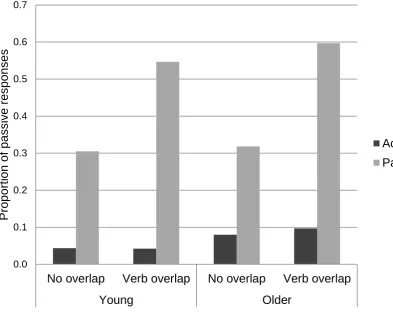
Figure 2 shows the passive responses as proportions of the sum of complete active
and passive responses produced in each condition; ‘other’ responses were not included.2 The
priming data were analyzed in R (R Core Team, 2015) using lme4 (Bates, Mächler, Bolker, &
Walker, 2015). Target responses were coded as 0 for actives and 1 for passives. We fitted a
mixed-logit model to the data; this is the most suitable way to analyze categorical responses
and excludes the need to conduct separate participant and item analyses (Jaeger, 2008). The
model predicted the probability of a passive response in each condition. We used a maximal
random effects structure (as recommended for a repeated-measures design; Barr, Levy,
Scheepers, & Tily, 2013): this allowed us to include per-participant and per-item adjustments
to the fixed intercept (“random intercepts”) with additional random adjustments to the fixed
effects (“random slopes”). We entered age group (young vs. older), prime syntax (active vs.
passive) and lexical overlap (no overlap vs. verb overlap) into the model as fixed effects. We
included intercepts for participants and items as random effects, as well as by-participant and
by-item random slopes for the fixed effects. All factors were sum-coded and transformed into
numerical values in order to have a mean of 0 and a range of 1 prior to analysis. Following
Barr et al. (2013), we performed a step-wise “best path” reduction procedure to locate the
best-fitting model of the data: we first removed internal correlations in the random effects
structure, followed by interactions, and then main effects, until the model converged. We
arrived at a final model that included all the fixed factors, but only a random by-participant
slope for the effect of prime syntax.
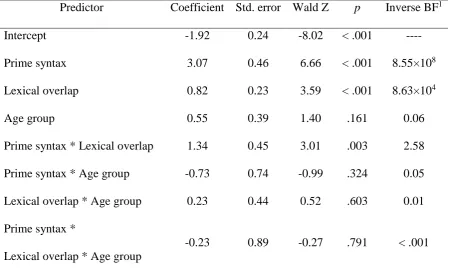
The final best-fitting model is reported in Table 2. There was a main effect of prime
passive primes (44.0%) than following active primes (6.5%), indicating an overall syntactic
priming effect of 37.5%. There was a main effect of lexical overlap, such that participants
produced significantly more passive responses in the verb-overlap condition (31.6%) than in
the no-overlap condition (18.6%). There was a significant interaction between prime syntax
and lexical overlap: the syntactic priming effect was only 25.0% in the no-overlap condition,
whereas this effect increased to 50.2% in the verb-overlap condition, indicating an overall
lexical boost of 25.2%. There was no significant effect of age group or any interactions
involving age group. Thus, between young and older adults, there was no significant
difference in the number of passives produced (23.3% vs. 26.8%), or in the syntactic priming
(38.2% vs. 36.8%) and lexical boost (24.3% vs. 26.1%) effects.
We also performed Bayesian analysis on the priming data to quantify the likelihood of
our findings. Following Wagenmakers (2007), we constructed a null mixed-logit model that
did not include the effect of interest and an alternative model that did include the effect, and
used Bayesian information criterion (BIC) values of the models to estimate the Bayes factor
(BF) as e(AlternativeBIC – NullBIC) / 2. The inverse BF values (reported in Table 2) support the
findings of the modelling analysis. In particular, the BF evidence “strongly” and “very
strongly” favors the null hypothesis for the effect of age group and all interactions involving
age group (Raftery, 1995).
Discussion
In a scripted dialogue priming task, we found robust evidence of syntactic priming
and lexical boost: participants were more likely to produce a passive response following a
passive prime than following an active prime, and this priming effect increased when there
was lexical overlap between the prime and target. These findings replicate previous language
production priming studies with young adults (see Mahowald et al., 2016). Critically though,
significantly between young and older adults. This indicates that, despite other age-related
changes in syntax production and comprehension, the underlying representations of syntactic
structures do not change with age.
It is notable that our robust findings of no age effects contrast with previous aging
research investigating syntactic processing in non-priming domains that has found age-related
declines in the production of complex syntactic structure (Kemper & Sumner, 2001; Kemper
et al., 2001, 2003; Rabaglia & Salthouse, 2011). One reason for this difference may be that
older adults’ production of complex syntactic structure has only previously been measured in
unsupported situations in which older speakers must independently construct sentences
without recent exposure to similar syntactic structures, and instead must rely on their limited
WM capacity to produce coherent complex sentences (Abrams & Farrell, 2011). By contrast,
in a syntactic priming task the prime sentence acts as a cue that supports and facilitates the
production of the target sentence of the same syntax. Research in other areas of cognition
indicates that the use of cues supports task performance equally in young and older adults
(e.g., James & Burke, 2000; Mahoney, Verghese, Dumas, Wang, & Holtzer, 2012; Soldan,
Gazes, Hilton, & Stern, 2008). Therefore, one way to explain both our finding and that of
previous aging syntax research is that, whereas underlying syntactic representations do not
change with age, the ability to access the representations of complex syntactic structures in
unsupported (i.e., unprimed) situations does decline in old age. This explanation draws
parallels with a debate in the aphasia literature, specifically whether aphasia results in a
complete degradation of syntactic knowledge (Grodzinsky, 1984, 2000) or just a loss of rapid
access to the relevant syntactic knowledge (Burkhardt, Avrutin, Piñango, & Ruigendijk,
2008; Love, Swinney, Walenski, & Zurif, 2008). Indeed, there is evidence that syntactic
priming is maintained in aphasics despite profound impairments in language production and
Theoretically, our findings of preserved syntactic priming and lexical boost support
the predictions of the residual activation model (Pickering & Branigan, 1998) that the access
and activation of combinatorial and verb nodes within the lexicon are unaffected by age.
Chang et al.’s (2006) model can also provide a valid explanation of preserved abstract
syntactic priming – both young and older adults are biased to express messages using recently
processed syntactic structures. However, our finding of preserved lexical boost is not
predicted by this model which proposes that lexical boost relies on the formation of explicit
memory traces between the prime and target. However, the prediction that older adults should
display a similar dissociation between syntactic priming and lexical boost to that which has
been observed in young children (Foltz et al., 2015; Rowland et al., 2012) may be an
oversimplification of the dynamic changes that occur across the lifespan. Aging is not simply
‘development in reverse’ and, although age-related brain changes do result in a regression in
some cognitive functions, older adults can compensate for these changes by recruiting new
brain areas and neural circuits (Craik & Bialystok, 2006). Moreover, recent evidence that
young children do display lexical boost that is equal in magnitude to adults (Branigan &
McLean, 2016) suggests that there is more continuity in syntactic processing across the
lifespan than Chang et al. (2006; 2012) originally supposed.
Our finding of preserved abstract syntactic priming suggests that older adults can
access syntactic representations in supported situations; however, questions still remain. For
example, we are aware that the transitive verb stimuli used in our study cannot be considered
as complex as the syntactic structures that have been used to assess syntax production in
previous aging studies, such as the use of subordinate clauses. It would therefore be of
interest for future studies to assess syntactic priming in older adults with more complex
syntax, such as conjunction sentences that can either be described using a coordinate (e.g.,
game has been delayed, we will have to wait”) syntactic structure. Evidence of such priming
would have two important implications. Firstly, it would demonstrate the retention of
representations of more complex syntactic structures in older adults. Secondly, given that
syntactic priming may have long-lasting effects on the representations and biases of different
structures (Chang et al., 2006), such priming could potentially serve to increase the variety of
syntax that older adults regularly use. This in turn may prevent a decline in language
proficiency and the associated harmful effects, such as negative appraisal by others (Ryan,
Hummert, & Boich, 1995).
In order to gain a clearer understanding of the changes that occur to syntactic
representations with age, future researchers should also investigate syntactic priming in older
adults in non-experimental settings. Long-term exposure to a greater variety of syntax in
naturalistic settings (e.g., nurseries) has been found to increase the syntactic corpus and
comprehension abilities of young children (Hesketh, Serratrice, & Ashworth, 2016;
Huttenlocher, Vasilyeva, Cymerman, & Levine, 2002); hence, long-term syntactic priming in
a more natural environment may also benefit older adults. If it can be shown that the regular
comprehension of more complex language actually benefits older adults because it biases
them toward producing more complex syntactic structures themselves, this could impact on
guidelines for how others, such as healthcare practitioners, should speak to older adults. This
is particularly important given the evidence that caregivers tend to use simplified speech
patterns when talking to older adults (elderspeak; Kemper, 1994), which may at times be
harmful to the receiver (Kemper & Harden, 1999; Ryan et al., 1995).
In conclusion, our study is the first to demonstrate that young and older adults display
identical syntactic priming and lexical boost effects in a scripted dialogue priming task. We
interpret this to mean that the syntactic representations within the lexicon are unaffected by
the access and activation of different syntactic structures in older adults that contrasts with
the processing of complex syntactic structures in an unprimed situation. Future work should
investigate other aspects of syntactic priming in older adults in order to gain a greater
References
Abrams, L., & Farrell, M. T. (2011). Language processing in normal aging. In J. Guendouzi,
F. Loncke, & M. J. Williams (Eds.), The handbook of psycholinguistic and cognitive
processes: Perspectives in communication disorders (pp. 49-74). New York:
Psychology Press.
Barr, D. J., Levy, R., Scheepers, C., & Tily, H. J. (2013). Random effects structure for
confirmatory hypothesis testing: Keep it maximal. Journal of Memory and Language,
68,255-278.
Bates, D., Mächler, M., Bolker, B. M., & Walker, S. (2015). Fitting linear mixed-effects
models using lme4. Journal of Statistical Software, 67, 1-48.
Bock, K. (1986). Syntactic persistence in language production. Cognitive Psychology, 18,
355-387.
Bock, K. (1989). Closed-class immanence in sentence production. Cognition, 31, 163-186.
Bock, K., Dell, G. S., Chang, F., & Onishi, K. H. (2007). Persistent structural priming from
language comprehension to language production. Cognition, 104, 437-458.
Bock, K., & Loebell, H. (1990). Framing sentences. Cognition, 35, 1-39.
Branigan, H. P. (2007). Syntactic priming. Language and Linguistics Compass, 1, 1-16.
Branigan, H. P., Pickering, M. J., & Cleland, A. A. (2000). Syntactic co-ordination in
dialogue. Cognition, 75, B13-B25.
Branigan, H. P., & McLean, J. F. (2016). What children learn from adults’ utterances: An
ephemeral lexical boost and persistent syntactic priming in adult-child dialogue.
Burkhardt, P., Avrutin, S., Piñango, M. M., & Ruigendijk, E. (2008). Slower-than-normal
syntactic processing in agrammatic Broca's aphasia: Evidence from Dutch. Journal of
Neurolinguistics, 21, 120-137.
Chang, F., Dell, G. S., & Bock, K. (2006). Becoming syntactic. Psychological Review, 113,
234-272.
Chang, F., Janciauskas, M., & Fitz, H. (2012). Language adaptation and learning: Getting
explicit about implicit learning. Language and Linguistics Compass, 6, 259-278.
Christianson, K., Williams, C. C., Zacks, R. T., & Ferreira, F. (2006). Younger and older
adults “good-enough” interpretations of garden-path sentences. Discourse Processes,
42, 205-238.
Craik, F. I. M., & Bialystok, E. (2006). Cognition through the lifespan: Mechanisms of
change. Trends in Cognitive Sciences, 10, 131-138.
Driscoll, I., Hamilton, D. A., Petropoulos, H., Yeo, R. A., Brooks, W. M., Baumgartner, R.
N., & Sutherland, R. J. (2003). The aging hippocampus: Cognitive, biochemical and
structural findings. Cerebral Cortex, 13, 1344-1351.
Elman, J. L. (2004). An alternative view of the mental lexicon. Trends in Cognitive Sciences,
8, 301-306.
Ferreira, V. S., Bock, K., Wilson, M. P., & Cohen, N. J. (2008). Memory for syntax despite
amnesia. Psychological Science, 19, 940-946.
Fleischman, D. A., Wilson, R. S., Gabrieli, J. D. E., Bienias, J. L., & Bennett, D. A. (2004).
A longitudinal study of implicit and explicit memory in old persons. Psychology and
Foltz, A., Thiele, K., Kahsnitz, D., & Stenneken, P. (2015). Children’s syntactic-priming
magnitude: Lexical factors and participant characteristics. Journal of Child Language,
42, 932-935.
Gow, A. J., & Mortensen, E. L. (2016). Social resources and cognitive ageing across 30
years: The Glostrup 1914 Cohort. Age and Ageing, 45, 480-486.
Grodzinsky, Y. (1984). The syntactic characterization of agrammatism. Cognition, 16,
99-120.
Grodzinsky, Y. (2000). The neurology of syntax: Language use without Broca's area.
Behavioral and Brain Sciences, 23, 1-71.
Hartsuiker, R. J., Bernolet, S., Schoonbaert, S., Speybroeck, S., & Vanderelst, D. (2008).
Syntactic priming persists while the lexical boost decays: Evidence from written and
spoken dialogue. Journal of Memory and Language, 58, 214-238.
Hartsuiker, R. J., & Kolk, H. H. J. (1998). Syntactic facilitation in agrammatic sentence
production. Brain and Language, 62, 221-254.
Hartsuiker, R. J., Pickering, M. J., & Veltkamp, E. (2004). Is syntax separated or shared
between languages? Cross-linguistic syntactic priming in Spanish-English bilinguals.
Psychological Sciences, 15, 409-414.
Hawkley, L. C., & Cacioppo, J. T. (2010). Loneliness matters: A theoretical and empirical
review of consequences and mechanisms. Annals of Behavioral Medicine, 40,
Hesketh, A., Serratrice, L., & Ashworth, R. (2016). Encouraging use of subordination in
children’s narratives: A classroom-based priming study. Language Learning and
Development, 12, 413-428.
Huttenlocher, J., Vasilyeva, M., Cymerman, E., & Levine, S. (2002). Language input and
child syntax. Cognitive Psychology, 45, 337-374.
Isingrini, M., Vazou, F., & Leroy, P. (1995). Dissociation of implicit and explicit memory
tests: Effect of age and divided attention on category exemplar generation and cued
recall. Memory & Cognition, 23, 462-467.
Jaeger, T. F. (2008). Categorical data analysis: Away from ANOVAs (transformation or not)
and towards logit mixed models. Journal of Memory and Language, 59, 434-446.
James, L. E., & Burke, D. M. (2000). Phonological priming effects on word retrieval and
tip-of-the-tongue experiences in young and older adults. Journal of Experimental
Psychology: Learning, Memory, and Cognition, 26, 1378-1391.
Jarosz, A. F., & Wiley, J. (2014). What are the odds? A practical guide to computing and
reporting Bayes factors. Journal of Problem Solving, 7, 2-9.
Kemper, S. (1994). Elderspeak: Speech accommodations to older adults. Aging and
Cognition, 1, 17-28.
Kemper, S., Greiner, L. H., Marquis, J. G., Prenovost, K., & Mitzner, T. L. (2001). Language
declines across the lifespan: Findings from the nun study. Psychology and Aging, 16,
227-239.
Kemper, S., & Harden, T. (1999). Experimentally disentangling what’s beneficial about
Kemper, S., Herman, R., & Lian, C. (2003). Age differences in sentence production. Journal
of Gerontology: Psychology Sciences, 58B,260-268.
Kemper, S., & Sumner, A. (2001). The structure of verbal abilities in young and older adults.
Psychology and Aging, 16,312-322.
Kemtes, K. A., & Kemper, S. (1997). Younger and older adults’ on-line processing of
syntactically ambiguous sentences. Psychology and Aging, 12, 362-371.
Light, L. L., & Singh, A. (1987). Implicit and explicit memory in young and older adults.
Journal of Experimental Psychology: Learning, Memory, and Cognition, 13, 531-541.
Lister, J. P., & Barnes, C. A. (2009). Neurobiological changes in the hippocampus during
normative aging. Archives of Neurology, 66, 829-833.
Love, T., Swinney, D., Walenski, M., & Zurif, E. (2008). How left inferior frontal cortex
participates in syntactic processing: Evidence from aphasia. Brain and Language,
107, 203-219.
Mahoney, J. R., Verghese, J., Dumas, K., Wang, C., & Holtzer, R. (2012). The effect of
multisensory cues on attention in aging. Brain Research, 1472, 63-73.
Mahowald, K., James, A., Futrell, R., & Gibson, E. (2016). A meta-analysis of syntactic
priming in language production. Journal of Memory and Language, 91, 5-27.
Pickering, M. J., & Branigan, H. P. (1998). The representation of verbs: Evidence from
syntactic priming in language production. Journal of Memory and Language, 39,
633-651.
Pickering, M. J., & Ferreira, V. S. (2008). Structural priming: A critical review.
R Core Team (2015). R: A language and environment for statistical computing. R Foundation
for Statistical Computing: Vienna, Austria. Retrieved from https://www.r-project.org
(last accessed October 1, 2016).
Rabaglia, C. D., & Salthouse, T. A. (2011). Natural and constrained language production as a
function of age and cognitive abilities. Language and Cognitive Processes, 26,
1505-1531.
Raftery, A. E. (1995). Bayesian model selection in social research. Sociological
Methodology, 25,111-163.
Raven, J. C., Raven, J., & Court, J. H. (1988). The Mill Hill vocabulary scale. London: H. K.
Lewis.
Roland, D., Dick, F., & Elman, J. L. (2007). Frequency of basic English grammatical
constructions: A corpus analysis. Journal of Memory and Language, 57, 348-379.
Rowland, C. F., Chang, F., Ambridge, B., Pine, J. M., & Lieven, E. V. M. (2012). The
development of abstract syntax: Evidence from structural priming and the lexical
boost. Cognition, 125, 49-63.
Ryan, E. B., Hummert, M. L., & Boich, L. H. (1995). Communication predicaments of
ageing: Patronizing behavior towards older adults. Journal of Language and Social
Psychology, 14, 144-166.
Salthouse, T. A. (2004). What and when of cognitive aging. Current Directions in
Segaert, K., Wheeldon, L., & Hagoort, P. (2016). Unifying structural priming effects on
syntactic choices and timing of sentence generation. Journal of Memory and
Language, 91, 59-80.
Soldan, A., Gazes, E., Hilton, H. J., & Stern, Y. (2008). Aging does not affect brain patterns
of repetition effects associated with perceptual priming of novel objects. Journal of
Cognitive Neuroscience, 20, 1762-1776.
Spaan, P. E. J., & Raaijmakers, J. G. W. (2011). Priming effects from young-old to very old
age on a word-stem completion task: Minimizing explicit contamination. Aging,
Neuropsychology, and Cognition, 18,86-107.
Tooley, K. M., & Bock, K. (2014). On the parity of structural persistence in language
production and comprehension. Cognition, 132, 101-136.
Tooley, K. M., & Traxler, M. T. (2010). Syntactic priming effects in comprehension: A
critical review. Language and Linguistics Compass, 4, 925-937.
Verreyt, N., Bogaerts, L., Cop, U., Bernolet, S., de Letter, M., Hemelsoet, D., Santens, P., &
Duyck, W. (2013). Syntactic priming in bilingual patients with parallel and
differential aphasia. Aphasiology, 27, 867-887.
Wagenmakers, E. (2007). A practical solution to the pervasive problem of p values.
Psychological Bulletin & Review, 14, 779-804.
Wechsler, D. (1981). Manual for the Wechsler adult intelligence scale-revised. New York:
Footnotes
1Note that Hartsuiker and Kolk (1998) and Ferreira, Bock, Wilson, and Cohen (2008)
both tested non-young adults as controls for clinical patients (n = 12 aged ~28-67 and n = 4
aged 50-57, respectively). The latter, though not the former, found evidence of syntactic
priming; neither study investigated lexical boost.
2Although older adults produced significantly more ‘other’ responses (M = 1.38, SD =
1.79) than young adults (M = 0.13, SD = 0.34), F(1, 46) = 11.31, MSE = 4.69, p = .002, these
were not significantly affected by prime syntax or lexical overlap condition (all ps > .1). A
qualitative overview of the ‘other’ responses indicated that, compared with young adults,
older adults produced more idiosyncratic responses (e.g., “the policeman is catching up on
the robber and the chase is coming to the end”) and were more likely not to use the verb
Table 1
Means and Standard Deviations of Characteristics and Background Measures for Young and
Older Adults, and the Results of Comparisons Between the Age Groups (Independent
Samples t-tests)
Young (n = 24) Older (n = 24) Comparison
Measure M SD M SD t(46) p
Age (years)
Years of education
20.59
16.04
1.44
1.40
73.65
17.29
2.99
3.54
----
-1.61
----
.115
Processing speed1 75.50 10.29 51.71 10.25 8.03 < .001
Vocabulary2 19.04 3.84 24.63 3.75 -5.10 < .001
1Processing speed was measured using the Digit Symbol Substitution Task (Weschler, 1981).
2Vocabulary was measured using the multiple choice part of the Mill Hill vocabulary test
Table 2
Coefficient and Probability Estimates of the Best-fitting Mixed-logit Model of the Priming
Data, Including the Inverse Bayes Factor (BF) Value for Each Effect
Predictor Coefficient Std. error Wald Z p Inverse BF1
Intercept -1.92 0.24 -8.02 < .001 ----
Prime syntax 3.07 0.46 6.66 < .001 8.55×10⁸
Lexical overlap 0.82 0.23 3.59 < .001 8.63×10⁴
Age group 0.55 0.39 1.40 .161 0.06
Prime syntax * Lexical overlap 1.34 0.45 3.01 .003 2.58
Prime syntax * Age group -0.73 0.74 -0.99 .324 0.05
Lexical overlap * Age group 0.23 0.44 0.52 .603 0.01
Prime syntax *
Lexical overlap * Age group
-0.23 0.89 -0.27 .791 < .001
1Values < 1 favor the null hypothesis, whereas values > 1 favor the alternative hypothesis
Figure 1. Prime condition alternatives for an exemplar target item (A), and the priming task
Figure 2. Mean proportion of passive responses produced by young and older adults
following active and passive primes in the no-overlap and verb-overlap conditions.
0.0 0.1 0.2 0.3 0.4 0.5 0.6 0.7
No overlap Verb overlap No overlap Verb overlap
Young Older
P
rop
o
rti
o
n
o
f
p
a
ssiv
e
re
sp
o
n
se
s
Active
Appendix
Experimental Stimuli
Target stimulus (T): transitive verb, agent noun, patient noun Prime stimulus (Pa): active, verb overlap
Prime stimulus (Pb): passive, verb overlap Prime stimulus (Pc): active, no overlap Prime stimulus (Pd): passive, no overlap
T1: chase, policeman, robber
P1a: the nun is chasing the sailor
P1b: the sailor is being chased by the nun P1c: the waitress is kicking the clown
P1d: the clown is being kicked by the waitress T2: chase, policeman, swimmer
P2a: the waitress is chasing the robber
P2b: the robber is being chased by the waitress P2c: the waitress is kicking the robber
P2d: the robber is being kicked by the waitress T3: chase, pirate, robber
P3a: the policeman is chasing the monk
P3b: the monk is being chased by the policeman P3c: the policeman is kicking the boxer
P3d: the boxer is being kicked by the policeman T4: chase, waitress, doctor
P4a: the pirate is chasing the swimmer
P4b: the swimmer is being chased by the pirate P4c: the policeman is kicking the clown
P4d: the clown is being kicked by the policeman T5: follow, pirate, sailor
P5a: the nun is following the doctor
P5b: the doctor is being followed by the nun P5c: the cowboy is pushing the swimmer
P5d: the swimmer is being pushed by the cowboy T6: follow, pirate, doctor
P6a: the nun is following the monk
P6b: the monk is being followed by the nun P6c: the chef is pushing the clown
P6d: the clown is being pushed by the chef T7: follow, nun, soldier
P7a: the pirate is following the ballerina
P7b: the ballerina is being followed by the pirate P7c: the cowboy is pushing the ballerina
P7d: the ballerina is being pushed by the cowboy T8: follow, nun, boxer
P8a: the pirate is following the robber
P8b: the robber is being followed by the pirate P8c: the chef is pushing the monk
T9: punch, artist, clown
P9a: the cowboy is punching the swimmer
P9b: the swimmer is being punched by the cowboy P9c: the sailor is touching the swimmer
P9d: the swimmer is being touched by the sailor T10: punch, artist, monk
P10a: the cowboy is punching the robber
P10b: the robber is being punched by the cowboy P10c: the sailor is touching the clown
P10d: the clown is being touched by the sailor T11: punch, cowboy, doctor
P11a: the artist is punching the ballerina
P11b: the ballerina is being punched by the artist P11c: the waitress is touching the sailor
P11d: the sailor is being touched by the waitress T12: punch, cowboy, ballerina
P12a: the artist is punching the boxer
P12b: the boxer is being punched by the artist P12c: the waitress is touching the doctor
P12d: the doctor is being touched by the waitress T13: scold, teacher, sailor
P13a: the policeman is scolding the doctor
P13b: the doctor is being scolded by the policeman P13c: the chef is shooting the boxer
P13d: the boxer is being shot by the chef T14: scold, policeman, ballerina
P14a: the teacher is scolding the boxer
P14b: the boxer is being scolded by the teacher P14c: the artist is shooting the robber
P14d: the robber is being shot by the artist T15: scold, policeman, boxer
P15a: the teacher is scolding the doctor
P15b: the doctor is being scolded by the teacher P15c: the chef is shooting the swimmer
P15d: the swimmer is being shot by the chef T16: scold, teacher, soldier
P16a: the policeman is scolding the monk P16b: the monk is being scolded the policeman P16c: the artist is shooting the ballerina
P16d: the ballerina is being shot by the artist T17: kiss, nun, boxer
P17a: the artist is kissing the ballerina
P17b: the ballerina is being kissed by the artist P17c: the pirate is pulling the ballerina
P17d: the ballerina is being pulled by the pirate T18: kiss, artist, soldier
P18a: the nun is kissing the clown
P18b: the clown is being kissed by the nun P18c: the boxer is pulling the clown
T19: kiss, nun, ballerina
P19a: the artist is kissing the boxer
P19b: the boxer is being kissed by the artist P19c: the boxer is pulling the soldier
P19d: the soldier is being pulled by the boxer T20: kiss, artist, clown
P20a: the nun is kissing the monk
P20b: the monk is being kissed by the nun P20c: the pirate is pulling the doctor
P20d: the doctor is being pulled by the pirate T21: slap, policeman, swimmer
P21a: the cowboy is slapping the teacher
P21b: the teacher is being slapped by the cowboy P21c: the waitress is tickling the doctor
P21d: the doctor is being tickled by the waitress T22: slap, policeman, boxer
P22a: the cowboy is slapping the soldier
P22b: the soldier is being slapped by the cowboy P22c: the waitress is tickling the monk
P22d: the monk is being tickled by the waitress T23: slap, cowboy, sailor
P23a: the policeman is slapping the clown
P23b: the clown is being slapped by the policeman P23c: the soldier is tickling the ballerina
P23d: the ballerina is being tickled by the soldier T24: slap, cowboy, ballerina
P24a: the policeman is slapping the monk
P24b: the monk is being slapped by the policeman P24c: the soldier is tickling the robber